On the Relative Contribution of Carbon Dioxide to the Earth’s Greenhouse Effect

September 10th, 2010

[NOTE: What follows assumes the direct (no-feedback) infrared radiative effects of greenhouse gases (water vapor, CO2, methane, etc.) on the Earth’s radiative budget are reasonably well understood. If you want to challenge that assumption, your time might be better spent here.]

I was recently asked by a reader to comment on a new paper by Schmidt et al. which put some numbers behind the common question, What fraction of the Earth’s greenhouse effect is due to carbon dioxide?

There are a wide variety of answers to this question depending on how you define “greenhouse effect”, what your assumed baseline is, etc. Conceptually, in any greenhouse atmosphere, greenhouse gases warm the lower layers and cool the upper layers compared to if those gases were not present. That never changes. It’s the way you compute the relative magnitude (say, in percent) of that warming that depends greatly upon your assumptions.

Note that the greenhouse effect can only be calculated based upon theory. The greenhouse effect isn’t a physical variable like temperature that you can measure. It is a radiative process that affects the atmosphere’s energy budget at all altitudes, warms the surface, and whose components must be calculated based upon radiative transfer theory and the IR absorption characteristics of greenhouse gases (and clouds).


The Wrong Question

I will argue that if what we are REALLY interested in is how much the Earth’s greenhouse effect will be enhanced by adding CO2 to the atmosphere (the only reason we are interested in the CO2 issue anyway, right?), then the above question is not very relevant.

In fact, the answer to it can totally mislead us. This is easy to show with 2 simple examples.

First, assume there was NO naturally occurring carbon dioxide in the atmosphere, and we added 300 ppm. In that case, the natural influence of CO2 on the Earth’s greenhouse effect would be zero, but the influence of adding 300 ppm would be quite significant.

Now, as the second example let’s assume the natural CO2 concentration is high, say 1,000 ppm, and THEN we added 300 ppm. In this second case, the natural role of CO2 in the Earth’s greenhouse effect would be very significant, but our addition of 300 ppm more would have a relatively small direct warming influence.

This is because the more CO2 there is in the atmosphere, the more “saturated” the CO2-portion of the greenhouse effect becomes, a well known feature that has a standard simplified, logarithmic formula for its computation.

Everyone already knows about this mostly saturated condition relative to the radiative effect of carbon dioxide – even the IPCC. Adding more and more CO2 causes incrementally less and less warming (again, assuming no feedback, which is a separate issue)….but the radiative effect of CO2 in the atmosphere is not totally saturated.

And it never can be, for the same reason that you can keep dividing a number by two forever, and the resulting number will get extremely small…but it will never reach zero.

So what do these two examples tell us? If the natural contribution of CO2 to the greenhouse effect was ZERO, then the warming effect of our addition of 300 ppm would be relatively large. But if the natural contribution of CO2 to the greenhouse effect was already large, then the incremental warming effect of adding more will be small.

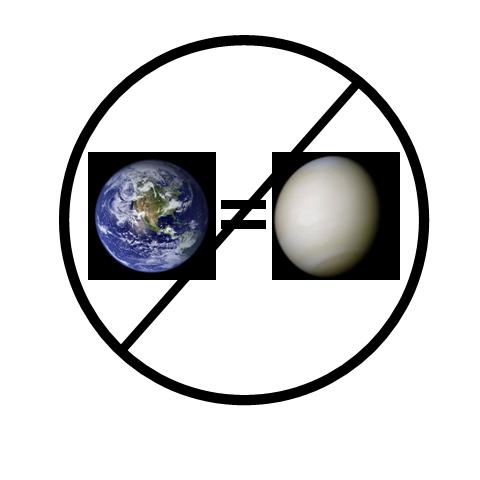
An extreme example would be Venus, which has 230,000 times as much CO2 in its atmosphere as Earth does. Our addition of CO2 to that atmosphere would have essentially no effect.

The point is that knowing what percentage of the Earth’s natural greenhouse effect comes from carbon dioxide alone tells us little of use in determining how much warming might result from adding more CO2 to the atmosphere.

How Much is the Earth’s Greenhouse Effect Enhanced by Adding More CO2?
This is the question we should be asking, and it can be easily answered with a couple of numbers quoted in the Schmidt et al. article.

Schmidt et al. assumes the commonly quoted 33 deg. C as the amount of surface warming due to the Earth’s greenhouse effect, and for the time being I will assume the same. (In my next blog post, I will explain why this number is NOT a good measure of the Earth’s greenhouse effect.)

Thirteen years ago, Danny Braswell and I did our own calculations to explore the greenhouse effect with a built-from-scratch radiative transfer model, incorporating the IR radiative code developed by Ming Dah Chou at NASA Goddard. The Chou code has also been used in some global climate models.

We calculated, as others have, a direct (no feedback) surface warming of about 1 deg. C as a result of doubling CO2 (“2XCO2”).

So, this immediately gives us numbers we can use to compute a percentage increase in the greenhouse effect: Doubling of atmospheric CO2 (which will probably happen by late in this century) enhances the Earth’s greenhouse effect by about (1/33=) 3%.

This value (3%) for the enhancement of the Earth’s greenhouse effect from our addition of CO2 is much smaller than the 20% value that Schmidt et al. get…but remember that we are addressing two different issues. I claim what we should be interested in is the relative size of our enhancement of the greenhouse effect, rather than how much of the Earth’s natural greenhouse effect is due to CO2. The latter question really proves nothing about how much effect adding MORE CO2 to the atmosphere will have.

Next Time: Why 33 deg. C is a Misleading Number

In my next post, I will discuss why the use of 33 deg. C for surface warming due to the greenhouse effect is very misleading. The issue is not new, as it has been known since the 1960s. I wasn’t aware of its central importance to the global warming debate until Dick Lindzen published his 1990 paper, Some Coolness Concerning Global Warming.

WeatherShop.com Gifts, gadgets, weather stations, software and more...click here!

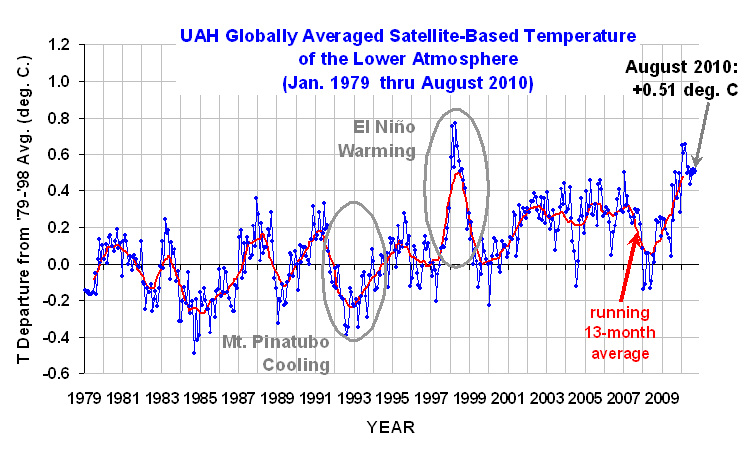
August 2010 UAH Global Temperature Update: +0.51 deg. C

September 2nd, 2010


YR MON GLOBE NH SH TROPICS
2009 1 0.251 0.472 0.030 -0.068
2009 2 0.247 0.565 -0.071 -0.045
2009 3 0.191 0.324 0.058 -0.159
2009 4 0.162 0.315 0.008 0.012
2009 5 0.139 0.161 0.118 -0.059
2009 6 0.041 -0.021 0.103 0.105
2009 7 0.429 0.190 0.668 0.506
2009 8 0.242 0.236 0.248 0.406
2009 9 0.505 0.597 0.413 0.594
2009 10 0.362 0.332 0.393 0.383
2009 11 0.498 0.453 0.543 0.479
2009 12 0.284 0.358 0.211 0.506
2010 1 0.648 0.860 0.436 0.681
2010 2 0.603 0.720 0.486 0.791
2010 3 0.653 0.850 0.455 0.726
2010 4 0.501 0.799 0.203 0.633
2010 5 0.534 0.775 0.292 0.708
2010 6 0.436 0.550 0.323 0.476
2010 7 0.489 0.635 0.342 0.420
2010 8 0.511 0.672 0.349 0.362

UAH_LT_1979_thru_Aug_10
(NOTE: 9/9/10, fixed 13-month running avg…it was 2 months behind)
While the global-average lower tropospheric temperature remained high, +0.51 deg. C in August, 2010, monitoring of the daily Aqua Ch.5 data at the Discover web site suggests that the cooling of global average sea surface temperatures that started several months ago is now causing the troposphere to cool as well. I will probably provide an update of that plot tomorrow.


As of Julian Day 243 (end of August), the race for warmest year in the 32-year satellite period of record is still too close to call with 1998 continuing its lead by only 0.06 C:

YEAR GL
1998 +0.61
2010 +0.55

As a reminder, six months ago we changed to Version 5.3 of our dataset, which accounts for the mismatch between the average seasonal cycle produced by the older MSU and the newer AMSU instruments. This affects the value of the individual monthly departures, but does not affect the year to year variations, and thus the overall trend remains the same as in Version 5.2. ALSO…we have added the NOAA-18 AMSU to the data processing in v5.3, which provides data since June of 2005. The local observation time of NOAA-18 (now close to 2 p.m., ascending node) is similar to that of NASA’s Aqua satellite (about 1:30 p.m.). The temperature anomalies listed above have changed somewhat as a result of adding NOAA-18.

[NOTE: These satellite measurements are not calibrated to surface thermometer data in any way, but instead use on-board redundant precision platinum resistance thermometers (PRTs) carried on the satellite radiometers. The PRT’s are individually calibrated in a laboratory before being installed in the instruments.]

WeatherShop.com Gifts, gadgets, weather stations, software and more...click here!

On the Debunking of Spencer’s Feedback Ideas: An Appeal to Physical Scientists Everywhere

September 1st, 2010

I am seeing increasing chatter about one or more papers that will (or already have) debunked my ideas on feedbacks in the climate system.

Yet, I cannot remember a climate issue of which I have ever been so certain.

I understand that most people interested in the climate debate will simply believe what their favorite science pundits at RealClimate tell them to believe, which is fine, and I can’t do anything about that.

But for those who want to investigate for themselves, I recommend reading only our latest and most comprehensive paper in Journal of Geophysical Research. It takes you from the very basics of feedback estimation — which I found I had to include because even the experts in the field apparently did not understand them — and for the first time explains why satellite observations of the climate system behave the way they do.

No one has ever done this before to anywhere near the level of detail we do.


[Unfortunately, our 2008 paper in Journal of Climate, I now realize, had insufficient evidence to make the case we were trying to make in 2008. I believe our claims were correct, but the evidence we presented could not unequivocally support those claims. Only after finishing our most recent 2010 paper did I realize the insufficiency of that previous work on the subject.]

Then, once you think you understand the main points we make in the new JGR paper, read any other critiques or criticisms that catch your fancy.

As a teaser, one of the clear conclusions the new paper supports is this: The only times that there is clear evidence of feedback in global satellite data, that feedback is strongly negative.

All I ask is that you evaluate whether anyone can come up with a better explanation than what we have given for the structures we see in the satellite observations of natural climate variations. Do not settle for others’ vague arm-waving dismissals based upon preconceived notions or what others have told them.

You engineers and scientists from other fields are capable of understanding this, and I am appealing to you to bring fresh eyes to a field where the research establishment has become hopelessly inbred and too beholden to special interests to see that which is staring them in the face.

This is the main reason why I wrote The Great Global Warming Blunder…the evidence is simple enough for the science-savvy public to understand. But the experts do not see the evidence because they refuse to open their eyes.

WeatherShop.com Gifts, gadgets, weather stations, software and more...click here!

The IPCC, Tipping Points, and Why Global Warming Must Remain Uncertain

September 1st, 2010

Now that I have opened the political Pandora’s Box, I might as well continue getting some of this off my chest.

Some people think that I hurt my scientific credibility by revealing my political views from time to time. Well, I don’t like politicians exploiting and ultimately destroying public faith in my scientific discipline (climate science) for their own political and financial gain.

We scientists will be sorry we ever allowed ourselves to be manipulated by powerful people who transformed what was a theoretical possibility for climate scientists, into a near certainty for public consumption.

While I firmly believe that the ultimate motivation behind the IPCC’s existence is not at all what they advertise it to be, I must admit the United Nations still has the upper hand: the theoretical possibility of catastrophic global warming (aka ‘climate change’).


As a scientist, I must admit that warming of 4 deg. C or more this century is theoretically possible. But it’s a little like concerns that the Large Hadron Collider will cause the Earth to be swallowed by a black hole when it is switched on.

Unlike particle physicists, climate researchers currently have no way to objectively determine the probability of dramatic changes like climate tipping points. At least when particle physicists talk probabilities, they are talking about real probabilities, based upon real observable events which are repeatable. The IPCC’s probabilities regarding one-of-a-kind events with uncertain causes (e.g. warming in the last 50 years) are no more than measures of their faith expressed in pseudo-scientific jargon.

And the people who write the Summary for Policymakers for the IPCC reports are masters at wordsmithing their documents to convey maximum alarm without resorting to outright falsehoods. How clever.

The fact that catastrophic warming will remain a possibility indefinitely allows the U.N. to continue its propaganda campaign.

Living is Risky

Modern fears of global warming and other perceived dangers to the consumer support my claim that our society is more risk adverse than any in history.

The very existence of the Precautionary Principle shows that even though every one of us weighs risks against benefits in every decision we make on a daily basis, some people can still dream up totally illogical reasons why humanity should stop doing this or that.

Never in history have so many advocates with so little common sense held so much influence over so selfish a political class who were elected by so gullible a public for such irrelevant reasons.

Living is risky. Get over it.

I’m sure that the IPCC’s embattled Grand Poobah, Rajendra Pachauri, flies in airplanes even though they might crash, crosses streets even though he might get run over, eats food even though he might choke to death, and writes vapid steamy romance novels even though he might be ridiculed.

Obviously, Pachauri weighs risks against benefits in his own life, as do we all. Please don’t insult our intelligence by demanding that we dismantle all coal-fired power plants and replace them with a million bird Cuisinarts (aka windmills).

Political Versus Climatic Tipping Points

We are endlessly fascinated by tipping points. The movie Day After Tomorrow involved a mini-Ice Age forming in a matter of days as a result of your SUV getting together with other SUVs after work and drinking too much at the local Exxon watering hole.

Scientists and engineers think of tipping points in terms of nonlinear relationships. A given forcing results in a certain response, but beyond a certain level of forcing the response grows dramatically. The future behavior of nonlinear systems is notoriously difficult to forecast.

The climate system is a nonlinear system. This doesn’t necessarily mean it has tipping points, but it sure doesn’t exclude the possibility either.

As long as people like James Hansen believe that the Ice Ages were the greatly amplified response to a weak forcing, they will be able to claim that our climate system has experienced tipping points in the past. No matter how long we go without significant warming, influential people like Hansen will still claim that it is only a matter of time before Mother Nature decides she has had enough, and turns the oven up from “warm” to “broil”.

As a result, there will always remain some science that can be used to justify the work of the IPCC.

The Future of the IPCC

The IPCC is now at a tipping point. Will its self-destruct? Probably not. Dramatic organizational changes will be instituted, and at some point success will be declared. The IPCC will be refocused, leaner, meaner, more transparent, more open to the views of the deniers…er…I mean skeptics.

But the ultimate purpose of the IPCC will remain unchanged: to cherry pick and misuse climate science in order to eventually control humanity’s access to energy.

So, in order to put the IPCC out of its misery, it will take more than to just point out its selective use of facts and its biased science. Its demise will have to be the result of political pressure related to its biased political agenda.

And at least in the U.S., the current indications are that the citizens have had just about as much as they can take from those whose (arguable) good intentions force others to pay for paving that proverbial road to hell.

WeatherShop.com Gifts, gadgets, weather stations, software and more...click here!

The Persistence of Paradigms

August 31st, 2010


I received a question from a reader today regarding why the writer of a recent article summarizing the state of the science on cloud feedbacks did not mention our newly published work.

The usual suspects were questioned, but there was nothing new there. Cloud feedbacks are just as uncertain today as they were 20 years ago, blah, blah. More of the same.

Now, I would like to think our new paper demonstrated not only the main reason why cloud feedbacks have remained so uncertain, but why their estimation from satellite data tends to give the illusion of a sensitive climate system.


None of the so-called experts mentioned what has been ignored as a potential climate change mechanism: Natural cycles in cloud cover. I had wondered for years why no one investigated the possibility, and our work clarified for me that this indeed is a huge question mark that most researchers do not even realize exists.

Unfortunately, I predict it will be at least 2 years before our paper is digested and believed by influential people in the climate community…if even then. (They still think the truth is lurking in computer models somewhere…just turn this knob a little more to the right left…)

This brings up the issue of how entrenched some ideas get in the scientific community, and not only for scientific reasons.

Dr. Roy in a Previous Millennium

In an earlier life, my claim to fame was demonstrating that satellite passive microwave radiometers could be used to measure rainfall over land. My first paper on the subject (actually, my first published paper ever) had the cover illustration on the front of Nature magazine. Ha! If they only knew I would grow up to be a “denier”.

At the time (1983) the established scientists working with NASA wanted to build the first weather radar to fly in space. While this was a worthy effort in its own right — finally realized with the Tropical Rainfall Measuring Mission (TRMM) — one of the radar’s original justifications was to measure rainfall over land.

My work was apparently providing evidence it was not needed. So, as a post-doc newcomer to the field, I was rocking that boat.

For me, that experience was when I lost my innocence. My research worldview was shaken. Scientists are not objective after all! Gasp!

Now, even after over 20 years of telling people of all of my subsequent experiences that only reinforced my claim that scientists are not objective, it seemed like no one was particularly worried about this.

Then Climategate broke upon the scene. Scientists behaving badly! Gasp!

What Was I Talking About? Oh, Yeah, Cloud Feedbacks

So, what I am getting around to is that it will take a long time before the climate research community looks at, understands, and believes what we have done.

Sometimes I have half-jokingly mentioned that it will probably take an IPCC-ordained scientist to “discover” the same thing. I experienced that behavior, too. NASA research centers can be pretty competitive with each other. If it wasn’t invented at their center, it wasn’t invented.

So, getting back to the original question: Why did this science writer not mention my work in his summary article on cloud feedbacks? I’m afraid he’s the last one I would expect to know.

Consider:
1) Most scientists, let alone science writers, will not even be aware that our paper has been published.
2) Even if they know it has been published, they won’t bother to read it because they have already heard it conflicts with IPCC orthodoxy.
3) Even if they dare read it, they probably won’t take the time to understand it, and so they will revert to the IPCC party line, anyway.
4) Even if they read it and understand it, they will not recognize its importance. After all, the reviewers made sure our paper was sanitized so that it would not make any outright claims that could potentially shake the faith of the Believers. The reader will instead have to know enough about the field to figure out for themselves what the implications are.

Fortunately, I have been getting some good feedback in recent days (Hah! Feedback!). A nice note from Lord Monckton basically said, “NOW I see what you have been talking about!”

A blog reader who doesn’t even do climate research read the whole paper and understood it. Now, THAT is cool.

But, while this is heartening, we still need the mainstream climate scientists to pay attention. Unfortunately, scientific discovery never was the purpose of the IPCC, and you disagree with them at your professional peril.

WeatherShop.com Gifts, gadgets, weather stations, software and more...click here!

Dump the IPCC Process, It Cannot Be Fixed

August 30th, 2010

In a recent opinion piece, Ross McKitrick has argued that the IPCC process needs to be fixed. He correctly points out that, “There is too much conflict of interest built into the report-writing process”.

But I say the process cannot be fixed. DUMP the IPCC process.


The reason why is because the IPCC process was never created to achieve what the U.N. claims, and what most people believe it exists for.

The IPCC was created to use the scientific community to build a case for regulating CO2 emissions. Period.

While you might believe otherwise, climate scientists back in the 1980s did not get together and decide “let’s create the IPCC and investigate the evidence for and against manmade climate change”. Instead, politicians and politically savvy opportunists saw global warming as the perfect excuse for instituting policies that would never have been achieved on their own merits.

Maybe some scientists thought they helped dream up the IPCC to help save humanity from itself. But the process was instigated by politicians and U.N. bureaucrats who misrepresented what they were trying to accomplish. Some people are gifted in their ability to get others to think that they came up with an idea, when in fact they were artfully guided into it.

As someone who watched from the sidelines as a U.S. government employee, I witnessed the mindset, and a few of the central players in action. These are people who think it is their gift to humanity to decide how others should live.

I’m NOT saying that most of the scientists involved in the IPCC effort are of this mindset…although I do find government employees and government-funded researchers (of which I am one) to be rather clueless about what helps, versus what hurts, the human condition.

Darn those pesky unintended consequences!

I am claiming this is the mindset of that handful of politically powerful people who saw a way to accomplish personal goals, and maybe even save humanity in the process. These people never expect that they will ever be required to live under the restrictions placed upon the rest of humanity. They are too important to the process. Sound familiar?

To believe otherwise is to have one’s proverbial head in the sand.

I hate to sound so cynical, but this is how I saw the IPCC process play out. I would personally dread having to be part of that process, because it is only using science and scientists to achieve policy and political goals. I don’t like to be asked to contribute my time when I know I am being used.

In stark contrast to me, John Christy (my boss) has valiantly attempted to change the process from within the IPCC. I think this is a valuable effort, and am glad someone is willing to try.

But I do not see the ultimate goal of the IPCC ever being changed as long as the United Nations and politicians who look favorably upon the UN’s long-term goals are in control of the process and the purse strings. It is as simple as that.

WeatherShop.com Gifts, gadgets, weather stations, software and more...click here!

Our JGR Paper on Feedbacks is Published

August 27th, 2010

After years of re-submissions and re-writes — always to accommodate a single hostile reviewer — our latest paper on feedbacks has finally been published by Journal of Geophysical Research (JGR).

Entitled “On the Diagnosis of Feedback in the Presence of Unknown Radiative Forcing“, this paper puts meat on the central claim of my most recent book: that climate researchers have mixed up cause and effect when observing cloud and temperature changes. As a result, the climate system has given the illusion of positive cloud feedback.

Positive cloud feedback amplifies global warming in all the climate models now used by the IPCC to forecast global warming. But if cloud feedback is sufficiently negative, then manmade global warming becomes a non-issue.

While the paper does not actually use the words “cause” or “effect”, this accurately describes the basic issue, and is how I talk about the issue in the book. I wrote the book because I found that non-specialists understood cause-versus-effect better than the climate experts did!

This paper supersedes our previous Journal of Climate paper, entitled “Potential Biases in Feedback Diagnosis from Observational Data: A Simple Model Demonstration“, which I now believe did not adequately demonstrate the existence of a problem in diagnosing feedbacks in the climate system.

The new article shows much more evidence to support the case: from satellite data, a simple climate model, and from the IPCC AR4 climate models themselves.


Back to the Basics

Interestingly, in order to convince the reviewers of what I was claiming, I had to go back to the very basics of forcing versus feedback to illustrate the mistakes researchers have perpetuated when trying to describe how one can supposedly measure feedbacks in observational data.

Researchers traditionally invoke the hypothetical case of an instantaneous doubling of the CO2 concentration of the atmosphere (2XCO2). That doubling then causes warming, and the warming then causes radiative feedback which acts to either reducing the warming (negative feedback) or amplify the warming (positive feedback). With this hypothetical, idealized 2XCO2 case you can compare the time histories of the resulting warming to the resulting changes in the Earth’s radiative budget, and you can indeed extract an accurate estimate of the feedback.

The trouble is that this hypothetical case has nothing to do with the real world, and can totally mislead us when trying to diagnose feedbacks in the real climate system. This is the first thing we demonstrate in the new paper. In the real world, there are always changes in cloud cover (albedo) occurring, which is a forcing. And that “internal radiative forcing” (our term) is what gives the illusion of positive feedback. In fact, feedback in response to internal radiative forcing cannot even be measured. It is drowned out by the forcing itself.

Feedback in the Real World

As we show in the new paper, the only clear signal of feedback we ever find in the global average satellite data is strongly negative, around 6 Watts per sq. meter per degree C. If this was the feedback operating on the long-term warming from increasing CO2, it would result in only 0.6 deg. C of warming from 2XCO2. (Since we have already experienced this level of warming, it raises the issue of whether some portion — maybe even a majority — of past warming is from natural, rather than anthropogenic, causes.)

Unfortunately, there is no way I have found to demonstrate that this strongly negative feedback is actually occurring on the long time scales involved in anthropogenic global warming. At this point, I think that belief in the high climate sensitivity (positive feedbacks) in the current crop of climate models is a matter of faith, not unbiased science. The models are infinitely adjustable, and modelers stop adjusting when they get model behavior that reinforces their pre-conceived notions.

They aren’t necessarily wrong — just not very thorough in terms of exploring alternative hypotheses. Or maybe they have explored those, and just don’t want to show the rest of the world the results.

Our next paper will do a direct apples-to-apples comparison between the satellite-based feedbacks and the IPCC model-diagnosed feedbacks from year-to-year climate variability. Preliminary indications are that the satellite results are outside the envelope of all the IPCC models.

WeatherShop.com Gifts, gadgets, weather stations, software and more...click here!

Daily Global Temperature Updates on the Discover Website: An Updated Tutorial

August 20th, 2010

I’m getting more and more questions about the daily global temperature updates we provide at the NASA Discover website. I suppose this is because 2010 is still in the running to beat 1998 as the warmest year in our satellite data record (since 1979).

But also we have made a couple of significant changes recently, and there continue to be some misunderstandings of the data that are posted there.

The bottom line is this: You can rely ONLY upon two channels at the Discover “Temperature Trends” page:

(1) the “Aqua ch.5 v2” channel for global-average mid-tropospheric temperatures, from the AMSU on NASA’s Aqua satellite, and

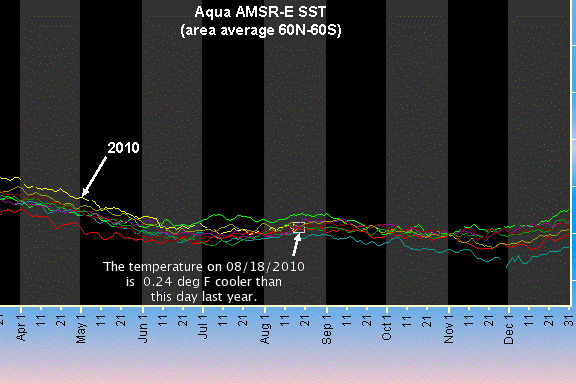
(2) the “Sea Surface” temperatures, which are averaged over the global ice-free oceans (60N to 60S), from the AMSR-E instrument on Aqua.

Do not trust any of the other channels for temperature trend monitoring. This is because, while the Aqua satellite equatorial crossing time is kept very near 1:30 am and pm with periodic orbit maneuvers, the rest of the channels come from the NOAA-15 satellite whose equatorial crossing time has now drifted from its original 7:30 am/pm value in late 1998 to about 4:30 am/pm now.

This orbital drift makes the NOAA-15 channels (4 and 6) unusually warm, and is why those of you who have been monitoring channel 4 and 6 at the Discover site are seeing such warm temperatures.


Tropospheric Temperature Monitoring
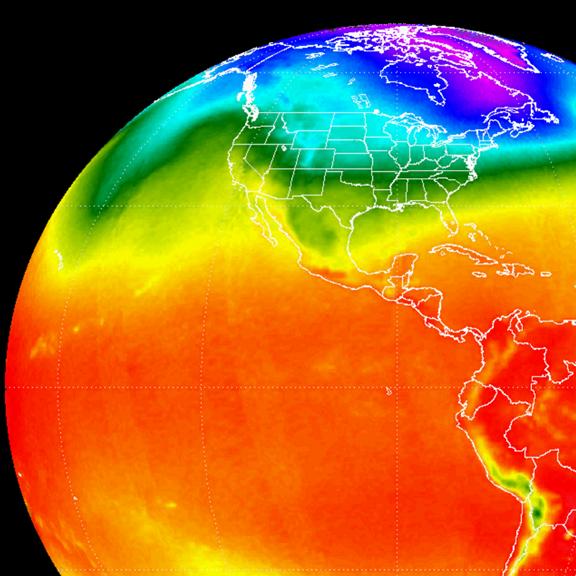
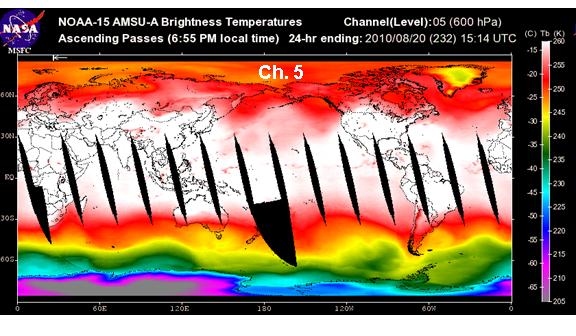
The following AMSU channel 5 image comes from the Discover “Recent Global Temperatures” page, and illustrates the kinds of signals present in this channel used in the construction of our UAH MT (mid-tropospheric) and LT (lower tropospheric) temperature products:

Note that even though NOAA-15 should not be used for trend monitoring, all of our global imagery at the “Recent Global Temperatures” page come from that satellite since the spatial patterns are not substantially affected by diurnal drift of the satellite orbit. If you scan through the global images for channels 1, 2, 3, 4, and 5 at the web site you will see how the surface and oceanic cloud water signatures change as you progress from the window channels (1, 2), to those channels more sensitive to oxygen emission at higher altitudes (3, 4, 5, etc.)

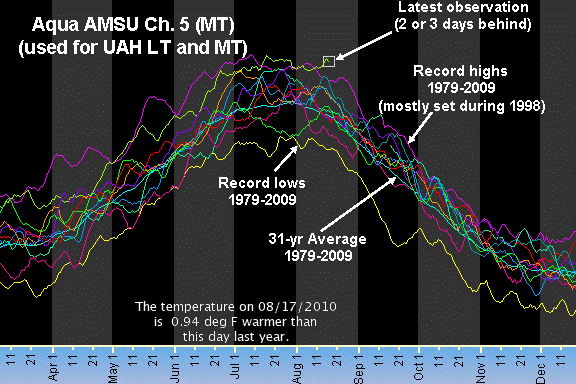
The next image is a screenshot of the Aqua AMSU ch.5 portion of our “Temperature Trends” page. In order to plot daily values that can be compared to previous years before the Aqua satellite was launched, we have intercalibrated the Aqua ch. 5 average annual cycle in daily global-average temperatures to the official UAH MT product during their overlap period (June 2002 through December 2009). This also allows us to compute curves for daily maximum, minimum, and 1979-1999 daily averages:

Most of the daily record high temperatures were set in 1998. As can be seen, 2010 has also been quite warm. For those who are wondering, the main reason why 1998 was warmer in the satellite record than the surface thermometer record is due to strong warming of the troposphere over the tropical east Pacific during the El Nino conditions in early 1998. These regions are not well represented in the surface thermometer data.

Sea Surface Temperature Monitoring
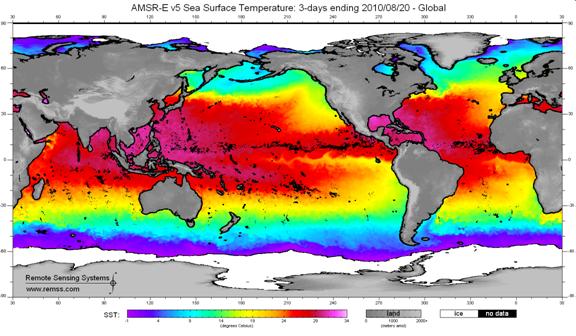
The following SST image comes from the Remote Sensing Systems website. It is based upon the most recent 3 days of SST retrievals from the AMSR-E instrument on Aqua. These measurements are made through most cloud conditions; areas of precipitation contamination are blacked out.

Because of AMSR-E’s through-cloud sensing, it provides a more accurate global average SSTs on short time scales compared to the traditional infrared measurements. We download the binary gridded SST data from the RSS website once a day and compute global area averages, which are labeled “Sea Surface” in the channel list on the Discover Temperature Trends page:

(Processing of the data is not trivial, and requires some programming skills.)

Since the AMSR-E data are available only since mid-2002, our SST record only extends back that far. There are no Max, Min, or Avg traces provided for this web page.

Why the Tropospheric Temperature Variations Don’t Match the Sea Surface Temperature Variations

Many people have noticed that the up- and down-ticks in these two temperature measures (troposphere versus sea surface) often diverge from each other. This is partly because the tropospheric temperatures include global land areas, whereas the SST data are (obviously) only over the ice-free oceans, approximately between 60N and 60S latitudes.

But another reason they diverge is because there are slight variations in the heat loss by the ocean to the atmosphere. These “intraseasonal oscillations” are usually in the tropics, and are only about +/- 1% variations in the average heat flux from the ocean to the atmosphere. Nevertheless, they can cause substantial temperature swings, especially in the troposphere.

This is why they produce opposing temperature signals. When there is above-normal ocean heat loss, the ocean surface cools below normal. Most of that heat loss is through evaporation. Meanwhile, the extra moisture in the atmosphere leads to above-normal rainfall, and so causes excess latent heating of the troposphere. The result is that SST cooling is accompanied by tropospheric warming, while SST warming is accompanied by tropospheric cooling.

These events occur on time scales of around 1 month, and so there is usually no long-term climate change significance to them. These high-frequency signals are always riding upon a more slowly varying background of temperature variability, which I believe are mostly caused by natural variations in cloud cover changing the solar energy input into the ocean.

WeatherShop.com Gifts, gadgets, weather stations, software and more...click here!

Still Cooling: Sea Surface Temperatures thru August 18, 2010

August 19th, 2010

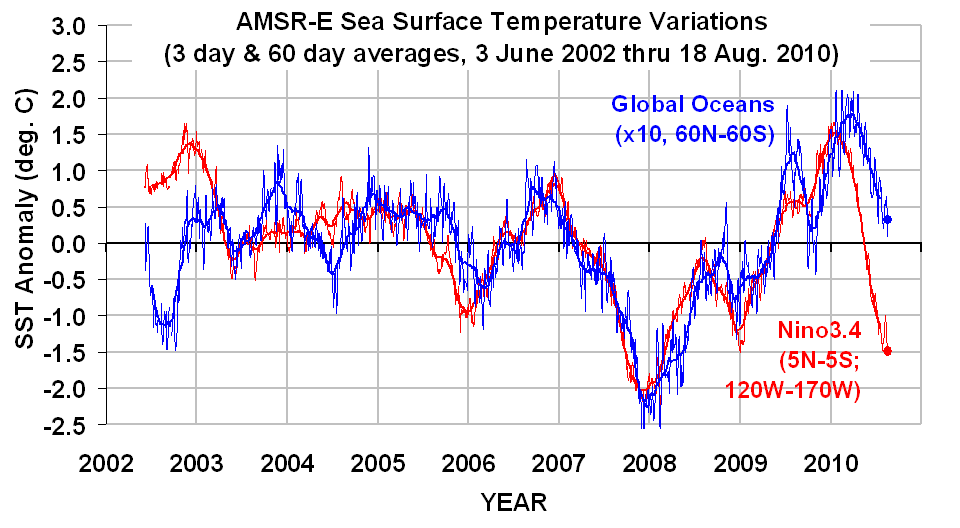
Sea Surface Temperatures (SSTs) measured by the AMSR-E instrument on NASA’s Aqua satellite continue the fall which began several months ago. The following plot, updated through yesterday (August 18, 2010) reveals the global average SSTs continue to cool, while the Nino34 region of the tropical east Pacific remains well below normal, consistent with La Nina conditions. (click on it for the large, undistorted version; note the global SST values have been multiplied by 10):


Anomalously High Oceanic Cloud Cover
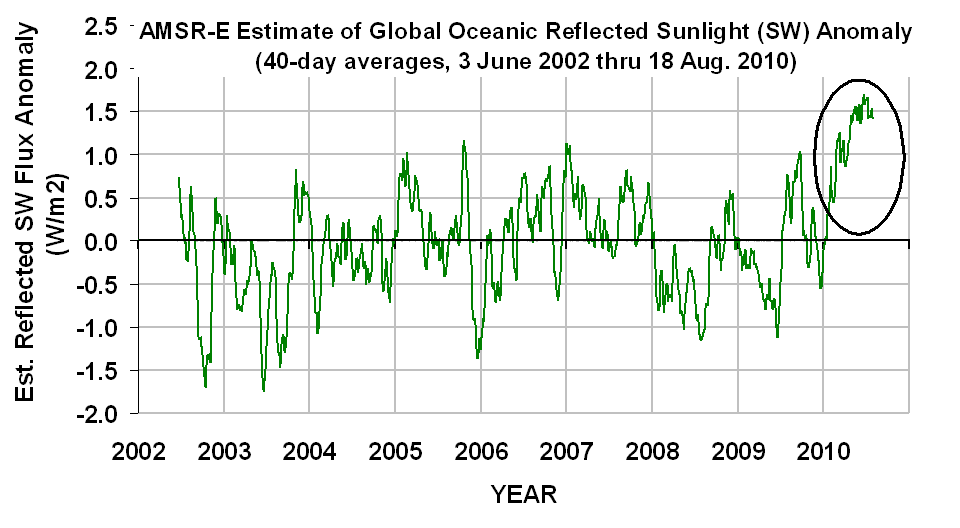
The following plot shows an AMSR-E estimate of anomalies in reflected shortwave (SW, sunlight) corresponding to the blue (Global) SST curve in the previous figure. I have estimated the reflected SW anomaly from AMSR-E vertically integrated cloud water contents, based upon regressions against Aqua CERES data. The high values in recent months (shown by the circle) suggests either (1) the ocean cooling is being driven by decreased sunlight, or (2) negative feedback in response to anomalously warm conditions, or (3) some combination of (1) and (2). Note that negative low-cloud feedback would conflict with all of the IPCC climate models, which exhibit various levels of positive cloud feedback.

WeatherShop.com Gifts, gadgets, weather stations, software and more...click here!

Help! Back Radiation has Invaded my Backyard!

August 6th, 2010

Measuring The (Nonexistent) Greenhouse Effect in My Backyard with a Handheld IR Thermometer and The Box

Laypersons are no doubt confused by all of our recent esoteric discussions regarding radiative transfer, and whether global warming is even possible from a theoretical standpoint.

So, let’s take a break and return to the real world, and the experiments you can do yourself to see evidence of the “greenhouse effect”.


One of the claims of greenhouse and global warming theory that many people find hard to grasp is that there is a large flow of infrared radiation downward from the sky which keeps the surface warmer than it would otherwise be.

Particularly difficult to grasp is the concept of adding a greenhouse gas to a COLD atmosphere, and that causing a temperature increase at the surface of the Earth, which is already WARM. This, of course, is what is expected to happen from adding more carbon dioixde to the atmosphere: “global warming”.

Well, it is one of the marvels of our electronic age that you can buy a very sensitive handheld IR thermometer for only $50 and observe the effect for yourself.

These devices use a thermopile, which is an electronic component that measures a voltage which is proportional to the temperature difference across the thermopile.

If you point the device at something hot, the higher-intensity IR radiation heats up the hot-viewing side of the thermopile, and the IR thermometer displays the temperature it is radiating at (assuming some emissivity…my inexpensive unit is fixed at e=0.95).

If you instead point it at the cold sky, the sky-viewing side of the thermopile loses IR radiation, cooling it to a lower temperature than the inside of the thermopile.

For instance, last night I drove around pointing this thing straight up though my sunroof at a cloud-free sky. I live in hilly territory, the ambient air temperature was about 81 F, and at my house (an elevation of 1,000 feet), I was reading about 34 deg. F for an effective sky temperature.

If the device was perfectly calibrated, and there was NO greenhouse effect, it would measure an effective sky temperature near absolute zero (-460 deg. F) rather than +34 deg. F, and nighttime cooling of the surface would have been so strong that everything would be frozen by morning. Not very likely in Alabama in August.

What was amazing was that driving down in elevation from my house caused the sky temperature reading to increase by about 3 deg. F for a 300 foot drop in elevation. My car thermometer was showing virtually no change. This pattern was repeated as I went up and down hills.

The IR thermometer was measuring different strengths of the greenhouse effect, by definition the warming of a surface by downward IR emission by greenhouse gases in the sky. This reduces the rate of cooling of the Earth’s surface (and lower atmosphere) to space, and makes the surface warmer than it otherwise would be.

If you have a day where there are patches of blue and clouds, you can point the thermometer at the clouds and pick up a warmer reading than the surrounding blue sky.

I did it this morning (see photo, above). When I moved from a view of the blue sky to the patch of clouds, the sky-viewing side of the thermopile became warmer…even though the thermopile is already at a higher temperature than the sky. The display would read a few degrees warmer than the reading looking at blue sky.

If you perform this experiment yourself, you need to be careful about the elevation angle above the horizon you are pointing being about the same. Even in a clear sky, as you move from the zenith (overhead), down toward the horizon the path length of sky the IR thermometer sees increases, and so you measure radiation from lower altitudes, which are warmer. This makes the effective sky temperature goes up. (This is ALSO evidence of the greenhouse effect, since looking at the sky above the horizon is like adding greenhouse gases to the atmosphere overhead. The (apparent) concentration of greenhouse gases in the lower atmosphere goes up, and so does the intensity of the back radiation.)

Even earlier in the morning, about 5:30, the middle-level clouds were thicker, and I measured a sky temperature in the 50’s F. We will see more evidence of that using air temperatures, below.

This shows that the addition of an IR absorber/emitter, even at a cold temperature (the middle level clouds were probably somewhere around 30 deg. F), causes a warm object (the thermopile) to warm even more! This is the effect that some people claim is impossible.

Remember, the IR thermometer calibrated temperature output is based upon real temperatures, the temperatures on either side of the thermopile.

And if you think this is just an effect of some sunlight reflecting off the cloud….read on.

Evidence from The Box

I have been seeing the same effect in “The Box”, which is my attempt to use the greenhouse effect to warm and cool a thin aluminum plate coated with high-emissivity paint, that is heavily insulated from its surroundings in order to isolate just the radiative transfers of energy between the sky and the plate. This can be considered a clumsy, inefficient version of the IR thermometer. But now, *I* am making actual temperature measurements.

The following plot (click on it for the full-size version) shows data from the last 2 days, up through this morning’s events. The plate gets colder at night than the ambient temperature because it “sees” the cold sky, and is insulated from heat flow from the surrounding air and ground.

In the lower right, I have also circled where thin middle-level clouds came over, emitting more IR radiation downward than the clear sky, and causing a warming of the plate. Since the plate is mostly isolated from heat exchanges with the surrounding air and warm ground, it responds faster than the ambient air temperature to the intensity of “back radiation” downwelling from the sky.

When I woke this morning before sunrise, around 5:30, I saw these mid-level clouds (I used to be a certified aviation weather observer), I measured about 50 deg. F from the handheld IR thermometer.

This supports what people already experience…cloudy nights are, on average, warmer than clear nights. The main reason is that clouds emit more IR downward, change the (im)balance between upwelling and downwelling IR, and if you change the balance between energy flows in and out of an object, its temperature will change. Conservation of Energy, they call it.

(WARNING: a technical detail about the above measurements and their importance to greenhouse theory follows.)
What this Means for the Miskolczi “Aa=Ed” Controversy

Except for relatively rare special cases, the total amount of IR energy downwelling from the sky (Ed) will ALWAYS remain less than the amount upwelling from below and absorbed by the sky (Aa). As long as (1) the atmosphere has some transparency to IR radiation (which it does), and (2) the atmosphere is colder than the surface (which it is), then Ed will be less than Aa…even though they are usually close to one another, since temperatures are always adjusting to minimize IR flux divergences and convergences.

But it is those small differences that continuously “drive” the greenhouse effect.

WeatherShop.com Gifts, gadgets, weather stations, software and more...click here!