UAH Global Temperature Update for May 2021: +0.08 deg. C

June 1st, 2021 by Roy W. Spencer, Ph. D.

The Version 6.0 global average lower tropospheric temperature (LT) anomaly for May, 2021 was +0.08 deg. C, up from the April, 2021 value of -0.05 deg. C.
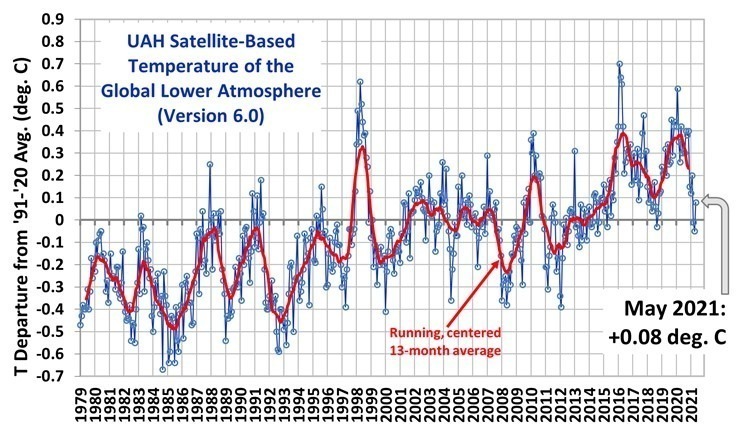
REMINDER: We have changed the 30-year averaging period from which we compute anomalies to 1991-2020, from the old period 1981-2010. This change does not affect the temperature trends.

The linear warming trend since January, 1979 remains at +0.14 C/decade (+0.12 C/decade over the global-averaged oceans, and +0.18 C/decade over global-averaged land).

Various regional LT departures from the 30-year (1991-2020) average for the last 17 months are:

YEAR MO GLOBE NHEM. SHEM. TROPIC USA48 ARCTIC AUST 
2020 01 0.42 0.44 0.41 0.52 0.57 -0.22 0.41
2020 02 0.59 0.74 0.45 0.63 0.17 -0.27 0.20
2020 03 0.35 0.42 0.28 0.53 0.81 -0.96 -0.04
2020 04 0.26 0.26 0.25 0.35 -0.70 0.63 0.78
2020 05 0.42 0.43 0.41 0.53 0.07 0.83 -0.20
2020 06 0.30 0.29 0.30 0.31 0.26 0.54 0.97
2020 07 0.31 0.31 0.31 0.28 0.44 0.27 0.26
2020 08 0.30 0.34 0.26 0.45 0.35 0.30 0.24
2020 09 0.40 0.41 0.39 0.29 0.69 0.24 0.64
2020 10 0.38 0.53 0.22 0.24 0.86 0.95 -0.01
2020 11 0.40 0.52 0.27 0.17 1.45 1.09 1.28
2020 12 0.15 0.08 0.22 -0.07 0.29 0.44 0.13
2021 01 0.12 0.34 -0.09 -0.08 0.36 0.49 -0.52
2021 02 0.20 0.31 0.08 -0.14 -0.66 0.07 -0.27
2021 03 -0.01 0.12 -0.14 -0.29 0.59 -0.78 -0.79
2021 04 -0.05 0.05 -0.15 -0.28 -0.02 0.02 0.29
2021 05 0.08 0.14 0.03 0.06 -0.41 -0.04 0.02

The full UAH Global Temperature Report, along with the LT global gridpoint anomaly image for May, 2021 should be available within the next few days here.

The global and regional monthly anomalies for the various atmospheric layers we monitor should be available in the next few days at the following locations:

Lower Troposphere: http://vortex.nsstc.uah.edu/data/msu/v6.0/tlt/uahncdc_lt_6.0.txt
Mid-Troposphere: http://vortex.nsstc.uah.edu/data/msu/v6.0/tmt/uahncdc_mt_6.0.txt
Tropopause: http://vortex.nsstc.uah.edu/data/msu/v6.0/ttp/uahncdc_tp_6.0.txt
Lower Stratosphere: http://vortex.nsstc.uah.edu/data/msu/v6.0/tls/uahncdc_ls_6.0.txt



4,403 Responses to “UAH Global Temperature Update for May 2021: +0.08 deg. C”

Toggle Trackbacks

  1. Clint R says:

    Thank you, Dr. Spencer.

    It’s interesting that USA48 is the lowest, but NHEM. is the highest!

  2. Willard says:

    Brace yourselves, the ice age is coming:

    Heat alerts have been issued by the National Weather Service in parts of California, Nevada, Oregon, Washington and Idaho.

    Areas in the excessive heat warning will see temperatures that could cause heat illnesses, including heatstroke and heat exhaustion.

    https://weather.com/forecast/regional/news/2021-05-29-west-record-highs-late-may-early-june

  3. bdgwx says:

    +0.08C for May on the new 1991-2020 baseline is equivalent to +0.20C on the old 1981-2010 baseline. Considering that the ENSO 3.4 phase is now in positive territory it is looking unlikely that all of those predictions that the UAH-TLT anomaly would go below zero on 1981-2010 baseline that were posted here will actually pan out. I will say that we are due for a VEI 6 eruption and a La Nina double dip is still possible so there is still a chance we could drop below the 1981-2010 baseline.

    • Scott R says:

      bdgwx,

      I see NOAA has the chances of a double dip la nina at around 50% for next winter. The way the data looks now, I don’t think it is necessary at all for a double dip la nina. The average is around 3.6 years for the phase to change (1/3rd solar cycle) but you certainly can’t set your watch by that. The wave from the end of 2018 to present DOES look short… extending the down move to the end of next winter certainly seems logical, but that wave might be done. I do see there were 2 Kelvin waves, and that region 4 is cooling. Once the Kelvin waves pass the mid / east ocean we could see a drop.

      As far as the intermediate trend, that is down since 2016. You have a lower swing high and a lower swing low. You will need to go above the 2020 highs to get an intermediate time frame reversal. If that doesn’t happen, you could easily head below the old baseline. I think it will happen, just not sure if it will make it this winter, or in 3-4 years.

      As for the VEI6, who knows when that will happen, but it definitely plays a roll comparing 1980-2000 and 2000-2020.

    • Bindidon says:

      bdgwx

      I read below your comment:

      ” As far as the intermediate trend, that is down since 2016. ”

      It is really incredible how many people insist on what is an evidence, as in 2016 we had the highest UAH LT anomaly since beginning.

      A period starting with its highest value can by definition only give a down trend.

      Even Monckton, the “Third Viscount” of Brenchley, unlorded since years, persists on publishing at WUWT, month after month, that we have now x years and y months with zero trend.

      Of course: he moves back month by month until the trend is zero, and that nice little exercise stops each time in… 2016.

      If you shift the trend period’s by just one year, the trend becomes totally different.

      Strange days. Thanks, Internet!

      J.-P. D.

      • Bellman says:

        Strictly speaking the “pause” generally starts just before 2016. This month it will be starting April 2015.

        In fact, at present a trend starting in May 2016 or later will be positive.

        • Bindidon says:

          Bellman

          You are of course correct when having a strict look at the data.

          Before the May 2021 anomaly, the last negative or zero trend in UAH LT for May 2015 till April 2021 is indeed -0.03 C / decade (but +- 0.11, what makes the trend ‘statistically insignificant’ anyway, but this never disturbed the ‘Third Viscount’).

          J.-P. D.

          • angech says:

            indidon says: Of course: he moves back month by month until the trend is zero, and that nice little exercise stops each time in… 2016.
            Bellman says:
            Strictly speaking the “pause” generally starts just before 2016. This month it will be starting April 2015.
            Bindidon says
            Bellman You are of course correct when having a strict look at the data..

            There is cherrypicking and there are pauses.
            The latest pause always starts at the last measurement.
            No cherrypicking.
            That is what it is..
            It will usually show a pause when there has been a higher previous value..
            The pause will usually go back beyond that highest value as it does not equal that highest value.
            The previous pause went back several years before the peak in 1998?.

          • Bellman says:

            angech,

            Much as I like reverse chronology fiction, I still don’t understand why so many Monckton apologists insist that his pauses start at the end. I really cannot see why you think this excuses his obvious cherry picking. The earliest date for any of his pauses is the date that will give him the longest possible negative trend. He ignores all other starting (or ending if you prefer) dates, either because they would show a positive trend, or a shorter negative trend. I don’t know what other word you could use to describe this careful selection of end points.

            The irony being he himself attacked the IPCC of doing just that when they published a graph showing warming over the last 25 years. He called this the end-point fallacy, and said it was a shoddy fraudulent technique where by carefully selecting the start point you could produce any trend you wanted.

          • angech says:

            Bellman
            “I still don’t understand why so many Monckton apologists insist that his pauses start at the end.”

            Really?

            If you are looking at a trend to see when a pause starts the only place you can do that from is the end.
            Whether it is trending up or down.

            If a pause develops you can pretend it is not happening.
            But that is like saying I lost the argument but I am not going to listen.
            Pauses are always occurring.

            The only other explanation is that you cannot afford to have a cherished belief contradicted in any way and so deny reality.
            Pauses are always occurring.

            You could adopt a better approach and say,
            yes I see a pause but I do not think it is significant.
            Whether it is Monckton or not.
            It is just one of a number of methods of measuring temperature.

            Sadly you and Bindinon cannot afford to give one inch because the other side would take a mile?
            Tough.
            You get credit in my view for facing facts and arguing their relevance, not playing games in a misleading fashion.

            The irony being he himself attacked the IPCC of doing just that when they published a graph showing warming over the last 25 years.
            Irony?
            In a modified wording of your comment you would shoot the IPC in the same way you would smear Monckton.
            “The earliest date for any of their pauses is the date that will give them the longest possible positive trend. They ignores all other starting (or ending if you prefer) dates, either because they would show a negative trend, or a shorter positive trend. I don’t know what other word you could use to describe this careful selection of end points.”

            Natural variation is the pits. Just one more La Nina would have blown CAGW out of the water 10 years ago. Now we have to wait until the 2 pauses join [if ever]. I guess if they did giving say a 27 year pause you would still close your eyes.

          • Bellman says:

            “If you are looking at a trend to see when a pause starts the only place you can do that from is the end.”

            I’ve no idea what you are saying here. If I have some time series data and I want to see if there is a trend I would simply calculate the linear regression across the entire range. The comparison is between the data and the time. If data tends to increase as time increases there is a positive trend and if it decreases as time increases the trend is negative. My assumption is that time flows forward so a trend starts at the beginning (earliest time), and finishes at the end (later times).

            If it looks like there is some deviation in the trend, such as increase or decrease in the trend, I could either try to fit a non-linear model, or estimate where the change in trend started, calculate the respective before and after trends, and see if they were significantly different. I’d also want to make sure the change date didn’t cause an unrealistic break in the trend, unless I thought it was plausible that the data had a discontinuity in it. (If I was more than an armchair statistician I’d probably have better tools at my disposal to more objectively establish the point change).

            What I wouldn’t do is start at the final piece of data and work back until I’d found some disconnected trend that I could use in a blog post. Doing that I can easily find trends starting at the end point that show greatly accelerated warming – e.g 10 years of warming over 4C / century.

          • Bellman says:

            angech,

            “If a pause develops you can pretend it is not happening.
            But that is like saying I lost the argument but I am not going to listen.”

            The thing is I’ve been debating this all through the previous, more plausible pause, and all I want is for someone to define what they mean by pause, and then justify it’s existence statistically. If you define the pause as Monckton does, as any period with a zero or less trend, then I don’t pretend it isn’t happening. It clearly is happening. I just don’t think it’s a useful or meaningful thing. It’s not something that has any statistical meaning. Statistics requires that you can distinguish a claim from the noise that results if the claim is not true. Statistics knows that all data is noisy, things happen by chance, and requires that a claim has to be supported by data that is unlikely to have occurred by chance.

            “Pauses are always occurring.”

            Which is the problem. You can look back through the UAH data and find many 6 year pauses. You can also find many 6 year periods when the rate of warming was much greater than the underlying rate, 7 or 8 degrees per century. Neither trend tells us much about the underlying trend, except the UAH monthly data is noisy, and short term trends are spurious.

          • Bellman says:

            angech

            “In a modified wording of your comment you would shoot the IPC in the same way you would smear Monckton.”

            If the IPCC ever tried to claim that a six year warming trend showed that warming had greatly accelerated, than I would indeed object.

          • angech says:

            Bellman says: June 3, 2021 at 11:42 AM
            “If you are looking at a trend to see when a pause starts the only place you can do that from is the end.”
            I’ve no idea what you are saying here.”

            Bellman
            “I still don’t understand why so many Monckton apologists insist that his pauses start at the end.”

            Get over Monckton.
            Get over defining a pause as only something that fits your narrative only [AKA cherrypicking.

            You have a graph of a variable.
            The graph is ongoing to the present.
            Whether it has a positive or a negative trend it has an endwhich is constantly changing.
            When you look for a new pause this is where you start.
            The moment it trends the other way you create a new pause.

            Significance?

            The longer the pause goes the less likely that it is noise and more likely that it is showing some sort of cause.

            Indeed that is why you are able to talk of warming in the first place.

          • angech says:

            If the IPCC ever tried to claim that a six year warming trend showed that warming had greatly accelerated, than I would indeed object.

            Pehaps you should write to Hansen?

            The World Has Cooled Off Whats the Significance?
            13 May2021 James Hansen
            Sat Global temperature in April continues to be much less than a year ago. ENSO (El Nino Southern Oscillation) is the principal cause of year-to-year global temperature change. We are in a moderately strong La Nina.NCEP
            (NOAAs ) current forecast suggests that tropical temperatures are headed for a double-dip La Nina. Nino forecasts are notoriously difficult, however, so we need towait a few months to see
            Global temperature is highly correlated (61.4%) with Nino3.4 index, with global temperature lagging Nino3.4 by 5 months

            The 12-month running mean temperature is dropping fast)and probably will not reach a minimum until November
            That minimum is likely to be well below the1970-2015 trend line )and 2021 will be much cooler than 2020.
            Will that global cooling imply that the apparent global warming acceleration of the past six years was a misleading deviation, rather than a significant change of the warming rate”
            He certainly claimed 6 years was significant until it was not.
            Is he part of the IPCC?

            Good to see you having fun with W.E.

    • gbaikie says:

      Most volcanic eruption occur in the ocean, or next larger volcanic event will occur in the ocean, the question is, will we detect it.

    • Richard M says:

      Bdgwx, it appears the 40 year baseline would produce something like 0.14 C. Do you realize what that means? In another 40 years (2061) we might skyrocket to a 0.28 C anomaly. How will humanity survive?

      • bdgwx says:

        UAH-TLT trend is +0.14C/decade. The next 40 years will be another +0.56C on top of what occurred in the previous 40 years. Humanity will survive.

        • RLH says:

          Linear trends are useless on data < 60 years in length and pretty much for periods longer that than too.

        • Nate says:

          Where do you get 60 from?

          • RLH says:

            Because there is a well acknowledge 60 year cycle to the weather.

          • Nate says:

            Not generally agreed..

            One or so ~ 60 y up-down may not be a real cycle.

          • RLH says:

            Ok. So it should have been ~60 years. Or somewhere between ~60 and ~75.

          • barry says:

            There is no such “well acknowledge 60 year cycle to the weather.”

            And if you meant “climate,” there is no well-acknowledged 60-year cycle, or 65 or 70-year cycle.

            There are 11-year solar cycles, which have little impact on surface temps, there are multidecadal fluctuations in ocean temps within at least two basins, which are not symmetrically phased nor any confidence that these are cyclical or even quasi-periodic.

            What we do have is a lot of noise and chatter devoted to making much of these fluctuations, while scientific studies about them are far more circumspect regarding their influence on “weather” and climate.

            By comparison, the periodic ENSO events are what we can call “well-acknowledged.”

          • RLH says:

            Well the Chinese have a calendar based on 60 years and used for farming predictions.

          • Nate says:

            And the Mayan calendar predicted our doom…sort of.

            And Astrology sez..let me check.

          • RLH says:

            There have also been many cycles of this sort of length discovered in many of the climate series, both temperature and proxy.

          • Nate says:

            Show us one.

          • RLH says:

            “The influence of the lunar tidal cycle on world mean temperature produces a natural quasi 60-year cycle in the Earth’s climate system.”

          • RLH says:

            https://link.springer.com/article/10.1134/S0016793218070241

            “60-Year Cycle in the Earths Climate and Dynamics of Correlation Links between Solar Activity and Circulation of the Lower Atmosphere” S. V. Veretenenko & M. G. Ogurtsov

          • RLH says:

            “Church and White (2011) estimated the acceleration term to be 0.009 [0.004 to 0.014] mm yr2 over the 18802009
            time span when the 60-year cycle is not considered.”

          • Nate says:

            Here is an actual long temperature record in England. No obvious 60 y period.

            https://tinyurl.com/jfpv7nyk

            I cant see your paper.

          • Nate says:

            1.5 oscillations make it periodic?

          • RLH says:

            Going back before 1850 is tricky, though I have some proxy data that goes back further. All with ~60 years in them

          • RLH says:

            How far back would you like to go?

          • RLH says:

            I can do proxy data back to 1500 if you like

          • RLH says:

            “Shen, C., W.-C. Wang, W. Gong, and Z. Hao. 2006.
            A Pacific Decadal Oscillation record since 1470 AD reconstructed
            from proxy data of summer rainfall over eastern China.
            Geophysical Research Letters, vol. 33, L03702, February 2006.”

          • barry says:

            Theorised – not “well-acknowledged.”

            “Past research argues for an internal multidecadal (40 to 60-year) oscillation distinct from climate noise. Recent studies have claimed that this so-termed Atlantic Multidecadal Oscillation is instead a manifestation of competing time-varying effects of anthropogenic greenhouse gases and sulfate aerosols. That conclusion is bolstered by the absence of robust multidecadal climate oscillations in control simulations of current-generation models. Paleoclimate data, however, do demonstrate multidecadal oscillatory behavior during the preindustrial era. By comparing control and forced “Last Millennium” simulations, we show that these apparent multidecadal oscillations are an artifact of pulses of volcanic activity during the preindustrial era that project markedly onto the multidecadal (50 to 70-year) frequency band. We conclude that there is no compelling evidence for internal multidecadal oscillations in the climate system.”

            https://science.sciencemag.org/content/371/6533/1014.abstract

          • RLH says:

            So you don’t acknowledge that there is a lunar 60 year cycle?

            And that the Moon causes tides in the atmosphere as well as oceans and land?

          • barry says:

            The notion of a 60-year lunar cycle is news to me. I doubt that if such a cycle existed it would have an impact on global temperatures in 60-year oscillations. In the list of papers you googled above, the cause of the purported 60-year cycle was unknown in one, lunar in another, solar in another…

            We don’t have a long enough record to determine if there are 60 year cycles in global temperature. We certainly don’t have a determined mechanism, just theorizations, not much agreement, and the originators of the AMO have now rescinded it. There’s always the PDO to keep the fans interested.

            No, a 60-year climate cycle is not a “well-acknowledged” fact, but I will acknowledge that 30 and 60 year cycles in global climate have been discussed for at least 3 decades.

          • RLH says:

            https://judithcurry.com/2020/02/13/plausible-scenarios-for-climate-change-2020-2050/#comment-909589

            “C. The influence of the lunar tidal cycle on world mean temperature produces a natural quasi 60-year cycle in the Earth’s climate system. This is also accompanied by a longer-term Gleissberg-like (88.5 years) and De Vries-like (208.0 years) tidal cycles that are synchronized with similar cycles in the level of solar activity.”

          • Nate says:

            “Going back before 1850 is tricky”

            I showed you real temperatures in Central Europe and Central England, going back to 1700s. I dont see the ’60 y cycle’ going back then.

            For European data over 6 sites can see spectral variation at various periods from 30s to 80s, nothing standing out.

            https://www.researchgate.net/figure/Left-panel-DFT-of-M6-average-from-six-central-European-instrumental-time-series-Right_fig4_280572883

          • RLH says:

            Fig 4

          • barry says:

            None of the references you cited show a lunar periodicity of 60 years. None of the references that appear in the blog comment (seriously?) at Curry’s either. Other than the statement made by the person who posted the comment.

            And I looked further afield, interested in what citing papers would make of the references. I got a couple positing a lunar cycle of 31 years and 35 years, but not 60 years. They weren’t half a cycle that we can double to corroborate, unfortunately.

            No, I definitely DO NOT acknowledge a 60-year lunar cycle.

            This is pretty obscure stuff, these references. And I see no reason to change my view that the 30 and 60 year cycles in global climate are not well-acknowledged facts.

            Looks to me like you are on a mission to dismiss AGW, hence the interest in obscure references to buttress a case of ABC (anything-but-CO2).

            The global temperature records are unreliable you say, with an uncertainty that defies a meaningful construction. And yet there is a discernible 60-year oscillation in the global temperature record you also say. A remarkable feat to hold these two views at the same time.

            And though you haven’t said it outright, I believe you mean to imply from the talk of climate cycles that much or all the warming in the modern record is likely from natural, not man-made causes.

          • Nate says:

            “Second highest peak is at 61 years”

            Meh. Others about the same. A broad distribution.

            Also, You are referencing Comments at Blogs by nutty cycle fanatics???

          • RLH says:

            No. Are you denying that a 15 year low pass filter reveals’ the frequencies you see?

            The problem with a periodogram is it can easily become critical as to if you infill (pre and post the window of interest) with 0s or white, pink or even red noise. 0s rarely occur in nature. (https://en.wikipedia.org/wiki/Colors_of_noise)

            You do not deny, I note, that the 61 year cycle achieves > 95% confidence levels. You really ought to blank the curve below the yellow line.

            The 248 year cycle may well be end artifacts from the end infilling. I would want to see re-runs with different types and level of noise in those areas.

          • RLH says:

            “Now, when reviewing the plot above some have claimed that this is a curve fitting or a cycle mania exercise. However, the data hasnt been fit to anything, I just applied a filter. Then out pops some wriggle in that plot which the data draws all on its own at around ~60 years. Its the data what done it not me! If you see any cycle in graph, then thats your perception. What you cant do is say the wriggle is not there. Thats what the DATA says is there.”

          • Nate says:

            ” Are you denying that a 15 year low pass filter reveals the frequencies you see?”

            No. I am saying there are 1.5 apparent periods that can be fortuitous, and they don’t seem to be there in the prior 150 y of the Central European record. It also doesnt seem to be continuing past 2000.

            There is no doubt that overall the data show a quadratic rise, together with mid-20th century pause in that rise, a plateau.

            Starting with Krakatoa in 1883 you have a period of high volcanic activity up to 1920.

            https://en.wikipedia.org/wiki/List_of_large_volcanic_eruptions_of_the_19th_century

            https://en.wikipedia.org/wiki/List_of_large_volcanic_eruptions_of_the_20th_century

            This has the effect of suppressing temperature, and it looks like another minima of your sine wave, but if we remove volcanic contribution the minima will go away.

          • bill hunter says:

            barry says:

            Theorised not ”well-acknowledged.”
            —————————–

            Actually barry that would be ”theorized” and ”well-acknowledged”.

            And not just by a little bit!

            The ancients who actually went outside and observed the climate acknowledge it very well. And for the entire instrument temperature record it has recorded 2 full cycles plus over the past 142 years.

            it is very well acknowledged and the only thing about it not acknowledged is its cause and whether the cycle has regular intervals. It currently stands as the biggest exception to the theory of CO2 being solely responsible for the modern warming over the instrument record with CO2 models failing completely to duplicate its effects clearly demonstrating a natural climate cycle.

          • Nate says:

            “Volcanoes do not explain this”

            ‘This’ shows TWO minima, which seems to convince you we have an ongoing cycle.

            Volcanoes explain one of those minima. Now there is one minima left to explain.

            Still think its cyclic?

          • barry says:

            bill,

            The “ancients” did not observe 60-year climate cycles. You just made that up.

            You can find calendars based on a 60-year period (eg, Chinese calendar), but these are not based on climate observations.

            The irony of people who say that the global temperature record is unreliable, and who also say that 60 year cycles are evident in it…

            Most people familiar with the temperature records know that they become less certain the further back you go.

            But as you seem to approve of the longer constructions today, perhaps you could point out the inflection points of the 60-year cycles.

            https://tinyurl.com/4486bxbn

            I’m seeing the first ‘cycle’ at 1850 to 1910 or thereabouts, a second from 1910 to 1970, roughly, and then from 1970… well I’m not seeing a curve down yet after 50 years.

            Is that why ‘skeptics’ are so eager for cooling to occur? Is it because they believe that this supposed 60-year cycle “currently stands as the biggest exception to the theory of CO2 being solely responsible for the modern warming over the instrument record.”

            By the way, it is only after 1950 that CO2 is reckoned, according to the IPCC to have been the dominant cause of warming. No straw men, please.

            IPCC AR5 – “It is extremely likely that more than half of the observed increase in global average surface temperature from 1951 to 2010 was caused by the anthropogenic increase in greenhouse gas concentrations and other anthropogenic forcings together. The best estimate of the human-induced contribution to warming is similar to the observed warming over this period.”

            Criticise by all means, but at least properly understand and reflect what it is you are criticising.

          • bill hunter says:

            barry says:

            But as you seem to approve of the longer constructions today, perhaps you could point out the inflection points of the 60-year cycles.

            https://tinyurl.com/4486bxbn

            I’m seeing the first ‘cycle’ at 1850 to 1910 or thereabouts, a second from 1910 to 1970, roughly, and then from 1970… well I’m not seeing a curve down yet after 50 years.
            ———————
            Why should I name the inflection points when you already appear to have named 2 1/2 cycles? Though I would put the end of cycle two at 1976-1980 instead. The cycles have run about 66 years though the astrometeorologists like to claim a celestial 72 year cycle for the effect. Internal cycles like ENSO obviously can create a plus or minus one decade delay or shortening if using the earth’s temperature response as a measuring device. And there is no reason to necessarily believe that the cause is a rigid cycle also as it is clear there is a plus or minus 20% for the length of the so-called solar cycles.
            ——————
            ———————
            ——————-
            —————–

            barry says:
            By the way, it is only after 1950 that CO2 is reckoned, according to the IPCC to have been the dominant cause of warming. No straw men, please.

            IPCC AR5 – “It is extremely likely that more than half of the observed increase in global average surface temperature from 1951 to 2010 was caused by the anthropogenic increase in greenhouse gas concentrations and other anthropogenic forcings together. The best estimate of the human-induced contribution to warming is similar to the observed warming over this period.”

            ————————–
            Well its not a strawman to point out that the entire IPCC is made up of institutional scientists whose institutions depend to a very large extent on the funding derived from gloom and doom forecasts of climate change.

            Nor is it a strawman to point out that not one of the souls that make up the IPCC owe you any obligation to tell you the straight story. The only incentives they have are reappointment, appointment to other cherry positions, and to their employer.

            And despite this people are ignorant to suggest you should believe them like you should blindly believe your doctor.

            Trust your own personal doctor. . . .yes! He owes you an obligation to tell you the straight story. But you should still trust and verify. But one should never trust those that don’t have a legal obligation to tell you the straight story. Every single profession has found the need to create that sort of obligation to protect their credibility.

            to do otherwise is no different than going into a utility rate commission meeting where every soul on the commission works for an energy-selling company.

          • RLH says:

            “Still think its cyclic?”

            Browse though https://tinyurl.com/w6brrffp and its tabs which shows low pass filtering of many climate data sources and tell me if there are cycles there.

          • barry says:

            “Well its not a strawman to point out that the entire IPCC is made up of institutional scientists whose institutions depend to a very large extent on the funding derived from gloom and doom forecasts of climate change…”

            No, that’s just a red herring you’ve brought up when the straw in your man got torched.

            And it’s a false red herring at that. None of the scientific contributors to the IPCC get paid, and the administrative staff are not made up of climate scientists.

            You’re a political animal, bill, which is exactly why you got the IPCC view wrong, why you got your red-herring wrong, and why you have far more interest in rhetoric than analysis.

          • bill hunter says:

            barry says:

            No, thats just a red herring youve brought up when the straw in your man got torched.

            And its a false red herring at that. None of the scientific contributors to the IPCC get paid, and the administrative staff are not made up of climate scientists.
            —————–
            You are just a nave babe barry. All the scientists are paid by the institutions they work for to participate in this. Its exactly like a corporation paying a lobbyist to represent their viewpoint. I can assure you thats the case as that is exactly what i have been doing for almost 25 years representing the interests of NGOs in political processes. And the IPCC is a political process.

            The only red herring around here is the argument these scientists instead have your interest at heart. I have had the experience of reorganizing and changing the culture of large institutions as part of my professional work prior to retiring and devoting my time to not-for-profit volunteer work. The people participating in these processes are politically appointed as suitable for representing the interests of the major institutions with the most political influence who in turn nominate the appointees.

            That is not a slur against any one individual participating. Where it shows though is in how the science is distilled and importance assigned to the science. Its purely political and has zero relationship to the normal processes of science that are based on the scientific method.

            Understand me clearly, the science behind global warming is highly uncertain. It would be insanity to do nothing and ignore it because of the uncertainty. Promoting research into alternative forms of energy is critical should the science determine that CO2 emissions represent a viable threat. But the idea of entering into agreements to allocate emissions among nations is off the rails and way premature. This explains the big disparities seen between the bodies of science represented in the main IPCC reports, the executive summaries, and finally the confabs of Presidents and politicians implementing a socialist approach to a solution of a problem than might not be a problem.

            Barry projects anyway:
            ”Youre a political animal, bill, which is exactly why you got the IPCC view wrong, why you got your red-herring wrong, and why you have far more interest in rhetoric than analysis.”

            LOL! And you are the guy that thinks we should do something now because the alleged built-up imbalance represents an unrealized warming threat while at the same time pooh poohing natural variation because solar activity peaked a few decades ago. To be an advocate for truth Barry you have to sometimes listen to your own silly rhetoric.

          • Nate says:

            Cycles there?

            Seems consistent with others. Possible cycle 1870-2000. No continuing ‘cycles’ further back in time, nor after 2000. You are leaving out 2010-2020?

            What are ignoring Volcano impacts 1880-1920??

            In addition to your 15 y filter, could you somehow remove the ultra-low-frequency, IOW the apparent long-term quadratic trend?

          • Nate says:

            Early study accounting for T record using volcanoes, sun, and CO2. See fig. 5b.

            https://pubs.giss.nasa.gov/abs/ha04600x.html

          • bill hunter says:

            Here is a very good article on the topic.

            https://judithcurry.com/2021/06/01/truth-or-consequences-global-warming-consensus-thinking-and-the-decline-of-public-debate/

            An aware person who has studied history will quickly recognize the obvious difference between religion and science and how traditionally the two have operated.

            When science begins to act like religion wise men who have been around the rodeo more than a few times recognize it. And those who have been around the rodeo long enough understand that its a lack of confidence in defending their position that brings about the approach being that the ”consensus” must be disproved scientifically and in the meantime the tactics will be derision and avoidance of discussion.

          • RLH says:

            “In addition to your 15 y filter, could you somehow remove the ultra-low-frequency, IOW the apparent long-term quadratic trend?”

            If you supply the appropriate frequency band expected then I should be able to provide a low pass filter that isolates that and displays it. You could then be able to use that to remove that signal, cyclic or non cyclic, from further considerations.

            You know, exactly like decomposition in Fourier series is supposed to work.

          • Nate says:

            OK, say 150 y period.

          • RLH says:

            https://royalsocietypublishing.org/doi/10.1098/rspa.2016.0871

            The Fourier decomposition method for nonlinear and non-stationary time series analysis by Pushpendra Singh, Shiv Dutt Joshi, Rakesh Kumar Patney and Kaushik Saha
            15 March 2017

            “For many decades, there has been a general perception in the literature that Fourier methods are not suitable for the analysis of nonlinear and non-stationary data. In this paper, we propose a novel and adaptive Fourier decomposition method (FDM), based on the Fourier theory, and demonstrate its efficacy for the analysis of nonlinear and non-stationary time series.”

          • RLH says:

            “OK, say 150 y period.”

            Trial data?

            I would expect that a Gaussian low pass at 150/2 = 75 y would suffice.

          • RLH says:

            I will require I suspect 4 * 75 years of data to provide the basic curve, longer if you have it

          • Nate says:

            Dont have 300 y except for England.

            http://climexp.knmi.nl/getindices.cgi?WMO=UKMOData/cet&STATION=Central_England_Temperature&TYPE=t&id=someone@somewhere

            The paper above has Central Europe, but dont know how to get raw data.

            For standard series it seems easier to fit to a quadratic and subtract.

          • RLH says:

            CET is an odd one. Easy to see wriggles at each end.

            https://tinyurl.com/67xywwvs

          • Mark B says:

            Nate says: In addition to your 15 y filter, could you somehow remove the ultra-low-frequency, IOW the apparent long-term quadratic trend?

            Removing low frequencies implies applying a high pass filter. For instance, one might subtract a 30 year running average from the temperature anomaly series which is an instantiation of high pass filter which nominally passes periodic signals with periods shorter than 30 years.

            An issue is that there will be end effects, that is, one can’t directly calculate a 30 year average closer than 15 years from the endpoint, confounding interpretation of the most recent data.

            The cascade of high pass and low pass filter is a band pass filter. So with 15y low pass and 30y high pass one would nominally see only periodicities in that range.

            To see the alleged 60 year period the high pass would have to be higher than that, thus having end effects on the order of 30 years or more. This quickly becomes problematic with, for instance the GISS series of about 140 year, and for which the most interesting part is the most recent decades.

            In short, what you propose is possible in theory, but probably not appropriate to the problem of interest. Regression techniques, while not without their own issues, make more sense in this context.

          • Mark B says:

            For what it’s worth, here’s a 15 year low pass filter applied to GISS with data to present:

            GISS LOTI LPF

          • Mark B says:

            And a piecewise linear fit to GISS using breakpoint analysis:

            GISS LOTI piecewise linear

          • Nate says:

            Yep. Looks like the apparent cycle has failed to return.

          • Mark B says:

            Nate says: Yep. Looks like the apparent cycle has failed to return.

            With the most recent data, the ~60 year cycle hypothesis seems less plausible than it did a decade ago. Even then, I don’t know that the available high resolution paleo proxies showed supporting evidence.

          • RLH says:

            Mark B: I have a PDO from rainfall records by Chen et al that goes back to 1500s that demonstrates cyclic behavior.

          • RLH says:

            “Removing low frequencies implies applying a high pass filter.”

            Decomposition by removing any long term cyclic or non cyclic behaviors is a better approach IMHO.

          • Mark B says:

            RLH says: “Removing low frequencies implies applying a high pass filter.”

            Decomposition by removing any long term cyclic or non cyclic behaviors is a better approach IMHO.

            That’s pretty much what I concluded in the cited post. My point there was to describe the issues in a pure filtering approach.

          • RLH says:

            DSP decomposition is about identifying and removing cyclic and non-cyclic frequency bands from consideration.

            Which is all I an trying to do. That requires filters. Preferably ones that have low distortion impulse characteristics, like Gaussian.

          • RLH says:

            “The cascade of high pass and low pass filter is a band pass filter.”

            Pass band + stop band = signal.

            A gaussian filter has both a pass band and a stop band.

            Pass band > the window used. Stop band < window used.

            So pass band = low pass.
            Stop band = high pass

          • bill hunter says:

            Nate says:
            June 10, 2021 at 7:06 AM
            Yep. Looks like the apparent cycle has failed to return.

            —————————-

            If there is the 60-72 year cycle the most recent warming phase would have ended sometime between 2010 to 2016. . . .beyond the end of the 15 year low pass.

            Continuing forward you could see the blue line pulled down below the existing redline as in the 1940’s.

          • Mark B says:

            bill hunter says: If there is the 60-72 year cycle the most recent warming phase would have ended sometime between 2010 to 2016. . . .beyond the end of the 15 year low pass.

            Fair enough, we’ll see what it looks like in a few years. There is some curious irony to cyclic lukewarmers counting “the pause” years to weigh on the rising side of the cycle.

            Here’s a view with the Lowess smooth extended to 72 years. This intended to show the hypothesized 60-72 year periodic behavior of the 15 year LPF curve vs a trend that nominally suppresses that signal content.

            GISS_LOTI_LPF15_L72.png

          • RLH says:

            Mark B: GISS LOTI LPF https://southstcafe.neocities.org/GISS_LOTI_LPF.png So you are saying that any cyclic behavior which was clearly present until the 1980s has disappeared since?

            That’s very late to be able to claim that it doesn’t exists at all.

            Do you have a mechanism that would operate on that sort of recent timescale?

            But all we have to do is wait another 10-15 years or so and we will see if this is an actual disappearance or some other factor causing any cycle, if present, to be depressed.

          • RLH says:

            I must bring this https://tinyurl.com/pazwzcdf up to date. It clearly shows that there is some wriggle that needs to be explained

          • RLH says:

            Mark B: You invoke Poe’s Law as a defense against Gauss! So much for science

          • Nate says:

            On MarkB’s plot the two clear minima are ~ 55 y apart.

            So the maxima of 1945 ought to repeat in ~ 2000 for a sine wave.

            So that is ~ 20 years late

            The maximum upward slope of the sine wave was ~ 1930, ought to repeat in ~ 1985.

            That one is ~ 35 y late.

          • RLH says:

            I do love it when people will insist on everything being a pure sinusoid. It is extremely unlikely that it would present as such. It is like thinking the the tides and their exact height present in such a simple way in an given ocean basin.

            Of course things will vary in periodicity over time. They will present as sometimes a cycle of 40 years, at others 90. They may even ‘disappear’ for a cycle or two. This is not a finely tuned instrument. In any given ‘basin’ they may well be driven more by other, more local, factors. This is chaotic nature.

            Which is why I prefer the term wriggles. That is a semi chaotic bunch of cyclic, semi cyclic and non-cyclic random behaviors presenting as an overall curve.

            What is needed is a generic low pass filter, longer than weather and shorter than climate, that allows for any frequency or frequencies that may be present to show their presence. If you run a periodogram or other tool over the available climate data, then it rapidly becomes apparent that there is a period, around 15-20 years, where there is little energy in the system.

            Which is why I use it.

          • Mark B says:

            RLH says: June 2, 2021 at 4:57 AM,
            Because there is a well acknowledge 60 year cycle to the weather.

            RLH says: June 12, 2021 at 3:49 AM,
            Mark B: GISS LOTI LPF https://southstcafe.neocities.org/GISS_LOTI_LPF.png So you are saying that any cyclic behavior which was clearly present until the 1980s has disappeared since?

            RLH says: June 14, 2021 at 12:16 AM
            Which is why
            I prefer the term wriggles. That is a semi chaotic bunch of cyclic, semi cyclic and non-cyclic random behaviors presenting as an overall curve.

            I like the terms “consistent” and “coherent”.
            “Consilience” is good too, but we seem to have different objectives here.

          • RLH says:

            Mark B: So are you saying that before 1980 or so there were wriggles in the data and since then there are not?

          • Mark B says:

            RLH says: Mark B: So are you saying that before 1980 or so there were wriggles in the data and since then there are not?

            By your definition “wriggles” is a “semi chaotic bunch of cyclic, semi cyclic and non-cyclic random behaviors presenting as an overall curve” which is so non-specific that it couldn’t possibly go away in any measured time series.

            As I and others said previously the hypothesis of nominally 60-72 year cyclic behavior in GISS LOTI is growing increasingly less plausible in light of recent data. That data is more consistent with the hypothesis of non-periodic cooling perturbations in the early 1900s and the 50s & 60s.

          • Nate says:

            “Of course things will vary in periodicity over time. They will present as sometimes a cycle of 40 years, at others 90. They may even ‘disappear’ for a cycle or two.”

            Ahh, then, not really a ‘a well acknowledge 60 year cycle to the weather” at all.

          • Mark B says:

            RLH, In the not unlikely case that you’re simply trolling the board, it’s kind of a shame the rules don’t allow you to break character long enough take a bow for “wriggle”.

          • Nate says:

            ” They will present as sometimes a cycle of 40 years, at others 90. They may even ‘disappear’ for a cycle or two.”

            Sounds like what we could expect if we have broadband noise that has no special frequencies in it, and apply your filters, 15 y and 75 y to it.

          • bill hunter says:

            Nate says:
            Ahh, then, not really a ‘a well acknowledge 60 year cycle to the weather” at all.

            —————————–

            No doubt for consistency Nate would argue that a 11 year solar cycle doesn’t exist either using the same argument.

          • Nate says:

            “would argue that”

            Again Bill prefers rebutting things I never claimed.

            Becoming a specialty.

          • bill hunter says:

            Nate you were only capable of comprehending half the post. I said if you were consistent you would argue that.

            But you admitting your purpose here as a propaganda slinging liar troll works even better.

          • Nate says:

            Troll handbook: What to do when you have no good arguments?

            Sling ad-homs..sure that’ll get em.

          • bill hunter says:

            Except of course when the fact itself is an adhom. so you also see your own behavior in the same light?

          • Nate says:

            It is fact that you often shoot-down arguments that I NEVER MADE, as you obviously did here.

            I never tried to deny that there is an 10-11 y solar cycle, which is a well established fact.

            Pointing this out is not an ad-hom, it is just a fact. I never made that argument, and never would.

          • bill hunter says:

            Nate that because either you lie or make really ignorant arguments.

            Your argument was regarding the regularity of the 60 year cycle not being widely acknowledged because of its irregularity.

            Yet it would require waiting until 2029 for the cycle to cycle to cooling to be as irregular as the 11 year well-acknowledged solar cycle that varies from 9.0 years to 13.6 years a 51% variation rate.

            One can use the 9 year minimum to measure it because the 60 year cycle has 3, 33year half phases in the books and is currently at 40 years for the fourth, which is less than a 25% variance so far.

        • bdgwx says:

          RLH,

          Linear trends have limitations for sure, but they certainly aren’t useless. I’m curious though…which technique would you use to quantify the warming from 1979-present given the UAH-TLT dataset?

          • RLH says:

            Like all signal processing I would use low pass filtering. Preferably with a gaussian or similar sampling characteristic.

          • bdgwx says:

            No doubt those are superior techniques when you want some temporal locality to the fitted curve.

            I think Richard M’s context was to assume the same amount of warming over the previous 40 years will continue through the next 40 years. He just made an arithmetic error. The warming trend via linear regression is +0.14C/decade not +0.14C/40-years.

            I do have a question though. Using a low pass filter on the UAH-TLT dataset how would you answer the question of how much warming occurred over the period of record?

          • RLH says:

            Why do you focus on that narrow question? Nature will not present in such a clear way. It will have cycles and quasi-cycles at multiple frequencies, phases and distributions. It is like asking what will be the precise height of the next tide. An approximation is easy. The exact number is very, very tricky.

          • Willard says:

            > Why do you focus on that narrow question?

            A simple “no, it’s just for curve-fitting purposes” would do, Richard.

          • RLH says:

            What curve fitting?

          • bdgwx says:

            RLH said: Why do you focus on that narrow question?

            Correct me if I’m wrong, but I think Richard M’s context was to extrapolate the previous 40 years warming over the next 40 years. To do that we need to objectively quantify the warming that occurred over the last 40 years and extrapolate. Linear regression is one method of doing this. Exponential regression is another. If you know of a better method of quantifying the warming that has already occurred in the UAH-TLT dataset that is still reasonably easy to implement I’ll do the calculation in Excel and we’ll see how it compares.

          • RLH says:

            It is the error range in the input data and what you do with it that matters.

            The first day of your trend could be +/- the uncertainty, let us assume +. the last day likewise but lets choose -.

            Or vice versa. That is the range of slopes over which the data could have been trending.

          • RLH says:

            Willard: I know what that says, I authored it.

          • bdgwx says:

            The standard error on the linear trend is +/- 0.0065C/decade. That means the uncertainty on the +0.56C of warming in 40 years is +/- 0.025C (1-sigma). That means the warming could be as low as +0.51C (2-sigma). That is hardly worth quibbling over, but is still significantly different than the +0.14C figure Richard M used above regardless.

          • RLH says:

            That is still a center to center calculation. It can quite easily be what you claim. What has that to do with the uncertainty range for each daily figure that makes up that range?

            You cannot make a cheap +/-5.0c thermometer into a +/-0.1c one just by taking 1,000,000 measurements with it. You may be able to reduce the central tendency to that figure if the errors when using it are randomly distributed but the inaccuracy will still remain at +/-5.0c. Regardless

          • bdgwx says:

            This has little to do with the uncertainty on daily mean values at single sites. We are discussing the linear regression trend slope in C/decade and the uncertainty on that figure.

            No one is saying that you can make a thermometer more precise/accurate by taking more measurements. We’re saying that the mean of a population of measurements are more precise/accurate as long as the errors are normally distrusted. That is usually the case when dealing with large numbers of instruments.

            And if the thermometer has a bias then the bias cancels out when doing anomaly analysis. The same is true for any dataset that induces a bias as part of its spatial/temporal averaging process. Any bias cancels out either way as long as it is time invariant. In other words, even if our global mean temperature monthly anomalies have a 5C bias on them it won’t matter when you subtract of the baseline reference computed using the same biased dataset.

            The fact remains that if you extrapolate the warming that has occurred as observed by UAH over the next 40 years you will get an additional 0.56C of warming. Don’t hear what I’m not saying. I not saying that WILL happen. It likely won’t because the +0.14C/decade is not likely to remain static. I’m just playing out the what-if scenario Richard M proposed above.

          • RLH says:

            The whole concept of using (min+max)/2 as a daily temperature estimate is wrong as the USCRN shows. That is unless you are prepared to add a range uncertainty to the figures so used.

            See elsewhere in another thread for precise details

          • RLH says:

            “Were saying that the mean of a population of measurements are more precise/accurate as long as the errors are normally distrusted.”

            They are not normally distributed. If you are talking about daily figures constructed using (min+max)/2 that is

          • Willard says:

            > I know what that says, I authored it.

            I’m sure you do, Richard:

            And there we have it. A simple data treatment for the various temperature data sets, a high quality filter that removes the noise and helps us to see the bigger picture. Something to test the various claims made as to how the climate system works. Want to compare it against CO2. Go for it. Want to check SO2. Again fine. Volcanoes? Be my guest.

            https://wattsupwiththat.com/2014/03/16/crowdsourcing-a-full-kernel-cascaded-triple-running-mean-low-pass-filter-no-seriously/

          • RLH says:

            Are you complaining that is works or that you don’t understand the maths behind it?

          • Willard says:

            No, dummy, I’m supporting my claim that your filter is meant for curve fitting.

          • barry says:

            “You cannot make a cheap +/-5.0c thermometer into a +/-0.1c one just by taking 1,000,000 measurements with it.”

            You say that so often that it has become a mantra, such that you drop it when discussing the satellite record, as now (UAH).

            You understand, I hope, that the satellite global temperature does not rely on thermometers?

            It is such a mantra, that not only does it occlude your mind when discussing the satellite record, it prevents you from acknowledging that many measurements DO improve the uncertainty on the ESTIMATE.

            And when working with anomalies, taking the ‘true’ temperature doesn’t matter, as long as the offset, if any, is consistent.

            The only thing that could possibly matter is if there is a time-dependent bias.

          • RLH says:

            “You understand, I hope, that the satellite global temperature does not rely on thermometers?”

            Do you understand what the satellite repeat cycle rate for any arbitrary lat/long means for signal processing accuracy of the measurements?

          • RLH says:

            “Im supporting my claim that your filter is meant for curve fitting.”

            Then you would be lying at best, distracting at least.

            The maths behind using gaussian sampling is well supported in the signal processing world. Especially for step changes or random movements in the input data.

          • Nate says:

            Well, notice that fancy bogus curve fit did a bang up job predicting the next 5 years…

          • RLH says:

            You do need to add the new data to get it up to date

          • Nate says:

            One can fit every wiggle in that series but not really useful to fit noise when interested in long-term climate change.

          • RLH says:

            Low pass filters do not do curve fitting.

          • RLH says:

            Interesting that VP supports the use of CTRMs but used here in a 22 year low pass. I’m sure you are not suggesting that VP does spurious curve fitting are you?

          • RLH says:

            Decomposing is not curve fitting

          • Willard says:

            You decided on a function, then applied it to the data. You then get a curve that filters out what you pretend is noise. Curve fitting. No intent necessary.

            I just showed you a solution within a God damn millikelvin, btw.

          • RLH says:

            A function that provides a gaussian low pass filter. One which has no little to no impact on the data supplied. As VP notes. I believe him

          • RLH says:

            You do realize that one of the and pass filters used is at 15 years don’t you? How long is climate supposed to be as a summation of weather? Do you know what an energy sweep of sampled data is and why you use it?

          • Willard says:

            Here is what you yourself say, Richard:

            And there we have it. A simple data treatment for the various temperature data sets, a high quality filter that removes the noise and helps us to see the bigger picture. Something to test the various claims made as to how the climate system works. Want to compare it against CO2. Go for it. Want to check SO2. Again fine. Volcanoes? Be my guest.

            https://wattsupwiththat.com/2014/03/16/crowdsourcing-a-full-kernel-cascaded-triple-running-mean-low-pass-filter-no-seriously/

            A food fight won’t erase the record.

            You got nothing against this.

          • RLH says:

            Those who say that filters remove data obviously have never done anything with band pass ones. They split the information into 2 parts, an upper part and a lower part. In digital (and even in analogue but there with some losses and phase problems) you can always get the bit you are not looking at by subtracting what you are looking at from the original signal. Which you always have to hand.

          • RLH says:

            “Were saying that the mean of a population of measurements are more precise/accurate as long as the errors are normally distrusted.”

            That’s a BIG assumption right there. There is NO evidence that day to day temperatures are normally distributed. In fact there is firm evidence to the contrary.

          • Willard says:

            > In digital (and even in analogue but there with some losses and phase problems) you can always get the bit you are not looking at by subtracting what you are looking at from the original signal.

            If you assume to have the original signal, Richard, you haven’t reconstructed it, have you?

          • RLH says:

            Idiot. The original signal before the low pass filter.

          • Willard says:

            “Original signal” isn’t that hard to grok, Richard. What I’m asking is how you get it back from your output and that other part you filter out. If you prefer, I’m asking if your filter is invertible.

            Once again you’re stuck within your own perspective.

          • RLH says:

            What part of band pass filter do you not understand? You know, the type of filter than splits the data into low pass and high pass.

            That is what we are talking about.

            A filter that has its corner frequency at 15 years. Thus removing the ‘noise’ of weather and annual cycles but preserves climate and other signals.

            And still you don’t like it because it has the word filter in its title.

            Signal processing is done this way all the time.

          • RLH says:

            “When I applied a standard time/energy low pass filter sweep against the data I noticed that there is a sweet spot around 12-20 years where the output changes very little. This looks like it may well be a good stop/pass band binary chop point. So I choose 15 years as the roll off point to see what happens. Remember this is a standard low pass/band-pass filter, similar to the one that splits telephone from broadband to connect to the Internet. Using this approach, all frequencies of any period above 15 years are fully preserved in the output and all frequencies below that point are completely removed.”

          • Willard says:

            I’m asking a simple question, Richard. A “no, it can’t” would do. A “yes, and here’s how” would do too. If it’s “no, it can’t,” it does not matter if you can claim to have all the original data. You lost information.

            Which is fine, really. I already hinted that not having invertibility is no big deal.

            If you don’t know, it’s no big deal either.

          • RLH says:

            I don’t know how much simpler I can make

            signal – high pass = low pass
            signal – low pass = high pass
            signal = high pass + low pass

            So, yes, I can get one from the other (provided I have the original signal).

          • Willard says:

            > signal = high pass + low pass

            So that’s a yes, your filter is indeed invertible.

            You should then be able to get your signal back by “adding” back your two bins.

            How does that “+” work exactly?

          • RLH says:

            “How does that + work exactly?”

            If we were in analogue them a simple summation. In digital exactly the same.

            You appear to be under the delusion that filters lose information. Nothing could be further from the truth. Filters (of the type we are talking about) assign information to either pass band or stop band. Nothing is ‘lost’

          • Willard says:

            The point of smoothing data is usually to reduce information, Richard. Glad to know that you found a reverse filter that behaves so well it can reconstruct the climate data you’re smoothing.

          • RLH says:

            Band pass filtering is not smoothing. It is selecting frequency ranges.

            Terms like smoothing, lost information, etc. just show that you are prejudiced against the use of filters in signal processing.

          • Willard says:

            “A low pass filter is the basis for most smoothing methods.”

            https://www.l3harrisgeospatial.com/docs/lowpassfilter.html

          • RLH says:

            Can be used as is not the same as is.

            LPs can also be used as a simple low pass as it is here, to extract all frequencies below a corner frequency. i.e. 15 years

            That’s the problem with taking simple things and using them as if you know what you are talking about

          • RLH says:

            “Now, when reviewing the plot above some have claimed that this is a curve fitting or a cycle mania exercise. However, the data hasnt been fit to anything, I just applied a filter. Then out pops some wriggle in that plot which the data draws all on its own at around ~60 years. Its the data what done it not me! If you see any cycle in graph, then thats your perception. What you cant do is say the wriggle is not there. Thats what the DATA says is there.”

          • Willard says:

            > Then out pops some wriggle

            You mean smooth wriggles:

            Low-pass filters provide a smoother form of a signal, removing the short-term fluctuations and leaving the longer-term trend.

            https://en.wikipedia.org/wiki/Low-pass_filter

          • RLH says:

            With a corner frequency at 15 years. Nothing in climate is lost. All annual and weather is removed.

          • Nate says:

            BTW, here is a calculation of total Effective Radiative Forcings.

            http://climexp.knmi.nl/getindices.cgi?WMO=LeedsData/Total_ERF&id=someone@somewhere

            Gives you an idea of the causes of Temperature trend other than internal cycles.

            And here is just Anthro portion.

            http://climexp.knmi.nl/getindices.cgi?WMO=LeedsData/Anthropogenic_total_ERF&id=someone@somewhere

            Notice there is a Raw Data button to obtain data.

            One could for example scale this data appropriately and subtract from Temperature to see what remains.

          • RLH says:

            Doesn’t look like there is much variance in that data

          • Nate says:

            Yep. Lacking internal variability like ENSO.

          • RLH says:

            Nate: PDO shows long term cyclic behaviors

          • Nate says:

            Ok, how much does PDO contribute to global temp? You have a long record?

          • RLH says:

            Now run a greater than 15 year low pass filter (running mean if you cannot source anything else) and see what happens.

            I have a proxy set for the PDO from Shen at al based on rainfall records that goes back to 1470.

            Shen, C., W.-C. Wang, W. Gong, and Z. Hao. 2006.
            A Pacific Decadal Oscillation record since 1470 AD reconstructed
            from proxy data of summer rainfall over eastern China.
            Geophysical Research Letters, vol. 33, L03702, February 2006.

          • RLH says:

            For you much shorter dataset try

            low-pass box 180 month

          • RLH says:

            Willard: Just ask VP if 12, 10, 8 is not a good implementation of his 1, 1.2067 and then 1.5478 observations to produce a 12 month Gaussian.

          • Willard says:

            Ain’t your monkey, Richard.

          • RLH says:

            You said you were great friends and met very few days/weeks

        • Richard M says:

          Bdgwx, I wasn’t assuming any trend but if you use what I stated the trend would be .035 C / decade (.14/4).

      • Bindidon says:

        ” Bdgwx, it appears the 40 year baseline would produce something like 0.14 C. ”

        ” In another 40 years (2061) we might skyrocket to a 0.28 C anomaly. ”

        Yeah.

        We see how knowledgeably the geniuses write about simplest things like a trend per decade.

        Until now I thought only the Robertson dumbie would write such a nonsense.

        It seems I was ‘plain wrong’.

        Ah well ah well, Flynn would have said.

        J.-P. D.

    • RLH says:

      Agreed

  4. E. Schaffer says:

    I will still go with the reduction of contrails being a primary reason for temperature decline, although there is certainly a lot of NINO/NINA noise.

    Anyhow, people might appreciate my profound re-analysis of the GHE.

    https://greenhousedefect.com/

    • Gordon Robertson says:

      gschaffer…”I will still go with the reduction of contrails…”

      As Roy Rogers (and Dale Evans) would have said, “Happy contrails to you”.

  5. CO2isLife says:

    So basically we are statistically the same as we were back in Mid-1980s. CO2 has increased by 25%, and Temperatures haven’t changed. How can anyone say with a straight fact that CO2 drives temperatures. We don’t need proxies for the past 40 years, we have actual measurements, and the models still fail miserably. Why? They model CO2 instead of what is actually causing the warming.

    Here are the charts that prove all this CO2 drives temperature hype is nothing but nonsense.
    https://imgur.com/a/IrE63Xo

    • Bellman says:

      There was only one month during the 1980s warmer than this month, only 14 equal to or warmer than last month.

      How did you decide that current temperatures are statistically the same as they were in the mid 80s?

      • CO2isLife says:

        Bellman, help me understand how a flux that falls below a level set 40 years ago somehow is evidence of CO2 causing warming? Unless the atmosphere is a battery, there has been absolutely 0.00 energy accumulated in the atmosphere over 40 years every though CO2 increased by 25%. Also, the current level is statistically the same as basically the entire 40 years to a 95 or more confidence level. I’m pretty sure that the current level is well within 3 standard deviations, so if is basically 0.00, and not statistically different from 0.00. Lastly, isolate the locations that are natural controls for CO2 and water vapor and you get no warming at all.
        https://imgur.com/a/IrE63Xo

        • Ball4 says:

          CO2isLife, as I have been pointing out, the black climate line in the top post moved up (increased) at the last change so you are wrong, there has been a lower atm. thermodynamic internal energy increase measured in the period globally for the Earth’s near surface climate during the satellite era.

          Sure, if anyone cherry picks station locations & time periods, anyone can get no warming at all due the many forcing variables. The challenge for global climate is better handled properly using all the available statistically meaningful observed multidecadal weather data.

          • CO2isLife says:

            Ball4 says: CO2isLife, as I have been pointing out, the black climate line in the top post moved up (increased)

            CO2 has increased 25% since that graphic started, and the temperature is up 0.08 Degree, basically statistically 0, and well within the normal variation of temperatures. Over that time period temperatures have increased, decreased, remained flat. CO2 increased. If you think you can take an independent variable that only increases, and model something that increases, decreases and remains flat apparently in a nearly random pattern or tied to El Ninos that have nothing to do with CO2, then you have discovered a whole new form of statistics and mathematics.

          • Craig T says:

            The TLT data above shows over 0.5C warming during the last 40 years.

          • Bellman says:

            CO2isLife

            “CO2 has increased 25% since that graphic started, and the temperature is up 0.08 Degree…”

            May 2021 is up 0.08 from the 1991-2020 average, not up by that much over the period CO2 increased by 25%.

            If you insist in comparing individual months, you could compare 2021 with the first monthly UAH data, December 1978, which was -0.48, so the temperature has increased by 0.56 degrees over that period.

          • CO2isLife says:

            Ball4 Says: CO2isLife, as I have been pointing out, the black climate line in the top post moved up (increased) at the last change so you are wrong, there has been a lower atm. thermodynamic internal energy increase

            I don’t think you are grasping the concept here. Last month the system zeroed out, and fell below zero. The atmosphere isn’t a battery, the energy level in the atmosphere was equal to the level 40 years ago. CO2 had increased over the past 40 years by 25%, and has had no measurable effect. Clearly, the higher CO2 level didn’t “trap” energy in the atmosphere. Now, this month the temperature increased. That means energy was added to the system. Thermalizing outgoing radiation doesn’t add energy to the system. Incoming radiation has to be the cause of the warming, not CO2.

            Anyway, explain this. How can CO2 increase by 25% and not cause any warming. Even if I give you the statistically insignificant 0.08Degree increase as actual warming, that is nothing to get alarmed about. Also, how does CO2 cause such variability in the temperature and ocean oscillations?

            You have to admit that is CO2 is such a great threat, those temperature numbers aren’t justifying the hype. My bet is that we will continue lower from here, and we are doing nothing more than recovering from an El Nino caused bump in temperatures.

          • Ball4 says:

            “How can CO2 increase by 25% and not cause any warming.”

            CO2 was a monotonic game in town during the black line period and the black line reasonably and meaningfully measured did move up the amount as predicted from the increase in global atm. IR opacity due added ppm CO2.

            “Incoming radiation has to be the cause of the warming, not CO2.”

            Well, sure, SW and LW acted as predicted on the increased lower atm. IR opacity due added ppm CO2. The upper atm. regions equally cooled in response.

            I will leave your political comments for someone else.

        • angech says:

          CO2isLife says: help me understand
          Not relevant.
          The question is how to sort the signal out from the background noise [natural variability.
          The evidence does not lie in the effect which is very small but in the physics including back radiation.
          Theologians often have to chuck the baby out with the bath water.

        • Bellman says:

          CO2isLife,

          “Bellman, help me understand how a flux that falls below a level set 40 years ago somehow is evidence of CO2 causing warming?”

          Always a bit of a tell when someone changes the subject like that. I was asking how you determined temperatures today are the same as in the mid-eighties. I said nothing about what causes of any warming might be.

          “Unless the atmosphere is a battery, there has been absolutely 0.00 energy accumulated in the atmosphere over 40 years every though CO2 increased by 25%.”

          The atmosphere is not like a battery. That’s why the fluctuations of individual months do not tell you much about the current temperature. The world doesn’t accumulate energy like a battery, rather it fluctuates around an “expected” value.

          “Also, the current level is statistically the same as basically the entire 40 years to a 95 or more confidence level.”

          That’s a flawed way of looking at it. If you take the confidence interval of a warming data set, of course the range of values will be large because the range includes the warming. It’s inevitable that most months will be within the 95% confidence interval because by definition only 5% of months should be outside it.

          If you want to compare current temperatures with the 1980s, you need to look at the confidence interval of the 1980s. It seems pretty obvious though, that if current months are considered cold are comprable to the warmest months during the 80s, there must have been some warming.

          • barry says:

            CO2isLife has been answered on this and many other objections here. They are impervious to learning anything, and simply repeat the same fatuous lines. I recommend not wasting your time.

    • gbaikie says:

      We have been living [maybe some of us} for 34 million years in an icehouse climate.
      It’s acceptable to call an icehouse climate, an Ice Age, 34 million year Ice Age, called the Late Cenozoic Ice Age or it’s also called the Antarctic Glaciation.
      What it’s not called is Greenhouse Climate or it’s not a Hothouse Climate. And it seems to me, Greenhouse or Hothouse climates don’t last a long time {in terms of tens of millions of years.
      It’s unlikely our current civilization {if you want to call it that] is not going to be in a Greenhouse Climate.
      Or it’s close to impossible that within the next 1000 year, Earth’s climate could go from Icehouse to a Greenhouse climate.

      Now due to manner Earth goes around the Sun, which usually called the the Milankovitch hypothesis with it’s Milankovitch cycles, the Earth climate warms and cools, which called glaciation period and warmer shorter period between than called interglacial period.
      Our present interglacial period is call the Holocene. And it appears to me, we past our peak in our Holocene, and possible within thousand years or so, we might mark a time where have considered we have entered a glaciation period.
      We actually sort of already did this, as called a period recently the Little Ice Age, and some guess the Little Ice Age might been the beginning, but more than 100 year later, it seems it was not the beginning. And the “not the beginning” morphed into some crazy people thinking Earth is going in the direction of the Planet Venus.
      Everyone knows such people were idiots, nor is their any shortage of human idiots. Though some call them liars and/or have “serious” mental problems. It seem humans are liars, but some people become more lost in their delusions they get to from constantly lying. They end up like Joe Biden {or even worse} or they simply spend too much of their lives as politicans or mere wannabes.
      Anyhow, icehouse climate’s definition tells you why Earth is cold. Part definition of Icehouse or greenhouse climate is coolness of the Ocean.
      The average temperature of ocean is said to be 3.5 C. And commonly said this way, over 90% of the ocean is 3 C or colder.
      Getting out of this Icehouse climate doesn’t require the ocean warm by much, a few or several degrees. But Greenhouse climate requires the ocean to warm by quite a lot, like 10 degrees or more.
      Anyhow the average temperature of our ocean has never warmed quickly- unless something one call “world ending” happens. 100 km diameter space rock hitting Earth is easily something one could call “world ending” and mass extinction type events. And Earth has had many of them during it’s long history.

  6. CO2isLife says:

    Germanys DWD: May 2021 Among Coldest In 140 Years Spring 2021 Clearly Too Cool
    http://notrickszone.com/#sthash.fxIbe7zk.dpbs

  7. TheFinalNail says:

    Good spot!

    • RLH says:

      “Our results indicate that when using maximum or
      minimum temperatures from the U.S. Cooperative
      Station Network, it is essential to employ yet another
      bias correction. Without adjustments to the data, large scale area averages of mean maximum and minimum
      temperature could have biases as large as 0.4° and
      0.3°C, respectively, and even larger for the mean
      diurnal temperature range (0.7°C). “

      • Willard says:

        ” The robustness of the biases we obtained from our analysis was derived from the eight combinations of tests we performed. “

        • RLH says:

          But the data we started with….

          • Willard says:

            With emphasis:

            “The robustness of the biases we obtained from our analysis was derived from the eight combinations of tests we performed.”

            Or if you prefer, with emphasis…

          • RLH says:

            Tell me how to create a robust anomaly dataset with data that has a random left and right skew (or none at all) at any given point on any given day.

          • Willard says:

            Would you like mustard or mayo in your sammich, Richard?

            Or are you suggesting you don’t know how to test and are just saying stuff you only support by eyeballing graphs?

          • RLH says:

            I am suggesting that you cannot create an anomaly dataset with randomly skewed data. You get way too many sidebands.

          • Willard says:

            Please send your suggestions to the NOAA, Richard.

            They might update their FAQ on anomalies.

          • RLH says:

            Anomalies are normally (pun) created assuming that the data is normally distributed. Skewed data produces way too many ‘sidebands’ which can make them almost flat or even U shaped depending on the degree of skew and its occurrence

          • Willard says:

            I thought anomalies were mere substractions:

            A temperature anomaly is the departure from the average temperature, positive or negative, over a certain period (day, week, month or year). In standard usage, the normal average temperature would be calculated over a period of at least 30 years over an homogeneous geographic region. For example, if the reference value is 15 C, and the measured temperature is 17 C, then the temperature anomaly is +2 C (i.e., 17 C −15 C).

            https://en.wikipedia.org/wiki/Temperature_anomaly

            I suppose one could argue that anomalies are what remains when you filter out the reference values. The reverse function would then be: add the reference value to each anomaly!

          • RLH says:

            The reference periods from which anomalies are created make the assumption that data within them is normally distributed for each period in the sequence.

            In fact because of the normally short periods of time, 30 cycles for instance, quite a bit of the ‘noise’ in each time period leaks through to the output.

  8. Richard M says:

    The HadSST3 November anomaly was down only .017 which led me to expect a UAH number pretty close to April. December 2020 had a bigger drop of .092 so it’s possible we will see one more value close to zero before heading up again.

    What will be more interesting is where we are around September when the La Nina effect is gone.

    • RLH says:

      I guess we will have to wait for Roy’s 13 running mean to get down to the 0 line before we find out : )

  9. Bindidon says:

    Some more serious data concerning Germany

    Gosselin’s (No?)TricksZone is always 100% fixated on showing what cools here and there, but never tells about what doesn’t cool at all.

    1. Here is a chart showing, for Germany from 1880 till 2021, absolute and anomaly data:

    https://drive.google.com/file/d/1k7cy95jYxFm_mh-ovnLCWXA8gl-3e4Lm/view

    This is the chart of a country which is moderately warming, and is way away from any cooling.

    For the last 30 years, the absolute data has a trend of
    0.09 +- 0.32 C / decade (hmmh)

    For the same period, the anomaly data has a trend of
    0.34 +- 0.09 C / decade

    *
    2. This is a chart showing for Germany, out of the same absolute data, the usual, seasonal separations (DJF, MMA, JJA, SON):

    https://drive.google.com/file/d/1_Cua0oSCHG3-UCln5kuImVcUo2XXnC1N/view

    It is easy to see that only spring data shows a negative trend since 30 years, but that conversely, the winter data has a pretty good positive trend.

    For the last 30 years, the winter data has a trend of
    0.36 +- 0.32 C / decade

    For the same period, the spring data has a trend of
    -0.14 +- 0.16 C / decade

    *
    Germany has never been a highly warming corner.

    But to keep fixated on decreasing spring temperatures while keeping silent about what happens during the winters: That is simply dishonest.

    J.-P. D.

    • Swenson says:

      Binny,

      So what warming trend have you calculated?

      It doesn’t really matter, because you refuse to commit yourself to how long it will continue!

      Grow some cojones, Binny. Take a wild stab – will the seas boil dry within 10,000 years?

      Cat got your tongue?

      • Bindidon says:

        As usual: dumbie Flynnson’s pseudocultivated sarcasm.
        How boring that the guy can’t stop with that.

        • Swenson says:

          As usual, Binny seems to be bereft of cojones – demands others demonstrate theirs, obviously jealous.

          However, he refuses to state the trend he spends so much time boasting about working on. I don’t blame him – he realises he will look very stupid, if he claims it will keep going until the Earth melts!

          He will also look very stupid if he has to explain when the trend will stop, and try to explain why.

          He looks very stupid anyway – with or without cojones!

    • esalil says:

      Is it somehow dangerous to the humanity or to the nature that winters are warming?

      • Bindidon says:

        esalil

        I have nothing against warm winters.
        I have something against cool springs.
        I have much against cool Mays!

        But… I don’t like people always exaggerating situations in whichever direction.

        Weeks ago, the TricksZone wrote a ‘Woooah’ thread about the ‘coolest April in Germany so far’.

        By end of June, all 929 German stations with valuable 2021 data will have sent their May stuff to NOAA’s GHCN daily corner.

        We will then see how that looks like for the whole spring in full historical comparison.

        J.-P. D.

    • RLH says:

      About what I would expect

    • Gordon Robertson says:

      binny…”Here is a chart showing, for Germany from 1880 till 2021, absolute and anomaly data:”

      Yet another faked graph by Binny.

      • RLH says:

        You can’t call it fake without examining the methodology

        • Bindidon says:

          RLH

          Don’t care about Robertson’s trash.

          It’s compulsive, like his permanent hatred against NOAA, GISS, Had-CRUT, RSS etc etc.

          Not only is he unable to examine any methodology behind data processing; he is above all unable to process any data.

          J.-P. D.

  10. Darwin Wyatt says:

    At the risk of setting off the crazies, exactly how much co2 must we emit to prevent the next ice age? I gots to know!

  11. barry says:

    A few years back there were a couple of posts about the Oroville Damn overflow, and I think greenies were getting the blame from the regulars here.

    So there is a you tube vid out where the vlogger spells out what happened based on a 600 page report prepared to assess what went wrong.

    https://www.youtube.com/watch?v=jxNM4DGBRMU

    Here’s the report:

    https://damsafety.org/sites/default/files/files/Independent%20Forensic%20Team%20Report%20Final%2001-05-18.pdf

    • barry says:

      Short story is that the original geological survey was wrong, and the spillway was designed poorly. Engineers made the original errors, and these were compounded later.

      • RLH says:

        Watched it live and agree with the report.

      • Gordon Robertson says:

        barry…”Short story is that the original geological survey was wrong, and the spillway was designed poorly”.

        And the reason for that is typical. California residents don’t want to pay out the money required to build a proper dam. Every year they suffer from wildfires because they are too cheap to spend the money for proper fire protection.

        At the same time, they probably have the highest per capita swimming pools in the world. A state that suffers from droughts regularly does not mind using valuable water to fill swimming pools while wasting it further on car washes and water slide fun parks.

        California, despite it’s reputation as a fun state is just plain weird.

      • barry says:

        Your harrumphing is happily ignored, Gordon. The report is there for you to read, and become informed, rather than take a blog comment as an opportunity to lash something you don’t like.

  12. Gordon Robertson says:

    binny…”It is really incredible how many people insist on what is an evidence, as in 2016 we had the highest UAH LT anomaly since beginning”.

    Yes, Binny, put away your number-crunching calculator and look at the evidence. Prior to the record EN in early 2016, there had been a flat trend for 18 years The EN raised the global average and for some reason those high temps lingered for 4 years, going up and down. However, the average trend ‘looks’ pretty flat albeit about 0.1C above the 18 year flat trend average.

    The same thing happened after the 1998 EN, a step increase. Seems the ocean oscillations are playing around with the global average, just as Tsonis claimed.

  13. Tim Wells says:

    To say spring and summer only just started in the UK I find this strange, I have seen the extreme cold weather reports around the world and volcanos are going mad every where.

    • RLH says:

      Weather is not climate

    • Bindidon says:

      Tim Wells

      The cold around western Europe (below 60N of course) are due to the coupling of

      – an increase of low pressure areas travelling from Northwest Atlantic regions down to Denmark, and all turning CCW;

      – an unusually stable high pressure area located between Portugal and madeira, turning CW of course.

      Draw a picture of that, and you soon understand that this worked like a giant Arctic air aspirator all the time between March and now.

      Duh! Grrrand Coooling ahead.

      J.-P. D.

  14. Gordon Robertson says:

    willard…”Heat alerts have been issued by the National Weather Service in parts of California, Nevada, Oregon, Washington and Idaho”.

    Yes, Willard, summer is nigh and heat alerts tend to occur in summer. Since we are talking about the US, particularly the West – Northwest, remember that the heat wave record for the US is still in the 1930s and well ahead of anything today.

    And don’t forget as well, we are talking a few tenths of a degree average warming. All this catastrophic nonsense has been about 1 C over the past 150 years, and most of it is re-warming from the Little Ice Age.

    • Entropic man says:

      ” It is re-warming from the Little Ice Age.”

      I never understood this.

      Why did we cool during the LIA?

      How much did we cool?

      Why are we re-warming?

      How long will the re-warming continue?

      At what temperature can we expect to stabilise?

      • Bindidon says:

        Entropic man

        And above all: if it was rewarming from the LIA all the time, why has it been so cold between 1880 and 1920, and between 1940 and 1980?

        Robertson ignores really everything what doesn’t fit into his trivial narrative.

        J.-P. D.

        • RLH says:

          Do linear trends suggest that cooling occurred in the centauries before the start point at the same rate or is this another attempt to create a hockey stick?

          • Bindidon says:

            RLH

            I couldn’t decipher this rather introverted message.
            Please develop in clearer terms.

            J.-P. D.

          • RLH says:

            An observation that if linear trends show warming in the decades ahead then they also show a cooling in the decades prior.

          • Bindidon says:

            RLH

            No progress, sorry. You often write very general statements.

            Let me be a bit more concrete concerning this boring ‘hockey stick’ stuff.

            Last year I downloaded a PAGES2K article

            https://www.nature.com/articles/sdata201788

            together with the data.

            Out of that, I made some comparisons of their temperature series for the ‘thermometer era’, one with JMA (from 1891) and one from Had-CRUT4 (from 1850), together with UAH LT.

            Here is the second one:

            https://drive.google.com/file/d/1H3mDVGgtHXG4Nct8LM9qcB85jnM1U_v1/view

            Then I made a graph out of their complete series, starting with 0 AD:

            https://drive.google.com/file/d/1QNmA5_rTVCHEOCo87TcPvmuB2GO_jiSV/view

            It is evident that what looks quite flat when occupying 100 % of a full 150 year interval, suddenly looks quite different when becoming 7.5 % of a 2000 year interval.

            *
            Now, maybe you geometrically accept that stick look, but nonetheless doubt a lot about the MWP and the Roman era looking so horribly low, compared with today.

            Then please address your contradictory claims to the PAGES2K people… it makes few sense to restrict your doubt to a blog like this.

            J.-P. D.

          • RLH says:

            “No progress, sorry. You often write very general statements.”

            I am sorry. I thought I was being clear.

            A linear trend has 2 ends. One for the future. One for the past. I at any point an observation is made about the future then a similar observation can be made about the past.

            So if the linear trend future ‘shows’ a warming trend then a similar conclusion could be drawn about the past. Continuous warming ahead means continuous cooling in the past.

            Unless an observation is made that only recent warming is implied in which case we have a hockey stick, starting with the bend possibly at the beginning of the linear trend.

          • Bindidon says:

            RLH

            Now you ‘speak’ clearly.

            What you write is the reason why I mention linear estimates in comment texts, but prefer to use running means in graphs, whose period is subjectively adapted to the data shown (e.g. 36 months for the satellite era).

            J.-P. D.

          • RLH says:

            Box car sampled running means are probably the worst mathematical choice there is. See the article over on WUWT referred elsewhere if you want the full details.

            Do at least use gaussian input sampling filter or a CTRM filter (which is possibly easier to implement – just 2 added steps to what you are doing right now) and reduce the mathematical errors to close to 0.

          • Willard says:

            > See the article over on WUWT referred elsewhere if you want the full details.

            There is no such detail in your post, Richard.

            Invertibility is cool in theory, but what does it give us here?

          • RLH says:

            “Invertibility”

            What has that to do with what we are discussing?

          • Bindidon says:

            RLH

            ” Box car sampled running means are probably the worst mathematical choice there is. See the article over on WUWT referred elsewhere if you want the full details.

            Do at least use gaussian input sampling filter or a CTRM filter (which is possibly easier to implement – just 2 added steps to what you are doing right now) and reduce the mathematical errors to close to 0. ”

            *
            When will you FINALLY stop writing here this pompous stuff, RLH, and start doing YOURSELF what you expect from others?

            I’m getting sad of your condescending remarks lacking any real, proving data coming from your side.

            At WUWT, there are dozens and dozens of people like you, who speak loud but never show anything of their own.

            J.-P. D.

          • RLH says:

            When you start reading the article and see the mathematic reasons why box cars are the worst possible choice.

            Or would you prefer to disagree with Vaugh Pratt as to the accuracies of CRTM filters?

          • RLH says:

            “who speak loud but never show anything of their own.”

            Sure. It is not like I don’t show the data, methodologies, code or anything else for open criticism.

          • Bindidon says:

            RLH

            I repeat: as many, you speak loud but show nothing.

            Case closed for me…

            J.-P. D.

          • RLH says:

            Bye

          • Willard says:

            > What has that to do with what we are discussing?

            You said that “Box car sampled running means are probably the worst mathematical choice there is.” Then you handwaved to your post. Your post does not contain anything to support that claim.

            If you prefer more direct:

            > Nothing is lost

            So give us a workflow using a freeware image processing package (e.g. gimp). If you can do it then youve just got the Noble prize for physics cause I know a whole populous of astronomers (including astrophysicist) who need your brilliance right now.

            https://wattsupwiththat.com/2014/03/16/crowdsourcing-a-full-kernel-cascaded-triple-running-mean-low-pass-filter-no-seriously/#comment-1220890

          • RLH says:

            “Then you handwaved to your post. Your post does not contain anything to support that claim.”

            So you didn’t understand all that complex maths then?

            Please enlighten us as to the mathematical errors introduced by using ‘Square wave’ or ‘box car’ sampling methods as compared to gaussian windows.

          • RLH says:

            “So give us a workflow using a freeware image processing package (e.g. gimp).”

            Signal – low pass = high pass
            Signal – high pass = low pass
            Low pass + high pass = signal

            We have the advantage of always having the signal to use. Before or after the filters.

          • E. Swanson says:

            RLH, I agree that “box car” (moving average) filtering is a poor choice. I presented a paper using a modified cosine filter to compare satellite data sets, which you may find interesting. The results demonstrated clear differences between the data sets, which point to a potential error in the UAH processing to combine the data from successive satellites into continuous time series. Other researchers have found similar problem areas, which continue within the current UAH product(s) AIUI.

          • Willard says:

            > So you didn’t understand all that complex maths then?

            There’s no complex maths in your post, Richard.

          • RLH says:

            So tell me what are the advantages and disadvantages of ‘box car’ over gaussian then.

          • RLH says:

            “RLH, I agree that box car (moving average) filtering is a poor choice. I presented a paper using a modified cosine filter to compare satellite data sets, which you may find interesting.”

            Read my article (and comments) for details on a whole load of proposed filters and why CTRM is the easiest and simplest solution.

          • E. Swanson says:

            RLH, I found your article, but I haven’t had the time to digest the comments.

            I should note that one must use an odd number of data points, whereas you used even numbers. A simple centered moving average with an odd number of points would preserve the timing of the result WRT the original data. Also, as you mention aliasing is a problem, the moving average will add a component to the output with the same period as the averaging period. I’m not sure what the consequences would be when applying repeated filtering with other moving averages. Of course, one would lose data points at each end of the filter outputs, which will compound the loss of data at the ends. Your suggestion to use convolution may introduce errors, though I’m not familiar with the technique you suggest.

            When applying a sliding window filter to time series, such as climate data, there’s another problem. Part of the data is the result of non-cyclic events, such as volcanic eruptions or even solar flares, which introduce “spikes” into the climate data set. A large volcanic eruption dumps a single sided impulse with a rapid rise and exponential decay into the climate system. Running a sliding window filter over the resulting data “smooths” that input such that the effects appear in the output before the actual date of the eruption. To see what I mean, try running a moving average across a test case with a single impulse or an impulse with exponential decay. When plotted, the area under the resulting curve will be the same as that under the original input, but spread over a wider period.

          • RLH says:

            “I should note that one must use an odd number of data points, whereas you used even numbers. A simple centered moving average with an odd number of points would preserve the timing of the result WRT the original data.”

            Or you could shift the output by 1 month.

          • E. Swanson says:

            RHL wrote:

            Or you could shift the output by 1 month.

            Would that be the month before or the month after?

            For example, the satellite monthly data is an average over the entire month, thus the associated time point should be the middle of the month. Using an odd number of points assigns the resulting value to the middle of the month, as in the original data.

          • RLH says:

            Months consist of 28,29,30 and 31 days.

            Which center day of the month would you suggest is used?

            As the year, too, is 375 or 366 days long where then is the center of the year? In month 5 or month 6?

          • RLH says:

            Typing without re-reading what I type

            As the year, too, is 365 or 366 days long where then is the center of the year? In month 6 or month 7?

  15. RLH says:

    So it looks like a paper with the title

    “Temperature readings alone, from both ground based thermometers and satellite ones, do not provide a reasonable estimate of thermal energy in the lower atmosphere without taking into account, moisture content of the air, wind and pressure, and frost, ice, snow, rain on the surface”

    is worth considering.

    Anything others would like to add?

    • Bindidon says:

      RLH

      What you write is so desperately, tremendously evident that I’m asking why you feel the need to write about it anyway on this blog.

      Go, RLH, study how climate models are really constructed, and send their designers and constructor your wonderful critique.

      We are all simple lay(wo)men here, and mostly talk about temperature, sea ice extent, sea level, solar flux and the like.

      J.-P. D.

    • RLH says:

      After refection I suppose I should add, the thickness of the PBL, the height of the cloud layer, the thickness, density pf that cloud layer to that at least

    • Nate says:

      “do not provide a reasonable estimate of thermal energy in the lower atmosphere without taking into account, moisture
      content of the air, wind and pressure, and frost, ice, snow, rain on the surface

      Seems you like to emphasize complications.

      You dont think weather effectively moves thermal energy around between all these?

      I agree that temperature is not sufficient for comparing desert and rainforest locations.

      But for a global measure of thermal energy, temperature is fine.

      Still better to look at ocean heat content which is vast majority of thermal energy. Its been consistently rising in last 25y.

      • Entropic man says:

        RLH, Nate

        Interesting to compare your different approaches.

        RLH is focused on the micro scale, a few metres difference around a single station.

        Nate is thinking on a macro scale, the gain in heat content of the entire ocean.

        If you are interested in weather detail, fair enough.
        Personally I think you learn more from a planetary energy budget. Terajoules and and Watts/m^2 give you a better insight into what’s happening to the climate, though temperature is easier for politicians to understand.

        • RLH says:

          Not really. The scale I work with goes from a few meters to a few km or even 10km or more.

          The ability to confuse temperature with thermal energy is one of my biggest bug bears.

    • RLH says:

      “I agree that temperature is not sufficient for comparing desert and rainforest locations.”

      So you agree that moisture in the air is a significant factor?

    • RLH says:

      “You dont think weather effectively moves thermal energy around between all these?”

      So why remove all the other weather information from consideration and only keep temperature as the sole data of importance?

      • Entropic man says:

        “So why remove all the other weather information from consideration and only keep temperature as the sole data of importance?”

        Don’t be silly.

        Weather and GCM models use 40 variables.

      • Nate says:

        “So why remove all the other weather information from consideration and only keep temperature as the sole data of importance?”

        No one is saying remove.

        GCM models consider all. Ice melt is obviously important and being studied. Ocean heat content important. Water vapor important. Clouds important.

        Short term variation in temperature, water vapor, pressure, wind, are all weather moving energy around.

        Global temperature trend is a good indicator. With higher temps comes higher water vapor content.

        Heat a pot of water on a burner. Measure the temperature rise at several locations. The average predictably warms.

        At the same time there is lots of convective turbulence in the fluid moving heat and kinetic energy around.

        Interesting, but the average temp rise is still a good indicator of the heat content rise. And in principle, predictable.

        • RLH says:

          I know what GCMs use. The point is that you can’t use just 1 series, temperature, and then compare it to them or to the real world either

        • RLH says:

          “Interesting, but the average temp rise is still a good indicator of the heat content rise. And in principle, predictable.”

          But until steady state conditions occur, I poor approximation to the actual energy in the system

  16. Cheshire Red says:

    So the ‘catastrophic climate emergency’ warming anomaly is… erm…less than one tenth of one degree, over a period exceeding 40 years.

    Righto.

    • Bindidon says:

      Cheshire Red

      ” … less than one tenth of one degree… ”

      A linear estimate of 0.14 C per decade, that is after all 0.56 C over 40 years.

      Still nothing to whine about, however.

      J.-P. D.

      • RLH says:

        With an uncertainty range of -6.95c/+3.6c, 0.56c over 40 years is kinda unimportant.

        • bdgwx says:

          Where are getting -6.95/+3.96C? Do you really think the global mean temperature could have been as low as 7C with ice sheets expanding into the United States and Europe in the last 40 years and no one noticed?

          • RLH says:

            The daily range of USCRN over the last 20 years differs that much between using (min+max)/2 compared to hourly means provides just that range. (methodology provided previously on previous main thread)

            So each days temperature data could be that much in error.

            It is the width of the line you draw, not the accuracy of the center of it that matters.

            The slope of the line that you claim lies not just between the center to center, but as an x between highest and lowest at each end.

          • RLH says:

            As usual I typed means but meant medians.

          • bdgwx says:

            Do you think it’s possible the global mean temperature trend over the last 40 years was -1.75C/decade?

          • RLH says:

            Can you prove it wasn’t? Given that the end points, the start and finish days, could be that much in error.

          • bdgwx says:

            Yes. We can definitely eliminate -1.75C/decade. The beginning and ending points have about +/- 0.15C uncertainty for UAH and about +/- 0.05C for surface datasets. That’s kind of moot though since it is considered cherry-picking to use only the beginning and ending points to establish trends. Instead it is standard to use linear regression or similarly robust technique which incorporate all data. The UAH trend is +0.135C/decade +/- 0.013 (2-sigma). Surface station trend uncertainty is a little lower at about +/- 0.011. They cluster around +0.19C/decade for full sphere and +0.17C/decade for partial sphere. There is no dataset that comes even remotely close to -1.75C/decade for the 1979-present period. Not even Mount Tambora which caused the year without a summer could cool the planet by 7C. Like, not even close.

          • RLH says:

            “The beginning and ending points have about +/- 0.15C uncertainty for UAH and about +/- 0.05C for surface datasets.”

            USCRN begs to differ

          • bdgwx says:

            RLH said: USCRN begs to differ

            USCRN is even better.

            Per Hubbard 2005 – “On the USCRN Temperature System” the single site monthly uncertainty is +/- 0.3C (2-sigma) or lower depending on the configuration used (RMY, PMT, or PRT sensor). Plugging that into E=S/sqrt(N) with S = 0.3/2 and N = 100 sites we have E = 0.15/sqrt(100) = +/- 0.015C for the error of the mean of all sites.

          • RLH says:

            We are not talking about that. We are talking about the uncertainty that arises from using (min+max)/2, which USCRN was designed to remove as an error with its very high sampling rates.

            If you were to calculate the day using a sum of the 5 min samples (which are derived from an even higher sampling rate) and then averaging that over a day, it does not even come close to (min+max)/2.

            That is what the range uncertainty shows. The basic daily data from which the monthly figures are then created has a large uncertainty range built into them from the start.

          • RLH says:

            e.g.

            Station,Date,avg,min,max,(min+max/2),uncertainty
            26494,20060203,-27.13,-32.1,-15.3,-23.7,-3.43

          • bdgwx says:

            I’m assuming ‘avg’ is the sum(Tn)/24 where Tn is the temperature at hour n?

            That 3.43 figure is the difference between the sum(Tn)/24 and (Tmin+Tmax)/2 methods. The (Tmin+Tmax)/2 method yields a value that is biased 3.43 higher wrt to the more accurate sum(Tn)/24 method. That’s just for one day at one site.

            What you need to do now is repeat the procedure for all sites and all days in the record. Compute the mean of this bias between the (Tmin+Tmax)/2 and sum(Tn)/24 method and standard deviation. Obviously check to see how different the population is from a perfect normal distribution.

            Next, compute monthly conus mean temperature anomalies using both methods. Because the USCRN sites are somewhat reasonably homogenously spaced you can probably due a trivial average here without having to deal with the complexities of more advanced spatial averaging techniques. Build a population of difference between the (Tmin+Tmax)/2 and sum(Tn)/24 methods. What is the mean difference? What is the standard deviation? Is the population normally distributed?

            Finally, do a linear regression of the monthly anomalies using both methods. Are there any significant differences?

            If you can show that the (Tmin+Tmax)/2 and sum(Tn)/24 produce significantly different trends then that would be useful to know.

          • RLH says:

            “Im assuming avg is the sum(Tn)/24 where Tn is the temperature at hour n?”

            Yup.

            “If you can show that the (Tmin+Tmax)/2 and sum(Tn)/24 produce significantly different trends then that would be useful to know.”

            Work is underway as we speak.

            What I can show is that using the (Tmin+Tmax)/2 produces an uncertainty as to the figure provided for each individual day when compared to the ‘true’ figure so far.

            A quick look at the data so far does not indicate that it is normally distributed but, as you say, the proof is not there yet.

          • Willard says:

            > Thats just for one day at one site.

            Bingo.

            Perhaps in a few months Richard will tell us how the errors propagate. If that does not imply the good ol’ excursus into stationarity, that’ll be something new in Climateball.

            But I’m not holding my breath.

          • RLH says:

            Well the fact that the distribution is biased (i.e. is not equally distributed about the center) tells us that some correction will be needed. -6.95/+3.6 for the whole of the USCRN over 20 years is most definitely not a normal distribution.

            This is (Average over 24 hours) – (min-max)/2 so (min-max)/2 overstates the ‘true’ daily temperature much more than it understates it.

          • bdgwx says:

            RLH said: Well the fact that the distribution is biased (i.e. is not equally distributed about the center) tells us that some correction will be needed. -6.95/+3.6 for the whole of the USCRN over 20 years is most definitely not a normal distribution.

            Is that true for all sites and all days in the record?

            And are you sure that it isn’t normally distributed or is the distribution just shifted to the left by around -3.5?

            RLH said: This is (Average over 24 hours) (min-max)/2 so (min-max)/2 overstates the true daily temperature much more than it understates it.

            Again…Is that true for all sites and all days in the record?

            Either way this bias should get removed when doing anomaly analysis.

          • Nate says:

            ” -6.95/+3.6 for the whole of the USCRN over 20 years is most definitely not a normal distribution.”

            Thought you hadnt yet done the work?

            Weather variation is on longer time scales, thus that error is almost certainly negligible compared to weather-caused variation in the monthly mean.

          • RLH says:

            “Thought you hadnt yet done the work?”

            I have done some of the work. The rest is in hand.

            “Weather variation is on longer time scales, thus that error is almost certainly negligible compared to weather-caused variation in the monthly mean.”

            Means are probably the worst choice for non-normal data. See any stats book

          • RLH says:

            “Is that true for all sites and all days in the record?”

            Yup

            “And are you sure that it isnt normally distributed or is the distribution just shifted to the left by around -3.5?”

            It shows typical skewed data characteristics. Left and right.

          • RLH says:

            How do you do anomalies of left tailed and right tailed data?

        • Bindidon says:

          RLH

          ” With an uncertainty range of -6.95c/+3.6c, 0.56c over 40 years is kinda unimportant. ”

          *
          Here you become really very, very arrogant, RLH.

          Either you calculate the exact uncertainty range for the UAH LT time series and publish it in a publicly available, signed document, or you definitely shut up.

          Your tendentious assertions, based on sheer guesswork, are just gross.

          J.-P. D.

          • RLH says:

            Give me the sample time in days for an arbitrary lat/long position here on Earth and I can give you and estimated error range quite easily.

          • RLH says:

            I admit the error range came from land based thermometers but I am told the 2 series are quite close to each other : )

          • bdgwx says:

            RLH,

            Just be clear…the task is to quantify the uncertainty on the global mean temperature trend using monthly anomalies. The uncertainty on individual monthly anomalies either globally average or within a specific cell in UAH’s grid mesh are interesting in their own right, but that’s NOT what is being discussed here. We are specifically discussing the global mean temperature trend which has units of C/decade and which is valid only for the global mean.

          • RLH says:

            “Just be clearthe task is to quantify the uncertainty on the global mean temperature trend using monthly anomalies.”

            I know what is done. But what if those monthly anomalies are in themselves inaccurate? What then the conclusions?

          • bdgwx says:

            They do have uncertainty. But remember, the standard error of the mean temperature of the grid mesh is much lower than the standard error of the temperature in each grid cell by itself. The standard error of the linear trend slope is lower still. For UAH the standard error on a individual cell is on the order of few degrees C. The standard error of the mean is on the order of 0.1C. And the standard error of the linear regression slope is on the order of 0.001C/month. What we are discussing here is the standard error of the linear regression slope which even integrated over a 40 year period is no where close to +/- 7C. It’s more like +/- 0.03C.

          • RLH says:

            As I said , you cannot turn bulk data into simple data unless you make one big assumption. The errors have to be normally distributed. They are not.

          • bdgwx says:

            That I do agree with you there. This definitely assumes the error on the monthly anomalies for individual grid cells is normally distributed. For the linear regression trend slope it also assume no time dependent bias contaminates the trend.

          • RLH says:

            The best that can be said of linear trends is that they are only valid over the time period covered and do NOT represent any future (or past) trend. Despite leading the eye to assume so.

  17. Willard says:

    Small world:

    “Since this is your first foray into climate science, Richard, let me help with the basics you will need to know.”

    https://wattsupwiththat.com/2014/03/16/crowdsourcing-a-full-kernel-cascaded-triple-running-mean-low-pass-filter-no-seriously/#comment-1220655

  18. Darwin Wyatt says:

    Entropic:

    “Dont Panic!

    If you read the Hitchhikers Guide to the Galaxy, it will tell you that humanity has already pumped out enough CO2 to postpone the next glacial period by at least 40,000 years.”

    So aco2 will forestall the ice age for 40,000 years but not one of the worst winter in 30 years? https://www.fox5ny.com/news/us-had-its-coldest-february-in-more-than-30-years-noaa-reports

    • bdgwx says:

      Via the most widely accepted definition we have been in an ice age for last 2.5 million years. It is the glacial and interglacial cycles within the ice age that cause the ice coverage to ebb and flow. 400 ppm is within the range in which the evidence suggests that the next glacial advance will be postponed for quite some time and possibly indefinitely. Weather still happens though. Global warming does not mean that winter goes away. And while the recurrence intervals of cold spells will likely change they won’t go away.

      • 400 ppm is within the range in which the evidence suggests that the next glacial advance will be postponed for quite some time and possibly indefinitely.

        The 400 ppm in Earth 1 bar atmosphere is a very small quantity. The glacial advance is a very powerful natural phenomenon…

        • bdgwx says:

          Has any of the glacial maximums over the Quaternary period occurred with over 400 ppm?

          • What I think is glacial-interglacial periods occur due to multimillennial scale orbital phenomena.

          • bdgwx says:

            Yes. Orbital perturbations are important in explaining the timing of the glacial cycles. But they cannot, by themselves, explain all of it. The mid-Pleistocene transition where the cycles transitioned from 40k to 100k intervals is a good example. Nevermind that orbital perturbations cannot explain the magnitude/amplitude of the cycles. But my point is really only that no glacial maximum has ever occurred with over 400 ppm of CO2 in the atmosphere. That should at least give you some pause as to whether it is possible or not.

          • Why do you think “…orbital perturbations cannot explain the magnitude/amplitude of the cycles.”?

            They explain it very precisely.

          • Entropic man says:

            Plot CO2 against time for the last few interglacial and you get this.

            https://www.cs.mcgill.ca/~rwest/wikispeedia/wpcd/images/27/2747.png.htm

            An oscillation with a rapid rise at the start of each interglacial followed by a slow decline.

            Concentrations oscillate between 200ppm and 300ppm.

          • Entropic man says:

            The temperature difference between a normal glacial period and the peak of an interglacial is 5C.

            IIRC the direct increase in temperature due to orbital changes at the start of an interglacial is 1.2C.

            Increased CO2, decreased ice albedo and other feedbacks then contribute another 3.8C.

          • “The industrial revolution has caused a dramatical rise in CO2.”

            Yes, that is true. The rise in CO2 is caused by the fossil fuels burning. And the rise is dramatical.
            But still it cannot overturn the natural climate trend because the natural climate trend is a warming trend, and not a cooling trend.

          • Entropic man says:

            “But still it cannot overturn the natural climate trend because the natural climate trend is a warming trend, and not a cooling trend. ”

            That turns out not to be the case.

            The Industrial Revolution interrupted a 5000 year cooling trend.

            http://railsback.org/FQS/FQS22katoFutureTemps03.jpg

          • Entropic man,

            I visited the link.
            “Global temperature reconstruction of Marcott et al (2013)”.

            When drawing a line from the position “Holocene” to the position “You are here” the trend will appear as a slight rise of the Global temperature. So it will be a warming trend.

            It cannot be a 5000 years cooling trend, because now we are in the culmination phase of the current orbital cycle. If it was a cooling trend, there couldn’t be any industrial revolution – The entire North Europe would have been covered with ice.

            https://www.cristos-vournas.com

          • Entropic man says:

            I think we interpret the graph rather differently.

            You can’t just pick a point 5000 years ago, a point today, draw a line between them and say “Look, a warming trend.” You have to take account of what happened in between.

            It’s a bit like CO2isLife drawing a line from the top of an earlier El Nino to the bottom of the current La Nina and saying “Look, no trend.”

            5000 years ago orbital changes shoved us off the Holocene Optimum sweet spot and we started cooling towards the next glacial period.

            Then around 1850 the Industrial Revolution kicked in and we went from slow natural cooling to rapid artificial warming.

          • Swenson says:

            EM,

            The warming is strongly correlated with the Industrial Revolution in both the UK, and Japan. Both island nations, with very different Industrial Revolution dates. Peer reviewed and all.

            Tends to fit with population centres becoming more industrialised, with consequent greater energy use, and of course more heat released Into the environment.

          • gbaikie says:

            –That turns out not to be the case.

            The Industrial Revolution interrupted a 5000 year cooling trend.

            http://railsback.org/FQS/FQS22katoFutureTemps03.jpg

            The cooling trend includes less grasslands in Sahara deserts and lower the tree line, and addition of glacier ice.
            The Industrial Revolution has not restored these warmer conditions, yet.
            Nor has our 3.5 C ocean, warmed back up.

          • RLH says:

            “The Industrial Revolution interrupted a 5000 year cooling trend.”

            I wish I could be so certain. Just because the 2 coincided in time does not mean that one caused the other.

          • gbaikie says:

            Warmer periods are generally a time of prosperity.
            Likewise cooler periods may regarded as more desperate times, in desperate time one can get more political change- the Industrial Revolution was the biggest revolution.
            So having willingness to change and getting better conditions = boom!
            Or you might need farm tractor to get by in cooler conditions, but then getting better conditions, you do a lot better.

            Or both cold and warm could be regarded as causational, rather Industrial Revolution causing cooling or warming.
            Of course people were warmer- as weren’t so poor and freezing to death. That people live in warm comfortable homes, will make people think the world is warmer. If their house was a 15 C, it would be cooler world.
            And having dry feet, also helps.

          • Willard says:

            > Just because the 2 coincided in time does not mean that one caused the other.

            More generally, just because X does not mean Y, unless X entails Y in some way.

    • Bindidon says:

      Darwin Wyatt

      I have nothing in mind with this good old CO2 guy, but… as far as (especially winter) temperatures are concerned, it has never been a good idea to confound tho ConUS states, or even Europe, with the Globe as a whole.

      From a recent processing (2021, May 17) of the data of all available GHCN daily stations (worldwide over 40,000 for the whole period), you see here the top of the descending sort of the monthly average of the anomalies of the daily absolute values, wrt the mean of 1981-2010:

      2016 3 0.97 (C)
      2016 2 0.88
      2020 11 0.84
      2015 12 0.83
      2016 4 0.73
      2020 3 0.72
      1881 12 0.72
      2020 2 0.69
      1882 1 0.69
      2007 1 0.65
      2020 1 0.64
      1998 6 0.64
      2019 12 0.63
      2015 11 0.63
      2017 3 0.59
      1998 7 0.59
      1998 2 0.59
      2015 10 0.58
      1998 5 0.56
      1998 4 0.55

      Feel free to believe those worldwide renowned specialists telling you : “It’s all El Nino”.

      Don’t wonder about so many winter months in the sequence: the purpose of anomaly construction is to remove the annual cycle (i.e. the seasonal dependencies), what gives every month the same ‘power’, including of course negative anomalies in summer months.

      Here are the lowest ones since… 1880:

      1904 8 -1.24
      1896 8 -1.27
      1909 6 -1.28
      1890 7 -1.28
      1882 7 -1.28
      1896 7 -1.30
      1881 6 -1.31
      1912 8 -1.32
      1911 6 -1.32
      1891 8 -1.32
      1912 7 -1.33
      1908 8 -1.36
      1909 7 -1.44
      1904 6 -1.46
      1882 6 -1.52
      1903 6 -1.57
      1895 7 -1.57
      1891 7 -1.57
      1908 6 -1.75
      1913 6 -1.94

      Yeah.

      J.-P. D.

  19. Chic Bowdrie says:

    Nate and I have been having a month long discussion on CO2 residence time in the atmosphere. That thread is simply too long to keep scrolling back to make a reply.

    http://www.drroyspencer.com/2021/05/uah-global-temperature-update-for-april-2021-0-05-deg-c/#comment-713938

    The discussion originates from Dr. Spencer’s spreadsheet model fitting the Mauna Loa data using math that requires the removal rate of CO2 from the atmosphere to be proportional to the difference between the level now and the pre-industrial level. My revised spreadsheet model removes CO2 proportional to the current CO2 level only. Both models fit the data, but my model uses the correct physics.

    Dr S model: http://www.drroyspencer.com/2019/04/a-simple-model-of-the-atmospheric-co2-budget/

    I think this topic is both climate-relevant as well as scientifically interesting. But to have a coherent discussion, basic agreement on the definitions of scientific terminology must be adhered to. Rather than continue going round and round with Nate, who seems only interested in disagreement, I would like other opinions on the definitions of terms related to e-time which is the reciprocal of the rate constant determining exponential decay.

    Problems arise when one refers to residence time which can have many definitions depending on the scientific field. I use e-time because it has a precise definition: the time for the level to move (1 1/e) of the distance from its present level to its balance level. It also can be defined by level/inflow or level/outflow if the level remains constant. E-time lends itself wonderfully to cases in between where the level is neither constant nor exponentially decaying.

    What do you think?

    • Chic Bowdrie says:

      E-time: the time for the level to move (1 – 1/e)….

    • Nate says:

      Noted physicist and climate skeptic Freeman Dyson has explained why there is more than one e-time for CO2.

      “I am talking about residence without replacement. My residence time is the time that an average carbon dioxide molecule stays in the atmosphere before being absorbed by a plant.”

      He is disagreeing with Monckton on what Monckton labels Residence Time, but they don’t disagree on not what will happen.

      Chic misses the point that Dyson was making:

      “Another way of describing the difference is in terms of the total amount of carbon dioxide in the atmosphere. His (Monckton’s) residence time measures the rate at which the total amount would diminish if we stopped burning fossil fuels. My residence time measures the rate at which the total amount would diminish if we replaced all plants by carbon-eaters which do not reemit the carbon dioxide that they absorb.”

      He is not disagreeing with Monckton that the time it will take the atmospheric CO2 concentration to decay is ‘about a century’. He is disagreeing on calling that RESIDENCE TIME.

      Now let’s be very clear, Chic’s e-time for the atmosphere has always been defined as (Total Mass of Atm CO2)/(Annual Natural CO2 Inputs).

      But that IS RESIDENCE TIME as Dyson and just about everyone else in science defines it. Because it is calculating the time for all of the atm CO2 to be cycled out–replaced by CO2 from land, bio and ocean reservoirs. And that is 4 years according to Chic and ~ 12 years according to Dyson.

      Meanwhile a measurement of the Residence Time for C14 from Bomb Tests shows that it is ~ 16 years.

      Dyson is crystal clear that Residence Time is NOT EQUAL to the CO2 concentration decay time. And most skeptic-scientists, like Spencer, Christy, Curry, etc understand this.

      And of course the main reason is that the ocean has a natural bottleneck (Stratification and Revelle Factor) for taking up added CO2.

      For some reason, Chic simply chooses to ignore this real-world constraint on e-time.

      • Chic Bowdrie says:

        Right off the bat, Nate shows you why he is the King of Obfuscation! The late Dr. Dyson did not mention e-time in his reply to Lord Robert M. May (not Lord Monckton, Nate).

        http://www.acamedia.info/sciences/sciliterature/globalw/reference/freeman-dyson-How_Long_Will_They_Stay.pdf

        “Chic misses the point that Dyson was making”

        No, I’m not missing any of your pathetic attempts to cloud the discussion, divert attention from the fact that you don’t have supporting data, models, and knowledge to make a decent scientific argument, and avoid dealing with the real issues of evaluating the e-times of atmospheric CO2 and C14.

        One wonder how Nate speaks for Dr. Dyson who died last year. Channeling perhaps? But what about for our host Dr. Spencer, and for the other two good Drs. Christy and Curry?

        “And of course the main reason [most skeptics understand Nate-think] is that the ocean has a natural bottleneck (Stratification and Revelle Factor) for taking up added CO2.”

        Unfortunately for Nate, the natural bottleneck hasn’t made much of a dent in the atmospheric CO2 4-year e-time of 410ppm/100ppm/year.

        • Willard says:

          You’re in dissertation mode for no good reason, Chic:

          “He says that the residence time of a molecule of carbon dioxide in theatmosphere is about a century, and I say it is about twelve years.”

          That’s all that matters.

      • Nate says:

        “Dr. Dyson did not mention e-time”

        OMG. Now that is actually obfuscating.

        That’s because physicists don’t call it e-time. Who does?

        But they are clearly talking about decay times for atmospheric CO2 concentration and Residence time. The latter is clearly what you are calling e-time.

        • Nate says:

          And yes you are correct, May not Monckton.

        • Nate says:

          Googled e-time. This is all I got

          https://www.urbandictionary.com/define.php?term=e-time

          time spent on-line on the www, or on a computer game or computer activity; time experienced subjectively while on line that feels short, but has been much longer in real time

          1. in e-time it seemed like I’d been online for 5 minutes, when in real time six hours had passed

          2. I spent 2 hours e-time in this beautiful electraglade I stumbled upon.

        • Chic Bowdrie says:

          “That’s because physicists don’t call it e-time. Who does?”

          Anyone who wants to avoid the confusion Dr. Dyson and Lord May were embroiled in.

          And I’m glad you admit that atmospheric CO2 decay and residence time are the same as e-time.

          • Nate says:

            “Anyone who wants to avoid the confusion Dr. Dyson and Lord May were embroiled in.”

            I think you meant ‘wants to avoid reality’.

            There is a legitimate difference between the two decay time constants because they are fitting different processes.

            “And Im glad you admit that atmospheric CO2 decay and residence time are the same as e-time.”

            Exponential decay is a mathematical relationship used to fit many different physico-chemical phenomena.

            Here we have two different phenomena, CO2 removal with or without replacement, both can have quasi-exponential decay, but have different decay time-constants in this system.

            Science gets this. Scientist-skeptics get this, and have explained it to you. They are not obfuscating you.

            It is your choice to remain oblivious to these differences.

          • Chic Bowdrie says:

            “There is a legitimate difference between the two decay time constants because they are fitting different processes.”

            No. They are describing the same process with two different definitions of residence. The process being discussed was atmospheric CO2 life cycle. I carefully chose those words to avoid using decay, residence, relax, etc., because without definition those terms induce confusion.

            Do you want clarity or to continue with obfuscation? If you want clarity, please use equations to describe how Lord May and Dr. Dyson differ in their interpretations of the process or processes if you insist. Lord May (according to Dr. Dyson) meant residence with replacement. Dr. Dyson meant residence without replacement. Both interpretations are fictional, because FF will continue being burned and plants will continue decomposing. Their century versus 12-year residence time disagreement, as Dr. Dyson says, “is a matter of arithmetic and not a matter of opinion.”

            I believe Dr. Dyson tried to avoid confusion by describing the argument three different ways while addressing a non-technical audience. I expect Dr. Spencer’s audience to be somewhat more perceptive than you appear to be.

            “Here we have two different phenomena, CO2 removal with or without replacement, both can have quasi-exponential decay, but have different decay time-constants in this system.”

            I partly agree with that. You describe the fictional/hypothetical scenarios as different phenomena which I describe as the same process undergoing different circumstances. To be clear, a time-constant defines an e-time. For exponential decay, the equation is Level = exp(-a*t) where “a” is a time-constant and 1/a is e-time. That same e-time applies regardless of whether the process is undergoing removal or replacement. The latter just needs an input function.

            However, to declare two processes with different time constants requires data to back it up. I can fit the C14 data to any time constant allowing for additional C14 input or one single time constant of about 1/16 years, without allowing for any additional C14 inputs. Otherwise, only one time constant can produce the C14 data.

    • Nate says:

      For added context, Dysons fuller statement:

      ” My residence time is the time that an average carbon dioxide molecule stays in the atmosphere before being absorbed by a plant. He is talking about residence with replacement. His (Monckton) residence time is the average time that a carbon dioxide molecule and its replacements stay in the atmosphere when, as usually happens, a molecule that is absorbed is replaced by another molecule emitted from another plant.”

      Thus residence time (Dyson’s and science’s) is time for individual molecules to remain in a reservoir. And a trace isotope like C14, measures residence time because once it leaves it is replaced by regular C12 or C13.

      • Stephen P. Anderson says:

        The IPCC calls it “turnover time.” Are they all of science? It isn’t decay; it is outflow. e-time is a linear function of level. Berry called it e time because of all the confusion between residence time, adjustment time and half life. e-time is the the time it takes for level to travel 1-1/e the distance to the balance level. There are different e times for the different carbon isotopes with C12 being the shortest at approximately 4 years. C12 is approximately 99% of the carbon so its e time will dominate. Check Berry’s preprint 3. The Revelle Factor isn’t a factor.

      • Chic Bowdrie says:

        Nate,

        What equation did Dyson and science use for the residence time of individual molecules remaining in a reservoir?

        • Nate says:

          IDK, look it up.

          Residence time is the time to remove a tracer like C14 permanently.

          The simple calculation of residence time (C in atmosphere)/(annual C replacement) assumes that once removed, the carbon is mixed into a LARGE semi-infinite reservoir (the ocean) and effectively NEVER returns.

          But this is too simple, because C14 can be removed to short-lived bio, surface soil or ocean mixed layer, which are FINITE reservoirs, and be returned quickly to the atmosphere.

          Apparently semi-permanent removal of C14 requires longer, 16 y, as it is incorporated into long-lived bio (wood), and penetrates the deeper ocean.

          Because the carbon cycle is not simple.

          • Chic Bowdrie says:

            “Residence time is the time to remove a tracer like C14 permanently.”

            That doesn’t happen unless you specify what amount of all is sufficiently “permanently” removed. That is why one e-time is defined as the level being reduced to (1 – 1/e) from the baseline. One e-time removes 63%, two removes 86%, three 95%, and so on.

            In one sense C14 is exactly like CO2. Without the bomb pulse, C14 would also have a relatively steady level in each reservoir slowly modified by time and circumstances. In another sense, they are completely different as evidenced by the 4-yr e-time versus 16-yr e-time. Am I to conclude you are now on board trying to discover the reasons why? I mean scientifically, not just assertions.

          • Nate says:

            ” That is why one e-time is defined as the level being reduced to (1 1/e) from the baseline. One e-time removes 63%, two removes 86%, three 95%, and so on.”

            Yes we are all aware of what exponential decay means. That has never been the issue.

            “In one sense C14 is exactly like CO2. Without the bomb pulse, C14 would also have a relatively steady level in each reservoir slowly modified by time and circumstances. In another sense, they are completely different as evidenced by the 4-yr e-time versus 16-yr e-time. Am I to conclude you are now on board trying to discover the reasons why? I mean scientifically, not just assertions.”

            When I show you papers, or describe what is known, that is hardly ‘just assertions’.

            ‘In another sense, they are completely different as evidenced by the 4-yr e-time versus 16-yr e-time.’

            The 4 year residence time has never been observed, has it? It has always been just a model.

            The claim that C14 isotope and C12 isotope behave very differently has always been a hand-wave excuse, with nothing to back it up.

          • Nate says:

            “Residence time is the time to remove a tracer like C14 permanently.”

            To clarify, I mean what Dyson means, to remove tracer molecules like C14 molecules without return. This process results in an exponential decay of C14 concentration towards equilibrium.

            If you have a single reservoir, R, connected to an infinite reservoir, and the annual exchange between them is dR, then each year a fraction dR/R of any tracer molecules present in R will be removed permanently to the infinite reservoir. That leads to an exponential decay of the tracer with decay time-constant R/dR. This is residence time, and same as Berry’s e-time.

            But the residence time for C14 in the atmosphere, 16 y, is longer than this simple model calculates, as I said, because the carbon cycle is not that simple.

          • Chic Bowdrie says:

            “… hardly ‘just assertions.'”

            Don’t be so touchy. I’m only interested in putting the petty residence time issue to rest. Solving the C14 and CO2 e-time discrepancy will require equations. A spreadsheet model is simply a tool to visualize those equations and compare them to the available data.

            The 4-year e-time is not just a model. It is the manifestation of the data that CO2 is about 410 ppm and the yearly CO2 inflows and outflows are about 100 ppm. The maximum variation in those numbers confines the e-time to approximately 4 years. That would be R/(dR/dt) to be mathematically accurate using your terms.

            Except for the extra neutrons, C14 is just CO2 and susceptible to the same inflows and outflows, but apparently not the same e-time. It’s a fascinating puzzle. Let’s work together to solve it.

          • Nate says:

            “The 4-year e-time is not just a model.”

            Are there any measurements of it showing 4 y? No. The only measurements we have indicate Residence e-time is 16 y. Need to specify that.

            The model that produces 4 y is wrong (and makes no sense, see my post for Stephen). This is an experimental test that it fails.

            You can’t invent new data for inputs with the right magnitude and time-history to magically give 4 years. That is cheating.

            You need to let go of assuming it is correct.

            “It is the manifestation of the data that CO2 is about 410 ppm and the yearly CO2 inflows and outflows are about 100 ppm. The maximum variation in those numbers confines the e-time to approximately 4 years. That would be R/(dR/dt) to be mathematically accurate using your terms.”

            This would be an accurate estimate of residence time for a single atm reservoir connected to an infinite reservoir. But that is too simple to match the Earth. And of course gives the wrong answer.

            “Except for the extra neutrons, C14 is just CO2 and susceptible to the same inflows and outflows, but apparently not the same e-time.”

            Not the same as a too-simple model’s e-time. Not surprising.

            “Its a fascinating puzzle. Lets work together to solve it.”

            OK, well I suggested what one problem was above. What do you think?

          • Chic Bowdrie says:

            “Are there any measurements of [yearly CO2 inflows and outflows of about 100 ppm] showing [the e-time for the atmospheric CO2 is] 4 y?

            The IPPC present it this way in Figure 6.1:

            http://www.climatechange2013.org/images/report/WG1AR5_Chapter06_FINAL.pdf

            Notice that natural emissions increase from 168.9 to 195.1 PgC from preindustrial to 2000-2009 more than 20 times the FF input.

            Happer, Koonan, and Lindzen describe it this way:

            “There is a nearly-balanced annual exchange of some 200 PgC between the atmosphere and the earths surface (~80 Pg land and ~120 Pg ocean); the atmospheric stock of 829 Pg therefore “turns over” in about four years.”

            https://tinyurl.com/28syx6d4 (scroll down next to the figure on page 19.

            “You cant invent new data for inputs with the right magnitude and time-history to magically give 4 years. That is cheating.”

            Without providing any valid contradictory data or models, you are in no position to make demands or false claims. If Stephen doesn’t destroy your “experimental test,” I will.

            “too simple …and gives the wrong answer.”

            You keep saying that without proof. I keep wondering why I waste time on you when I could be investigating the C14 problem. If you think your reply to Stephen was any problem, I think you need psychological help.

            The doctor is in.

          • Nate says:

            “You keep saying that without proof. ”

            Nope I keep saying that we have data! Any theory can be proven wrong by experimental data. Thats how science works.

            The available data are not consistent with an e-time of 4.

            “‘Are there any measurements of [yearly CO2 inflows and outflows of about 100 ppm] showing [the e-time for the atmospheric CO2 is] 4 y?'”

            No. That is not data for e-time it is FLOW data plugged into a wrong model.

          • Chic Bowdrie says:

            Let the record show Nate claims the sworn testimony of Drs. Happer, Koonan, and Lindsen is false; he thinks that nearly balanced FLOWs between the atmosphere and the surface of 200 PgC/year do not indicate a 800 PgC atmospheric turnover rate (e-time) of 4 years.

            “That is not data for e-time it is FLOW data plugged into a wrong model.”

            You have no alternative model that fits the FLOW data that the IPCC and everyone except you recognize as fact. Your denial of this is laughable. There are bigger mountains to climb. Quit sweating the small stuff.

            No model, no data, no contradictory argument.

          • Nate says:

            “Let the record show Nate claims the sworn testimony of Drs. Happer, Koonan, and Lindsen is false”

            Lets see the ‘testimony’ of these guys on this issue.

            Certainly Happer and Lindzen have never claimed the rise in atm CO2 is mostly natural. They dont agree with Berry.

          • Nate says:

            I see that you have now switched to ‘atmospheric turnover rate’.

            Obviously if the atmosphere is exchanging 1/4 of its mass per year then you can call that turnover rate.

            But that will not NEED TO match tracer decay rate (residence time for no-return) because, as I noted, if neighboring reservoirs are FINITE, the tracer can be RETURNED.

            You are illustrating right there that all e-times need not be equal.

          • Chic Bowdrie says:

            It’s possible Happer and Lindzen don’t realize the contradiction between recognizing the validity of a data-derived 4-yr turnover rate and regurgitating AGW dogma. Coming from you, it’s questionable what you write is true.

            Turnover rate is their term. As explained to you many times, we use e-time to avoid confusion and people wanting to obfuscate.

            A tracer can be returned whether the neighboring reservoirs are finite or not. A “residence time for no return” doesn’t apply here because C14 does return and that affects the C14 e-time.

            I never implied that all e-times are equal. Why do you continue to lie and obfuscate?

          • Nate says:

            “I never implied that all e-times are equal. Why do you continue to lie and obfuscate?”

            OMG…

            “That is why one e-time is defined as the level being reduced to (1 1/e) from the baseline. One e-time removes 63%, two removes 86%, three 95%, and so on.”

            “Turnover rate is their term. As explained to you many times, we use e-time to avoid confusion and people wanting to obfuscate.”

            Turnover rate is specific term that can be clearly understood. “Obviously if the atmosphere is exchanging 1/4 of its mass per year then you can call that turnover rate.”

            You guys have been consistently trying to smear all the e-times together, which ADDS TO confusion. That is straight-up obfuscation.

            You are doing it again right here:

            “Its possible Happer and Lindzen dont realize the contradiction between recognizing the validity of a data-derived 4-yr turnover rate and regurgitating AGW dogma.”

            AGW dogma is that there are different e-times!

          • Nate says:

            “I never implied that all e-times are equal. Why do you continue to lie and obfuscate?”

            Nate: ‘There is a legitimate difference between the two decay time constants because they are fitting different processes.’

            Chic

            “No. They are describing the same process with two different definitions of residence. The process being discussed was atmospheric CO2 life cycle. I carefully chose those words to avoid using decay, residence, relax, etc., because without definition those terms induce confusion.”

          • Nate says:

            Here’s Berry:

            “This paper uses e-time rather than ‘residence’ time because
            there are many definitions of residence time. E-time has a
            precise definition: the time for the level to move (1 1/e) of
            the distance from its present level to its balance level. The
            balance level is defined below.”

            The only data we have on this e-time using his definition is C14 data, showing e-time is 16.5 y, according to his paper.

            BUt his Model’s e-time is found by his hypothesis:

            “The Physics Model has only one hypothesis, that outflow is proportional to
            level:

            Outflow = L / Te”

            This matches ‘Turnover Time’ used by you Happer, Koonan, and Lindzen, which is clearly 4 years.

            His Model e-time = Turnover Time, as defined by Skeptic-Scientists.

            This does not match 16.5 years. The only Measurement of e-time as defined by his paper.

            And again, his model is SIMPLE but not physically appropriate to the Earth we have, as I showed below.

            It is quite starange then that he is able to claim that:

            “The Physics Model exactly replicates the 14C data from
            1970 to 2014 with only two physical parameters: balance level and e-time.”

            Huh?! The Physics Model predicts an e-time! And it is 4 years.
            “The 14C data trace how CO2 flows out of the
            atmosphere. The Physics Model shows the 14 CO2 e-time is a constant 16.5 years.”

            NO! The Physics Model does NOT show that. The data show that! The ironically titled ‘Physics Model’ does NOT allow e-time to be an adjustable parameter. It makes a very specific prediction for it to be LEVEL/OUTFLOW.

            “Other data show e-time for 12CO2 is about 4 to 5 years.”

            What other data? The only other data showing that is for

            ‘Turnover Time’ AKA ‘Residence Time’

            “Also, IPCC [3] agrees 12CO2 turnover time (e-time) is about 4 years.” “Segalstad [10] calculated 5 years for e-time.” This is RESIDENCE TIME from an unpublished essay.

            Then in his paper’s Conclusions Berry states:

            “atmospheric CO2 must be able to replicate the 14C data.
            The Physics Model exactly replicates the 14C data after
            1970. This replication shows the e-time for 14CO2 is 16.5
            years and that this e-time has been constant since 1970.”

            “The replication shows the Physics Model hypothesis that
            outflow equals level divided by e-time is correct.”

            HUH?!

            Outflow = 100 ppm/year, DOES NOT EQUAL 400 ppm/16.5 years

            Pure Obfuscation.

          • Nate says:

            And now I’ve read your cite of the ‘Testimony’ of the 3 well known skeptic-scientists.

            Read their Answer to Question 7 and try to understand it.

            “Question 7: What are the main sources of CO2 that account for the incremental buildup of CO2 in the atmosphere?”

            “Returning to the present, human emissions of CO2 have
            grown dramatically since 1900, as shown in the adjacent
            AR5 WG1 Figure 6.8. Most of this CO2 comes from
            combustion of fossil fuels for generating electrical power,
            heating, and mobility, but about 4% is from cement
            manufacture, where fossil fuel is used to bake limestone,
            or calcium carbonate (CaCO3) to make calcium oxide (CaO)
            and CO2. The natural land and ocean sinks have kept pace
            with human emissions, maintaining the airborne fraction
            at about one half. Growing human emissions have increased the atmospheric concentration of CO2, from about 280 ppm in 1900 to just over 408 ppm today.”

            “The long atmospheric lifetime of CO2
            and the roughly constant airborne fraction mean that this
            concentration growth is proportional to the cumulative
            human emissions.”

            These guys are respected scientists, but have shown that they are skeptics who have no problem disputing what the IPCC says.

            Yet here they are absolutely clear that Anthro CO2 is the cause of the rise, and that it takes a long time for it to removed from the atmosphere.

            They are not obfuscating you.

          • Chic Bowdrie says:

            “Turnover rate is specific term….”

            Not unless defined. That is what e-time does. Which I’ve written 100 times. Two reasons why you don’t get that. You want to keep obfuscating and you can’t bear to agree with the rest of us. That would create too much cognitive dissonance in your belief system.

            That is why one e-time is defined as the level being reduced to (1 – 1/e) from the baseline.”

            This doesn’t mean all e-times are the same.

            “AGW dogma is that there are different e-times!”

            That’s correct, but not what I was referring to. Even skeptics are divided on how much humans contribute to global warming. This doesn’t take anything away from the data that indicates a 4-year e-time for the atmosphere.

            http://www.drroyspencer.com/2021/06/uah-global-temperature-update-for-may-2021-0-08-deg-c/#comment-718714

            I agree with all that. What is the problem?

            “The only data we have….”

            Now you are just being stupid. We have C14 decay 16-year e-time and we have Level/inflow = 4-year e-time for the atmosphere. Why can’t you see that?

            “His Model e-time = Turnover Time, as defined by Skeptic-Scientists. This does not match 16.5 years. The only Measurement of e-time as defined by his paper.”

            You really don’t understand that C14 decay and CO2 e-time are different processes, do you? Why would you expect their e-times to be same?

            Nothing you showed me invalidates a simple model.

            “And it is 4 years.”

            The same simple model fits both processes, but their levels and e-times are different. You really don’t get that do you?

            “Physics Model does NOT allow e-time to be an adjustable parameter.”

            That proves you don’t get it. There’s no hope for you.

            “What other data?”

            Dr. Berry goes back and forth showing how the two processes fit the same model. Any competent scientist would know that.

            “Pure Obfuscation.”

            Don’t co-opt my word unless you have a good reason. The C14 level is not 400 ppm. How many times do I have to say the simple model works for both species and they don’t have the same levels or e-times.

            “…this concentration growth is proportional to the cumulative human emissions.”

            That is true and deceptive, because it ignores natural emissions which are 20 greater than FF emissions.

            I understand what you and the AGW crowd are up to. You and they are the ones doing the obfuscation.

          • Nate says:

            “That is why one e-time is defined as the level being reduced to (1 1/e) from the baseline.”

            Yes, I get that: I clearly stated thats how Berry defines it.

            “This doesnt take anything away from the data that indicates a 4-year e-time for the atmosphere.”

            No! WHAT DATA!!??

            There is ONLY DATA measuring TURNOVER TIME = 4 y.

            THERE IS NO DATA measuring a 4 year e-time with your’s and Berry’s stated definition!

            Then there is Berry’s HYPOTHESIS. That he claims in his conclusion was proven, but with no measurements of e-time that match his hypothesis!

            He is a smooth talker, but in the end he is relying on people being confused about what was actually measured.

            Pure obfuscation.

          • Nate says:

            “Nothing you showed me invalidates a simple model.”

            But nothing supports it.

            There is noting in Berry’s paper that supports his conclusions

            “The replication shows the Physics Model hypothesis that
            outflow equals level divided by e-time is correct.”

            “The same simple model fits both processes, but their levels and e-times are different. You really don’t get that do you?

            Sure they COULD BE different.

            But the measurements show a factor of 4 larger e-time then the prediction.

            There is NO evidence provided that the factor of 4 larger e-time is due to the Mass of CO2 being 46 instead of 44.

            There is no prediction in his paper of a factor of 4 increase in e-time for C14.

            There is no data shown to explain that factor of 4.

            “That proves you don’t get it. There’s no hope for you.”

            Yes, I don’t get it. How NOT replicating the predictions somehow counts as proof of the prediction?

            Clearly you are content to be part of a cult.

            The one rule is the cult cannot be criticized.

          • Chic Bowdrie says:

            Now it seems you don’t think turnover time and e-time are the same. Can you make up your mind? Please demonstrate with equations to show how atmosphere’s CO2 e-time and turnover time are different.

            “THERE IS NO DATA measuring a 4 year e-time with your’s and Berrys stated definition!”

            Our stated definition: Level/inflow = level/outflow = e-time. The data is level is about 400 ppm and the inflows and outflows about 100 ppm. That is the data which results in an e-time of 4 years.

            “But nothing supports [a simple model].”

            Only if you ignore the data staring you in the face.

            “But the measurements show a factor of 4 larger e-time then the prediction.”

            No one is predicting anything. The Physics Model is simply a hypothesis that fits both CO2 and C14 only with different levels and e-times. How many times do I have to repeat that? And it’s not just Berry that adheres to that hypothesis. He has much support outside the AGW cult.

            The discrepancy between the 4-year and 16-year e-time is still an open question. You have had plenty of time to provide alternative models that can resolve this conundrum.

            You are the one obfuscating by bringing up predictions. What predictions? The Physics model fits data for CO2 and C14. No one is predicting anything other than to hypothesize a model and fit the data to it.

            How pathetic you are. You continue to dispute Dr. Berry’s model with no alternative. How long are you going to continue with this pointless pissing contest?

          • Nate says:

            “That is why one e-time is defined as the level being reduced to (1 1/e) from the baseline.”

            That is your stated definition. Thats it.

            Berry made a big deal of being PRECISE about his definition.

            But then he, and now you, are pulling a switcheroo, with the one used for Turnover Time.

            “Our stated definition: Level/inflow = level/outflow = e-time.”

            Nope. That is Berry’s unproven Hypothesis, his Model’s prediction for e-time.

            The one that fails.

          • Chic Bowdrie says:

            Here we go round and round again. You are a pathetic obfuscator.

            E-time for exponential decay is level being reduced to (1-1/e) from baseline. E-time when the level stays relatively constant is level/inflow or level/outflow.

            “That is Berry’s unproven Hypothesis”

            Do you have evidence that his Hypothesis is incorrect?

            “his Model’s prediction for e-time.”

            It’s not a prediction, dummy. When data is applied to the model, the model gives the result of a 4-year e-time. All you need is some alternative hypothesis or method of determining why 400ppm/100ppm/year is not an e-time of 4 years. Otherwise Dr. Berry’s model stands.

            If you want to make new definitions for decay e-time and constant level e-time, knock yourself out.

            How much longer are you going to keep up this pointless pissing contest?

          • Nate says:

            This Berry’s attempt to make a precise definition.

            This paper uses e-time rather than residence time because
            there are many definitions of residence time. E-time has a
            precise definition: the time for the level to move (1 1/e) of
            the distance from its present level to its balance level. The
            balance level is defined below.

            You now have decided that you can use different one. Why?
            One that only works if his simple model is correct. The burden is on him to prove it correct for the Earth. He has failed to do that.

            If you don’t get that you are definitely delusional.

          • Nate says:

            I think another way in which Berry is obfuscating you and others is the claim that :

            “The Physics Model (8) accurately replicates the 14CO2 data
            from 1970 to 2014 with e-time set to 16.5 years, balance level
            set to zero, and starting level set to the D14C level in 1970.
            Figure 7 shows how the Physics Model replicates the 14C
            data.”

            He seems to be trying to say that simply the fact that the data can be fitted with an exponential is somehow confirmation of his model.

            But this is utterly ridiculous. This is like saying the data fit a line, and my model predicts a line, this proves my model!

            Exponential or quasi-exponential decay is a ubiquitous feature in nature. Particularly for chemical kinetics such as this.

            Even a multi-exponential decay can be fit by an exponential over a short time period. Exponential or quasi-exponential decay is a ubiquitous feature in nature.

            No scientist finds this to be a convincing argument.

          • Chic Bowdrie says:

            “You now have decided that you can use different one. Why?

            I’ve explained it over and over. Get it through your thick skull. There are two basic circumstances defined by an e-time. One is exponential decay. The other is constant level with constant inflows and outflows.

            The exponential decay for C14 and CO2 levels and annual flows are easily shown to fit Berry’s Physic’s model. They both work for the available data.

            How much longer are you going to continue this facade?

            “He seems to be trying to say that simply the fact that the data can be fitted with an exponential is somehow confirmation of his model.”

            Duh, yes he is and so would any intelligent scientist. You’ve been invited to show alternative data and a model that is contradictory to that obvious fact that the data can be fitted with Berry’s exponential decay model.

            Nothing is proven by fitting a model and no reputable scientist would claim that it’s anything other than evidence. Alternative hypotheses, data, and models are required to prove otherwise. After all this time, you continue to go round and round trying to defame Dr. Berry and others who share his views.

            The rest of your rant is blah, blah, blah. No scientist will be convinced by it without contradictory models and data.

            You are a mental case. The doctor is in.

          • Nate says:

            If it doesnt bother you to be conned, thats up to you.

            Getting the ignorant contrarian masses to think that exponential decay is somehow new and special, and a unique signature of Berry’s model is a con job.

            “There are two basic circumstances defined by an e-time. One is exponential decay. The other is constant level with constant inflows and outflows.”

            The first is the only Definition promoted by Berry.

            The second is derived directly from his Hypothesis/Model:

            The annual CO2 Output from the atmosphere = Level/e-time. Thus the equilibrium Level occurs when Input = Output

            You cannot use this Hypothesis as a new Definition. That makes no sense, since the whole point of any science paper is to Test a hypothesis.

            He Concludes his paper stating that his Hypothesis was proven correct.

            But nowhere in the paper does he actually do that. Again, if being conned by him is ok, thats up to you.

            It aint convincing to knowledgeable people, even well-known skeptic scientists. That ought to give you pause.

          • Chic Bowdrie says:

            You really do need help. You are in total obfuscation mode now. Insanity: doing the same thing over and over expecting a different result.

            “It aint convincing to knowledgeable people, even well-known skeptic scientists.”

            Names and references, please.

            I’m done throwing pearls after swine. The Physics Model was explained to you. I went back and forth giving answers to your questions in good faith. You’ve had plenty of opportunity to provide alternative models and data to rebut the simple model that describes the turnover e-time for the atmosphere.

            Let’s analyse the psychology of our debate. You love to obfuscate and argue with anything that disagrees with AGW dogma. I hate that. I love to argue with anything that doesn’t seem scientifically correct. So we have a love/hate relationship.

            The farce is strong in this one.

          • Nate says:

            “I went back and forth giving answers to your questions in good faith.”

            You really think so? I don’t. I think your answers are always based on the principle that your heroes, like Berry and Salby, must be right, and must be defended at all costs, rather than looking at the facts and truth of the matter.

            “Youve had plenty of opportunity to provide alternative models and data to rebut the simple model that describes the turnover e-time for the atmosphere.”

            Dishonest. I have shown you alternative models and data to rebut, many times. See below.

            “Lets analyse the psychology of our debate. You love to obfuscate and argue with anything that disagrees with AGW dogma. I hate that. I love to argue with anything that doesnt seem scientifically correct. So we have a love/hate relationship.”

            Sure, lets.

            I have never actually obfuscated you. Ive supported science that I think is solid with what I believe is supportive evidence or logical arguments.

            Anything that you don’t get, or contradicts your beliefs, you call obfuscation, which is dumb, and a sign of deep insecurity.

            Someone doing actual science could deal with critique. You can’t, because you are doing BELIEF not science.

            “I love to argue with anything that doesnt seem scientifically correct.”

            Like some others here, you LOVE contrarians, like Berry and Salby. I dont think it even matters if their ideas hold water.

            Because you LOVE that they are sticking it to the IPCC.

            The problem is that reality is what it is, regardless of the IPCCs position on it.

            As you can clearly see, renowned skeptic scientists, like Lindzen, Koonen, Spencer, Curry, Dyson, Happer, etc AGREE with the IPCC and Climate Science on the anthro origins of CO2 rise.

            They are skeptics, but are also experts who have seen the evidence, understand it. THEY are not obfuscating you. They just don’t believe the crap Berry and Salby are selling.

            Read the testimony on Q7.

            That should concern you. Why doesnt it?

            I guess you have sworn a contrarian oath or something.

          • Chic Bowdrie says:

            “I have never actually obfuscated you.”

            Proof that you are the King of Obfuscation.

            Get help, Nate.

          • Nate says:

            ‘Get help’

            Ok maybe I’ll form a support group with Lindzen, Koonen, Spencer, Curry, Dyson, Happer, on how to ‘recover’ from Anthro Carbon Confusion.

        • Chic Bowdrie says:

          You really do need help. You are in total obfuscation mode now. Insanity: doing the same thing over and over expecting a different result.

          “It aint convincing to knowledgeable people, even well-known skeptic scientists.”

          Names and references, please.

          I’m done throwing pearls after swine. The application of the Physics Model to both decay and constant level was explained to you. I went back and forth giving answers to your questions in good faith. You’ve had plenty of opportunity to provide alternative models and data to rebut the simple model that describes the turnover e-time for the atmosphere.

          Let’s analyse the psychology of our debate. You love to obfuscate and argue with anything that disagrees with AGW dogma. I hate that. I love to argue with anything that doesn’t seem scientifically correct. So we have a love/hate relationship. But I refuse to go insane responding to your never ending obfuscation.

          The farce is strong in this one.

      • Nate says:

        Stephen, there are lots of papers on this subject that show Revelle Factor is important.

        The problem is if you ONLY read Berry, you get a very limited, biased POV.

        • Nate says:

          From Berry’s ‘paper’

          “Kohler [7] claims Hardes [24] model and therefore the
          Physics Model is ‘too simplistic’ and ‘leads to flawed results
          for anthropogenic carbon in the atmosphere.’
          Kohler is wrong. There is no such thing as a system being
          ‘too simplistic.'”

          I’m sorry but how ignorant is that!

          And other things to marvel at:

          “IPCC [3] defines ‘adjustment time (Ta)’ as:
          The time-scale characterising the decay of an
          instantaneous pulse input into the reservoir.
          Cawley [5] defines ‘adjustment time (Ta)’ as:
          The time taken for the atmospheric CO2 concentration to
          substantially recover towards its original concentration
          following a perturbation.
          The word ‘substantially’ is imprecise.
          Cawley follows IPCC to define ‘residence time (Tr)’ as:
          The average length of time a molecule of CO2 remains in the
          atmosphere before being taken up by the oceans or terrestrial

          Some authors use ‘residence time’ to mean ‘e-time’ but
          other authors, such as Cawley and IPCC, have a different
          meaning for residence time. This paper uses e-time because its
          definition is precise.”

          OMG.

          His definition of e-time IS EQUIVALENT TO the definition of Residence Time.

          While he is misrepresenting it as measuring exactly what Adjustment Time measures.

          How imprecise and obfuscating he is here!

          • Stephen P. Anderson says:

            e-time is a mathematical term. It simplifies it. We know precisely what it is.

          • Stephen P. Anderson says:

            >How ignorant is that? So, the Law of Parsimony doesn’t apply in physics? Einstein was ignorant?

          • Chic Bowdrie says:

            Stephen,

            I think Nate is just complaining that Dr. Berry doesn’t equate the precisely defined e-time with the ambiguously phrased, “The average length of time a molecule of CO2 remains in the atmosphere before being taken up by the oceans or terrestrial” which Cawley and the IPCC seem comfortable with.

        • Stephen P. Anderson says:

          Berry’s POV? So, are you saying the continuity equation, Inflow-Outflow= DL/dt, doesn’t describe atmospheric CO2? Are you saying Murry Salby is wrong? Daniel Jacob is wrong?

          • Stephen P. Anderson says:

            Are you saying the IPCC is wrong?

          • Nate says:

            Yep the Berry model just never made much sense physically.

            Einstein said ‘as simple as possible, but no simpler.’

            It is entirely possible for someone to produce a model that is too simplistic to fit the real system. Why not?

            And his is.

            Just consider some implications:

            He finds Level/e-time = outlow or inflow.

            The inflow and outflow correspond to ~ 100 ppm rise in the atmosphere for a year.

            But in order for their to be an actual FLOW, which apparently is measured, there would need to be a Level difference between the atmosphere and another reservoir, B.

            EG (LevelB-LevelA)/e-time = 100 ppm for inflow. If e-time is 4 years as he calculates, then we need Level B-Level A = 400 ppm. IOW Level B = 800 ppm since Level A = 400 ppm.

            Same goes for OUTPUT to reservoir C (LevelA- LevelC) = 400 ppm. So Level C is 0.

            These would need to be active for a whole year to achieve the observed annual flows.

            Is there any evidence of large reservoirs with 800 ppm and 0 ppm??

            if the flows are operating only part time then the level difference would need to be higher.

            The model just makes no sense.

          • Chic Bowdrie says:

            Stephen,

            Nate’s comment is naively convoluted or intentionally obfuscational.

            I’ll defer to you as thread initiator.

          • Nate says:

            Specifically?

          • Chic Bowdrie says:

            You created a nonsense example to fool someone who doesn’t understand the physics and mathematics of mass transport. You may just be obfuscating again or you simply don’t understand CO2 cycling.

            The levels are concentrations. The FLOWs between the levels are masses/year. So LevelB/e-time – LevelA/e-time cannot be 100 ppm/year. Using the atmosphere data, LevelA being 400 ppm with e-time 4 years is 100 ppm/year. But LevelB is something like 2mM which fluctuates when an annual mass of the atmosphere exchanges with the ocean. That annual amount exchanged will be 100 ppm * the weight of the atmosphere, call it A. Mass A divided by the mass of the ocean is some small concentration A*mM. So the e-time for the ocean is 2mM/A*mM/year which would be quite a bit larger than 4 years I’m guessing. I’ll leave the exact number as homework.

            The key to your deception is trying to subtract concentrations between levels of two reservoirs with different masses.

            Adding a reservoir C to the model, say by separating the ocean into a mixed layer and deep ocean, just makes for the need for another rate constant between those two layers. This is at best a theoretical exercise since the data on that exchange is vague. The two-reservoir model has been solved using differential equations for both CO2 and C14 by Kevin Hashemi. IIRC, he concludes no need to split the ocean up.

            https://homeclimateanalysis.blogspot.com/2015/12/carbon-cycle-equations-and-diagram.html

          • Nate says:

            “LevelA being 400 ppm with e-time 4 years is 100 ppm/year.”

            Yes, and it also can be expressed as a partial pressure, Pa

            “But LevelB is something like 2mM which fluctuates when an annual mass of the atmosphere exchanges with the ocean.”

            Yes, that is concentration. Concentration reaches equilibrium with a specific partial pressure in the atmosphere above it, via Henrys Law. Thus concentration can be expressed as an ocean partial pressure, Po.

            When out of equilibrium, this can be described as a Pressure Difference between them, Pa-Po.

            There is no flow from atm to ocean UNLESS Pa-Po > 0.

            “So the e-time for the ocean is 2mM/A*mM/year which would be quite a bit larger than 4 years I’m guessing. I’ll leave the exact number as homework.”

            Yes e-time for ocean is larger, proportional to Volume. To =Ta (Vo/Va).

            Since Mass = PV, this difference in e-time cancels when working with pressure change due to a mass flow between them: (I can show you the algebra, or you can work it out)

            For atm: dPa/dt = (Po-Pa)/Ta

            for ocean it is dPo/dt = (Pa-Po)/To

            So for the atm, if you have a flow out to the ocean of dP/dt =100 ppm/year equivalent, and Ta is 4 y, Then that requires a Pressure difference with the ocean of Pa-Po = 400 ppm.

            But we know that the partial pressure of CO2 in the ocean is always tracking closely to that of the atmosphere. The difference is nowhere near 400 ppm.

            https://agupubs.onlinelibrary.wiley.com/doi/epdf/10.1002/2017GL073814

            See figure 3.

          • Nate says:

            And notice my eqns with P are equivalent to his for M, using ka = 1/Ta.

          • Nate says:

            And hmm. Compare Kevins eqs. to mine, using ka = 1/Ta, kr = 1/To

          • Nate says:

            Posting issue, so ignore 7:29 AM post.

          • Chic Bowdrie says:

            First problem for both of us is we only considered the 80 PgC atmosphere-ocean flux. We ignore roughly 120 PgC atmosphere-land flux if we base our arguments on ocean data alone.

            Other than that, there is gross misuse of scientific principle contortion in your attempt to get a 400 ppm discrepancy. What for?

            “Since Mass = PV, this difference in e-time cancels when working with pressure change due to a mass flow between them: (I can show you the algebra, or you can work it out)

            Please show the algebra, because there in no way the e-times cancel with reservoirs of different volumes.

            Your problem is in trying to get mass transfer to act like a pressure difference. The difference initiates the mass transfer, but the proper starting point is dMa = dMo, not dPa/dt = (Po-Pa)/Ta. That abuses the input = Level/e-time relationship. (Pa-Po) does not equate to inflow in mass/time units.

            Your link provides good data supporting the IPCC position that CO2-ocean fluxes are about 80 PgC/year or 4 ppm/yr. Check Figure 3 to see for yourself.

            As for the Hashemi definitions being analogous to yours, you are simply misusing mass vs. concentration again. kaMa does not equal Pa/Ta.

            Keep working on it and maybe the coin will drop.

          • Chic Bowdrie says:

            …CO2-ocean fluxes are about 80 PgC/year or 40 ppm/yr, not 4 ppm/yr.

          • Nate says:

            “Your problem is in trying to get mass transfer to act like a pressure difference.”

            C’mon, These are simple proportional relationships. As I explained the mass density of carbon in the atm or ocean in ppm can be easily converted to partial pressure. Everyone understands that partial pressure is proportional to the mass of carbon per unit volume.
            P ~ M/V.

            The paper in figure 3 reports ocean carbon content as a partial pressure in micro-atmospheres.

            Do you doubt any of that?

            “The difference initiates the mass transfer, but the proper starting point is dMa = dMo, not dPa/dt = (Po-Pa)/Ta. That abuses the input = Level/e-time relationship. (Pa-Po) does not equate to inflow in mass/time units.”

            Puleez, abuse? Just different units and algebra.

            my equation:

            dPa/dt = (Po-Pa)/Ta
            = Po/Ta -Pa/Ta

            Now as noted the e-time for ocean larger due to larger volume.

            To =Ta(Vo/Va) Yes/No?
            so

            dPa/dt = Po/[ToVa/Vo] -Pa/Ta now multiply both sides by Va

            VadPa/dt = VaPo/ToVa/Vo]-VaPa/Ta

            = VoPo/To -VaPa/Ta

            dMa/dt = Mo/To – Ma/Ta

            dMa/dt = koMo – kaMa

            Familiar?? This is Kevin’s eqn.

          • Chic Bowdrie says:

            Well done. I’m impressed, with your algebra at least.

            Now we should be able to agree that e-time doesn’t cancel out, but is in fact necessary to be corrected by the difference in reservoir volumes.

            Also we should agree that the data from AJ Sutton et alia shows that seawater pCO2 varies +/- 40 microatm depending on the year. Not 400 ppm and this is consistent with a CO2 flux of 40 ppm as it should be to be consistent with IPCC estimates.

          • Nate says:

            Thank you.

            “Now we should be able to agree that e-time doesnt cancel out, but is in fact necessary to be corrected by the difference in reservoir volumes.”

            I can agree that e-time relates to volume of the reservoir.

            “Also we should agree that the data from AJ Sutton et alia shows that seawater pCO2 varies +/- 40 microatm depending on the year. Not 400 ppm and this is consistent with a CO2 flux of 40 ppm as it should be to be consistent with IPCC estimates.”

            OK. First, we need to agree that ‘not 400 ppm’ means not consistent with the Berry model.

            There is no physical reality that matches his Model whereby there is simply a flow of 100 ppm from atm at 400 ppm (micro-atm) to an ocean/land reservoir at 0 atm, with 4 y e-time.

            The reality is that pco2 of the ocean (presumably land also) is quite close on average to the pco2 of the atm.

            But I can believe that with seasonal warming/cooling there can be variation of, as you say, +-40 ppm. (probably for half the year)

            For a 40 micro-atm to drive a flux of 40 ppm would require the e-time to be 1 year, or maybe 0.5 y if the 40 mic-atm was applied for only half of the year.

            I would again suggest these are solar-powered driven flows.

          • Chic Bowdrie says:

            “OK. First, we need to agree that not 400 ppm means not consistent with the Berry model.”

            That is wrong. The fluctuation of approximately 40 ppm is consistent with IPCC estimates and Berry’s model when you add the 60 ppm from the land sources. 40 ppm + 60 ppm = 100 ppm.

            The rest of your comment is gobbledygook. A 1 or 0.5 year e-time? You have no model and no data in your efforts to find fault with Dr. Berry’s hypothesis, model, and supportive data.

            Throwing stuff at the wall to see if it sticks is not how science is done. Is climate science the exception to the rule?

          • Chic Bowdrie says:

            Think of it this way. Each year, about 100 ppm of natural emissions pour into the air from both ocean and land. Also each year, a percentage of those natural emissions plus the extra CO2 from FF are reabsorbed. You can quibble about what the exact percentage is, but you can’t deny the data indicating that about 100 ppm are also being reabsorbed each year. That is outflow. So the level/outflow = 400ppm/100ppm/year or approximately a 4-year e-time.

          • Nate says:

            our quote: “There is a nearly-balanced annual exchange of some 200 PgC between the atmosphere and the earths surface (~80 Pg land and ~120 Pg ocean)”

            So in ppm units this is 60 ppm from the atm to the ocean.

            Berry’s hypothesis , again, Output = Level/e-time.

            Again, Level here is understood to be RELATIVE to the level of the Ocean the place the the Output is going. It is the DIFFERENCE IN LEVELS that drives the Flow.

            If you are saying relative to the Ocean the Level of the atmosphere is ~ 40 micro-atm at most, and we use e-time = 4 y,

            Then we get Output = 40/4 = 10 ppm. That is 10 ppm.

            It just makes no sense.

            To get an output of 60 ppm requires an e-time of 2/3 of a year.

            Do facts such as these matter or not??

          • Chic Bowdrie says:

            “If you are saying relative to the Ocean the Level of the atmosphere is ~ 40 micro-atm at most, and we use e-time = 4 y,”

            No one is saying that. Stop making stuff up and obfuscating. I mixed up the ocean and land emissions, but that doesn’t invalidate the Physics Model.

            “Then we get Output = 40/4 = 10 ppm. That is 10 ppm.”

            No dummy. The combined inflows are 100 ppm/year which maintains the 400 ppm level. You are intentionally obfuscating. Why? It won’t change anything. The Physics Model is not going away. The 400 ppm will continue to rise as the 100 ppm inflows continue to rise.

            If you have a problem with that, find an alternative model that fits the data. That is what a legitimate scientist would do.

            Don’t you have a life outside this blog? Are you living in your parents basement collecting unemployment instead of going back to work at Burger King?

          • Nate says:

            ‘Then we get Output = 40/4 = 10 ppm. That is 10 ppm.’

            “No dummy. The combined inflows are 100 ppm/year which maintains the 400 ppm level. You are intentionally obfuscating. Why?”

            Im simply plugging the available data into his Model.

            40 is the Level relative to the Ocean.

            4 is the e-time..Level/e-time 10 = Predicted Output.

            10 is not = 60 which is the measured flux from atm to ocean.

            What am I missing here?

          • Chic Bowdrie says:

            “40 is the Level relative to the Ocean.”

            No, it is not. CO2 was 400 ppm in the atmosphere in 2015, which equals 400 microatm of pCO2 in seawater. You can check that by Figure 3 in the Sutton et alia paper you cited some days ago.

            The 40 microatm is the fluctuation in CO2 flux which represents the inflows and outflows between the ocean and atmosphere. The value of 40 I referred to previously was wrong. I had mixed up the land and ocean emissions. Based on that mistake I am about 20 microatm short of the 60 needed to have natural emissions totaling 100 assuming the 120/80 PgC ratio is correct and assuming the sealevel fluxes are correct. That discrepancy needs to be investigated.

            My prediction is that you will use this as evidence of the Physics Model failure. Unfortunately, I may not be able to address your concerns while I’m away on a consulting trip.

            Maybe you should take a break too and ask yourself why arguing with Dr. Berry’s model is so important to you. Maybe counselling would help. In case you were wondering the same about me, I use your contrarian answers to improve my models and be better prepared for public presentations. But as said above, I won’t continue arguing with someone who mind is infinitely more closed than mine.

          • Nate says:

            “40 is the Level relative to the Ocean.”

            “No, it is not. CO2 was 400 ppm in the atmosphere in 2015, which equals 400 microatm of pCO2 in seawater. You can check that by Figure 3 in the Sutton et alia paper you cited some days ago.”

            Uhhh, where we you when we looked at the paper showing PCO2 in seawater is NEARLY the same as the PCO2 in the atmosphere???

            Did you somehow miss the whole point of the discussion about the correct equations for dP/dT being proportional to Pa-Po???

            First of all, you agreed that FLOW is driven by a pressure DIFFERENCE. If the pressure is the same in the atmosphere and ocean their will be NO FLOW between. But FLOW between them is measured to be 120 ppm/year.

            Second, look at Berry’s Model. He is schematically showing the LEVEL in the atmosphere relative to an ocean level that is 0.

            We know it is not really 0 in the ocean. What matters is the atm level relative to the ocean level.

            The difference in pressure level between the ocean and atmosphere is not close to 400 micro-atm.

            The paper shows that the ocean average was ~ 380 mic atm in 2015, when the atmosphere was 400. So the difference is ~ 20.

            You said pm 40 variation. I believe it.

          • Nate says:

            “My prediction is that you will use this as evidence..”

            Sure, I get it, you need an out, since you have run out of sensible answers..

            Here’s a simple solution.

            Stop bringing up, and endlessly defending the indefensible Berry and Salby BS, and I will stop arguing with your posts.

          • Chic Bowdrie says:

            I want an out, because it is wrong to waste my time with a professional obfuscator who isn’t interested in exploring any science. You just like to argue with anyone exposing the AGW dogma as flawed.

            I got under your skin. I get that. But instead of dealing with it, you will stalk me forever trying to prove something. Are you compensating for not being able to get it up?

            Eventually you will eat crow, because Berry and Salby’s science is valid as demonstrated by your lack of credible evidence to the contrary. What a fool you made of yourself.

            One thing I do give you credit for…being the King of obfuscation.

          • Willard says:

            > Berry and Salbys science is valid as demonstrated by your lack of credible evidence

            That’s not how validity works, Chic.

          • Nate says:

            “Waste my time with professional obfuscator who isnt interested in exploring any science.”

            Always the last thing said when deniers run out of sensible answers to legit science questions.

  20. RLH says:

    USCRN hourly data

    Station,Date,Hour,Median,Min,Max,(min+max)/2,Uncertainty
    94060,20011221,16,-10.5,-7.8,-13.3,-9.15,-1.35

    And that is just for one day.

    And, no, it doesn’t all average out as a normal distribution would

    • RLH says:

      USCRN Daily data

      Station,Date,Median,Min,Max,(min+max)/2,Uncertainty
      53877,20010605,15.4,11.9,26.7,19.3,-3.9

      This stuff cascades

      • RLH says:

        All Stations, all days, from 2000 to date

        MinErr,MaxErr
        -6.95,3.6

        • Entropic man says:

          You seem to have wandered off into some statistical fairy land. Please describe your calculation.

          Are you using something like this to calculate the uncertainty in the median?

          https://physics.stackexchange.com/questions/292871/uncertainty-propagation-upon-taking-the-median#:

          • RLH says:

            The methodology for it you mean (pun)

            1) Take a copy of the USCRN data, 5 min of you want precise figures, hourly if you are prepared to get up just a little accuracy.

            2) Extract from that the temperature figures per 5 min or hour as required.

            3) Create an accurate summation, avg, or median of the day using the above.

            4) Calculate the (min+max)/2

            5) Derive the uncertainty from avg-(min+max)/2 or median-(min+max)/2

          • Willard says:

            That won’t tell EM what you did, Richard.

          • barry says:

            I’m concerned that because things like humidity and wind speed are not factored, and because these temperature readings don’t include all of a 3 metre volume of air around the thermometer, that the results of this uncertainty test will be spurious.

          • barry says:

            Gordon now thinks plotting a linear trend estimate for temperature data is OK. How can this be when:

            “There is no way to draw a line through the data… representing a linear trend line, and have it represent, even closely, what actually happened.”

            Surely he hasn’t changed his mind because of the start date? Or because of the source?

            The article is 7 years old, plotting temp data for the full 10 years of the USCRN data.

            10 years.

            But never fear! WUWT updated 3 years later.

            https://wattsupwiththat.com/2017/11/08/the-uscrn-revisited/

            Though they tried to spin it as the same story, a cooling trend had changed to a warming one (0.6 C/decade (+/- 0.9), so instead of repeating that the pause continued, they adjusted the rhetoric to “still no statistically significant warming,” despite that the trend was negative in the 2014 post…

            But never fear! I’ve downloaded the data for the latest update:

            USCRN = 0.9 C/decade (+/- 1.2)

            Dang! Warmer, but still not statistically significant based on annual averages.

            But the p-value and the F statistic have both improved, and don’t the kids just love it.

          • RLH says:

            “Im concerned that because things like humidity and wind speed are not factored, and because these temperature readings dont include all of a 3 metre volume of air around the thermometer, that the results of this uncertainty test will be spurious.”

            This is not test of uncertainty, this is an observation that uncertainty exists if the temperature only figures are used because they do not take into account all the other factors.

            This is all about confusing simple temperature with thermal energy. Unless you consider other factors there is no direct link.

          • RLH says:

            “rlh no significant warming shown in USCRN data”

            That article is 6 years old. Care to update it to cover recent times?

          • RLH says:

            “USCRN = 0.9 C/decade (+/- 1.2)”

            Where did you get that from? Mind you, it would show that the uncertainty range for the last 20 years worth of data is quite large.

          • barry says:

            I got that estimate from running a linear regression on the USCRN annual data in Excel using the “add-on” statistics pack and reading the upper/lower 95%.

            Data from here:

            https://tinyurl.com/9hdhr6ry

            Yep, no surprise that a linear regression using data from a small percentage of the Earth’s surface (more noisy than global) isn’t statistically significant after only 16 years. I would have been very surprised if it was. I wouldn’t even bet on a warming trend for regional data that short (post 1950).

            You can find 16-year linear estimates with statistical significance in global surface data, but it’s not convincing – partly because that is not a consistent feature. Multidecadal periods are required.

          • RLH says:

            “I got that estimate from running a linear regression on the USCRN annual data”

            and you think that provides what?

          • barry says:

            An update to Gordon’s article.

            It’s odd, because he doesn’t like linear trends either. But apparently they’re ok when he likes the gist of the article using them.

          • RLH says:

            Linear trends provide an observation only over the time period they cover. They provide NO information at all about time periods before of after that central period. In fact they cannot only be very wrong but misleading too.

          • Mark B says:

            RLH says: Linear trends provide an observation only over the time period they cover. They provide NO information at all about time periods before of after that central period.

            The warming temperature trend is evidence broadly consistent with AGW theory. The temperature trend is merely a statement of some characteristic of the observation and does not necessarily have predictive power in and of itself.

            The rational for expecting the trend to continue is that the observation is consistent with the expected increase in forcings per AGW theory. Further that AGW is the only cohesive coherent explanation for the observed trend.

            It’s the theory that allows us to speculate about the future, not the supporting observations from the past, but the more the theory-consistent observations we accumulate, the more confidence we have in projecting from theory.

          • RLH says:

            There is no specific evidence that we are out of the natural range so far.

            To say that there is no natural range to the signal is stupid

          • Mark B says:

            RLH says: There is no specific evidence that we are out of the natural range so far.

            What source(s) are you using to bound the natural range?

            To say that there is no natural range to the signal is stupid.

            I’d feel smarter about not having said that if it weren’t likely that no one has ever said that.

          • RLH says:

            What source(s) are YOU using to bound the natural range?

  21. Darwin wyatt says:

    Natural variability explains all of the cold and warm periods not just now but before aco2 could ever be a problem (1950). The recent Eemian interglacial (geologically speaking) with its much higher sea levels, is probably where we’re headed. Co2 is nowhere near the driving force of our climate. You jokers need to let go of the stone.

  22. AaronS says:

    Dr. Spencer or another expert,
    Any thoughts or statement about this paper?

    I am just not qualified and seek better understanding, but sure seems based on media coverage to be an attempt to muddy the “Luke warm” story that seems to be emerging over the last 40 years of satellite data.

    https://journals.ametsoc.org/view/journals/clim/aop/JCLI-D-20-0768.1/JCLI-D-20-0768.1.xml

    • barry says:

      I’m not qualified either, but from the abstract it looks like they are comparing temperature trends in the lower and mid troposphere, the lower stratosphere and sea surface and in atmospheric water vapour, checking those against what is expected from modelling of the 1979 to 2019 period, and finding some discrepancies of note for the tropical region.

      Specifically, if the models have the ratio between the trends correct, they think that either satellite temperature trends of the tropical troposphere are too low, or that observed trends in atmospheric moistening are too high. They are as yet unable to determine which.

      I couldn’t find a free full copy of the paper, unsurprisingly.

    • E. Swanson says:

      AaronS, That article should be a good one. The list of authors includes most of the NOT UAH satellite data community, as I recall. Too bad it’s not open access.

    • Gordon Robertson says:

      aarons…look at the author list, it’s a who’s who of climate alarmists. Mears and Wentz are in it, proving RSS is now part of the climate alarmist clowns.

      Susan Solomon is an IPCC poobah and ordered Chapter 9 to look into allegations by McIntyre and McKitrick for irregularities in the Mann hockey stick. Chapter 9, being friends of Mann, ignored her and she did nothing about it. An investigator appointed by the IPCC to look into irregularities in the hockey stick, Wegmann, suggested Chapter 9 reviewers were nepotic. Besides being friend of Mann, they only cited each other’s papers.

      Santer, of course, is a well known alarmist.

      You won’t get scientific truth from that horde of clowns.

      • barry says:

        Could you even understand what Gordon wrote?

        Wegman wrote:

        “Although Michael Mann remains an author with high centrality, Tett, Briffa and Cook emerge as belonging to their own cluster and they also exhibit high centrality. Schweingruber and Collins also appear to have relatively high centrality. One interesting observation is that although Tett is fairly central, he has no direct linkage to Mann. Similarly the Gareth Jones-Allen-Parker- Davies-Stott clique also has no direct linkage to Mann. There are two Joneses. Gareth Jones is not the same person as the person previously labeled as Jones.”

        In a field as small as it was at the time, it’s not surprising that there was a lot of cross-collaboration. The above quote is concerned with 75 the most frequently published authors and co-authors in the field of climate reconstruction.

        • Willard says:

          Ed basically discovered that Mike was at the center of his own clique:

          8. At the hearing you were asked if you disputed the conclusions or the methodology of Dr. Wegman’s report, and you stated that you did not. Were you referring solely to Dr. Wegman’s criticism of the statistical approach of Dr. Mann, or were you also referring to Dr. Wegman’s social network analysis and conclusions?

          ANSWER: Dr. Wegman’s criticisms of the statistical methodology in the papers by Mann et al were consistent with our findings. Our committee did not consider any social network analyses and we did not have access to Dr. Wegman’s report during our deliberations so we did not have an opportunity to discuss his conclusions. Personally, I was not impressed by the social network analysis in the Wegman report, nor did I agree with most of the report’s conclusions on this subject. As I stated in my testimony, one might erroneously conclude, based on a social network analysis analogous to the one performed on Dr. Mann, that a very active and charismatic scientist is somehow guilty of conspiring or being inside a closed community or ‘mutual admiration society’. I would expect that a social network analysis of Enrico Fermi or any of the other scientists involved with the development of modern physics would yield a similar pattern of connections, yet there is no reason to believe that theoretical physics has suffered from being a tight-knit community. Moreover, as far as I can tell the only data that went into Dr. Wegman’s analysis was a list of individuals that Dr. Mann has co-authored papers with. It is difficult to see how this data has any bearing on the peer-review process, the need to include statisticians on every team that engages in climate research (which in my view is a particularly unrealistic and unnecessary recommendation), or any of the other findings and recommendations in Dr. Wegman’s report.

          http://rabett.blogspot.com/2010/10/gerald-north-dishes.html

      • Swenson says:

        GR,

        From the abstract x

        “If model expectations of these four covariance relationships are realistic, . . . ”

        If wishes were fishes, no one would starve.

        Just more bumbling buffoons wasting taxpayer money. Some of them might not be frauds, fools, or fakers.

    • AaronS says:

      So this issue of moisture and temperature is also related to cloud life time and is a potential blunder in recent C.M.I.P.6 models with to much warming and there is apparently a need to consider returning warming back to v5 models. Or perhaps as the previous paper cited suggests it is the satellite “Luke warm” data that is wrong. It will be interesting to watch this academic debate unfold.

      https://www.nature.com/articles/s41558-021-01038-1

      “This suggests that model errors in cloud-precipitation processes may bias cloud feedbacks by as much as the CMIP5-to-CMIP6 climate sensitivity difference. Reliable climate model projections therefore require improved cloud process realism guided by process-oriented observations and observational constraints.”

  23. Darwin Wyatt says:

    I have dibs on Eric the red’s property in Greenland. Just saying.

  24. TomIsAlwaysRight says:

    Oy bozo, try telling g that to Punxsutawney Phil…

  25. Afterthought says:

    Again, literally nothing is happening.

  26. Gordon Robertson says:

    binny…”A linear estimate of 0.14 C per decade, that is after all 0.56 C over 40 years”.

    Typical comment from a number cruncher.

    Context!!! There is no way to draw a line through the data from 1979 onward, representing a linear trend line, and have it represent, even closely, what actually happened.

    The first 18 years of anomalies were largely below the baseline and it was explained in the UAH 33 year report that those anomalies were largely due to cooling from volcanic aerosols. Therefore, any trend line in that data was a recovery from cooling.

    From 1998 – 2015, there was a flat trend that ended in early 2016 with the major El Nino. That EN helped maintain the global average at an unrealistic level from which it has recently descended.

    Anyone trying to claim a 0.56C warming based on such variability is from another planet.

    • barry says:

      “it was explained in the UAH 33 year report…”

      You’re nae true skeptic, laddie. Ye believe it when ye like the politics of the people writin’ it.

    • Bindidon says:

      Typical trash from the one who distorts, discredits, denigrates everything what doesn’t fit to his dumb, uneducated narrative, and insults all people whose meaning differs from his own ‘meaning’.

      Better to be a number cruncher than a disgusting guy like you, Robertson.

      And btw, people like the UAH team itself, or like commenter RLH, are number crunchers as well.

      But… they all crunch for the Cosa Nostra, don’t they?

      J.-P. D.

  27. Darwin Wyatt says:

    Seems like if you jokers really believed aco2 to be the climate threat you say, you’d be promoting planting trees instead of snipe hunting all day on Reagan’s military communication system.

    • barry says:

      Learn about logical fallacies before wasting bandwidth here.

      https://www.thoughtco.com/tu-quoque-logical-fallacy-1692568

      Example III is all you.

      To answer your question as if it isn’t rhetorical detritus, I vote for parties in favour of CO2 mitigating policies, I recycle, I consciously lower my CO2 footprint in little ways.

      In this forum the interest is in science, not activism. Try to keep your politicking to a minimum.

      • Steve Case says:

        Barry says:

        “… I vote for parties in favour of CO2 mitigating policies,…”

        Increasing atmospheric CO2 is not a problem. Warmer weather, more rain, more arable land, longer growing seasons and increased food production all due to that extra CO2 in the air just doesn’t add up to “The existential crisis of our time.” that the Democrats have been screaming about for the last 40 years.

        Life on Earth is dependent on two chemical compounds, H20 and CO2, and one of them is in short supply

        Here are links to NOAA and NASA web pages that deal with the benefits of extra CO2 in the air:

        Carbon Dioxide Fertilization Greening Earth NASA

        Finding Significant Greening in Earth’s Vegetative Areas NOAA

        Global Warming, Climate Change, Climate Disruption, Climate Emergency, Climate Crisis, The Existential Crisis of Our Time … is no doubt the most successful propaganda campaign of all time.

        So you ignore all that and vote to mitigate CO2. Do you deny the upside of CO2? Do you deny that most of the predictions and projections such as polar bear extinction, increased tropical cyclones, increased tornadoes, increased droughts, increased floods all due to a one degree rise in temperature since 1850 really haven’t happened? Do you deny all that?

        The only thing your side of the coin has is that one degree increase since 1850 and sea level rise which precedes the rise in CO2 by more than a century.

      • barry says:

        “Do you deny the upside of CO2?”

        Not at all. Only one of does the denying, Steve. You deny the downsides that cause me to make the choices I do.

        • Steve Case says:

          You deny the downsides that cause me to make the choices I do.

          And those downsides are exactly what?

    • Willard says:

      Where’s your rolling coal, Darwin?

      • Swenson says:

        Waffling Wee Willy,

        I give up. Where is it?

          • Swenson says:

            Witless Wee Willy,

            Yet another pointless attempt to get me to click on yet another of your pointless links?

            Where are your cojones, Wee Willy? Can’t bring yourself to take responsibility for what you point to?

            Get a grip, kiddo. I know obscure idiocy is your forte, but you might find nobody cares for your opinion.

            Carry on trying to appear clever. There are no doubt some people even more stupid than you appear to be. How are your “silly semantic games” going”? Do you have any opponents, or do you just spend your time playing with yourself?

          • Willard says:

            Mike Flynn,

            You asked –

            “Where is it?”

            You got served.

            Don’t whine if that makes you unhappy.

            Ho! Ho! Ho!

          • Swenson says:

            Whacky Wee Willy,

            You provided a link – to what, who knows?

            Does it really explain where Darwin’s rolling coal is? No?

            At a guess, it wouldnt contain the words “Darwin Wyatt” at all. Am I right? All you have done is illustrate your pointless attempts at trolling – yet again, kiddo’

            I don’t need to tell you to keep on being an idiot – you’re doing fine without my direction.

          • Willard says:

            Mike Flynn,

            Once again you get caught butting in an exchange without having read it.

            And now you’re playing dumb.

            And?

            Nothing.

            That’s why you’re so much fun!

          • Swenson says:

            Weird Wee Willy,

            You provided one of your irrelevant links.

            You are definitely not just playing dumb, you are positively stupid. Point out where Darwin Wyatt’s comment would prompt you to respond as you did. Silly request – you can’t, of course.

            More “silly semantic games”?

            You need to try harder, kiddo!

          • Willard says:

            Mike Flynn,

            How can you tell if my link is irrelevant if you don’t click on it and if you fail to understand the exchange in which you butt in?

            The answer is easy –

            You’re Mike Flynn!

            Cheers.

          • Dr Roys Emergency Moderation Team says:

            Willard, please stop trolling.

          • RLH says:

            Hare a Troll, there a Troll. Everywhere a Troll

          • Dr Roys Emergency Moderation Team says:

            RLH, please stop trolling.

          • RLH says:

            #101

          • Dr Roys Emergency Moderation Team says:

            #2

            RLH, please stop trolling.

  28. ren says:

    The global temperature will not rise in the following months due to the low temperature of the eastern tropical Pacific and will fall again in November.
    The magnetic activity of the solar wind is still at the level of the last solar minimum.
    https://i.ibb.co/MB01J0D/onlinequery.gif

  29. ren says:

    It is important to realise that the northern hemisphere astronomically is already past its interglacial peak.
    These plots present time series (updated daily) of the current amount of water stored by the seasonal snowpack (cubic km) over Northern Hemisphere land areas (excluding Greenland).
    https://www.ccin.ca/home/sites/default/files/snow/snow_tracker/nh_swe.png

    • Entropic man says:

      Snowpack is tricky.

      In a warmer climate extra evaporation from water upstream increases precipitation and therefore snowpack.

      At the same time the warming climate turns the earliest and latest snowfall to rain.. This reduces the number of days in the snowpack season and reduces total accumulation.

      Overall it is difficult to know whether the observed warming would be expected to increase snowfall or decrease it.

    • Entropic man says:

      On the orbital cycles, I agree with you. We are past the peak of the Holocene, so without our interference the natural trend would be cooling.

  30. RLH says:

    So I think we can all agree that there are sufficient thermal energy flows in Earth’s climate to do with freezing/thawing and evaporation/condensation that using air temperatures alone, regardless which instruments are used to measure them, land or satellite, without too considering those other local factors is a poor way of describing that climate.

    • Entropic man says:

      A good weather station measures temperature (at standard times of day plus max and min), relative and absolute humidity, wind speed and direction, rainfall, light intensity and UV index.

      Hardly measuring air temperature alone.

      You’ve built a straw man argument that weather and climate studies focus entirely on air temperature. You’ve been waving it around for weeks now, despite its poor fit to reality. Please stop.

      • RLH says:

        Only if others also stop claiming that rising air temperatures imply that climate is also at risk

      • RLH says:

        Do you claim that rising air temps alone are a risk?

      • RLH says:

        “at standard times of day plus max and min”

        Do you know how bad mathematically (min+max)/2 is for assessing what the true temperature over a day is?

        • Willard says:

          If anybody does, it certainly won’t be because you showed how bad it was mathematically.

          • RLH says:

            So you don’t understand the maths even though Vaughn laid it out for you (and me)

          • RLH says:

            Oops. Sorry. That was for CTRM filters, not (min+max)2

          • RLH says:

            It is just a simple case of applying appropriate sampling methodologies. Above you I suspect

          • Willard says:

            There’s something about “mathematically” that seems to escape you, Richard.

          • Willard says:

            > Vaughn laid it out for you (and me)

            It’s Vaughan, Richard, and I already showed you evidence that I read that thread where Vaughan spank you gently over and over again. Just as I gave you evidence I read the comment thread to your own post.

            Who do you think you’re kidding right now?

          • RLH says:

            Signal processing seems to escape you.

            And VP (typing mistakes to the contrary) uses the same CRTM filter as one of the simplest possible with which I concur.

          • Willard says:

            > [Vaughan] uses the same CRTM

            I’d say it’s the other way around.

            Note the date of the two posts.

          • RLH says:

            I am aware of the fact that his post predates mine, but I was unaware of his work when I wrote my article.

          • Willard says:

            Look, Richard.

            Even assuming you know your shit as well as Vaughan, which is a stretch, your defensiveness is getting the better of you. You’re botching most if not all the responses you made to just about everybody here. That slows you down more than anybody else. It’s your quest. If you can’t take feedback constructively, what the hell are you doing here?

            There’s nothing wrong with curve fitting. Even overfitting can be useful sometimes! At the very least, own it. Vaughan does. Why wouldn’t you?

            At the end of the day you need to come up with a mechanism. You won’t find it in Hume, Burke, or whatever old conservative thinkers for whom you may be rooting.

            Meanwhile, you’re still conflating systematic with random error. That may not be the best way to buttress your condescension. But hey, you’re old enough to be your own man.

            You do you.

          • RLH says:

            Because the use of a simple low pass filter does not do curve fitting. It does pass band

          • Willard says:

            Sure, Richard.

            You just filter data and then you stop and do nothing.

          • RLH says:

            Do you understand what pass band filtering does?

          • Willard says:

            You understand that Vaughan knows he’s fitting curves, right?

          • RLH says:

            You do understand that VP knows a lot more about what he is doing than you do. and most of it is not what you think.

          • Willard says:

            I do understand that you’re not Vaughan, Richard.

            Do you?

          • RLH says:

            Of course. Do you think you have insights into what he does and writs about that are any better than mine?

          • Willard says:

            I actually think I do, Richard, but that’s irrelevant to the point at hand, which is that you haven’t shown anything mathematically.

            Just like handwaving to textbooks does not establish formally how observational errors propagate, paying lip service to Vaughan does not replace a proof.

          • RLH says:

            Assuming that errors are normally distributed without any evidence to support it is about as bad statistics as you can get.

          • RLH says:

            You’ll be telling me next that thermometers measure only sensible heat and that latent heat is of no importance.

          • Willard says:

            > Youll be telling me next

            I don’t need to extend the commitments I made so far, Richard.

            Please don’t conflate reductio with ridicule.

          • RLH says:

            Ridicule is all I have of you and your thinking.

          • Willard says:

            Another thing that distinguishes you from Vaughan, Richard.

          • RLH says:

            IYHO of course

          • Willard says:

            Sure, Richard.

          • RLH says:

            Your discipline sampling theorem then? Do you know that it turns out that even very, very minor variations in clock sampling rates are audible on CD/DVD record or replay?

          • Willard says:

            Imagine a Climateball player boasting his system guru creds and not being able to deliver, Richard.

            You’re supposed to be too experienced not to make that mistake.

          • RLH says:

            I don’t play Climateball

          • Willard says:

            Wanna bet?

          • RLH says:

            Found the latent heat yet?

          • Willard says:

            Arguing by ignorance using a rhetorical question may not be the best way not to play Climateball.

          • RLH says:

            Do you agree that whilst thermometers track both sensible and latent heat in the atmosphere and that, without considering wider climate data, temperatures alone may be a poor track of thermal energy in the climate system?

          • Willard says:

            I agree that you’re playing Climateball, Richard.

          • RLH says:

            Giving no answer is not an answer you know?

            Do you think that temperature alone is sufficient to observe climate and climate trends?

          • Willard says:

            I don’t need to flash my creds for what I do, Richard.

            How about you?

          • RLH says:

            Observations about reality not your strong point then

    • RLH

      > “…using air temperatures alone, regardless which instruments are used to measure them, land or satellite, without too considering those other local factors is a poor way of describing that climate.”

      Yes it is. Thermometers measure the surrounding environment temperature, not the air temperature…

      Thermometers are in the Stevenson standardized screens with air natural circulation, thru louvers.

      No, it is impossible to accept thermometers measure air temperature.
      Not by the current very advanced science’s standards…

      https://www.cristos-vournas.com

      • RLH says:

        That is but a small concern when considering the point sample to lower atmosphere volume problems

      • Gordon Robertson says:

        christos…”Thermometers are in the Stevenson standardized screens with air natural circulation, thru louvers”

        I have not looked into this. Do you mean the thermometers are in contact with the walls of the Stevenson screen or are they suspended independently?.

        The only one I have seen was decades ago at an airport. The thermometers were for weather prediction and they kept a sling psychrometer for measuring humidity in the same box. Look at the Stevenson screen at this link. It is filled with material and even has an electrical outlet in it.

        I think you’re right, the thermometer should be suspended independently to reduce direct conduction.

        https://en.wikipedia.org/wiki/Hygrometer

  31. RLH says:

    “For a normal distribution, the standard deviation is a very appropriate measure of variability (or spread) of the distribution. But for skewed distributions, the standard deviation gives no information on the asymmetry. It is better to use the first and third quartiles, since these will give some sense of the asymmetry of the distribution.”

    Who here really believes that daily temperature data is normally distributed?

    • RLH says:

      Or monthly or Yearly temperature data likewise

    • Craig T says:

      The UAH monthly global TLT has a range from -0.67 to 0.70, a mean of -.077, a median of -0.07 and mode of -0.07. That doesn’t scream skewed distribution.

      • RLH says:

        Do you know what the repeat cycle time is for an arbitrary lat/long position are on Earth of the satellites and how that effects any signal analysis?

        • Craig T says:

          That sounds more like a question for Dr. Spenser since he converts the satellite data to temperatures. How does the repeat cycle time relate to the monthly temperature data distribution not being skewed?

          • RLH says:

            The nearest I got was

            “As discussed in CSM95, once the zonal anomalies of each satellite are determined relative to the reference of NOAA-6 or -7, they are filtered in time with a 5-day median filter to account for day-to-day intersatellite differences in orbital swath ground tracks. These intersatellite differences are most pronounced in the subtropical latitudes where gaps appear in a single days coverage as schematically shown in Fig. 5. Each satellite crosses a given latitude (to 82.5 lat) 28 times per day during its 14 orbits. At the equator, the swaths achieve an almost even spatial distribution and therefore provide excellent spatial sampling there. Poleward of about 40 lat, the convergence of the swaths also produces excellent sampling as the swaths overlap.

            However, the ground track of the satellites in the subtropical regions produces a pattern that is not spatially complete. In the unshaded gaps of Fig. 5, which are maximized at about 24 lat, no observations are possible on a given day. This entire pattern precesses eastward about 700 km (at equator) each day so that within a 34-day period all gaps are filled. However, any two satellites in orbit do not have exactly the same precession rate so their sampling patterns fluctuate in and out of phase with a period of about 1012 days. This is illustrated in Fig. 3b (no median filter) where T2err reveals substantial 1012 day oscillations in which T2err is low when the ground track patterns are in phase (matching) and large when out of phase.

            When the two satellites are out of phase, one satellite views the subtropical locations that mostly represent the data gaps of the other. The existence of longitudinal atmospheric temperature variations, therefore, is enough to cause increases in Terr. In the subtropics, however, there are also substantial longitudinal variations in surface topography. For land below 500 m, T2LT emissions from the surface account for about 15%20% of the total signal and for oceanic surfaces, about 10%. At higher elevations, the surface shines through more and more because the oxygen overburden, from which the atmospheric emissions originate, becomes less of the observational signal.

            As long as the surface is sampled in correct proportion for all oceanlandmountain surface types in each latitude band, the surface emission effect, being very systematic, may be eliminated in the anomaly dataset for constant LCT. This happens for the near-equator and extratropical latitudes. However, for subtropical latitudes, one cannot assume that on a daily basis a consistent proportion of oceanlandmountains will be observed by a given satellite. For example, the width of the Andes Mountains is approximately the width of the gaps shown in Fig. 5. Thus, the extent to which the Andes are sampled on a given day would impact the zonal-mean temperature and the anomalies produced therefrom.”

            See fig 5 in particular

        • Craig T says:

          Or monthly or Yearly temperature data likewise?

          • RLH says:

            Months and Years are treated as a simple average of Days. If the Days are uncertain….

    • Craig T says:

      Can you show us a graph of the 1st and 3rd quartiles of the UAH TLT?

  32. RLH says:

    Or monthly or Yearly temperature data likewise

  33. We are past the peak of the current astronomical cycle centuries before industrial revolution commenced…

    If the trend was cooling, it would had been impossible for the industrial revolution to flourish, since North Europe would have been covered by glaciers now.

    Fortunately, we are past the peak of the current astronomical cycle, but the trend is still a warming trend.

    https://www.cristos-vournas.com

    • ren says:

      Glaciations in the Northern Hemisphere ended when the greatest insolation was at the 65th parallel in July. Now it is different and snowfall in the northern hemisphere will increase because the oceans are warmer in the winter. Glaciation in the northern hemisphere could happen in as little as 100 years (with low solar activity) or in 8,000 years. Nothing will stop this process.

    • ren says:

      The trend in the troposphere can change quickly if you look at Pacific temperatures.
      https://i.ibb.co/QX3XnbV/gfs-nh-sat4-sstanom-1-day.png

  34. Clint R says:

    RLH has taken on the AGW nonsense from a statistical stance. He’s battling the cult mentality, but RLH is also obsessed, so the battle is interesting to watch.

    But the fact that RLH makes so many good points indicates the shallowness of the AGW nonsense.

    Let’s look at the scoreboard:

    1) RLH has compelling arguments against the data manipulation.
    2) All of the perversions of physics have been easily debunked — “33K”, “claiming solar is only 163 W/m^2, instead of the actual 960 W/m^2”, “steel greenhouse”, etc.
    3) The phony “EEI” (Earth Energy Imbalance), that tries to “balance” flux, which doesn’t balance!
    4) The sea level nonsense where some, like Entropic man, claim sea levels are “accelerating”, but they don’t know what the sea level is supposed to be!

    5) The work by Christos Vournas and “CO2isLife”, and verified by the physics of a rotisserie, that indicates no CO2 is needed for Earth’s 288K average temperature.

    The list goes on and on.

    That’s why this is so much fun.

      • RLH says:

        You don’t do relevance do you?

        • Willard says:

          You do realize that Clint is a sock puppet, Richard. Right?

          You’ll never guess what was his previous sock.

          • RLH says:

            Why would I care?

          • Willard says:

            Perhaps you don’t care that when you’re responding to my comment, you’re responding to my comment.

          • RLH says:

            True. But what do I care about socks, puppet or otherwise?

          • Willard says:

            Why should I care if you care or not, Richard?

            Every time you get a response that displeases you, you punt.

            I hope you do not treat any employee like that.

          • RLH says:

            I’m retired, I don’t get to employ people any more

          • Willard says:

            Got a spouse?

          • RLH says:

            You getting personal or what?

          • Willard says:

            One big problem with bragging is that you become a target, Richard.

            But in our case I only want to make sure that you keep your defensive patterns to online exchanges. I don’t mind them. Few here do.

          • RLH says:

            I don’t brag. Doesn’t work in business. I do deal with idiots though all the time.

          • RLH says:

            If you have qualifications then you state them if pushed. You pushed, I stated them. Get over it.

            You can’t imply or state that I have no experience in the fields in which I have worked without prompting some sort of response.

            I have done digital signal processing since the very early days, and analogue before that.

            I have done computing since the days before personal computers were possible.

            If you think that none of that means that I cannot observe what I see as the deficiencies in the work done in climate or counter what people who claim ridiculous things put forward, well…..

          • Willard says:

            > You can’t imply or state that I have no experience in the fields

            The original implication was that you’re either dense or inexperienced, Richard. My own point was that it’s easy to say stuff on the Internet. That’s when you responded that you have three letters. As if it meant anything.

            Later on you admitted that your three letters were a master certificate. And when pushed you also said that your experience was acquired before that title. So your justification does not even float.

            Being dense wasn’t that farfetched after all. I prefer to interpret it as defensiveness.

          • RLH says:

            “The original implication was that youre either dense or inexperienced, Richard. My own point was that its easy to say stuff on the Internet. Thats when you responded that you have three letters. As if it meant anything.”

            So you were as wrong in your initial assertion as you have been ever since.

            Those letters were hard earned. Do you have anything similar to provide weight to your assertions?

          • Willard says:

            > So you were as wrong in your initial assertion

            It wasn’t my assertion, Richard.

            My own point still stands.

          • RLH says:

            An implication is not an assertion, who knew?

          • Willard says:

            When I say “and I’m a ninja,” I’m not implying that I value credentialism, dummy. On the contrary.

            So shining your own medal does not counter what I’m implying.

          • Mark B says:

            If you think that none of that means that I cannot observe what I see as the deficiencies in the work done in climate or counter what people who claim ridiculous things put forward, well…..

            Certainly one can observe deficiencies in others work. That’s why it is important to remain humble about one’s own work enough to accept and objectively evaluate criticism of such.

            To that end, you apparently have downloaded hourly data from several stations, but it’s not clear that you’ve tested your theory that using (min+max)/2 rather than higher resolution metrics significantly affect the long term temperature anomaly trend. This is not a great way to convince anyone of the merit of your theory nor does it show critical self-evaluation.

            Feynman: The first principle is that you must not fool yourself and you are the easiest person to fool.

          • RLH says:

            I supplied the methodology. Why don’t you repeat the work and try and refute it?

          • Mark B says:

            I supplied the methodology. Why don’t you repeat the work and try and refute it?

            You provided methodology to show that (min+max)/2 provides a “daily” temperature than does a mean or median of hourly samples. This is hardly surprising. Unless I missed it, you haven’t shown a comparison of the long term trend computed from a series of such measurements.

            I find it strange that you’ve gone to the trouble of sourcing hourly data and computed daily differences without taking the obvious next step of comparing the long term trend from these time series which seems central to your assertions.

          • RLH says:

            If you can tell me how you compare one day with leftwards skew with another later day at the same site with rightwards skew them I am all up for listening.

        • Mark B says:

          If you can tell me how you compare one day with leftwards skew with another later day at the same site with rightwards skew them I am all up for listening.

          Statistics!


          Ordinary_least_squares

          • RLH says:

            https://en.wikipedia.org/wiki/Skew_normal_distribution works for consistently skewed data. Nothing AFAIK works for data that randomly includes left and right skewed data

          • RLH says:

            Sorry. Randomly here means that may or may not. Pure random would get back to normal distributions

          • Willard says:

            > AFAIK

            That’s obvious.

            Think of two loaded dice. Nothing works?

          • RLH says:

            If at each throw there may or may not be loaded dice there then proving that there is one present is quite non trivial

          • Willard says:

            I’d rather say that your point then becomes irrelevant, Richard.

            If you don’t know what are the true values, on what grounds would you reject outliers?

          • RLH says:

            I think that is my point precisely

          • Willard says:

            Mine is that one still can process skewed data.

            See the paper that shows how the climate signal increases skewness.

          • Mark B says:

            For what it’s worth, here are trends calculated for a couple representative stations using (min+max)/2, mean, and median daily values. For the stations I’ve looked at the trend shows little dependency upon the technique.

            ParisDeGaulle.png

            PhoenixSkyHarbor.png

            Trends are calculated from daily values derived from hourly sampling.

            Plots show an annual running average of the daily values.

            I picked Paris because it was used in the previous thread and Pheonix because it showed the most dramatic difference in min/max rates of the stations I’ve tested.

          • RLH says:

            “Mine is that one still can process skewed data.”

            If it were consistently skewed I would agree But as you observe, if it is inconsistently so then the problems arrive

          • RLH says:

            “Trends are calculated from daily values derived from hourly sampling.”

            Other studies have shown wider differences.

            “This study assesses the spatial variability of the differences in these two methods of daily temperature averaging [i.e., (Tmax + Tmin)/2; average of 24 hourly temperature values] for 215 first-order weather stations across the conterminous United States (CONUS) over the 30-yr period 19812010. A statistically significant difference is shown between the two methods, as well as consistent overestimation of temperature by the traditional method [(Tmax + Tmin)/2], particularly in southern and coastal portions of the CONUS.”

            “An analysis of the spatial and temporal (monthly, seasonal, annual) differences in mean daily temperature between the traditional [(Tmax + Tmin)/2] and 24 hourly observations at 215 CONUS first-order weather stations sampling a wide range of climate types is undertaken for the recent climate normals period (19812010). Such an analysis is predicated on the need to identify any statistical biases present in near-surface air temperature data derived utilizing the traditional method that is used routinely in studies of recent climate trends and changes. Moreover, the possibility that spatial patterns of the temperature differences between the two methods may not be stable temporally is assessed in a preliminary way by comparison with the more recent period of rapid temperature increase (200115).”

            https://journals.ametsoc.org/view/journals/clim/31/3/jcli-d-17-0089.1.xml

          • Willard says:

            > But as you observe, if it is inconsistently so then the problems arrive

            That’s not what I observe, Richard. Neither does the citation you “borrow” from me does, if only because they do indeed presents an analysis of skewed data that evolve over time.

            Perhaps you forget why the difference between the two methods matter:

            Comparing spatially the differences between the two temperature-averaging methods for the most recent climate normals period (19812010) with the last 15 years of the most rapid temperature increase (200115) reveals a shift, on average, toward underestimation by the traditional method. This result strongly suggests that the shape of the daily temperature curve is changing, such that more hours per day are spent closer to Tmin than Tmax during the more recent (200115) period versus the base period (19812010). A physical driver of this shift appears to be an overall increase in specific humidity at all 215 stations studied, aligned with the observed warming. Air with more moisture warms more slowly, thus allowing for more time to be spent closer to the Tmin than to Tmax. Of course, clarification of this possible shift requires the continued forward extension of temperature records at the 215 first-order stations used here, culminating in the next climate normals period of 19912020, and consideration of the impact of the changeover to ASOS data.

            https://journals.ametsoc.org/view/journals/clim/31/3/jcli-d-17-0089.1.xml

            So what you would be tempted to filter out as noise is actually signal.

            Real scientists don’t simply shrug because data does not meet their inner High Expectation Auditor.

          • RLH says:

            “a shift, on average, toward underestimation by the traditional method. This result strongly suggests that the shape of the daily temperature curve is changing, such that more hours per day are spent closer to Tmin than Tmax during the more recent (200115) period versus the base period (19812010).

            Real scientists don’t ignore facts that are observed by others either

          • RLH says:

            “Neither does the citation you borrow from me does”

            I’m not sure that you provided that citation, but either way it shows that the traditional method has some question to answer.

            Like how it accounts for latent heat in the thermometer record. You know, the stuff that weather forecasters are so concentrated on.

          • Willard says:

            > Real scientists don’t ignore facts that are observed by others either

            Hence why I quoted it, dummy.

          • Willard says:

            > Like how it accounts for latent heat

            Real scientists don’t move goalposts.

          • Willard says:

            > you “borrow” from me does,

            Correction: looking back the April thread, I found that this citation was provided by JP:

            In 2019, I read this excellent paper: […]

            https://www.drroyspencer.com/2021/05/uah-global-temperature-update-for-april-2021-0-05-deg-c/#comment-707703

            I only searched into my own bookmarks when writing the above, and it’s dated the same day as JP’s note.

            Sorry, JP.

          • Mark B says:

            Like how it accounts for latent heat in the thermometer record.
            If (min+max)/2 is skewing higher because of increased water vapor content doesn’t that suggest the possibility that it is, quite by happenstance, a better metric for accounting for latent heat?

          • RLH says:

            Unless you know what the air moisture content and ground conditions are (ice, frost, snow, dew, etc.) temperature alone will tell quite little at 1.5m. In 1850 or now.

          • RLH says:

            “Real scientists dont move goalposts”

            Real scientists consider all the facts.

          • RLH says:

            “Hence why I quoted it, dummy.”

            You quoted it first did you? I think your latter comment shows that neither of it of us were first here.

          • Willard says:

            > Unless you know what

            Unless we don’t know everything, we know nothing.

            ***

            > Real scientists consider all the facts.

            There’s no such thing as ALL THE FACTS, and here this illusion serves as another goalpost switching.

          • RLH says:

            “So what you would be tempted to filter out as noise is actually signal.”

            Do tell me how band pass filter with a corner at 15 years reduces the climate signal in the data.

          • Mark B says:

            RLH says: Unless you know what the air moisture content and ground conditions are (ice, frost, snow, dew, etc.) temperature alone will tell quite little at 1.5m. In 1850 or now.

            Still, it gives us a reasonable approximation of the observed temperature progression at that point in space over time. That you’d like to know something different doesn’t make what it does tell you wrong.

          • RLH says:

            Mark B: You do realize just how much temperature movement there is by adding, say 10% humidity, to the temperature of the air you are measuring don’t you?.

          • RLH says:

            Mark B: You do realize just how much temperature movement there is by adding, say 10% humidity, to the temperature of the air you are measuring don’t you?.

          • RLH says:

            I’ll try that again. (to satisfy Willard)

            A low pass filter with a corner frequency at 15 years does not remove any climate signal in the data

    • Gordon Robertson says:

      clint…”RLH has taken on the AGW nonsense from a statistical stance”.

      That’s what Meier did with the lunar orbit. He estimated the motion of each particle on the Moon statistically and reached the unbelievable conclusion that the Moon rotates on a local axis. Binny has been pushing Meier’s bad physics, still unable to understand the difference between rotation and libration.

      The big test for RLH will be whether he can see that the Moon cannot rotate on a local axis while keeping the same face pointed to the Earth, even though NASA claims it does. I’ll even give RLH a hint. The Moon’s orbital trajectory is translation with no local rotation, the only explanation for how it can orbit while keeping the same face pointed at the Earth.

      My point is that statistics alone, model theory, and bad science lead to erroneous conclusions. It’s the inability to think clearly that leads to climate alarm.

      • RLH says:

        Does the Moon have rotational inertia? Around the axis on which it rotates?

        • Clint R says:

          RLH, everything has inertia. Inertia is nothing more than the tendency of a mass to maintain whatever motion it has, unless acted on by an external force.

          I think you are asking if Moon is rotating about its own center of mass axis. Moon is NOT rotating about that axis.

          Moon’s only motion is orbiting. In pure orbital motion, the front side always faces the direction of instantaneous travel, and the same side faces the inside of the orbit. That’s the same motion as a ball-on-a-sting, or a jet airplane circling the globe.

          • RLH says:

            Yup. Rotational energy around the central axis of the Moon. i.e. the Moon rotates around its own axis once per orbit around Earth.

          • Clint R says:

            Yup, you don’t understand physics, orbital motion, or anything I said.

          • RLH says:

            And you don’t believe that NASA can do orbital calculations.

          • RLH says:

            DREMT:
            “Another one of Teslas particular quirks was a strange obsession with the number three. He would often engage in rituals that involved the number three, including his habit of walking three times around a building before entering it.”

          • Clint R says:

            RLH, “NASA calculations” and “Tesla quirks” are just your effort to troll away from the issue.

            The model of “orbital motion without axial rotation” is the ball-on-a-string, or a jet airplane circumnavigating Earth. Neither is actually rotating about its axis.

            I’ve learned that you can go all day, obsessively learning nothing. So unless you have a mature response, I’m done here.

          • Dr Roys Emergency Moderation Team says:

            And?

          • E. Swanson says:

            RLH has taken the troll bait, thinking that he is responding to posters who actually accept factual information. This “The Moon doesn’t rotate on it’s own axis” diversion has been ongoing for months. Consider the sock puppet ClintR/DRsEMT, who just wrote: “…the same side faces the inside of the orbit.” That statement is clearly false, as is obvious from this graphic.

            The fact is that Moon’s rotational axis is tilted WRT the orbital plane. As a result, a slightly different “view” is presented to an observer as the Moon orbits.

          • Dr Roys Emergency Moderation Team says:

            An imaginary line passing through the moon remains tilted WRT the orbital plane, due to the way the moon moves as it passes through its orbit. Explain precisely why you believe this proves the moon rotates on its own axis.

          • RLH says:

            “RLH has taken the troll bait”

            It is useful for sorting out those who believe in science and those who believe in fairy tales.

          • Dr Roys Emergency Moderation Team says:

            Yes, very basic science, the moon does not rotate on its own axis.

          • Nate says:

            ” due to the way the moon moves as it passes through its orbit. ”

            You guys call it ‘the way it moves’. Hilarious.

            Everyone else calls it spinning on an internal axis.

          • Clint R says:

            E. Swanson, here’s some factual information for you to reject:

            * Moon does not rotate about its axis. Its only motion is orbiting.
            * “The same side faces the inside of the orbit” is true. That’s why a jet airplane circling the globe always has its bottom side facing Earth.
            * You’re confused by “libration”, which has been explained numerous times.
            * We only see one side of Moon. You’re trying to claim Moon rotates about its axis because it has an elliptical orbit. That just implies you don’t understand orbital motion.

            Also, Swanson, where’s your model of “orbital motion without axial rotation”? Until you have a model that works, you have NOTHING.

          • Craig T says:

            Rotational axis are imaginary lines, ones that have real geographic features that travel around them. If the Moon’s rotational axis was exactly 90 degrees to its orbital plane arguing about if the Moon rotates could be just a matter of semantics. That is precisely why the angle between the Moon’s orbital plane and rotational axis proves the moon rotates on its own axis.

          • Dr Roys Emergency Moderation Team says:

            Nonsense, Craig, it just proves that the moon remains oriented a certain way WRT the orbital plane whilst it moves around its orbit. It is still just orbiting, and not rotating on its own axis.

          • Craig T says:

            “Where’s your model of ‘orbital motion without axial rotation’?”

            That would be an orbiting object that tumbles in relation to the orbital plane. Axial rotation creates stability (think gyroscope.) That’s why planets and moons have a stable orientation that asteroids lack.

          • Dr Roys Emergency Moderation Team says:

            If it was "tumbling" it would be "rotating on its own axis".

          • RLH says:

            The Moon used to rotate more frequently on its own axis. What made it slow down?

          • Dr Roys Emergency Moderation Team says:

            Once again, I do not dispute the tidal locking mechanism. All you need to realize is that from the “Non-Spinner” perspective, a tidally-locked moon is one that does not rotate on its own axis.

          • Craig T says:

            Tumbling is “a more complex state of rotational motion than simple principal axis rotation.” It involves differing angular velocities on the X, Y nd Z axis.
            https://trs.jpl.nasa.gov/bitstream/handle/2014/32558/94-0304.pdf

            Spin stabilization is the most efficient way to maintain the orientation an object in space and avoid tumbling.

          • Dr Roys Emergency Moderation Team says:

            The point went straight over your head, Craig. Never mind.

          • RLH says:

            “a tidally-locked moon is one that does not rotate on its own axis.”

            A tidally-locked moon is one that has reduced its rotation to once per orbit of the body it orbits around.

          • Dr Roys Emergency Moderation Team says:

            …from the “Spinner” perspective, RLH.

            From the “Non-Spinner” perspective, a tidally locked moon is one that does not rotate on its own axis.

          • RLH says:

            They would be wrong then.

          • Clint R says:

            Until you spinners can come up with a model for “orbital motion without axial rotation”, you have nothing.

            You’re just spinning…

          • RLH says:

            Until you can come up with a url reference for that phrase (that is not your own) then….

          • Clint R says:

            Keep spinning, RLH.

            That’s all you’ve got.

          • Willard says:

            Where’s your model, Pup.

          • RLH says:

            As I suspected, the phrase is you own made up one. Keep on being deluded in your own little world

          • Dr Roys Emergency Moderation Team says:

            The meaning of "orbital motion without axial rotation" is obvious. Just because you can’t find an "url reference" for that phrase doesn’t suddenly make it meaningless. What an odd argument.

          • Clint R says:

            RLH has demonstrated he has no understanding of physics or orbital motion.

            Now, he demonstrates he doesn’t even understand his own nonsense: “A tidally-locked moon is one that has reduced its rotation to once per orbit of the body it orbits around.”

            The conventional view claims Mercury is also “tidally-locked”, but it makes 3 axial rotations in 2 orbits!

            They cling to things they don’t even understand. Typical cult behavior.

          • RLH says:

            Whoever said that 1:1 was the the only resonance possible doesn’t understand much about resonance. 3:2 is also in there.

          • Clint R says:

            Now RLH rushes to deny his own words!

            That’s why this is so much fun.

          • RLH says:

            The Moon is in a 1:1 tidal lock with Earth (which its what we were mostly discussing) Mercury is in a 3:2 tidal lock with the Sun (which you brought up). Neither is evidence of the object not rotating about its own axis. In fact Mercury proves it is so rotating.

          • Dr Roys Emergency Moderation Team says:

            RLH, tidal locking proves absolutely nothing about whether the moon rotates on its own axis or not.

          • Dr Roys Emergency Moderation Team says:

            Point?

          • Willard says:

            Look above your head.

          • Dr Roys Emergency Moderation Team says:

            Not going to explain yourself, then. OK.

          • Willard says:

            It’s rather self-explanatory, kiddo.

            You said “proof.” That’s silly.

          • Dr Roys Emergency Moderation Team says:

            OK, I will rephrase.

            RLH, tidal locking suggests absolutely nothing about whether the moon rotates on its own axis or not. It simply does not factor into the argument at all. It resolves nothing. It is a complete non-issue.

          • Willard says:

            > tidal locking suggests absolutely nothing

            Of course it does, if only it’s also called synchronous rotation.

            And the imperfection of the locking is even more suggestive.

          • Dr Roys Emergency Moderation Team says:

            “Synchronous rotation” implies two rotations happening synchronously, the moon rotating about the Earth-moon barycenter, and the moon rotating about its own center of mass. I can state with absolute certainty that the two rotations are not occurring at the same time. If they were, you would see all sides of the moon from Earth.

          • Willard says:

            > I can state with absolute certainty that the two rotations are not occurring at the same time.

            Certainty means little without some precision.

            How does the ball-on-a-string theory account for the fact that 59 percent of the Moon’s total surface may be seen with repeated observations from Earth?

          • Dr Roys Emergency Moderation Team says:

            If the moon were rotating about both the Earth-moon barycenter, and about its own center of mass, we would see all sides of the moon from Earth. Just a fact about rotation, I’m afraid.

            You might be confused…many "Spinners" argue that the moon’s motion is comprised of a translation in an ellipse plus a rotation on its own axis.

          • Willard says:

            > I’m afraid

            Don’t be afraid, kiddo.

            Just say how does the ball-on-a-string theory account for the fact that 59 percent of the Moons total surface may be seen with repeated observations from Earth.

          • Dr Roys Emergency Moderation Team says:

            There is no “ball on a string theory”. The ball on a string is a simple analogy for “orbital motion without axial rotation”. It is not meant to encompass libration.

          • Willard says:

            Fair enough.

            Can the analogy be extended to other celestial bodies, or is it just the Earth Moon that behaves that way?

          • Dr Roys Emergency Moderation Team says:

            The ball on a string is a simple analogy for “orbital motion without axial rotation”.

          • Willard says:

            Let’s rephrase, then:

            How does “orbital motion without axial rotation” account for the fact that 59 percent of the Moons total surface may be seen with repeated observations from Earth?

          • Dr Roys Emergency Moderation Team says:

            Because that "orbital motion" is elliptical rather than circular, and because the moon’s orbital plane deviates from the ecliptic.

          • Clint R says:

            The idiots still can’t understand “libration”.

            And it’s so easy.

            But, that’s why this is so much fun.

          • Willard says:

            I thought you were of the opinion that trying to denigrate just indicates you have NOTHING, Pup.

          • Dr Roys Emergency Moderation Team says:

            Yes, that shows it nicely. Thanks for your support, Willard.

          • Clint R says:

            For you Willard, “idiot” is a compliment.

            And no, I won’t be feeding you anymore tonight.

          • Willard says:

            I don’t mind feeding you your own words, Pup.

            Don’t forget that Sky Dragons are the trolls here.

          • Willard says:

            > Yes, that shows it nicely.

            What “it,” kiddo?

            Look back at the animation, this time focus on the position of the biggest crater you can spot top left:

            https://upload.wikimedia.org/wikipedia/commons/8/87/Moon_Phases_2019_-_Northern_Hemisphere_-_4K.webm

          • Dr Roys Emergency Moderation Team says:

            “What “it,” kiddo?”

            Libration of longitude and latitude.

          • Willard says:

            I thought the “it” was “orbital motion without axial rotation.”

          • Dr Roys Emergency Moderation Team says:

            Well you thought wrong. Have a read through again and see if you can get yourself sorted.

          • Willard says:

            Whenever you’re ready to show me for the “orbital motion” to which you allude that looks like this, kiddo:

            https://upload.wikimedia.org/wikipedia/commons/8/87/Moon_Phases_2019_-_Northern_Hemisphere_-_4K.webm

            I’ll be here for you.

          • Dr Roys Emergency Moderation Team says:

            As I said, your animation shows what we see from Earth as a result of the fact that the moon’s "orbital motion" is elliptical rather than circular, and because the moon’s orbital plane deviates from the ecliptic. Libration of longitude and latitude.

          • Willard says:

            The animation shows the Moon rotating, kiddo.

            Care to try again?

          • Dr Roys Emergency Moderation Team says:

            "The animation shows the Moon rotating, kiddo."

            No, it does not. Care to try again?

          • Willard says:

            It does, kiddo.

            You know, you could try to pull your trick without saying stuff.

          • Dr Roys Emergency Moderation Team says:

            You can’t even tell the difference between libration and rotation. You have no idea what you are talking about, once again. I’ll put you on ignore for this sub-thread, as well.

          • Willard says:

            You’re trying to gaslight what I see with my own eyes, kiddo.

            The craters appear in disappear in the left side of the animation.

      • Craig T says:

        Glad to see we got back to the important debate.

        • Dr Roys Emergency Moderation Team says:

          Indeed.

          • Craig T says:

            Here’s more from the Gospel of Lord Tesla:

            “In a third section of the same paper Tesla explodes still another popular delusion, viz., that wireless waves follow the curvature of the earth when messages are transmitted, let us say from a point in the United States to a point in Europe. In his revolutionary arguments, supported by facts as well as by logic, Tesla shows why the currents do not travel around the earth but directly thru it.”

            Care to defend the idea that radio waves travel through the Earth?

          • Clint R says:

            Craig T, trying to denigrate Tesla just indicates you have NOTHING.

            There is no doubt about Tesla’s contribution to electromagnetic theory. In fact, he is honored by the unit for magnetic flux density being named after him — the “Tesla”.

            Like the others, you have no model for pure orbital motion. You have NOTHING.

          • RLH says:

            But I like pearls!

          • Craig T says:

            The Moon rotates on an axis that is 6.7 degrees off from its orbital plane. That can’t be explained by claims the rotation is an illusion.

            DREMT argues with articles written by Tesla as proof the Moon doesn’t rotate, that and stories about horses and airplanes. In the past I’ve linked to NASA papers on the Moon based on laser – reflector measurements with accuracies in the millimeter range. Here’s another:
            https://www.researchgate.net/publication/246734681_Lunar_rotational_dissipation_in_solid_body_and_molten_core

            Tesla never studied the Moon’s motion. He was grossly wrong about many things. I denigrate Tesla because that is all you have to back your position.

          • Dr Roys Emergency Moderation Team says:

            "The Moon rotates on an axis that is 6.7 degrees off from its orbital plane. That can’t be explained by claims the rotation is an illusion."

            An imaginary line passing through the moon remains tilted WRT the orbital plane, due to the way the moon moves as it passes through its orbit. Explain precisely why you believe this proves the moon rotates on its own axis.

            "DREMT argues with articles written by Tesla as proof the Moon doesn’t rotate"

            No I don’t. I link to articles written by Tesla because it summarizes the main arguments succinctly, in an attempt to save having to go through the same points over and over again.

            "in the past I’ve linked to NASA papers on the Moon based on laser – reflector measurements with accuracies in the millimeter range."

            The fact those reflectors are always facing the Earth shows that the moon is not rotating on its own axis, it is only orbiting.

          • RLH says:

            “The fact those reflectors are always facing the Earth shows that the moon is not rotating on its own axis, it is only orbiting.”

            Or turning once on its axis for every orbit of the Earth. As almost everybody else claims.

          • Nate says:

            Apparently it is not OK to point out that Tesla was right about some things and wrong about several others…

          • Dr Roys Emergency Moderation Team says:

            "As almost everybody else claims."

            Wrongly. A ball on a string is not rotating on its own axis. To argue that it is, is to do away with the concept of "rotation about an external axis" altogether.

          • Willard says:

            > trying to denigrate […] just indicates you have NOTHING.

            Good to know, Pup.

          • RLH says:

            A ball on a string is the physical equivalent of a rod of similar dimensions. Does that describe the Moon/Earth orbit?

          • Dr Roys Emergency Moderation Team says:

            "Rotation about an external axis" exists. Therefore the ball on a string is not rotating on its own axis. The ball on a rod is not rotating on its own axis. They are instead rotating about an external axis. Forget about the moon for a moment. Just realize those facts, first. You’ll get there.

          • RLH says:

            Just a rod will do. The far end of the rod is the same, regardless if a ball is on the end or not.

          • Dr Roys Emergency Moderation Team says:

            Sure, obviously the far end of the rod is not rotating on its own axis.

          • RLH says:

            And also very clear that the Moon is not like a rod. The Moon used to rotate faster than it does not around its own axis. What sense do your claims make then?

          • RLH says:

            not = now

          • Craig T says:

            Obviously a ball on a string has a physical connection that keeps it from rotating on its own axis. Objects in free fall have no such constraints.

          • Dr Roys Emergency Moderation Team says:

            Makes perfect sense, RLH. From the “Non-Spinner” perspective, if the moon once rotated on its own axis, then it slowed to a stop, and no longer rotates on its own axis. From the “Spinner” perspective, if the moon once rotated on its own axis faster than once per orbit, it slowed to once per orbit.

            Since “Non-Spinner” zero axial rotations per orbit = “Spinner” one axial rotation per orbit, it shouldn’t be too difficult to work out.

          • Dr Roys Emergency Moderation Team says:

            “Obviously a ball on a string has a physical connection that keeps it from rotating on its own axis. Objects in free fall have no such constraints.”

            Obviously, Craig. The point is that you recognize that the motion of a ball on a string is movement in which the ball is not rotating on its own axis.

          • Craig T says:

            “Since ‘Non-Spinner’ zero axial rotations per orbit = ‘Spinner’ one axial rotation per orbit, it shouldn’t be too difficult to work out.”

            When the Moon had more than one axial rotation per orbit, all the features on it rotated around an axis. Those features are still rotating around that same axis.

          • Dr Roys Emergency Moderation Team says:

            If the moon was at some point in the distant past rotating on its own axis, such rotation would have been visible from Earth.

          • Craig T says:

            “If the moon was at some point in the distant past rotating on its own axis, such rotation would have been visible from Earth.”

            It would have and it still is visible. Cassini saw that over 300 years ago through close observations of the Moon.

          • RLH says:

            “If the moon was at some point in the distant past rotating on its own axis”

            What do you mean ‘if’?

          • Craig T says:

            “If the moon was at some point in the distant past rotating on its own axis, such rotation would have been visible from Earth.”

            It was just as it is now. That’s how Cassini recognized that the Moon was rotating but tidally locked with the Earth over 300 years ago. He saw the same thing in some of Saturn’s moons.

          • Clint R says:

            Until you spinners can come up with a model for “orbital motion without axial rotation”, you have nothing.

            You’re just spinning…

          • Dr Roys Emergency Moderation Team says:

            "It was just as it is now"

            Craig, no rotation of the moon is visible from Earth. We always see the same side (a little bit more than one side if you take into account libration, but we do not see all of the Moon’s surface over time as we would if it were actually rotating on its own axis).

          • RLH says:

            “The moon orbits the Earth once every 27.322 days. It also takes approximately 27 days for the moon to rotate once on its axis. As a result, the moon does not seem to be spinning but appears to observers from Earth to be keeping almost perfectly still. Scientists call this synchronous rotation.”

          • RLH says:

            “”The moon keeps the same face pointing towards the Earth because its rate of spin is tidally locked so that it is synchronized with its rate of revolution (the time needed to complete one orbit). In other words, the moon rotates exactly once every time it circles the Earth.

            “The same forces that create tides in the Earth’s oceans (from the gravitational pull of the moon and, to a lesser extent, the sun) also act on the solid body of the moon. The Earth’s gravitational force on the moon distorts the moon into a slightly prolate, or football, shape; in addition the moon’s intrinsic form is somewhat egg-shaped. If the tip of the football/egg does not point toward the Earth, then gravitational forces exert a torque that makes the tip point back toward the Earth (in reality, the moon oscillates a small amount around perfect alignment, a motion called the lunar libration).”

            It is very unlikely that the moon started out synchronized; that would indeed be a surprising ‘coincidence.’ As Boss explains, ‘The moon’s synchronous spin state is thought to have arisen billions of years ago, when the moon was much closer to the Earth, and so tidal forces were much stronger than at present. The Earth’s gravity maintained this spin state even as other gravitational interactions caused the moon to move outward to its present orbital radius.'”

          • Clint R says:

            The conventional view is that Moon rotates about its axis. We have presented evidence that this is wrong, and why.

            So what does RLH do? He copies and pastes from conventional view sites!

            He has no ability to think on his own. He can’t reason, or deal with reality.

            You just can’t make this stuff up.

          • Willard says:

            > We have presented evidence

            All you got is a thought experiment, Pup.

          • Craig T says:

            “…if you take into account libration…”

            And how do you explain librations without the axial rotation of the Moon?

          • Craig T says:

            “He has no ability to think on his own.”

            Rejecting what others have found through observation to come up with a personal theory from your armchair is not thinking on your own. It’s sophistry.

          • Clint R says:

            Craig T says: “And how do you explain librations without the axial rotation of the Moon?”

            Libration is only due to Moon’s orbit. It is not an actual motion. If you watch a track runner, from the center of the oval, you see more of his back as he passes, then you see more of his front when he returns.

            Rejecting what others have found through observation to come up with ways to pervert reality to protect your cult is not thinking on your own, Craig. It’s sophistry.

          • RLH says:

            “The Earths gravitational force on the moon distorts the moon into a slightly prolate, or football, shape; in addition the moons intrinsic form is somewhat egg-shaped. If the tip of the football/egg does not point toward the Earth, then gravitational forces exert a torque that makes the tip point back toward the Earth (in reality, the moon oscillates a small amount around perfect alignment, a motion called the lunar libration).”

            And there I was thinking that reasoning why the Moon is tidally locked would be important.

          • Dr Roys Emergency Moderation Team says:

            "And how do you explain librations without the axial rotation of the Moon?"

            Explain why you think librations prove axial rotation of the Moon.

          • Willard says:

            That the Moon rotates on its axis explains better this phenomenon than any ball on a string:

            https://en.wikipedia.org/wiki/Libration#/media/File:Lunar_libration_with_phase_Oct_2007_(continuous_loop).gif

            There are also other kinds of libration, one of which could be incorrectly attributed to Galileo.

            If that could appease contrarians who self-identify with him, I don’t mind the misattribution.

          • Dr Roys Emergency Moderation Team says:

            Explain why you think librations prove axial rotation of the Moon.

          • Dr Roys Emergency Moderation Team says:

            You can’t. Exactly.

          • Willard says:

            I can’t do what exactly, kiddo?

          • Dr Roys Emergency Moderation Team says:

            I will just ignore you from now on, child.

          • Willard says:

            Promises, promises.

          • Dr Roys Emergency Moderation Team says:

            Just in this one, specific, sub-thread, mind.

          • Willard says:

            You just did.

          • RLH says:

            You 2 still at it? Get a room

          • Dr Roys Emergency Moderation Team says:

            RLH, please stop trolling.

          • RLH says:

            DREMT: Please get a life

          • Dr Roys Emergency Moderation Team says:

            #2

            RLH, please stop trolling.

          • RLH says:

            A soulless automaton resorts to a count

          • Dr Roys Emergency Moderation Team says:

            #3

            RLH, please stop trolling.

          • Willard says:

            You 2 still at it? Get a room

          • RLH says:

            : ) There appears to be a double echo in here now

          • RLH says:

            Microphone and speaker characteristics and placement are important in that film.

          • Willard says:

            They *too* are sitting in the room!

          • RLH says:

            I know. Not done much room audio setups have you?

          • Willard says:

            They could be standing instead, however.

          • RLH says:

            3D placement of everything in the room effects it’s audio characteristics.

      • Willard says:

        > model theory

        Since you mention it, Gordon:

        https://en.wikipedia.org/wiki/Model_theory

  35. Jeff Gannon says:

    REMINDER: They have changed the 30-year averaging period from which they compute anomalies to 1991-2020, from the old period 1981-2010. This change does not affect the temperature trends. It just makes it easier to argue those trends are no big deal, which is this sites’ entire reason to exist.

    • Nate says:

      “It just makes it easier ” How so?

    • RLH says:

      “It just makes it easier to argue those trends are no big deal”

      Actually changing the reference period does not effect the trends. Only where the 0 line is drawn on the graph. (OK so that e-are some small differences between different reference periods but you get the basic thrust).

  36. Willard says:

    BREAKING:

    BBC Weather forecaster Helen Willetts said most of Europe will see higher temperatures over the weekend. Western and southwestern parts of Europe will see the hottest temperatures with Spain expected to reach 35C.

    https://www.express.co.uk/news/weather/1442953/BBC-Weather-Europe-temperature-update-latest-heatwave-news-update-vn

    Ice Age incoming!

  37. moira says:

    Another resounding victory for naive forecasts (based only on the satellite trend itself) vs nearly all the GCMs with ECS > 2.0 — GCMs are still far away from justifying their decades of driving policy.

    Science will reveal the truth.

  38. gbaikie says:

    What are the big questions?

    Meaning what do you all think is big questions.

    I googled it. And apparently there is 8:
    https://www.newscientist.com/round-up/biggest-questions/
    And there is 20 big Questions:
    https://www.scientificamerican.com/article/20-big-questions-about-the-future-of-humanity/

    I was going to say Aliens would be one. UFOs and/or etc.
    #1: Does humanity have a future beyond Earth?
    “I think it’s a dangerous delusion to envisage mass emigration from Earth. There’s nowhere else in the solar system that’s as comfortable as even the top of Everest or the South Pole….”

    Whereas my question would be does humanity have future without going beyond Earth.
    I have often wondered about that.
    For instance, it’s possible fusion energy could work. But I have tended to think we will have to become spacefaring before we will make fusion work.
    Oh, my big question is will politicans ever become rational human beings. Is there a cure for this disease. If politicans weren’t such sick puppies, then we probably could manage stay on Earth forever.
    And of course the alien thing will be mostly a political thing- meaning it would involve human politicans and therefore become a really big problem and billion of humans will suffer enormously- because, all politicans are sick puppies.
    Hmm:
    4. Will the entire world one day have adequate health care?

    The entire world will never have an uniform health care.
    That would be just too dumb to do. But adequate health care would be indicated by average lifetime would be over 100 years. And that seems likely.
    I think if just made people happier when +80 years old, that do a lot. But as I said politicans kind of get in the way of making people happy. So, getting back the problem of the crazy, criminal politician problem. We have at least one political creature who wants limit human life to the age of 75. And no one has killed son of a bitch, yet.
    How deeply dysfunctional is that??
    But wasn’t really wondering about the authoritative/expert list of big questions. And don’t even want a list. 1 big question would better than few, but if want to give 100 of them, that would ok if you rank them.
    My one question is, will there be a cure for politicans?
    I think replacing them with AI might work.

    • gbaikie says:

      “9 Where do we put all the carbon?

      For the past couple of hundred years, we’ve been filling the atmosphere with carbon dioxide – unleashing it by burning fossil fuels that once locked away carbon below the Earth’s surface. Now we have to put all that carbon back, or risk the consequences of a warming climate. But how do we do it? One idea is to bury it in old oil and gas fields. Another is to hide it away at the bottom of the sea. But we don’t know how long it will stay there, or what the risks might be. Meanwhile, we have to protect natural, long-lasting stores of carbon, such as forests and peat bogs, and start making energy in a way that doesn’t belch out even more.”
      https://www.theguardian.com/science/2013/sep/01/20-big-questions-in-science

      Or what do you with all the methane {carbon}?

      According to the cargo cult methane is a very dangerous greenhouse gas- much worse than CO2.
      So you got all this methane hydrates in the ocean, but it’s not safely stored in the ocean.
      So you got all this methane {and CO2] sitting ocean floor like a bomb, but since it’s not manmade bomb- then you don’t worry about it?
      And you coal mines which might burn because human accident, but also coal which starts burning from natural causes.

      Another question:
      “7 Why is there stuff?

      You really shouldn’t be here. The “stuff” you’re made of is matter, which has a counterpart called antimatter differing only in electrical charge. When they meet, both disappear in a flash of energy. Our best theories suggest that the big bang created equal amounts of the two, meaning all matter should have since encountered its antimatter counterpart, scuppering them both and leaving the universe awash with only energy. Clearly nature has a subtle bias for matter otherwise you wouldn’t exist. Researchers are sifting data from experiments like the Large Hadron Collider trying to understand why, with supersymmetry and neutrinos the two leading contenders.”

      I was wondering, the energy we mostly “see” is from normal matter, but I guess there a lot energy from Anti-matter combining with normal matter.
      Is there any difference in this energy, if source is from antimatter and matter combining?

      • Swenson says:

        g,

        Where do we put all the carbon?

        In plants? Grow timber and use it to build things? Let the deserts become green again – and all that sort of stuff. Let Nature take its course. 99.9% of all life that has ever existed became extinct before the advent of Homo sapiens.

        Why is there stuff?

        Because. Just because. Sounds silly, but might be true. Who knows?

        • gbaikie says:

          So, you saying to be safe, we have to mine the methane hydrate, and burn it for energy and then trees can be used to store CO2?

          “Let Nature take its course.”

          Or we could turn Sahara desert into forests.

          • Swenson says:

            b,

            Probably easier to mine the easy stuff first. Coal, oil, uranium etc.

            I see that China has managed to sustain 120 million degree Tokamak fusion reaction for over 100 seconds. Dang! Maybe we only need to keep mining coal and oil for making steel, motor fuels, lubricants, plastics and similar stuff.

            Fission and fusion only produce heat, things like wind and solar PV produce electricity, which is then turned into heat. Cut out the middleman, I say.

            Try to do it all safely, minimise harm, of course, but life is uncertain anyway. I’d rather have the benefits of coal, oil, and their products, than not. I have no desire to freeze in the dark, subsisting on roots and berries. I am happy to leave that to the woke brigade.

          • Craig T says:

            “Fission and fusion only produce heat, things like wind and solar PV produce electricity, which is then turned into heat. Cut out the middleman, I say.”

            Electricity is what leaves a nuclear plant.

          • RLH says:

            A by-product is heat

      • Craig T says:

        “So you got all this methane {and CO2} sitting ocean floor like a bomb,but since its not manmade bomb- then you don’t worry about it?”

        Yes, you worry about it.
        https://worldoceanreview.com/en/wor-1/ocean-chemistry/climate-change-and-methane-hydrates/

    • Chic Bowdrie says:

      “Where do we put all the carbon?”

      Where we’ve been putting it?

      Some say CO2 in the atmosphere was over 10,000 ppm at some point in the past. Why didn’t it stay there?

      Where did it go?

    • gbaikie says:

      Buzz! You took too long.
      So, in this time period I manage to think or remember what is
      a big question- as it relates to climate.
      Certainly what to do with the carbon is a pretty big
      question. But it’s governing type thing rather a big question
      to be answered.
      And big question like what do about war- it’s a governing type thing. Or the answer probably going to be a bad answer. Some hideous manner of stupid is what will be done- being the “correct answer” to that big question.
      Anyhow, a Big Question.
      Why is our ocean so cold?
      Or would be more optimistic, and ask why isn’t our ocean colder?
      What make the ocean temperature what it is.
      So ocean temperature being average temperature of entire ocean.
      That is simple, in that you make more complicated and include all the ice we got.
      If going to include the ice, then got to decide what ice is included, and is some ice more important and etc.
      Like is Greenland ice equal to polar sea ice {ton = ton} or equal to Himalayas glacial ice.
      Per ton or per cubic km is all ice equal, or is some more important then others. And if going about ice, what about the ice in all the clouds? Do know how many cubic km of ice is in the clouds.
      I like to know how much ice is in clouds, but also like to make simpler by just talking about average temperature of the liquid ocean water.

      It seems something causes ocean average temperature to increase in temperature, but something make it so doesn’t get much warmer than 5 C.
      I loosely think glaciation period somehow warm ocean water, and interglacial periods include the warmest ocean gets, but something related to interglacial periods, cause ocean average temperature to cool.
      It’s my belief that over last 5000 years the ocean was warmer, and it’s cooled to around 3.5 C average temperature it is today, and as continue along within our interglacial period, the average ocean temperature will go down to 3 C.
      Or not blaming our interglacial period, rather all interglacial period do this- cool ocean average temperature. And we would get get out of glaciation period, unless it warm up again.
      So what we call glaciation periods, warm the oceans, and what call interglacial period, cool the ocean, but in terms highest ocean temperature it is leaving and starting an interglacial period- the big spikes are warmer ocean water being “un lost” in the ocean.
      It could be or probably must have something to ocean circulation, and probably something to do with insulative effects of polar sea ice. And is effected by geothermal heat.

      • gbaikie says:

        I was re-reading my hideous post. I wondered, can get solar pond under ice.
        This might interesting in regards a climate issue, also I wondering about in regards to Mars settlements.
        As perhaps some people might aware, I think people should live in lakes on Mars.
        It’s sort of like lakeside real estate, except people would/should live in the lake.
        Anyhow, kind of going back and forth on idea of whether the lake surfaces are liquid or ice. A bit of problem with ice covered lakes
        is water is pretty cold. And I kind of like idea swimming under water in warmer water.
        So, one can see usefulness a solar pond under ice- warm water protected by a salt gradient. But the salt gradient must be still water. And don’t really like idea of swimming in saltwater {and activity water is problem relate needing still water}.
        So, need floating barrier, separating lower water which is warm fresh water, and saltwater with salt gradient which has ice on top.

        In terms of climate, what happens if go under some meter plus thick polar sea ice and pump/dump a lot warm water under it.
        Should that not make a solar pond type thing?

  39. Eben says:

    This is how climate back radiation greenhouse effect energy amplifier models work,

    https://youtu.be/RHoXUP804vg

    But real thermodynamix doesn’t

  40. Gordon Robertson says:

    christos…”Fortunately, we are past the peak of the current astronomical cycle, but the trend is still a warming trend”.

    ***

    We have no idea what the average temperature of the Earth is meant to be. We have not been around long enough.

    Akasofu claimed that we are warming 0.5C/century since the end of the Little Ice Age. That’s about right.

  41. Gordon Robertson says:

    barry…”Youre nae true skeptic, laddie. Ye believe it when ye like the politics of the people [UAH] writin it”.

    Ach, awa the noo.

    There are no politics at UAH. As John Christy once explained, he got his degree in climate science studying under Kevin Trenberth. He learned Trenberth’s POV and he was surprised to find the UAH sat data sets did not agree with what he’d been taught.

    I admire him for having the guts to say so.

    Roy tends to support the notion that CO2 can cause warming in the atmosphere but neither he nor John think it could amount to much. Their data sets prove as much. That’s not politics, it’s science.

    UAH is just the messenger, please put your ordinance away.

  42. Mark Wapples says:

    Willard

    Uk met office predicts temperatures in 20s this week.

    Being a little bit older I know this is what we expect at the start of May in the UK.

    Not at the start of June.

    The UK weather seems to be a month late this year.

    • RLH says:

      Weather is not climate

      • goldminor says:

        Over time weather does become climate.

        • RLH says:

          But you have to wait a long time for that to happen

          • Willard says:

            What if I told you that we get weather wrong every day?

          • RLH says:

            What if I were to tell you that we get weather wrong enough times to get climate wrong too.

          • Willard says:

            You’d make what I would call the meterological fallacy.

            Patent pending.

          • Willard says:

            > meterological fallacy

            I mean the meteorological fallacy.

          • RLH says:

            That’s an old one. From 5+ years ago on Judith’s channel.

          • Willard says:

            It’s older than that. I still have to write a post where I offer a canonical characterization. Lost interest in Senior’s crap.

            Perhaps when you’ll publish your analysis?

            You can’t say there’s no incentive for you to write one!

          • RLH says:

            I am currently busy translating my r into c# so that I can publish updates to Roy’s graph using CTRM rather than box car. You do agree with the mathematical problems that box cars add?

            You have the source data. Why don’t you do an analysis of left and right skewed data on a day to day basis and justify using normal characteristics to do so?

          • RLH says:

            “canonical characterization”

            Ah. You’re that sort of Professor

          • Willard says:

            Please, Richard. Willard would do.

            If I can’t cite a resource where I characterize the meteorological fallacy, I can’t say I characterized it, can I?

            That’s how I roll, and I expect the same from you. So if you speak of an analysis, I want to see it.

            The alternative would filter you into the same bin as Pup, kiddo, and Mike Flynn. The names should tell you it’s a Very Low Pass filter.

          • RLH says:

            There speaks a man who understand very little about filters. Who thinks that they remove information. Who seems not to understand signal processing, digital or analogue, or how to use it.

          • Willard says:

            You were wise in not taking that bet, Richard.

            Information does not reduce to data, you know.

          • RLH says:

            But what if the information IS the data?

          • Willard says:

            That’s quite possible. Sometimes what we want is precisely *everything*. That ideal appeals to my inner Archivist.

            Is it the case with the kind of analysis of the climate datasets you have in mind?

          • RLH says:

            Threating climate data series the same way as any other signal processing task or problem?

            Yes.

          • RLH says:

            Treating

          • Willard says:

            The climatic signal isn’t the data itself tho.

          • RLH says:

            The data we collect to track climate, such as temperature, is the information we have.

          • Willard says:

            From your own discipline:

            Over the last three decades, several analyses in Information Science, in Information Systems Theory, Methodology, Analysis and Design, in Information (Systems) Management, in Database Design and in Decision Theory have adopted a General Definition of Information (GDI) in terms of data + meaning.

            https://plato.stanford.edu/entries/information-semantic/#1.2

          • RLH says:

            “A clear way of formulating GDI is as a tripartite defintion:

            The General Definition of Information (GDI):

            σ is an instance of information, understood as semantic content, if and only if:

            (GDI.1) σ consists of one or more data;
            (GDI.2) the data in σ are well-formed;
            (GDI.3) the well-formed data in σ are meaningful.”

            “Sigma /ˈsɪɡmə/ (uppercase Σ, lowercase σ)”

            Why did you stop so soon? As I said the labels data and information can be interchangeable in my world

          • RLH says:

            Damn this web site doesn’t like lower case sigma

          • RLH says:

            “A clear way of formulating GDI is as a tripartite defintion:

            The General Definition of Information (GDI):

            Sigma is an instance of information, understood as semantic content, if and only if:

            (GDI.1) Sigma consists of one or more data;
            (GDI.2) the data in Sigma are well-formed;
            (GDI.3) the well-formed data in Sigma are meaningful.

          • Willard says:

            data + meaning != data

          • RLH says:

            “(GDI.3) the well-formed data in Sigma are meaningful.”

            i.e Information

          • Willard says:

            Next you’re gonna tell me that everything that is yellow is a lemon.

          • RLH says:

            You want to deflect into logical fallacy?

          • Willard says:

            When you say that “the data we collect to track climate, such as temperature, is the information we have,” Richard, you presume that data is information.

            It’s not.

          • RLH says:

            The temperature data is part of the information we have about climate. The rest we apparently ignore

    • Willard says:

      Mark,

      If it’s been cold on the British islands, chances are it’s warm elsewhere, e.g.:

      Northwestern Ontario could see close to record-breaking highs through the weekend and into next week, after a few thunderstorms.

      https://kenoraonline.com/articles/hot-humid-temperatures-to-continue-into-next-week-

      Since the extreme temperatures from the West coast is moving East, the next Ice age may have to wait for the week-end.

  43. Gordon Robertson says:

    binny…”And btw, people like the UAH team itself, or like commenter RLH, are number crunchers as well”.

    Roy has a degree in meteorology and John has a a degree in climate science. I would think that puts them in the realm of science and not the realm of mathematics, where true number crunchers exist.

    RLK has revealed he has a degree in systems analysis and I would think number crunching is merely a tool to him. His original approach to the blog was not about statistics, it was about boundary layers and the reliability of data taken at certain altitudes as applied to the whole.

    You, on the other hand, take seriously fudged data from the likes of GHCN and try to pass it off as legitimate without giving a hoot what it means.

    • Bindidon says:

      ” You, on the other hand, take seriously fudged data from the likes of GHCN and try to pass it off as legitimate without giving a hoot what it means. ”

      Ha ha ha haaaah

      Wunderbar.

    • RLH says:

      “His original approach to the blog was not about statistics, it was about boundary layers and the reliability of data taken at certain altitudes as applied to the whole.”

      You would be correct. I should now add to that the problems with thinking that thermometers only measure sensible heat and leave latent heat (at any height) unrecorded.

  44. RLH says:

    I still hold that rather obviously temperature holds only a passing relationship to thermal energy in the system. Be that in boundary layers or elsewhere.

    If people wish to draw a high degree of coincidence then that is their limitation IMHO

    • Swenson says:

      RLH,

      Agreed. A candle flame has a temperature of around 1000 C, corresponding to a lot of W/m2.

      Now try and heat 200 litres of water with that intense, high temperature, candle flame.

      The donkeys are in charge of the feed store.

      Oh dear!

    • Norman says:

      RLH

      I believe your view is wrong. Thermal energy is directly related to temperature by the definition of the term. Maybe you are meaning something else when you use thermal energy, but to avoid confusion you should keep the established definition.

      https://en.wikipedia.org/wiki/Thermal_energy

    • RLH says:

      How much thermal energy is there in freezing/thawing and evaporating/condensing which will not result in any change in air temperature

      • RLH says:

        “Sensible heat is the heat that causes an object to change temperature. When an object is heated the increase in heat is called the sensible heat. When the temperature of an object falls, the heat removed is called sensible heat. Latent heat is the heat the heat added to an object in order for it to change state. All natural substances can change state; solids become liquids (ice turns into water) and liquids can turn in gasses (water turns into vapour) when heat is added removed from them. However, latent heat does not affect the temperature of a substance or object. Water for example boils at 100C and the latent heat keeps the water boiling. Total capacity in an air conditioner is the sum of the sensible and latent heat values. The term sensible capacity defines the cooling capacity of an air conditioner, whilst the term latent capacity defines the capacity of the cooling unit to remove the moisture from the air.”

  45. RLH says:

    Has it never occurred to most people that there will be tides in the TOA to surface distance of the atmosphere in the same way as there are tides in water height in the oceans and tides in land height all over the globe?

    And that the Moon has a 60 cycle period in its orbit around Earth.

    Hardly surprising then if this shows up in the climate here on Earth.

    The AMO has a quasi 60-year pattern to observe but one.

  46. RLH, here is a lecture about tides you might be interested.

    Chapter 9
    Atmospheric tides
    Supplemental reading:
    Chapman and Lindzen (1970)
    Lindzen and Chapman (1969)
    Lindzen (1979)
    Lindzen (1967b)

    “One of the most straightforward and illuminating applications of internal
    gravity wave theory is the explanation of the atmosphere’s tides. In any real
    problem we must adapt the theory to the specific problem at issue.

    For tides,
    we must consider the following: 1. We are on an unbounded atmosphere; and
    2. We are on a rotating sphere.”

    https://ocw.mit.edu/courses/earth-atmospheric-and-planetary-sciences/12-810-dynamics-of-the-atmosphere-spring-2008/lecture-notes/chapter_9.pdf

    • RLH says:

      Thanks for that. It puts into an academic perspective the rather obvious atmospheric tide observation.

      What I find odd is that no acknowledgement is made. here or elsewhere IFAIK, on how that will also effect air temperatures measured by any instrument in the long term.

      I would add

      3) The depth of the atmosphere is small compared to its horizontal span. We are, in lots of places on Earth, closer to space than we are to the nearest population center.

      • RLH

        “The depth of the atmosphere is small compared to its horizontal span.”

        Yes, that is why we think of atmosphere as of something big and thick.
        I live at an elevated place. I can see from my window as far as 150 km. Over the sea gulf the mountains tops on the other side. When in summer it is hot, there is a a lot of moisture in the air. The visibility is limited to 5-7 km.
        But it is a 5-7 km of the horizontally oriented warm and water saturated air.

        We do not have on the vertical direction 5-7 km warm and water saturated air.

        Also, when on summer holidays on a Greek island, you cannot see the other islands nearby because of the moisture in the air.
        Once a short summer rain occur and I went inside… but suddenly everyone run out shouting…
        The moisture in the air momentarily condensed and as a miracle we saw the surrounding us the other closely islands.
        Unfortunately this phenomenon lasted only for a minute. Then the moisture took over again and the spectacular view the same miraculous way disappeared.
        But in cooler times of the year the view around the islands is always spectacular.

      • RLH says:

        Ever thought about the latent heat in that moisture?

  47. Bindidon says:

    El Robertsonito shows one more time his endless ignorance of facts.

    He writes

    Roy has a degree in meteorology and John has a a degree in climate science. I would think that puts them in the realm of science and not the realm of mathematics, where true number crunchers exist. ”

    *
    1. When ‘Roy’ and ‘John’ (Germans say: “er ist ja mit ihnen auf du und du”) collect and process atmospheric O2 microwave emission data and transpose it, in several steps, into a monthly time series of absolute Kelvin temperatures in a 2.5 degree grid, whose end result looks like this

    https://drive.google.com/file/d/1EbBQi-znfR5ywqScG3BOxGh2dPTL-rPb/view

    this has evidently NOTHING to do with number crunching.

    *
    2. And when they compute, out of that absolute data, a similar grid of temperature anomalies wrt a reference period, as is visible in the head post, of course no number crunching was needed: it was done by magic…

    *
    3. When ‘John’ uses NOAA’s USHCN temperature data set to show that in CONUS, the number of daily maxima observations was higher in the 1930’s than today

    https://drive.google.com/file/d/1qno66UybjEWAPKBJiQxxaIXaOu-MO3Xz/view

    so is his use of “seriously fudged data” suddenly, by magic, absolutely correct.

    But when doing the same job, on the base of nearly identical input (GHCN daily’s source of the monthly USHCN station data, with an own, severe quality check eliminating more stations)

    https://drive.google.com/file/d/1p1WcqGyE6IingEZMb9VFO1LXzBo_UCax/view

    ‘binny’ of course tries “to pass it off as legitimate without giving a hoot what it means“, especially when showing the same stuff

    https://drive.google.com/file/d/1sVA3c7j94Cr12tNcfzSQwdNX8gIV9hjq/view

    in a different way!

    *
    Wunderbar, magnifique, wonderful.

    That is El Robertsonito… always ready to distort, discredit, denigrate anything what doesn’t fit into his ignorant narrative!

    But… zero real knowledge of what he is talking about, regardless what it is: climate data, viruses, lunar spin, Clausius 1854 vs. 1887, Essen vs. Einstein, etc etc.

    J.-P. D.

    • RLH says:

      1. When Roy and John collect and process atmospheric O2 microwave emission data and transpose it, in several steps, into a monthly time series of absolute Kelvin temperatures in a 2.5 degree grid, whose end result looks like this

      They do not do absolute temperatures. The methodology they use does not allow for that type of calculation. They use differentials, as in anomalies, to compare one pass with the next.

      • Bindidon says:

        RLH

        Please stop playing teacher.

        That the O2 stuff by no means can directly result into temperatures: that’s absolutely evident.

        But… the end result nonetheless is a 2.5 degree grid monthly time series, basta ya:

        http://www.drroyspencer.com/2016/03/uah-v6-lt-global-temperatures-with-annual-cycle/

        Why, do you think, does the UAH team provide a reference period climatology for each observed atmospheric layer (LT, MT, TP, LS)?

        Where, do you think, do these four monthly 30 year averages of the UAH grid come from? Magic?

        Here is the LT guy:

        https://www.nsstc.uah.edu/data/msu/v6.0/tlt/tltmonacg_6.0

        You seem to love hiding evidence. Frogs name that ‘jeter de la poudre aux yeux’.

        J.-P. D.

      • RLH says:

        Sure you can back convert the final anomalies into absolute if you wish. Using the reference period provided.

        • RLH says:

          Doesn’t provide any more insights

        • Bindidon says:

          RLH

          I repeat, as you avoided to reply:

          Why, do you think, does the UAH team provide a reference period climatology for each observed atmospheric layer (LT, MT, TP, LS)?

          Where, do you think, do these four monthly 30 year averages of the UAH grid come from? Magic?

          J.-P. D.

          • RLH says:

            From a summation of data gathered by multiple passes over any given lat/long position over time. Absolutely referenced to balloon data or similar.

            How else do you think it is gathered?

          • Bindidon says:

            RLH

            ” balloon data ”

            Are you kidding me, RLH?

            Which balloon data do you mean?

            – the (worldwide!) 85, highly homogenized RATPAC-A/B stations?
            or
            – the over 1500 IGRA stations with their super raw data?

            And… what about the oceans? How many balloons did you manage to find there, except those located on islands (30 % in RATPAC)?

            Here is a comparison I made years ago, of three monthly time series
            – RATPAC-B homogenized
            – the RATPAC-B balloons, but with their original, raw IGRA data
            – the entire IGRA stuff

            https://drive.google.com/file/d/1VxPFlXEvnzEvQRdBmWKLdvMiQmr7JwDP/view

            And such a stuff you would use as reference material, or even as calibration source?

            Wow, RLH. Great.

            J.-P. D.

          • RLH says:

            I can’t find the reference that Christy made as to how they convert O2 frequency stats into kelvin but I know it relies on balloon data to do so.

          • RLH says:

            “We believe that lower-tropospheric temperatures measured directly by satellites have excellent long-term accuracy, as seen by comparisons with independent atmospheric measurements from weather balloons.”

          • RLH says:

            I think it is buried in
            https://www.tandfonline.com/doi/full/10.1080/01431161.2018.1444293

            “Examination of space-based bulk atmospheric temperatures used in climate research by John R. Christy,Roy W. Spencer,William D. Braswell & Robert Junod”

          • RLH says:

            Or else in
            “Several studies compared UAH and RSS products to local, regional or
            global raw/homogenized radiosonde data (Christy and Norris, 2006,
            2009; Christy et al., 2007, 2010, 2011; Randall and Herman, 2008;
            Mears et al., 2012; Po-Chedley and Fu, 2012). “

          • Bindidon says:

            RLH

            I lack today late evening the time for a longer reply to your least comments.

            Let me at least tell you that imho you can’t have read Christy and Norris’ 2006 paper:

            https://journals.ametsoc.org/view/journals/atot/23/9/jtech1937_1.xml

            Simply because this paper has nothing to do with any trial to correlate satellite readings to balloon data.

            Nothing.

            The goal of the paper was to identify, among the huge IGRA balloon-borne radiosonde data set, a tiny subset of 31 (!) US-controlled (!!!) units, and to compare them with satellite (UAH & RSS) data.

            I read that paper in 2016, after having processed the complete IGRA data stuff.

            I then selected the 31 ‘Christy-Norris’ balloons and generated time series for all their 13 pressure levels, from surface down to 30 hPa.

            It was immediately visible that the 31 ‘Christy-Norris’ units had, ‘by accident’, trends similar to UAH’s data at pressures of 500 and 700 hPa, but which were differing by a lot from those of the full IGRA set.

            More tomorrow, when I have time again.

            *
            Before saying ‘Buenas noches’, here is a little graph I made last year, comparing UAH6.0 LT with NOAA STAR MT:

            https://drive.google.com/file/d/1E-GWkQvAunLlcb2qsC1Qt143aA8IMIhD/view

            I repeat: LT vs. MT…

            Don’t wonder about the genius’ comments about NOAA.

            J.-P. D.

          • RLH says:

            So you tell me how the o2 brightness is calibrated to kelvin then?

          • barry says:

            “So you tell me how the o2 brightness is calibrated to kelvin then?”

            It is verified against onboard devices.

            “Now for the important part: How are these instrument digitized voltages calibrated in terms of temperature?

            Once every Earth scan, the radiometer antenna looks at a ‘warm calibration target’ inside the instrument whose temperature is continuously monitored with several platinum resistance thermometers (PRTs). PRTs work somewhat like a thermistor, but are more accurate and more stable. Each PRT has its own calibration curve based upon laboratory tests.

            The temperature of the warm calibration target is allowed to float with the rest of the instrument, and it typically changes by several degrees during a single orbit, as the satellite travels in and out of sunlight. While this warm calibration point provides a radiometer digitized voltage measurement and the temperature that goes along with it, how do we use that information to determine what temperatures corresponds to the radiometer measurements when looking at the Earth?

            A second calibration point is needed, at the cold end of the temperature scale. For that, the radiometer antenna is pointed at the cosmic background, which is assumed to radiate at 2.7 Kelvin degrees. These two calibration points are then used to interpolate to the Earth-viewing measurements, which then provides the calibrated ‘brightness temperatures’.”

            http://www.drroyspencer.com/2010/01/how-the-uah-global-temperatures-are-produced/

            The comparison with radiosondes is after the data has been produced, and not used to calibrate or verify as part of the original data processing.

            “One can imagine all kinds of lesser issues that might affect the long-term stability of the satellite record. For instance, since there have been ten successive satellites, most of which had to be calibrated to the one before it with some non-zero error, there is the possibility of a small ‘random walk’ component to the 30+ year data record. Fortunately, John Christy has spent a lot of time comparing our datasets to radiosonde (weather balloon) datasets, and finds very good long-term agreement.”

            Although, UAH compares favourably with some sonde data sets but not with others.

          • RLH says:

            My bad, verify rather than calibrate.

  48. RLH says:

    “1. When Roy and John … collect and process atmospheric O2 microwave emission data and transpose it, in several steps, into a monthly time series of absolute Kelvin temperatures in a 2.5 degree grid, whose end result looks like this”

    They do not do absolute temperatures. The methodology they use does not allow for that type of calculation. They use differentials, as in anomalies, to compare one pass with the next.

    • E. Swanson says:

      RLH wrote

      They use differentials, as in anomalies, to compare one pass with the next.

      No, with Version 6, they start with the recorded the swath brightness temperature data in Kelvin, processing it into stacked grids for each channel. At the end of each month, they reduce these data from the stacked grids into a grid for a single pressure height, producing a monthly value at each grid point. These data are then zonally averaged and further processed creating zonal anomalies, which are then combined into the respective regional subsets, area averaging by the cosine of latitude. NOTE: I many not have the exact chain, but you get the point.

      The results are their MT, TP and LS time series. The LT is a combination of those three channels. The LT is not a measured variable, it’s calculated based on weighting which is calculated from atmospheric modeling.

      • RLH says:

        I know. But it is still at the heart a pass to pass differential. As Roy explained to me when I asked him.

        • E. Swanson says:

          RLH, Your comment is not what I understand from reading their published work. Are you thinking of Version 5.x (and previous), instead of Version 6?

          • RLH says:

            Nope. It comes from the basic way that satellite data is collected. From UAH, RSS, AIRS, etc.

            They compared one pass to another pass over the same lat/long to create a differential between those passes. They then reference that to balloon data or similar to proved an absolute vertical base.

            Various methodologies are then used to summate that data collection into data series.

            I you know different then please enlighten me.

          • RLH says:

            As they use the same satellites with the same data collection I rather suspect that although they have refined the analysis f the data the data collection is the same.

            “In Version 6 of the UAH global temperature products, almost all of the dataset correction and processing procedures have been improved.”

          • E. Swanson says:

            RLH, Did you read anything of the processing details? For example, S&C don’t calibrate their data with that from balloons which you claimed, although they have presented other papers which do compare these data sets.

          • RLH says:

            So as you are so sure, how is the unreferenced o2 brightness calibrated to kelvin then?

          • RLH says:

            I probably should have used verify rather than calibrate in what I said previously (now I found the quote)

            “To verify the accuracy of temperature data collected by microwave sounding units, John Christy compared temperature readings recorded by “radiosonde” thermometers to temperatures reported by the satellites as they orbited over the balloon launch sites.

            He found a 97 percent correlation over the 16-year period of the study. The overall composite temperature trends at those sites agreed to within 0.03 degrees Celsius (about 0.054 Fahrenheit) per decade. The same results were found when considering only stations in the polar or arctic regions.

            “The idea was to determine the reliability of the satellite data by comparing it to an established independent measurement,” Christy said. “If satellite data are reliable when the satellites are over the radiosonde sites, that means you should be able to trust them everywhere else.””

          • E. Swanson says:

            RLH wrote:

            So as you are so sure, how is the unreferenced o2 brightness calibrated to kelvin then?

            If you had done your homework, you might have learned that the MSU/AMSU instruments are self calibrating. They scan cross track, stopping for a short period at different angles WRT nadir to measure the intensity. At one end of each scan the radiometer views a heated target which has several high precision sensors embedded in it. At the other end, the radiometer views deep space at about 2.7 K. I think that the MSU’s analysis assumes a linear scale between, much like the definition of the Celsius scale. The AMSU is calibrated in a thermal vacuum chamber pre-launch to determine the actual non-linear response of the instrument. Over the years, with multiple instruments, some problems with this calibration approach have been reported.

            As for your quote regarding radiosondes, I can’t reply to it without knowing the source. Taking a quote out of context without a reference or link and expecting a reply is a waste of my time.

          • RLH says:

            E. Swanson: As you may have seen upthread I realized I should have use verify rather than calibrate.

            I finally found the quote I was looking for where John said just this.

          • RLH says:

            “Id say the quote comes from that press release:”

            You would be correct.

          • RLH says:

            E. Swanson: Enter the magic of google. Take the first few words of any quote (how many depends on if you want the answer in the top 10 or be the top 1), feed it into google and low and behold….

          • Willard says:

            Giving the link yourself might have saved you this comment, Richard.

          • RLH says:

            True. But I normally expect people to be competent in google

          • Willard says:

            That’s your quote, Richard. Your job to source it.

            Mine is to show that you’re relying on press releases while E asks you if you read the papers.

          • E. Swnson says:

            RLH, AS Willard noted, your quoted passage is from a press release. It appeared as a comment from NCAR about Christy’s 1995 paper. Lots of water under the bridge since then.

            FYI, you might want to go further back and read Reference 3 and 4 from the PR…

          • RLH says:

            Has time changed the method of scanning the planet using MSU satellites and the basic collection of data?

          • RLH says:

            Other than moving to AMSU-A that is

          • E. Swanson says:

            RLH asked:

            Has time changed the method of scanning the planet using MSU satellites and the basic collection of data?
            /blockquote>
            The MSU instruments were not designed to provide long term climate data. Spencer & Christy introduced a technique to analyze the data in order to provide such a product. What has changed is the processing and there are other groups, particularly RSS, who jumped into the game because S&C presented questionable results. S & C used one basic analytical method thru V5.6, then they switched to v6, which is a whole different animal.

            Do your homework, I’m not going to be your professor…

          • RLH says:

            So what you are saying is that the basic data collection has not changed but the methodology of analyzing it has.

            And that the orbits do still leave gaps but that can be filled in by other methods.

            You do know how that last statement would be met in signal sampling and analysis world?

          • RLH says:

            “Mine is to show that youre relying on press releases while E asks you if you read the papers.”

            Papers like https://www.drroyspencer.com/2021/06/uah-global-temperature-update-for-may-2021-0-08-deg-c/#comment-717345

          • Willard says:

            > June 5, 2021 at 5:15 PM

            About time.

            Well done!

          • Willard says:

            Ah, the good ol’ times:

            [MARKB] See Mears & Wentz, 2016.

            [RICHARD] Try to read Christy, Spencer & Lobl 1998 where they address this issue.

            https://www.drroyspencer.com/2021/05/uah-global-temperature-update-for-april-2021-0-05-deg-c/#comment-712966

          • RLH says:

            You mean

            Analysis of the Merging Procedure for the MSU Daily Temperature Time Series John R. Christy1, Roy W. Spencer2, and Elena S. Lobl3
            01 Aug 1998

            https://journals.ametsoc.org/view/journals/clim/11/8/1520-0442_1998_011_2016_aotmpf_2.0.co_2.xml

            which includes

            https://journals.ametsoc.org/view/journals/clim/11/8/1520-0442_1998_011_2016_aotmpf_2.0.co_2.xml#i1520-0442-11-8-2016-f05

            as referenced at https://www.drroyspencer.com/2021/06/uah-global-temperature-update-for-may-2021-0-08-deg-c/#comment-717345

            and this raised the question about known gaps in the scan data and the potential problems that it brings for signal processing of swath data

          • RLH says:

            Did I mention that was SO last month?

          • RLH says:

            E. Swanson: So I take it that you don’t like the UAH series then

    • goldminor says:

      The comments made on that post are interesting.

      • Gordon Robertson says:

        gm…another comment by Wentworth in the comments area, agreed to unfortuntely by others:

        “Compression of gases produces transient one-time heating, not ongoing heating in steady-state.

        Steady-state is what is relevant to determining the temperature of an atmosphere”.

        I doubt that this guy has a degree in physics, applied or otherwise. The Ideal Gas Law is clear on this point.

        PV = nRT

        You can see clearly their is a proportional relationship between pressure and temperature. Note that n = number of atoms/molecules is considered a constant in the atmosphere. or close enough to it.

        What is pressure? It is the force created on container walls based on the number of atoms/molecules per unit volume.

        PV = nRT tells you that a pressure increases at constant volume increases T. Wentworth thinks the temperature increase is transient and I don’t see a term in the IGL for transient heat.

        In the atmosphere, P is also a function of gravitational force. Air pressure of air molecules is ordered in a negative gradient with altitude.

        Wentworth is wrong. An increase in pressure does cause a steady state increase in temperature. There are times when you have to put away your theory and look at what is going on. Temperature is a measure of relative heat levels and heat is the kinetic energy of atoms/molecules.

        THE IGL tells us that as the number of atoms/molecules increases in a constant volume, the kinetic energy of those atoms/molecules increases hence the heat increases, as measured by temperature.

    • Clint R says:

      The subscripts are messed up, making it hard to follow. But it appears he makes the same mistake as in the AGW nonsense. He’s trying to average flux.

      I imagine this “physicist, PhD” is someone that has never worked with emitted flux.

      • Willard says:

        > He’s trying to average flux.

        Where?

        The subscripts are fine on my browser.

      • Clint R says:

        I had some time to do more checking on this character. It turns out I was right. He has no experience in physics. He’s some kind of cult leader:

        https://orncc.net/users/bob-wentworth

        And I wasn’t the only one that had the subscripts messed up:

        writing observer
        June 4, 2021 6:25 am
        Im only making one comment here, as this one will probably blow up later today –if a moderator has time, they should replace the U+209b and U+209c codes with subscript tags (i.e., Ms and Mt). These don’t show up properly on many browsers, even my fully updated Foxfire.

        This character is clearly perverting physics, so I won’t be wasting any more time.

        • Willard says:

          “Mt is the radiant exitance into space from the top of the atmosphere of the planet (or from the materials associated with the object). The subscript “t” is for “top-of-atmosphere (TOA).”

          Even Joe follows that convention in his magnum opus, Pup.

    • Gordon Robertson says:

      entropic…Wentworth’s arguement breaks down right at the beginning when he states:

      “Then, it follows that there is a maximum average temperature that the surface of the planet (or object) can have, unless there are materials capable of absorbing (or reflecting) LW radiation between it and space.

      If the average surface temperature of the planet (or object) is higher than this limit, then that can only happen because of the presence of LW-absorbing (or reflecting) materials between the planetary surface (or object surface) and space”.

      ****

      Wentworth is applying Stefan-Boltzmann, an equation derived from colour temperatures derived from an electrically-heated platinum wire (Tyndall) and the frequency of the colour wrt the wire temperature. Gerlich and Tseuschner, experts in thermodynamics, pointed out that the S-B constant applies only in that temperature range and does not apply at terrestrial temperatures.

      That’s a minor point. Wentworth’s argument that a theoretical temperature can be determined for a planet with oceans and an atmosphere is sheer bs. Under those conditions, heat conduction and convection become major factors. You simply cannot arbitrarily apply S-B to such a complex system.

      It’s obvious there is a time factor involved between solar input and IR radiation. I don’t see a time factor in his equations. The current temperature of the Earth’s atmosphere has much more to do with the ability of nitrogen and oxygen to be heated directly by the surface then to be unable to radiate it away (Wood). Then there’s the retention of heat by the oceans, lakes, etc.

      The warming of the planet to its current temperature is better explained by the amount of nitrogen/oxygen, which amounts to 99% of the atmosphere, than it does to CO2 at 0.04% and WV at 0.3% for the entire atmosphere. The temperature also involves the distance of the Earth from the Sun, its axial tilt, it orbital period, and it local rotation.

      If Wentworth wants to talk science, why has he omitted reference to the Ideal Gas Law. The IGL makes it clear that CO2 at 0.04% could cause no more warming than 0.04C for every 1C warming.

      • gbaikie says:

        The GHE theory starts with an ideal thermally conductive blackbody.
        Which is a model of “something” and the “something” could be something you call a machine.

        So, I want to design an “ideal thermally conductive blackbody machine for Mars distance.
        At wiki, depending it’s distance from Sun, Mars gets the max of sunlight of 715 watts per square meter and min of 492 watts per square meter. Average distance is about 1.5 AU
        1.5 squared is 2.25 and divide that by 1361 watts and get: 604.88
        and divide that by 4 = 151.22 watts.
        And I want my machine to transfer at least the difference of 604.88 – 151.22 watts or about 450 watts. So make engine able to transfer 500 watts per square meter.
        So, 222 K blackbody in vacuum emits 137.7 watts, 225 K = 145.31 watts and 227 K 150.55 watts and 227 K is about -51 F or -46 C

        So my machine in vacuum at same distance as Mars should make the surface have uniform temperature of about -46 C
        So getting 715 watt, with the machine ability transfers 500 watt-
        715 – 500 = equal 215 watts. the surface would be bit warmer than -46 C when sun is at zenith. And we more than enough, make it be able to handle a transfer 600 watts.
        Now whole point of this fun, is to then take the same machine to Earth distance from the sun.
        So when there is more energy to thermally conduct than the machine can handle, what’s it’s average global temperature.
        To make a new machine, we the 340 watt and maxi sunlight of 1,413 and min of 1,321 watts per square meter
        Or 1413 – 340 = 1,073 watts
        So should make machine to be able to handle 1100 watts, but by just moving machine designed for Mars to Earth orbit, and it’s designed for 600 watts. Or night side could emit 600 watts, if had enough energy. But let’s instead look at the limitation of machine designed for Mars. Which means can’t have surface only be 5 C when sun is at zenith, because it had “pull” 1073 watts and can only pull 600 watts {unless my machine over performs it’s design limits- which is possible}. But for safety reasons I could have bureaucrat, which may not allow more 600 watts- could only happen if the bureaucrat makes a mistake {which does also happen}
        So when sun does 1413 then – 600 = 813 watts per square it’s emitting. say 333 K is 697.2 watt square meter.
        And 1,321 – 600 = 721 watt square meter. And average is
        1361 – 600 = 761 watt.
        So at all times when sun’s zenith the surface will warmer than 333 K or 60 C.
        And since warmer on sunlight side, than nightside can’t as warm, as would be if design it to handle 1100 watt rather than using Mars machine, so it’s got to be less than 5 C. But as wild guess I doubt it’s colder than say 0 C.
        Or this wrong designed machine for distance of 1 AU would increase the average temperature global temperature.
        345 K [72 C} emits about 803 watts per square meter, so lunar surface in terms average distance will not warm to 72 C, it’s only when the sun get closest to Sun where surface gets as hot or hotter than 72 C.
        So at equator when nearest sun it’s average of equator area would be 36 C.
        So properly designed machine would be 5 C average at equator.

  49. Theoretically it is possible to calculate the planet mean surface temperature Tmean from the planet effective temperature Te.

    There is a relation for the planets without atmosphere between their planet Te and planet Tmean.

    Te = [ Φ (1-a) S /4σ ]¹∕ ⁴ – is the planet effective temperature…

    And

    Tmean = Te * X

    or

    Tmean = [ (1-a) S /4σ ]¹∕ ⁴ * X

    or

    Tmean = [ (1-a) S* X⁴ /4σ ]¹∕ ⁴

    Where:

    Te – planet effective temperature
    Tmean – planet mean surface temperature
    a – planet Albedo
    S – the Solar flux
    σ – the Stefan-Boltzmann constant
    Φ = 1 or Φ = 0,47 (lets not discus it yet, for the sake of dispute, say it is Φ= 1)
    X – the planet relation (Tmean = Te * X) coefficient, which differs from planet to planet, because every planet has its own different surface properties.

    https://www.cristos-vournas.com

    • Stephen P. Anderson says:

      I love your webpage CV.

    • Thank you Stephen.

      Lets
      continue with the above syllogism:

      For every planet without atmosphere there is a theoretical uniform surface effective temperature Te.

      And for every planet without atmosphere there is an average surface temperature (the mean surface temperature) Tmean.

      The planet surface Tmean temperatures are very much precisely being measured by satellites.

      Now, we can accept that for every planet (ι) there is a Te.ι and there is a Tmean.ι

      So we have here

      Tmean.ι = Te.ι * Χ.ι
      or
      Tmean.ι = [ Φ (1-a) S (X.ι)⁴ /4σ ]∕ ⁴

      Conclusion:

      We have admitted that for every planet (ι) there is a different for each planet (ι) a factor [(X.ι)⁴ ], which relates for the purpose to theoretically calculate the planet (ι) the average (mean) surface temperature Tmean by simply multiplying the X.ι with the planet (ι) the theoretical uniform surface effective temperature Te.ι

      https://www.cristos-vournas.com

  50. Gordon Robertson says:

    rlh…”“The moon orbits the Earth once every 27.322 days. It also takes approximately 27 days for the moon to rotate once on its axis. As a result, the moon does not seem to be spinning but appears to observers from Earth to be keeping almost perfectly still. Scientists call this synchronous rotation.””

    ***

    How does it rotate once on its axis while keeping the same face pointed to the Earth? When I wrote to NASA with the same question, they replied that their POV is from the stars. In other words, they see the Moon ‘APPEAR TO’ rotate through 360 degrees per orbit wrt the stars and conclude it must be rotating on a local axis.

    You have a masters degree and you should be able to focus on the following. Presume a circular orbit. At ant point in the orbit, draw a radial line from the Earth’s centre through the Moon’s centre and out the other side. Obviously, the radial line enters the lunar face through the side that always points to the Earth and the radial line turns with it.

    Draw a tangent line where the radial line enters the near face and it will describe the instantaneous rate of change of an inner orbit for the near face. Draw another tangent line where the radial line exists the far side (Pink Floyd’s Dark Side) and it will define the the instantaneous rate of change of an orbit for the far side.

    Do the same for the centre of the Moon and you get an instantaneous tangent line describing the rate of change of an orbit for the centre point. You now have three concentric orbits describing three points on the Moon. The near face point, the centre, and the far face points are all turning in concentric circles. You can extend that to an infinite number of points on the radial line within the Moon and you’ll get an infinite number of concentric orbital paths for each point.

    If all points on the Moon are moving in concentric circles it is not possible for them to rotate about a local axis. What you are observing is translation and it is curvilinear translation, even though some bloggers here object to that definition. To keep the peace, I’ll refer to it only as translation.

    I offer another proof of that translation. If you could build a runway right around the Equator, you could taxi a jetliner around that runway and its lower side would always face the Earth while its nose to tail axis appeared to rotate about its COG, wrt the stars. We know that is not true because an aircraft rotating in that direction about its COG would crash.

    If the pilot took off and followed the same path at 35,000 feet, the lower side would still always face the Earth. The nose-tail axis would APPEAR to be rotating around its COG once per orbit, but if it did physically, the plane would crash.

    That’s what the Moon is doing. It’s moving with only linear momentum and the direction of that momentum is being gradually bent into an orbit by gravity. The Moon is translating with no local rotation. The Earth is translating with local rotation.

    • Clint R says:

      RLH, is a new idiot, adding to the fun. I love it when the cult idiots get tangled up in their nonsense. If they believe Moon is rotating about its axis, in a 1:1 spin/orbit resonance, then they must believe Mercury is in a 5:2 spin/orbit resonance. Here’s the accounting:

      3 rotations in 2 orbits, that can be clearly seen
      2 rotations in 2 orbits, that can’t be seen
      5 rotations in 2 orbits, total

      But the own cult claims 3:2! Their cult is confused, and they’re confused.

      That’s why this is so much fun.

      • Gordon Robertson says:

        clint…it amazes me that the human mind can be so deluded it cannot see its own delusions. I am not excusing myself since I am stuck with the same delusion creating machinery. However, I have become aware of the faulty mechanism, which helps.

        We have discussed many examples: the ball on the string, the horse on the track, the horse on the merry-go-round, the coins, with one orbiting the other, and still the delusions carry on rather than LOOKING at the problem.

        How can anyone claim that a ball attached firmly to a string, and rotated about a person’s head, is rotating about its COG? Rather than look at the problem, people rush off to arguments about different frames of reference. It doesn’t matter what reference frame you are looking from, if a body is not rotating about a COG in one it is not rotating about the same COG in any of them.

        Even NASA is not immune to those delusions.

        • Clint R says:

          That’s why this Moon issue is so relevant, Gordon. It is easy to understand. There are not hundreds of “papers” to cloud the issue. There is no heavy physics. It’s as easy as a ball-on-a-string.

          People refuse reality because they can’t leave their cult. They would be lost without their false beliefs. They’d have to start thinking for themselves. That idea scares them.

        • RLH says:

          “Even NASA is not immune to those delusions.”

          I would take NASA being less deluded than you any day.

      • Willard says:

        > RLH, is a new idiot, adding to the fun.

        The honeymoon was short.

      • RLH says:

        If you want to live inside your own delusions, then there is nothing stopping you doing so. Just don’t expect the majority of people to join you.

        • Clint R says:

          Realizing that the “majority” is often wrong is part of growing up, RLH. Adults prefer reality over running with the “in-crowd”.

          • RLH says:

            I don’t care about ‘in crowds’. I care about science

          • Clint R says:

            There is no evidence of that, RLH. In fact, there is evidence you reject science.

            You reject the reality that a ball-on-a-string models “orbital motion, without axial rotation”.

          • RLH says:

            There is no reality in that phrase. In fact it is your construction alone and no-one else uses it.

          • Clint R says:

            No reality? Are you saying that objects can’t orbit without also rotating about their axes?

            Then you’re denying jet airplanes, tetherballs, merry-go-round horses, oval race tracks, and Moon!

            That’s a lot of denial there, RLH. But that’s what cults are good at.

          • RLH says:

            I am saying that I am part of the mains stream and you are delusional

          • Clint R says:

            Yes RLH, you cling to your cult and your cult tactics, including personal attacks.

          • RLH says:

            Whereas you….

      • RLH says:

        “Mercury rotates in a way that is unique in the Solar System. It is tidally locked with the Sun in a 3:2 spinorbit resonance, meaning that relative to the fixed stars, it rotates on its axis exactly three times for every two revolutions it makes around the Sun. As seen from the Sun, in a frame of reference that rotates with the orbital motion, it appears to rotate only once every two Mercurian years. An observer on Mercury would therefore see only one day every two Mercurian years.”

    • RLH says:

      “You have a masters degree and you should be able to focus on the following. Presume a circular orbit. ”

      I do indeed. I know when I am being fed bullshit. The conventional view that the Moon rotates around its own axis once per orbit, as supported by NASA, is good enough for me.

      • Clint R says:

        Spoken like a devoted cultist, RLH. You prefer your false beliefs over reality.

        • RLH says:

          My cult is science, not idiocy

          • Clint R says:

            Sorry RLH, but your cult is “fantasy”. You have no science. For example, the model of “orbital motion, without axial rotation” is a ball-on-a-string, or a jet airplane circumnavigating Earth, or a wooden horse on a merry-go-round, or Moon.

            But, you reject all that reality.

          • RLH says:

            Google “orbital motion, without axial rotation” and tell me how many other support you.

          • Clint R says:

            RLH, how many people are not familiar with the work of Newton? Millions? Billions?

            At least you have company….

          • RLH says:

            I’m actually a great supporter of Newton

          • Clint R says:

            That’s probably because you “googled” his name after I mentioned him, RLM. You were curious who he was. You obviously have no understanding of his work.

          • RLH says:

            Newton? You have to be kidding. I have been studying his work my whole life.

          • Clint R says:

            You must have been “studying” the wrong Newton.

            I’m talking “Isaac”, not “Fig”.

          • RLH says:

            I’m talking about Isaac too.

          • Clint R says:

            Then it’s your learning disability.

          • Willard says:

            Whereas you.

          • Dr Roys Emergency Moderation Team says:

            Willard, please stop trolling.

  51. Gordon Robertson says:

    craig t…libration without local rotation.

    Consider the orbit to be circular. Draw a radial line from Earth’s centre through Moon’s centre. At all points of the orbital path, gravity is acting straight down the radial line and no libration is possible.

    Now, allow the orbit to be elliptical. The radial line at the lunar end no longer points to the Earth’s centre. To find that radial line you must draw a line from Earth’s centre (at foci 1) to the lunar centre and another line from foci 2 to the lunar centre. That applies to any position of the Moon in its elliptical orbit.

    This means gravity is no longer operating with full force on the near face, it acts with a cosine or sine equivalent force.

    You must bisect the angle formed by the two lines to get the instantaneous direction of a radial line extending from the Moon’s centre. That’s true with any curve. A radial line from a point on the curve must be perpendicular to a tangent line at that point. With an ellipse, that’s how you find the radial line and also determine the tangent line.

    As the degree of eccentricity of an elliptical orbit increases, the radial line of the Moon will point further away from the Earth’s centre. Since that radial line represents the pointing direction of the near face, it means we can see further around the edge of the Moon, and that is libration.

    There is no physical motion with libration, the Moon does not rotate back and forth. Libration is simply a product of an eccentric orbit. Of course, I am talking only about one kind of libration.

    • Tim Folkerts says:

      “This means gravity is no longer operating with full force on the near face, it acts with a cosine or sine equivalent force.”>/i>

      I don’t understand what you are saying here. Gravity always acts with “full force” = G m(1) m(2) / r^2 where “r” is the distance between the centers of the two objects. This force is always straight toward the other object. Are you claiming this formula is wrong in an elliptical orbit?

      “Since that radial line [perpendicular to the direction of travel] represents the pointing direction of the near face … “
      This would be true for the ‘near face’ of a train car rolling along an elliptical path. It is NOT true for moon orbiting a planet.

      As an example, consider a moon that moves from perigee 1/4 of the total DISTANCE around the orbit (from the major axis to the minor axis). Your prediction would be that the moon also turns 1/4 of a turn so the side that had been facing the earth will now be facing the center of the ellipse.

      In fact, this motion takes less than 1/4 of the total TIME, so the moon would turn less than 1/4 of a rotation. The “near face” will be facing somewhere between the center and ‘focus 2’. This is a different libration than you predict, so we have a testable difference. Only one of these two can be correct.

      HINT Conservation of angular momentum agrees with my hypothesis.

      • Clint R says:

        TF, who are you trying to kid?

        Hint: You don’t know crap about orbital motion.

        • Tim Folkerts says:

          Clint, if you have something to add, add it. What direction do YOU think a moon will face in an elliptical orbit? Why?

          • Clint R says:

            What direction will a runner face on an oval track?

            Or, is that over your head also?

          • Willard says:

            You might as well stick to the squirrel and the tree, Pup:

            SOME YEARS AGO, being with a camping party in the mountains, I returned from a solitary ramble to find every one engaged in a ferocious metaphysical dispute. The corpus of the dispute was a squirrel – a live squirrel supposed to be clinging to one side of a tree-trunk; while over against the tree’s opposite side a human being was imagined to stand. This human witness tries to get sight of the squirrel by moving rapidly round the tree, but no matter how fast he goes, the squirrel moves as fast in the opposite direction, and always keeps the tree between himself and the man, so that never a glimpse of him is caught. The resultant metaphysical problem now is this: Does the man go round the squirrel or not? He goes round the tree, sure enough, and the squirrel is on the tree; but does he go round the squirrel? In the unlimited leisure of the wilderness, discussion had been worn threadbare. Every one had taken sides, and was obstinate; and the numbers on both sides were even. Each side, when I appeared therefore appealed to me to make it a majority. Mindful of the scholastic adage that whenever you meet a contradiction you must make a distinction, I immediately sought and found one, as follows: “Which party is right,” I said, “depends on what you practically mean by ‘going round’ the squirrel. If you mean passing from the north of him to the east, then to the south, then to the west, and then to the north of him again, obviously the man does go round him, for he occupies these successive positions. But if on the contrary you mean being first in front of him, then on the right of him, then behind him, then on his left, and finally in front again, it is quite as obvious that the man fails to go round him, for by the compensating movements the squirrel makes, he keeps his belly turned towards the man all the time, and his back turned away. Make the distinction, and there is no occasion for any farther dispute. You are both right and both wrong according as you conceive the verb ‘to go round’ in one practical fashion or the other.”

            https://www.marxists.org/reference/subject/philosophy/works/us/james.htm

          • Dr Roys Emergency Moderation Team says:

            Willard, please stop trolling.

          • Willard says:

            You do realize that the Sky Dragon trick is an old one, kiddo, right?

          • Dr Roys Emergency Moderation Team says:

            #2

            Willard, please stop trolling.

          • Willard says:

            Does the man go round the squirrel or not, kiddo?

          • Dr Roys Emergency Moderation Team says:

            #3

            Willard, please stop trolling.

          • RLH says:

            This man can count

          • Dr Roys Emergency Moderation Team says:

            Yes, I counted that in the last month’s temperature update you wrote about 960 comments, and Willard wrote about 1000. In contrast I wrote about 450. Which includes all the “please stop trolling” comments.

          • Willard says:

            And if you remove your PSTs, kiddo, how much did you contribute to this thread?

          • Dr Roys Emergency Moderation Team says:

            This month, so far:

            RLH = 287
            Willard = 169
            DREMT = 54 (including PSTs)

            So you two are still the biggest two trolls on the thread.

          • Willard says:

            > including PSTs

            Not what I asked, kiddo.

            Does the man go round the squirrel or not?

          • Dr Roys Emergency Moderation Team says:

            Shut up, troll.

          • RLH says:

            Look who’s talking

          • Dr Roys Emergency Moderation Team says:

            RLH, please stop trolling.

          • Willard says:

            Many trolls leave one comment, kiddo.

            Also, your “analysis” omits the possibility of autocorrelations.

          • Dr Roys Emergency Moderation Team says:

            #4

            Willard, please stop trolling.

          • RLH says:

            So that was at least 450 useless comments (yours) then

          • Dr Roys Emergency Moderation Team says:

            #2

            RLH, please stop trolling.

          • RLH says:

            #64

          • Dr Roys Emergency Moderation Team says:

            #3

            RLH, please stop trolling.

          • RLH says:

            #71

          • Dr Roys Emergency Moderation Team says:

            #4

            RLH, please stop trolling.

          • RLH says:

            #111

          • Dr Roys Emergency Moderation Team says:

            #5

            RLH, please stop trolling.

          • RLH says:

            #202

          • Dr Roys Emergency Moderation Team says:

            #6

            RLH, please stop trolling.

        • RLH says:

          “Hint: You dont know crap about orbital motion.”

          Neither do NASA, according to you, even though they do orbital stuff all the time.

        • Tim Folkerts says:

          “What direction will a runner face on an oval track?”

          When a runner is in orbit, then that will be germane. Do you have anything to add about orbital mechanics? You know, where the only force is gravity?

          • Clint R says:

            TF, if you understood the science you would know that a runner on an oval track models pure orbital motion. It’s the same motion as a ball-on-a-string.

            But if you want a real situation of “orbital motion without axial rotation”, look at Moon.

          • Tim Folkerts says:

            Clint, there is friction between a runner and the track, allowing forces a torques in many directions.

            Gravity only applies a central force and no torque (other than a VERY small torque due to tides). The two are VERY different!

          • Clint R says:

            But if you want a real situation of “orbital motion without axial rotation”, look at Moon.

          • Willard says:

            > look at the Moon

            Looking at the Moon does not explain what you see when you look at the Moon, Pup.

            That’s, like, circular, with or withour rotation.

          • RLH says:

            “orbital motion without axial rotation”

            Repeating a made up phrase does not make it a reality.

          • Clint R says:

            RLH, do you realize that your comments are “made up phrases”?

          • RLH says:

            No they are not,

            That combination of words is unique to you. It carry’s no real meaning to anyone.

          • Dr Roys Emergency Moderation Team says:

            The meaning is obvious.

          • RLH says:

            Only to you. No-one else, and I mean no-one, thinks that it carries any meaning at all.

          • Dr Roys Emergency Moderation Team says:

            The meaning is obvious, and I have seen responses from many people on both sides of the debate that confirm it is easily understood.

          • RLH says:

            I carries meaning only because you say that it does. Nothing else.

          • Dr Roys Emergency Moderation Team says:

            Incorrect.

          • RLH says:

            Who, you? Definitely

          • Dr Roys Emergency Moderation Team says:

            Why are you such a child?

          • RLH says:

            Getting down to the level required is rarely determined by the adults.

          • Dr Roys Emergency Moderation Team says:

            OK, RLH.

          • RLH says:

            #88

          • Dr Roys Emergency Moderation Team says:

            RLH’s current comment count = 379.

          • RLH says:

            You need to keep up

          • Dr Roys Emergency Moderation Team says:

            No, thanks. I’ll let you win the Golden Troll award.

          • RLH says:

            Here a troll. There a troll. Everywhere a troll, troll

      • RLH says:

        “This force is always straight toward the other object.”

        Not quite true when velocities get high enough. Gravity takes time to get places (at the speed of light) so it is where it was rather than where it is that matters. Hence gravity is slightly more (if using actual positions as opposed to apparent ones) when tangential velocities are high.

        • Tim Folkerts says:

          ” Gravity takes time to get places … “
          True, but at the level of this discussion, details like ‘the speed of gravity’ and ‘gravitons’ can be safely ignored. We can’t get beyond moons being on tracks or on strings!

          • Clint R says:

            TF, what is YOUR model of “orbital motion, without axial rotation”?

            You don’t have one.

            You’ve got nothing, except your impotent attempts to pervert reality.

          • RLH says:

            My comment wasn’t really for the Earth/Moon pairing.

          • Tim Folkerts says:

            “Orbital motion” = the motion of the center of mass of an object (usually due to gravity).

            “Rotation” = change in orientation of an object relative to some chosen reference frame.

            The only real issue here is whether the ‘chosen reference frame’ should be:
            1) the inertial reference frame relative to the ‘fixed stars’
            or
            2) the non-inertial reference relative to …
            a) the line joining the two objects (ball on a string)
            b) the forward, tangential direction of the object (car on a track)

            You can work out the correct motion of an object in any reference frame. But (1) is much easier! An orbiting object rotates at constant angular velocity with constant angular momentum in Frame 1. An orbiting object rotates with changing angular velocity and changing angular momentum in Frame 2a or 2b, requiring the introduction of ‘fictitious forces’. And it req

          • Tim Folkerts says:

            And to expand, there are two non-standard models competing with each other.
            * The ‘ball on a string’ camp where “without rotation” means one point on the object is always aligned toward the barycenter (along the ‘string’)
            * The ‘car on a track’ camp, where one point is always aligned tangent to the orbit (forward along the ‘track’).

            These two are incompatible with each other! (And are also incompatible with the actual motion of the moon along its elliptical orbit!)

          • Dr Roys Emergency Moderation Team says:

            No Tim, "orbital motion" = "revolution" = "rotation about an external axis" = motion like a ball on a string. And that remains true, regardless of reference frame.

          • Willard says:

            > And that remains true, regardless of reference frame.

            Reality does not care much about truths by definition.

          • Dr Roys Emergency Moderation Team says:

            I’ll just ignore you on this sub-thread, once again, Willard.

          • Clint R says:

            TF claims: “These two are incompatible with each other!”

            False, TF. A car on an oval track and a ball on a string are completely compatible as simple analogies to pure orbital motion. Both have the same side facing the inside of the orbit.

            In fact, it would be easy to construct an exact scale model of Moon. All that would be needed was a slanted oval track to replicate Moon’s orbit, and some way of propelling a “moon” around the track.

            You get so many things wrong. You clearly don’t understand any of this.

          • Willard says:

            Anything is analogous to anything, Pup.

            Compatibility is stronger than that.

          • Tim Folkerts says:

            CLINT: “False, TF. A car on an oval track and a ball on a string are completely compatible “

            No. They are not compatible. They give different answers for elliptical orbits. Which one do you choose?

          • Clint R says:

            TF, maybe if you get an adult to explain it to you:

            False, TF. A car on an oval track and a ball on a string are completely compatible as simple analogies to pure orbital motion. Both have the same side facing the inside of the orbit.

            Do you have your model of “orbital motion without axial rotation”, yet?

            If not, why not?

          • Tim Folkerts says:

            “Both have the same side facing the inside of the orbit.”

            That is simply false.

            For a ‘ball on a string’ the side that is facing the planet at perigee is always facing the planet (the primary focus).

            For a ‘ball on a car’ the side that is facing the planet at perigee faces various points between the two foci.

            Two. Different. Motions.

          • Clint R says:

            TF, Both have the same side facing the inside of the orbit.

            Get an adult to explain it to you.

          • RLH says:

            “These two are incompatible with each other!”

            Not true. It all depends on what reference frame you chose.

            Fixed stars or something else.

            Newton used the fixed stars.

          • Dr Roys Emergency Moderation Team says:

            No, this has nothing to do with reference frames.

          • RLH says:

            Says you.

            Everything can be simply explained by the use of the correct reference frame.

          • Dr Roys Emergency Moderation Team says:

            The “Spinners” see “orbital motion without axial rotation” like the “moon on the right” in the below gif. The “Non-Spinners” see “orbital motion without axial rotation” like the “moon on the left” in the below gif.

            https://upload.wikimedia.org/wikipedia/commons/5/56/Tidal_locking_of_the_Moon_with_the_Earth.gif

            The two motions are completely different, regardless of reference frame, therefore the difference between the “Spinner” and “Non-Spinner” position transcends reference frames.

          • RLH says:

            As seen from the fixed stars there is no confusion.

          • Dr Roys Emergency Moderation Team says:

            I repeat my previous comment, which refutes your response.

          • RLH says:

            You are the equivalent of ‘flat earthers’, nothing will shake you delusion.

          • Dr Roys Emergency Moderation Team says:

            You do not even understand our argument, so are not in a position to comment on whether we are delusional or not.

          • RLH says:

            See the new comment about entering an orbit at the bottom

          • Dr Roys Emergency Moderation Team says:

            I saw it. It will only lead to more confusion, and will resolve nothing. You need to try to understand our position first.

          • RLH says:

            But I tell you, the Earth is not flat

          • Dr Roys Emergency Moderation Team says:

            Agreed.

          • RLH says:

            But your arguments are

          • Dr Roys Emergency Moderation Team says:

            OK, RLH.

          • RLH says:

            #94

          • Dr Roys Emergency Moderation Team says:

            Number.

          • RLH says:

            #111

          • Dr Roys Emergency Moderation Team says:

            RLHs current comment count = 421.

          • RLH says:

            More now having responded to all your stupidities

        • gbaikie says:

          “The only real issue here is whether the ‘chosen reference frame’ should be:
          1) the inertial reference frame relative to the ‘fixed stars’
          or
          2) the non-inertial reference relative to …
          a) the line joining the two objects (ball on a string)
          b) the forward, tangential direction of the object (car on a track)”

          It seem only real issue, is if spinning, can the spinning velocity be transferred.

          Earth is spinning, and a rocket can steal this spinning energy- and/or rocket add to the Earth spinning energy, if it launches towards the west.
          Something in orbit is travelling in straight line {and something in orbit, it could also spin]. The vector of traveling in straight line can added to or decreased {by rocket power}. And rocket power can also cause something to spin or stop the spinning. And something spinning in orbit can use energy of spin, to go in straight line.
          Got a long stick spinning you holding on to end of stick, you let go, you travel in straight line, and the long stick’s spin decreases.

        • Tim Folkerts says:

          DREMT: “”orbital motion” = “revolution”

          You can define words however you want. The real question is if you can predict anything useful.

          Can you use your definition to predict the orientation of a tidally locked moon in an elliptical orbit? Not just “one side is always kida sorta toward the barycenter” but an accurate description of libration / accurate description of the orientation of the surface relative to the ‘fixed stars’.

          • Clint R says:

            TF, I think that is the most desperation I have ever seen.

            And, I’ve seen a lot….

          • Willard says:

            Predictions.

            The true sign of desperation.

          • RLH says:

            Engineers predict things all the time. What load that bridge will take. How fast that car will drive.

            Prediction without supporting evidence is quite different though

          • Dr Roys Emergency Moderation Team says:

            It is not “my” definition, Tim. Orbital motion = revolution = rotation about an external axis = motion like a ball on a string.

            https://www.thoughtco.com/rotation-and-revolution-definition-astronomy-3072287

            “Revolution

            It is not necessary for the axis of rotation to actually pass through the object in question. In some cases, the axis of rotation is outside of the object altogether. When that happens, the outer object is revolving around the axis of rotation. Examples of revolution would be a ball on the end of a string, or a planet going around a star. However, in the case of planets revolving around stars, the motion is also commonly referred to as an orbit.”

            https://en.m.wikipedia.org/wiki/Rotation

            “A rotation is simply a progressive radial orientation to a common point. That common point lies within the axis of that motion. The axis is 90 degrees perpendicular to the plane of the motion. If the axis of the rotation lies external of the body in question then the body is said to orbit. There is no fundamental difference between a “rotation” and an “orbit” and or "spin". The key distinction is simply where the axis of the rotation lies, either within or outside of a body in question. This distinction can be demonstrated for both “rigid” and “non rigid” bodies.”

          • Tim Folkerts says:

            RLH: “Prediction without supporting evidence is quite different though”

            You are clearly new to these discussions. There are three basic proposals for what “without rotating” should mean. It could mean constant orientation with respect to …
            1) the barycenter (ball on a string)
            2) the direction of motion (car on a track).
            3) the ‘fixed stars’ (the definition of every physicist, engineer and astronomer).

            There is overwhelming evidence for the ‘standard’ definition.
            It gives correct libration for one thing. It conserves angular momentum for another. It doesn’t require two different definitions of ‘not rotating’ — one for orbiting objects and one for non-orbiting objects. There are reasons this is the preferred definition!

            Changing the definition to either of the other two non-inertial frames introduces all sorts of complications, like ‘fictitious forces’.

          • Dr Roys Emergency Moderation Team says:

            Tim, you are the one “changing definitions”!

          • RLH says:

            Tim Folkerts: Agreed

          • Clint R says:

            TF gets himself so tangled up that no one can untangle him.

            He confuses a model for pure orbital motion with Moon. He confuses libration with axial rotation. He’s confused about what “facing the inside of the orbit” means.

            He doesn’t understand any of this.

            And, like the other idiots, he can’t learn.

          • Willard says:

            Still no model, Pup.

            So much fun.

          • Dr Roys Emergency Moderation Team says:

            Willard, please stop trolling.

          • RLH says:

            #110

          • Dr Roys Emergency Moderation Team says:

            RLH, please stop trolling.

          • RLH says:

            #201

          • Dr Roys Emergency Moderation Team says:

            #2

            RLH, please stop trolling.

    • Craig T says:

      “Consider the orbit to be circular. Draw a radial line from Earth’s centre through Moon’s centre. At all points of the orbital path, gravity is acting straight down the radial line and no libration is possible.”

      Gravity always acts down a straight line between the two bodies centers of mass no matter the shape of the orbit.

      In the track and string analogies the same part of the runner and ball are tangent to the path taken at all times. For the Moon’s orbit, the same lunar feature is tangent to the path only at apogee and perigee.

      The Moon rotates on its axis at a constant speed of 1 rotation every 27.3 days. It’s orbital motion is fastest at perigee and slowest at apogee. This difference creates the longitudinal libration, the most extreme of the Moon’s 3 librations.

      At 6.8 days after apogee the Moon has made a quarter rotation but is not 1/4 through it’s orbital path. The feature that was tangent to the orbital path at apogee is now 8 degrees off the path. Both the orbit and rotation are at the halfway point when the Moon reaches perigee. At 6.8 days after perigee the lunar rotation is 3/4 through the cycle but has traveled over 3/4 of the orbit. The tangent at apogee is now -8 degrees off the current tangent.

      The longitudinal libration allows the most western features of the Moon to be seen from Earth at 6.8 days after apogee and the most eastern features 6.8 days after perigee. Here’s a graph showing the longitudinal and latitudinal librations of the Moon in 2019.
      https://sparky.rice.edu/images/lunar5.png

      • Clint R says:

        Craig T, did you find some more cult nonsense to support your cult nonsense?

        That ain’t science.

        Let’s see your model of “orbital motion without axial rotation”.

        Your “asteroid tumbling in space” was funny. But, that ain’t science. Tumbling is rotating about an axis.

        Hint: Learn the motions being discussed.

        • Craig T says:

          My model of “orbital motion without axial rotation”.

          Drill a hole through a bowling ball, going through it’s center of mass. Place a frictionless bearing at the center. Mount a shaft on a merry-go-round perpendicular to the rotational plane and mount the bearing on the shaft.

          Like the horses on the merry-go-round the center of mass of the bowling ball will travel in a circle. Unlike the horses anchored to the floor the bowling ball will not have any rotational energy transferred to it.

          Paint an arrow pointing north on the bowling ball. While the horses will always be tangent to the direction of motion the bowling ball will continue to point north as it travels in a circle.

          • Clint R says:

            Nice try to pervert reality, Craig T. But, you failed again.

            The bowling ball is rotating about its axis since its axis is rotating. You have orbital motion WITH axial rotation. You were trying for orbital motion WITHOUT axial rotation.

            You STILL don’t understand the motions.

            As Gordon pointed out, even NASA no longer holds to the nonsense. You idiots haven’t gotten the memo yet, but NASA admits Moon is only rotating “relative to inertial space”.

            Translation for idiots: Moon is not actually rotating about its axis.

          • Willard says:

            Where’s your model, Pup?

          • RLH says:

            “NASA admits Moon is only rotating relative to inertial space.”
            around its own axis.

            And it is not ‘admits’, it is a definition of the plane of rotation.

            Talk about twisting the words others use to support you own argument.

        • Craig T says:

          “That ain’t science.”

          Of course not. It’s just data from observations collected over years and examined to see if models match reality.
          https://sparky.rice.edu/public-night/libration.html

      • Dr Roys Emergency Moderation Team says:

        “The Moon rotates on its axis at a constant speed of 1 rotation every 27.3 days. It’s orbital motion is fastest at perigee and slowest at apogee. This difference creates the longitudinal libration, the most extreme of the Moon’s 3 librations.”

        The Moon changes orientation wrt “the fixed stars” at a constant speed over 27.3 days. Its orbital motion is fastest at perigee and slowest at apogee. This difference creates the longitudinal libration, the most extreme of the Moon’s 3 librations.

        “Spinners” wrongly equate “changing orientation wrt the fixed stars” with “axial rotation”.

        • RLH says:

          “changing orientation wrt the fixed stars”

          Is how it is. A body without rotation of any sort would always be pointing in a static direction compared to the fixed stars. It would have no rotational energy with respect to them. Any other motion requires rotational energy to do so and could be recovered to stop the motion.

          • Dr Roys Emergency Moderation Team says:

            Right, but “orbital motion without axial rotation” is, in itself, a rotation about the barycenter.

          • RLH says:

            Wrong – no rotational motion would mean the stars are fixed in the sky. Which is why the stars move as seen from Earth because of the rotation of Earth with respect to them.

          • Clint R says:

            That’s what I was hoping to get: “A body without rotation of any sort would always be pointing in a static direction compared to the fixed stars.”

            That is RLH’s idea of “orbital motion without axial rotation”. The orbiting body will always face a distant star. Of course, that is completely WRONG!

            RLH has no knowledge of the physics involved. Like Entropic man, RLH would have a passenger jet flying sideways and backwards.

            Idiots.

          • Dr Roys Emergency Moderation Team says:

            There really is no reasoning with them.

          • RLH says:

            “Of course, that is completely WRONG!”

            So you believe that without any other body an object would rotate.

            Whereas I believe it would remain fixed wrt the stars.

            Placing that object into an orbit does not alter its state of motion.

          • RLH says:

            “orbital motion without axial rotation” = flat Earth

          • Clint R says:

            RLH, I know you are the biggest troll here. So if your comment doesn’t make sense, I will simply ignore it. I refuse to try to interpret what uneducated idiots are saying.

            Care to try again?

          • Clint R says:

            Correct DREMT. We’re dealing with the braindead.

          • RLH says:

            orbital motion without axial rotation is the equivalent of flat Earthers. Nothing you say will make them depart from their delusions.

          • RLH says:

            No you are dealing with the logical.

            orbital motion without axial rotation is the equivalent of flat Earthers. Nothing you say will make them depart from their delusions.

          • Dr Roys Emergency Moderation Team says:

            Both sides of this debate have an idea of how an object that is “orbiting, but not rotating on its own axis” remains oriented whilst it moves. That is all that is meant by “orbital motion without axial rotation”. So your last comment makes no sense, RLH.

          • Willard says:

            Having an idea is good, kiddo. Having an argument is better. All you got is a silly thought experiment.

            At best you could argue that the two models are equivalent. But you won’t, for you have no idea what’s a model or a theory.

          • Dr Roys Emergency Moderation Team says:

            Both sides of this debate have their own, different conception of how an object that is “orbiting, but not rotating on its own axis” remains oriented whilst it moves. That is all that is meant by “orbital motion without axial rotation”. So your last comment makes no sense, RLH.

          • Willard says:

            It’s possible to have two equivalent models of the same theory, kiddo. It’s also possible to have two equivalent theories, but nevermind that for the moment.

            That’s the best you can get, and you won’t even try to get it.

          • Clint R says:

            The models are NOT equivalent.

            Passenger jets do not fly backwards and sideways.

            Uneducated idiots do not understand basic physics.

          • Willard says:

            > The models are NOT equivalent.

            First you’d need a model, Puppy.

          • Dr Roys Emergency Moderation Team says:

            Both sides of this debate have their own, different conception of how an object that is “orbiting, but not rotating on its own axis” remains oriented whilst it moves. That is all that is meant by “orbital motion without axial rotation”. So your last comment makes no sense, RLH.

          • Willard says:

            > different conceptions

            Then they’ll lead to two different models, kiddo.

            Problem is that you don’t have a model.

          • Dr Roys Emergency Moderation Team says:

            The “Spinners” see “orbital motion without axial rotation” like the “moon on the right” in the below gif. The “Non-Spinners” see “orbital motion without axial rotation” like the “moon on the left” in the below gif.

            https://upload.wikimedia.org/wikipedia/commons/5/56/Tidal_locking_of_the_Moon_with_the_Earth.gif

            The two motions are completely different, regardless of reference frame, therefore the difference between the “Spinner” and “Non-Spinner” position transcends reference frames.

          • Willard says:

            You said it more than 30 times in this thread, kiddo.

            That’s in fact the only thing you contributed.

            Why do you think Pup is burdening Tim with having to come with a model?

            It’s as if you pay no attention at all to what’s going on.

          • Dr Roys Emergency Moderation Team says:

            "Why do you think Pup is burdening Tim with having to come with a model?"

            Clint R already revealed why:

            "That’s what I was hoping to get: “A body without rotation of any sort would always be pointing in a static direction compared to the fixed stars.”

            That is RLH’s idea of “orbital motion without axial rotation”. The orbiting body will always face a distant star. Of course, that is completely WRONG!"

            Pay attention, Willard.

          • RLH says:

            “Of course, that is completely WRONG!””

            Only in your mind. The rest of the world, including Newton , thinks otherwise.

          • Dr Roys Emergency Moderation Team says:

            OK, RLH.

          • Willard says:

            [Kiddo] Pup already revealed why

            [Pup] Thats what I was hoping to get

          • Dr Roys Emergency Moderation Team says:

            No substantive response, from Willard.

          • Willard says:

            In the quote, kiddo, Pup isn’t saying why he’s asking for a model. He’s specifying what he can’t himself provide.

            So the reason why Pup is burdening Tim with that burden is to conceal his inadequacy to model anything past silly thought experiments.

          • Dr Roys Emergency Moderation Team says:

            You will refer to me as DREMT, and Clint R by his name, if you wish to continue a discussion.

            Not that you can follow this one, as your comments reveal.

          • Willard says:

            Dear Rajinder,

            Please rest assured that Pup will be referred as “Pup” as long as he continues acting like a silly sock puppet. As for yourself, you’re kiddo because, well, that’s kinda obvious, isn’t it?

            When you will both learn how to specify scientific models, we’ll see.

            So bite me.

          • Dr Roys Emergency Moderation Team says:

            OK, kiddo, then you are on ignore in this sub-thread as well.

          • Willard says:

            As opposed to when, kiddo?

          • RLH says:

            “You will refer to me as DREMT, and Clint R by his name”

            Is that an order?

          • Dr Roys Emergency Moderation Team says:

            No, it was conditional, if you read the whole sentence.

          • RLH says:

            You babble too much to try and pick out the sentences

          • Dr Roys Emergency Moderation Team says:

            Lol. OK, RLH.

          • Willard says:

            Your conditional begs the question at hand, kiddo.

            Inverse your if and then, and all should be well.

  52. Swenson says:

    Guardian –

    “David Attenborough Netflix documentary: Australian scientists break down in tears over climate crisis”

    Swenson –

    “BBC presenter with record of fakery sucks in woke alarmist with imaginary climate crisis. Sensitive precious petal, terrified by prospect of imminent doom, bursts into tears, and runs to Mummy.

    Harden up, princess!”

    Hopefully, sanity will eventually prevail.

    • Gordon Robertson says:

      swenson…”Hopefully, sanity will eventually prevail”.

      Mental illness is rampant throughout the world at this time. Mental illness does not have to mean the hard stuff like schizophrenia, it can mean simple neurosis, which is an inability to tell actuality from the false reality a person has created in his/her mind. Normally, we can handle minor neurosis but when it becomes more severe it can lead to severe emotional trauma.

      All of us are neurotic to one degree on another but recently, with this covid thing, I am horrified at the extent to which politicians have fallen prey to hysteria and irrational fear.

      It’s quite another thing when scientists begin peddling fear with the hope of scaring people to accept their arguments. And yet another, when the idiots believe their own trash and make themselves emotionally distraught.

      This is not about climate, it’s about control. They are emotionally distraught because they want to control the way people think and they have hissy fits when no one pays them any heed.

      • Michael Jackson says:

        Don’t ya just love listening to Statler and Waldorf opine about the world. Loads of laughs here.

      • nurse ratchet says:

        “All of us are neurotic to one degree on another..”
        Sorry dear, it is just you at the moment.

      • Craig T says:

        “This is not about climate, it’s about control.”

        Also said by science deniers:

        “Requiring masks is not about Covid, it’s about control.”

        “Banning smoking is not about cancer, it’s about control.”

        “Cap and trade is not about sulfur dioxide, it’s about control.”

        It’s like a game of Conservative Mad Lib. “[Something I’m against] is not about [the obvious reason for the action], it’s about control.”

        • Gordon Robertson says:

          craig t …”This is not about climate, its about control.
          Also said by science deniers:
          Requiring masks is not about Covid, its about control.”

          There is a lot of nonsense passed off these days as science that has nothing to do with science and more to do with hysteria and paranoia. Your example of cancer and smoking is well taken, and being a non-smoker, I am in agreement with the action taken to prevent innocents being exposed to smoke from cigarettes.

          Your example about masks is pseudo-science.

          There is not a shred of scientific proof that any cloth mask can block a virus. When they do such tests they use aerosols since they don’t have viruses to blow around to test the masks. Even if they had them they still have to prove that the virus caused an infection, which is more difficult than it seems.

          A typical virus has a diameter of around 100 nanometers, 100 billionth of a metre. Even the N95, the professional grade mask, is claimed to block 90% of viruses, and again, none have been tested with viruses. The N95 does its work using electrostatics built into the weave along with chemicals to block a virus.

          Anyone wearing a cloth mask, even a double mask, like the idiot Fauci, is kidding themselves if they think air-borne viruses are trapped by a mask. But first, they have to prove a virus can be airborne without a transporter like water droplets from the human mouth. That’s what a cloth mask does best, including a surgeon’s mask, is block water droplets right at the mouth.

          Fauci just admitted that he does not wear a double mask for scientific purposes, he does it for show, to convince people to double up. I suppose he wears a belt with suspenders to hold up his pants. He has more serious issues now that it’s been discovered he has been in collusion to supply funding to the Wuhan lab.

          I am just skimming the surface. The entire covid science being presented is fraudulent. No virus has been physically isolated and the tests are based on a presumption that the virus has been isolated.

          I am not in denial that something has posed a serious problem to tiny fractions of 1% of any population (typically 0.06%). Most of those people are immune-challenged and over 99% of people are having difficulty dealing with the contagion.

          No…this covid scam has been an exercise in power and control.

          You need to inform yourself better, Craig, rather than joining the status quo, unchallenged, re covid.

          • RLH says:

            “The entire covid science being presented is fraudulent.”

            Sure. Lots of people died because of no cause.

          • E. Swanson says:

            Adding to what RLH wrote, in addition to the mortality, there’s lots of clinical evidence that COVID-19 is a new disease. The evidence from many chest X rays revealed a previously unrecognized type of damage, both in people who died and those with survived less serious infections.

            Of course, Gordo’s rant ends with a conspiracy claim, rather like the crap from the radical right and Q-Anon idiots.

          • RLH says:

            There are many parts of the existence of Covid that cannot be explain by conspiracy theories

    • nurse ratchet says:

      “Hopefully, sanity will eventually prevail.”
      Only if you keep taking your pills.

      • Swenson says:

        Hark, is that the discordant twittering of the lesser psychobabbler I hear?

        Not extinct, after all!

  53. RLH says:

    https://journals.ametsoc.org/view/journals/clim/11/8/1520-0442_1998_011_2016_aotmpf_2.0.co_2.xml

    Analysis of the Merging Procedure for the MSU Daily Temperature Time Series John R. Christy1, Roy W. Spencer2, and Elena S. Lobl3
    01 Aug 1998

    “As discussed in CSM95, once the zonal anomalies of each satellite are determined relative to the reference of NOAA-6 or -7, they are filtered in time with a 5-day median filter to account for day-to-day intersatellite differences in orbital swath ground tracks. These intersatellite differences are most pronounced in the subtropical latitudes where gaps appear in a single days coverage as schematically shown in Fig. 5. Each satellite crosses a given latitude (to 82.5 lat) 28 times per day during its 14 orbits. At the equator, the swaths achieve an almost even spatial distribution and therefore provide excellent spatial sampling there. Poleward of about 40 lat, the convergence of the swaths also produces excellent sampling as the swaths overlap.

    However, the ground track of the satellites in the subtropical regions produces a pattern that is not spatially complete. In the unshaded gaps of Fig. 5, which are maximized at about 24 lat, no observations are possible on a given day. This entire pattern precesses eastward about 700 km (at equator) each day so that within a 34-day period all gaps are filled. However, any two satellites in orbit do not have exactly the same precession rate so their sampling patterns fluctuate in and out of phase with a period of about 1012 days. This is illustrated in Fig. 3b (no median filter) where T2err reveals substantial 1012 day oscillations in which T2err is low when the ground track patterns are in phase (matching) and large when out of phase.

    When the two satellites are out of phase, one satellite views the subtropical locations that mostly represent the data gaps of the other. The existence of longitudinal atmospheric temperature variations, therefore, is enough to cause increases in Terr. In the subtropics, however, there are also substantial longitudinal variations in surface topography. For land below 500 m, T2LT emissions from the surface account for about 15%20% of the total signal and for oceanic surfaces, about 10%. At higher elevations, the surface shines through more and more because the oxygen overburden, from which the atmospheric emissions originate, becomes less of the observational signal.

    As long as the surface is sampled in correct proportion for all oceanlandmountain surface types in each latitude band, the surface emission effect, being very systematic, may be eliminated in the anomaly dataset for constant LCT. This happens for the near-equator and extratropical latitudes. However, for subtropical latitudes, one cannot assume that on a daily basis a consistent proportion of oceanlandmountains will be observed by a given satellite. For example, the width of the Andes Mountains is approximately the width of the gaps shown in Fig. 5. Thus, the extent to which the Andes are sampled on a given day would impact the zonal-mean temperature and the anomalies produced therefrom.”

      • RLH says:

        Construction and Uncertainty Estimation of a Satellite-Derived Total Precipitable Water Data Record Over the World’s Oceans
        Carl A. Mears, Deborah K. Smith, Lucrezia Ricciardulli, Junhong Wang, Hannah Huelsing, Frank J. Wentz
        20 April 2018

        “Missing data due to gaps between measurement swaths can lead to substantial differences between the satellite average and the true monthly average. “

        • RLH says:

          Assessing uncertainty in estimates of atmospheric temperature
          changes from MSU and AMSU using a Monte‐Carlo estimation technique
          Carl A. Mears,1 Frank J. Wentz, Peter Thorne and Dan Bernie2

          “Sampling errors are largest in the midlatitudes, where the
          effects of large day‐to‐day variability and gaps in temporal
          sampling are combined together. The gaps in temporal
          sampling are even larger in the tropics, but there is usually
          much less day‐to‐day variability so that the magnitude of
          the sampling error is less.”

          https://agupubs.onlinelibrary.wiley.com/doi/pdf/10.1029/2010JD014954

    • E. Swanson says:

      RLH, In the referenced report from 1998, they address their methods for combining the data from successive satellites to create a continuous time series. That processing occurred after their calculations to combine the swath data.

      So, what’s your point?

      • RLH says:

        I realize that they can and do merge multiple satellites to produce a full coverage. I was addressing the potential problems that this brings and wondering, having conducted a reasonable search of their papers, what level of uncertainty is allowed in their output for this.

        I have the same complaint about all satellite data in that they all acknowledge gaps in surface coverage which they overcome in different ways. UAH, RSS, AIRS, etc.

        Allied to that is that temperature measurements alone, from both ground and satellite, do not seem to deal with latent heat (of water) because no allied water saturation series are taken into consideration.

        It is very likely that this latent heat is a bigger consumer of thermal energy than any air temperature measurement on its own will allow.

        As you may have gathered I come from a signal processing and computing background where these things would be to the forefront of question asked about the temperature series offered.

        • Entropic man says:

          The perfect is the enemy of the good. Any competent scientist or engineer acknowledges the limitations of their technique and takes measures to minimise those limitations given the resources available.

          Having studied the field, perhaps you could estimate how many extra satellites and how much extra budget would be required to achieve the standard you feel necessary.

          • RLH says:

            So what allowances is made for latent heat of water in the datasets provided?

          • Willard says:

            See, Richard?

            That’s punting.

          • RLH says:

            No its an observation of science.

            If you compare the temperature of the air on a day with 10% relative humidity to another with 80% relative humidity where did the energy come from for all that water vapor?

            If they both have the same energy input over the day from the Sun, the temperatures should be lower on the day with higher relative humidity than those with a lower relative humidity.

          • Willard says:

            [VLAD] As you may have gathered I come from a signal processing and computing background where these things would be to the forefront of question asked about the temperature series offered.

            [ESTR] Having studied the field, perhaps you could estimate how many extra satellites and how much extra budget would be required to achieve the standard you feel necessary.

            [VLAD] So what allowances is made for latent heat of water in the datasets provided?

          • RLH says:

            No extra satellites are required for that relative humidity question.

          • Willard says:

            No amount of knowledge about latent heat of water will answer EM’s question.

          • RLH says:

            Did I not make it clear that I don’t want extra satellites so his question is moot.

            The question about humidity is still very relevant, regardless of the number of satellites.

          • Willard says:

            EM can correct me if I’m wrong, but I think he wanted to have an idea how much achieving the standard you feel necessary would cost.

          • Mark B says:

            So what allowances is made for latent heat of water in the datasets provided?

            If the temperature series measured latent heat it would be an energy series, not temperature series. It’s one thing to want such a series, but it’s silly to criticize the temperature series for not being something it isn’t intended to be.

            In any case, as I understand it, gathering water vapor data was always a part of the primary mission for the NOAA satellites. Measuring temperature was a bit of an afterthought, credit mostly to Dr Spencer.

          • RLH says:

            “I think he wanted to have an idea how much achieving the standard you feel necessary would cost.”

            I think that even adding an infinite number of satellites will not answer the proportion of air temperature that should be assigned to sensible and latent heat at each layer.

          • RLH says:

            “If the temperature series measured latent heat it would be an energy series, not temperature series.”

            You don’t say. And yet the temperature series is used as though it was an energy series by most, if not all, people

          • RLH says:

            “No amount of knowledge about latent heat of water will answer EMs question.”

            A correct measurement of the proportion of the energy in a parcel of air that is assigned to the sensible heat and the latent heat of its contents is the question I seek an answer for.

        • E. Swanson says:

          RLH wrote:

          I have the same complaint about all satellite data in that they all acknowledge gaps in surface coverage

          You pointed to Figure 5 in Christy 1998 showing coverage gaps between MSU scan swaths. Now look at the equations in Section 2, particularly the (then) renamed 2LT product. There are eleven scan positions in each swath, but the equation includes only 8, leaving a “hole” around nadir (5, 6 and 7). Worse, the equation uses the outer 4 scan positions (1, 2, 10 and 11) to calculate a correction to the middle swath scans (3, 4, 8 and 9), so the resulting 2LT in realty had even less effective coverage than depicted in Figure 5.

          This scheme was introduced to correct for the influence of the Stratosphere on the channel 2 product and was introduced in S&C 1992b. Figure 1 shows the theoretical weighting for the respective channels. Note that the 2LT has a larger surface influence, which is another problem. See also the companion S&C 1992a paper and the references in both.

          • RLH says:

            “so the resulting 2LT in realty had even less effective coverage than depicted in Figure 5.”

            So are you saying that its worse than I thought?

            AFAIK that paper was mainly about merging data series from multiple satellites over time. I am unaware if it dealt with interpolation between swaths for a given satellite which all the various groups seem to acknowledge in their papers.

            If it does please point me to the precise section.

          • E. Swanson says:

            RLH, Where did I mention anything about interpolation between swaths? I was simply pointing out that the T2LT calculation left out a large fraction of the area covered by each swath. That fact would apparently make it “worse than (you) thought”.

          • RLH says:

            What I am looking for is a repeat time for all given lat/longs all over the planet. Then a simple *2 gives a effective minimum sample rate for that spot. Better still is more than 4 times oversampling or better yet is 10 times.

            Full coverage of the planet is required. Anything less is a problem.

          • E. Swanson says:

            RLH, Repeat time? I’ve heard it to be about 3 days, but don’t know exactly what that means. Orbital dynamics requires a fixed period per orbit and, ideally, the same LECT, but the coverage is not likely to produce an exact nadir pass over the same location, (+/- some deviation). That’s because the orbit’s period isn’t an integer fraction of 24 hours. For example AQUA’s orbital period is ~98.8 minutes.

            The UAH satellite data was “binned”, that is, averaged into 2.5×2.5 lat/lon grid boxes over an entire month. I suppose that the nadir position determines which grid box is selected. There’s no daily data. The latest Version 6 is more complicated.

          • RLH says:

            I know how orbital mechanics work. Ever noticed that even small variations in the rate of ticking of a CD/DVD clock affects its ability to play music correctly.

          • E. Swanson says:

            RLH wrote: “Ever noticed that even small variations in the rate of ticking..”.
            No.

          • RLH says:

            Easily demonstrated. Creates a fuzziness to the sounds.

          • E. Swanson says:

            RLH, If you read my comment, I wasn’t referring to under sampling error, aka, Claude Shannon’s work. The same situation pertains with MP3 sampling rates, where higher sampling rates produce “higher fidelity” reproduction, at the cost of larger files.

            Data compression and quantization are well known problems in electronics, but the situation with climate data is rather different, The historical data is limited and you aren’t going to be able to “remaster” the vinyl record for CD or up scale FHD DVD video to 4k. You are nibbling around the edges of time series analysis without making the effort to go back and understand what’s already been accomplished and why things were done the way they were.

          • RLH says:

            “Data compression and quantization are well known problems in electronics, but the situation with climate data is rather different, The historical data is limited and you arent going to be able to remaster the vinyl record for CD or up scale FHD DVD video to 4k. You are nibbling around the edges of time series analysis without making the effort to go back and understand whats already been accomplished and why things were done the way they were.”

            So put in the appropriate error bands for what is known and possible historically.

            As any other science would do.

            If you are going to use (min+max)/2 as you assessment of the real temperature during any day in the past, have the guts to setout what the known error rate that methodology covers from modern readings at higher resolutions.

  54. Rob Mitchell says:

    Speaking of satellites, have any of you heard about a whole new fleet of satellites that will be launched to study clouds and aerosols? I wonder if UAH will have access to the data transmitted by this new generation of earth observing satellites. I know there may be some enemies of Spencer and Christy who will try to deny them the data.

    A lot of global warming activists will think these new satellites will prove human-caused global warming. I’m not certain about that. In fact, it may end up blowing up in their faces.

    Here is the link to an article about it –

    https://www.sciencemag.org/news/2021/05/nasas-new-fleet-satellites-will-offer-insights-wild-cards-climate-change

    • RLH says:

      More data. especially about things other than temperature, is to be welcomed.

      • Rob Mitchell says:

        I certainly agree there. And I would think that Dr. Christy and Dr. Spencer (and/or their successors) should have access to that data. I fear that NASA will have their own selected scientists to study the cloud and aerosol data, and nobody else. Science has become so politicized, I would not put it past them.

    • Entropic man says:

      Reconnaissance is never wasted.

  55. Gordon Robertson says:

    Current temperature in Vancouver, Canada = 11C. The high and low for June is typically 20C and 12C.

  56. Gordon Robertson says:

    craig t …”For the Moons orbit, the same lunar feature is tangent to the path only at apogee and perigee”.

    A tangent line is a tangent line is a tangent line…. It’s a property of a curve and not a feature on a body following the curve as an orbit.

    The tangent line disproves that the Moon can rotate about a local axis but thus far none of you spinners have been able to understand the math.

    Once again, presume a circular orbit. Set up an x-y axis with a circle centered at 0,0. Draw a circle at 12 o’clock to represent the Moon but draw it so the bottom edge of the Moon moves along the circumference of the circle. That bottom edge will be the side that always faces the Earth.

    At 12 o’clock, a tangent line drawn where the Moon’s near face touches the circle on the y-axis, is common to both circles, presuming the Moon is a uniform sphere in cross-section. Let the radial line from 0,0 to the tangent line begin rotating CCW.

    The common tangent line must move in-step with the Moon along the circle. It is always perpendicular to the radial line. At the same time, as the tangent line moves around the circle, the angle it makes with the x-axis changes through 360 degrees. That changing angle is what spinners call lunar rotation about a local axis. It’s an illusion.

    If you draw tangent lines parallel to the described tangent line at the Moon’s centre and the far side, they will always move parallel to each other, ruling out any local rotation.

    Now consider an elliptical orbit. You can no longer define the tangent line as you would for a circle. With a circle, the tangent line is always perpendicular to a radial line from the circle’s centre. With an ellipse, the tangent line is found by drawing lines from each focal point to a point on the ellipse and bisecting the angle. A line drawn perpendicular to that bisector is the tangent line.

    Consider the near face of the Moon in such an orbit. It must always point toward the Earth but no one said it had to point toward the centre of the Earth. The direction it points, as described above, is a direction perpendicular to the tangent line at any point on the ellipse.

    Every curve has a different means of determining the tangent line and that depends on the properties of the curve. You are claiming that the near face is only tangent at two points on the ellipse. That’s not true. The motion of the near face is always tangential to the ellipse.

    With the near face pointing slightly askew from the Earth’s centre we can see a few degrees around the corner of the near face and that viewing angle is called libration. It requires no rotation of the Moon, it is due entirely to the slight eccentricity of the elliptical orbit.

    • Craig T says:

      This is why observation of the Moon is important. Based on the shape of the orbital ellipse of the Moon the most the view would vary is 3 degrees if the same surface of the Moon always stayed tangent to the orbital path. The longitudinal libration changes the side facing the Earth by 8 degrees.

      And if the same side of the Moon always was tangent to the orbit there would be no latitudinal libration. The rotational axis of the Moon stays oriented to the fixed stars just as does the Earth’s. When the Moon’s north rotational axis leans away from the Earth 7 degrees more of the Moon’s southern surface shows. When leaning toward the Earth the Moon shows 7 degrees more of the northern surface.

      • Clint R says:

        “And if the same side of the Moon always was tangent to the orbit there would be no latitudinal libration.”

        Wrong, Craig T. You don’t understand libration.

        Have you ever been to a horse race? If you stand in the exact center of the oval track, you would see different views of the jockey, during a lap. That’s all libration is.

        This stuff is amazingly simple. But not for braindead cultists.

  57. captain droll says:

    The UAH global anomaly for May was +0.08 degC.
    What are the odds that the value for June will jump up and exceed +0.20 degC?
    If you are a warmist, you might estimate about 50%.

    If you are a denier, or a “pausist”, you should, assuming you have the courage of your convictions, say less than 50%.

    If you are a fool, like some old codgers here, you will not be brave enough to provide an estimate. The usual excuse is “I don’t need to give a value since mother nature/god/my personal deity/whatever will decide” or ” I don’t gamble” or similar cowardly rubbish.

    • Entropic man says:

      I note that after a La Nina event temperatures recover at about 0.1C/month.

      An evens bet that the June temperature reaches 0.2C sounds about right.

      Thought it has nothing to do with warmism or coolism, just inspection of the data.

      Allowing political ideology to distort one’s judgement of reality is foolish.

    • RLH says:

      Less than 50% based on science : )

  58. Entropic man says:

    Why not?

    I will undertake to donate 10 to the Royal National Lifeboat institution if the June UAH temperature is below anomaly 0.2C.

    This is conditional on at least one person undertaking to pay 10, 10 or 10$ to a charity of their choice if the June temperature reaches or exceeds 0.2C.

  59. It became possible to theoretically calculate the planet without atmosphere mean surface temperature.

    For every planet without atmosphere there is a theoretical uniform surface effective temperature Te.

    And for every planet without atmosphere there is an average surface temperature (the mean surface temperature) Tmean.

    The planet surface Tmean temperatures are very much precisely being measured by satellites.

    Now, we can accept that for every planet (ι) there is a Te.ι and there is a Tmean.ι

    https://www.cristos-vournas.com

    • We can accept that for every planet (ι) there is a Te.ι and there is a Tmean.ι

      So we have here

      Tmean.ι = Te.ι * Χ.ι
      or
      Tmean.ι = [ Φ (1-a) S (X.ι)⁴ /4σ ]∕ ⁴

      Conclusion:

      We have admitted that for every planet (ι) there is a different for each planet (ι) a factor [(X.ι)⁴ ], which relates for the purpose to theoretically calculate the planet (ι) the average (mean) surface temperature Tmean by simply multiplying the X.ι with the planet (ι) the theoretical uniform surface effective temperature Te.ι

      https://www.cristos-vournas.com

    • Also for every planet (ι) without atmosphere we have the planet
      (N.ι*cp.ι) product.

      I have demonstrated in my website that planet mean surface temperatures relate (everything else equals) according to their
      (N*cp) products’ sixteenth root.

      Thus we can in the equation

      Tmean.ι = [ Φ (1-a) S (X.ι)⁴ /4σ ]∕ ⁴

      the (X.ι)⁴ term to replace with the

      (β*N.ι*cp.ι)∕ ⁴ term

      where

      a.ι – is the planet (i) the average surface Albedo

      Φ.ι – is the solar irradiation accepting factor (for smooth surface planets Φ = 0,47 and for rough surface planets Φ = 1)

      N.ι – is planet (ι) rotational spin (rot/day)

      cp.ι – is the planet average surface specific heat (cal/gr.oC)

      β = 150 days*gr*oC/rotation*cal is a Rotating Planet Surface Solar Irradiation Absorbing-Emitting Universal Law constant

      Consequently for every without-atmosphere planet (ι) we have:

      Tmean.ι = [ Φ.ι (1-a.ι) S.ι (β*N.ι*cp.ι)∕ ⁴ /4σ ]∕ ⁴

      Conclusion:

      The above formula theoretically calculates the planets without atmosphere mean surface temperatures with very closely matching to the satellite measured temperatures results.

      Planet….Te……Tmean….Tsat.mean

      Mercury..439,6 K..325,83 K…340 K

      Earth…..255 K…287,74 K…288 K

      Moon…..270,4 Κ…223,35 Κ…220 Κ

      Mars….209,91 K…213,21 K….210 K

      https://www.cristos-vournas.com

  60. RLH says:

    So if we had a spaceship the size of the Moon, non rotating wrt the fixed stars, which was passing by the Earth and then has sufficient force applied to it to put it into orbit around the Earth, why would it start rotating?

    • Clint R says:

      If it were not rotating to begin with, and went into orbit, it would still NOT be rotating. It would only be orbiting. It would APPEAR to be rotating if viewed from outside the orbit, but one side would be facing the inside of the orbit, so it is NOT rotating about its axis.

      It’s the same motion as a ball-on-a-string, or Moon.

      Idiots cannot understand simple motions.

      • RLH says:

        “It would APPEAR to be rotating if viewed from outside the orbit,”

        On the contrary it would remain pointing at a fixed star.

        • Clint R says:

          If you weren’t an uneducated idiot troll, you could make a vector diagram of the motions involved. That would prove you wrong.

          But, you don’t understand physics, and you can’t learn.

          • RLH says:

            I can do vector plots and inertial calculations quite well thank you. The craft will remain pointing at a fixed star unless energy is applied to make it rotate. Entering orbit by reduction in forward velocity does not provide that energy.

          • Clint R says:

            WRONG again, RLH. If you were able to do vector diagrams you would learn you’re wrong. You’re still trying to make jets fly backwards, as you reveal your ignorance of vectors.

            Again, this takes us back to Newton. His work showed that the model for “orbiting, without axial rotation” would be a ball-on-a-string.

          • RLH says:

            He did not. Please do show where he said that. He understood very well that things do not rotate without forces being applied.

          • Clint R says:

            He did. But, you don’t understand his work. You don’t understand vectors. You don’t understand physics. You can’t even understand the simple ball-on-a-string.

            You can’t understand any of this, and you can’t learn.

          • captain droll says:

            Infantile abuse means game, set and match to RLH I believe.

          • Clint R says:

            You mean RLH is abusing infantiles, in addition to perverting science?

            No wonder he has so much time to troll. He’s under house arrest!

          • RLH says:

            I’ve probably been doing the stuff longer than you have.

            Got that url for proof that Newton said what you claim?

          • Craig T says:

            “If you weren’t an uneducated idiot troll, you could make a vector diagram of the motions involved. That would prove you wrong.”

            Why don’t you make a vector diagram to prove RLH wrong? Show us how an object not rotating in relation to the fixed stars is really rotating.

            “You’re still trying to make jets fly backwards, as you reveal your ignorance of vectors.”

            Jets always have a forward force from the engines and a lift opposing gravity applied through the wings. Remove those vectors and you have a jet moving like the Moon, only moving by momentum and the pull of gravity. The jet could hit the ground in any orientation.

          • Craig T says:

            “Again, this takes us back to Newton. His work showed that the model for ‘orbiting, without axial rotation’ would be a ball-on-a-string.”

            Too bad Newton never discussed why the Moon always shows the Earth the same face.

            “But because the lunar day, arising from its uniform revolution about its axis, is menstrual, that is, equal to the time of its periodic revolution in its orb, therefore the same face of the moon will be always nearly turned to the upper focus of its orb; but, as the situation of that focus requires, will deviate a little to one side and to the other from the earth in the lower focus; and this is the libration in longitude; for the libration in latitude arises from the moon’s latitude, and the inclination of its axis to the plane of the ecliptic.”

            PROPOSITION XVII. THEOREM XV.
            https://en.wikisource.org/wiki/The_Mathematical_Principles_of_Natural_Philosophy_(1846)/BookIII-Prop2

          • Clint R says:

            “I’ve probably been doing the stuff longer than you have.”
            Correct RLH, I don’t abuse infants or pervert science.

            “Got that url for proof that Newton said what you claim?”
            We got the ball-on-a-string from Newton. You can’t understand it. He used a cannonball. You won’t be able to understand that. Your problem is you reject reality.

            The ball-on-a-string is NOT rotating about its axis. But, you believe it is. But if it were, the string would be wrapping around it. You can’t visualize that. You won’t do any experimenting to learn. You can’t learn.

            But, you’re not alone….

          • Clint R says:

            Craig, you can’t understand any of this.

            Right before the text you lifted, you will find “…with respect to the fixed stars…”

            Also, you’re completely missing the point about jets.

            You don’t understand any of this.

          • Willard says:

            Explain the first part, Pup:

            [B]ecause the lunar day, arising from its uniform revolution about its axis, is menstrual, that is, equal to the time of its periodic revolution in its orb, therefore the same face of the moon will be always nearly turned to the upper focus of its orb; […]

          • Clint R says:

            What’s the first part, Willard?

            (Whenever I have time, I’m going to start trolling the troll.)

          • Willard says:

            Playing dumb seems to come naturally to you, Pup.

            Here is again the first part of the quote Craig provided:

            [B]ecause the lunar day, arising from its uniform revolution about its axis, is menstrual, that is, equal to the time of its periodic revolution in its orb, therefore the same face of the moon will be always nearly turned to the upper focus of its orb; […]

            Care to explain it, say in terms of the ball on a string?

            You can take a flying chicken for all I care.

          • Craig T says:

            PROPOSITION XVII. THEOREM XV.

            That the diurnal motions of the planets are uniform, and that the libration of the moon arises from its diurnal motion.

            The Proposition is proved from the first Law of Motion, and Cor. 22, Prop. LXVI, Book I. Jupiter, with respect to the fixed stars, revolves in 9h.56′; Mars in 24h.39′; Venus in about 23h.; the Earth in 23h.56′; the Sun in 25½ days, and the moon in 27 days, 7 hours, 43′. These things appear by the Phænomena. The spots in the sun’s body return to the same situation on the sun’s disk, with respect to the earth, in 27½ days; and therefore with respect to the fixed stars the sun revolves in about 25½ days.

            *Note to Clint: All “diurnal motions” happen with respect to the fixed stars.

          • Clint R says:

            Did you ever find the model you were looking for?

          • Clint R says:

            Craig T, don’t let words like “diurnal” confuse you even more.

            The ball-on-a-string would appear to be rotating relative to the fixed stars. That apparent rotation would coincide with its actual orbital period. But, we know the ball was not really rotating about its axis, because the string would wrap around it.

            This stuff is really easy, except for braindead cultists.

          • Willard says:

            Try the following ones, Pup:

            In the development of eqns (19)-(24), we have assumed that the Earth was the only perturbing body, but in fact all other gravitating bodies can be treated in the same way. Indeed, Eckhardt’s work has included the direct effect of the Sun, omitted as insignificant in earlier work. Even so, that which I have called the basic theory, is quite restricted. It consists only of the libratory response of a second-degree triaxial Moon to the torques caused by the effects of Earth and Sun, as represented by the ” main problem ” of the lunar theory. Even
            when carried to extreme precision, such a theory no longer suffices to describe the rotation of the real Moon. The other contributions that must now be considered in high-precision lunar astrometry complete what I shall call the augmented theory. At the moment, they consist of three parts: one represents a simple extension of the basic theory, another a modification of the physical model, the last the adjustment for a structural error in a fundamental assumption.

            https://www.persee.fr/doc/barb_0001-4141_1974_num_60_1_61004

          • Clint R says:

            Good example, Willard.

            Reality is simple, nonsense is complicated.

          • Willard says:

            And then there’s physics, Pup. A great blog, btw:

            https://andthentheresphysics.wordpress.com/

            At least now you know how a scientific model looks like.

          • Clint R says:

            No thanks. I get enough of your perverted physics here.

          • Willard says:

            Ninja physics, Pup.

            If you prefer vintage stock:

            According to a letter Lagrange wrote to Euler October 28th, 1762, his two memoirs of 1761 were only a short abstract of a larger
            treatise that he had written, or had planned to write. It is possible that one of the reasons why Lagrange just presented
            a short abstract is the fact that a new and different analytical foundation of mechanics had occurred to him. Lagrange presented his new conception in a memoir, written to answer a question
            advanced in 1762 by the Academy of Paris, concerning the libration of the moon. More than 15 years later, he outlined a more elaborate and general version of the same program was outlined by Lagrange. He finally realised this program in the Mechanique analitique.

            https://halshs.archives-ouvertes.fr/halshs-00116768/document

          • Clint R says:

            No, that won’t work either.

            You can use the first one, or half the other two.

          • Willard says:

            Perhaps you prefer something more at your level:

            https://www.youtube.com/watch?v=kEYlueoSVZk

          • Clint R says:

            Yes, that’s real physics.

            I’m surprised you’re promoting it.

            Probably you didn’t realize it was valid.

          • RLH says:

            Newton said NOTHING about the orientation of the cannon ball in that thought experiment. The fact that others have drawn it as ball on a string was not his intention or understanding.

        • Craig T says:

          “The ball-on-a-string would appear to be rotating relative to the fixed stars.”

          A ball on a string has no rotation on an axis through it’s center of mass that can point to a fixed star. And what part of “the libration of the moon arises from its diurnal motion” do you not understand?

          …therefore the same face of the moon will be always nearly turned to the upper focus of its orb; but, as the situation of that focus requires, will deviate a little to one side and to the other from the earth in the lower focus; and this is the libration in longitude; for the libration in latitude arises from the moon’s latitude, and the inclination of its axis to the plane of the ecliptic.

          • Clint R says:

            Wrong again, Craig T.

            You could swing the ball in such a way that its imaginary axis aimed at the North Star. Not a problem.

            But the ball, and Moon, are still not rotating about their axes.

            Notice that the more you study, the less you learn. I know why that is….

          • Willard says:

            > You could swing the ball in such a way

            What is “you” representing in reality, Pup?

          • Craig T says:

            I guess Newton had never been to a horse race.

          • Clint R says:

            Craig T, horse racing was certainly around in Newton’s time. But, he was such a genius he didn’t need to actually observe one to understand libration.

          • Willard says:

            Newton might never have seen a racehorsing puppy:

            “Say you sue me because you say my dog bit you,” he told the audience. “Well, now this is my defense: My dog doesn’t bite. And second, in the alternative, my dog was tied up that night. And third, I don’t believe you really got bit.”

            His final defense, he said, would be: “I don’t have a dog.”

            https://www.abajournal.com/magazine/article/richard_racehorse_haynes

          • Clint R says:

            The question is whether or not the action is a response, or just an affirmation of the alternative?

          • Willard says:

            “The question is,” said our beloved Pup, “whether you can make words mean so many different things.”

          • Clint R says:

            Words mean things. It’s when the n+1 is less than the operator. That will clog up the works.

          • Willard says:

            Words of wisdom, Pup.

            Words of wisdom.

          • Dr Roys Emergency Moderation Team says:

            Willard, please stop trolling.

          • RLH says:

            Newton said NOTHING about the orientation of the cannon ball in that thought experiment you are using. The fact that others have drawn it as ball on a string was not his intention or understanding.

          • Dr Roys Emergency Moderation Team says:

            Suppose there were a road that went all the way around the equator. You’re driving along the road and eventually you can return to your original starting point. At no point on your journey around the globe did the bottom of the car point anywhere other than down towards the Earth.

            You fire Newton’s Cannonball from atop the “very high mountain” without spin. It moves around the equator, and ends up back where it started. At no point on its journey around the globe did the bottom of the cannonball point anywhere other than down towards the Earth. It was fired without spin, it orbited without spin. The same face was always aligned with the Earth. Just like a ball on a string…

          • RLH says:

            “At no point on its journey around the globe did the bottom of the cannonball point anywhere other than down towards the Earth.”

            Newton said that the ‘bottom’ of the cannonball would remain pointing at a fixed star, not the center of the Earth.

          • Willard says:

            > Suppose there were a road

            There is:

            https://youtu.be/LQiOA7euaYA

          • Dr Roys Emergency Moderation Team says:

            RLH: "Newton said NOTHING about the orientation of the cannon ball in that thought experiment you are using."

            Also RLH: "Newton said that the ‘bottom’ of the cannonball would remain pointing at a fixed star, not the center of the Earth."

            Despite you contradicting yourself there, would you like to suggest at exactly what height above the Earth’s surface does the logic with the car’s journey stop applying?

          • RLH says:

            “Despite you contradicting yourself there, would you like to suggest at exactly what height above the Earths surface does the logic with the cars journey stop applying?”

            Anytime it is not touching the surface

          • Dr Roys Emergency Moderation Team says:

            You’re being deliberately obtuse, now, RLH.

            Apply it to an aircraft circumnavigating the globe, then. Same thing. The bottom of the aircraft remains pointing down towards the Earth the whole way around. Yet the aircraft is not rotating on its own axis.

          • RLH says:

            Aircraft are not like spaceships.

            Aircraft are propelled by engines in a forwards direction and are held in neutral vertical position by lift and mass.

            Spaceships purely have the thrust element.

            In orbit, a spaceship would have a force acting on the center of their mass, but no rotational forces on the spaceship itself.

          • Dr Roys Emergency Moderation Team says:

            At exactly what height above the Earth’s surface does the logic with the aircraft’s journey stop applying?

          • RLH says:

            When it runs out of air to provide lift

          • Dr Roys Emergency Moderation Team says:

            No point talking to you.

          • RLH says:

            Observations of fact too much for you?

          • Dr Roys Emergency Moderation Team says:

            Your eternal and perhaps deliberate missing of the point is too much.

          • Craig T says:

            “At exactly what height above the Earths surface does the logic with the aircrafts journey stop applying?”

            “When it runs out of air to provide lift.”

            Nothing using thrust after the beginning of orbital motion applies to the Moon’s orbit. Here is an object about 5 feet off the ground moving in a way that applies to the Moon:
            https://youtu.be/j1URC2G2qnc?t=48

          • Dr Roys Emergency Moderation Team says:

            I repeat my previous comments, which refute your response.

    • gbaikie says:

      [[Obi-Wan Kenobi: That’s no moon… it’s a space station. Han Solo: It’s too big to be a space station. Luke Skywalker: I have a very bad feeling about this..]]

      Star Wars had small space stations.
      In the whole galaxy space stations can’t be bigger than a moon.
      How big was the Death Star?
      “The Death Star is at most 100 miles (160 kilometers) in diameter, and would not be able to survive long in low Earth orbit.”
      {because atmospheric drag?? Why wouldn’t something 160 kilometer in diameter not survive in LEO?}
      Could We Build a Real-Life Death Star?
      https://www.space.com/35020-could-we-build-a-real-death-star.html
      [why would you put huge reactor in the center of it and why would it explode if you did?]
      Anyhow 160 km diameter is pretty small moon- but bigger than Mars moons [22.2 km & 12.6 km in diameter- big space rocks- would destroy Earth if such size rocks hit Earth- assuming an average impact velocity of around 20 km/sec- less problem when they spin in into Mars at a relatively slow orbital velocity in the future].

      “In 2012, more than 25,000 people signed a petition asking the U.S. government to construct its own Death Star. The White House (as it is bound to do when petitions receive a certain number of signatures) considered the application and penned a discouraging but tongue-in-cheek response — among the concerns cited in the rejection letter were the cost of such a project, and the fact that a single, small spacecraft was apparently enough to destroy it (a significant flaw for such a massive project). ”

      –“Pyle says estimates indicate it would take 830,000 years of Earth’s current steel output to create enough metal for the hull of the superstructure alone.

      Rocket launches to send all that metal and other building materials to space would “pollute the atmosphere to the point that anyone left who could use the Death Star would have to live on it — Earth would be uninhabitable,” Pyle said–

      Current world steel output: “In 2019, total world crude steel production was 1869.9 million tonnes”
      Times 830,000 = 1,557,626,700 million tonnes.
      Sphere 80 km radius has volume of:
      2.14×10^15 cubic meter.
      If water: 2.14×10^15 tonnes vs
      1.55 x 10^15 tonnes of steel
      How surface area of 80,000 meter radius sphere:
      8.04×10^10 square meter
      if 1 meter thick ice/water:
      8.04×10^10 cubic meter of H20
      Steel has 8 times mass as water:
      100 cm / 8 = 12.5 cm. Lets make twice as thick: 25 cm {a hull thickness thicker than battleship. And structural design rather
      than solid- and outer layer shuttle type insulation would more effective against hyper velocity stuff, so can make much stronger than any battleship against typical space type weapons {which battleship would no chance against, even conventional weapons there more about holding together than stopping].
      So hull 1800 billion tonnes. Make more than one hull, say +3000 billion tonnes, totals 6000 billion tonnes.
      Roughly off by around 100,000. Or 10 year of world steel.
      Of course one would make it from Lunar steel. Can’t think any reason to put it in LEO- if put in equatorial LEO, every piece space junk could be removed with it, just by hitting it- rather something smarter, like vaporizing the junk with some kind of weapons.
      But one could also make it from all garbage carbon fiber used in wind mills if want to get from Earth and want take 100 years to build it.
      Congress love long pork barrel project particularly if last more than 100 years.
      So, anyhow, a moon like the death star?
      Does it warp in or is it some kind hohmann transfer- because the stars are going to move with the more “traditional” ways we move things in space.

  61. Bindidon says:

    Just for fun…

    ” Idiots cannot understand simple motions. ”

    Here is an enumeration of a few of these ‘idiots’.

    XVIIth, XVIIIth, XIXth centuries

    – Cassini
    – Newton
    – Mercator
    – Mayer
    – Lagrange
    – Laplace
    – Delalande
    – Schröter
    – Beer
    – Mädler

    XXth, XXIst centuries

    – Habibullin
    – MacDonald
    – NASA’s Apollo scientists
    – Rizvanov
    – Rakhimov
    – Calamé
    – Chapront
    – Chapront-Touzé
    – Eckhardt
    – Curtiss
    – Gabbey
    – Migus
    – Moons
    – Barricelli
    – Kopeikin
    – Pavlis
    – Wisdom
    – Arbab
    – Japan’s SELENA scientists
    – China’s Chang’e scientists

    For sure: there are many, many more one could name.
    For sure: all ‘idiots’.

    J.-P. D.

    • Clint R says:

      You’re an idiot if you believe that, Bindidon.

      But of course we already knew that….

    • Gordon Robertson says:

      binny…” Idiots cannot understand simple motions.

      Here is an enumeration of a few of these idiots.”

      We’re not talking about the great scientists through the ages, we are talking about the likes of you and others who persist in refusing to see that the Moon is a translating body with no local rotation.

    • Bindidon says:

      Oh look!

      Robertson is now too cowardly, after he has often been harshly contradicted, to claim that “the great scientists over the centuries” would all be wrong!

      And that is the reason why he now keeps behind an anonymous

      talking about the likes of you and others who persist in refusing to see that the Moon is a translating body with no local rotation

      altough he perfectly knows that all these “great scientists through the ages” have, from Cassini to the Chinese Chang’e group, shown ad nauseam that the Moon both ORBITS around Earth AND b>ROTATES about an interior axis.

      This is so laughable, so poorish.

      J.-P. D.

  62. TYSON MCGUFFIN says:

    True to form, the Idiot wind is blowing strong through Dr. Roy’s Bodega.

    Bob Dylan wrote a song with y’all in mind:

    idiot wind
    Blowing every time you move your mouth
    Blowing down the back roads headin’ south
    Idiot wind
    Blowing every time you move your teeth
    You’re an idiot, babe
    It’s a wonder that you still know how to breathe

  63. RLH says:

    Day 6 and still the Lower Troposphere link still only shows up to month 4.

    • Entropic man says:

      The first estimate of the monthly average temperature usually comes out in the first few days of the month.

      The formal, fully checked value is not usually issued for a week or more into the next month.

  64. Swenson says:

    Heres what a guy named Paul Pukite wrote (he operates a silly climate-related blog – I believe Wee Wily Idiot is a fan).

    “Emissions of CO2 from burning fossil fuel contributes significantly to a gradual increase in the worlds average temperature.”

    This is the sort of idiot who stands in front of a coal or oil fire, and tries to convince gullible suckers that it is CO2 warming him up!

    Another bumbling buffoon?

    • Willard says:

      No, Mike Flynn, and no.

      • Swenson says:

        Stupid Wee Willy,

        Are you telling me what I believe or don’t believe? Good luck with that!

        Got a citation, dimwit? How are you getting on, trying to play your “silly semantic games”? Still reduced to playing with yourself, I suppose.

        Oh well.

        • Willard says:

          Mike Flynn,

          No, I’m not telling you what you believe.

          I’m telling you your belief is wrong.

          One of the two “no” answered your rhetorical question.

          So yes, while I don’t particularly like Web, he’s no buffoon.

          Whereas you, well…

          But we love our Sky Dragon buffoons here!

        • Dr Roys Emergency Moderation Team says:

          Willard, please stop trolling.

  65. Gordon Robertson says:

    tim…”I dont understand what you are saying here. Gravity always acts with full force = G m(1) m(2) / r^2 where r is the distance between the centers of the two objects. This force is always straight toward the other object. Are you claiming this formula is wrong in an elliptical orbit?”

    Nope…I wrote… “gravity is no longer operating with full force on the near face…”. This is not about gravity per se, it’s about the direction in which the near face is pointing in an elliptical orbit.

    We also need to remember that the shape of an elliptical orbit, in the Earth/Moon case, is a resultant between the Moon’s linear momentum and gravitational force. The orbit is slightly elliptical only because the Moon’s linear momentum has a slightly greater effect than gravity. Remember also, that the Moon’s action is strictly translation. You must treat the Moon as a body that is performing translation while being gradually bent into an orbit.

    The near face does not point straight at the centre of the Earth in an elliptical orbit, therefore gravity is acting at a very slight angle to the near face.

    Consider a mass sliding down a frictionless ramp. To get a freebody diagram, you remove the ramp and replace it with a vertical vector representing gravity, with gravity as mg, acting at the centre of the mass. You also draw another vector in the direction of the ramp to determine the component of gravitational force acting down the ramp. It is a sine or cosine component, depending on the angle you use.

    If you take the vertical vector representing mg and draw another line perpendicular to the ramp, the angle, theta, between the gravity vector and the line is the angle you want.

    You can complete the triangle from that angle to get a component parallel to the ramp. In this case, the parallel component is the component of gravity and since it is the opposite side of the angle, the relation ship is mg.(sin theta).

    Since mg = 9.8 m/s^2, and theta is 45 degrees, and sin 45 degrees = 0.707 then the force component down the ramp is 9.8 m/s^2(0.707) = 6.93m/s^2. Even though gravity is acting on the centre of the mass with full force, the dynamics of the mass sliding on a ramp changes the effect of the force.

    The Moon is not a mass on a string, but the string/ball is a good model for the action of the Moon that orbits the Earth. The Moon is actually an independent body with its own linear momentum and it would move in a straight line along its instantaneous tangential path if gravity was suddenly switched off.

    The key here is that the same face always points to the Earth. In a circular orbit, the near face would always be perpendicular to a radial line from the Earth’s centre through the Moon’s centre. Therefore the gravitational field can be replaced by a vector pointing along that radial line WRT THE NEAR FACE.

    The tangent line that determines the instantaneous direction of the Moon’s linear momentum, with a circular orbit, is always perpendicular to that radial line.

    As the orbit becomes elliptical, that is no longer true because the tangential direction at any point on an ellipse cannot be determined by drawing a line perpendicular to a radial line between Earth’s centre and the lunar centre. That’s where the ramp analogy comes into it.

    Remember, we’re talking about the near face. To find the direction in which the near face is pointing with a given eccentricity, we put the Earth at the principal focal point. We locate the Moon at any given instant and draw lines from it’s centre to the principal focal point (Earth) and to the secondary focal point. We bisect that angle and that gives the direction in which the near face is pointing. A line perpendicular to that line, at the orbit, is the tangent line, and the instantaneous direction in which the Moon is moving.

    With a small eccentricity (the lunar orbit is almost circular) that angle will be very small. Say it’s 5 degrees. We want to know the gravitational force in that direction = mg (cos 5 degrees) = 9.76 m/s^2. Small difference but keep in mind that the gravitational force on the Moon will be less that 9.8m/s^2 at the Moon’s altitude.

    Note: cos is used in this case because the near side component is the adjacent side of a triangle.

    I did not include the gravitational component for any reason other than to illustrate that the near face in an elliptical orbit is pointed slightly away from the Earth’s centre. That’s why we can see slightly around the edge of the near side, hence libration.

    • E. Swanson says:

      Gordo pontificated:

      The key here is that the same face always points to the Earth.

      No, it doesn’t, idiot.
      LOOK AT THIS GRAPHIC from one on Wikipedia which I modified.

      Notice what when the Moon is on the RHS and the Sun is toward the left, an observer on Earth viewing along the Moon’s orbital plane sees more of the Moon’s southern Hemisphere. When the situation is reversed, with the Moon on the LHS of the graphic and the Sun on the right, the observer sees more of the Moon’s northern hemisphere.

      Those facts are the basis for early conclusions that the Moon rotates. Your 2 dimensional flat orbital plane thinking ignores the fact that the universe has at least 3 dimensions.

      • Clint R says:

        E. Swanson, janitors have no understanding of orbital motions.

        Your graphic is clearly wrong. If Moon’s imaginary rotational axis leans toward Earth on one side of orbit, it would learn toward Earth on the other side of the orbit.

        You don’t understand any of this.

        (Have you learned the difference between a mop and a broom yet?)

    • Craig T says:

      “With a small eccentricity (the lunar orbit is almost circular) that angle will be very small. Say it’s 5 degrees.”

      At it’s greatest a line drawn from the center of the Earth to the center of the Moon is 3 degrees off of a normal to the tangent of the orbital path. This is the point halfway between apogee and perigee. At that point the face of the Moon that was nearest to the Earth at apogee and perigee is at 8 degrees to the normal of the lines between centers.

      “We want to know the gravitational force in that direction = mg (cos 5 degrees) = 9.76 m/s^2. Small difference but keep in mind that the gravitational force on the Moon will be less that 9.8m/s^2 at the Moon’s altitude.

      Note: cos is used in this case because the near side component is the adjacent side of a triangle.”

      The force of gravity is always along the vector between the two centers of mass. Here’s how you find the force of gravity between the Earth and the Moon.
      https://www.youtube.com/watch?v=UXHUih_YVEE

  66. Gordon Robertson says:

    rlh …”So if we had a spaceship the size of the Moon, non rotating wrt the fixed stars, which was passing by the Earth and then has sufficient force applied to it to put it into orbit around the Earth, why would it start rotating?”

    Exactly. The force applied or reduced (retros) would be adjusted till the velocity of the spaceship produced a momentum that would balance gravitational force, producing an orbital path. If the momentum exceeded the effect of gravity, the orbit would become elliptical, proportional to the degree to which the effect of linear momentum exceeded the effect of gravity. If momentum became too great, the spaceship would break free of the orbit. Conversely, if the effect of momentum became less than the effect of gravity, the spacecraft would lose orbit and spiral into the Earth.

    So, if the spacecraft was not rotating about its COG in a nose-tail axis (ie. tumbling nose over tail) it would orbit with the same face pointed to the Earth. That is, provided it was not rotating about the nose-tail axis itself in a lateral direction. If, however, the spacecraft was tumbling nose-over tail, it would be impossible to keep the same face pointed toward Earth, even if the tumbling action was synchronous with the orbital period, as is claimed for the Moon.

    The Moon’s orbit is oriented about 5 degrees to Earth’s orbital plane. Therefore the near side appears as if a potential axis through the Moon is slanted 5 degrees to Earth’s orbital plane. The same thing applies here as to the spacecraft, if the same face is always pointed to the Earth, the Moon cannot possibly rotate about that potential axis.

    I may be wrong but I think you made reference to reference frames. It would not matter from which reference frame you viewed the Moon, or the spacecraft, if they are not rotating about a local axis in one reference frame they are not rotating about an axis in any reference frame.

    This is about physical reality. You cannot view a non-rotating body from a different reference frame to start it physically rotating. If that appears to be the case, it is an illusion and that’s the case with the Moon viewed from a different reference frame. The notion that the Moon is rotating about a local axis is an illusion produced by the Moon translating with linear momentum while having that path bent into an orbit by gravity.

    As gravity bends it into an orbit, the orientation of the near side changes through 360 degrees per orbit.

    • Gordon:

      “You cannot view a non-rotating body from a different reference frame to start it physically rotating.”

      Very much agreed.

      • Ball4 says:

        “You cannot view a non-rotating body from a different reference frame to start it physically rotating.”

        Actually, Christos 1:53AM, you should have disagreed.

        Consider observing the moon from the Apollo 15 landing site where you observe that the moon is not rotating on its own axis while just orbiting the Earth.

        Then you observe the moon from the Earth where you see the moon rotating once on its own axis per orbit to keep the same face toward Earth like a ball on a string.

        Our moon was rotating on its own axis once per Earth orbit all along but your reference frame change view of a non-rotating body from a different reference frame did start it physically rotating.

        This is is the science of relativity which Gordon, DREMT, and Clint R are a long way from understanding as is their misunderstanding of climate thermodynamics.

        • Clint R says:

          Ball4 believes an orbit is also axial rotation. He believes that based on “relative to the stars” nonsense. That means he also believes a merry-go-round wooden horse, bolted to the MGR platform, is also rotating about its axis.

          Another example of idiots not being be able to learn.

          • Craig T says:

            “Ball4 believes an orbit is also axial rotation.”

            Actually that would be Gordon.

            “As gravity bends it into an orbit, the orientation of the near side changes through 360 degrees per orbit.”

          • Dr Roys Emergency Moderation Team says:

            No, Craig. What we are all arguing is that “orbital motion without axial rotation” is motion like the “moon on the left” in this gif:

            https://upload.wikimedia.org/wikipedia/commons/5/56/Tidal_locking_of_the_Moon_with_the_Earth.gif

            As you can see, “orbital motion without axial rotation”, as the “Non-Spinners” see it, involves the orientation of the object changing through 360 degrees per orbit. Axial rotation is then separate from this motion. For instance, “Non-Spinners” see the “moon on the right” as orbiting counter-clockwise, whilst rotating on its own axis clockwise, once per orbit.

          • Willard says:

            > What we are all arguing

            You’re not arguing, kiddo.

            You’re repeating yourself.

          • Dr Roys Emergency Moderation Team says:

            Can you see that the “moon on the right” is orbiting counter-clockwise, whilst rotating on its own axis clockwise, once per orbit, Willard?

          • Willard says:

            Yes, kiddo.

            As soon as you give me a non-spinning numerical model.

          • Dr Roys Emergency Moderation Team says:

            "Yes, kiddo"

            Good for you. Many of the "Spinners" can’t.

          • Ball4 says:

            Sure, if Willard is viewing the figure from the same accelerated ref. frame as DREMT. Motion is all relative DREMT, you just need to read up on the correct science and understand – then you can show Gordon and Clint R where they go wrong.

          • Dr Roys Emergency Moderation Team says:

            Nothing to do with reference frames, Ball4.

            If "orbital motion without axial rotation" is as per the "moon on the left", then the "moon on the right" is rotating on its own axis clockwise once per counter-clockwise orbit.

            If "orbital motion without axial rotation" is as per the "moon on the right", then the "moon on the left" is rotating on its own axis counter-clockwise once per counter-clockwise orbit.

            It’s as simple as that.

          • RLH says:

            The “moon on the right” is pointing at a fixed star for each counter-clockwise orbit.

            As Newton described.

          • Dr Roys Emergency Moderation Team says:

            If "orbital motion without axial rotation" is as per the "moon on the left", then the "moon on the right" is rotating on its own axis clockwise once per counter-clockwise orbit.

            If "orbital motion without axial rotation" is as per the "moon on the right", then the "moon on the left" is rotating on its own axis counter-clockwise once per counter-clockwise orbit.

            It’s as simple as that.

            Do you understand?

          • Willard says:

            If the Moon is made of cheese, then Wallace had a good reason to shoot for it.

          • Ball4 says:

            Everything to do with reference frames, DREMT; you simply reveal a location of each of your observations as does Gordon and Clint R.

          • Dr Roys Emergency Moderation Team says:

            Wrong, Ball4. Re-read until understood.

          • Ball4 says:

            I’ve already read and understood DREMT’s location of observation since all motion is relative.

          • Dr Roys Emergency Moderation Team says:

            I’m right, you’re wrong.

          • RLH says:

            DREMT: No you’re just an idiot

          • Dr Roys Emergency Moderation Team says:

            Did you understand my 12:37 PM comment or not, RLH?

          • Willard says:

            Did you understand my 12:43 PM comment, kiddo?

            Here’s a hint:

            https://www.youtube.com/watch?v=_VUnQ2qeJbQ

          • RLH says:

            DREMT: The one that was completely wrong?

          • Dr Roys Emergency Moderation Team says:

            It was right, and quite obviously so. It even includes your perspective on the issue. Sheesh these people are slow on the uptake.

          • Ball4 says:

            Many commenters are slow to take up your nonsense DREMT, really slow like identically zero. The moon doesn’t rotate on its own axis when DREMT reveals observing from the moon, an accelerated frame.

          • Willard says:

            [Kiddo, to Craig] Well, sorry if you found any of my comments condescending, Craig. Cant really recall talking to you much.

            [Also Kiddo] It was right, and quite obviously so. It even includes your perspective on the issue. Sheesh these people are slow on the uptake.

          • Dr Roys Emergency Moderation Team says:

            You’re right, Willard. I should have called RLH “kiddo”. Then it would have been a condescending comment.

          • Willard says:

            “Any of my comments” is hard for you to defend, kiddo.

          • Dr Roys Emergency Moderation Team says:

            Well, I think it’s clear from context that I meant any comments I made that to Craig T, directly. Which, like I said, I can’t remember there being that many.

          • Willard says:

            I think it might be quicker to identify the comments in which you’re not condescending, kiddo.

            Think about it. Do you really think that a ball on a string is hard to understand?

          • Dr Roys Emergency Moderation Team says:

            The fact that it’s not rotating on its own axis sure seems to be hard for people to grasp. No condescension intended. Genuinely. People have enormous trouble understanding it.

          • Ball4 says:

            …when observed from the accelerated ball frame. No problem understanding that.

          • Dr Roys Emergency Moderation Team says:

            See? Even Ball4 doesn’t get it…and he’s named after a ball!

          • Willard says:

            Easy to argue by assertion, kiddo.

            What is it exactly that Ball doesn’t understand?

          • Dr Roys Emergency Moderation Team says:

            That a ball on a string is not rotating on its own axis, regardless of reference frame.

          • Ball4 says:

            That a ball on a string is observed not rotating on its own axis by DREMT simply reveals DREMT’s location of observation.

          • Ball4 says:

            …which come to think of it, also reveals why DREMT is always so dizzy discussing relative motion and thermodynamics.

          • Willard says:

            Wait. Does kiddo not get that the point where the string is attached to the ball completes a full loop every revolution?

          • Ball4 says:

            No Willard, DREMT is too dizzy observing that the orbiting ball on a string is not rotating on its own axis to get that point.

          • Dr Roys Emergency Moderation Team says:

            The ball on a string is not rotating on its own axis, regardless of reference frame.

            The wooden horse on a merry-go-round is not rotating on its own axis, regardless of reference frame. It is rotating about an axis in the center of the merry-go-round.

          • Ball4 says:

            …as DREMT observes from riding the objects spinnning on their own axes making DREMT quite dizzy.

          • Dr Roys Emergency Moderation Team says:

            Ball4, you are even more repetitive than I am.

          • Willard says:

            Emphasis won’t turn your definition into an empirical claim, kiddo.

          • Dr Roys Emergency Moderation Team says:

            OK, Willard. Sorry you don’t understand rotation.

          • Willard says:

            You mean I don’t understand the concept of rotation, kiddo.

          • Dr Roys Emergency Moderation Team says:

            Willard, please stop trolling.

    • Craig T says:

      “The Moon’s orbit is oriented about 5 degrees to Earth’s orbital plane. Therefore the near side appears as if a potential axis through the Moon is slanted 5 degrees to Earth’s orbital plane. The same thing applies here as to the spacecraft, if the same face is always pointed to the Earth, the Moon cannot possibly rotate about that potential axis.”

      The Moon’s orbit is 5 degrees off of Earth’s orbit but the “potential” axis is 6.7 degrees off the normal of the Moon’s orbital plane. That is the rotational axis that stays aligned to the fixed stars. It’s the same orientation that causes the Earth’s seasons.

      “As gravity bends it into an orbit, the orientation of the near side changes through 360 degrees per orbit.”

      Ignoring tidal forces, gravity acts on the center of mass of an object. It will not keep the same side of an orbiting object facing inward through a singe orbit. Satellites can be stabilized like the Moon through rotation but must use energy to keep oriented to the Earth.

      • Clint R says:

        Craig T, Moon’s axial rotation axis is imaginary, since Moon has NO axial rotation.

        And you’re wrong again about gravity’s effect on an orbiting body. If the body is not rotating about its axis, gravity will maintain that motion. It’s the same as a ball-on-a-string. Don’t be confused by man-made satellites. They are so close to Earth they are affected by the atmosphere.

        • RLH says:

          “If the body is not rotating about its axis, gravity will maintain that motion.”

          Inertia governs rotations. Gravity governs orbits.

          • Clint R says:

            “Governs” is a poor choice of words, RLH.

            How about “inertia cannot create axial rotation” and “gravity cannot create axial rotation”?

          • Craig T says:

            How about inertia perpetuates axial rotation and gravity only affects axial rotation through tidal forces.

            If the Moon had started out rotating slower the 1 revolution per orbit, the tidal forces of gravity would speed up the rotation until the Moon became tidally locked. Even RLH’s Moon sized craft would slowly start to rotate through tidal forces.

          • Clint R says:

            Craig T, that’s wrong again!

            Gravity can NOT speed up axial rotation.

            You must enjoy being an idiot.

          • Craig T says:

            I enjoy watching you ignore facts.

          • Dr Roys Emergency Moderation Team says:

            “If the Moon had started out rotating slower the 1 revolution per orbit, the tidal forces of gravity would speed up the rotation until the Moon became tidally locked.”

            Or, from the “Non-Spinner” perspective:

            If the Moon had started out rotating less than 0 axial rotations per orbit (for instance 1 clockwise axial rotation per counter-clockwise orbit), the tidal forces of gravity would adjust the rotation until the Moon became tidally locked (at 0 axial rotations per orbit).

          • Willard says:

            More repetition, kiddo.

          • Dr Roys Emergency Moderation Team says:

            Sure, this debate is very simple, and all the arguments have been had many times before. I repeat myself for the benefit of any new readers. Or those who somehow missed the point the first time around. I will do as I please.

          • RLH says:

            “”Governs” is a poor choice of words, RLH.”

            My choice of words was intentional.

          • RLH says:

            “Even RLHs Moon sized craft would slowly start to rotate through tidal forces.”

            Agreed . But the rate of increase would be quite slow.

          • Willard says:

            > I will do as I please.

            Of course you will, kiddo.

            I bet you will even continue to present repeating definitions as arguments.

            No wonder Sky Dragons such as Joe want to return to mathematical ontology.

          • Dr Roys Emergency Moderation Team says:

            Willard, please stop trolling.

          • Willard says:

            Please stop denying you don’t have a model, kiddo.

          • Dr Roys Emergency Moderation Team says:

            #2

            Willard, please stop trolling.

          • Clint R says:

            Willard still hasn’t found the model?

            Another good example of “braindead”.

          • Willard says:

            I gave you three so far, Pup.

            Where’s yours?

            Here’s a cookie:

            https://en.wikipedia.org/wiki/Orbit_of_the_Moon

          • Dr Roys Emergency Moderation Team says:

            #3

            Willard, please stop trolling.

          • RLH says:

            #186

        • Craig T says:

          “Don’t be confused by man-made satellites. They are so close to Earth they are affected by the atmosphere.”

          Even geosynchronous satellites need stabilization to face the Earth. Maybe we should argue if geosynchronous satellites really orbit the Earth or float above a fixed point of the planet.

          • Clint R says:

            No, they’re not “floating”, they’re “orbiting”.

            Again, don’t be confused by man-made satellites.

          • Craig T says:

            The same forces and physics apply to both natural and artificial satellites.

            Geosynchronous satellites only orbit the Earth relative to the fixed stars just as the Moon only rotates relative to the fixed stars. Since you claim the Moon does not truly rotate you should be consistent and claim geosynchronous satellites don’t truly orbit.

          • Clint R says:

            Craig T, that makes no sense.

            Geosynchronous satellites orbit Earth. Period. You can choose incorrect reference frames, but
            Geosynchronous satellites only orbit the Earth. Period.

            Why not try to learn instead of trying NOT to learn?

          • Craig T says:

            Pluto and Charon are tidally locked with each other – The same side of Charon always faces the same side of Pluto. Does Charon have axial rotation? Does it orbit Pluto? Only in relation to the fixed stars.

          • Clint R says:

            Both are orbiting, Craig T.

            You’re confused by: “…in relation to the fixed stars”, again.

            You can’t learn.

            That’s why this is so much fun.

          • Willard says:

            [EXTREME OPRAH VOICE] You got an orbit! You got an orbit!

            Everybody gets an orbit!

          • Craig T says:

            “Both are orbiting, Craig T.”

            Are either rotating on its axis?

          • Clint R says:

            Craig T, they are orbiting each other. But they always face each other. That means there is NO axial rotation.

            You keep trying to associate axial rotation with orbiting. That makes you wrong. Axial rotation and orbiting are two independent motions. You can’t get “relative to the stars” out of your head. That’s one of the reasons you can’t learn.

          • Craig T says:

            Clint, the whole point of using the fixed stars as a reference is that everything in the solar system is in motion. That’s why astronomers since before Newton has used them for observing orbits and rotation.

            “Axial rotation and orbiting are two independent motions.”

            Yes, but both can only be measured from an outside reference frame. From Pluto’s perspective Chiron is not rotating or orbiting. From the Earth’s perspective the Moon is not rotating. From the Earth’s perspective the Sun travels around the Earth. All are illusions.

          • Clint R says:

            That’s the beauty of simple analogies, Craig T.

            The mgr horse, the race car, the ball-on-a-string, all model “orbital motion without axial rotation”. So once we know what pure orbital motion is, it’s easy to determine if something that is orbiting is rotating or not.

            Of course that requires the ability to think….

          • Willard says:

            > all model

            The technical term is caricature model, Pup:

            Caricature models isolate a small number of salient characteristics of a system and distort them into an extreme case.

            https://plato.stanford.edu/entries/models-science/

          • Clint R says:

            Cool. Willard has another link he can’t understand.

            Billions more out there.

            It keeps him busy.

          • Dr Roys Emergency Moderation Team says:

            Willard, please stop trolling.

          • RLH says:

            #117

          • Willard says:

            [ISAAC] Because the lunar day, arising from its uniform revolution about its axis, is menstrual, that is, equal to the time of its periodic revolution in its orb, therefore the same face of the moon will be always nearly turned to the upper focus of its orb.

          • RLH says:

            He loved words

    • barry says:

      The question was asked how a object not rotating with respect to the fixed stars, would then start to rotate relative to the fixed stars once pulled into an orbit around the Earth. That question was not answered, just an assertion that this is what would happen.

      Many moons are tidally locked to the planets they orbit. From our perspective, we see different faces of these moons. If you stood on the surface of them (and also of our moon), you would see the star-scape change. If you lay on your back at the poles of any of these tidally locked moons, you would see the universe spin. That’s not an illusion. These moons are rotating with respect to the fixed stars, including our own.

      • Clint R says:

        barry, you’re still confused by “relative to the fixed stars”. You’re not making any progress. You’re not learning.

        And, I know why….

      • barry says:

        I am not at all confused by “relative to the fixed stars.” That is a standard reference frame to describe the motion of celestial bodies.

        Newton agrees that the moon rotates.

        “…But because the lunar day, arising from its uniform revolution about its axis, is menstrual, that is, equal to the time of its periodic revolution in its orb, therefore the same face of the moon will be always nearly turned to the upper focus of its orb…

        …The utmost satellite of Saturn seems to revolve about its axis with a motion like this of the moon, respecting Saturn continually with the same face…

        …So also the utmost satellite of Jupiter seems to revolve about its axis with a like motion, because in that part of its body which is turned from Jupiter it has a spot, which always appears as if it were in Jupiter’s own body, whenever the satellite passes between Jupiter and our eye.”

        https://en.wikisource.org/wiki/The_Mathematical_Principles_of_Natural_Philosophy_(1846)/BookIII-Prop2

        Clearly Newton sees that a satellite which keeps its face to the parent body is rotating.

        And so do pretty much all astronomers, including the ones listed by Bindidon, I presume.

        I don’t think you believe in what you opine on the moon’s rotation, and you are just trolling.

    • RLH says:

      I am talking about the orientation of the Moon sized craft with respect to the stars. One face of the Moon would continue to always point towards a fixed star even it entered orbit around the Earth. Thus appearing to rotate backwards as seen from Earth.

      • Clint R says:

        Wrong RLH.

        A non-rotating object entering orbit would remain non-rotating. “Relative to the stars” is NOT actual axial rotation. That’s one of several things confusing you.

        • Craig T says:

          Clint, you missed his point. RLM agrees that a non-rotating object entering orbit would remain non-rotating. His point was that from the Earth’s perspective it would appear to rotate.

          • Clint R says:

            Wrong again, Craig T. If it is not rotating it will keep one side facing Earth.

            It’s the same motion as a ball-on-a-string, or Moon.

          • Craig T says:

            Before entering orbit the Moon size craft did not keep the same side facing Earth as it traveled. You could not look up from a side of the ship parallel to a line from the Earth to the ship and watch the fixed stars appear to rotate. Why would any of that change when the craft entered orbit?

          • Clint R says:

            Of course it would not face Earth before entering orbit — it was not yet in orbit!

            But, you finally got something right Craig T: “…and watch the fixed stars appear to rotate.”

            Even a blind squirrel finds a nut occasionally.

          • Craig T says:

            Of course fixed stars only appear to rotate from the view of a rotating object. It’s the object itself that actually rotates. The Moon appears to not rotate from Earth because it actually rotates at the rate of 1 rotation per orbit.

            What force would cause the craft to keep the same side toward Earth once it entered orbit? Gravity only acts on the center of mass.

          • Dr Roys Emergency Moderation Team says:

            …and on the Moon the stars appear to rotate because the Moon is rotating about the Earth/moon barycenter (“orbiting”) and not rotating on its own axis.

          • Clint R says:

            This is where you need to learn about vectors, Craig T.

            The two vectors operating on an orbiting body produce the change in direction. That change in direction is what confuses you. The body is “falling” as it’s being “pushed”. The resultant steers the body. This is what Newton explained with his cannonball.

          • Willard says:

            > The two vectors operating on an orbiting body produce the change in direction.

            Vectors are mathematical representations, Pup.

            Try again:

            What exactly produces the change(s) in direction(s)?

          • RLH says:

            “his is what Newton explained with his cannonball.”

            He NEEVR said that the cannonball would rotate when in orbit. EVER.

          • Clint R says:

            Yes, I could tell you don’t understand vectors, Willard.

            Thanks for confirming your ignorance, again.

          • Clint R says:

            Correct RLH. The cannonball isn’t rotating. It’s only orbiting.

            Same motion as a ball-on-a-string, or Moon.

          • Willard says:

            > I could tell

            Here, Pup:

            Historically, vectors were introduced in geometry and physics (typically in mechanics) before the formalization of the concept of vector space. Therefore, one often talks about vectors without specifying the vector space to which they belong. Specifically, in a Euclidean space, one considers spatial vectors, also called Euclidean vectors which are used to represent quantities that have both magnitude and direction, and may be added, subtracted and scaled (i.e. multiplied by a real number) for forming a vector space.

            https://en.wikipedia.org/wiki/Vector_(mathematics_and_physics)

            Vector space might very well be the final Sky Dragon frontier.

          • Clint R says:

            Willard, links you don’t understand just adds to the fun. Same with Norma.

            There’s an infinite number of links out there you don’t understand.

            Go for it.

          • Clint R says:

            Good job, Willard.

            You found another link you can’t understand.

            And, do you even know what “sky dragon” refers to? Or are you just throwing nonsense out, trying to cover up for the fact that you’re braindead?

          • RLH says:

            “Correct RLH. The cannonball isnt rotating. Its only orbiting.”

            With its front face remaining pointing at a fixed star.

          • Clint R says:

            Wrong RLH. It’s front face would be facing its instantaneous direction of travel.

            You don’t understand any of this.

          • Willard says:

            > Its front face

            That’s how you reveal you don’t know ANYTHING about this, Pup.

            So much fun.

          • RLH says:

            “Its front face would be facing its instantaneous direction of travel.”

            What force was applied to change it from pointing to a fixed star? Is that force still there?

        • RLH says:

          Indeed. not rotating about any axis is what the spaceship will do before and after entering orbit. Its rotation wrt the stars is a property that will not change

        • Craig T says:

          Any orbiting object has two angular vectors acting on it – the acceleration vector from gravity and the velocity vector normal to acceleration. Those forces change the position of the object but not it’s orientation. Angular velocity will keep an orbiting object rotating on its axis at a constant rate independent of angular forces.

          That is why the axial tilt of the Earth and the Moon both stay at fixed angles to the stars during orbit. Even Uranus, whose axial tilt is almost parallel to its orbital plane, keeps its axis at the same orientation throughout its orbit.

          “and on the Moon the stars appear to rotate because the Moon is rotating about the Earth/moon barycenter (‘orbiting’) and not rotating on its own axis.”

          The axial rotation of the Moon is not around a normal of the orbital plane. It is around an axis at 6.7 degree tilt to that plane. You cannot make it go away as some side affect of orbital rotation.

          • Dr Roys Emergency Moderation Team says:

            I don’t need to make it go away. The so-called "axial tilt" of the moon does not prove axial rotation of the moon. As I said up-thread, it just proves that the moon remains oriented a certain way with regard to the orbital plane whilst it moves around its orbit. It is still just orbiting, and not rotating on its own axis.

          • Clint R says:

            Craig T, you can put out more nonsense than I have time to correct. I’ll just address the first thing I came to — The vectors operating on Moon are NOT “angular vectors”.

            You just keep throwing junk out, hoping something willl stick. It’s called “pathetically desperate”. Often associated with “braindead”.

          • Clint R says:

            Willard, you found another link you don’t understand.

            That has nothing to do with axial rotation.

            Keep proving how braindead you are.

          • Willard says:

            Pup,

            You have no model except perhaps for a silly thought experiment.

            So show me.

          • Clint R says:

            W, where is there ANY evidence you understand ANY of this?

            You can’t get anything right. You have no understanding of physics. You can’t even find links that are topical.

            I can’t teach physics to idiots.

          • Willard says:

            You go first, Pup.

            Show me your numerical model. We’ll talk.

          • Craig T says:

            “As I said up-thread, it just proves that the moon remains oriented a certain way with regard to the orbital plane whilst it moves around its orbit. It is still just orbiting, and not rotating on its own axis.”

            If it was the orbit of the Moon that made the Moon appear to rotate in relation to fixed stars, the rotation would have to appear to be around an axis perpendicular to the orbital plane. Instead there is an axis 6.8 degrees off of any normal to the plane that is found to be where the rotation is centered.

            Without rotation around the feature, what is it about the observed lunar axis that makes it always pointed in the same direction in relation to the fixed stars? If the Moon truly did not rotate why not pick any line through the center of mass at random and observe where it points?

            You stay incredibly vague about the motions of the Moon because you don’t want to get into details that would prove or disprove your view.

          • Dr Roys Emergency Moderation Team says:

            "If it was the orbit of the Moon that made the Moon appear to rotate in relation to fixed stars, the rotation would have to appear to be around an axis perpendicular to the orbital plane."

            Incorrect.

          • Clint R says:

            Craig T, if you weren’t braindead, there is a simple experiment you could do to disprove your cult beliefs about the imaginary lunar rotation axis.

            Equipment required:

            1 apple
            1 thumbtack
            1 pencil
            1 string about, 1 foot long
            1 cognitive adult

            Place the apple on a table so that it is stable. Slicing off the bottom, to provide a flat surface may be necessary.

            Once the apple is stable, determine its topmost spot (“north pole”). Carefully stab the apple with the pencil, about 10 degrees off the “north pole”. (This is an exaggerated amount, but helps make the demonstration more obvious.)

            Using the thumbtack, attach the string to the apple, about half way to the bottom, close to the “equator”.

            Holding the loose end of the string on the table with one hand, pull the slack out of the string. Note the direction the pencil is pointing. Holding the loose end of the string, slowly orbit the apple. Note the direction that the pencil is pointing changes, as the apple orbits.

            Idiots will not be able to properly perform the experiment. And if they could, they would not learn anything from it.

          • Willard says:

            > there is a simple experiment

            That’s just a silly analogy, Pup.

            Give it up.

          • Clint R says:

            Thanks for verifying how effective it is, W.

          • Craig T says:

            “Carefully stab the apple with the pencil, about 10 degrees off the ‘north pole’…. Holding the loose end of the string, slowly orbit the apple. Note the direction that the pencil is pointing changes, as the apple orbits.”

            Then look at how the rotational axis of the Earth and Moon maintain their orientation despite their orbital position. The Earth has seasons because its Northern rotational axis leans toward the Sun during Northern Hemisphere Summer and away during winter. The Moon shows its most northern edge to the Earth When its northern rotational axis leans toward the Earth. Slightly less than 14 days later that axis points away from the Earth and the Moon’s southern most edge can be seen.

          • Dr Roys Emergency Moderation Team says:

            …and even an object moving as you see “orbital motion without axial rotation” could have a “rotational axis” that maintains its orientation despite its orbital position. Take the apple, remove the string, move it in a circle whereby you maintain the apple’s orientation wrt a fixed point in the room. The pencil will of course also maintain its orientation despite its orbital position. Voila.

          • Craig T says:

            “Take the apple, remove the string, move it in a circle whereby you maintain the apple’s orientation wrt a fixed point in the room. The pencil will of course also maintain its orientation despite its orbital position.”

            I agree. A viewer inside of the circle the apple followed would see all sides of the apple as it moved the way you described. We have an analogy of orbiting without rotation.

            To keep the same side of the apple facing a viewer inside the circle it would have to be rotating one time while traveling around the circle. If the apple is rotating on the axis defined by that pencil (10 degrees is close to the 6.7 degrees of the Moon’s axis) the pencil will stay aimed at that fixed point while the viewer only sees one side of the apple.

          • Dr Roys Emergency Moderation Team says:

            The correct analogy for orbiting without axial rotation is a ball on a string, or wooden horse on a merry-go-round.

            My point was that even an object moving as you see “orbital motion without axial rotation” could have a “rotational axis” that maintains its orientation despite its orbital position.

            Therefore the moon’s so-called “axial tilt” does not prove axial rotation of the moon.

          • Willard says:

            > the moons so-called axial tilt does not prove axial rotation of the moon

            That’s where you’re wrong, kiddo.

            Axial tilt makes axial rotation more plausible. It’s not impossible to imagine that the Moon does not rotate. It just happens you don’t have any numerical model that show it does not.

            Which is unsurprising considering all you got is a bunch of definitions, analogies, and thought experiments.

          • Dr Roys Emergency Moderation Team says:

            OK, Relentless Responder. Whatever you say.

          • Willard says:

            I say that you should leave the site, kiddo.

          • Craig T says:

            “My point was that even an object moving as you see ‘orbital motion without axial rotation’ could have a ‘rotational axis’ that maintains its orientation despite its orbital position.”

            As you described it any pencil at any angle would maintain its orientation to the room. The apple is not rotating. But if the apple is moved around the circle keeping the same side facing inward only one axis will maintain its orientation.

          • Dr Roys Emergency Moderation Team says:

            Craig, you have missed the point. Never mind.

          • Willard says:

            I say that you state what is the point that Craig is missing, kiddo.

          • Craig T says:

            DREMT you explained perfectly what many of us have been trying to show you for years. A non-rotating body would keep its alignment with the fixed stars along any axis. And it would show the Earth all sides by the end of an orbit.

            If the Moon moved as if it was attached to a disk around the barycenter any normal from that plane would stay aligned to the fixed stars. A line through the Moon not normal to the orbital plane staying oriented to fixed stars shows the Moon is rotating independent of its orbital motion.

            The only way the Moon can keep one side to the Earth is if it rotates one time per orbit. I understand that doesn’t look like a rotation from the Earth, but astronomy has made great strides since it gave up its geocentric perspective.

          • Dr Roys Emergency Moderation Team says:

            "DREMT you explained perfectly what many of us have been trying to show you for years. A non-rotating body would keep its alignment with the fixed stars along any axis. And it would show the Earth all sides by the end of an orbit."

            Craig, I have always understood the "Spinner" position. It’s not exactly difficult to understand. I understand, and disagree. A body that is orbiting, but not rotating about its axis, moves like a ball on a string. The same side always facing the inside of the orbit, whilst it moves.

            "If the Moon moved as if it was attached to a disk around the barycenter any normal from that plane would stay aligned to the fixed stars. A line through the Moon not normal to the orbital plane staying oriented to fixed stars shows the Moon is rotating independent of its orbital motion."

            Obviously the moon is not actually physically attached to the barycenter. Hence there is no reason why it can’t be aligned in such a way whilst it orbits that an imaginary line passing through the moon remains oriented to a certain fixed star. This does nothing to suggest rotation about that imaginary line. I hoped you would understand that as soon as you realized that even an object moving as you see “orbital motion without axial rotation” could have a “rotational axis” that maintains its orientation despite its orbital position.

          • Craig T says:

            “Obviously the moon is not actually physically attached to the barycenter. Hence there is no reason why it can’t be aligned in such a way whilst it orbits that an imaginary line passing through the moon remains oriented to a certain fixed star. This does nothing to suggest rotation about that imaginary line.”

            “…and on the Moon the stars appear to rotate because the Moon is rotating about the Earth/moon barycenter (“orbiting”) and not rotating on its own axis.”

            If the Moon’s rotational axis was normal to its orbital plane you could be right and this would just be a matter of how you define rotation.

            But an imaginary line through the Moon normal to the orbital plane will be 13 degrees off normal half an orbit later and pointed at different stars. Astronomers identified the one orientation of the Moon that aligns with fixed stars throughout the orbit.

          • Dr Roys Emergency Moderation Team says:

            You are just repeating yourself, Craig. I do not agree that “axial tilt” settles the issue, and have explained why.

  67. Clint R says:

    This is going to be too complicated for Spinners. But, it needs to be pointed out, since they still cling to the “relative to the stars” nonsense.

    The Spinners believe that an orbit causes a rotation. That’s wrong, but that’s what they believe. That’s why they claim something (race horse, race car, runner) on an oval track is rotating about its axis as it makes a lap. That’s wrong, but that’s what they believe.

    They believe a ball-on-a-string, swung in a circle, is rotating about its axis. That’s wrong, because if the ball were really rotating, the string would wrap about it. They’re wrong, but that’s what they believe.

    They believe an orbit is also a “spin”. With Moon, they believe the orbit is 1 “spin” CCW, and Moon makes 1 CW in that orbit, to result in no apparent spin. They believe Moon is rotating on its axis to make up for the “spin” from its orbit. They’re wrong, but that’s what they believe.

    Planet Mercury has a 3:2 spin/orbit resonance. The planet rotates about its axis 3 times in 2 orbits. But, to be consistent in their nonsense, the Spinners must believe Mercury rotates 5 times in 2 orbits, a 5:2 spin/orbit resonance! The planet has 3 spins that are observed, plus the 2 spins from 2 orbits, for a total of 5 spins!

    But NASA, and reality, only claims 3:2 spin/orbit resonance.

    As usual, nonsense eventually leads to more nonsense.

    • Craig T says:

      I hate quoting Wikipedia but…

      “Mercury rotates in a way that is unique in the Solar System. It is tidally locked with the Sun in a 3:2 spinorbit resonance, meaning that relative to the fixed stars, it rotates on its axis exactly three times for every two revolutions it makes around the Sun. As seen from the Sun, in a frame of reference that rotates with the orbital motion, it appears to rotate only once every two Mercurian years. An observer on Mercury would therefore see only one day every two Mercurian years.”

      So to be consistent with your nonsense you need to argue that Mercury only does one revolution every two orbits.

      • Clint R says:

        Wrong again, Craig T.

        Mercury actually spins 3 times in 2 orbits. I’m right. NASA gets this one right also. It’s you idiots that can’t get it right. To be consistent, you must claim Mercury spins 5 times in 2 orbits.

        Mercury, like Moon, like the ball-on-a-string, does not spin because of its orbit.

        I’m glad you enjoy being an idiot.

        • Craig T says:

          Odd that NASA sees it your way for Mercury but agrees with the consensus when talking about the Moon. Can you link to something from NASA that backs up your view on Mercury?

          • Clint R says:

            I usually let students do their own homework, Craig T. But since you’re being such a good example of “braindead”, here you go:

            https://nssd**c.gsfc.nasa.gov/planetary/factsheet/mercuryfact.html

            (You must remove the two asterisks before using the link.)

          • Craig T says:

            From your link:

            Sidereal orbit period (days) – 87.969
            Length of day (hrs) – 4222.6

            NASA says a day on Mercury lasts 176 Earth days and a year on Mercury is 88 Earth days.

            “Mercury actually spins 3 times in 2 orbits. I’m right..”

            Sure. You get a trophy and an ice cream cone.

          • Willard says:

            > I usually let students do their own homework

            Students don’t have to support your claims, Pup.

            You do.

          • Clint R says:

            And the fact that I’m right means you’re wrong, Craig T.

            But I bet you didn’t learn that.

          • Craig T says:

            Mercury only rotates 3 times in 2 orbits in relation to the fixed stars, the same way the Moon rotates once per orbit. If the measure of a rotation is the time needed for the same face of the body to return to facing the object it orbits the Moon doesn’t rotate and Mercury rotates once every two orbits.

            I did give you an award for competing since you tried to offer new information to defend your position. It makes me think that you and DREMT may not be the same person.

          • Clint R says:

            Wrong again, braindead Craig.

            Mercury rotates 3 times in 2 orbits, that’s FACT. We can SEE it. But you Spinners are omitting the 2 extra “spins” due to the 2 orbits. You’re not being consistent with your nonsense.

            But, when you have no respect for reality, why worry about consistency?

          • Willard says:

            > you and [kiddo] may not be the same person.

            They’re not. Check the timestamps.

            Also, check how one obdurately repeats the same things, while the other is merely shadowboxing without seldom saying anything.

            Roy’s has three main Sky Dragon trolls. Each voices an aspect of the Dark Triad. Mike is the abusive bully. Kiddo is the manipulative weasel. Pup is the Big Ego.

            Each has their manners to channel and project their violence.

            For thereon, dads need to do better.

          • Clint R says:

            That sounds almost exactly like something Norma would say.

            Is “Willard” just another name for Norma, Norman, Nomran, Doris, Lois, Lori….?

          • Willard says:

            No, Pup.

            And your problems are only starting.

          • Dr Roys Emergency Moderation Team says:

            …and Willard is the abusive bully, manipulative weasel, and Big Ego all rolled into one.

          • RLH says:

            DREMT however is just an idiot

          • Dr Roys Emergency Moderation Team says:

            OK, RLH.

          • Willard says:

            > and Willard is

            … a ninja, kiddo.

            A ninja.

          • Dr Roys Emergency Moderation Team says:

            No, definitely not that I’m afraid.

          • Willard says:

            Don’t be afraid, kiddo.

            Be interesting.

      • Willard says:

        I love quoting Wikipedia when it suffices to deflate contrarian bubbles.

        Many bubbles don’t make it through the first paragraphs of thy Wiki entries.

      • Willard says:

        [VLAD] Planet Mercury has a 3:2 spin/orbit resonance. The planet rotates about its axis 3 times in 2 orbits.

        [ESTR] Relative to the fixed stars, it rotates on its axis exactly three times for every two revolutions it makes around the Sun.

        [VLAD] Wrong again. Mercury actually spins 3 times in 2 orbits.

        [ESTR] Can you link to something that backs up your view.

        [VLAD] I usually let students do their own homework. Here.

        [ESTR] So it says a day on Mercury lasts 176 Earth days and a year on Mercury is 88 Earth days.

        [VLAD] The fact that Im right means youre wrong.

        • Clint R says:

          W can pervert comments as well as he perverts science.

          • Willard says:

            You are welcome to edit the quotes, Pup.

            It’s as if you thought that your high school cafeteria tricks would work with a written record.

          • Clint R says:

            I don’t teach physics to idiots, and I don’t play games with perverts.

            The reality is that you have NOTHING to offer here. You have no background in science. Your only interest is to attack and molest.

            But, that reveals a lot about your cult.

          • Craig T says:

            If Willard is perverting the comments, how long is a day on Mercury (sunrise to sunrise) compared to a year on Mercury?

          • Clint R says:

            Craig, I gave you the link.

            Can’t you do anything?

            Oh….

          • Craig T says:

            “Cant you do anything?”

            I can’t figure out if you don’t see how the difference between 1 Mercury rotation and one Mercury day shows your Mercury comments backfired or if you’re just dancing around the problem.

            Mercury makes one rotation in relation to the stars as it makes 2/3 of an orbit, But if you ignore the fixed stars and go by sunrise to sunrise the rotation of Mercury lasts for two of its years. Since you reject using fixed stars aa a reference for axial rotation you should think of Mercury as completing 1/2 a rotation during its year.

            I won’t hold you to that because I realize you have no problem holding inconsistent views, but at least don’t claim that people who measure rotations from the fixed stars want to squeeze 5 rotations into one Mercury year.

          • Clint R says:

            Craig T, as I stated at the beginning, “This is going to be too complicated for Spinners.”

            And, you’re not making any progress. You just keep trying new tactics to dodge reality. I don’t have time to track down all your dodges.

            I’m simply pointing out that with Moon, your cult counts an orbit as a spin. But, with Mercury, your forgets to count an orbit as a spin.

            It’s just one more flaw in your cult.

          • W says:

            Once again you gloat without saying nothing, Pup.

            Here, check the yellow line:

            https://svs.gsfc.nasa.gov/4709

          • Clint R says:

            And some will fall for that nonsense just because it’s NASA. Big, bloated, wasteful, agenda-driven, un-scientific NASA.

            They probably paid contractors 1000’s of dollars for that animation. They could have just said “relative to the stars”.

            They appeal to idiots.

          • Clint R says:

            Cartoons go well with your trolling.

            Nice fit.

          • Willard says:

            So says the pup whose Moon model is a ball on a string.

          • Dr Roys Emergency Moderation Team says:

            *Finger guns*

            That’s where you’re wrong, kiddo.

    • Willard says:

      [ISAAC] Because the lunar day, arising from its uniform revolution about its axis, is menstrual, that is, equal to the time of its periodic revolution in its orb, therefore the same face of the moon will be always nearly turned to the upper focus of its orb.

    • Willard says:

      > This is going to be too complicated

      You can’t model, Pup.

      Here’s what a numerical model looks like:

      http://adsabs.harvard.edu/full/1981M%26P….24..281C

      • TYSON MCGUFFIN says:

        Willard at 10:37 AM
        Your link does not work.

        • Willard says:

          Sigh.

          It’s “Numerical model of the Moon’s rotation” by R. J. Cappallo, R. W. King, C. C. Counselman III & I. I. Shapiro.

          https://doi.org/10.1007/BF00897102

          • RLH says:

            That one works

          • Clint R says:

            The braindead found another link about “Moon’s rotation”. But, being idiots, they failed to read the first sentence: “…equtions [sic] for the Moon’s rotation with respect to an inertial coordinate system…”

            They are still clinging to “reference to the stars” nonsense. They can’t learn.

          • RLH says:

            Are you saying that a frame that is fixed wrt the fixed stars does not exist?

          • Willard says:

            > They are still clinging to reference to the stars nonsense.

            Have you ever wondered why the inertial frame of reference was also called Galilean, Pup?

          • Clint R says:

            RLH, why do you want to appear braindead?

            Go back up the thread and read my comments (along with the other Non-Spinners). If you can’t understand, get an adult to help you.

          • Willard says:

            [ISAAC] Because the lunar day, arising from its uniform revolution about its axis, is menstrual, that is, equal to the time of its periodic revolution in its orb, therefore the same face of the moon will be always nearly turned to the upper focus of its orb.

          • Craig T says:

            “We have integrated numerically the differential equations for the Moon’s rotation with respect to an inertial coordinate system, and the variational equations for (i) the six initial conditions of the rotation; (ii) the moment-of-inertia ratios [beta] and [gamma]; and (iii) the coefficients of the third-degree gravitational harmonics. … [W]e find an rms orientation difference over a six-year interval of [equivalent to] 0.03 arcsecond, after removal of a constant bias.”

            Now that is a model that holds up well to reality. No vague comments about seeing different sides of a rider.

          • Willard says:

            Let’s see if Pup can beat that precision with a ball on a string!

          • Clint R says:

            So W and CT found a link they can’t understand and believe it proves their cult nonsense?

            We haven’t seen that before….

          • Clint R says:

            And notice that Craig T had to correct the misspelling of “equations”.

            That’s the “precision” poor Willard is referring to.

            That’s why this is so much fun.

          • Willard says:

            Pup can’t bring equations.

            But he sure can spell “equations”!

          • Craig T says:

            “So W and CT found a link they can’t understand and believe it proves their cult nonsense?”

            I’ll freely admit I can’t use Euler’s differential equations to model space. I can draw tangents to ellipses and see why it doesn’t model the Moon’s librations.

            “And notice that Craig T had to correct the misspelling of ‘equations’.”

            It was spelled correctly in the original
            https://apps.dtic.mil/sti/pdfs/ADA045591.pdf

          • Clint R says:

            No equations needed to squash idiot trolls.

            Reality does that for me.

          • RLH says:

            Clint R: You can’t handle reality

          • Clint R says:

            Give me one example that gives you that opinion, RLH.

          • RLH says:

            Ball on a string is the direct equivalent of the Moon’s orbit. Wrong

          • Clint R says:

            Well, I never said that, RLH.

            What I have (repeatedly) said is that the ball-on-a-string is a simple analogy of pure orbital motion. The purpose it to teach people what “pure orbital motion” looks like. You would be surprised at how many people don’t understand such simple concepts.

          • Willard says:

            Everyone here understands your silly analogy, Pup.

            What you still fail to produce, after all these years (!!!!), is a numerical model that shows it makes a difference.

          • Clint R says:

            Wrong W.

            RLH didn’t understand it.

            And numbers are not needed for a simple visual.

            Idiots can barely understand it as it is….

          • RLH says:

            “You would be surprised at how many people dont understand such simple concepts.”

            I get the simple, I’m not sure about concepts though. That would imply that you understood that your narrow view was rejected by 99% of the population.

          • Dr Roys Emergency Moderation Team says:

            I suspect the majority of the population do not have an opinion one way or the other.

          • RLH says:

            That’s not what the Internet says. One revolution per orbit is the agreed, common place, observation.

          • Dr Roys Emergency Moderation Team says:

            I agree it is the prevailing opinion amongst those that have one, I just doubt that the majority of the population have an opinion either way. Those that became interested would most likely just go with what authority told them.

          • RLH says:

            With what common sense told them.

          • Dr Roys Emergency Moderation Team says:

            Common sense would tell them that a ball on a string, or wooden horse on a merry-go-round, is not rotating on its own axis.

          • RLH says:

            Common sense would tell them that the Moon rotates once per orbit on its own axis.

          • Dr Roys Emergency Moderation Team says:

            That actually completely goes against common sense, but OK.

          • Willard says:

            You’ll make Isaac sad, kiddo:

            [ISAAC] Because the lunar day, arising from its uniform revolution about its axis, is menstrual, that is, equal to the time of its periodic revolution in its orb, therefore the same face of the moon will be always nearly turned to the upper focus of its orb.

        • TYSON MCGUFFIN says:

          Willard at 11:46 AM
          Got it, thanks. This put me in the mood for one of Professor Vandiver’s lectures: History of Dynamics; Motion in Moving Reference Frames

      • RLH says:

        “Requested scanned pages are not available”

  68. Eben says:

    Sorry to interrupt your flat moon debate, NINO forecast update shows we are about to start the descent into second cooling

    http://www.bom.gov.au/climate/ocean/outlooks/archive/20210605//plumes/sstOutlooks.nino34.hr.png

    https://www.cpc.ncep.noaa.gov/products/CFSv2/imagesInd3/nino34Mon.gif

  69. Willard says:

    INCOMING ICE AGE UPDATE

    All the sun with a warm breeze combined to provide us with record breaking warmth in Syracuse late Sunday afternoon when the temperature reached 93 degrees late this afternoon!

    https://www.localsyr.com/weather/record-warmth-in-syracuse-sunday/

  70. Bindidon says:

    Once more I’m laughing a lot about all these warming denialists who

    – permanently discredit and denigrate NOAA because of its allegedly exaggerated representation of warming

    BUT

    – suddenly agree with NOAA when it shows an increasing La Nina because there might be some Coooooling behind.

    That is exactly as ridiculous as the negation of the lunar spin, or of the existence of viruses.

    *
    Since months, the Japanese Met Agency shows a quite different picture of how La Nina develops:

    http://ds.data.jma.go.jp/tcc/tcc/products/elnino/elmonout.html#fig2

    For the third time in sequence, JMA’s 5 month forecast shows

    – 20 % El Nino;
    – 70 % neutral;
    – 10 % La Nina.

    Note that I don’t care about how La Nina will develop.

    All I hope (e.g. for the people living in Eastern Australia) is that it keeps way below the 2010/12 edition.

    J.-P. D.

    • Clint R says:

      Bindidon, you’ve admitted you don’t have a model for “orbital motion, without axial rotation”. So, by continuing to mention “lunar spin”, you’re just trolling. You have NOTHING.

      You’re like a spoiled child that gets told “no”.

      • Willard says:

        Pup,

        This is a Arby’s.

        You’re showboating without ever showing anything.

        You’re gaslighting and all you bring are flames.

        You’re trolling to dominate and humiliate without ever trying to make people think, like Socrates did.

        Your repertoire of abuses is unoriginal and self-sealing.

        Have you ever thought about having fun without displaying your narcissistic wounds to everybody?

        • Clint R says:

          W can rant just like Norma.

          They both went to the same troll school, but neither has a clue about the issues.

        • Dr Roys Emergency Moderation Team says:

          Willard, you thought it was "gaslighting" when you couldn’t tell the difference between libration and rotation, and I pointed out that the animation showed libration.

          • Willard says:

            Pup,

            The animation shows both.

            Please let kiddo do the stickling.

          • Dr Roys Emergency Moderation Team says:

            God you’re ridiculous.

          • Willard says:

            Check again, kiddo:

            https://en.wikipedia.org/wiki/File:Moon_Phases_2019_-_Northern_Hemisphere_-_4K.webm

            This time, pay attention to the top left part of it.

          • Dr Roys Emergency Moderation Team says:

            It’s showing libration you pathetic piece of shit.

          • Willard says:

            Perhaps you’re a reader, kiddo:

            “This 4K visualization shows the Moon’s phase and libration at hourly intervals throughout 2019, as viewed from the Northern Hemisphere. Each frame represents one hour. In addition, this visualization shows the moon’s orbit position, sub-Earth and subsolar points, distance from the Earth at true scale, and labels of craters near the terminator.”

          • Dr Roys Emergency Moderation Team says:

            Yes, that confirms I am correct.

          • Willard says:

            Everything always seems to do, kiddo.

            Have another cookie:

            The Moon orbits Earth in the prograde direction and completes one revolution relative to the Vernal Equinox and the stars in about 27.32 days (a tropical month and sidereal month) and one revolution relative to the Sun in about 29.53 days (a synodic month). Earth and the Moon orbit about their barycentre (common center of mass), which lies about 4,670 km (2,900 mi) from Earth’s center (about 73% of its radius). On average, the distance to the Moon is about 385,000 km (239,000 mi) from Earth’s center, which corresponds to about 60 Earth radii or 1.282 light-seconds.

            https://en.wikipedia.org/wiki/Orbit_of_the_Moon

          • Dr Roys Emergency Moderation Team says:

            I’m right you stupid cunt.

          • Willard says:

            Promises, kiddo. Promises.

            Have another cookie:

            About 1000 BC, the Babylonians were the first human civilization known to have kept a consistent record of lunar observations. Clay tablets from that period, which have been found over the territory of present-day Iraq, are inscribed with cuneiform writing recording the times and dates of moonrises and moonsets, the stars that the Moon passed close by, and the time differences between rising and setting of both the Sun and the Moon around the time of the full moon. Babylonian astronomy discovered the three main periods of the Moon’s motion and used data analysis to build lunar calendars that extended well into the future.[10] This use of detailed, systematic observations to make predictions based on experimental data may be classified as the first scientific study in human history. However, the Babylonians seem to have lacked any geometrical or physical interpretation of their data, and they could not predict future lunar eclipses (although “warnings” were issued before likely eclipse times).

            https://en.wikipedia.org/wiki/Orbit_of_the_Moon#History_of_observations_and_measurements

            Moonies can’t even beat Babylonians!

          • Craig T says:

            “It’s showing libration you pathetic piece of s***.”

            “Im right you stupid c***.”

            Dr. Spenser has definitely turned off the filters. A few years ago I couldn’t accurately quote Newton because the word menstral was blocked.

          • Dr Roys Emergency Moderation Team says:

            Well, I’m sick and tired of being condescended to by a complete moron.

          • Willard says:

            And notice that Craig T has to correct the misspelling of “Spencer” and “menstrual”. Thats the “precision” our ninja is referring to. Thats why this is so much fun.

            Oh. Wait. I’m not Pup!

          • Willard says:

            > a complete moron.

            A complete moron that has admin power on a blog to which you commented, Rajinder.

            Do you realize what this implies?

          • Dr Roys Emergency Moderation Team says:

            Can you not just admit you were wrong about the animation, for crying out loud!?

          • Willard says:

            If only you were, kiddo. If only you were.

            Have you noticed that on the top left, you’re not looking at the Moon from the Earth’s perspective?

          • Dr Roys Emergency Moderation Team says:

            Right, so you were talking about the Moon’s orbit position indicator. You think that shows the Moon rotating on its own axis?

          • Willard says:

            My screen is good enough for me to see the craters, kiddo.

            How about yours?

          • Dr Roys Emergency Moderation Team says:

            That little orbit position indicator (if that is what I’m now supposed to believe you were talking about all along), shows the moon rotating about the Earth, and not on its own axis. Hence why you can just about see the craters appear and disappear, as you put it.

          • Craig T says:

            “Well, I’m sick and tired of being condescended to by a complete moron.”

            You’ve given me years of experience on the subject. Need some pointers?

          • Dr Roys Emergency Moderation Team says:

            Well, sorry if you found any of my comments condescending, Craig. Can’t really recall talking to you much.

          • Willard says:

            > shows the moon rotating about the Earth, and not on its own axis

            Perhaps you ought to address your semantic concerns to those who *wrote* the damn code, kiddo.

            Why not both, btw?

          • Dr Roys Emergency Moderation Team says:

            If it were rotating about both the Earth, and its own axis, it would inevitably present all its sides to the Earth over time, instead of just the one side.

          • RLH says:

            How’s about exactly one revolution per orbit? Exactly as claimed.

          • Dr Roys Emergency Moderation Team says:

            Poor RLH still doesn’t understand. If it were rotating about the Earth, whilst rotating on its own axis once per rotation about the Earth, it would present all of its sides to the Earth, over time, rather than just the one.

            They just don’t understand rotation.

          • Willard says:

            > If it were rotating about the Earth, whilst rotating on its own axis once per rotation about the Earth, it would present all of its sides to the Earth, over time, rather than just the one.

            https://knowyourmeme.com/memes/thats-where-youre-wrong-kiddo

          • RLH says:

            “If it were rotating about the Earth, whilst rotating on its own axis once per rotation about the Earth, it would present all of its sides to the Earth, over time, rather than just the one.”

            Wrong. What you are selling has been debunked over and over. You are just like flat earthers, disbelievers in truth.

          • Dr Roys Emergency Moderation Team says:

            What I just wrote to RLH is a fact about rotation.

          • Willard says:

            > a fact about rotation.

            Facts are not conditional, kiddo.

            Try counterfactual.

          • Clint R says:

            W and RLH, is a racehorse rotating about its axis as it completes a lap on an oval track?

          • Dr Roys Emergency Moderation Team says:

            If it were rotating about the Earth, whilst rotating on its own axis once per rotation about the Earth, it would present all of its sides to the Earth, over time, rather than just the one.

            I’m happy that’s correct, and always will be.

          • Willard says:

            > If it were rotating

            See, kiddo?

            That’s how you reveal not talking about a fact at all.

          • Dr Roys Emergency Moderation Team says:

            Well if you don’t think that “orbital motion” is a rotation about an external axis, just say so.

          • Willard says:

            Compare and contrast, kiddo:

            (1) If it were rotating about the Earth, whilst rotating on its own axis once per rotation about the Earth, it would present all of its sides to the Earth, over time, rather than just the one.

            (2) if you don’t think that “orbital motion” is a rotation about an external axis, just say so.

            How is (2) related to (1) exactly?

          • Dr Roys Emergency Moderation Team says:

            OK, Willard.

            If it were rotating about the Earth, whilst rotating on its own axis once per rotation about the Earth, it would present all of its sides to the Earth, over time, rather than just the one.

            I’m happy that’s correct, and always will be.

          • RLH says:

            “If it were rotating about the Earth, whilst rotating on its own axis once per rotation about the Earth, it would present all of its sides to the Earth, over time, rather than just the one.”

            How? The little moon on the left in your diagram from the wiki shows just that scenario.

          • Dr Roys Emergency Moderation Team says:

            You really do not understand, do you?

          • RLH says:

            That you are an idiot? I’m convinced of that

          • Dr Roys Emergency Moderation Team says:

            Sorry for your argument loss, RLH.

          • Willard says:

            What argument, kiddo?

            Your counterfactual is clearly false.

          • RLH says:

            Let you delusions keep you warm at night.

          • Dr Roys Emergency Moderation Team says:

            The “moon on the left” in the below gif shows the motion “rotation about an external axis”:

            https://upload.wikimedia.org/wikipedia/commons/5/56/Tidal_locking_of_the_Moon_with_the_Earth.gif

            Therefore if the moon were rotating about the Earth (rotating about an external axis) whilst also rotating on its own axis once per rotation about the Earth, it would present all of its sides to the Earth, over time, rather than just the one.

          • RLH says:

            The little moon on the left in your diagram from the wiki shows one rotation of the Moon per orbit around the Earth. Fact.

          • Dr Roys Emergency Moderation Team says:

            Then you are not defining an “orbit” as a “rotation about an external axis”.

          • Willard says:

            I see both moons rotating, kiddo.

            How about you?

          • Dr Roys Emergency Moderation Team says:

            Then you are not a typical “Spinner”. Most “Spinners” would describe the motion of the “moon on the right” as curvilinear translation.

          • Willard says:

            The only things I spin are shurikens, kiddo.

            When will you admit that in the end the only difference is how you define words?

          • Dr Roys Emergency Moderation Team says:

            Incorrect. The fundamental difference comes down to how each side conceives of “orbital motion without axial rotation”.

            “Non-Spinners” = “moon on the left”
            “Spinners” = “moon on the right”

            That difference transcends words…and reference frames.

          • Willard says:

            Conceptions imply concepts, kiddo.

            See? That is a conceptual point.

          • Dr Roys Emergency Moderation Team says:

            Willard, please stop trolling.

          • RLH says:

            “Then you are not defining an orbit as a rotation about an external axis.”

            Correct. That is not its definition. See
            https://www.drroyspencer.com/2021/06/uah-global-temperature-update-for-may-2021-0-08-deg-c/#comment-720304

          • Dr Roys Emergency Moderation Team says:

            Exactly. You think "orbital motion without axial rotation" is as per the "moon on the right". I think it is as per the "moon on the left", i.e. a "rotation about an external axis"…and I have previously linked to support for that definition.

          • Dr Roys Emergency Moderation Team says:

            I did indeed.

          • bobdroege says:

            Ooh,

            Can I get down and wallow in the mud with you DREMPTY?

            “I’m right you stupid cunt”

            No, I am right.

            The Moon rotates as everyone who has passed an eighth grade science class would know.

            Just calling orbiting rotating doesn’t make a dog’s tail a leg.

          • Dr Roys Emergency Moderation Team says:

            You have called me that word several times, bob.

          • Willard says:

            Not words, kiddo.

            Concepts.

          • Dr Roys Emergency Moderation Team says:

            *Finger guns*

            That’s where you’re wrong, kiddo.

    • Gordon Robertson says:

      binny…”Once more Im laughing a lot about all these warming denialists who
      permanently discredit and denigrate NOAA because of its allegedly exaggerated representation of warming
      BUT
      suddenly agree with NOAA when it shows an increasing La Nina because there might be some Coooooling behind”.

      ****

      Can you not see the difference? NOAA has retroactively fudged the temperature series, both surface ans SST, and they cannot fudge the La Nina info since it is here and now.

      It’s the use of your word ‘alleged’ that is the mystery, when scads of evidence is available to prove they have fudged the record. You need some medication for your denial.

  71. Dr Roys Emergency Moderation Team says:

    Surely you’re not talking about the Moon’s orbit position indicator!?

  72. captain droll says:

    And there you have it.
    The rage and immaturity of a typical ignorant denier all summed up in one comment:
    “I’m right you stupid c…”
    Time for the moderator to step in I believe.

    • Dr Roys Emergency Moderation Team says:

      OK. captain droll, please stop trolling.

      • Willard says:

        Don’t be sad, kiddo.

        Have a cookie:

        the appearance and position of the Moon change based on the way the Earth and Moon orbit the Sun and the fact that the Earth spins round once every 24 hours. But with all this spinning and orbiting, it begs the question: why dont we see the Moon spinning too? In fact, though we always see the same side of the Moon, the Moon is spinning. Its just spinning at exactly the same rate as its orbit one revolution every 27 days. Effectively, its day is as long as its year.

        https://www.iop.org/explore-physics/moon/phases-and-orbits-moon

      • Dr Roys Emergency Moderation Team says:

        Like a true sadistic sociopath, Willard smells an opportunity here. He sees that perhaps I’m genuinely irritated, and he senses that if he keeps pushing me, perhaps he can get more fireworks…

        • Willard says:

          “The Moon is just spinning at exactly the same rate as its orbit — one revolution every 27 days,” kiddo. “Effectively, its day is as long as its year.”

          You should have folded a long time ago.

          This is why it’s so much fun.

          • Dr Roys Emergency Moderation Team says:

            Willard, you can find many such quotes, all over the internet, since the prevailing opinion is that the moon rotates on its own axis. You think this settles anything!?

            You are just trying to provoke and irritate. That’s all you’re ever doing.

            That’s why you’re so much of a troll.

          • Willard says:

            > all over the internet

            You mean the Institute Of Physics, kiddo.

            But you’re right: nothing is ever settled.

            Except for settled matters, of course.

            Have another cookie:

            The mean draconic month is 0.10944 day (2h 36m 36s) shorter than the sidereal month. Consequently, the lunar nodes slowly rotate west or retrograde (opposite the Moon’s orbital motion) along the ecliptic at a rate of 0.05295° per day. One complete rotation of the ascending node about the ecliptic requires 18.6 years (6793.48 days) with respect to the fixed stars.

            https://eclipse.gsfc.nasa.gov/SEhelp/moonorbit.html

            Sky Dragons ought to know abut draconic months!

          • Dr Roys Emergency Moderation Team says:

            Why do you think this has anything to do with "Sky Dragons"?

          • Willard says:

            You and Pup are Sky Dragons, kiddo. I know that Joe isn’t a Moonie, and I suspect that he knows about draconic months.

            Another cookie:

            The draconic or nodical month is the average interval between two successive transits of the Moon through the same node. Because of the torque exerted by the Sun’s gravity on the angular momentum of the Earth–Moon system, the plane of the Moon’s orbit gradually rotates westward, which means the nodes gradually rotate around Earth. As a result, the time it takes the Moon to return to the same node is shorter than a sidereal month, lasting 27.212220 days (27 d 5 h 5 min 35.8 s).[11] The line of nodes of the Moon’s orbit precesses 360° in about 6,798 days (18.6 years).

            https://en.wikipedia.org/wiki/Lunar_month#Anomalistic_month

            Science is like a force field.

          • Dr Roys Emergency Moderation Team says:

            You realize that a lot of your quotes have little relevance to the actual issue of whether the Moon rotates on its own axis or not?

          • RLH says:

            DREMT: You realize that none of your thinking’s have anything to do with reality, don’t you?

          • Dr Roys Emergency Moderation Team says:

            I’m pretty happy that the reality is a ball on a string is not rotating on its own axis, RLH.

          • Clint R says:

            RLH, do you believe a racehorse on an oval track is rotating about its axis, as it makes a lap?

          • Dr Roys Emergency Moderation Team says:

            A ball on a string is not rotating on its own axis, Willard. The ball is not rotating about its own center of mass. It is rotating about your hand as you swing it.

            A wooden horse on a merry-go-round is not rotating on its own axis, Willard. It is rotating about an axis in the center of the merry-go-round.

            Start by accepting those two truths.

          • Willard says:

            I just showed you a ball that does, kiddo.

            Another cookie:

            https://svs.gsfc.nasa.gov/4709

          • Dr Roys Emergency Moderation Team says:

            Your animation shows the moon rotating about the Earth, and not on its own axis. Just like the ball on a string, and horse on the merry-go-round.

            Not hard to understand, is it?

          • RLH says:

            “An enduring myth about the Moon is that it doesn’t rotate. While it’s true that the Moon keeps the same face to us, this only happens because the Moon rotates at the same rate as its orbital motion, a special case of tidal locking called synchronous rotation. The animation shows both the orbit and the rotation of the Moon. The yellow circle with the arrow and radial line have been added to make the rotation more apparent. The arrow indicates the direction of rotation. The radial line points to the center of the visible disk of the Moon at 0N 0E.”

          • Dr Roys Emergency Moderation Team says:

            The animation shows the moon rotating about the Earth, and not on its own axis. Just like the ball on a string, and horse on the merry-go-round.

            Not hard to understand, is it?

          • Willard says:

            > Your animation shows the moon rotating about the Earth, and not on its own axis.

            First, it’s not my animation, but NASA’s.

            Second, here’s what they say:

            The animation shows both the orbit and the rotation of the Moon. The yellow circle with the arrow and radial line have been added to make the rotation more apparent. The arrow indicates the direction of rotation. The radial line points to the center of the visible disk of the Moon at 0°N 0°E.

            https://svs.gsfc.nasa.gov/4709

            You know, kiddo, there are court cases where gaslighting led to prison time.

          • Dr Roys Emergency Moderation Team says:

            Once again, the animation shows the moon rotating about the Earth, and not on its own axis. Just like the ball on a string, and horse on the merry-go-round.

            Not hard to understand, is it?

            I’m not gaslighting anybody. I’m just pointing out a fact about rotation.

          • RLH says:

            Now isolate just the Moon bit. Center it so that you are at Moon reference. Now tell me is does not rotate about its axis.

          • Willard says:

            Well, that’s just you’re opinion, kiddo:

            http://gph.is/1L3DDSO

          • Dr Roys Emergency Moderation Team says:

            RLH, if you isolate "just the Moon bit" then you are tricking yourself into seeing a motion that is not really there.

          • Willard says:

            > you are tricking yourself?

            How do you know, kiddo?

            If the yellow arrow isn’t enough, check the craters.

          • Dr Roys Emergency Moderation Team says:

            I can see that, and I can see beyond it, too. Can you?

          • Willard says:

            I already see where this is going, kiddo.

            Check back my first comment on the matter.

          • Dr Roys Emergency Moderation Team says:

            It is quite remarkable after all this time to see that these people still do not understand the “Non-Spinner” position. Oh well.

            At least I got to call Willard a c***.

          • Willard says:

            I’m not falling for that trap, kiddo.

            Unless you produce a numerical model, all you got is a silly semantic trick.

          • Clint R says:

            W and RLH are infatuated with that stupid NASA animation.

            As I stated above, NASA could have just said “relative to the stars”.

            Even the ball-on-a-string is rotating “relative to the stars”!

            Idiots just can’t sort it all out. Too complicated.

          • Clint R says:

            That’s just dumb, W.

            Did you know that some uneducated types rely on XKCD to make them “feel” smart?

            It’s kinda like a momentary upper for the uninformed.

          • RLH says:

            Dumb as a ball-on-a-string comes to mind

          • Clint R says:

            RLH, I’m glad to see you’re going full troll.

            At first, you were trying to fake a knowledge of science, but that failed. Science, like reality, can be such an encumbrance. It’s best to shed all that and just swallow as much nonsense as you can hold.

          • Dr Roys Emergency Moderation Team says:

            They just do not understand rotation.

          • Clint R says:

            DREMT, they don’t understand ANYTHING about ANY of it!

            They don’t understand orbital motion, axial rotation, libration, gravity, vectors…NOTHING.

            All they can do is parrot their cult nonsense. Look how excited they got over that useless NASA animation. It’s like they’ve never heard of “relative to the stars” before.

            They’re braindead.

          • Willard says:

            > Thats just dumb

            I agree that your silly double bind is dumb, Pup.

            You can’t argue that your argument is elementary and that no one understand it.

            Well, you can, but then we know that consistency isn’t your forte.

          • Clint R says:

            “W” for “wrong”, I see you’ve moved up to “false accusations” now: “…we know that consistency isn’t your forte.”

            Where was I not consistent?

          • Willard says:

            Which part of “you can’t argue that your argument is elementary and that no one understand it” you do not get, Pup?

          • Clint R says:

            Sorry W, but if you’re going to make accusations you need to be able to follow up.

            Where was I not consistent?

            Some lame interpretation of yours won’t work. Give me a link to where you believe I was not consistent.

            You don’t want people thinking you just make things up, do you?

          • Willard says:

            You’re playing dumb once more, Pup.

            Either your analogy is so transparent everybody can understand it, or it conceals your position, in which case it’s normal you feel misunderstood.

            Can’t have both.

          • Clint R says:

            Yup, you were just making things up.

            And got caught.

          • Willard says:

            Here’s the double bind, Pup:

            [B1] A car on an oval track and a ball on a string are completely compatible as simple analogies to pure orbital motion.

            [B2] [T]hey dont understand ANYTHING about ANY of it!

            A double bind is a dilemma in communication with two or more conflicting messages, with one negating the other.

          • RLH says:

            “you are tricking yourself into seeing a motion that is not really there.”

            No, its called adopting a reference frame.

          • Dr Roys Emergency Moderation Team says:

            The animation shows the moon rotating about the Earth, and not on its own axis. Just like the ball on a string, and horse on the merry-go-round.

            If you “adopt a reference frame” whereby you isolate “just the moon bit” you can trick yourself into thinking it is rotating on its own axis…but it is not, in reality. It is only “orbiting”. “Adopt a reference frame” where you can “see the bigger picture” and you will see it for what it is.

            You won’t understand. Oh well.

          • RLH says:

            DREMT: Idiots are always convinced of there own view of things. Meanwhile the rest of the world goes on without them

          • Dr Roys Emergency Moderation Team says:

            If only you understood, then you would be fit to judge…

          • RLH says:

            If I understood your delusions then I would be part of it. The rest of the world thinks you are ‘flat earthers’. I concur.

          • Dr Roys Emergency Moderation Team says:

            You don’t understand, and you don’t want to understand.

          • RLH says:

            I understand that you, like flat earthers, are deluded.

          • Dr Roys Emergency Moderation Team says:

            How can you know, when you admit that you do not understand?

          • RLH says:

            I understand all too well that you are deluded.

          • Dr Roys Emergency Moderation Team says:

            OK, RLH.

  73. RLH says:

    Waiting for May’s data to be posted. Should be later in the month

    https://climatedatablog.wordpress.com/2021/06/07/2973/

      • RLH says:

        If you would like to suggest a color coding scheme I will consider changing it.

        Any other comments on what it shows?

        • Willard says:

          There’s a climate scientist who has very strong opinions on colors:

          https://www.nature.com/articles/519291d

          Otherwise, keep on the good work!

          • RLH says:

            So I’ll let others work out a color scheme. It will take a few seconds to change the code to generate that.

            Seriously, all you can think about is the color scheme.

            No other scientific questions come to mind?

          • Willard says:

            Regarding which analysis?

          • RLH says:

            The various traces which show the comparison between Global, Land and Ocean since 1979.

          • Willard says:

            I missed your analysis, then.

            Where can I read it?

          • RLH says:

            So you see nothing of interest in those traces. Nothing that would cause you to ask if there was something worth looking at?

            You just want someone else to do the work and present it to you so you don’t have to think or question for yourself?

          • Willard says:

            If there is something on your mind, Richard, you should say it instead of playing Sphinx.

          • RLH says:

            Why? I am just testing your ability to observe and think

          • Willard says:

            You go first, dear Richard.

          • RLH says:

            How can I go first if I am checking out your abilities?

          • Willard says:

            Perhaps I’m the one checking your abilities, Richard.

            But in contrast to you I have a fairly good reason to do so: your own commitments.

          • RLH says:

            So tell me, what differences do you see in the traces to the left and to the right from roughly in the center?

          • Willard says:

            So tell me, what differences do you see in the traces to the left and to the right from roughly in the center?

          • RLH says:

            I see differences . Do you not? Clue, look at the Ocean and Land curves.

          • Willard says:

            I see differences. Do you not? Clue, look at the Ocean and Land curves.

          • RLH says:

            So no intelligence then, purely an echo

          • Willard says:

            So no intelligence then, pure riddle.

          • RLH says:

            I see an unexpected change in Ocean/Land temperatures around the 1998/1999 central peak. Before then, Land was cooler than the Oceans, since then Land is hotter than the Oceans.

            Has anyone noticed this before?

          • Willard says:

            No idea, Richard.

            You know what we can find in scientific papers?

            Reviews of the relevant lichurchur.

            Have you done any?

          • RLH says:

            “Reviews of the relevant lichurchur.”

            Done

            “Have you done any?”

            No

          • RLH says:

            Make that last one.

            None found

          • Willard says:

            Well, Richard, I got good and bad news.

            The bad news is that if you’re right you’re on your own.

            The good news is that if you’re right you found a niche!

            Are you a half-full-glass or half-empty-glass kind of guy, and have you considered hiring assistants?

          • RLH says:

            As someone who is retired and not in Academia, hiring assistants is not really an option

          • Willard says:

            Then you’ll have to increase your likeability, Richard.

          • RLH says:

            That rules you out then.

          • Willard says:

            Even if you offered to pay me I would refuse, Richard.

            I have enough not to work for asshats.

          • RLH says:

            As I said, that rules you out.

          • Mark B says:

            RLH says: I see an unexpected change in Ocean/Land temperatures around the 1998/1999 central peak. Before then, Land was cooler than the Oceans, since then Land is hotter than the Oceans.

            Has anyone noticed this before?

            1) It is well known that land temperatures are rising faster than ocean temperatures.

            2) Re-baselining the two differently sloped series across the full span makes them cross over more or less in the middle of the series.

            3) Plotting the linear trend for each series would have made this blindingly obvious.

            4) Any response to this post that is not, “Thank you for pointing out my silly mistake, I will try to be more careful and humble going forward.”, means you fully deserve to be haunted by Willard to hell and back.

          • RLH says:

            2005/6 is not the center of the time period.

          • RLH says:

            “It is well known that land temperatures are rising faster than ocean temperatures.”

            Why is that? The Oceans cover around 71% of the Earth’s surface and hold a larger thermal capacity, at least in useable form.

          • RLH says:

            “Re-baselining the two differently sloped series across the full span makes them cross over more or less in the middle of the series.”

            This is Roy’s data, not mine. I have done no re-baselining.

          • RLH says:

            A 1.0c degree change in Land temps between 1993 (-0.6c) to 2016 (+0.4c) takes a bit of explaining.

          • RLH says:

            Make that 1.9c if I look at the raw data.

            -1.0c to 0.9c

          • Bellman says:

            “2005/6 is not the center of the time period.”

            But it is the center of the new base period.

          • RLH says:

            True. But 2 occupancies of the low temp in the land figures and then 2 occurrences of the high temp says there is more needed to be explained than simply ‘everything is getting hotter’

          • RLH says:

            Altering the base period does not effect the temp differences as recorded. Only where the 0 line is (OK, there are some small difference due to the 30 year period chosen but they are that, small).

          • Bellman says:

            “Altering the base period does not effect the temp differences as recorded.”

            It does affect the relative anomalies of land and ocean, which is what you were puzzled about.

      • barry says:

        I’m red/green colour blind and often have difficulty with graphs using those colours, as well as with blues, purples and browns. For instance, this familiar site, I can’t tell which is which from the colour.

        https://tinyurl.com/4kh8h4ka

        If the lines were thicker I might be able to do it.

        My version of colour blindness is by far the most common (medium deuteranopia). About 5% of the population have it.

        The red and green used in RLH’s graph are thick enough and primary enough to make out fairly easily.

        If you’re curious what the world looks like to colour blind people, these pictures of surfboards do a very good job.

        https://www.healthline.com/health/eye-health/what-do-colorblind-people-see#visual-differences-in-images

        The deuteranopia version – the colours are almost exactly alike to me between the two images.

        • RLH says:

          I would be very interested if you could provide me with some appropriate colors for the various traces. 4 in total. The box car and the 3 CTRMs. It would take very little to change the code to do that.

        • barry says:

          Having another look, I realize that global boxcar and Gland CTRM look the same to me. One of them (can’t tell which) is mostly obscured by the others, so I didn’t see it at first. The rest are distinct.

          A dark blue and a light blue would work, you already have the dark blue. The more primary the colour, the easier it gets to see them.

          I once was playing climate ball with a poster on some blog somewhere (possibly this one), and he kept offering the same graph in different colour contrasts to see which was easiest for me to see. It was very kind if him to take such an interest, and I think we looked at maybe 10 or 12 before finding one that was easy to see. I can’t remember which colour scheme it was (a difficult task for me anyhow), but it might have been blues and greys.

          Deuteranopia causes one to see less green, and more red in green colours. If you put blue green next to lime, deutans will have no problem, but a dark green can be confused for brown, a mid to dark green for red (especially if it is a thin line). Mid greys (like on cars) can even look like a cool, mid green.

          What often helps is to have dark and light colours contrasting that have little red or green in them. Or just have one fire-engine red colour and a lime green, if the lines are thick enough, and the rest without those hues present much.

        • RLH says:

          Hmm. I chose dark and bright green because the 2 are always going to be similar.

          The only differences are in that the box car will show slightly higher peaks when encountering step changes than the CTRM. One could call me picky but I notice these things.

          • RLH says:

            I only put in the box car (running mean) so that people could see the differences.

    • RLH says:

      I see an unexpected change in Ocean/Land temperatures around the 1998/1999 central peak. Before then, Land was cooler than the Oceans, since then Land is hotter than the Oceans.

      Has anyone noticed this before?

      • Bellman says:

        Isn’t this just the expected result of land warming faster than ocean, combined with using a recent base period? The recent base period will move land and sea temperatures to be similar, close to zero, which has the effect of cooling the earlier land anomalies more than the sea ones.

        • RLH says:

          Well a 1.0c move in Land temps between 1993 and 2016 takes some explaining

          • Bellman says:

            What’s to explain?

            Linear warming rate for land is 0.18C / century, which is equivalent to about 0.75C over the last 4 and a bit decades. Why wouldn’t the difference between the coldest and warmest fluctuations be as much as 1C?

          • RLH says:

            Because before the jump there was more than one low temp visible in the Land figures. Afterwards more than one at the higher temperature

    • RLH says:

      Anyone want to do an OLS of the 3 data sets. Global, Ocean and Land, from the links at the top and see where they cross?

      • RLH says:

        OK. So the central point around which both Global Land, Global Ocean and Combined Global operate is slightly to the right of that which I eyeballed earlier. OLS says that they all cross around 2004

        • RLH says:

          A 1.0c degree change in Land temps between 1993 (-0.6c) to 2016 (+0.4c) takes a bit of explaining.

  74. Bindidon says:

    For those who are interested in the work done in the lunar research area by serious people in Kazan, Russia since the end of the XIXth century:

    History of development of selenodesy and dynamics of the Moon in Kazan

    Rizvanov N.G. and Rakhimov L.I.
    Engelhardt Astronomical Observatory, Kazan, Russia

    selena.sai.msu.ru/Symposium/kazan.pdf

    A nice, unpretentious paper.

    *
    Another one was written by Karol Koziel in 1979:

    http://adsabs.harvard.edu/full/1979M%26P….21..351K

    This paper contains an interesting sequence of references to people having made relevant contributions to lunar spin observation and explanation since Cassini, Newton, Mayer, lagrange etc.

    J.-P. D.

  75. Ken says:

    Bore of the week award.

    304 posts out of 1485 to date and not a single one has anything to do with climate change.

    • Ken says:

      Don’t feed the troll.

    • Gordon Robertson says:

      ken…”304 posts out of 1485 to date and not a single one has anything to do with climate change”.

      1)Roy’s blog is not about climate change, he offers the monthly global temperature anomalies and at other times he offers an editorial piece on other subjects. At times, he has diverged as far as photography.

      2)Most of the 304 posts to which you refer are exchanges between climate alarmists and skeptics. Even the Moon discussion is aimed at exposing the inability of alarmists to think clearly. That means their thoughts on global warming/climate change are just as muddled.

      • Ken says:

        All 304 posts are by one ‘contributor’ who has no status as an alarmist or a skeptic. The only status that can be attributed is ‘troll’. As a result this thread has too much noise in the signal to noise ratio.

        Keep in mind there are other ‘trolls’ on this thread too so the noise ratio is exceptionally high and extremely off-putting to someone who was here to actually learn something.

      • RLH says:

        Me knowing that the Moon rotates around its axis once per orbit does not make me a Alarmist. Or a sceptic for that matter. You missed out the classification of ‘troll baiter’

  76. Gordon Robertson says:

    rlh…”If it were rotating about the Earth, whilst rotating on its own axis once per rotation about the Earth, it would present all of its sides to the Earth, over time, rather than just the one.

    Wrong. What you are selling has been debunked over and over. You are just like flat earthers, disbelievers in truth”.

    ***

    You are coming across as yet another person with a degree who has gotten there by blindly feeling his way. You are obviously unable to think critically.

    I have given you incontrovertible evidence that the Moon is translating without local rotation yet you are unable to defeat my argument. Sometimes, you need to step back from what you think you know and look at what is actually happening.

    Prove that the Moon, turning once per orbit on a local axis, can keep the same face pointed toward the Earth. I have proved it cannot, using mathematics and physics, prove me wrong.

    • RLH says:

      “You are obviously unable to think critically.”

      Sure. You keep telling yourself that if it keeps you warm at night

      • Entropic man says:

        Lower noise level than Dr Spencer’s graph. Shows the trend more clearly.

        • RLH says:

          Has less odd harmonics you mean?

          Nothing else?

        • Entropic man says:

          The shorter term variation looks strongly correlated to ENSO.

        • barry says:

          If you put these in adjacent tabs:

          https://climatedatablog.wordpress.com/2021/06/07/2973/

          http://www.drroyspencer.com/wp-content/uploads/UAH_LT_1979_thru_May_2021_v6.jpg

          and flick between them, they are incredibly similar.

          Roy’s 13-month filter looks very much like the global CTRM.

          Would you be able to plot them together, RLH?

          • RLH says:

            The 2 green traces are, dark green= box car (i.e. running mean) and CRTM = bright green.

            The only differences are that CTRM does not have the odd harmonics (3rd, 5th, 7th, etc.) that box car does. That is the difference between square wave sampling and gaussian.

          • barry says:

            Ah, thanks, I was commenting on the similarity of the profile, rather than the colour. I can’t tell much difference between Roy’s 13-month rolling average and global CTRM.

          • RLH says:

            The differences are small but shout out to me at least. Comes from having done this stuff in audio way too much. Signal processing is signal processing regardless of frequency.

          • E. Swanson says:

            RLH wrote:

            Signal processing is signal processing regardless of frequency.

            So what? We are interested in time series analysis and one of the requirements is that the statistics be stationary. In the climate world, there are oscillations which do not have fixed periods, even as they may appear as such. Climate is also influenced by random events, such as volcanoes, that can result in large short term perturbations. There may be long term internal and external influences which can not be captured with short periods of measurements. Smoothing filters applied to such data can give confusing results, as your graphic link demonstrates.

            Applying the wrong analytical technique will give you the wrong answers. It’s well known that moving averaging is a poor choice for time series analysis, so why even consider it? Besides, in the end, the trend is all that matters.

          • RLH says:

            “We are interested in time series analysis and one of the requirements is that the statistics be stationary.”

            Time series analysis is what signal processing does.

            “Besides, in the end, the trend is all that matters.”

            Agreed. But using linear trends tells you nothing. Other than what happened in the time period.

            A method which uses the known frequencies that are present in the data window is much more likely to produce correct answers.

          • RLH says:

            “In the climate world, there are oscillations which do not have fixed periods, even as they may appear as such. ”

            I am not filtering for a known frequency. I am looking at ALL frequencies that are greater than 15 years. That includes occasional half cycle ones of arbitrary length.

          • E. Swanson says:

            RLH wrote:

            I am not filtering for a known frequency. I am looking at ALL frequencies that are greater than 15 years.

            In so doing, you arbitrarily assume that the “signal” is actually composed of multiple sine waves. As I pointed out before, this is not the situation.

            Of course, there is the strong annual cycle, but this is removed when the anomalies are calculated using some base averaging period. But, changing the base period, as S&C have recently done, changes the annual cycle, although the trends in the resulting series are the same.

          • RLH says:

            “In so doing, you arbitrarily assume that the “signal” is actually composed of multiple sine waves. As I pointed out before, this is not the situation”

            Well there goes the whole science of signal processing. c.f.
            https://www.dspguide.com/ch1/1.htm

            All signals, including single asymmetrical ones, can be decomposed into a set of frequencies using both whole and half cycles to do so.

            “Of course, there is the strong annual cycle, but this is removed when the anomalies are calculated using some base averaging period. ”

            You seem to think that the only method of removing the annual cycle is to use anomalies. Nothing could be further from the truth.

            Do you contest Roy’s use of a 13 month running mean? No? That does exactly the same job.

            A 12 month CRTM does the same job again but with less distortions in the data.

          • RLH says:

            “But, changing the base period, as S&C have recently done, changes the annual cycle, although the trends in the resulting series are the same.”

            Because by using only 30 years, some of the differences in different 30 year periods ‘leak’ through into the output.

            That is inevitable.

            This is not to contest using a 30 year period but an observation of fact if a period of 30 years is used.

          • barry says:

            “You seem to think that the only method of removing the annual cycle is to use anomalies. Nothing could be further from the truth.

            Do you contest Roy’s use of a 13 month running mean? No? That does exactly the same job.”

            The 13 month running mean is of the anomalies. The seasonal cycle has already been removed before the smooth is applied.

            A 13 month running mean of ‘absolute’ temperatures per UAH would give you a seasonal cycle, just a very muted one.

            [time passes]

            I plotted that to check:

            https://i.imgur.com/jtQd1eP.png

          • barry says:

            “using linear trends tells you nothing. Other than what happened in the time period.”

            Yep.

            “A method which uses the known frequencies that are present in the data window is much more likely to produce correct answers.”

            Answers to what? Is this going to tell you what happens outside the time period?

            And is there a way to test if those frequencies are spurious – ie statistical artifacts rather than actual mechanics?

          • RLH says:

            “Answers to what? Is this going to tell you what happens outside the time period?”

            Inertia in large systems means that it it likely to follow an extension of what it has previously done. This is best projected by curves that are already present within the time window.

            Of course nature is not simply a resonance machine. But it can be close to one.

          • RLH says:

            “The 13 month running mean is of the anomalies. The seasonal cycle has already been removed before the smooth is applied.

            A 13 month running mean of ‘absolute’ temperatures per UAH would give you a seasonal cycle, just a very muted one.”

            A 12 Month CTRM (12, 10, 8) will produce the same output for full or anomaly data. Just around a different center.

          • RLH says:

            Using different refence periods will show the differences between those periods of course.

          • E. Swanson says:

            RLH wrote:

            Well there goes the whole science of signal processing.

            I’m aware that Fourier transforms are based on the mathematical world view that all periodic “signals” can be represented by a weighted sum of cycles of increasing frequencies. I think the theory doesn’t work with data which includes non-periodic components, though one can still apply the same analytical techniques.

            And where did I say that I approved of filtering with a moving average? Did you even bother to read the paper I presented in which I made use of different filtering technique?

            Perhaps you are unaware that the use of a 30 year base period is rather standard in meteorological analysis. You don’t like using the series of anomolies which result, but you are ignoring that area averaging requires their use when comparing seasonal variations within latitude ranges. The data from UAH is presented in different latitude bands, try that without removing the seasonal cycle, for example, combine absolute temperatures of the Arctic with the tropics and see what you get.

            UAH provides the gridded data for both the anomalies and the annual cycle of the MT, TP and LS series, from which you can calculate the absolute temperatures, then compute zonal averages, etc. Go for it, quit wasting time ranting about what you think is being done incorrectly.

          • RLH says:

            “I’m aware that Fourier transforms are based on the mathematical world view that all periodic “signals” can be represented by a weighted sum of cycles of increasing frequencies. I think the theory doesn’t work with data which includes non-periodic components, though one can still apply the same analytical techniques.”

            You would be wrong in saying it didn’t work

          • RLH says:

            “The data from UAH is presented in different latitude bands, try that without removing the seasonal cycle, for example, combine absolute temperatures of the Arctic with the tropics and see what you get.”

            A 12 month CTRM (12, 10, 8) has the same effect as creating anomalies via reference periods without including the noise that choosing any reference period creates.

            It completely removes the seasonal cycle without the side effects.

          • RLH says:

            “I think the theory doesnt work with data which includes non-periodic components, though one can still apply the same analytical techniques.”

            I guess you never heard of the sinc function then. Applies to the input of a single rectangular pulse wave.

          • barry says:

            “A 12 Month CTRM (12, 10, 8) will produce the same output for full or anomaly data. Just around a different center.”

            Hmmm, that is very much a non-answer to what I posted. Here it is again.

            “The 13 month running mean is of the anomalies. The seasonal cycle has already been removed before the smooth is applied.”

            You seem not to be aware that the 13 month running mean is of the anomalies, and you did not confirm either way when you responded with the above. You had firmly implied that the 13 month running mean was of the absolute temps, and did as good a job as anomalies of removing the seasonal signal.

            I’m going to hold you to straightforward replies, and I hope you see the value in that. Care to answer straightforwardly on this, and not ignore?

            “Of course nature is not simply a resonance machine. But it can be close to one.”

            Can we agree that frequencies brought up by fourier transform are not automatically actual harmonics? And are you able to to describe way/s in which the apparent frequencies can be tested for actuality?

            There are ways to test which model is best for time series data. Being less familiar with frequency analysis, I’m wondering what checks there are on output, and whether you’ve applied them?

          • RLH says:

            Barry: see

            https: slash slash climategrog dot files dot wordpress dot com slash 2013 slash 05 slash gauss_rm_fft.png

            for the differences between running means and gaussians

          • RLH says:

            Barry: Regardless of if you add back in the absolute reference period or not used to create anomalies, the Gaussian will produce the same output. The only difference will be where the 0 is.

          • RLH says:

            Or https://tinyurl.com/rz54rdv7 if the spam filter allows it through

          • RLH says:

            Barry: “Can we agree that frequencies brought up by fourier transform are not automatically actual harmonics?”

            Decomposition is not about harmonics.

          • RLH says:

            Barry: https://www.dspguide.com/ch5/7.htm

            Chapter 5: Linear Systems
            Common Decompositions

          • RLH says:

            Barry: Also see http://www.dspguide.com/ch8/1.htm

            Chapter 8: The Discrete Fourier Transform
            The Family of Fourier Transform

            In particular the DFT and DTFT

        • RLH says:

          “Shows the trend more clearly.”

          Now if I can just get people away from straight line regressions and into real world frequency plots….

      • Bindidon says:

        Why don’t you simply explain what you did?

        • RLH says:

          If you want a detailed methodology for CRTM and how to do it in r and excel then have a look at my previous article over on WUWT.

          https://wattsupwiththat.com/2014/03/16/crowdsourcing-a-full-kernel-cascaded-triple-running-mean-low-pass-filter-no-seriously/

          • Bindidon says:

            I am, like e.g. Willis Eschenbach and Bernie Hutchins, not terribly impressed by this 2014 guest post I didn’t watch at that time.

            The fist thing which disturbed me was that you claimed about CTRM filtering being better than any single pass running mean, but… didn’t manage to show that in a graph, let alone with a difference time series:

            https://wattsupwiththat.files.wordpress.com/2010/07/fig-1-feb-uah-monthly-global-anomalies-with-ctrm-annual-low-pass-filter2.png

            Why didn’t you show a graph comparing the two?

            *
            Now, looking at the difference you show these days between running and CTRM…

            https://climatedatablog.files.wordpress.com/2021/06/globe-1.jpeg

            this is simply laughable when applied to short time series like UAH or the like.

            Maybe you should compare running means with the CTRM stuff in less simple contexts, e.g. Jevrejeva’s and Dangendorf’s evaluations of the PMSML sea level data set.

            That would IMHO be really interesting.

            *
            Unfortunately, Grant Foster (one more person so woefully denigrated by stubborn, ignorant, all time lying dumbies writing trash on this blog) does not seem at all to be in any healthy state; otherwise, he would have explained us all we need about that.

            J.-P. D.

          • Entropic man says:

            You are using techniques intended for electronics on real-world physical data.

            Two questions.

            Do the patterns your analysis produces exist as real-world phenomena or are they artefacts of your analysis?

            If they are genuine real-world phenomena, what physical processes are generating them?

          • RLH says:

            “The fist thing which disturbed me was that you claimed about CTRM filtering being better than any single pass running mean, but didnt manage to show that in a graph, let alone with a difference time series:”

            But I did. Look at the 2 green traces.

          • RLH says:

            “Do the patterns your analysis produces exist as real-world phenomena or are they artefacts of your analysis?”

            They are there. The data says they are there. A band pass at 15 years says they are there.

            “If they are genuine real-world phenomena, what physical processes are generating them?”

            You tell me. The curves are what the data provides.

          • RLH says:

            “this is simply laughable when applied to short time series like UAH or the like.”

            A gaussian filter at 12 months in width is laughable. But a running mean of 13 months is acceptable. Give me a break.

          • RLH says:

            “Do the patterns your analysis produces exist as real-world phenomena or are they artefacts of your analysis?”

            I forgot that this is only the first step. This is a CTRM (gaussian) of 12 months wide. Nearly the same as the 13 month running mean that Roy uses.

          • RLH says:

            “Jevrejevas and Dangendorfs evaluations of the PMSML sea level data set.”

            Do you have a free url for that data set?

          • RLH says:

            See
            https: slash slash climatedatablog dot wordpress dot com slash combined slash

            for a whole range of things using CTRMs

          • Mark B says:

            You are using techniques intended for electronics on real-world physical data.

            The fixation on CRTM in this context is very strange.

            The CRTM filter’s real world value is that it approximates the behavior of a Gaussian filter while requiring no multiplications and only a single addition and subtraction per sample per stage. This is a big deal if the filter must run fast as in real time signal processing and potentially saves a lot of transistors in an integrated circuit.

            Running non real-time on a general purpose computer the transistors are already allocated and computational efficiency generally isn’t at a premium, so one might as well just run a Gaussian filter with floating point coefficients if it’s characteristics are perceived to be advantageous.

          • RLH says:

            “Running non real-time on a general purpose computer the transistors are already allocated and computational efficiency generally isnt at a premium, so one might as well just run a Gaussian filter with floating point coefficients if its characteristics are perceived to be advantageous.”

            Try creating a gaussian filter in excel. Two extra rows is all that is required for a CTRM. I showed an excel version in my post at WUWT

          • RLH says:

            Mark B: Have a look at https://tinyurl.com/22xvwam4 and tell me that the wiggles thus shown (via low pass filters) are not present.

          • Entropic man says:

            Humans are pattern seeking animals, liable to see patterns even when there are none.

            Your software is also designed for pattern seeking. Is it seeing patterns in the data due to real physical processes, or pulling spurious patterns out of the noise?

            Can you distinguish between the two?

          • RLH says:

            I create no patterns. What the data show may or may not contain any pattern.

            It is not possible to create patterns by the use of low pass filters. Note these are low pass, not ones tuned to a specific frequency.

          • RLH says:

            “Is it seeing patterns in the data due to real physical processes”

            Yes

          • Mark B says:

            RLH says:
            “Is it seeing patterns in the data due to real physical processes”

            Yes

            Longer reply is getting rejected by spam filters, but the question is “What real physical process?”

            More to the point is it truly periodic and single cause or are the inflection points due to non-related causes?

            Why is the graph 7 years out of date?

          • RLH says:

            “What real physical process?”

            The same real physical processes that create the wriggles in the first place. Likely to be a whole combination of other things, including mass transport and orbital mechanics.

    • SkepticGoneWild says:

      Gordon cannot even get the basic concept of translation correct The concept is the same in physics and math, where the object maintains the same orientation during its motion. The concept has been known for centuries. Gordon cannot understand it so he makes up his own definition, much like his dumb idea that the crescent moon is caused by the earth’s shadow. LMAO! What a moron.

      • Dr Roys Emergency Moderation Team says:

        “..,where the object maintains the same orientation during its motion.”

        Like the “moon on the right”, here:

        https://upload.wikimedia.org/wikipedia/commons/5/56/Tidal_locking_of_the_Moon_with_the_Earth.gif

        • RLH says:

          The Moon to the left show one revolution per orbit.
          The Moon to the right shows a constant orientation to the fixed stars.

          • Dr Roys Emergency Moderation Team says:

            …and from the “Non-Spinner” perspective, the “moon on the left” is only orbiting, whilst the “moon on the right” is orbiting whilst rotating on its own axis, clockwise, once per counter-clockwise orbit.

          • barry says:

            DREMT, if a moon sized sphere travelling through the solar system that had no rotation with respect to the fixed stars became caught in Earth’s orbit, would it immediately start to behave as our moon, or would it maintain its rotational aspect relative to the fixed stars?

          • Dr Roys Emergency Moderation Team says:

            Scroll up to where this exact same question was last discussed. I have nothing to add.

          • Willard says:

            > I have nothing to add.

            You can always repeat what you said, kiddo.

            You always do.

          • barry says:

            I did read that segment earlier. It’s what prompted me to ask here again. Clint said,

            “If it were not rotating to begin with, and went into orbit, it would still NOT be rotating.”

            So that would be the moon on the right, unless Clint is suddenly changing frame of reference (the fixed stars) without telling us. It seems he has regarding the rest of the post.

            As Clint is a little unclear here, I wonder what YOU see happening in this scenario, and with the frame of reference as the fixed stars, as in the original question.

          • Clint R says:

            barry, you don’t understand orbital motion.

            A moon with NO axial rotation gets trapped by a planet, then it still has NO axial rotation. An orbit is NOT axial rotation.

            Gravity does NOT cause axial rotation, idiot.

            You’re an idiot to keep avoiding that reality.

            Hope that is clear enough for you.

            Idiot.

          • barry says:

            If orbits caused moon-like behaviour to happen as a matter of course, we should see that with every celestial body with an orbit. But we certainly do not. We even have a planet that spins at 90 degrees to the normal axis of rotation. 4 billion years has not changed that. An orbit does not immediately cause the same face of the satellite/planet to face the planet/sun.

            A body with no rotation relative to the fixed stars still has no rotation relative to the fixed stars if pulled into a planetary (or solar) orbit.

            There is no force acting on the body to change its rotational aspect with respect to the fixed stars when pulled into orbit. Gravity doesn’t cause an object to spin (relative to the fixed stars) or stop spinning – in the short term: gravity does have an effect over very long periods.

            So the non-rotating object retains its rotational inertia upon entering orbit – still not rotating WRT the fixed stars. But you believe that because it is now orbiting, then the object suddenly has rotation. An intriguing twist on physics, when no force has caused rotation to happen.

            It must be the frame of reference then. A geocentric one.

          • RLH says:

            barry: I think that they have not grasped that an orbit, which is determined by gravity, is a MOVEMENT around a barycenter. Whereas a rotation about an axis is just that, a rotation. Determined by inertia

          • barry says:

            You may be right, RLH, which is why I pointed to other objects in the solar system that do not behave as the moon does re the Earth.

            Clint said:

            “A moon with NO axial rotation gets trapped by a planet, then it still has NO axial rotation. An orbit is NOT axial rotation.

            Gravity does NOT cause axial rotation”

            So far so good. And way upthread Clint said:

            “If it were not rotating to begin with, and went into orbit, it would still NOT be rotating.”

            However, this is where the disconnect happens, as you suggest. In Clint’s conception the orbit WOULD make the moon rotate with respect to the fixed stars, because he believes that the orbit itself entails that the moon must keep its face to the planet. This, to Clint, is maintaining non-rotation.

            Clint describes it thus:

            “It would APPEAR to be rotating if viewed from outside the orbit, but one side would be facing the inside of the orbit, so it is NOT rotating about its axis.”

            Even though the moon is now rotating relative to the fixed stars where it wasn’t before.

            Clint has said that gravity can’t cause rotation (great! we agree), but he maintains that the moon must now keep one face to the planet, which means it is now rotating relative to the fixed stars.

            No force has been applied to change the angular momentum, or rotational inertia, so Clint can only hold the view that the non-rotation continues by switching from the frame of reference of the fixed stars, to the geocentric frame of reference.

            If he kept the frame of reference to the fixed stars throughout, he would thus be obliged to say that gravity DOES cause rotation. But he discards that frame of reference as soon as the moon is in planetary orbit.

          • Clint R says:

            barry, you were doing pretty good until you tried to claim I’m both “using” and “discarding” the reference frame of distant stars. That is YOUR interpretation, based on YOUR misunderstanding.

            Is a racehorse running in a straight line “rotating about its axis”?

            As the racehorse goes into the far end of the oval track, is it “rotating about its axis”?

            You are still confused about “relative to the stars”.

            And, you can’t learn.

          • Willard says:

            > Is a racehorse running in a straight line rotating about its axis?

            See, Pup?

            That’s bait.

          • barry says:

            You accepted the premise, upthread, that an object hurtling through space could be non-rotational with respect to the fixed stars.

            You asserted – correctly – that gravity does not provide rotation.

            But when the non-rotating object is drawn into Earth’s orbit, you see it immediately keeping the same face to the planet.

            “If it were not rotating to begin with, and went into orbit, it would still NOT be rotating. It would only be orbiting. It would APPEAR to be rotating if viewed from outside the orbit…”

            This is clearly a rotation with respect to the fixed stars – “viewed from outside the orbit.”

            No force has acted on the object to cause it to rotate, as we agree.

            So you must have changed the frame of reference, as the object is definitely rotating WRT the fixed stars if it is behaving like our moon.

            And as the solar system has plenty of moons that are not tidally locked, there is no reason to expect tidal locking upon entering orbit.

            There is no reason whatsoever to expect that an object that is not rotating WRT the fixed stars should start rotating in that reference frame once achieving orbit.

            But you won’t discuss from that reference frame for long. You abandon it once orbit is achieved. You make analogies, but don’t explain why the standard reference frame should be abandoned.

            The rotational angular momentum of the moon has been calculated. If Earth vanished the moon would go off in a straight line, still rotating once every 27 days or so.

            Only if the moon entered orbit at zero rotation WRT the fixed stars, and stayed in that rotational configuration, would it then not rotate WRT the fixed stars, sailing away from an Earth vanished in a puff of antimatter.

          • Willard says:

            I hope you realize that all these years you’ve been struggling with a mere description, kiddo.

          • Clint R says:

            barry, the “stars” can give you the wrong result for axial rotation. That’s why I used the example of a racehorse. When the horse runs on the straights, it is NOT rotating about its axis. And when it completes a lap, it is NOT rotating about its axis. There are two separate motions. “Orbiting” is NOT “rotating about an axis”.

            That’s why the idiots hate the ball-on-a-string. The ball is not rotating about its axis. If it were, the string would wrap around it.

            This is easy stuff, but I predict you will continue to avoid learning.

          • Clint R says:

            And barry, this is completely WRONG: “If Earth vanished the moon would go off in a straight line, still rotating once every 27 days or so.”

          • Willard says:

            > the stars can give you the wrong result for axial rotation.

            See, Pup?

            That is moving the goalposts.

            More bait.

          • Clint R says:

            barry, another good analogy I just saw was a 20 ft long canoe in circular moat that was only 10 ft wide. The canoe could “orbit” around the moat, but could not possibly “rotate about its axis”.

          • Willard says:

            > another good analogy I just saw

            More bait.

            Kiddo already gave the game away, Pup:

            The strict definition of rotation is “the circular movement of an object about a point in space.”

            https://www.thoughtco.com/rotation-and-revolution-definition-astronomy-3072287

          • Craig T says:

            “When the horse runs on the straights, it is NOT rotating about its axis. And when it completes a lap, it is NOT rotating about its axis.”

            Clint has given me visions of horses running into the fence around the track because they never rotated on their axis at the end of the straight.

          • Clint R says:

            That’s more evidence that you’re braindead, Craig T.

            You still cling to your believe that a change in direction is axial rotation.

            We know that’s incorrect because of the ball-on-a-string. The ball is changing direction, but it is not rotating about its axis.

          • barry says:

            “You still cling to your believe that a change in direction is axial rotation.”

            No, a change in orientation is axial rotation. And that is what is being referred to not a change in direction.

            All your examples are Earth-bound, just like your view of the moon. You are always inside the ‘orbit’.

            The pedal of a bike behaves as the ball on a string, if the axis is being turned and no one actually pedalling. But the whole object is rotating, pedals included. It’s the same as having a sphere rotating, then carving out a set of pedals from it. The lot is rotating, every point of it. Same with a ball on a spring. If you face the ball as it swings around its ‘orbit’, YOU are then rotating on the spot. It is all one rotating machine: pedal, crank and axle: ball string and you.

            The frame of reference for the horses around a track is the points of the compass, a fully geocentric frame of reference. But you will the frame of reference to be within the borders of the track.

            Your entire trick is to keep making the frame of reference within the orbit.

            You can keep asserting that as long as you like, but that doesn’t make it the right or best frame of reference.

            With regards the moon, if it is not rotating WRT the fixed stars, then it must stay that way when captured within Earth’s orbit.

            To argue that it must now face the Earth consistently is to insist that orbits cause this behaviour.

            But orbits do not cause this behaviour or that is what we would see with every orbiting object in the solar system, and certainly every moon around every planet.

            The non-rotating object WRT the fixed stars cannot start to rotate WRT to the fixed stars once orbit is achieved, because gravity doesn’t cause spin. As we agree.

          • Dr Roys Emergency Moderation Team says:

            “No, a change in orientation is axial rotation”

            Incorrect.

          • Dr Roys Emergency Moderation Team says:

            Yup.

          • barry says:

            So apparently NASA is full of people who wish to pervert science by claiming the moon rotates.

            Why they should do this is beyond me. There are no grants in it.

            So I thought it would be good to check other scientific institutes to see the ‘truth’ of moon’s non-rotating status.

            European Space Agency….

            “It revolves on its slightly inclined axis in 27 days 7 hours and 43 minutes, precisely the same as its orbital period, the time it takes to complete one orbit of the Earth.”

            Damn, the Europeans are lying/befuddled, too!

            How about the Japan Aerospace Exploration Agency. Surely they’ll get it right.

            “Since the period of lunar rotation is the same as that of the lunar revolution around the Earth, the near and far sides of the Moon are always fixed to the Earth and, thus, we cannot directly measure the reverse side.”

            Doh!

            Surely there is some national space institute somewhere that corroborates that the moon doesn’t rotate!

            Nope. Only internet cranks push that. And unfortunately they will cry appeal to authority (mistaking that for a valid appeal to expertise), while pushing one famous scientist as their appeal to authority – but unfortunately not expertise.

            The space institutes of the world are not befuddled. Our friends here on Dr Spencer’s blog are.

          • Dr Roys Emergency Moderation Team says:

            barry, an object that is rotating about an external axis, without rotating about its own center of mass, changes its orientation whilst it moves. So a change in orientation does not equal axial rotation.

          • Willard says:

            That’s where you’re wrong, kiddo:

            If the rotation axis passes internally through the body’s own center of mass, then the body is said to be autorotating or spinning, and the surface intersection of the axis can be called a pole.

            https://en.wikipedia.org/wiki/Rotation

            Do you even definitions?

          • barry says:

            Someone upthread implied that early NASA got the science right, and the newfangled NASA gets it wrong.

            NASA was formed in 1958. I found a review paper on the effects of the moon on Earth’s rotation from 1964.

            http://adsabs.harvard.edu/full/1966ems..conf..165M

            Well, page 170 of this vintage NASA document talks about the rotational momentum of the moon.

            So there’s go that piece of purely invented BNS by whoever said or implied early NASA supported lunar non-rotation.

            Come on cranks, give it up.

          • barry says:

            Actually, keep going, cranks. It seems to do something for you. Take what comfort ye can from bulldust.

          • Dr Roys Emergency Moderation Team says:

            OK, barry.

          • Willard says:

            > purely invented BNS by whoever said or implied early NASA supported lunar non-rotation

            Probly our Mensa chap, Gordon.

            Nice paper. Had to select the URL from right to left and then copy it in the nav bar, but it works. Thanks.

  77. The mount Everest “orbits” Earths axis once a day.

    Mount Everest does not rotate around its axis.

    Why should Moon rotate around its axis?

    Where is the Moons axis of rotation?

    And where is the mount Everests axis of rotation?

    • RLH says:

      Mount Everest is attached to the Earth’s surface. The Moon is not.

    • Craig T says:

      “Where is the Moons axis of rotation?”

      It passes through the Moon’s center of mass and is 6.7 degrees to a normal from its rotational plane.

      “And where is the mount Everests axis of rotation?”

      It passes through the Earth’s center of mass and is 23.5 degrees to a normal from its rotational plane.

    • Bindidon says:

      Vournas

      It’s not so long time ago that you wrote that the Moon very well rotates about its (interior) axis.

      I don’t recall the place exactly, and it is not my job to find it out.

      But I remember that you were immediately contradicted by Robertson, and soon agreed with him.

      The reason for your sudden face vault was evident: you need people like Robertson and a few others agreeing to your ‘theory’.

      *
      Now to your question

      ” Where is the Moons axis of rotation? ”

      This, Vournas, has been very accurately described by the German astronomer Tobias Mayer in 1750, but he wrote his 130 pages work of course in German.

      I have read it in its entirety. Translating that into English is feasible but useless: nobody would read that, especially not (sudden) denialists like… you.

      *
      The Dutch scientist Steven Adriaan Wepster did his PhD about Mayer’s work:

      https://dspace.library.uu.nl/bitstream/handle/1874/22975/index.html%3Bjsessionid=42D429814C688D0C5038F5F265EDD4B2?sequence=19

      In chapter 9 of his dissertation, you see, on page 173, the beginning of a section entitled

      9.5.1 Locating the rotational axis

      On page 175, you read

      ” Mayer’s goal of finding the orientation of the lunar axis entails the determination of the angle α= AP between the ecliptic poles and rotational poles, and the precise longitude EF of the equinoctial point N. ”

      Look at the figure 9.1 on page 174:

      ” Figure 9.1: Determination of the position of the moon’s polar axis. ”

      *
      Maybe you’ll understand that locating this axis, and computing the rotation period with an incredible accuracy, were the primary conditions to his success in establishing a perfect cartography of the Moon’s craters?

      J.-P. D.

      • Clint R says:

        Bindidon,

        1) You don’t know crap about orbital motion.

        2) You worship your cult “authorities”.

        If any thing changes, let us know.

      • Craig T says:

        Bindidon thanks for the link. Mayer put 4 years into calculating the angle of the lunar axis. I bet every weekend there was a table of old men at the beer garden heckling him about how the Moon didn’t rotate.

        • Clint R says:

          Craig T, you can’t understand Mayer’s work if you don’t understand the simple analogy of a ball-on-a-string.

          • Willard says:

            See, Pup?

            That is trolling.

          • Clint R says:

            Yes Willard, every time you attempt to bring others down to your level, that is indeed, “trolling”.

            But, that’s all you do.

          • Willard says:

            No, Pup.

            Here is your comment:

            [BAIT] You cant understand Mayers work if you dont understand the simple analogy of a ball-on-a-string.

            That’s bait.

            Bait is the first trolling trick.

            Here is your response to my comment:

            [SWITCH] Yes, every time you…

            That’s a flip, which is a kind of switch.

            Switch is the second trolling trick.

            Trolling is the art of bait and switch.

            Is that clear enough for your little head, now?

          • Clint R says:

            Yes Willard, making things up and attempting to bring others down to your level, that is indeed, “trolling”.

            But, that’s all you do.

          • Willard says:

            You’ll never succeed in lowering me at your level, Pup.

    • Clint R says:

      Mount Everest is another good “simple analogy”.

      (The “anti-science” crowd hates simple analogies.)

      Thanks, CV.

    • Willard says:

      > Why should Moon rotate around its axis?

      It’s not a “should” thing, Christos.

      It’s a “is” thing.

  78. TYSON MCGUFFIN says:

    Nothing new here, just an update on ongoing work.

    Clouds could have a greater cooling effect on the planet than climate models currently suggest, according to new research.

    However, the lead author of the study tells Carbon Brief that fixing the “problem” in rainfall simulations “reduces the amount of warming predicted by the model, by about the same amount as the warming increase between CMIP5 and CMIP6”.

    Due to this, he says that the key takeaway from the study is to “take the extra warming in CMIP6 with a grain of salt until some of the other known cloud problems are also fixed in the models”.

  79. RLH says:

    An orbit is best described as 2 (or more) bodies in an elliptical (special case of circular) motion about a barycenter.

    No rotation of the bodies around their own axis is implied or required.

  80. Craig T says:

    Another thought experiment:

    Take a massive ball on a string and rotate it around the Earth-Moon barycenter on the same plane as the Moon. Put a camera on top and record the stars for 28 days.

    Compare those stars to a video of stars as seen in the Northern Hemisphere. They won’t match because the Earth rotates on it’s own axis. Polaris won’t be the star the others appear to circle from the ball’s perspective.

    Now stick a camera on the Moon and record for 28 days. It won’t show Polaris in the center and it won’t match the view from the ball on a string. The center stars as seen from the Moon will be whatever stars the northern rotational axis is pointed at.

    The Earth’s rotational axis, the Moon’s orbital axis and the Moon’s rotational axis all point in different directions in relation to the fixed stars. The Moon’s rotation is not an illusion created by orbital motion.

    • Dr Roys Emergency Moderation Team says:

      If you believe the Moon has an "orbital axis" then you believe the Moon is rotating about the Earth/Moon barycenter. If you believe the Moon is rotating about the Earth/Moon barycenter then you already accept that it is not rotating on its own axis. Whether you understand that, or not.

      You can think that the Moon is translating in an ellipse about the Earth/Moon barycenter, whilst rotating on its own axis. But then you do not have an "orbital axis".

      • Craig T says:

        Here from the figure, you can see that the ball in question is launched from point O and it reaches point C traveling through points A and B. This type of motion is called projectile motion. Projectile motion is curvilinear in nature. Here ball is moving in a curved path instead of a straight line in order to move from point O to point C.

        Please note that if this ball starts to spin as in the case of a cricket ball then motion here would no longer be translational because now the ball is executing a complex kind of motion where it is moving from one point to another (translation) along with a spin along its own axis (rotation) … This motion can be thought of translational motion of the center of the body and rotational motion of the body around the center of mass.
        https://physicscatalyst.com/article/translational-motion/

        • Dr Roys Emergency Moderation Team says:

          Now you’re getting it.

          • RLH says:

            If you only understood that orbits involve moving around a barycenter about which the word rotation is not appropriate.

            Rotation only applies to an axis.

          • Dr Roys Emergency Moderation Team says:

            Then there should be no such thing as an “orbital axis”…

          • RLH says:

            There isn’t. There are only barycenter’s

          • Dr Roys Emergency Moderation Team says:

            You can argue that out with Craig T…

          • RLH says:

            I suspect that Craig T and I agree on most if not all things

          • Dr Roys Emergency Moderation Team says:

            OK, RLH.

          • Craig T says:

            “You can argue that out with Craig T…”

            I’m good either way.

          • Dr Roys Emergency Moderation Team says:

            No, not really, Craig. If there is an “orbital axis” then it just lends weight to the idea that orbital motion is a rotation about an external axis, i.e. motion like the “moon on the left”.

          • Willard says:

            > it just lends weight

            How?

          • Dr Roys Emergency Moderation Team says:

            Because the word “axis” is associated with rotation, and not translation.

          • Willard says:

            > Because the word “axis” is associated with rotation, and not translation.

            So it lends semantic weight, right?

          • Dr Roys Emergency Moderation Team says:

            You hate that this issue is so simple, don’t you, Willard? You seem to desperately want it to be more complex than it is.

            An “orbital axis” means there is orbital rotation about that axis. Thus, motion like the “moon on the left”. Simple.

          • Willard says:

            You mean the conceptual issue, kiddo?

            It’s a rather trivial one. So to sing Don’t Let Me Be Misunderstood in each and every thread is rather manipulative of you. Don’t you think?

            What is less trivial is the explanatory power of a model you can’t even produce.

          • Dr Roys Emergency Moderation Team says:

            No, Willard, I do not think I am manipulative.

          • Willard says:

            Either you’re sincere or you’re concern trolling, kiddo, and concern trolling implies passive aggressive manipulativeness.

            I don’t think you can pretend being sincere anymore.

          • Dr Roys Emergency Moderation Team says:

            *Finger guns*

            That’s where you’re wrong, kiddo.

    • Craig T says:

      I believe the Earth is rotating about the Earth/Moon barycenter. That doesn’t preclude it from rotating on it’s own axis.

      • Dr Roys Emergency Moderation Team says:

        Actually, it does.

        Don’t get me wrong, though. I’m not arguing that a body can’t rotate about the barycenter, and rotate on its own axis.

        What I am saying is that the motion "rotation about an external axis" (such as the barycenter) already involves the body moving like a ball on a string, with the same face always oriented towards the inside of the orbit.

        So, to argue that the moon is rotating about the Earth/moon barycenter, is already to argue that it is moving like the moon, without it rotating on its own axis.

        I have been trying to explain this for some years now. Some get it, some don’t.

        • Dr Roys Emergency Moderation Team says:

          Ignore the: "Actually, it does. Don’t get me wrong, though."

          I thought you had written:

          "I believe the Moon is rotating about the Earth/Moon barycenter. That doesn’t preclude it from rotating on it’s own axis."

        • Willard says:

          > What I am saying is that the motion “rotation about an external axis” (such as the barycenter) already involves

          See, kiddo?

          That is a conceptual argument.

      • Craig T says:

        I’m arguing that the center of the Moon moves around the barycenter while the Moon has rotational motion around an axis 6.7 degrees off of normal. That rotational motion is tidally locked to the orbital motion.

        • Dr Roys Emergency Moderation Team says:

          You must mean “the center of the Moon translates around the barycenter…”

          That’s the key. Translation, rather than rotation. Hence you cannot believe in the existence of an “orbital axis” that you mentioned.

          • Craig T says:

            “Wrong, Craig. The string acts through the center of mass of the ball and thus applies no torque to it.”

            So why does the ball rotate before it starts moving?

            The string on a yoyo acts on its center of mass. Place a yoyo on a table and it won’t rotate no matter which direction (parallel to the table) you pull the string.

          • Dr Roys Emergency Moderation Team says:

            The ball is rotating about an external axis, not on its own.

          • Willard says:

            The moon is not a ball on a string, kiddo.

            It’s more like a yoyo that the Earth has put to sleep.

          • Craig T says:

            “The ball is rotating about an external axis, not on its own.”

            Only in the same way as the Earth and the Sun “rotate” around a barycenter. A yoyo in the Around the World trick also moves like a ball on a string. The difference is the force from the string acts on the yoyo’s center of mass. It doesn’t apply a torque to change the rotation of the yoyo.

          • Dr Roys Emergency Moderation Team says:

            ““The ball is rotating about an external axis, not on its own.”

            Only in the same way as the Earth and the Sun “rotate” around a barycenter.”

            Yes, Craig, exactly…and if the Earth was not rotating on its own axis, it would always present the same face towards the Sun. Just like the ball on a string.

          • Willard says:

            > if the Earth was not rotating on its own axis, it would always present the same face towards the Sun.

            The Earth could present the same face towards the Sun and still be rotating on its own axis, kiddo. All you need is that a day on Earth is the same as a year.

            We already have similar cases at hand.

            Please ask me which ones.

          • Dr Roys Emergency Moderation Team says:

            Willard completely misses the point, as always.

            If the Earth were rotating around the Sun, without rotating on its own axis, then it would always show the same face to the Sun, whilst moving around it.

            If the Earth were translating around the Sun, without rotating on its own axis, then it would present all of its sides to the Sun, whilst moving around it.

          • Craig T says:

            “The Earth could present the same face towards the Sun and still be rotating on its own axis, kiddo. All you need is that a day on Earth is the same as a year.”

            Even then there would be seasons because the Earth’s axis is tilted. That and we would be arguing if the Earth’s librations could be explained by the elliptical orbit of the Earth.

          • Willard says:

            > Willard completely misses the point, as always.

            You still don’t get it, kiddo. Do you? You got your implication backasswards.

            We know that we only see one face from the Moon. (Well, kinda, the concept of face is moot at best since it includes 59% of the surface.) The question is: how do we explain this phenomenon? This is where comes in rotation, translation, or whatever word you might choose to represent a concept everyone here understands.

            Words are meant to be used to increase our understanding of the world, not to break online communication for years to lulz, to feel superior, or God knows what.

            You have never tried to explain anything in your life and it shows.

          • Dr Roys Emergency Moderation Team says:

            Currently, I am trying to explain this to you:

            If the Earth were rotating around the Sun, without rotating on its own axis, then it would always show the same face to the Sun, whilst moving around it.

            If the Earth were translating around the Sun, without rotating on its own axis, then it would present all of its sides to the Sun, whilst moving around it.

            Do you understand? Yes or no?

          • Willard says:

            Look, kiddo.

            You’re trying to solve an empirical problem with (mostly idiosyncratic) definitions.

            Nobody really cares about definitions. We still don’t know what’s a mountain, a tree, a planet, or a sammich. Except perhaps ontologists.

            You know why you cling to your definitions?

            You can’t do equations.

            Do you really think you’ll demolish a complex numerical problem using analogies and definitions?

            You won’t.

            So what do you think you’re doing here?

          • Willard says:

            > Do you really think youll demolish a complex numerical problem

            A complex numerical model, that is.

          • Dr Roys Emergency Moderation Team says:

            I will take that as a no.

          • Willard says:

            You can take that as you please, kiddo.

            By your logic, must I presume you don’t understand what I just told you?

          • Dr Roys Emergency Moderation Team says:

            Well either you do not understand, or there is some other reason you have refused to answer a simple yes or no question.

          • Willard says:

            Which part of “You got your implication backasswards” you do not get, kiddo?

          • Dr Roys Emergency Moderation Team says:

            Willard: do you understand? Yes or no.

            Please, please just respond to this comment with a yes or no.

          • Willard says:

            Kiddo,

            Here is what you said yesterday:

            I will do as I please.

            I say that what goes for the troll goes for his slayer.

            Do you understand what I mean by “you got your implication backasswards”?

        • Craig T says:

          I never want to waste time splitting hairs about terms. We can call all orbital motion translation and restrict the word rotation to describe motion a body makes around its center of mass.

          But by those definitions bodies only translate around a barycenter and never rotate around it. Was I not “getting it” when I quoted physicscatalyst.com?

          • Dr Roys Emergency Moderation Team says:

            You can call all “orbital motion without axial rotation” translation. Indeed, you have to, for your view on the moon’s rotation to make any sense…

            …but you would be wrong to do so.

          • Clint R says:

            If poor Craig T did not have a closed mind, he might be a smart chap. He has exerted tremendous effort trying to dodge reality. No matter how many times we prove him wrong, he just finds another way to be stupid.

            But, he’s not alone….

          • Willard says:

            Vintage June 8, 2021 at 4:28 PM

            Personal attacks are an important part of trolling.

            https://www.drroyspencer.com/2021/06/uah-global-temperature-update-for-may-2021-0-08-deg-c/#comment-720517

          • Clint R says:

            Willard, where are your many links to “pup”, “kiddo”, “sky dragon”, “joe”, “Rajinder”, etc?

            Do you want to deny your focus on nonsense?

          • Willard says:

            Pup,

            Rajinder is Rajinder’s name.

            Joe is how kiddo asked me to spell Joe’s name.

            You and kiddo earned your nicks.

            You both are Sky Dragons for you deny the Greenhouse effect.

            You’re the trolls here.

            You have no idea what is trolling.

            This is why it’s so much fun.

          • Clint R says:

            Willard, you must have been sleeping through that session at troll school.

            “Sky dragons” refers to those that believe in the CO2 nonsense. “Slayers” are those that do not believe in the CO2 nonsense.

            Not only do you not have any science background, but you don’t even understand trolling.

            Norma does a better job than you!

          • Willard says:

            Pup,

            You’re not a slayer. You’re the troll. I’m the slayer here.

            In that piece of crap, “Sky Dragon” refers to a theory, not people. Since this book does not slay anything, there’s no incentive to keep that usage.

            You get so many things wrong it’s not funny. Kidding.

            That’s why it’s so much fun!

          • Clint R says:

            Willard, your incompetent response qualifies as trolling, but your response time of 9 minutes is unacceptable.

            Step it up. There are a lot of trolls out there wanting to replace you.

          • Willard says:

            Pup,

            You’re just saying stuff.

            Fun!

          • Clint R says:

            And you’re just continuing with your immature incompetence, Willard.

          • Craig T says:

            “You can call all ‘orbital motion without axial rotation’ translation. Indeed, you have to, for your view on the moons rotation to make any sense”

            All orbital and ballistic motion is translation. I like the precision of the term because it will help me explain something Clint and Gordon always get wrong.

            Gravity does not put any rotational forces on a rigid body. The link is to a physics demo where a medicine ball is thrown straight up in the back of a truck traveling 15 mph. The video makes it clear that the ball follows the arc of a projectile without rotating. The only motion is translation.
            https://youtu.be/j1URC2G2qnc?t=48

            If Newton’s cannonball was not rotating when it left the barrel it would maintain its orientation to fixed stars as it orbited the Earth.

            “…but you would be wrong to do so.”

            You have to call “orbital motion without axial rotation” translation if you use the term at all. I’ve checked several astronomy pages and all using the term translation reserve rotation to describe motion around a body’s center of mass. Translation around a barycenter applies no torque to a body so makes no changes in rotation.

            The problem with the term translation is it forces the point that a body not rotating around its center of mass cannot change its orientation in relation to the fixed stars. If the Moon had no rotation all lines drawn through its center of mass would stay pointed at the same star.

            I know I’m about to repeat myself but if the Moon rotated on an axis normal to the orbital plane it could in some way be viewed as not rotating. Since the rotation is not on that axis but 6.7 degrees off it’s impossible to exclude that rotation in an accurate description of the motions of the Moon.

          • Willard says:

            See, Pup?

            That is not trolling.

          • Clint R says:

            Craig T, thank you for being such a great example of “braindead”.

            The simple analogy of a ball-on-a-string negates all your keyboard nonsense.

          • Craig T says:

            Willard be nice to Clint. As we say in Texas “bless his heart.”

          • Willard says:

            > The simple analogy of a ball-on-a-string negates all your keyboard nonsense.

            http://gph.is/2cje5Iq

          • Dr Roys Emergency Moderation Team says:

            If all orbital motion is translation then there should be no such thing as an “orbital axis”…

            …poor Craig still doesn’t see the problem…

          • RLH says:

            There is no such think as orbital axis. There is only a barycenter. About which things move in orbit. They may also rotate about their own inertial axis independent of that (or not).

          • Dr Roys Emergency Moderation Team says:

            Yes, there is such a thing as an orbital axis…

            …as orbital motion is a rotation about an external axis:

            https://www.thoughtco.com/rotation-and-revolution-definition-astronomy-3072287

            “Revolution

            It is not necessary for the axis of rotation to actually pass through the object in question. In some cases, the axis of rotation is outside of the object altogether. When that happens, the outer object is revolving around the axis of rotation. Examples of revolution would be a ball on the end of a string, or a planet going around a star. However, in the case of planets revolving around stars, the motion is also commonly referred to as an orbit.”

            https://en.m.wikipedia.org/wiki/Rotation

            “A rotation is simply a progressive radial orientation to a common point. That common point lies within the axis of that motion. The axis is 90 degrees perpendicular to the plane of the motion. If the axis of the rotation lies external of the body in question then the body is said to orbit. There is no fundamental difference between a “rotation” and an “orbit” and or "spin". The key distinction is simply where the axis of the rotation lies, either within or outside of a body in question. This distinction can be demonstrated for both “rigid” and “non rigid” bodies.”

          • RLH says:

            Imprecise or alternative language does make something into fact.

          • Craig T says:

            “…poor Craig still doesn’t see the problem…”

            It was RLH that said there is no orbital axis only barycenters. He’s right but I don’t mind calling a normal from the orbital plane going through the barycenter an orbital axis.

            The problem I clearly see is that orbital motion is a translation. It has no influence on what side of a body faces the barycenter.

          • Willard says:

            Here you go, kiddo:

            The strict definition of rotation is “the circular movement of an object about a point in space.” This is used in geometry as well as astronomy and physics. To help visualize it, imagine a point on a piece of paper. Rotate the piece of paper while it’s lying flat on the table. What’s happening is that essentially every point is rotating around the place on the paper where the point is drawn. Now, imagine a point in the middle of a spinning ball. All the other points in the ball rotate around the point. Draw a line through the center of the ball where the point lies, and that’s its axis.

            https://www.thoughtco.com/rotation-and-revolution-definition-astronomy-3072287

            So much the worse for the ball on string!

          • Dr Roys Emergency Moderation Team says:

            “The problem I clearly see is that orbital motion is a translation.”

            Yes, that is a problem…because orbital motion is a rotation about an external axis.

          • Craig T says:

            From DREMT’s ThoughtCo link:

            Sometimes people will say that Earth revolves around the Sun. Orbit is more precise and is the motion that can be calculated using the masses, gravity, and the distance between the orbiting bodies.

            The same is true for the Moon.

          • Dr Roys Emergency Moderation Team says:

            Yes, Craig. Indeed that is true. As is the point they also make, that orbital motion is a rotation about an external axis.

          • Willard says:

            The operative part is “the motion that can be calculated using the masses, gravity, and the distance between the orbiting bodies,” kiddo.

            Balls on strings and dictionaries won’t give you that calculation.

          • Dr Roys Emergency Moderation Team says:

            Orbital motion is a rotation about an external axis. Motion like the “moon on the left”.

          • Willard says:

            > Orbital motion is a rotation about an external axis. Motion like the moon on the left.

            According to your own source, kiddo, neither are:

            [I]n the case of planets revolving around stars, the motion is also commonly referred to as an orbit.

            https://www.thoughtco.com/rotation-and-revolution-definition-astronomy-3072287

          • Dr Roys Emergency Moderation Team says:

            My sources support the idea that orbital motion is a rotation about an external axis. Got any that support the idea orbital motion is translation?

          • Craig T says:

            A motion calculated using only the masses, gravity, and the distance between the orbiting bodies gives you the Moon on the right. To calculate the motion shown by the Moon on the left requires adding a rotation around the Moon’s center of mass.
            https://upload.wikimedia.org/wikipedia/commons/5/56/Tidal_locking_of_the_Moon_with_the_Earth.gif

            A ball on a string adds a torque to the outside of the ball. If the ball is laid on a table with the string tangent to the ball, pulling the string rotates the ball until the center of mass lines up with the string. Gravity acts on the center of mass of a rigid body and creates no torque.

            (At least not in the time frame of a single orbit. Over thousands of years the small torque from gravity slowed the Moon’s rotation until it was tidally locked.)

          • Dr Roys Emergency Moderation Team says:

            Wrong, Craig. The string acts through the center of mass of the ball and thus applies no torque to it.

          • Craig T says:

            “Got any [sources] that support the idea orbital motion is translation?”

            http://www.drroyspencer.com/2021/06/uah-global-temperature-update-for-may-2021-0-08-deg-c/#comment-720391

          • Dr Roys Emergency Moderation Team says:

            Where does that specify orbital motion, Craig?

          • Willard says:

            > My sources support the idea that orbital motion is a rotation about an external axis

            Your source states that the concept of orbit applies to “planets revolving around stars,” kiddo.

            Your turn.

          • Dr Roys Emergency Moderation Team says:

            Willard, just going to ignore you on this sub-thread, again. You really are quite thick.

          • Willard says:

            You can do whatever you please, kiddo.

            I will continue to show everyone that all you got is silly word games and that you suck at them.

          • Craig T says:

            “Where does that specify orbital motion, Craig?”

            It says projectile motion. Do you want to argue that orbital motion and projectile motion aren’t the same?

            Translational Motion: the gravitational external force
            acts on center-of-mass
            Rotational Motion: object rotates about center-of-mass

            https://ocw.aprende.org/courses/physics/8-01sc-physics-i-classical-mechanics-fall-2010/rotation-and-translation/two-dimensional-rotation-and-translation-kinematics/MIT8_01SC_slides26.pdf

          • Dr Roys Emergency Moderation Team says:

            What I want you to do is find support for the idea that “orbital motion without axial rotation” is motion like the “moon on the right”. Either that or you can tell astronomers to stop describing orbital motion as a rotation about an external axis and using terms such as “orbital axis”.

            If orbital motion is simply translation in an ellipse, then there is nothing actually connecting it to the barycenter. Orbital motion being rotation about an external axis connects the motion (rotation) to the axis (passing through the barycenter). It simply makes more sense. There is no “axis” with translation.

          • Willard says:

            > It simply makes more sense.

            What I want you to do is to find a numerical model for your conception, kiddo.

            Once Craig made you the sammich you request, here’s what you’ll reply:

            [Y]ou can find many such quotes, all over the internet, since the prevailing opinion is that the moon rotates on its own axis. You think this settles anything!?

            https://www.drroyspencer.com/2021/06/uah-global-temperature-update-for-may-2021-0-08-deg-c/#comment-719285

          • Craig T says:

            “If orbital motion is simply translation in an ellipse, then there is nothing actually connecting it to the barycenter.”

            Only the force of gravity.

            “Orbital motion being rotation about an external axis connects the motion (rotation) to the axis (passing through the barycenter). It simply makes more sense. There is no ‘axis’ with translation.”

            Different forces affect ​translation and rotation. Nothing about orbital motion determines the orientation of the orbiting body.

            What I want you to do is find support for the idea that ‘orbital motion without axial rotations’ is motion like the ‘moon on the right’.”

            Where am I going to find an astronomer using the phrase “orbital motion without axial rotation”? Orbital motion is independent of rotation. I could drown you in explanations of why the Moon moves like the Moon on the right and why that requires a lunar rotation on its axis. Bindidon even linked to a paper about how that rotation was first measured through observation and how the angle of the Moon’s rotational axis was calculated.

            If the Moon actually moved in the way you describe as orbital motion without axial rotation I’d write it off as a difference in perspective. Three hundred years of observing the Moon shows the motion to be more complicated.

          • RLH says:

            “The problem I clearly see is that orbital motion is a translation. It has no influence on what side of a body faces the barycenter.”

            I agree

          • Dr Roys Emergency Moderation Team says:

            Yes, Craig, the force of gravity connects it to the barycenter…what I meant was, when you describe orbital motion as translation in an ellipse…there is nothing about translation itself connecting it to the barycenter. Translation in an ellipse could happen anywhere. Whereas rotation about an external axis, is motion specifically occurring about an axis. So the barycenter is kind of “built in” to the motion. Making it a more logical way to describe orbital motion.

            “I could drown you in explanations of why the Moon moves like the Moon on the right”

            Our moon moves as per the “moon on the left”.

          • Craig T says:

            “‘I could drown you in explanations of why the Moon moves like the Moon on the right’

            Our moon moves as per the ‘moon on the left’.”

            Touche

            But you know what I meant.

          • Dr Roys Emergency Moderation Team says:

            The reason that the moon’s motion is so complicated ultimately comes down to the competing gravitational influence of the Earth and the Sun. The complexity doesn’t automatically mean that the moon is rotating on its own axis, though.

          • Willard says:

            > If the Moon actually moved in the way you describe as orbital motion without axial rotation I’d write it off as a difference in perspective.

            Bingo:

            https://en.wikipedia.org/wiki/Indeterminacy_of_translation

            Funny how “translation” itself is indeterminate.

          • Willard says:

            > The complexity doesnt automatically mean that the moon is rotating on its own axis

            Empirical science does not work by meaning automatically.

            Srsly, kiddo. Think that one through. You don’t even get the logical form of your implicit argument.

          • Craig T says:

            “[W]hat I meant was, when you describe orbital motion as translation in an ellipse…there is nothing about translation itself connecting it to the barycenter.”

            The formula that describes the translation of an orbit defines the barycenter. What it lacks is any description of how a body following the orbit will rotate.

            “Whereas rotation about an external axis, is motion specifically occurring about an axis. So the barycenter is kind of ‘built in’ to the motion. Making it a more logical way to describe orbital motion.”

            The formula describing rotation is independent of the barycenter. The only time a body seems to rotate around an axis through its barycenter is if it is tidally locked and the rotational axis of the body is normal to the orbital plane. It’s more logical to accept translation and rotation as separate movements.

          • Dr Roys Emergency Moderation Team says:

            “The only time a body seems to rotate around an axis through its barycenter is if it is tidally locked and the rotational axis of the body is normal to the orbital plane.”

            Completely false. The Earth can be described as rotating about an external axis, and rotating on its own axis, 365.25 times per orbit.

            As opposed to how you would have to describe it if you consider the orbital motion to be translational, where you would say:

            The Earth can be described as translating in an ellipse, and rotating on its own axis, 366.25 times per orbit.

          • Willard says:

            [CRAIG] The only time a body seems to rotate around an axis through its barycenter is if it is tidally locked and the rotational axis of the body is normal to the orbital plane.”

            [KIDDO] Completely false. The Earth can be described as rotating about an external axis, and rotating on its own axis, 365.25 times per orbit.

            [PUP] This is why it’s so much fun!

          • Craig T says:

            “The Earth can be described as rotating about an external axis, and rotating on its own axis, 365.25 times per orbit.

            Only if you want to imply that the translation is circular around the barycenter and the Earth has no axial tilt in relation to its orbit.

            “As opposed to how you would have to describe it if you consider the orbital motion to be translational, where you would say:

            The Earth can be described as translating in an ellipse, and rotating on its own axis, 366.25 times per orbit.”

            You could trim that down to “The Earth can be described as translating in an ellipse and rotating 366.25 times per orbit.” You could also say the Earth completes one elliptical orbit while rotating 366.25 times. Nothing is gained by bringing up some external axis.

          • Willard says:

            > Nothing is gained by bringing up some external axis.

            How about years of trolling?

          • Dr Roys Emergency Moderation Team says:

            “Only if you want to imply that the translation is circular around the barycenter and the Earth has no axial tilt in relation to its orbit.”

            Rotation, not translation. It would not imply that the Earth had no axial tilt.

            Craig, you are working awfully hard to redefine orbital motion as translation, rather than a rotation about an external axis. I suppose you could edit the Wikipedia page…

          • Craig T says:

            “Craig, you are working awfully hard to redefine orbital motion as translation, rather than a rotation about an external axis. I suppose you could edit the Wikipedia page…”

            Don’t really need to.

            While revolution is often used as a synonym for rotation, in many fields, particularly astronomy and related fields, revolution, often referred to as orbital revolution for clarity, is used when one body moves around another while rotation is used to mean the movement around an axis.

          • Dr Roys Emergency Moderation Team says:

            Yes, Craig, but one body is still moving around the other when it is rotating about the other…rotation is just a more specific description.

          • RLH says:

            Well if you will confuse the momentum from forward motion with the momentum caused by rotation then there is no limit to what you can get wrong.

          • Dr Roys Emergency Moderation Team says:

            Nobody is doing that.

          • RLH says:

            You are. You want to treat the Moon as though it was a very tall mountain.

          • Dr Roys Emergency Moderation Team says:

            You have no idea what you are talking about.

          • Nate says:

            “It simply makes more sense.”

            Thats what works for DREMT.

            OTOH,

            “The universe is under no obligation to make sense to you”

            -Neil deGrasse Tyson

          • Dr Roys Emergency Moderation Team says:

            “You want to treat the Moon as though it was a very tall mountain.”

            Mind you, you at least understand that the mountain is not rotating about its own center of mass, just because the Earth is rotating on its own axis…

      • RLH says:

        Revolution and rotation are 2 different things.

        “”Rotation” refers to an objects spinning motion about its own axis.

        “Revolution” refers the objects orbital motion around another object. For example, Earth rotates on its own axis, producing the 24-hour day. Earth revolves about the Sun, producing the 365-day year. A satellite revolves around a planet.

        https://solarsystem.nasa.gov/basics/chapter2-1/

    • Clint R says:

      Craig T is still confusing a ball-on-a-string with Moon.

      The simple analogy has been explained many times. It is ONLY a model of pure orbital motion. It is NOT a model of Moon.

      Crain T, like the other braindead, can’t learn.

  81. Bindidon says:

    After a long, really cool spring, mainly due to endless, harsh atmospheric depressions traveling from the Northwest Atlantic down to Western Europe, we enjoy now something like

    Sumer is icumen in

    Beautiful English medieval songs, by the way.

    J.-P. D.

    • RLH says:

      We do have summers here in the UK too you know

      • Craig T says:

        I hear Paul Hogan saying “You call that a summer?”

        • RLH says:

          There are Summers and then there are Summers. In the UK we don’t have what a lot of people would call Winter either.

          • Entropic man says:

            You should try living in Northern Ireland.

            If you can see the hills it’s going to rain. If you cant see the hills it’s raining.

            If you dont like the weather wait ten minutes and it will change.

            You know its Summer because the rain gets warmer.

          • RLH says:

            LOL

  82. Bindidon says:

    If I do well remember, Gordon MacDonald was in the 1960’s the first scientist to express that for celestial bodies, orbiting AND spin both inherently belong coupled as basic attributes of masses developing within young stars’ accretion disks.

    The Sudanese professor for Experimental Physics Arbab I. Arbab, whose hobby concentrates around exoplanets, was more or less predestined for a comparison between the the infinitely small and the infinitely large.

    *
    1. Spin – orbit coupling in gravitational systems

    https://www.researchgate.net/publication/306255599_Spin_-_orbit_coupling_in_gravitational_systems/link/5b87f2b1299bf1d5a731f8ea/download

    *
    2. The generalized Newton’s law of gravitation versus the general theory of relativity

    https://arxiv.org/pdf/1105.1911

    *
    3. The planetary spin and rotation period: A modern approach

    https://arxiv.org/abs/1301.4720

    *
    Nice jobs.

    Of course: who can’t think even a millimeter above ‘ball-on-a-string’, ‘merry-go-round’ and other stupid coin ‘theories’ can’t do anything else than totally denigrating Arbab’s thoughts.

    I guess the guy has no problem with that… Me too.

    J.-P. D.

    • Clint R says:

      Bindidon, you’ve admitted you don’t have a model for “orbital motion, without axial rotation”. So, by continuing to mention the Moon issue, you’re just trolling. You have NOTHING.

      You can’t compete with with the science, so you have to resort to “authorities”, even to the point of misinterpreting them.

      You’re like a spoiled child that gets told “no”.

    • RLH says:

      “2. The generalized Newton’s law of gravitation versus the general theory of relativity”

      Interestingly if you take the apparent distance from the Sun to Mercury in its orbit (that length over which gravity and light travels) against its actual distance (where it actually is when the light/gravity arrives at the ends) you end up with exactly the deficiency that was noted in orbits without the complications that Relativity brings.

      act = sqrt(app^2 – orb^2)

      • Craig T says:

        You and Bindidon are sadists bringing up Relativity with people still struggling with Newton’s laws. Or maybe masochists. Do you think they have a problem with Mercury’s precession not matching Newtonian predictions?

        • RLH says:

          Did you read the alternative suggestion above as to why Mercury does not progress in line with Newtonian maths because he (and others) did not know that gravity travelled at the speed of light?

          • Entropic man says:

            Newton died in 1727.

            He certainly knew of Old Romer’s 1676 determination of the speed of light from timing the motion of Jupiter’ moons.

            Ole got a figure about 25% below the modern figure,

            https://en.m.wikipedia.org/wiki/Rmer%27s_determination_of_the_speed_of_light

          • RLH says:

            But he was unaware that gravity travelled at the speed of light

          • RLH says:

            “Laplace assumed that when an object like the Earth is moving around the Sun, the attraction of the Earth would not be toward the instantaneous position of the Sun, but toward where the Sun had been if its position was retarded using the relative velocity (this retardation actually does happen with the optical position of the Sun, and is called annual solar aberration). Putting the Sun immobile at the origin, when the Earth is moving in an orbit of radius R with velocity v presuming that the gravitational influence moves with velocity c, moves the Sun’s true position ahead of its optical position, by an amount equal to vR/c, which is the travel time of gravity from the sun to the Earth times the relative velocity of the sun and the Earth.”

            An alternative theory is that the apparent effect in the magnitude of Gravity changes because of the finite time of travel of Gravity.

          • RLH says:

            F/gamma = ma

  83. Willard says:

    MOAR ICE AGE:

    California, along with much of the rest of the western United States, is once again mired in drought. In fact, California has experienced significant drought conditions in 13 of the 22 years (60%) since the turn of the century.

    https://yaleclimateconnections.org/2021/06/california-americas-garden-is-drying-out/

  84. Gordon Robertson says:

    willard…”Second, here’s what they say:

    The animation shows both the orbit and the rotation of the Moon. The yellow circle with the arrow and radial line have been added to make the rotation more apparent. The arrow indicates the direction of rotation. The radial line points to the center of the visible disk of the Moon at 0°N 0°E.

    https://svs.gsfc.nasa.gov/4709

    They are sure hiring some stupid people at NASA these days. They have obfuscated the Moon’s orbital motion by superimposing the shadow on it caused by solar lighting. You cannot see the near face because the shadow is obliterating it.

    That’s beyond dumb.

    If you want to see the real near face, look at the partial radial line inside the circle around the Moon. Watch where it contacts the Moon…that is the real near face. It is always on the inside of the orbital path, proving that the near face does not rotate about a local axis.

  85. We had to answer these two questions:
    1. Why Earth’s atmosphere doesn’t affect the Global Warming?

    It is proven now by the Planet’s Mean Surface Temperature Equation calculations. There aren’t any atmospheric factors in the Equation. Nevertheless the Equation produces very reasonable results:

    Tmean.earth = 287,74 K,

    calculated by the Equation, which is the same as the

    Tsat.mean.earth = 288 K,

    measured by satellites.

    Tmean.moon = 223,35 K, calculated by the Equation, which is almost identical with the

    Tsat.mean.moon = 220 K, measured by satellites.

    2. What causes the Global Warming then?

    The Global Warming is happening due to the orbital forcing.

    And… what keeps Earth warm at Tsat.mean.earth = 288 K, when Moon is at Tsat.mean.moon = 220 K? Why Moon is on average 68 oC colder? It is very cold at night there and it is very hot during the day…

    Earth is warmer because Earth rotates faster and because Earth’s surface is covered with water.

    Does the Earth’s atmosphere act as a blanket that warms Earth’s surface?

    No, it does not.

    https://www.cristos-vournas.com

    • Entropic man says:

      Your equation does not explain why the Earth was 5C cooler 20,000 years ago and 5C warmer 20 million years ago.

    • TYSON MCGUFFIN says:

      Christos Vournas at 2:31 AM, can you answer the following question with a simple Yes or No:

      Are you disputing the findings of Svante Arrhenius published in his paper of 1896, https://www.rsc.org/images/Arrhenius1896_tcm18-173546.pdf?

      Your answer will help frame your comment in the context of the literature on the subject.

      Thx.

      • TYSON

        “Are you disputing the findings of Svante Arrhenius published in his paper of 1896, https://www.rsc.org/images/Arrhenius1896_tcm18-173546.pdf?”

        Earth is on average warmer than Moon because Earth rotates faster and because Earth’s surface is covered with water.

        Does the Earth’s atmosphere act as a blanket that warms Earth’s surface?

        No, it does not.

        https://www.cristos-vournas.com

        • TYSON MCGUFFIN says:

          Christos Vournas at 7:39 AM

          So, is that a Yes or a No?

        • TYSON,

          I cannot dispute Svante Arrhenius findings published in his paper of 1896, https://www.rsc.org/images/Arrhenius1896_tcm18-173546.pdf?”

          Svante Arrhenius cannot dispute my findings Feb. 2019…

          You can dispute my findings, it is OK.

          • TYSON MCGUFFIN says:

            Christos Vournas at 8:45 AM: I cannot dispute Svante Arrhenius findings published in his paper of 1896.

            So I don’t see any point to your post.

            In Arrhenius’ 1896 paper we witness the birth of modern climate science. Working with incomplete theoretical basis and a few beams of moonlight, Arrhenius calculated the warming that would result from doubling the CO2, concentration of the atmosphere, a quantity that modern climate scientists call the climate sensitivity. Granted he may have gotten lucky to get what is essentially the right answer, but more importantly his approach was well guided, and brilliantly creative. Along the way, Arrhenius described the water vapor feedback, which about doubles the impact of changing CO2, and the ice albedo feedback, which is largely responsible for the intensified warming in high latitudes. Although Arrhenius is best known for the Arrhenius equation,
            which describes the effect of temperature on the rates of chemical reactions, his 1896 paper contribution
            stands squarely at the foundation of Earth science.

            From David Archer’s “The Warming Papers.”

            Thanks for the Gish gallop.

          • Clint R says:

            TM, do you understand why that Arrhenius equation is invalid?

          • RLH says:

            “In physical chemistry, the Arrhenius equation is a formula for the temperature dependence of reaction rates.”

            I think that one is correct

          • Clint R says:

            The equation I’m talking about is the one involving CO2.

            ΔF = αln(C2/C1)

            That’s the equation that is invalid. Adding CO2 to a system is NOT a “radiative forcing”.

          • Willard says:

            > Adding CO2 to a system is NOT a radiative forcing.

            Well, at least this dictionary game is relevant to Climateball.

            https://www.epa.gov/climate-indicators/climate-change-indicators-climate-forcing

          • Dr Roys Emergency Moderation Team says:

            *Finger guns*

            That’s where you’re wrong, kiddo.

          • Willard says:

            About what, kiddo?

          • TYSON MCGUFFIN says:

            Clint R at 11:25 AM
            TM, do you understand why that Arrhenius equation is invalid?

            So, J-D-Huff-n-Puff believes that one of the most important relationships in physical chemistry is invalid.

            To which I can only say G.T.F.O.H.

          • Dr Roys Emergency Moderation Team says:

            #2

            *Finger guns*

            That’s where you’re wrong, kiddo.

          • Willard says:

            [K] That’s where you’re wrong.

            [W] About what?

            [K] That’s where you’re wrong.

          • Dr Roys Emergency Moderation Team says:

            Second one was for Tyson, kiddopup.

          • Willard says:

            [Tyson] Christos, can you answer my question with a yes or a no.

            [Christos] Earth is on average warmer than Moon because Earth rotates faster and because Earth’s surface is covered with water.

            [Tyson] Is that a yes or a no?

            [Christos] I cannot dispute Svante Arrhenius findings published in his paper…

            [Tyson] So I don’t see any point to your post.

            [Pup] Do you understand why that Arrhenius equation is invalid?

            [Tyson] Pup believes that one of the most important relationships in physical chemistry is invalid.

            [Kiddo] That’s where your wrong.

            So again, about what, kiddo?

          • Dr Roys Emergency Moderation Team says:

            Poor kiddopup. Hopelessly confused by the simplest things. I would help him out, but I prefer to laugh.

          • Willard says:

            I thought Pup was the one to say that kind of things, kiddo.

          • Dr Roys Emergency Moderation Team says:

            “…those kind of things”, kiddopup.

          • Willard says:

            Many things can be of the same kind, kiddo.

            You and Pup, for instance.

          • Dr Roys Emergency Moderation Team says:

            I was just correcting your grammar, kiddopup.

          • Willard says:

            You should have checked, kiddo:

            Is kind of patents ever correct?

            It’s a bit informal. Kind of (plural noun) is surprisingly uncommon in formal writing, fairly uncommon even in journalism, but common in speech and fiction […]

            https://english.stackexchange.com/questions/43933/can-what-kind-be-plural

          • Dr Roys Emergency Moderation Team says:

            OK, kiddopup.

  86. Bindidon says:

    Craig T

    ” I bet every weekend there was a table of old men at the beer garden heckling him about how the Moon didnt rotate. ”

    *
    What amazes me most is that hardly anyone who reported on Mayer’s work ever mentioned his exceptionally accurate calculation of the lunar rotation.

    The most typical example is Eric Gray Forbes,
    – who was a professor of the history of science and
    – whose wife was even a German linguist!

    In Forbes’ two reports I know about, he wrote almost exclusively about libration and Mayer’s use of averaging the solution of 9 sets of 3 equations to determine Moon’s rotation angle wrt the Ecliptic.

    Moon’s spin calculation manifestly in his opinion wasn’t worth a mention.

    The same goes for Gudrun Wolfschmidt, a German professor of astronomy; like Forbes, she concentrated almost exclusively on these famous 27 equations and thereby, strangely enough, made Mayer a pioneer in statistical evaluations.

    The far more important fact that he calculated the period of rotation with an accuracy almost approaching that of the Lunar Laser ranging was for her not worth mentioning either.

    J.-P. D.

    • Clint R says:

      Bindidon, did you find some more sources you don’t understand?

      “Libration” is NOT axial rotation. Libration is caused by Moon’s orbit. In fact, if Moon’s orbit were more elliptical, libration would increase. If Moon’s orbit were a perfect circle, there would be no libration.

      You idiots don’t know anything about orbital motion, and you can’t learn. If you braindead types were able to think for yourselves, you could prove Moon has no axial rotation is a few easy experiments.

      But, you’re braindead.

      That’s why this is so much fun.

      • Willard says:

        Are ya winning, Pup?

      • Craig T says:

        “Craig T is still confusing a ball-on-a-string with Moon.

        It is ONLY a model of pure orbital motion. It is NOT a model of Moon.”

        So a ball on a string is not one of the few easy experiments?

      • Bindidon says:

        As always, Hush Puppie is over 100% right!

        It is absolutely evident that not only Lagrange, but above all the entire Acadmie des Sciences in Paris was all utterly wrong, as these ignorant ‘scientists’ awarded Lagrange the first prize for having found and proposed the best explanation for the longitudinal libration of the Moon: its rotation in a period equal to that of its revolution around our Earth.

        https://drive.google.com/file/d/1vXxroMHi8H_GBI9925-ZUe437wZLMQeN/view

        None of them of course did know anything of what he was talking about.

        *
        But luckily, Hush Puppie knows!

        We should all be grateful to him for accompanying us on the way to absolute knowledge.

        J.-P. D.

      • bobdroege says:

        JD puff n stuff

        You can still have libration with a circular orbit.

        To bad you are too stupid to figure that out.

        I would explain that to you if I gave a shit about you.

        Too bad I don’t.

        • Clint R says:

          I remember you bob. You got the science wrong so often that you had to rely on insults and profanity.

          I see you haven’t changed….

          • bobdroege says:

            Huff’n’Puff,

            That’s because you think your science is correct, when it’s wrong, so naturally you think I’m wrong when I have the science right.

            The hypothesis is the Moon is rotating.

            The Null is the Moon is not rotating.

            Libration causes the Null to be rejected.

            I think the ratio of you using “idiot” to my using “cunt” is near a thousand to one.

            You do use insults far more than I do.

          • Willard says:

            That Huff’N’Puff?

          • Clint R says:

            All wrong, bob. As usual.

            Libration is the result of orbits. Moon’s orbit is slightly elliptical, as well as slanted from Earth’s orbital plane.

            You don’t understand any of this.

            And “idiot” is reserved for those that deny reality. If you don’t want to be an idiot, don’t deny reality…idiot.

          • Willard says:

            Yet we both know that the belief that the Moon was not always at its present distance from the Earth is unbelievable, since it is just the right distance to precisely eclipse the Sun as it regularly does, Pup.

            Like our meeting, in which I eclipse you so perfectly, it can’t be chance.

          • RLH says:

            You both have the same sized head?

          • Willard says:

            The possibility of a perfect eclipse isn’t predicated by sameness of size, Richard.

            A Sun might be required.

            That’s where your charismatic magnetism comes in.

          • RLH says:

            I suppose it comes down to who is standing nearest the light. Now who would that be would you think?

          • Willard says:

            The one who’d represent Mercury.

            Perhaps EM?

          • RLH says:

            I thought you might volunteer to be the Sun, having the biggest head of all.

          • Willard says:

            I thought that my comment where I say “A Sun might be required” was clear enough, Richard. Also, when I say “Earth” and “Moon” I am referring to the Earth and the Moon.

          • RLH says:

            I though the Sun might shine out of one of your orifices

          • Willard says:

            True enough, Richard.

            You sure can kiss my ass.

          • RLH says:

            Nope

          • bobdroege says:

            Clint R dumb as a bag of hammers and almost as quick as a tree.

            “All wrong, bob. As usual.

            Libration is the result of orbits. Moons orbit is slightly elliptical, as well as slanted from Earths orbital plane.

            You dont understand any of this.”

            And idiot is reserved for those that deny reality. If you dont want to be an idiot, dont deny realityidiot.”

            There are four, count them four types of libration, if you don’t understand that the four are each cause by a different property of the Moon’s orbit, well you could crack an Astronomy text.

            But no, you are too cool for school.

  87. Entropic man says:

    RLH

    The May 2021 UAH data is out.

    • RLH says:

      Thanks

        • RLH says:

          For those who haven’t noticed, a 12 month CTRM completely removes the seasonal cycle from both full fat and anomaly data without the side effects that reference periods create. The only difference between the two is that full fat output is offset by the mean of any reference period from the anomaly output.

          • Bindidon says:

            I did of course notice, RLH.

            Again, the difference is… laughable when used for anomalies in which the seasonal dependencies were already removed, by computing monthly departures from monthly means within a 30 year long reference period.

            Maybe you become a bit more convincing when comparing, for reconstructed absolute UAH6.0 LT data, the 13 month cent(e)red running mean with your CTRM stuff.

            I’m too lazy to do such a useless job.

            Here is the raw, absolute data you can upload and process according to your personal wishes:

            https://drive.google.com/file/d/1cLxp4fc5FGDG_jGXWBacNp1lKM3vtbLC/view

            This what you should obtain for the 13 month crm (starting June 1979 and ending Nov 2020):

            https://drive.google.com/file/d/1W4u9tUrqo-i3VFODYSAQmcB0AkcECk4N/view

            Do the best out of it…

            J.-P. D.

          • RLH says:

            You never listen do you? It would be a 12 month CTRM (12, 10, 8) to remove any yearly component in any signal.

            The same answers come out if fed full fat or anomaly data, just an offset due to the mean of the reference datum.

          • RLH says:

            If you want me to do a direct equivalent of the graph I am now using I will require non anomaly data for Global, GLand and GOcean along with the mean of the reference periods.

          • Bindidon says:

            ” You never listen do you? ”

            So?

            ” If you want me to do a direct equivalent of the graph I am now using I will require non anomaly data for Global… ”

            That is exactly what I gave you

            https://drive.google.com/file/d/1cLxp4fc5FGDG_jGXWBacNp1lKM3vtbLC/view

            and out of what I NOW REALLY EXPECT YOU

            – to run your CTRM stuff over it
            – to generate in Excel a graph comparing, for this absolute data, your CTRM out put and the centered 13 month running mean I gave you as well:

            https://drive.google.com/file/d/1W4u9tUrqo-i3VFODYSAQmcB0AkcECk4N/view

            IS THAT SO DIFFICULT, RLH ????

            Why do you all the time turn around the pot?

            I am not interested in ocean / land separation.

            If you have problems due to CTRM giving a 12 month mean, what doesn’t fit to the CRM13, then please manage to solve it.

          • E. Swanson says:

            RLH, I told you how to get the data. UAH posts the monthly gridded data for MT, TP and LS, along with the corresponding 30 year base period’s monthly averages. HERE’s a link to the data Given that the LT is constructed from the MT, TP and LS, I think you would want to reconstruct the absolute gridded data from the MT, TP and LS series and do the LT calculation yourself.

            Note that they don’t give separate land or ocean series for the LT, just the global gridded data. Hope these data meet your “requirements”.

          • RLH says:

            “That is exactly what I gave you”

            No you gave

            Year, Month, Global

            What I require is

            Year, Month, Global, GLand, GOcean

            as I indicated.

            I also require the mean of the reference period so that I can deduct it from the resultant curve.

          • RLH says:

            “I think you would want to reconstruct the absolute gridded data from the MT, TP and LS series and do the LT calculation yourself.”

            No I would not

          • RLH says:

            ” to run your CTRM stuff over it
            to generate in Excel a graph comparing, for this absolute data, your CTRM out put and the centered 13 month running mean I gave you as well:”

            All because you can’t follow previously given clear instructions and understand that it is a 12 month CRTM of 12, 10, 8 months

            I even gave an excel example of a 12 month CTRM as above in my previous article on WUWT which you probably didn’t even study.

          • RLH says:

            “CRM13”

            CTRM of 13 wide would fail it its task of annual removal. Do you understand nothing about frequency analysis and accuracy?

          • RLH says:

            See http://wattsupwiththat.files.wordpress.com/2010/07/uah-with-annual-ctrm.xlsx
            and feel free to extend the dat columns as required

          • Bindidon says:

            Sorry, that gets now too stubborn for me.

            Either you are able to show on a graph the difference between the CTRM stuff applied to the absolute data I have uploaded for you, and a classical running mean on it, or you aren’t.

            Anyway, as I wrote, the difference between CTRM and running mean for UAH anomalies is laughable, as shown by your own graph comparing them.

            J.-P. D.

          • RLH says:

            You’re the one challenging the work I have done. You do the work in that case. I have already provided clear instructions and examples both here and previously on WUWT.

            If I have time to re-work all I have done in code just in order to prove that you know nothing about what I talk about then I will do so. Otherwise just shut up until then.

          • RLH says:

            If you don’t understand that the difference between Gaussian and near Gaussian is going to be small then more fool you.

          • RLH says:

            Notice, however, that a Gaussian annual filter achieves the same thing as reference periods and anomalies in one step rather than many.

          • Bindidon says:

            I don’t challenge anything, RLH. And I’m not about to do your job here!

            I await your results, and see that they aren’t coming soon, whatever the reason.

            You speak a lot, but… do a lot less.

            J.-P. D.

          • RLH says:

            Methodology:

            1. Open the CTRM excel worksheet provided previously at WUWT
            2. Paste in the new absolute data column contents provided
            3. Extend the graph to include the new data
            4. Remove the actual temperature data trace
            5. Publish the resultant single curve

          • RLH says:

            Oops. I forgot

            2a. Extend the 2 CRTM columns to include the new data

          • RLH says:

            2 more than the simple running mean column which is the first one. You need to extend all 3 for it to work correctly of course

          • RLH says:

            A little apology from Bindidon is in order I think. I won’t hold my breath though

          • E. Swanson says:

            RLH, I did as you suggested, updating your spreadsheet with the latest LT v6 thru January. Then, I added a column with my 25 point cosine filter. HERE’s the RESULT.

            Visually, the two filters appear almost identical. However, differencng the two curves results in the red curve, which has some interesting characteristics. The big difference, shown in the lower graph, is the phase difference between the two time series. The odd number 25 C filter is locked on to the monthly dates, whereas using your CTRM filter results in one month earlier dating. That may not be a problem for some folks, but I like my approach better.

          • RLH says:

            Output of any filter is an interesting question. Is half way through the year in month 6 or month 7?

          • RLH says:

            Why would you run a gaussian filter of anything other than 12 months if you are trying to remove the annual seasonal swing?

          • E. Swanson says:

            RLH wrote:

            Why would you run a gaussian filter…

            I didn’t use a gaussian filter.

          • RLH says:

            In any case, the true comparator is Roy’s 13 month running mean, which requires both a reference period of 30 years, an anomaly calculation and a running mean whereas a CTRM (Gaussian) requires no such efforts. Just one offset of the mean of the reference period to get the same results around 0.

          • RLH says:

            “I didnt use a gaussian filter.”

            I know. And therefore allowed some of the previous and post years to bleed into the signal.

            25 months covers slightly more than two years not one.

          • RLH says:

            If you look at the frequency response of your cosine and that of the gaussian there is no contest. The cosine has distortions as bad as square wave sampling does. Lots of addition peaks and troughs both pre and post window. A gaussian has none of that. In fact it is considered the ideal filter in that regard. See Greg’s analysis and VP comments to my previous work.

            You obviously don’t consider fidelity in the output to be important. I do.

            No wonder you see differences when comparing them. The distortions that a cosine filter gives are clear.

          • E. Swanson says:

            RLH, The filter I used isn’t the one you pointed to. I selected the length of the filter to produce a roll off at around 17 points/months and the result happens to give a curve almost identical to your CTRM calculation. I would expect that your CTRM would also have a similar cutoff period.

            But, you wrote:

            …Roy’s 13 month running mean, which requires both a reference period of 30 years, an anomaly calculation and a running mean whereas a CTRM (Gaussian) requires no such efforts.

            You left out the zonal mean and area weighting calculations. In the end, Roy’s use of the 13 month centered mean is just curve fitting to make his graph easier to comprehend, it’s not necessary.

            I’m afraid that you are thrashing in tall grass, looking for something which you are sure must be there if only you can find it. So, as a sort of science guy, what’s your hypothesis?

          • RLH says:

            “I selected the length of the filter to produce a roll off at around 17 points/months””

            So you use a window length of 17 to remove a 12 month seasonal cycle?

            “You left out the zonal mean and area weighting calculations. In the end, Roy’s use of the 13 month centered mean is just curve fitting to make his graph easier to comprehend, it’s not necessary.”

            Did you not notice that a 12 month gaussian applied to the absolute data produced the same output (less that extra stuff caused by using box car selections) gave the same output as Roy’s 13 month running mean?

            One step without 30 year reference periods, anomalies, weightings, or all the rest of the complications. And, no, running means are not curve fitting, they are data fitting.

            “So, as a sort of science guy, what’s your hypothesis?”

            That a 12 month window better removes the 12 month seasonal cycle.

          • RLH says:

            “The filter I used isnt the one you pointed to.”

            Do provide the impulse characteristics of the one you did use.

          • E. Swanson says:

            RLH, You are still thrashing about in the weeds. The use of a 30 year average base period to compute anomalies is a standard in the field and is thus a requirement for comparison of the sat data with other time series. That process also removes the average annual cycle, so there’s no need to separately remove the 12 month seasonal cycle.

            If you want to get rid of the annual cycle, why not work with simple yearly averaged data? Define the averaging period using the weather year, i.e., December thru November, since the calendar year is based on an arbitrary 1 January thru 31 December period which has no basis in physics. There’s no need for monthly data to compute long term trends.

            So, what’s your hypothesis again?

          • RLH says:

            “The use of a 30 year average base period to compute anomalies is a standard in the field and is thus a requirement for comparison of the sat data with other time series. ”

            I know what the standard approach is. By using a 12 month gaussian in the way I have shown, none of that is required. In any time based series, of any sort.

            If you want to turn the output into the equivalent of an anomaly series, calculate the mean (just the simple, one figure, mean) of the period of interest and deduct that from the gaussian output and you achieve the same outcome.

          • RLH says:

            In any climate related, time based series that has an seasonal cycle, of any sort.

          • RLH says:

            “Theres no need for monthly data to compute long term trends.”

            I have never said that the methods presented by the use of a gaussian annual/seasonal filter will alter in any significant way any long term trends that have been or will be discovered.

          • Willard says:

            So, Richard, what’s your hypothesis again?

          • RLH says:

            One of them is that a 12 month gaussian is a better and simpler approach than anomalies for climate work

          • RLH says:

            Another is that using a 15 year gaussian removes weather and other short term signal from climate data without impacting long term cyclic and non-cyclic effects

          • E. Swanson says:

            RLH, You keep flipping around between your CTRM and a Gaussian filter. Your 8-10-12 CTRM from your spreadsheet requires at least 29 data points (i.e., months), whereas my filter uses only 25. Where do you come up with your 12 (or 15?) month Gaussian filter? Is that the 3db down point on a graph?

            Of course, you may apply your methods to any time series you want. Just don’t demand that others must also use your techniques instead of long standing practices. I also think it’s improper for you to demand that those with the data supply you with the data in some non-standard format.

            For example, Bindidon posted a link to some data above, replying to your request, so you are free to use it. Don’t like it? Then stop ranting and go to the source, such as the UAH web site.

          • RLH says:

            “You keep flipping around between your CTRM and a Gaussian filter. Your 8-10-12 CTRM from your spreadsheet requires at least 29 data points (i.e., months), whereas my filter uses only 25. Where do you come up with your 12 (or 15?) month Gaussian filter? Is that the 3db down point on a graph?”

            CTRM is gaussian. Gaussian is CTRM. To all practical purposes. Do you understand nothing?

            A 12 month CTRM is 12 months, 10 months and 8 month running means cascaded in sequence with the output of one feeding into the next as shown quite clearly in the excel worksheet I referred to. And as demonstrated here https://app.box.com/s/nevd1jgbvgv17vce7ynorur1yc93pnzd by yourself!

            Look at the coverage of the various colors. You can even reverse the 12 and 8 columns if you like.

            The data collection or window from the initial UAH dataset is as narrow as either 8 or 12 months depending on the order you put the columns in. All the rest are cascaded off that initial collection window.

            So you could say that in the order I have them in on the example spreadsheet the data collection window is just 8 months. In the alternative order it is 12 months.

            Either way it replicates a Gaussian window of 12 months over the original data set.

            I have replicated from the absolute data re-worked from UAH provided by Bindidon to demonstrate my assertion that Gaussian/CTRM works just as well on absolute data as it does on anomaly ones.

          • RLH says:

            That absolute UAH data to output is available here

            https://climatedatablog.wordpress.com/2021/06/09/2984/

          • RLH says:

            E. Swanson: P.S, You forgot (probably deliberately) to supply the impulse characteristics for the filter you used.

            Gaussian/CTRM, as I’m sure you are well aware, has no overshoot characteristics at all.

          • E. Swanson says:

            RLH, Here’s your GRAPH.

          • RLH says:

            What on Earth is that supposed to represent?

            Do you ever bother to sanity check your thinking?

            Why is it that the output from a 12 month CTRM/Gaussian so closely matches a 13 month running mean that it almost faithfully covers it?

            The facts are that a Gaussian window of 12 months is only 12 months of input wide. The CTRM of 12, 10, 8 can just as easily be shown as stacked vertically one above the other within that 12 month window with only the last output being delayed as required to line up with the data points that it covers. Output is not the same as input.

            So go out and find a Gaussian curve that covers 12 months. Lay it down over the required 12 months input window. Work out the required fractional weightings that it implies. Apply those to each month in the 12 month window and you will then possibly understand what is going on here.

          • RLH says:

            Your fantastical triangle output does NOT represent any practical impulse characteristic of any filter on Earth. In fact it only shows that you don’t know what one looks like.

          • E. Swanson says:

            RLH, Are you really so clueless as to fail to understand what your filter actually does? All I did was replace the input time series in your spread sheet with all zeros, except for a single value of 1.0. The “triangle” is what happens when graphing that single point connected with lines to the rest of the input.

          • RLH says:

            Thus proving that you can create a triangular impulse. Also proving you do not know what the response of your filter would be to that triangular impulse. As I suspected.

          • RLH says:

            Now try it with various widths of triangle, including those that are wider than your filter.

          • RLH says:

            Then also with asymmetrical rectangular waveforms which are what are normally called ‘impulses’

          • E. Swanson says:

            RLH, Yet again, you fail to comprehend that the input is not a “triangle”, but an impulse that has height of 1.0 and width of one “month”. You are free to do all the mathturbation you want, I rest my case.

          • Willard says:

            > Are you really so clueless as to fail to understand what your filter actually does?

            In fairness, it’s not exactly Richard’s.

            Let’s say he borrowed it.

          • RLH says:

            “Yet again, you fail to comprehend that the input is not a ‘triangle’, but an impulse that has height of 1.0 and width of one ‘month’. You are free to do all the mathturbation you want, I rest my case.”

            Yet again you fail to realize what a impulse response is. Have you heard of Finite impulse response (FIR) filters and what that means?

            https://uk.mathworks.com/help/dsp/ug/how-is-moving-average-filter-different-from-an-fir-filter.html

            “The moving average filter is a special case of the regular FIR filter. Both filters have finite impulse responses. The moving average filter uses a sequence of scaled 1s as coefficients, while the FIR filter coefficients are designed based on the filter specifications. They are not usually a sequence of 1s.”

          • RLH says:

            “In fairness, its not exactly Richards.
            Lets say he borrowed it.”

            The concept of no overshoot I learned from JLH. He regarded it as vey important in all his work.

            A Gaussian filter is the only one that provides a no overshoot impulse response in the digital world.

            A CTRM provides a simple way of producing a Gaussian filter.

          • RLH says:

            https://www.youtube.com/watch?v=wWFbiy9UGp0

            Triangular pulse as an impulse signal

          • RLH says:

            https://ptolemy.berkeley.edu/eecs20/week12/movingAvgMagResponse.png

            Frequency Response of the Running Average Filter

          • RLH says:

            https://homepages.inf.ed.ac.uk/rbf/HIPR2/figs/gausfreq.gif

            Comparison of the frequency response of moving average (Box) and Gaussian filters

          • RLH says:

            https://en.wikipedia.org/wiki/Raised-cosine_filter#/media/File:Raised-cosine-impulse.svg

            Impulse response of raised-cosine filter with various roll-off factors

          • RLH says:

            https://en.wikipedia.org/wiki/Raised-cosine_filter#/media/File:Raised-cosine_filter.svg

            Frequency response of raised-cosine filter with various roll-off factors

  88. RLH says:

    “”Rotation” refers to an object’s spinning motion about its own axis. “Revolution” refers the object’s orbital motion around another object. For example, Earth rotates on its own axis, producing the 24-hour day. Earth revolves about the Sun, producing the 365-day year. A satellite revolves around a planet.”

    https://solarsystem.nasa.gov/basics/chapter2-1/

    • Dr Roys Emergency Moderation Team says:

      Obviously…

      • RLH says:

        So use the correct terminology from now on

        • bobdroege says:

          He won’t!

        • Dr Roys Emergency Moderation Team says:

          I already am.

          • RLH says:

            No you are not

            The Earth rotates on its own axis
            The Moon rotates on its own axis
            The Moon revolves around the Earth

          • Dr Roys Emergency Moderation Team says:

            Yes, I am. Revolution is just another word for “rotation about an external axis”.

            The Earth both revolves around the Sun, and rotates on its own axis.
            The moon just revolves around the Earth.

          • RLH says:

            “Revolution is just another word for “rotation about an external axis”

            No it isn’t. And that’s your problem right here. You want to re-define the world and its meanings to fit your views.

          • Willard says:

            > The moon just revolves around the Earth.

            That’s where you’re wrong, kiddo.

          • Dr Roys Emergency Moderation Team says:

            “No it isn’t.”

            Yes it is.

          • Clint R says:

            RLH, if a racehorse makes a lap on an oval track, did he “rotate on its axis”?

          • RLH says:

            Well if he left with his nose to the front and returned after a lap with his nose pointing the same way, he sure as heck didn’t do a straight line

          • RLH says:

            In space, however, he would run out of air before he’d taken a step or two

          • Clint R says:

            See RLH, that’s your problem. You pontificate and furnish definitions from the web, but you can’t deal with a simple question.

            The CORRECT answer is the horse did NOT rotate about its axis. It ran a circular path. Running in a circle is NOT rotating about an axis. The two motions are DIFFERENT.

            The ball-on-a-string is NOT rotating about its axis. It is only making one motion–“revolving”, aka “orbiting”.

            It’s the same with Moon.

            I predict you will not learn anything.

          • Willard says:

            How many times have you asked the same stupid questions, Pup?

            Do you believe doing the same stupid thing over and over, hoping for different results, is a good definition of insanity?

            Your stupid questions dont help you not look stupid.

          • Clint R says:

            I knew I hit the target when I saw RLH’s lame answer. He was the big “expert”, but couldn’t answer a simple question.

            But thanks for confirming my success with your ineffective flak, Willard.

          • Willard says:

            The flak is all yours, Pup.

          • RLH says:

            Well if his nose pointed to the right at the start and when he returned his nose was still pointing to the right at the end, some change in direction must have occurred.

            Neither of which is to do with rotation or revolution of the Moom

          • Clint R says:

            A horse running on a circular track has the motion of “revolving”, or “orbiting”. The motion involves changing direction, but does NOT involve “rotation” or “rotating about its axis”.

            A racehorse, ball-on-a-string, and Moon are all “orbiting, with no axial rotation”.

          • Willard says:

            > A racehorse, ball-on-a-string, and Moon are all “orbiting, with no axial rotation”.

            U sure about the last bit, Pup?

          • Craig T says:

            ‘Bend’ in horse riding can be explained fairly easily: the horse bends his body into the arc of the circle that he is travelling in. Think of the curve of a banana as an image in your mind.
            https://www.horselistening.com/2016/05/03/what-bend-really-means/

          • RLH says:

            “A horse running on a circular track has the motion of revolving, or orbiting. The motion involves changing direction, but does NOT involve rotation or rotating about its axis.

            A racehorse, ball-on-a-string, and Moon are all orbiting, with no axial rotation.”

            You can keep your repetitive stupidities up all you like.

            Rotation and Revolving are 2 sperate things. Governed by 2 separate forces. Rotation about an axis concerns inertia. Revolving around a barycenter concerns Gravity.

            As NASA correctly identified.

          • Gordon Robertson says:

            rlh …”Revolving around a barycenter concerns Gravity”.

            Is that why a firearm with a rotating chamber is called a revolver?

          • RLH says:

            They make them THAT big?

          • Gordon Robertson says:

            rlh…”They make them [revolver] THAT big?

            No barycentre.

          • RLH says:

            A barycenter is a point. It has no dimensions other than position.

          • bobdroege says:

            I see Clint R is still riding his horse down the backstretch ass first.

          • RLH says:

            That would require a relative viewpoint

    • Gordon Robertson says:

      rlh…”Earth rotates on its own axis, producing the 24-hour day”.

      Thanks for acknowledging that time is based on the Earth’s rotation. Since the Earth rotates at an essentially constant rate that makes time a constant (as Newton claimed), proving Einstein’s time dilation though experiment is wrong.

      Furthermore, as you claim, a rotating body has rotational inertia, meaning it rotates through 360 degrees. Please prove how the Moon can keep the same face toward the Earth and rotate through 360 degrees.

      Refrain from thinking this out since the conditioning you have received through the years will lead you to the same, tired, old conclusion. Take two coins, mark one on the edge and move it around the other coin while keeping the mark pointed to the other coin’s centre.

      If you are observant you will notice two conditions. One condition requires rolling the moving coin around the stationary coin, in which case the mark on the moving coin will rotate through 360 degrees per orbit. The other condition, in which the mark always points to the centre of the stationary coin, requires you to slide the moving coin around the other.

      However, you must continually adjust the moving coin as you slide it so the mark points toward the centre of the stationary coin. That’s exactly what gravity does to the Moon, which is translating in an instantaneous straight line. Gravity adjusts the instantaneous linear path of the Moon into an orbital path.

      You might try that with the marked coin on a flat surface as well. Place the mark against the surface and note that you must roll the coin to turn the mark through 360 degrees. To keep it touching the surface, you must slide it. Now fold the flat surface into a cylinder and repeat.

      I am saying this with humour, but if you cannot replicate that experiment and adjust your belief system accordingly, you are a hopeless wanker.

      • RLH says:

        “Since the Earth rotates at an essentially constant rate that makes time a constant”

        The measurement of time and time itself are separate things.

      • RLH says:

        “you are a hopeless wanker.”

        F… off

      • Craig T says:

        “Since the Earth rotates at an essentially constant rate that makes time a constant (as Newton claimed), proving Einstein’s time dilation though experiment is wrong.”

        About that…

        https://www.youtube.com/watch?v=gdRmCqylsME

        An experiment using civilian aircraft and atomic clocks to provide evidence for Einstein’s time dilation theory. Time dilation applies to satellites that orbit the earth as they move forward in time by 0.01 seconds per year. This may not seem much but the clocks on the satellites need to take this into account in order to stay in time with clocks on earth. More info regarding the experiment- http://hyperphysics.phy-astr.gsu.edu/… More info regarding the experiment- https://en.wikipedia.org/wiki/Hafele%E2%80%93Keating_experiment

      • Craig T says:

        “However, you must continually adjust the moving coin as you slide it so the mark points toward the centre of the stationary coin. That’s exactly what gravity does to the Moon…”

        Gravity “slides” the Moon around the Earth like a finger slides the coin. The Moon’s rotation “adjusts the moving coin” so it always keeps the same face to the Earth. As you point out they are two independent movements.

        • RLH says:

          Gravity is slippery stuff

          • Gordon Robertson says:

            rlh…”Gravity is slippery stuff”

            If the lunatics running modern universities have their way, gravity will no longer be considered a force, but a space-time anomaly. The idiots are already talking about gravity wells, whatever that means.

            Is no one able to look at physical reality as it is? Or to even try?

          • RLH says:

            I’m with Newton on that one. The only thing he did not know was that Gravity travelled at the speed of light.

          • Nate says:

            “running modern universities have their way gravity will no longer be considered a force, but a space-time anomaly.”

            Did someone lose a century in there?

            We’re post-post-modern now.

          • RLH says:

            A millenary probably

          • RLH says:

            Damn auto correct. Millennium

        • Gordon Robertson says:

          craig t…”The Moons rotation adjusts the moving coin so it always keeps the same face to the Earth”.

          That’s not possible if you slide the coin, as I illustrated on a flat surface. Only when you slide the coin does the same face remain pointing to the surface. If the coin rotates at all, that face no longer points to the surface.

          Come on guys, dismiss the conditioning from your minds and work this out. You have to look real hard to overcome the conditioning.

          The Moon is adjusting nothing, it has only instantaneous linear momentum. Gravity does not turn the Moon, it simply redirects the linear momentum.

          If you look at any circle or ellipses, they are nothing more than a series of instantaneous tangent lines. At any instant, the Moon is moving along one of those tangent lines. There is no angular rotation involved about a local lunar axis.

  89. Bindidon says:

    For persons interested in the history of astronomy, I recommend

    Anton Pannekoek, 1961

    https://www.astro.ru.nl/~fverbunt/iac2011/pannekoek61.pdf

    For the dumbies: it is ‘pre-NASA’.

    J.-P. D.

  90. Bindidon says:

    Here is a superposition of UAH6.0 LT’s absolute temperatures, for the years 2015-2021, together with 1998 and the 12 month means for 1981-2010 and 1991-2020.

    https://drive.google.com/file/d/1GYWNHBLQFRetPEJ-83c1Oeh-n8PbERt0/view

    J.-P. D.

  91. Bindidon says:

    Maybe one day I’ll go into this stuff I obtained months ago from DLR, the German Aerospace Agency, and download their software and data allowing for a deep simulation of Earth’s and Moon’s motions:

    https://github.com/cosmoscout/cosmoscout-vr#readme

    From the DLR staff I obtained, together with the link, some interesting pictures showing the correlation between real photography and simulation data vision:

    https://drive.google.com/file/d/1N6csahJUIyk6b-ITXV-28WDr4JXgS058/view

    Very nice work!

    J.-P. D.

  92. Bindidon says:

    Some months ago, a genius wrote, at either Gosselin’s TricksZone or WUWT:

    ” Arctic sea ice resists melting. ”

    And together with these words, there was a picture showing sea ice, ending – probably by accident – exactly at the topmost sea ice value for 2021, recorded on March 11.

    We can now see how brilliant the sea ice has been.

    https://drive.google.com/file/d/1zduPq2XEOZgj6X3CLezp2OZvEPgVAhac/view

    There was an incredible effort, but as every year it was unfortunately in vain.

    But we see that the 2021 level is higher than those in 2020 and 2019.

    As for every year, we’ll wait till next October.

    J.-P. D.

  93. RLH says:

    Apparently it’s easy to solve Climate Change. All we have to do is change the Moon’s orbit

    https://www.theguardian.com/us-news/2021/jun/09/texas-republican-louie-gohmert-climate-change

    “Texas Republican asks: can we fix the moons orbit to fight climate change?”

    • Eben says:

      As long as the islands don’t start tipping over and capsize we should be ok
      https://youtu.be/eYb3FjxRa_s?t=121

    • Craig T says:

      Did you think we were off-topic talking about the Moon’s translation and rotation? Louie Gohmert, bless his heart.

      • RLH says:

        I’d say ‘why does America elect such bat shit crazy people’, but then I look at the UK and go, huh?

        • Gordon Robertson says:

          rlh…”Id say why does America elect such bat shit crazy people, but then I look at the UK and go, huh?”

          When I was back in Scotland a few years ago I was at a Tesco check out. The cashier was a lovely Scottish lady and she asked if I was American. I replied in the affirmative. She asked where I was from and I told her Vancouver, Canada.

          She looked puzzled, adding, “But Canada is not in America”. I told her it most definitely is in America, along with the United States and Mexico, to name a few countries in America.

          Then the light went on and she said, “Och, aye, of course it is”. She added that she had never thought of that and had a good laugh.

          I left her laughing harder when I pointed out that Hawaii is in the United States but it’s not in America.

        • Entropic man says:

          Neither the US or the UK are good adverts for democracy at the moment!

  94. Gordon Robertson says:

    rlw…”Orbits are around a barycenter. Rotations are around an axis. One body out of the minimum two may, or may not, have both”.

    Are you pay attention to what I write at all? Your reply has nothing to do with what I wrote.

    I was pointing out that the NASA article was showing the illumination of the Sun moving on the face of the Moon and calling that rotation. I pointed out, that if you look at where the partial radial line meets the Moon it’s at the near face (the side we always see). The point where the radial line meets the near side is moving in its own orbit and it never leaves that orbit.

    In other words, if the partial radial line is extended to the Earth’s centre and through the Moon, all points on the radial line within the Moon are turning in concentric circles. That defines translation without local rotation.

    Come on RLH, you’ve got the Masters degree, good for you. Now it’s time to apply it by thinking problems through rather than regurgitating what you were taught.

    • RLH says:

      I do think. That is why I know that NASA are correct in this. Rotation and Revolution are different things and mean different forces are involved

      • Clint R says:

        Sorry RLH, but you don’t think. You regurgitate, as Gordon mentioned. You find definitions on the web, but you can’t apply them.

        That’s why you couldn’t answer the simple question about a racehorse.

        • RLH says:

          I answered the horse question. Just not in the way you wanted.

          • Clint R says:

            Correct RLH, I wanted the answer based on reality.

            A racehorse running an oval track is NOT rotating about its axis. The horse only has one motion — orbiting, or revolving. Your “fixed stars” lie to you. “Fixed stars” cannot tell the difference between “revolving” and “rotating”.

            Another easy way to learn the difference is with the recent example of a canoe in a circular moat. The canoe is 20 feet long, but the moat is only 10 feet wide. The canoe can easily make laps in the moat. The “fixed stars” would claim the canoe is “rotating on its axis”. But, it cannot possibly rotate about its axis.

            I predict you will not understand any of this.

          • RLH says:

            “The horse only has one motion orbiting”

            No horse I know of is in orbit around anything

    • Craig T says:

      “I was pointing out that the NASA article was showing the illumination of the Sun moving on the face of the Moon and calling that rotation.”

      You misunderstood what they called rotation. The Illumination did not rotate, the line between night and day always was roughly 45 degrees to the right. The yellow line showed the rotation. It was always pointed at the center of the side of the Moon that faces Earth. They explained that in the caption.

      An enduring myth about the Moon is that it doesn’t rotate. While it’s true that the Moon keeps the same face to us, this only happens because the Moon rotates at the same rate as its orbital motion, a special case of tidal locking called synchronous rotation. The animation shows both the orbit and the rotation of the Moon. The yellow circle with the arrow and radial line have been added to make the rotation more apparent. The arrow indicates the direction of rotation. The radial line points to the center of the visible disk of the Moon at 0 degrees N 0 degrees E.

      Saying the Moon doesn’t rotate because the same side always faces Earth is as wrong as saying the Sun orbits around the Earth every 24 hours. Motions in space can’t be defined only in relation to the Earth.

      • Dr Roys Emergency Moderation Team says:

        The moon is rotating about the Earth, and not on its own axis. And that has nothing to do with defining motions in space only in relation to the Earth. It is simply a fact about rotation.

        • Willard says:

          > The moon is rotating about the Earth, and not on its own axis.

          *Finger guns*

          That’s where you’re wrong, kiddo.

          • Dr Roys Emergency Moderation Team says:

            *Finger guns*

            That’s where you’re wrong, kiddo.

          • Willard says:

            > It is simply a fact about rotation.

            That the Moon rotates on itself is a fact about the Moon.

          • Dr Roys Emergency Moderation Team says:

            #2

            *Finger guns*

            That’s where you’re wrong, kiddo.

          • Willard says:

            Show me, kiddo.

          • Dr Roys Emergency Moderation Team says:

            Already have, kiddopup.

          • Dr Roys Emergency Moderation Team says:

            Scroll up. Look through the comments under past articles. I have previously provided support that rotation about an external axis (without rotation about the object’s own center of mass) involves the object moving with the same face always oriented towards the inside of the orbit. There are even “Spinners” here who accept that.

            Therefore the moon is rotating about the Earth, and not on its own axis.

            The way to counter my argument is to argue that “orbital motion without axial rotation” is translation. Motion like the “moon on the right”.

          • Willard says:

            > Scroll up.

            No.

          • Dr Roys Emergency Moderation Team says:

            OK, kiddopup. If you are too lazy to search, suit yourself. I am happy with the argument win.

          • Willard says:

            OK, kiddo.

            If you’re too lazy to trace back your own argument, I’ll just assume that you’re beautifying the *one* single definition you provided so far on this matter.

          • Dr Roys Emergency Moderation Team says:

            Fig. 2(b).

          • Willard says:

            Bob already hammered you so many times over that one, kiddo.

          • Dr Roys Emergency Moderation Team says:

            Lol.

          • Willard says:

            And Bob does it with style to boot, e.g.:

            Yeah moon-rock mooncalf

            just look at the diagram

            https://en.wikipedia.org/wiki/Orbit_of_the_Moon#/media/File:Lunar_Orbit_and_Orientation_with_respect_to_the_Ecliptic.tif

            It has the moon’s axis of rotation clearly marked

            https://www.drroyspencer.com/2019/08/july-2019-was-not-the-warmest-on-record/#comment-375851

            See? Bob can even diagram!

          • Dr Roys Emergency Moderation Team says:

            His comment had nothing to do with Fig. 2(b) and the fact that rotation about an external axis (without the object rotating about its own center of mass) involves the object moving with the same face always oriented towards the inside of the orbit. Why do you embarass yourself, kiddopup?

          • Willard says:

            Here’s what could be the most beautiful refutation of your silliness, kiddo:

            IF you are on a merry-go-round, do you get dizzy?

            But, you guys are already dizzy, so how could you tell?

            https://www.drroyspencer.com/2019/08/july-2019-was-not-the-warmest-on-record/#comment-375034

            I bet you don’t even appreciate its logical perfection.

          • Dr Roys Emergency Moderation Team says:

            Read my response to him. You get dizzy on the edge of a merry-go-round platform because you are rotating about the center of the platform, not on your own axis. Which is kind of the whole point of Fig. 2(b) and what I am currently trying to explain to you, kiddopup.

          • Willard says:

            > Read my response to him.

            I already did, kiddo.

            In fact I already read most of your comments invoking that “Fig. 2(b)”

            Where’s that figure, btw?

          • Dr Roys Emergency Moderation Team says:

            You get dizzy on the edge of a merry-go-round platform because you are rotating about the center of the platform, not on your own axis. As agreed by “Spinner”, Norman.

          • Willard says:

            A simple URL would do, kiddo.

            Where’s the figure?

          • Dr Roys Emergency Moderation Team says:

            Find it yourself you obnoxious twat.

          • Willard says:

            I bet you already know why I’m asking, kiddo.

          • Willard says:

            That’s better. So here’s how fig 2b is described:

            Rotation should not be confused with certain types of curvilinear translation. For example, the plate shown in Fig 2(a) is in curvilinear translation, with all its particles moving along parallel circles, while the plate shown in Fig 2(b) is in rotation, with all its particles moving along concentric circles. In the first case, any given straight line drawn on the plate will maintain the same direction, whereas in the second case, point O remains fixed. Because each particle moves in a given plane, the rotation of a body about a fixed axis is said to be a plane motion.

            So all you got is a definition, not unlike what I said.

          • Dr Roys Emergency Moderation Team says:

            “with all its particles moving along concentric circles…”

            Like:

            The horse on a merry-go-round
            The ball on a string
            The moon

          • Willard says:

            > The moon

            That’s where you’re wrong, kiddo.

            You know, definitions can’t change reality.

          • Dr Roys Emergency Moderation Team says:

            Concentric circles, concentric ellipses…close enough.

            Either way, a ball on a string is not rotating on its own axis. As per Fig. 2(b), it is rotating about point O.

          • bobdroege says:

            DREMPTY DREMPTY DREMPTY in my best Jan Brady voice

            “His comment had nothing to do with Fig. 2(b) and the fact that rotation about an external axis (without the object rotating about its own center of mass) involves the object moving with the same face always oriented towards the inside of the orbit. Why do you embarass yourself, kiddopup?”

            Absolutely not true.

            The rotation about an external axis has nothing to do with rotation about an internal axis.

            Remember, I like to quote song lyrics when I can to prove a point.

            The Offspring say “You got to keep em separated”

            You got your own facts, keep them to yourself, they are not facts.

            Here is a fact, a natural object rotating around an external axis without rotating around an internal axis has never been observed.

            Why do you keep embarrassing yourself?

          • Willard says:

            > The Offspring

            Please, kiddo. For the sake of everyone here, please stop.

            Nobody wants more of The Offspring!

          • Dr Roys Emergency Moderation Team says:

            "The rotation about an external axis has nothing to do with rotation about an internal axis.

            Yes, exactly. they are two completely separate motions.

            "Here is a fact, a natural object rotating around an external axis without rotating around an internal axis has never been observed."

            Any tidally-locked moon. I remember your problem, bob. You think an object that is rotating about an external axis, without rotating about its own center of mass, moves like the "moon on the right". But, as I explained to you at the time, that motion is more commonly referred to by "Spinners" as curvilinear translation, in a circle. Then you replied that curvilinear translation, in a circle, and rotation about an external axis (without internal axis rotation) are the same thing. Which is when I had to start laughing at you.

          • bobdroege says:

            DREMPTY DREMPTY DREMPTY

            “Any tidally-locked moon. I remember your problem, bob. You think an object that is rotating about an external axis, without rotating about its own center of mass, moves like the “moon on the right”. But, as I explained to you at the time, that motion is more commonly referred to by “Spinners” as curvilinear translation, in a circle. Then you replied that curvilinear translation, in a circle, and rotation about an external axis (without internal axis rotation) are the same thing. Which is when I had to start laughing at you.”

            Any tidally-locked moon is rotating on its axis once for each time it revolves or orbits.

            Curvilinear translation keeps the object orientation fixed, no turning, no changing the direction it faces.

            That’s what you can do with the baseball when you revolve it around the basketball.

            What you can’t do with the baseball is keep one face pointed to the basketball as you revolve it around, without dislocating your shoulder.

            Rotation around an external axis, is revolving, or orbiting, and can have any value of rotational speed about an internal axis, if the rotational speed is zero, then it is the same as curvilinear translation in a circular orbit. With no rotation.

            For two years you have been wrong about this, or is it longer.

          • Dr Roys Emergency Moderation Team says:

            “Rotation around an external axis, is revolving, or orbiting, and can have any value of rotational speed about an internal axis”

            Right.

            “if the rotational speed is zero, then it is the same as curvilinear translation in a circular orbit.”

            Wrong. If the rotation about an internal axis speed is zero, rotation about an external axis is not the same as curvilinear translation in a circular orbit. It is instead motion like the “moon on the left”.

            Like I said, this is where I have to start laughing at you. You are making the basic mistake Madhavi warns about, of conflating curvilinear translation with rotation about an external axis.

        • bobdroege says:

          DREMPTY,

          I thought you were going to start using the correct terminology.

          So it’s back to hammers.

          • Dr Roys Emergency Moderation Team says:

            I am using the correct terminology. Revolution is just another word for rotation about an external axis.

            The moon revolves, and does not rotate on its own axis.

            The moon rotates about the Earth, and does not rotate on its own axis.

            Same thing.

          • Willard says:

            > The moon revolves, and does not rotate on its own axis.

            *Finger guns*

            That’s where you’re wrong, kiddo.

          • Dr Roys Emergency Moderation Team says:

            *Finger guns*

            That’s where you’re wrong, kiddo.

          • Willard says:

            Show me, kiddo.

          • Dr Roys Emergency Moderation Team says:

            Already have.

          • Dr Roys Emergency Moderation Team says:

            Kiddopup, you are just going to have to accept that this is a simple debate, with straightforward arguments. There is no way for you to obfuscate. It is already over. The “Spinners” lost.

          • Willard says:

            Kiddo,

            You are going to have to accept that I already knocked down your position in the very first comment I made on that issue. And by “position” I mean the best you could do, not how you constantly misplay it. I could play both sides, but it’s boring.

            You have too much experience on this. You have no excuse.

            There is zero evidence that you believe any of this shit.

          • Dr Roys Emergency Moderation Team says:

            Sorry kiddopup, you couldn’t knock down a domino.

          • Willard says:

            I don’t care much about the opinion of patzers, kiddo.

          • Dr Roys Emergency Moderation Team says:

            You are completely obsessed with me. At least that is how it appears from the way you seek me out wherever I am commenting to attempt to engage with me.

          • Willard says:

            You are completely obsessed with me. At least that is how it appears from the way you seek me out wherever I am commenting to attempt to engage with me.

          • Dr Roys Emergency Moderation Team says:

            I do not seek you out in an attempt to engage with you. I happily ignore many of your discussions with other people. Writing PSTs do you do not count as an attempt to engage. Quite the opposite, in fact

          • Willard says:

            I know, kiddo.

            That you try to make me or anyone else believe that I want to engage with you is quite something.

            Let me think about what that something is.

            Manipulative? There is that. Passive-aggressive? Sure. Trolling? There is that too. Silly? Yes. That’s the one.

            You’re being silly, kiddo.

          • Dr Roys Emergency Moderation Team says:

            You don’t want to engage with me!? Is that what you are trying to claim!? Then why, when I was responding to Craig T, did you insert yourself into this discussion by responding directly to me!?

          • Willard says:

            > why, when I was responding to Craig T, did you insert yourself into this discussion by responding directly to me!?

            God you’re silly.

            Here’s what I responded:

            > The moon is rotating about the Earth, and not on its own axis.

            *Finger guns*

            Thats where youre wrong, kiddo.

            So once again that’s where you’re wrong, kiddo.

          • Dr Roys Emergency Moderation Team says:

            Yes, kiddopup, that is what you said. A direct response to me. I directed a comment to Craig, because that is who I wanted to talk to. You directed a comment, out of nowhere, to me, presumably because I was the person you wanted to engage with. No!?

          • Willard says:

            [KIDDO] Writing PSTs do you do not count as an attempt to engage. Quite the opposite, in fact.

            [ALSO KIDDO] Yes, that is what you said. A direct response to me.

            Don’t ever change, kiddo.

          • Dr Roys Emergency Moderation Team says:

            Here’s a thought. You stay out of my comments, I stay out of yours. Including PSTs.

          • Willard says:

            Here’s a thought.

            You don’t respond to me. I do whatever I please.

          • Dr Roys Emergency Moderation Team says:

            …and “what you please” will be continuing to respond to my comments wherever I write them and whoever I address them to. No thanks.

          • Willard says:

            Fair enough.

            How about you stop responding to me, and I only respond to you when you’re trolling?

          • Dr Roys Emergency Moderation Team says:

            You stay out of my comments, I stay out of yours.

          • Willard says:

            That won’t help me slay trolls, kiddo.

            No deal.

          • Dr Roys Emergency Moderation Team says:

            You are the troll, kiddopup.

          • Willard says:

            Not really, kiddo. You’re the troll. I’m the slayer.

            How about you don’t respond to my comments, but I respond to your trolling of those who want to discuss scientific issues srsly, like Craig?

            There’s no need for me to respond to your responses to Bob. Bob can take care of himself. He can take care of you too, with zest and gusto.

          • Dr Roys Emergency Moderation Team says:

            ^^ Trolling ^^

          • Willard says:

            *Finger guns*

            That’s where you’re wrong, kiddo.

            I’m srsly asking you to stop trolling people who are not trolling.

          • Dr Roys Emergency Moderation Team says:

            I am genuine. I genuinely think that the moon does not rotate on its own axis. So I am not trolling Craig.

          • Willard says:

            I don’t believe you, kiddo. But whatever your mental states you keep arguing by ad nauseam:

            https://en.wikipedia.org/wiki/Ad_nauseam

            That’s all you got left. That and lulzing when you can fool people with your walls of words. Then you scream “oh, Lord, please don’t make me be misunderstood”!

            Your trick is really simple:

            [MOON TRICK] If D, then M; D; therefore M (and not R).

            In the above, D is whatever definition you please, M is the claim that the Moon does not rotate, and R is rotation.

            Your main premise is unsound: the Moon does not meet your definition, and definitions can’t change reality.

            You inference from M to not R is also invalid. It is not impossible to have two models of the Moon, one in which it rotates, and the other in which it does not. They could even be equivalent. They’re not in the same conceptual universe, so they’re not strictly speaking (i.e. locally) incompatible.

            Even then, the two models need to describe explain the phenomena. That is, you need numerical models that properly fit the data we have. If one model does that better than the other one, then so much the words for that latter model.

            You don’t have a numerical model, so that’s the end of it.

            I agree with you. All this is fairly simple. Anyone who read about the inderminacy of translation (I wish I could have intended the pun) can see at the first glance how all this is silly.

            Your turn.

          • Dr Roys Emergency Moderation Team says:

            My argument is not all about definitions, kiddopup. I have made some arguments that involve definitions, true. But like I keep coming back to, it ultimately all depends on how each side of this argument sees "orbital motion without axial rotation". The "Spinners" see it like the "moon on the right", and the "Non-Spinners" see it like the "moon on the left". That isn’t "definitions", it is not even about words at all. It is about two completely different motions.

          • Willard says:

            > like I keep coming back to, it ultimately all depends on how each side of this argument sees “orbital motion without axial rotation”

            Using “sees” does not make the kind of argument you try to make any less conceptual, kiddo. We already went over this.

            Your counterfactual is not exactly empirical either:

            [KC] If the moon were rotating about both the Earth-moon barycenter, and about its own center of mass, we would see all sides of the moon from Earth.

            I showed you an animated model that falsifies the claim. It clearly simulated a spinning Moon that showed only one of its face at all time.

            There are other details, but this should have been enough to put the whole issue to rest a long time ago.

          • Dr Roys Emergency Moderation Team says:

            No kiddopup, the animation showed the moon rotating about the Earth, and not on its own axis. All of the moon’s particles were moving in concentric circles about the Earth.

            When you say things like "I showed you an animated model that falsifies the claim" it tells me that you do not follow the arguments being made.

          • Willard says:

            > the animation showed the moon rotating about the Earth, and not on its own axis

            I found a version that addressed this purely performative contradiction, kiddo:

            https://svs.gsfc.nasa.gov/4709

            That’s, like, a mathematical proof that it’s quite possible for a moon to rotate and keep one of its face perpendicular to the planet around which it translates.

            And again, note the wording. I’m not saying that the proof shows how reality is. I’m saying that the proof refutes your argument.

            How we choose our models to represent reality is another matter.

          • Dr Roys Emergency Moderation Team says:

            "That’s, like, a mathematical proof that it’s quite possible for a moon to rotate and keep one of its face perpendicular to the planet around which it translates."

            Aha! Translates. Translates, yes. Rotates, no. Yes, the moon can rotate on its own axis and keep one of its faces oriented towards the planet if you consider "orbital motion without axial rotation" to be translation.

            But here is what I said, again:

            If the moon were rotating about both the Earth-moon barycenter, and about its own center of mass, we would see all sides of the moon from Earth.

            Which is absolutely correct.

          • Willard says:

            > Rotates, no.

            *Finger guns*

            That’s where you’re wrong, kiddo.

            Keep repeating *ad nauseam*, I have a model that disproves your counterfactual.

            At least stop pretending you’re misunderstood.

            You’re not. You’re just being silly, and called on it.

          • Willard says:

            See, kiddo?

            That is an argument by assertion.

            I showed you numerical models that disprove your counterfactual. You have toy models. So I’ll take my chances.

            At least don’t whine about being misunderstood.

          • Willard says:

            God I hate Roy’s parser.

          • Dr Roys Emergency Moderation Team says:

            "I have a model that disproves your counterfactual."

            You don’t, and I just clearly explained why. The problem is that despite all your bluster, you really don’t understand what I’m saying.

            The moon translating in a circle is one motion. It is a movement like the "moon on the right". You can add an axial rotation to that motion and end up with an overall movement like the moon in your animation (motion like our moon, in other words). That is possible.

            But rotation about an external axis, is a different motion to translation in a circle. It is a movement like the "moon on the left". If you add axial rotation to that movement (at any speed, and in either direction), you end up with an overall motion whereby the moon will present all of its sides to the Earth, over time. That should be obvious.

          • Willard says:

            Poor kiddo. Feeling misunderstood once more.

            All you need for a Moon to rotate on itself and to translate around the Earth is for its day to equal its year.

            It’s simple, really. Either you contradict that with a formal argument or you got nothing.

            I’m truly sorry you invested so much over this.

          • Dr Roys Emergency Moderation Team says:

            "All you need for a Moon to rotate on itself and to translate around the Earth is for its day to equal its year."

            Agreed. But then, you said translate again. Re-read my previous comments until understood.

          • Willard says:

            You presume I don’t understand what you’re saying, kiddo.

            That’s, like, wrong.

            I rather like how Bob puts it:

            Dont go away mad.

            Its like 2 + 2 = 6 is clearly understandable, but clearly wrong.

            I might have said 2 + 2 = 5 but I didnt.

            The one saying the moon rotates is the honest one.

            The one saying the moon doesnt rotate is the liar.

            with pants on fire.

            http://www.drroyspencer.com/2019/07/lunar-living-9-weird-aspects-of-living-on-the-moon/#comment-373344

            August 2019. Fancy that.

          • Dr Roys Emergency Moderation Team says:

            Well, if you understand, then you will realize my counter-factual, as you call it, is correct. Then we can stop arguing, as we are in agreement.

          • Willard says:

            It is quite possible that your counterfactual is wrong and that I understand it, kiddo. It is also possible that I misunderstand it and it’s still wrong.

            If you agree that it’s possible for the Moon to rotate on itself and to translate around the Earth, then it is you who are agreeing with me and everyone else.

            Yet you reject the models I offered you.

            Which means you were running a motte-and-bailey all along.

          • Dr Roys Emergency Moderation Team says:

            “Orbital motion without axial rotation” is not translation (motion like the “moon on the right”). That is where we disagree. Clearly you do not understand. That’s OK. I’m happy with that.

            My counter-factual is correct.

          • Willard says:

            It’s counterfactual in one word, kiddo:

            https://plato.stanford.edu/entries/counterfactuals/

            Your “Orbital motion without axial rotation” is not translation” is utterly irrelevant to the point I’m making. It won’t slow me down. I’m coming for your bailey.

            You know why I keep saying that semantic games are silly? They’re too easy for me. You’ll get your ass kicked and then whine that it feels like it’s battery or something.

          • Dr Roys Emergency Moderation Team says:

            My counter-factual is correct. Smile.

          • Willard says:

            OK, kiddo 🙂

          • Dr Roys Emergency Moderation Team says:

            I am glad you finally agree. Smile.

          • Willard says:

            That’s where you’re wrong, kiddo.

            You are the one who agrees with me!

          • Dr Roys Emergency Moderation Team says:

            We are in agreement when you say the moon can be described as translating (motion like the “moon on the right”) plus rotating on its own axis.

            I have never disagreed with that. In fact, it is rather obvious.

            What is also obvious is that if the moon were rotating about the Earth, whilst also rotating on its own axis, you would see all sides of the moon from Earth.

          • Willard says:

            You still have more work to do for the two claims to be commensurable, kiddo:

            [K1] The Moon can be described as translating plus rotating on its own axis.

            [K2] If the moon were rotating about the Earth, whilst also rotating on its own axis, you would see all sides of the moon from Earth.

            I highlighted the parts you need to rework.

          • Dr Roys Emergency Moderation Team says:

            I don’t need to do anything, kiddopup. You need to learn the difference between translation and rotation about an external axis, and how to mentally add two motions together. Once you have learned that, you will understand that I am correct. Smile.

          • Willard says:

            > You need to learn the difference between translation and rotation about an external axis

            That’s where you’re wrong, kiddo.

            You need to show that this semantic difference makes all the difference in the world, or at least in the numerical models of the Earth-Moon system.

            You also need to make the two claims commensurable, otherwise we can’t compare them.

          • Dr Roys Emergency Moderation Team says:

            The difference between “translation” and “rotation about an external axis” is not “semantics”, kiddopup.

          • Willard says:

            That’s where you’re wrong, kiddo.

            Notice how you cling on “semantic” to dodge everything else.

          • Dr Roys Emergency Moderation Team says:

            You need to learn the difference between translation and rotation about an external axis, and how to mentally add two motions together. Once you have learned that, you will understand that I am correct. Smile.

          • Willard says:

            Everyone here knows that difference between the two words, Kiddo. Nobody denies it.

            Once again you get suckered by your poor geometric intuition. That’s all.

          • Dr Roys Emergency Moderation Team says:

            To understand, is to realize that my counterfactual is correct. Once you have the humility to admit you were wrong, and that my counterfactual is correct, we can proceed. Until then, keep learning.

          • Willard says:

            > To understand, is to realize that my counterfactual is correct.

            That’s where you’re wrong, kiddo.

            *Finger guns*

            Look at how you still pretend that your position follows by definition.

          • Dr Roys Emergency Moderation Team says:

            Once you have the humility to admit you were wrong, and that my counterfactual is correct, we can proceed. Until then, keep learning. Smile.

          • Willard says:

            Please stop altercasting, Kiddo.

          • Dr Roys Emergency Moderation Team says:

            #2

            Once you have the humility to admit you were wrong, and that my counterfactual is correct, we can proceed. Until then, keep learning. Smile.

          • Willard says:

            Kiddo can’t stop replying.

            He will reply to this comment.

            Moar words. (Yes, kiddo, letters can be words.) Moar win.

            So much fun!

          • Dr Roys Emergency Moderation Team says:

            Kiddopup can’t stop replying. He will reply to this comment…blah, blah, blah…

  95. When observed from above, from above the North Pole, Earth orbits sun counter-clock-wise. Also Earth rotates counter-clock-wise.

    Moon orbits Earth counter-clock-wise too.

    If Moon rotates, what direction is it? Is it also counter-clock-wise, or is it not?

    • RLH says:

      The Moon rotates once per orbit of Earth. In a counter-clockwise direction. Mind you, ‘above’ is a human choice. Why would the North Pole be the chosen orientation?

      • Clint R says:

        Wrong RLH. You don’t understand orbital motion, or rotation.

        Moon only has ONE motion — orbiting. It is NOT rotating about its axis.

        • RLH says:

          Only if you consider it to be the same as a very tall mountain.

          • Clint R says:

            Let me attempt to pin you down, RLH.

            Are you admitting that the “very tall mountain” is NOT rotating about its axis?

          • RLH says:

            A very tall mountain rotates around the Earth’s axis. Just like the rest of the Earth does.

          • Clint R says:

            Let me attempt, again, to pin you down, RLH.

            Are you admitting that the “very tall mountain” is NOT rotating about its axis?

          • RLH says:

            Can you not read what I said?

          • RLH says:

            The mountain does not have an axis. The Earth, of which it is part, does.

          • Clint R says:

            RLH, you are the one that brought up the “very tall mountain”. You are the one that chastised people for confusing “revolving” with “rotating”. Now, you are doing just that!

            So, let me attempt to pin you down, once more.

            Are you admitting that the “very tall mountain” is NOT rotating about its axis?

            (You know what they say, “The third time’s the charm”.)

          • RLH says:

            If you haven’t worked it out yet, a very tall mountain is also like a rod or a ball on a string attached to the Earth. None of them have an axis of their own to rotate about. They all rotate about the Earth’s axis.

            So creating an extra axis ‘at the other end’ just to satisfy your needs is pointless.

            In any case, the Moon is not rigidly connected to the Earth, therefore is not like all of those things listed above. It has its own axis and is in orbit around the Earth. Rotating about that axis once per revolution around the Earth.

          • Clint R says:

            Ok RLH, you won’t answer the simple question, again.

            You want to hide behind the fact that the mountain is “attached”. So, let’s use an example that is not attached.

            A rocket is orbiting Earth. The rocket is high enough that there is no effective atmosphere. That means there are only two vectors affecting the rocket — Earth’s gravitational pull, and the force from the rocket engine. The rocket’s orbit is such that it is nearly a perfect circle. The rocket is small enough that no other celestial bodies affect it.

            Now, does the rocket’s nose always face in the direction it is traveling? Or, does the rocket’s nose always face toward a distant star?

          • RLH says:

            “Now, does the rocket’s nose always face in the direction it is traveling? Or, does the rocket’s nose always face toward a distant star?”

            If the rocket is coasting (i.e. not under power) it will always point at a fixed star (assuming it had no inherent rotation when the engine stopped). If there was inherent rotation, then that will continue.

            If the rocket is under power it will go in the direction of thrust through the center of mass.

          • Clint R says:

            RLH, your first answer is wrong: “If the rocket is coasting (i.e. not under power) it will always point at a fixed star (assuming it had no inherent rotation when the engine stopped).”

            If the engine stopped, the rocket would plunge into Earth.

            Your second answer is avoiding the question: “If the rocket is under power it will go in the direction of thrust through the center of mass.”

            You are avoiding answering because the question destroys you nonsense. The rocket will orbit Earth with its nose always facing its direction of travel. The nose will NOT be facing a distant star. Pure orbital motion is changing direction without axial rotation.

            I predict you will not learn anything here.

          • RLH says:

            “If the engine stopped, the rocket would plunge into Earth.”

            No it would remain in orbit, if it was in one in the first place. If it was in outer space it will act as I described.

          • Clint R says:

            Well, under ideal circumstances (absolutely no drag or less of energy) the rocket would remain in orbit.

            But, it would NOT change to pointing its nose at a distant star. The nose would continue pointing in its direction of travel.

            You’re still not getting this, as was predicted.

          • RLH says:

            “But, it would NOT change to pointing its nose at a distant star.”

            You know nothing about inertial mechanics do you? It will remain pointing where it was pointing. Or rotating as it was rotating. Nothing more, nothing less.

          • Clint R says:

            Wrong again, RLH. It will remain responding to the vectors acting on it. It’s held in orbit by gravity, and pushed along by its linear momentum.

            See. I predicted you couldn’t learn.

            That’s a trait common to your cult.

          • RLH says:

            “Its held in orbit by gravity, and pushed along by its linear momentum.”

            Orbits and momentum operate on the center of mass. Direction and changes to it are constant unless operated on by a force. See Newton.

          • Craig T says:

            “But, it would NOT change to pointing its nose at a distant star. The nose would continue pointing in its direction of travel.”

            Life would be so much easier for satellite designers if that were true. Satellites need some type of stabilization to maintain orientation. Look at the problems the first US satellite faced.

            Explorer 1 was designed to use spin stabilization along its long axis. Because of Explorer 1’s flexible antennas it wound up rotating end over end.
            https://aerospacenerd.com/2020/05/11/lessons-learnt-spinning-satellites-explorer-1/

          • RLH says:

            I suppose I should have characterized what I said as being about solid bodies.

          • Clint R says:

            Good RLH, you’re just restating what I said: “It will remain responding to the vectors acting on it. It’s held in orbit by gravity, and pushed along by its linear momentum.”

            Or maybe you don’t understand that’s what you’re doing?

          • Craig T says:

            “I suppose I should have characterized what I said as being about solid bodies./i>

            Clint’s argument isn’t sophisticated enough for that to matter.

          • Clint R says:

            Craig T, you’ve already proved you’re an idiot. There’s no need to keep providing further evidence.

            Satellites are affected by the atmosphere. That’s why I specifically stated the rocket would be so high there would be no atmosphere. So providing irrelevant links just makes you look stupid.

            I predict you will not understand and keep up with your usual nonsense.

          • Craig T says:

            “Good RLH, youre just restating what I said: ‘It will remain responding to the vectors acting on it. Its held in orbit by gravity, and pushed along by its linear momentum.'”

            The difference is that RLH understands that gravity alone will not change the orientation of a rigid body. I can’t show you images of a satellite moving around the Earth but I can show you objects on the Earth don’t “point in its direction of travel” because of gravity. Gravity only acts on the center of mass.
            https://youtu.be/j1URC2G2qnc?t=48

          • Willard says:

            Pup, learn some physics.

          • Clint R says:

            Craig T proves me right again: “I predict you will not understand and keep up with your usual nonsense.”

          • Willard says:

            Pup proves me right again: he’s a sock.

          • RLH says:

            “Or maybe you don’t understand that’s what you’re doing?”

            Or maybe you just don’t understand that the Moon is not like a very tall mountain (aka a rod, a ball-on-a-string, a racehorse, etc.)

          • Clint R says:

            Sorry RLH, but you don’t understand that you are evading reality.

            You cannot admit that a mountain is not rotating about it axis. You cannot admit such a simple reality. You have to go off on distractions. The reality is a mountain is NOT rotating about its axis.

            The reason you can’t admit that is because that reality destroys your nonsense. And, you’ve figured it out. The mountain is rotating about its axis “relative to the fixed stars”!

            So again, your “fixed stars” are lying to you. “Fixed stars” can not tell the difference between orbiting and rotating.

          • RLH says:

            “You cannot admit that a mountain is not rotating about it axis.”

            The mountain has no separate axis to rotate around. Nor do a rod or the ball-on-a-string. They all rotate around the Earth’s axis as the are rigidly connected to it.

          • RLH says:

            If we were to replace your ball-on-a-string with 2 dumbbells connected through zero friction bearings via a link between them, then the Earth dumbbell would be able to rotate with a 24 hour period and the Moon dumbbell would be able to orbit the ‘Earth’ every 28 days.

            What makes you think that the ‘Moon’ dumbbell would have a face that always points towards the ‘Earth’? Other than by rotating around its bearing that is?

          • RLH says:

            Newton says that the ‘Moon’ dumbbell would remain with a face pointing at a fixed star unless given some rotation force not to do so.

          • Clint R says:

            RLH, you can string your comments as much as you want, since you have nothing else to do.

            But, why not try to learn some science? Why stick with a cult that just makes you look like an idiot?

            No matter how much you try to twist reality, that mountain is NOT rotating about its axis.

          • RLH says:

            The mountain does not have an axis to rotate around

          • Clint R says:

            RLH, does a mountain have a center of mass?

            (The correct answer is “yes”.)

            Is that mountain rotating about its center of mass?

            (The correct answer is “no”.)

            See how I try to help you. I give you the answers. I don’t trap you. I try to teach you. I’m not your enemy. Your cult is your enemy.

          • RLH says:

            “RLH, does a mountain have a center of mass?

            (The correct answer is yes.)”

            I was unaware that a mountain had a lower physical limit (other than the center of the Earth)

            “Is that mountain rotating about its center of mass?

            (The correct answer is no.)”

            See above

            “See how I try to help you. I give you the answers. I dont trap you. I try to teach you. Im not your enemy. Your cult is your enemy.”

            No you’re just an idiot.

          • Clint R says:

            RLH, what I get from your last response is:

            1) You don’t know what a mountain is.
            2) You don’t understand “center of mass”.
            3) You won’t leave your cult.
            4) You have a closed mind.
            5) You’re only here to troll.

            Which mostly just re-confirms what we already knew about you.

            Thanks.

          • RLH says:

            “1) You dont know what a mountain is.
            2) You dont understand center of mass.”

            1. A vertical extension of the Earth’s surface
            2. The Earth’s center of mass is the center of the Earth. Duh!

          • Clint R says:

            If you now know what a mountain is, and you now know what center of mass is, then does a mountain have a center of mass?

            Does that mounting rotate about that center of mass?

            You have to believe that, because it appears to from the “fixed stars”.

            But the reality is a mountain is NOT rotating about tis axis.

          • RLH says:

            Each ‘bump’ on the surface of something can be considered to be a separate object. It is more normal to consider them as a whole though.

  96. Willard says:

    A blast from the past:

    Time for Harry Dale Huffman to take a bow I think.

    https://tallbloke.wordpress.com/2012/01/23/nasa-builds-high-pressure-venus-surface-simulation/

    The best strategy against Sky Dragons might be:

    https://memegenerator.net/instance/57624648/watanabe-let-them-fight

  97. Gordon Robertson says:

    bob d…”You can still have libration with a circular orbit”.

    That’s like saying AGW theory explains cooling.

  98. Gordon Robertson says:

    craig t …”The yellow circle with the arrow and radial line have been added to make the rotation more apparent”.

    Why are you spinners supporting NASA with this nonsense? The partial radial line, if extended to the Earth, would touch Earth’s centre, since they have used a circular orbit. That radial line always rotates about the centre with an angular velocity. It also goes through the lunar surface that always points to the Earth, through the centre of the Moon and out the other side.

    For cripes sake, are you guys that dense? The radial line must rotate about the Earth’s centre THEREFORE every point it touches on the Moon must rotate about the centre with it. That means the near side, the centre, the far side, and every point along that radial line within the Moon is orbiting in concentric circles.

    Come on, this is not rocket science, it stands out like a sore thumb. It is impossible for the lunar side, always facing the Earth, to rotate about a local axis. I just proved that and I have not seen one argument against it. All you spinners know you are wrong and you have resorted to obfuscated arguments about reference frames and re-definition of the meaning of rotating.

  99. TYSON MCGUFFIN says:

    Christos Vournas 7:09 AM The mount Everest “orbits” Earths axis once a day.
    Mount Everest does not rotate around its axis.
    Why should Moon rotate around its axis?
    Where is the Moons axis of rotation?
    And where is the mount Everests axis of rotation?

    Reply

    Christos Vournas, you say you are a mechanical engineer. So I ask, what kind of [mechanical] engineer does not know the definition of a rigid body? F.Y.I.: A rigid body is one for which the distance between the individual particles making up the rigid body remains unchanged under the action of external forces. Does that answer your question?
    Not a ringing endorsement for the profession.

    • Clint R says:

      TM, your comment makes no sense.

      • TYSON MCGUFFIN says:

        Duly noted J-D-Huff_n_toot or g-e-r-a-n or whoever you are.

        • Clint R says:

          I get called a lot of names by people that have nothing else to offer, TM.

          It’s as if they believe they can make up for their incompetence, by being childish.

          • TYSON MCGUFFIN says:

            Sure, you keep telling yourself that. I reality though, your comments are verbatim retreads of the inane and incessant trolling by those banned commenters.

          • Clint R says:

            Why do you trolls never have anything of value to contribute?

          • Willard says:

            I get called a lot of names by people that have nothing else to offer, Pup.

            It’s as if they believe they can make up for their incompetence, by being childish.

          • Dr Roys Emergency Moderation Team says:

            I get called a lot of names by people that have nothing else to offer, kiddopup.

            It’s as if they believe they can make up for their incompetence, by being childish.

          • Willard says:

            Pup shrieks, judders and jerks with passionate fury that Tyson is making no sense.

            Kiddo gibbers, drools, pulsates, erupts, and ejaculates with a frenetic intensity of hatred equivalent in magnitude to a billion atomic bombs of sheer rage-energy. Every single molecule of his being is now devoted, 24/7, to single issues of this one debate, every ounce of his life force is given to be spent on arguing about this “finger guns” or “tesla” issue, **only**. He will **never** debate even one other sub-topic about this one issue, or any other issue, ever again, so long as he lives.

            Kiddo convulses, screams, spasms, dribbles, somersaults, expands, contracts, rotates, and squirts out a neverending stream of bile from the depths of his soul, like a grotesque Catherine Wheel of relentless, unstoppable fury, every single bad event in his life getting wrapped up into this one issue, scrunched up into a ball deep inside until he explodes into a supernova of limitless ire with the force to wipe out the entire Earth’s population in one fell swoop.

          • Dr Roys Emergency Moderation Team says:

            Sure, SGW (who I originally wrote that about), was one angry individual.

          • Willard says:

            Like a true troll, kiddo, perhaps you smelled an opportunity back then. You saw that perhaps that commenter was genuinely irritated. Perhaps you also sensed that if you kept pushing him, you could get more fireworks.

            How does that feel?

          • Dr Roys Emergency Moderation Team says:

            There were never any fireworks, he had always just kept writing things like, “Gordon blubbers” and “Clint squeals” etc, so I felt like lampooning him. He relentlessly insulted me and others for months, just because we didn’t agree with him on the moon issue. So he thoroughly deserved it. Not that it seemed to bother him one iota.

          • Willard says:

            So no lulz for you.

            How sad.

          • Dr Roys Emergency Moderation Team says:

            I’m not like you, kiddopup. I don’t get my lulz from upsetting other people.

          • Willard says:

            > I dont get my lulz from upsetting other people.

            That’s where you’re wrong, kiddo:

            Im just having a bit of fun. When I write “please stop trolling”, it doesnt actually have any effect. People are still able to say whatever they want to say, and it will be posted and there for posterity, no matter how many times I repeat my “please stop trolling”.

            I think what people are really upset about by the “please stop trolling” is… they dont get to have the last word.

            https://www.drroyspencer.com/2021/04/an-earth-day-reminder-global-warming-is-only-50-of-what-models-predict/#comment-679401

          • Dr Roys Emergency Moderation Team says:

            Making someone a little bit annoyed because they did not get to have the last word is hardly the same thing as attempting to relentlessly and systematically break down another person entirely through continuous condescension, kiddopup. What you do is psychological battery. You are sick in the head.

          • Willard says:

            I’m sorry you feel that way, kiddo.

            Take a break from commenting for a few months. You’ll feel better.

          • Dr Roys Emergency Moderation Team says:

            Sorry for your argument loss. Smile.

          • Willard says:

            Don’t be sorry, kiddo.

            Be felicitous.

          • Dr Roys Emergency Moderation Team says:

            I am happy with the win. Smile.

          • Willard says:

            What win, kiddo?

          • Dr Roys Emergency Moderation Team says:

            Words said in response.

          • Willard says:

            Are ya winning, Kiddo?

          • Dr Roys Emergency Moderation Team says:

            Additional words.

          • Willard says:

            Begone, troll!

          • Dr Roys Emergency Moderation Team says:

            Kiddopup, please stop trolling.

          • Willard says:

            MOAR WORDS.

          • Dr Roys Emergency Moderation Team says:

            #2

            Kiddopup, please stop trolling.

  100. When a rocket launches from Earth it is set to the East-ward direction orbiting Earth. Because there is a need to get beneficial of Earth’s rotational spin inertia…

    If Moon rotated, what direction would be there beneficial for the rocket launches orientation?

    • RLH says:

      The spin rate at the surface of the Moon is quite low but it would always be in the direction of the spin to get any useful energy

      • Clint R says:

        The spin rate of Moon is really quite low. It’s ZERO.

        • RLH says:

          Only in your world view. Why don’t you check out with NASA and the Moon landings?

          • Clint R says:

            RLH, you think you can change reality by mentioning NASA?

            You know nothing about this issue.

          • RLH says:

            You think you can change reality by denying that NASA is correct?

          • Clint R says:

            It’s hard for you to keep up, RLH, but apparently NASA is backing down from the Moon rotation nonsense. Now they are only claiming its axial rotation is apparent, based on the “fixed stars”.

            That’s a start.

            It’s very likely that some NASA folks have been following Dr. Spencer’s blog, and are becoming more and more embarrassed by their own nonsense.

            That’s good.

          • Craig T says:

            “Now they are only claiming its axial rotation is apparent, based on the ‘fixed stars'”

            I doubt they used the word “only” when they said that. This is from JPL’s Lunar Constants and Models Document.

            Figure 2-8A illustrates librations in longitude. The figure shows that while the Moon rotates at a constant rate, its velocity about the Earth is not constant due to the fact that Moons orbit is elliptical. For example, in the time it takes for the Moon to rotate 90 degrees, the Moon has traveled less than 90 degrees in its orbit (from position 1 to 2 in the figure). This leads to an apparent east-west rocking motion of the Moon over one complete orbit as viewed from Earth allowing an observer on the Earth to see a little bit around to the back-side or far-side of the Moon
            https://www.hq.nasa.gov/alsj/lunar_cmd_2005_jpl_d32296.pdf

          • Craig T

            “The figure shows that while the Moon rotates at a constant rate, its velocity about the Earth is not constant due to the fact that Moons orbit is elliptical.”

            Well, it is obvious now that Moon has a constant rotational rate, which is clearly observed because of the Moon’s velocity about the Earth not being constant.

            Thank you Craig.

          • Dr Roys Emergency Moderation Team says:

            “The figure shows that while the Moon rotates at a constant rate, its velocity about the Earth is not constant due to the fact that Moons orbit is elliptical”

            The figure shows that while the Moon changes its orientation at a constant rate, its velocity about the Earth is not constant due to the fact that the Moon’s orbit is elliptical.

          • bobdroege says:

            DREMPTY,

            It is impossible for an object to change its orientation without rotating on its axis.

            Just a fact of physics for you to deny.

          • Dr Roys Emergency Moderation Team says:

            An object that is rotating about an external axis (without rotating about its own center of mass), changes its orientation whilst it moves. Proving you wrong, bob.

          • Clint R says:

            bob, if you believe that an orbit is also a rotation, then it is impossible to orbit without making a rotation.

            Of course that is nonsense, but that’s what your cult has to believe. So one orbit CCW = one spin CCW, to your cult.

            One of your problems is that that pits you against the informed part of NASA. The informed part of NASA realizes that Mercury spins 3 times in 2 orbits. But, your cult MUST believe that Mercury is spinning 5 times in 2 orbits.

            I predict you won’t understand your problem, and will just keep spouting nonsense.

          • Willard says:

            [BOB] It is impossible for an object to change its orientation without rotating on its axis.

            [KIDDO] An object that is rotating about an external axis (without rotating about its own center of mass), changes its orientation whilst it moves.

            Notice how many words kiddo added to prove Bob wrong about something he hasn’t said.

          • Dr Roys Emergency Moderation Team says:

            Kiddopup cannot follow another discussion. Big surprise.

          • Willard says:

            Poor kiddo, forever the victim of misunderstanding. It’s not like he hasn’t repeated his claptraps for more than two years…

          • Dr Roys Emergency Moderation Team says:

            …and you still cannot follow it.

          • Willard says:

            You said this of everybody, kiddo.

            Imagine the number of commenters you gaslighted.

          • Dr Roys Emergency Moderation Team says:

            I have not gaslighted anybody, kiddopup. Your comment suggests you do not understand. Simple as that. Why do you not just let bob respond?

          • Willard says:

            > Your comment suggests you do not understand. Simple as that.

            You said that of everyone who responded to you, kiddo.

            For two years.

            Why don’t you grow a pair and start playing silly semantic games?

          • Dr Roys Emergency Moderation Team says:

            #2

            I have not gaslighted anybody, kiddopup. Your comment suggests you do not understand. Simple as that. Why do you not just let bob respond?

          • Willard says:

            Thanks for the win, kiddo.

          • Dr Roys Emergency Moderation Team says:

            #3

            I have not gaslighted anybody, kiddopup. Your comment suggests you do not understand. Simple as that. Why do you not just let bob respond?

          • Willard says:

            Kiddo, please stop trolling.

          • Dr Roys Emergency Moderation Team says:

            Kiddopup, please stop trolling.

          • Willard says:

            “The primary purpose of this document is to provide a single source for the constants and models to be used in the trajectory and navigation design of missions whose objective is to orbit or land on the Moon.”

            https://www.hq.nasa.gov/alsj/lunar_cmd_2005_jpl_d32296.pdf

          • bobdroege says:

            DREMTPY DREMTPY DREMPTY

            “An object that is rotating about an external axis (without rotating about its own center of mass), changes its orientation whilst it moves. Proving you wrong, bob.”

            Nope, and object that doesn’t rotate doesn’t change its orientation.

            Try turning your head while not turning your head.

          • bobdroege says:

            Clint R, puffinhuffinpuff

            “bob, if you believe that an orbit is also a rotation, then it is impossible to orbit without making a rotation.”

            I was just using that terminology because that’s what DREMPTY is comfortable using, I believe that terminology is imprecise, but DREMPTY doesn’t want to use the correct terminology.

            “One of your problems is that that pits you against the informed part of NASA. The informed part of NASA realizes that Mercury spins 3 times in 2 orbits. But, your cult MUST believe that Mercury is spinning 5 times in 2 orbits.”

            So now you are telling me what to believe, are you gaslighting me?

            I’ll believe what I want to believe and disregard the rest.

            The Moon rotates on its axis once for every time it revolves around the Earth.

          • Dr Roys Emergency Moderation Team says:

            Sorry bob, try reading that again. An object that is rotating about an external axis (without rotating about its own center of mass), changes its orientation whilst it moves. Proving you wrong.

          • bobdroege says:

            DREMPTY,

            Try posting something that isn’t self-contradictory

            “Sorry bob, try reading that again. An object that is rotating about an external axis (without rotating about its own center of mass), changes its orientation whilst it moves. Proving you wrong.”

            An object that is not rotating about its own center of mass is not changing its orientation.

            Proves you fail to make your point.

            The non-spinner position contradicts itself.

            Game over, head for the showers with Nadal.

          • Dr Roys Emergency Moderation Team says:

            It is not self-contradictory, bob. An object can be rotating about an external axis, without rotating about an internal axis. Just like the “moon on the left”. It changes its orientation whilst it moves, however it is not rotating on its own axis. Proving you wrong. Smile.

  101. Bindidon says:

    I’m coming around here and see, from the dumbest person I ever did read about, concerning lunar spin:

    ” I just proved that and I have not seen one argument against it. ”

    Robertson thinks he proved anything!

    Incredible.

    He never was even a bit able to understand the proofs made, among lots of others, by Mayer and Lagrange, and woefully denigrated their work.

    He claims to be or have been an engineer, and is not even able to understand how to integrate these differential equations of motion Newton is the mental origin of, and how Mayer and Lagrange used that concept.

    Maybe one day Robertson manages to discover Pannekoek’s excellent ‘History of Astronomy’, stops for a while on page 278, and reads the stuff on that page one hundred times.

    Maybe he then begins to understand what Pannekoek wrote on page 305.

    J.-P. D.

  102. Craig T says:

    “Come on, this is not rocket science…”

    Actually it is. To know exactly where the Moon will be when a craft arrives requires NASA to calculate the Moon’s position far more accurately than using Earth’s gravity alone. The pull of the Sun and Jupiter are just some of the other factors.

    While the actual orbital path varies over time the rotation rate of the Moon is constant.

    “Why are you spinners supporting NASA with this nonsense?”

    Because what they do depends on details like how the Moon rotates.

    • Clint R says:

      Craig T, you’re sure loyal to your cult. You’re even willing to distort reality. There’s no limit to how far some cult members will go to protect their false beliefs. The extreme ones are called “terrorists”.

      • RLH says:

        Idiots only see what they want to see. As you have proved time and time again.

        It is not without reason that I think you bear a striking resemblance to ‘flat earthers’

        • Clint R says:

          Your problem RLH, as several others have already pointed out, is you can’t back up what you spout.

          That makes you just another useless troll.

        • RLH says:

          “As you can’t back up what you spout.”

          When challenged, as I was upthread on CTRMs, I can deliver on what I claim.

          Unlike you who regurgitates bad science whilst claiming it is fact. Just like a flat earther.

          • Clint R says:

            Okay, you’re challenged. Where I have stated anything that defies physics or reality?

          • Craig T says:

            “Where I have stated anything that defies physics or reality?”

            Let’s start with the motion of horses.

            Horses move through the force their hooves apply to the ground. If that force is aligned with its center of mass the horse moves forward. If any force is applied clockwise to the horse’s center of mass it turns left and a counterclockwise force turns the horse right.

            The only way a horse turns to follow a circular track is by rotating on its center of mass. A horse is capable of moving in a circle sideways or even backwards, it just won’t win any races that way.

          • Willard says:

            > A horse is capable of moving in a circle sideways or even backwards, it just wont win any races that way.

            Secretariat would still win.

          • Clint R says:

            It’s coming up on 2 hours, and no response from RLH.

            Craig managed to copy/paste my exact words, but he was unable to understand it. Maybe it was the word “where”?

            They’ve got NOTHING.

          • Willard says:

            Craig is making a simple point, Pup, which incidentally refutes the following rant:

            A racehorse is NOT rotating on its axis, but clowns find some “frame of reference” where the horse appears to be rotating, and then they use it to try to pervert reality.

            http://www.drroyspencer.com/2019/07/lunar-living-9-weird-aspects-of-living-on-the-moon/#comment-369023

            July 2019.

            Fancy that.

          • Clint R says:

            RLH, has “left the building”. But his cult members tried to save him.

            It’s like someone that can’t swim jumping in to save someone that can’t swim either.

          • Craig T says:

            “Craig managed to copy/paste my exact words, but he was unable to understand it.”

            I may have misunderstood. Does “Where I have stated anything that defies physics or reality?” mean the same as “Where have I stated anything that defies physics or reality?”

            And congratulations to RLH for having something better to do.

          • Clint R says:

            Craig, you are honoring RLH for running from his own words — “When challenged…I can deliver on what I claim.”

            But, if you’re trying to “save” him, your task is to link to where I defied physics or reality.

          • Willard says:

            The only way a horse turns to follow a circular track is by rotating on its center of mass, Pup.

            You just get confused because Craig used one of your analogy against the other. That’s all.

            Playing dumb is another way trolls get a reaction.

          • RLH says:

            “RLH, has left the building.”

            I’m still here but following all your threads has become challenging.

            Rotation and revolution are different things

          • RLH says:

            “Where I have stated anything that defies physics or reality?”

            Your use of rotation about an axis when talking about revolution around another body

  103. Tim Folkerts says:

    At the risk of prolonging this moon debate unnecessarily, one sub-discussion was about the NASA animation of the moon in its elliptical orbit about the earth. https://svs.gsfc.nasa.gov/4709

    There are TWO key directions to notice — one defined by orientation of the moon itself, and the second defined by the motion of the moon around the earth.
    1) The “yellow line” in the animation marks the 0° longitude meridian on the Moon (stated in the caption). I.e. it is fixed to a meridian fixed to the moon, like a laser pointing straight up from a specific spot on the moon. .
    2) A separate line (we’ll call it a ‘blue line’) connecting the center of the earth to the center of the moon.

    Are these two the same? No. The ‘yellow line’ moves with constant angular velocity with respect to the stars; the ‘blue line’ moves with varying speeds with respect to the stars. The ‘blue line’ always points straight toward the middle of the earth; the yellow line can be ahead of or behind the center of the earth, depending on the location of the moon in its orbit. They are not co-linear.

    This immediately tells us that this is not ‘just like a horse on a merry-go-round’. The ‘blue line’ would be attached to the platform and the ‘yellow line’ would be attached to the horse. Both would move with the the same angular speed and both would always be parallel on a merry-go-round. But for this analogy to work for the moon, the ‘horse’ would have to rock in and out on its post as the merry-go-round turns.

    So the merry-go-round analogy or ball-on-string analogy would need to be refined to give an actual representation of the moon’s motion.

    • Clint R says:

      TF, that’s a lot of blah-blah just to end up still being confused about the ball-on-a-string. How many times have you been told it’s a simple analogy for “orbital motion without axial rotation”? It is NOT a model for Moon.

      You just can’t learn, and we know why….

      (Did you do the hammer/hand experiment yet?)

      • Willard says:

        > It is NOT a model for Moon.

        You might need to consult with your fellow Skydragon before trolling, Pup:

        “with all its particles moving along concentric circles…”

        Like:

        The horse on a merry-go-round
        The ball on a string
        The moon

        https://www.drroyspencer.com/2021/06/uah-global-temperature-update-for-may-2021-0-08-deg-c/#comment-724085

        • Dr Roys Emergency Moderation Team says:

          Concentric circles, concentric ellipses. Close enough, but Clint is of course correct. Nobody is arguing that the moon is going to move exactly like a ball on a string, or horse on a merry-go-round. We never have been.

          • Willard says:

            > Close enough

            That’s where you’re wrong, kiddo.

            Tim is of course correct. For your silly analogy to work for the Moon, the horse would have to rock in and out on its post as the merry-go-round turns.

            Besides, I’m writing a post on How to Reason by Analogy:

            https://plato.stanford.edu/entries/reasoning-analogy

            Don’t worry. This time it ain’t about Joe.

          • Dr Roys Emergency Moderation Team says:

            Nobody is arguing that the motion of the moon is modelled precisely by the ball on a string, or wooden horse on a merry-go-round. We never have been.

            You do not listen.

          • Clint R says:

            DREMT, one of the funny things about TF’s comment was his link. The animation shows a circular orbit! TF is always raving against simple analogies because Moon has an elliptical orbit. So what does TF do but produce an analogy with a circular orbit!

            You just can’t make this stuff up.

          • Willard says:

            Nobody is arguing that you’re arguing that the motion of the moon is modelled precisely by the ball on a string, kiddo.

            So you’re not even wrong.

          • Dr Roys Emergency Moderation Team says:

            “For your silly analogy to work for the Moon…”

          • Willard says:

            “work” == “close enough”

          • Dr Roys Emergency Moderation Team says:

            Well, kiddopup, if neither you or Dim are arguing that we are saying the moon is going to move exactly like the ball on a string, then there is no problem, and once again we can stop arguing.

            Somehow I do not see that happening…

          • Willard says:

            Everybody knows that an analogy always break at some point, kiddo. That means everybody knows that an analogy is not perfect. That’s contained in the idea of analogy.

            What Tim is arguing is that your analogy conflates two critical directions, which means it is not good enough to work.

            Alternatively, we could say that your analogy works to conceal these two directions, which means it’s good enough for Skydragon sophistry.

            Which horn do you prefer?

          • Dr Roys Emergency Moderation Team says:

            “What Tim is arguing is that your analogy conflates two critical directions, which means it is not good enough to work.”

            This appears to be gibberish, kiddopup.

          • Willard says:

            “There are TWO key directions to notice”

            Looks like Tim anticipated that you’d be playing dumb on that one.

          • Craig T says:

            “DREMT, one of the funny things about TF’s comment was his link. The animation shows a circular orbit!”

            The Moon’s orbit is so close to circular the difference can’t be seen at the scale of that animation. It’s also hard to see how many degrees that yellow line would be off from a line run from the Earth to the Moon.

            The motion of a horse on a merry-go-round is like the motion of a mountain on the Earth. Both are part of a rigid body that rotate on the center of mass of that body. DREMT’s idea of “orbital motion without axial rotation” only works for circular motion.

          • Dr Roys Emergency Moderation Team says:

            Dim’s dissertation ends with:

            “So the merry-go-round analogy or ball-on-string analogy would need to be refined to give an actual representation of the moon’s motion.”

            The merry-go-round analogy or ball-on-string analogy were never intended to give “an actual representation of the moon’s motion”. That libration happens is a result of the fact that while the Moon changes its orientation at a constant rate, its velocity about the Earth is not constant due to the fact that the Moon’s orbit is elliptical.

          • Willard says:

            > The merry-go-round analogy or ball-on-string analogy were never intended to give “an actual representation of the moon’s motion”.

            Nobody is arguing that you’re arguing that the motion of the moon is modeled precisely by the ball on a string, kiddo.

            There, I corrected your typo.

          • Craig T says:

            “That libration happens is a result of the fact that while the Moon changes its orientation at a constant rate, its velocity about the Earth is not constant due to the fact that the Moon’s orbit is elliptical.”

            If libration was only caused by the elliptical orbit of the Moon the Moon’s velocity would not matter. The greatest libration would always be when the Moon was 1/4 and 3/4 through its orbit. Because the Moon’s rotation has a constant rate but the Moon moves slower when near apogee the greatest libration show up before the Moon has traveled halfway to perigee and after traveling halfway to apogee. And the Moon’s libration is over twice what can be explained by only the elliptical shape of orbit.

          • Dr Roys Emergency Moderation Team says:

            “Somehow I do not see that happening…”

            …I was right again.

          • Dr Roys Emergency Moderation Team says:

            “Because the Moon’s rotation has a constant rate but the Moon moves slower when near apogee the greatest libration show up before the Moon has traveled halfway to perigee and after traveling halfway to apogee”

            Because the Moon changes its orientation at a constant rate but the Moon moves slower when near apogee the greatest libration show up before the Moon has traveled halfway to perigee and after traveling halfway to apogee.

          • Willard says:

            “Moon’s libration is over twice what can be explained by only the elliptical shape of orbit.”

            Kiddo won’t respond to that one, Craig.

          • Dr Roys Emergency Moderation Team says:

            Just did, kiddopup.

          • Clint R says:

            Craig is feeling his oats — ” And the Moon’s libration is over twice what can be explained by only the elliptical shape of orbit.”

            Well, that’s obviously wrong.

            But show us the trig to support that nonsense, Craig.

            That won’t happen.

          • Tim Folkerts says:

            “Concentric circles, concentric ellipses. Close enough…”
            Close only counts in horseshoes and grenades.

            You keep insisting on a specific definition – that “pure orbital motion” is rigid circular motion about a point. When the definition is clearly wrong, well then ‘close enough’ is good enough. You can’t have it both ways.

            The competing theory does not need to be just ‘close enough’. It exactly describes the motion — the motion of a point along an ellipse combined with the rotation of an object around that point.

            The first requirement of a theory is to accurately describe the motion of an object. Your theory requires some unexplained ‘fudge factor’; the standard theory does not!

            PS. “concentric ellipses” does not describe the motion of the moon.
            Concentric ellipses are closer together at the minor axis and farther apart at the major axis, so you are describing a moon that is stretching and compressing as it orbits.

          • Dr Roys Emergency Moderation Team says:

            “…is rigid circular motion about a point”

            Ftop_t already showed using Desmos that rotation around an external axis can occur in an elliptical shape, Tim. As you know.

          • Willard says:

            > When the definition is clearly wrong, well then ‘close enough’ is good enough. You can’t have it both ways.

            Kiddo can try still.

          • Dr Roys Emergency Moderation Team says:

            If the definition is wrong, change the Wikipedia entry on “Rotation”. Get the Thoughtco article altered. Otherwise that thorn in your side is going nowhere.

          • Willard says:

            The wiki definition is perfectly fine, kiddo.

            Your understanding of it may not be, however.

          • Dr Roys Emergency Moderation Team says:

            “…if the rotation axis passes internally through the body’s own center of mass, then the body is said to be autorotating or spinning, and the surface intersection of the axis can be called a pole. A rotation around a completely external axis, e.g. the planet Earth around the Sun, is called revolving or orbiting, typically when it is produced by gravity, and the ends of the rotation axis can be called the orbital poles.”

            “A rotation is simply a progressive radial orientation to a common point. That common point lies within the axis of that motion. The axis is 90 degrees perpendicular to the plane of the motion. If the axis of the rotation lies external of the body in question then the body is said to orbit. There is no fundamental difference between a “rotation” and an “orbit” and or "spin". The key distinction is simply where the axis of the rotation lies, either within or outside of a body in question. This distinction can be demonstrated for both “rigid” and “non rigid” bodies.”

          • Clint R says:

            TF, do you know the difference between “blah-blah” and “physics”?

            What’s your model for “orbital motion, without axial rotation”?

          • Tim Folkerts says:

            “Nobody is arguing that the motion of the moon is modelled precisely by the ball on a string …

            That libration happens is a result of the fact that while the Moon changes its orientation at a constant rate, its velocity about the Earth is not constant due to the fact that the Moons orbit is elliptical.”

            Then what exactly IS the point of an analogy that does not worK? You even recognize that libration happens precisely because your analogy fails! Precisely because the the moon is NOT rigidly rotating around the earth.

          • Dr Roys Emergency Moderation Team says:

            I am reliably informed that all analogies break down at some point, Tim. No need to throw the baby out with the bathwater. No need to change Wikipedia just yet.

          • Willard says:

            > Your understanding of it may not be, however.

            …I was right again.

          • Dr Roys Emergency Moderation Team says:

            “You keep insisting on a specific definition – that “pure orbital motion” is rigid circular motion about a point. When the definition is clearly wrong…”

          • Willard says:

            > No need to change Wikipedia just yet.

            Quoting a more relevant bit might be better:

            While revolution is often used as a synonym for rotation, in many fields, particularly astronomy and related fields, revolution, often referred to as orbital revolution for clarity, is used when one body moves around another while rotation is used to mean the movement around an axis. Moons revolve around their planet, planets revolve about their star (such as the Earth around the Sun); and stars slowly revolve about their galaxial center. The motion of the components of galaxies is complex, but it usually includes a rotation component.

            https://en.wikipedia.org/wiki/Rotation#Astronomy

          • Dr Roys Emergency Moderation Team says:

            Does not affect the clear meaning of the parts I quoted, kiddopup.

          • Willard says:

            You quoted the mathematical definition, kiddo.

            Even the cosmological entry could be more relevant:

            The laws of physics are currently believed to be invariant under any fixed rotation. (Although they do appear to change when viewed from a rotating viewpoint: see rotating frame of reference.)

            In modern physical cosmology, the cosmological principle is the notion that the distribution of matter in the universe is homogeneous and isotropic when viewed on a large enough scale, since the forces are expected to act uniformly throughout the universe and have no preferred direction, and should, therefore, produce no observable irregularities in the large scale structuring over the course of evolution of the matter field that was initially laid down by the Big Bang.

            In particular, for a system which behaves the same regardless of how it is oriented in space, its Lagrangian is rotationally invariant. According to Noether’s theorem, if the action (the integral over time of its Lagrangian) of a physical system is invariant under rotation, then angular momentum is conserved.

            https://en.wikipedia.org/wiki/Rotation#Cosmological_principle

          • Dr Roys Emergency Moderation Team says:

            I quoted two paragraphs, kiddopup. One was from the mathematical section, but the first paragraph I quoted was from the introduction. Those words are not going away just because you quote other sections.

          • Willard says:

            > Those words are not going away just because you quote other sections.

            Math is math, kiddo. Its concepts can be used in many contexts. Usually those who apply them know their limit.

            Let’s quote the bit that gives Bob the win:

            The end result of any sequence of rotations of any object in 3D about a fixed point is always equivalent to a rotation about an axis. However, an object may physically rotate in 3D about a fixed point on more than one axis simultaneously, in which case there is no single fixed axis of rotation – just the fixed point. However, these two descriptions can be reconciled – such a physical motion can always be re-described in terms of a single axis of rotation, provided the orientation of that axis relative to the object is allowed to change moment by moment.

          • Dr Roys Emergency Moderation Team says:

            I think you just throw everything at the wall, hoping something will stick.

          • Willard says:

            And I think you don’t read, Kiddo.

            Just look at you. Two years to defend a conception that is not a model based on what? Elementary definitions.

            How are definitions supposed to defend the idea that the Moon isn’t rotating on its axis in reality?

            The Baron Munchausen made more sense.

            All this is very silly.

          • Dr Roys Emergency Moderation Team says:

            There’s more to it than definitions, kiddopup. But, it is quite simple overall, really. The discussions continue due to several of the regular commenters being in denial. Authority can’t be wrong!

          • Willard says:

            Alternatively, kiddo, everyone is tired of getting gaslighted about a very basic astronomical fact.

            One hypothesis is more economical than the other.

          • Dr Roys Emergency Moderation Team says:

            A

          • Willard says:

            “A secondary objective is to provide the mission analyst with some basic background information about the Moon, its orbit, and the previous missions that have explored the Moon.”

            https://www.hq.nasa.gov/alsj/lunar_cmd_2005_jpl_d32296.pdf

          • Dr Roys Emergency Moderation Team says:

            B (Kiddopup will even argue with somebody who is just reciting the alphabet)

          • Willard says:

            “As a result, this document contains more information than the typical constants and models document.”

            https://www.hq.nasa.gov/alsj/lunar_cmd_2005_jpl_d32296.pdf

          • Dr Roys Emergency Moderation Team says:

            C

          • Willard says:

            (Let’s see if Kiddo realizes what I’m doing.)

            “Some of the data are required for mission studies while other data are simply provided for educational purposes.”

            https://www.hq.nasa.gov/alsj/lunar_cmd_2005_jpl_d32296.pdf

          • Dr Roys Emergency Moderation Team says:

            D

          • Willard says:

            “This document provides only brief descriptions of the constants and models. The user should consult the references if more detailed information is desired.”

            https://www.hq.nasa.gov/alsj/lunar_cmd_2005_jpl_d32296.pdf

          • Craig T says:

            “But show us the trig to support that nonsense, Craig.”

            The Moon’s orbit is an ellipse with a semi-major axis of 384,700 km and semi-minor axis of 383,800. The Earth is 363,200 km from the Moon at perigee so 21,500 km from the center of the ellipse.

            A line from the Earth to halfway between apogee and perigee creates an angle around 3 degrees with a normal from the ellipse. Before the Moon gets halfway to perigee the Moon is showing over 6 degrees more of its face to the Earth.

          • Dr Roys Emergency Moderation Team says:

            E

          • Clint R says:

            As usual Craig T-for Troll, you didn’t support your claim. We know Moon has libration, due to its orbit. But your claim was: “And the Moon’s libration is over twice what can be explained by only the elliptical shape of orbit.”?

            We know Moon has libration. Your task is too prove your claim.

            That won’t happen….

          • Willard says:

            The claim was “If libration was only caused by the elliptical orbit of the Moon the Moons velocity would not matter,” Pup.

            So your “we know Moon has libration, due to its orbit” isn’t responsive at all.

            Pure contradiction is one way trolls get a reaction.

          • Dr Roys Emergency Moderation Team says:

            F.

          • Willard says:

            Kiddo can’t stop replying.

            He will reply to this comment.

            Moar words. (Yes, kiddo, letters can be words.) Moar win.

            So much fun!

          • Dr Roys Emergency Moderation Team says:

            G (see, kiddopup really will even argue with somebody who is just reciting the alphabet)

          • Willard says:

            Kiddo does not recognize Pup’s trick.

            ^( ̄- ̄^)

          • Dr Roys Emergency Moderation Team says:

            H (I have already responded to Craig, accepting his premise, and have refuted his argument (June 11, 6:20 PM))

      • bobdroege says:

        Clint R,

        Have you done the basketball baseball experiment yet?

        Hold a baseball in one hand, and without shifting your grip. Revolve it around the basketball three times keeping one side of the baseball facing the basketball.

        We will visit you in hospital if you manage to do it.

        • Clint R says:

          Yes bob, you don’t understand orbital motion.

          3-time loser, remember?

        • Dr Roys Emergency Moderation Team says:

          Unbelievably stupid, bob.

          • Willard says:

            Do you prefer wrenches, kiddo?

          • Dr Roys Emergency Moderation Team says:

            Butting in to yet another discussion, kiddopup?

          • Willard says:

            You said the magic words, kiddo:

            “Unbelievably stupid, bob.”

          • Dr Roys Emergency Moderation Team says:

            Let bob fight his own battles. Begone, troll.

          • Willard says:

            You’re the troll who just said “Unbelievably stupid, bob,” kiddo.

          • Dr Roys Emergency Moderation Team says:

            That is my opinion of his comment, and it is my right to express that opinion. You have the right to reply to me, and I have the right to tell you to begone.

            Now…

            …let bob fight his own battles. Begone, troll.

          • Willard says:

            > That is my opinion of his comment

            Then that’s not a “conversation,” kiddo, is it?

          • Dr Roys Emergency Moderation Team says:

            I might be able to have a conversation with bob, if you would only let him get a word in edgeways…

          • Willard says:

            You sure can prefer hammers to wrenches, kiddo.

          • Dr Roys Emergency Moderation Team says:

            Begone, troll.

          • Willard says:

            Does that mean Bob could respond “begone, troll” and you’d be gone, kiddo?

          • Dr Roys Emergency Moderation Team says:

            #2

            Begone, troll.

          • Willard says:

            Kiddo, please stop trolling.

          • Dr Roys Emergency Moderation Team says:

            kiddopup, please stop trolling.

          • Willard says:

            #2

            Kiddo, please stop trolling.

          • Dr Roys Emergency Moderation Team says:

            #2

            Kiddopup, please stop trolling.

          • Willard says:

            #3

            Kiddo, please stop trolling.

          • Dr Roys Emergency Moderation Team says:

            #3

            Kiddopup, please stop trolling.

          • Willard says:

            #4

            Kiddo, please stop trolling.

          • Dr Roys Emergency Moderation Team says:

            #4

            Kiddopup, please stop trolling.

          • Willard says:

            #5

            Kiddo, please stop trolling.

          • Dr Roys Emergency Moderation Team says:

            #5

            Kiddopup, please stop trolling.

          • Willard says:

            #6

            Kiddo, please stop trolling.

          • Dr Roys Emergency Moderation Team says:

            #6

            Kiddopup, please stop trolling.

          • Willard says:

            #7

            Kiddo, please stop trolling.

          • Dr Roys Emergency Moderation Team says:

            #7

            Kiddopup, please stop trolling.

          • Willard says:

            #8

            Kiddo, please stop trolling.

          • Dr Roys Emergency Moderation Team says:

            #8

            Kiddopup, please stop trolling.

          • Willard says:

            #9

            Kiddo, please stop trolling.

          • Dr Roys Emergency Moderation Team says:

            #9

            Kiddopup, please stop trolling.

          • Willard says:

            #10

            Kiddo, please stop trolling.

          • Willard says:

            > #10

            TEN

            I WIN!

            \o/

          • Dr Roys Emergency Moderation Team says:

            #10

            Kiddopup, please stop trolling.

          • Willard says:

            Too late, kiddo.

            I WON!

            More words only means one thing:

            MOAR WIN!

            ⠀⠀⠀⠀⣀
            ⠀⠀⣶⣿⠿⠀⠀⠀⣀⠀⣤⣤
            ⠀⣶⣿⠀⠀⠀⠀⣿⣿⣿⠛⠛⠿⣤⣀
            ⣶⣿⣤⣤⣤⣤⣤⣿⣿⣿⣀⣤⣶⣭⣿⣶⣀
            ⠉⠉⠉⠛⠛⠿⣿⣿⣿⣿⣿⣿⣿⠛⠛⠿⠿
            ⠀⠀⠀⠀⠀⠀⠀⣿⣿⣿⣿⣿⠿
            ⠀⠀⠀⠀⠀⠀⠀⠿⣿⣿⣿⣿
            ⠀⠀⠀⠀⠀⠀⠀⠀⣭⣿⣿⣿⣿⣿
            ⠀⠀⠀⠀⠀⠀⠀⣤⣿⣿⣿⣿⣿⣿
            ⠀⠀⠀⠀⠀⠀⠀⣿⣿⣿⣿⣿⣿⠿
            ⠀⠀⠀⠀⠀⠀⠀⣿⣿⣿⣿⣿⠿
            ⠀⠀⠀⠀⠀⠀⠀⣿⣿⣿⣿⣿
            ⠀⠀⠀⠀⠀⠀⠀⠉⣿⣿⣿⣿
            ⠀⠀⠀⠀⠀⠀⠀⠀⠉⣿⣿⣿⣿
            ⠀⠀⠀⠀⠀⠀⠀⠀⠀⠉⣿⠛⠿⣿⣤
            ⠀⠀⠀⠀⠀⠀⠀⠀⠀⣀⣿⠀⠀⠀⣿⣿⣤
            ⠀⠀⠀⠀⠀⠀⠀⠀⠀⣿⠀⠀⠀⣶⣿⠛⠉
            ⠀⠀⠀⠀⠀⠀⠀⠀⣤⣿⣿⠀⠀⠉
            ⠀⠀⠀⠀⠀⠀⠀⠀⠀⠉

          • Dr Roys Emergency Moderation Team says:

            #11

            Kiddopup, please stop trolling.

          • Willard says:

            ⠀⠀⠀⠀⠀⠀⣶⣿⣶
            ⠀⠀⠀⣤⣤⣤⣿⣿⣿
            ⠀⠀⣶⣿⣿⣿⣿⣿⣿⣿⣶
            ⠀⠀⣿⣿⣿⣿⣿⣿⣿⣿⣿
            ⠀⠀⣿⣉⣿⣿⣿⣿⣉⠉⣿⣶
            ⠀⠀⣿⣿⣿⣿⣿⣿⣿⣿⠿⣿
            ⠀⣤⣿⣿⣿⣿⣿⣿⣿⠿⠀⣿⣶
            ⣤⣿⠿⣿⣿⣿⣿⣿⠿⠀⠀⣿⣿⣤
            ⠉⠉⠀⣿⣿⣿⣿⣿⠀⠀⠒⠛⠿⠿⠿
            ⠀⠀⠀⠉⣿⣿⣿⠀⠀⠀⠀⠀⠀⠉
            ⠀⠀⠀⣿⣿⣿⣿⣿⣶
            ⠀⠀⠀⠀⣿⠉⠿⣿⣿
            ⠀⠀⠀⠀⣿⣤⠀⠛⣿⣿
            ⠀⠀⠀⠀⣶⣿⠀⠀⠀⣿⣶
            ⠀⠀⠀⠀⠀⠀⠀⠀⠀⣭⣿⣿
            ⠀⠀⠀⠀⠀⠀⠀⠀⣤⣿⣿⠉

          • Dr Roys Emergency Moderation Team says:

            #12

            Kiddopup, please stop trolling.

          • Willard says:

            ⠀⠀⠀⠀⠀⠀⠀⠀⠀⣤⣶
            ⠀⠀⠀⠀⠀⣀⣀⠀⣶⣿⣿⠶
            ⣶⣿⠿⣿⣿⣿⣿⣿⣿⣿⣿⣤⣤
            ⠀⠉⠶⣶⣀⣿⣿⣿⣿⣿⣿⣿⠿⣿⣤⣀
            ⠀⠀⠀⣿⣿⠿⠉⣿⣿⣿⣿⣭⠀⠶⠿⠿
            ⠀⠀⠛⠛⠿⠀⠀⣿⣿⣿⣉⠿⣿⠶
            ⠀⠀⠀⠀⠀⣤⣶⣿⣿⣿⣿⣿
            ⠀⠀⠀⠀⠀⣿⣿⣿⣿⣿⣿⣿⠒
            ⠀⠀⠀⠀⣀⣿⣿⣿⣿⣿⣿⣿
            ⠀⠀⠀⠀⠀⣿⣿⣿⠛⣭⣭⠉
            ⠀⠀⠀⠀⠀⣿⣿⣭⣤⣿⠛
            ⠀⠀⠀⠀⠀⠛⠿⣿⣿⣿⣭
            ⠀⠀⠀⠀⠀⠀⠀⣿⣿⠉⠛⠿⣶⣤
            ⠀⠀⠀⠀⠀⠀⣀⣿⠀⠀⣶⣶⠿⠿⠿
            ⠀⠀⠀⠀⠀⠀⣿⠛
            ⠀⠀⠀⠀⠀⠀⣭⣶

          • Willard says:

            ⠀⠀⠀⠀⠀⠀⠀⠀⠀⣤⣤
            ⠀⠀⠀⠀⠀⠀⠀⠀⠀⣿⣿⣿
            ⠀⠀⣶⠀⠀⣀⣤⣶⣤⣉⣿⣿⣤⣀
            ⠤⣤⣿⣤⣿⠿⠿⣿⣿⣿⣿⣿⣿⣿⣿⣀
            ⠀⠛⠿⠀⠀⠀⠀⠉⣿⣿⣿⣿⣿⠉⠛⠿⣿⣤
            ⠀⠀⠀⠀⠀⠀⠀⠀⠿⣿⣿⣿⠛⠀⠀⠀⣶⠿
            ⠀⠀⠀⠀⠀⠀⠀⠀⣀⣿⣿⣿⣿⣤⠀⣿⠿
            ⠀⠀⠀⠀⠀⠀⠀⣶⣿⣿⣿⣿⣿⣿⣿⣿
            ⠀⠀⠀⠀⠀⠀⠀⠿⣿⣿⣿⣿⣿⠿⠉⠉
            ⠀⠀⠀⠀⠀⠀⠀⠉⣿⣿⣿⣿⠿
            ⠀⠀⠀⠀⠀⠀⠀⠀⣿⣿⣿⠉
            ⠀⠀⠀⠀⠀⠀⠀⠀⣛⣿⣭⣶⣀
            ⠀⠀⠀⠀⠀⠀⠀⠀⣿⣿⣿⣿⣿
            ⠀⠀⠀⠀⠀⠀⠀⠀⠀⣿⣿⠉⠛⣿
            ⠀⠀⠀⠀⠀⠀⠀⠀⠀⣿⣿⠀⠀⣿⣿
            ⠀⠀⠀⠀⠀⠀⠀⠀⠀⣿⣉⠀⣶⠿
            ⠀⠀⠀⠀⠀⠀⠀⠀⣶⣿⠿
            ⠀⠀⠀⠀⠀⠀⠀⠛⠿⠛

          • Dr Roys Emergency Moderation Team says:

            #13

            Kiddopup, please stop trolling.

          • bobdroege says:

            DREMTPY

            says

            “I am Unbelievably stupid, bob.”

            Fixed that for you

          • Dr Roys Emergency Moderation Team says:

            Even more unbelievably stupid response, bob.

          • bobdroege says:

            Just like you have to turn the baseball in your hand to keep its one side pointed to the basketball, the Moon has to turn to keep the Man on the Moon facing somewhat near the Earth.

            If it didn’t turn, after half an orbit the Man on the Moon would be looking in the opposite direction from Earth, and those of us on the Earth would see a completely different side of the Moon.

            Since it is turning, it is rotating.

            And it revolves around one axis, while rotating around another axis, and these two axes are not parallel.

            Now what part of all that do you not understand?

          • Dr Roys Emergency Moderation Team says:

            “Revolution” is just another word for “rotation about an external axis”.

            If an object rotates about an external axis whilst also rotating on its internal axis, you see all sides of the object from the center of the orbit.

          • RLH says:

            “If an object rotates about an external axis whilst also rotating on its internal axis, you see all sides of the object from the center of the orbit.”

            If it rotates once about its axis whilst it revolves once around another body then only one face with be seen from the barycenter of the orbit.

          • Dr Roys Emergency Moderation Team says:

            Then you are defining “revolve” as translational motion, not rotation about an external axis.

          • bobdroege says:

            DREMPTY

            “If an object rotates about an external axis whilst also rotating on its internal axis, you see all sides of the object from the center of the orbit.”

            But that is what the Moon is doing, and the two axes are not parallel, and we do not see all sides of the Moon from the Earth.

            Your theory that the Moon doesn’t rotate is refuted by the observational evidence.

          • Dr Roys Emergency Moderation Team says:

            No bob, the moon is only rotating about an external axis, and not rotating on its own axis. Hence why we do not see all sides of the moon from Earth.

          • Ball4 says:

            …as observed from DREMT’s revealed location on the moon.

          • Dr Roys Emergency Moderation Team says:

            Ball4 as well? No thanks.

          • bobdroege says:

            DREMPTY,

            Try the baseball and basketball experiment.

            You will find you have to twist your arm to keep the baseball’s face pointed to the basketball, hence the Moon is rotating.

          • Dr Roys Emergency Moderation Team says:

            Your “experiment” has long been understood, bob. It does not prove axial rotation of the moon. That you think it does proves your lack of understanding of what our argument even is. This overall discussion is just a complete waste of time.

          • bobdroege says:

            DREMPTY,

            I understand your argument, I have said that several times, it’s just wrong.

            The experimental evidence and observations prove it wrong.

            Yeah, it’s a complete waste of time.

          • Dr Roys Emergency Moderation Team says:

            You say you understand it, and then you argue things that somebody who understood it just would not say.

          • bobdroege says:

            DREMPTY

            “You say you understand it, and then you argue things that somebody who understood it just would not say.”

            Like what?

            Give me an example that shows I don’t understand your position, or theory, or that you claim the Moon doesn’t rotate on its axis.

            Your position will still be wrong.

            There are lots of theories that I understand that are wrong, for example the old one gene one enzyme theory.

          • Dr Roys Emergency Moderation Team says:

            Like your basketball/baseball experiment. That is one example.

          • Willard says:

            > This overall discussion is just a complete waste of time.

            That’s where you’re wrong, Kiddo.

            *Finger guns*

            You can stop trolling at any time of your choosing.

          • Dr Roys Emergency Moderation Team says:

            #14

            Kiddopup, please stop trolling.

          • bobdroege says:

            DREMPTY,

            “Like your basketball/baseball experiment. That is one example.”

            How so?

            If you do it right, which you won’t, it shows you have to rotate the baseball in order to keep one face oriented towards the basketball, and you can only make one revolution or so before your arm runs out of twist.

            You can force it, of course, but then it’s off to the hospital.

            Thing is, you don’t understand that that proves the Moon is rotating.

            You lose another argument.

          • Dr Roys Emergency Moderation Team says:

            It shows you don’t understand, because the obvious counter to your argument is the ball on a string, or horse on a merry-go-round. They are not rotating about their own axis, they are rotating about an external axis. They are orbiting, but not rotating on their own axes. Yet they move essentially like your baseball around the basketball, with one face always oriented towards the inside of the orbit.

            So here will be where you say that a ball on a string is rotating on its own axis…

            …and some "Spinners" agree with you, some do not…

            …the point is, we just go round and round, and never get anywhere.

          • Willard says:

            > the obvious counter to your argument is the ball on a string

            A counter to what, Kiddo?

            You don’t even understand Bob’s point.

          • Dr Roys Emergency Moderation Team says:

            #15

            Kiddopup, please stop trolling.

          • Willard says:

            Try the baseball and basketball experiment, Kiddo.

            Make Bob happy.

          • Dr Roys Emergency Moderation Team says:

            #16

            Kiddopup, please stop trolling.

          • bobdroege says:

            DREMPTY,

            Take the ball on the string, and hold the ball in your hand so it can’t rotate, and swing it around its axis, in doing so the string wraps around the ball, proving that the ball is indeed rotating.

            You stupid needle dick bug fucker.

          • Dr Roys Emergency Moderation Team says:

            That’s right, bob, if the string wraps around the ball, the ball on a string is rotating on its own axis. If the ball on a string just swings around that external axis, without the string wrapping around the ball, the ball on a string is not rotating on its own axis.

          • bobdroege says:

            DREMPTY,

            You hold the ball so it doesn’t spin, then you revolve the ball around, and the string wraps around the ball.

            Remember, the string is rotating.

            “That’s right, bob, if the string wraps around the ball, the ball on a string is rotating on its own axis. If the ball on a string just swings around that external axis, without the string wrapping around the ball, the ball on a string is not rotating on its own axis.”

            The string rotates.

            If you hold the ball so it doesn’t rotate, the string wraps around the ball.

            If you allow the ball to rotate with the string, it rotates with the string and the string doesn’t wrap around the ball.

            Proves that the ball on a string is rotating on its own axis.

          • Dr Roys Emergency Moderation Team says:

            As I predicted, bob tries to argue that the ball on a string is rotating on its own axis…

            …and some “Spinners” agree with him, and some do not…

            …and we just go round and round in circles, getting nowhere.

            The ball on a string is an example of rotation about an external axis (with no rotation about the center of mass of the ball). That is just what that motion is, that is how an object undergoing that motion remains oriented whilst it moves. To argue that the ball on a string is rotating on its own axis is to argue that rotation about an external axis does not exist…

            …and we’ve even seen one “Spinner” state just that!

            If you hold the ball so that it remains oriented with one face always pointing towards a fixed distant star and move it around the central point, as you are suggesting, then of course the string will wrap around it. That is because you are translating the ball in a circle rather than just swinging it (which rotates it about the external axis). All you are “proving” here is that “translation plus axial rotation” equals “rotation about an external axis (with no internal axis rotation).”

            Which most “Spinners” already accept (but not bob, for some reason).

  104. barry says:

    “The ISS revolves around the Earth at about 17,500 mph (28,000 km/h) resulting in it completing one revolution in about 90 minutes, and about 16 revolutions per day.

    The ISS rotates about its center of mass at a rate of about 4 degrees per minute so that it will complete a full rotation once per orbit. This allows it to keep its belly towards the Earth.”

    https://www.forbes.com/sites/quora/2017/10/03/how-does-the-iss-travel-around-the-earth/?sh=1cd43428141f

    • Dr Roys Emergency Moderation Team says:

      Yes, barry. You can find many such articles, that support your beliefs.

    • Clint R says:

      barry found a link that supports his beliefs.

      That ain’t science, barry.

    • Willard says:

      Good find, Barry!

      This finding is not going away just because Pup & Kiddo are whining.

    • Clint R says:

      In fact, I remember this link from last year. It was one that Norma found.

      What was funny was the writer got the examples of revolving and rotating correct, but when he put them together, he got it wrong!

      Yeah, he works for NASA….

      • Clint R says:

        Found it!

        http://www.drroyspencer.com/2020/05/uah-global-temperature-update-for-april-2020-0-38-deg-c/#comment-475332

        barry is hawking the same nonsense as Norma!

        These idiots must spend all day searching for anything to support their nonsense. They can’t think on their own. Typical cult behavior.

        • Willard says:

          [PUP] I remember this link from last year.

          [ALSO PUP] *Finds a link from 2020-05-21*.

          This is why it’s so much fun.

        • Clint R says:

          This makes a good test for barry, who obviously believes in this crap.

          So barry, find what is wrong here:

          “Imagine it this way — your friend is standing in front of you. If you walk in a circle around your friend, you are revolving. If you do not change your location, but turn around to not face your friend, you are rotating. If you walk in a circle around your friend and constantly turn so that you are continually facing him, you are both revolving and rotating.”

          Can you find the problem? It doesn’t involve heavy physics. It just requires you to be able to think for yourself. Can you do it?

          • Willard says:

            Simple, Pup. Your problem is here:

            Orbiting does not also mean rotating on an axis. It is possible to orbit, without rotating on an axis.

            https://www.drroyspencer.com/2020/05/uah-global-temperature-update-for-april-2020-0-38-deg-c/#comment-475347

            You presume that for the Moon to rotate translation needs to imply rotation.

            That’s just not how empirical science works.

            The simplest explanation for that kind of reasoning is that you’re trolling.

            Sorry.

          • barry says:

            “Can you find the problem?”

            There’s no problem.

          • Clint R says:

            barry, in his example, his “walk around” was “orbiting”. His “turn around without moving” was rotating on an axis. He got both correct. But when he put them together, he ended up with orbiting!

            You could actually perform this yourself, and learn.

            I predict that won’t happen.

          • Willard says:

            > But when he put them together, he ended up with orbiting!

            No, Pup: he ended up orbiting while continually facing his friend.

            God you’re weak.

          • Dr Roys Emergency Moderation Team says:

            Yes, Clint R. Wonder if barry will see the problem.

            The only way this works is if your “walk in a circle around your friend” involves you always facing the same point in the room whilst you move. Which would involve you having to walk forward, sideways, and backwards at points. But who “walks in a circle” that way!? If you walk in a circle around your friend like any normal human being would, you will always be showing the same side of your body to them, whilst you move around them. This motion, plus axial rotation, does not equal always facing your friend whilst moving in a circle around them.

          • Willard says:

            Barry,

            Have you ever wondered if Kiddo & Pup have ever made an experiment in their life?

            I mean, it’d be easy for them to see for themselves. All they need is to walk around something while looking at its center.

            A table. A chair. A computer. A rock. A wrench. A dance pole.

            They should notice something in their neck, their hips, their ankles.

            Perhaps they’d need exercise bands to feel it. They could also make a movie and post it on YT. They could send their demo to a predatory journal.

            But all they have is word games.

            One has to wonder why.

          • Dr Roys Emergency Moderation Team says:

            The trouble is, kiddopup cannot mentally add two motions together. He does not see that if walking in a circle around someone (and thus keeping the same side of your body always facing them) is “orbiting”, and standing on the spot whilst turning around is “rotating on your own axis”, adding the two together will necessarily result in a motion whereby your friend will see all sides of your body as you walk around them.

          • Willard says:

            The problem with Kiddo is that if he adds rotation with translation, he should get rotation and translation, not pure translation.

            If all he needed to move around the dance pole was translation, he would not need to add rotation.

            But he can’t move by pure translation alone around the pole. Not because he’s a lousy dancer. Which he probably is.

            Just because that’s the way it is.

          • Dr Roys Emergency Moderation Team says:

            Kiddopup continues to prove to those that understand the issue, that he is hopelessly lost. No doubt he will consider this comment “gaslighting”. It’s hard not to laugh.

          • Willard says:

            Kiddo continues to troll.

            He should stop.

            He won’t.

          • Dr Roys Emergency Moderation Team says:

            My 3:39 AM and 7:50 AM comments were correct. You attack with no understanding of them. It gets boring after a while.

          • Willard says:

            Kiddo keeps pretending he can be judge and party.

            Trolls often do that.

    • Dr Roys Emergency Moderation Team says:

      Uncanny similarity there, ClintR! People will talk…

    • Willard says:

      How could Kiddo and Pup miss:

      To revolve involves translational motion, while to rotate involves a change in orientation. Imagine it this way your friend is standing in front of you. If you walk in a circle around your friend and constantly turn so that you are continually facing him, you are both revolving and rotating. Thats what the ISS does.

      https://www.forbes.com/sites/quora/2017/10/03/how-does-the-iss-travel-around-the-earth/

      • bill hunter says:

        I am going to stick with Dr. Madhavi and the lessons in Kinematics. An anonymous Quora contributor from which you drew the above quote doesn’t count of anything. It was probably Nate as he is the big translational motion guy for anything rotating around an external axis.

        • Willard says:

          > An anonymous Quora contributor

          His name is Robert Frost, Bill. Not the poet, but the Instructor and Flight Controller in the Flight Operations Directorate at NASA.

          Madhavi’s handhout does not add anything more than what we can read on the relevant Wiki entries, none of which can replace an argument, even less a numerical model.

          Hiding one’s argument behind basic definitions is lame. Nothing much follows from them.

          • bill hunter says:

            Willard says:
            Madhavi’s handhout does not add anything more than what we can read on the relevant Wiki entries, none of which can replace an argument, even less a numerical model.

            Hiding one’s argument behind basic definitions is lame. Nothing much follows from them.
            ———————

            The pot calling the kettle black Willard, please stop trolling.

        • E. Swanson says:

          To second W’s comment, geostationary satellites also rotate once each orbit to maintain their pointing direction toward the Earth’s surface. Every weather satellite photograph is acquired that way, which is the reason we can view the same side of the Earth. It’s basic engineering and physics. The Moon is also a satellite, rotating once as it revolves around it’s orbit, so we see only one side (mol) facing the Earth.

          • bill hunter says:

            E. Swanson, satellites have an independent control system to manage its spin, thus it is not dependent upon earth’s gravity to maintain its orientation. Whole different enchilada Swanson. You need to see the connection between the spin and the forces that manage its movements. The satellite most definitely does not fit the model of fully dependent rotation about an external axis. The difference being that while gravity can have control over the orientation of the satellite it is not the controlling mechanism as designed by their designers.

            To review a satellite may enter an orbit with an independent spin put on it by other forces. That spin arises out of a source whether identifiable or not.

            The orbited body also has a force to control spin called gravity. However, it may not be the controlling force. However it will change the spin rate of an object with an independent spin either slowing it to one turn per orbit, or to zero spin per orbit and then accelerating to one spin per orbit (depending upon direction of the independent spin)

            In every case, once gravity has assumed control of the orbiting body’s spin it will require a force to change that rate of spin.

            A manmade satellite may be put into a gravity controlled spin by forces on it to bring it into compliance with such, once there it will not require further adjustment because the spin is not longer independent or its rotation around an external axis.

            Bottom line is you can’t have a body orbiting another body without some control that is also going to affect the attitude of the orbiting object. It all goes together in an inseparable manner. Just because there is a simple mathematical process that involves two equations doesn’t establish that you can have Lorb without Lspin. . . .that only exists in your imagination as an inaccurate extrapolation from your inculcation.

          • Willard says:

            > satellites have an independent control system to manage its spin, thus it is not dependent upon earths gravity to maintain its orientation.

            Why not both, Bill?

            You can walk and chew gum all by your own, but if you spit your gum above your head, it will fall back.

          • bill hunter says:

            Willard there always is both except L can be zero.

            However, L cannot be negative because it is a psuedovector.

            So you can have an object that just rotates around an external axis and you can have an object that just rotates around an internal axis
            and you can have an object that both rotates around an external axis and an internal axis.

            I think if spinners want to make a case for their position they must show an object with a rotation around an external axis that can not become a pure rotation in the absence of any restraint. Obviously gravity forces a pure rotation, a string forces a pure rotation, a mechanical arm forces a pure rotation, a disk has rigidity and forces a pure rotation of all its particles. The force to do one is sufficient to do the other.

            Thus Lmoon = Lorb+Lspin and Lspin cannot be removed from Lorb without adopting the concept of a negative value.

            So as DREMT has maintained for months. You have Lmoon the sum of one Lorb+ one Lspin and to make it not rotate from the perspective of a distance star it needs a positive Lspin force in the opposite direction of the Lspin that is an integral part of any rotation around an external axis.

            Scientists have been extrapolating things that can’t be ever since they first declared the world was flat.

        • Dr Roys Emergency Moderation Team says:

          “The Moon is also a satellite, rotating once as it revolves around it’s orbit”

          Sure, if you define “revolves” and “orbit” to mean translational motion (motion like the “moon on the right” in the below gif):

          https://upload.wikimedia.org/wikipedia/commons/5/56/Tidal_locking_of_the_Moon_with_the_Earth.gif

        • Willard says:

          > if you define “revolves” and “orbit” to mean translational motion

          Sure, if you inject your own position into an idiosyncratic definition.

          Ordinary definition suffices to dispel the trick. From our trolls’ favorite entry:

          “While revolution is often used as a synonym for rotation, in many fields, particularly astronomy and related fields, revolution, often referred to as orbital revolution for clarity, is used when one body moves around another while rotation is used to mean the movement around an axis. Moons revolve around their planet, planets revolve about their star (such as the Earth around the Sun); and stars slowly revolve about their galaxial center. The motion of the components of galaxies is complex, but it usually includes a rotation component.”

          https://en.wikipedia.org/wiki/Rotation#Astronomy

        • Dr Roys Emergency Moderation Team says:

          …and, more importantly:

          “…if the rotation axis passes internally through the body’s own center of mass, then the body is said to be autorotating or spinning, and the surface intersection of the axis can be called a pole. A rotation around a completely external axis, e.g. the planet Earth around the Sun, is called revolving or orbiting, typically when it is produced by gravity, and the ends of the rotation axis can be called the orbital poles.”

          “A rotation is simply a progressive radial orientation to a common point. That common point lies within the axis of that motion. The axis is 90 degrees perpendicular to the plane of the motion. If the axis of the rotation lies external of the body in question then the body is said to orbit. There is no fundamental difference between a “rotation” and an “orbit” and or "spin". The key distinction is simply where the axis of the rotation lies, either within or outside of a body in question. This distinction can be demonstrated for both “rigid” and “non rigid” bodies.”

        • Dr Roys Emergency Moderation Team says:

          Which means “revolves” and “orbit” are instead defined as “rotation about an external axis” (motion like the “moon on the left”).

          “Spinners” see “orbital motion without axial rotation” as motion like the “moon on the right”.

          “Non-Spinners” see “orbital motion without axial rotation” as motion like the “moon on the left”.

          …and that’s all there is to it.

        • Willard says:

          > Which means “revolves” and “orbit” are instead defined as “rotation about an external axis”

          There’s no “instead” there. It always has been the case. Eric’s description satisfies that definition.

          Kiddo still pretends that it’s the problem. This is not a definition problem. It’s a trolling problem.

          Hence why it’s so much fun!

        • Dr Roys Emergency Moderation Team says:

          Kiddopup keeps pretending he can be judge, when he cannot even follow the discussion. Trolls often do that.

        • Willard says:

          Kiddo keeps whining about being misrepresented.

          That’s how we recognize passive-aggressive trolls who enjoy manipulating otters.

        • Dr Roys Emergency Moderation Team says:

          I will await a response from Swanson. Maybe he will understand the point being made.

        • Willard says:

          While Kiddo waits, let’s recall a fact mentioned by Eric:

          “geostationary satellites also rotate once each orbit to maintain their pointing direction toward the Earths surface”

        • Dr Roys Emergency Moderation Team says:

          Sure, if you define “orbit” to mean translational motion (motion like the “moon on the right”). But, “orbit” means rotation about an external axis (motion like the “moon on the left”).

        • Willard says:

          Kiddo can’t wait for Eric’s response to reiterate his silly definition trick.

          Trolls often do that.

        • Dr Roys Emergency Moderation Team says:

          Actually, I am off out. Enjoy wasting your time missing the point.

        • Willard says:

          ⠀⠀⠀⣶⣿⣶
          ⠀⠀⠀⣿⣿⣿⣀
          ⠀⣀⣿⣿⣿⣿⣿⣿
          ⣶⣿⠛⣭⣿⣿⣿⣿
          ⠛⠛⠛⣿⣿⣿⣿⠿
          ⠀⠀⠀⠀⣿⣿⣿
          ⠀⠀⣀⣭⣿⣿⣿⣿⣀
          ⠀⠤⣿⣿⣿⣿⣿⣿⠉
          ⠀⣿⣿⣿⣿⣿⣿⠉
          ⣿⣿⣿⣿⣿⣿
          ⣿⣿⣶⣿⣿
          ⠉⠛⣿⣿⣶⣤
          ⠀⠀⠉⠿⣿⣿⣤
          ⠀⠀⣀⣤⣿⣿⣿
          ⠀⠒⠿⠛⠉⠿⣿
          ⠀⠀⠀⠀⠀⣀⣿⣿
          ⠀⠀⠀⠀⣶⠿⠿⠛

          • Willard says:

            ⠀⠀⠀⣶⣿⣶
            ⠀⠀⠀⣿⣿⣿⣀
            ⠀⣀⣿⣿⣿⣿⣿⣿
            ⣶⣿⠛⣭⣿⣿⣿⣿
            ⠛⠛⠛⣿⣿⣿⣿⠿
            ⠀⠀⠀⠀⣿⣿⣿
            ⠀⠀⣀⣭⣿⣿⣿⣿⣀
            ⠀⠤⣿⣿⣿⣿⣿⣿⠉
            ⠀⣿⣿⣿⣿⣿⣿⠉
            ⣿⣿⣿⣿⣿⣿
            ⣿⣿⣶⣿⣿
            ⠉⠛⣿⣿⣶⣤
            ⠀⠀⠉⠿⣿⣿⣤
            ⠀⠀⣀⣤⣿⣿⣿
            ⠀⠒⠿⠛⠉⠿⣿
            ⠀⠀⠀⠀⠀⣀⣿⣿
            ⠀⠀⠀⠀⣶⠿⠿⠛

    • Willard says:

      A blast from the past:

      The Non-Spinners:

      JD Huff.man
      DREMT
      Gordon Robertson
      Mike Flynn
      gbaikie
      bill hunter
      Scott R
      ClintR

      https://www.drroyspencer.com/2020/05/uah-global-temperature-update-for-april-2020-0-38-deg-c/#comment-475766

      I sense double accounting!

    • barry says:

      I didn’t know the ISS article had already been posted here.

      Everywhere I look on national aerospace sites and in the journals on astronomy, everyone agrees that the moon rotates.

      So yes, I am very confident that links supporting this will be hugely abundant and expert opinion will concur.

      Leaving Tesla and some cranks on the net in support of the alternative.

      • Clint R says:

        barry, why do you think people are afraid to buck the “consensus”. I mean, it’s like a cult. They really get fanatical. They even call non-believers “cranks”.

        Why to you think that is?

        • Craig T says:

          Yes, Clint. Why don’t the people involved in sending rockets into space believe rockets continue to point the way they orbit? Why do they call flat Earthers and people that refuse to admit the Moon rotates “cranks”?

          • Clint R says:

            Craig T-for-Troll, if you’re going to answer for barry, then you need to answer. Not just come up with distracting questions.

            That’s just trolling.

            Oh….

          • Willard says:

            Pup,

            If you’re going to ask a leading question to Barry, you’ll get a response from me.

            For you’re just trolling.

      • Willard says:

        > Leaving Tesla and some cranks on the net in support of the alternative.

        Having the cranks read Nikola’s article would be better than what we have.

        I wasn’t around when the link appeared at Roy’s, so thanks for it.

      • Dr Roys Emergency Moderation Team says:

        “…everyone agrees that the moon rotates.”

        Sure, barry, the moon does rotate…

        …just not on its own axis.

        • RLH says:

          What causes it to not rotate? Given that it is a sphere and they naturally have an axis about which they CAN rotate.

          • Dr Roys Emergency Moderation Team says:

            It does rotate…

            …just not on its own axis.

          • Willard says:

            *Finger guns*

            That’s where you’re wrong, kiddo.

          • Dr Roys Emergency Moderation Team says:

            #2

            It does rotate…

            …just not on its own axis.

          • Willard says:

            How do you know, Kiddo?

          • Dr Roys Emergency Moderation Team says:

            Because I know what “rotation about an external axis” is.

          • Willard says:

            The meaning of words can’t tell you about how reality is, Kiddo.

            Your loss.

          • Dr Roys Emergency Moderation Team says:

            The motion, not the phrase. My win.

          • Willard says:

            The meaning of “revolution” does not tell you if the Moon rotates on its own axis, Kiddo.

          • Dr Roys Emergency Moderation Team says:

            I am talking about what specific motions actually are, and not the meaning of words.

          • Willard says:

            Sure, Kiddo:

            [W] How do you know, Kiddo?
            [K] Because I know what “rotation about an external axis” is.

          • Dr Roys Emergency Moderation Team says:

            Yes, exactly. I know what “rotation about an external axis” is. I know what the actual motion involved is.

          • Dr Roys Emergency Moderation Team says:

            Yes, exactly.

          • Willard says:

            [ESTR] Everyone agrees that the Moon rotates.

            [VLAD] It does rotate… just not on its own axis.

            [ESTR] Thats where youre wrong, kiddo.

            [VLAD] It does rotate… just not on its own axis.

            [ESTR] How do you know, Kiddo?

            [VLAD] Because I know what “rotation about an external axis” is.

            [ESTR] The meaning of words cant tell you about how reality is.

            [VLAD] I am talking about what specific motions actually are, and not the meaning of words.

            [ESTR] The meaning of “revolution” does not tell you if the Moon rotates on its own axis.

            [VLAD] The motion, not the phrase.

            [ESTR] You said “Because I know what “rotation about an external axis” is.”

            [VLAD] I know what “rotation about an external axis” is. I know what the actual motion involved is.

            So Kiddo knows that the Moon does not rotate on its axis because he knows it.

          • Dr Roys Emergency Moderation Team says:

            “Rotation about an external axis” is motion like the “moon on the left”.

            Motion like the “moon on the left” is motion like our moon.

            Therefore the phrase “the moon rotates…but not on its own axis” describes the motion of our moon. Because it is rotating about an external axis, and not on its own axis.

          • Willard says:

            So you know because you know, Kiddo, and because you know the meaning of words.

            Got it.

          • Dr Roys Emergency Moderation Team says:

            It has absolutely nothing to do with the meaning of words. It has everything to do with what motions are. You refuse to understand. That is your problem.

          • Willard says:

            “I know what “rotation about an external axis” is” isn’t about the world, Kiddo. It’s about the meaning of “rotation about the external axis.”

            And if we abstract that distraction of yours you’re stuck with saying that you know because you know.

          • Dr Roys Emergency Moderation Team says:

            Gibberish.

          • Willard says:

            Kiddo’s responses so far:

            [Dictionary Buff] I know what words mean.

            [Rubber Stamper] I know because I know.

            [Poor Sod] You refuse to understand.

            [Gaslighter] Gibberish.

          • Dr Roys Emergency Moderation Team says:

            I have absolutely no idea what your problem is. Genuinely.

          • Willard says:

            [Dictionary Buff] I know what words mean.

            [Rubber Stamper] I know because I know.

            [Poor Sod] You refuse to understand.

            [Gaslighter] Gibberish.

            [Mesmerized Psychologist] I have absolutely no idea what your problem is.

          • Dr Roys Emergency Moderation Team says:

            What is your actual argument? Lol…

          • Willard says:

            [Dictionary Buff] I know what words mean.

            [Rubber Stamper] I know because I know.

            [Poor Sod] You refuse to understand.

            [Gaslighter] Gibberish.

            [Mesmerized Psychologist] I have absolutely no idea what your problem is.

            [Lulzer] Lol…

          • Dr Roys Emergency Moderation Team says:

            kiddopup, please stop trolling.

          • Willard says:

            Kiddo’s Modes

            [Dictionary Buff] I know what words mean.

            [Rubber Stamper] I know because I know.

            [Poor Sod] You refuse to understand.

            [Gaslighter] Gibberish.

            [Mesmerized Psychologist] I have absolutely no idea what your problem is.

            [Lulzer] Lol

            [Hall Monitor] Please stop trolling.

          • Dr Roys Emergency Moderation Team says:

            Please stop responding to me.

          • Nate says:

            “I am talking about what specific motions actually are, and not the meaning of words.”

            OMG. DREMT spends most of his countless of posts arguing over the MEANING OF WORDS, like ORBIT, ORBITAL MOTION, REVOLUTION, HEAT, etc.

            REVOLUTION:

            https://www.drroyspencer.com/2021/06/uah-global-temperature-update-for-may-2021-0-08-deg-c/#comment-725969

            ORBIT:

            https://www.drroyspencer.com/2021/06/uah-global-temperature-update-for-may-2021-0-08-deg-c/#comment-720431

            Most of these involve making up his own DEFINITIONS.

            Oh well, just one more DREMT contradicting DREMT.

          • Dr Roys Emergency Moderation Team says:

            “[Rubber Stamper] I know because I know”

            I never actually said or even implied anything like that. That is just your erroneous interpretation based on failing to understand the motions involved.

  105. Once upon a time Moon and Earth had the same rotational spin N1.

    Years passed and, eventually, tidal forces from both Moon and Earth mutually annulated some of the rotational inertia Moon and Earth have.

    Now Earth has N.earth.2 = 1 rot/day
    Moon has N.moon.2 = 1/27,3 rot/day

    If assuming Earth and Moon mass and dimensions remained constant, can you calculate what the initial N1 Earth and Moon had?

    • Clint R says:

      CV, the belief that Moon and Earth once had the same spin is based on the “Giant Impact” guess, which has long been debunked.

      The “null hypothesis” is that Moon has NEVER rotated about its axis.

      That’s why this is such a fanatical belief for the cult. Moon defies any know explanation. As do other celestial bodies including Mercury.

    • TYSON MCGUFFIN says:

      Christos Vournas at 4:57 AM
      If you are genuinely curious about the evolution of the Earth-Moon spin-orbit resonance you may find the following paper interesting. I certainly enjoyed it, but my background means that I tend to nerd out on this stuff. Enjoy, or not!

      Why is the Moon synchronously rotating?
      Valeri V. Makarov
      Monthly Notices of the Royal Astronomical Society: Letters, Volume 434, Issue 1, 1 September 2013, Pages L21L25, https://doi.org/10.1093/mnrasl/slt068
      Published:
      20 June 2013

      Abstract

      If the Moon’s spin evolved from faster prograde rates, it could have been captured into a higher spinorbit resonance than the current 1:1 resonance. At the current value of orbital eccentricity, the probability of capture into the 3:2 resonance is as high as 0.6, but it strongly depends on the temperature and average viscosity of the Moon’s interior. A warmer, less viscous Moon on a higher eccentricity orbit is even more easily captured into supersynchronous resonances. We discuss two likely scenarios for the present spinorbit state: a cold Moon on a low-eccentricity orbit and a retrograde initial rotation.

  106. RLH says:

    Why is the Mollweide projection not used more widely in climate data series?

    Except for https://www.nsstc.uah.edu/climate/ that is.

    • E. Swanson says:

      RLH, Why? Maybe because it overstates the area in the tropics in the viewer’s perspective. This understates the fact that the poles, especially the North Polar region, are experiencing the greatest rate of climate change. Of course, the linked graph uses the latest base period of 1991 thru 2020, which is some 0.26K warmer for the NH than the earlier base period, thus the latest map shows less warming.

      • RLH says:

        It overstates nothing. It is equal area. Unlike Mercator which does overemphasize the Tropics.

        https://map-projections.net/compare.php?p1=mercator-84&p2=mollweide

        • RLH says:

          Sorry. I meant underemphasizes the Tropics. It makes Greenland look bigger than Africa for instance

          • E. Swanson says:

            RLH, There’s no easy way to look at the situation. For example, the area of the Arctic Ocean is about 5,440,000 sq miles, or about half again the size of the entire US Lower 48, but is nearly off the map.

            Another thing. S&C’s global map has a range of colors representing -9.5 to +9.5 C. This gives the impression that there’s little warming, as the range shown is about +/- 3.5 C, which is quite a difference, considering the measurement is above the surface. There are 19 colors available in steps of 1.0 C, but only 8 are used for May. Quickly looking back at the UAH archives, the greatest excursion I found was about +6.5 C.

            This presentation is intended to focus attention on monthly excursions, when it’s the long term trend that’s important. Doing things this way keeps viewers interested in UAH, perhaps as a way to promote themselves politically.

          • RLH says:

            You do understand what equal area means don’t you? What you see is a true representation of its area weighting in the globe. In fact, in addition to that, you should consider the depth of the atmosphere too, from 9km at the poles to 17km at the equator. A factor of nearly 2.

            You can set the center of an Mollweide projection to be anywhere on the globe. Even place it at one of the poles if you like. It is normally placed on the equator but that is purely convention.

            “It is used primarily for showing global data distributions.”

            Such as temperature.

          • RLH says:

            For an alternative Mollweide which might be more to your taste see

            http://spatial.ucsb.edu/archive/map-projections/Pseudocylindrical/Atlantis_projection.pdf

          • E. Swanson says:

            RLH continues with his red herring diversion, writing:

            …you should consider the depth of the atmosphere too, from 9km at the poles to 17km at the equator. A factor of nearly 2.

            Wrong, it’s more than 100km. Perhaps you are thinking of the height of the tropopause.

          • RLH says:

            Agreed. But that is where the bulk of the atmosphere resides is in the troposphere (70% to 80%) along with by far the most of the water vapor (99%).

          • E. Swanson says:

            RLH, So how is your effort to re-process the UAH data coming along? You need something to show for all your talk.

          • E. Swanson says:

            RLH, I thought you were going to go deeper starting with the gridded data to get rid of the base period calculation with your filtering process.

          • RLH says:

            You were wrong then. Each station individually can have its seasonal cycle removed without requiring any anomalies or gridding to do so.

          • E. Swanson says:

            RLH, Is this another red herring, or have you lost track of the conversation? We had been discussing satellite data and you indeed posted a link to a graph of the UAH LT global data which was said to be converted to absolute temperature. I have no clue how that conversion was done.

            Now you’ve jumped to a comment about “station” data, as in, surface data? Lost in the weeds again are we?

  107. TYSON MCGUFFIN says:

    http://www.drroyspencer.com/2020/11/uah-global-temperature-update-for-october-2020-0-54-deg-c/#comment-556191

    Gordon Robertson November 20, 2020 at 7:10 PM
    Here’s feedback I just sent to NASA re Bob’s link.
    Hi…would you please correct the error on your misconceptions page about the Moon rotating on its axis. It is simply not possible for the Moon to keep the same face toward the Earth while rotating on its axis. You are likely confusing a change in pointing direction of the near face during the orbit as local rotation but it is actually due to curvilinear translation.

    Well, a quick check of the NASA misconceptions page reveals that as-of-today it still reads:

    Q: Does the Moon rotate?
    A: Yes. The time it takes for the Moon to rotate once around its axis is equal to the time it takes for the Moon to orbit once around Earth. This keeps the same side of the Moon facing towards Earth throughout the month.
    If the Moon did not rotate on its axis at all, or if it rotated at any other rate, then we would see different sides of the Moon throughout the month.

    • Clint R says:

      Yes TM, there are opposing sides within NASA. That’s why so many inconsistencies exist.

      Just one more reason for you to learn to think for yourself.

    • Gordon Robertson says:

      maguff…”The time it takes for the Moon to rotate once around its axis is equal to the time it takes for the Moon to orbit once around Earth. This keeps the same side of the Moon facing towards Earth throughout the month”.

      I have written to them twice. The first time they almost acknowledged my point by claiming they are viewing the alleged lunar rotation from a perspective of the stars. What they are doing, in fact, is seeing a 360 degree change in orientation of the Moon, due to the effect of the Moon translating in its orbit and confusing that change in orientation for local rotation.

      Several times, I have provided evidence that an airliner orbiting the Earth will have the same change in orientation yet we know it cannot rotate on its COG in a nose-tail direction or it will crash. The airliner keeps the same face pointed toward the Earth, and held at a constant velocity (constant momentum) and constant altitude, gravity will cause it to orbit the Earth in the same way it causes the Moon to orbit.

      The only difference is that the Moon has a linear momentum with no air resistance, whereas the airliner depends on its motors and air surfaces to combat air resistance, to remain at a constant altitude.

  108. Clint R says:

    There appears to be fewer and fewer idiots identifying as “Spinners”.

    The reason might be because they are unable to come up with a model of “orbital motion, without axial rotation”.

    Bindidon has admitted he can’t, but wants to remain an idiot anyway.

    Folkerts, Norma, Craig T, TYSON, and barry have all failed to produce a model.

    But, they cling to their cult beliefs, unable to produce any scientific support.

    It’s almost as if they rely on braindead trolls to protect them….

    Hint: Braindead trolls ain’t science.

    • Willard says:

      Here you go, Pup:

      https://svs.gsfc.nasa.gov/4709

      Thanks for playing Moonball!

    • Clint R says:

      I forgot to include Ent! How could I forget Ent?

      Folkerts, Norma, Craig T, TYSON, barry and Entropic man, have all failed to produce a model.

      Now corrected.

      • RLH says:

        NASA supplied a model which you don’t accept as valid.

        • Clint R says:

          Share that with us, RLH.

          Most of the time you can’t do what you claim. Here’s your chance to do differently.

          Link to NASA’s model of “orbital motion without axial rotation”.

          Don’t let us down now.

          • RLH says:

            They did supply an example model for the Moon’s orbit and rotation on its own axis which you rejected.

            Other than for loosely or rigidly connected bodies it is not possible to demonstrate rotation about an external axis as such. There is no such thing as an external axis for such bodies. There may be one which is outside parts of the body but it will always reside at the center of mass. Like a gymnast rotating in the air.

            Anything that uses gravity, like orbits, is Revolution, not Rotation.

            “‘Rotation'” refers to an object’s spinning motion about its own axis. ‘Revolution’ refers the object’s orbital motion around another object. For example, Earth rotates on its own axis, producing the 24-hour day. Earth revolves about the Sun, producing the 365-day year. A satellite revolves around a planet.”

          • Clint R says:

            RLH, how many times have you failed to support your claims. How many times have you been caught in your own web of deceit?

            And long keyboard exercises to distract won’t help you. That’s what Norma and Folkerts try.

            You’re a useless troll.

          • RLH says:

            And you are just an idiot. A flat earth idiot to boot

          • Clint R says:

            And, just as other trolls, you become petulant and angry when exposed.

          • RLH says:

            Whereas you are an idiot all the time.

            And, no, I have never been proved wrong in what I claim despite your assertions.

          • RLH says:

            Clint R; The fact is that my rebuttal of your claim that there is an ‘external axis’ about which to rotate stands. As a reality.

            NASA did supply an example model for the Moon’s orbit and rotation on its own axis which you rejected.

            Other than for loosely or rigidly connected bodies it is not possible to demonstrate rotation about an external axis as such. There is no such thing as an external axis for such bodies. There may be one which is outside parts of the body but it will always reside at the center of mass. Like a gymnast rotating in the air.

            Anything that uses gravity, like orbits, is Revolution, not Rotation.

            “‘Rotation’” refers to an object’s spinning motion about its own axis. ‘Revolution’ refers the object’s orbital motion around another object. For example, Earth rotates on its own axis, producing the 24-hour day. Earth revolves about the Sun, producing the 365-day year. A satellite revolves around a planet.”

          • Clint R says:

            RLH, you can’t even stay on topic here. I started the topic:

            There appears to be fewer and fewer idiots identifying as “Spinners”.

            The reason might be because they are unable to come up with a model of “orbital motion, without axial rotation”.

            You claimed that NASA had a model of such. So I asked you share it:

            Link to NASA’s model of “orbital motion without axial rotation”.

            You don’t understand the topic. You can’t link to that model, because NASA doesn’t have such a model!

            You can’t support your claims.

          • RLH says:

            There is no claim to support as you are using the incorrect terminology for orbits. It should be revolving not rotating.

          • Clint R says:

            Then why did you make that claim, troll?

            (I’m not going to respond to any more nonsense from you.)

          • RLH says:

            “I’m not going to respond to any more nonsense from you.”

            Promise?

            In fact they are just fully supported scientific observations

        • Willard says:

          Here you go, Pup:

          https://svs.gsfc.nasa.gov/4709

          Thanks for playing Moonball!

    • Dr Roys Emergency Moderation Team says:

      It really is quite painful, Clint. They do not have a clue.

  109. Morris Mossyrock says:

    The earth is rotating relative to the sun at a different rate than it rotates relative to the stars, and relative to an observer on earth it is not rotating at all. So does this mean that rotation is solely a relative phenomenon?

    Not necessarily. Newton argued that centrifugal force would cause the earth to be wider at the equator than from pole to pole, and that this deformation would be true from ALL frames of reference, thereby demonstrating absolute rotation. Newton was proved correct.

    Same idea with lunar rotation:

    https://earthsky.org/space/moons-bulge-reveals-its-slow-retreat-from-earth/

    • Gordon Robertson says:

      morris…”Newton argued that centrifugal force would cause the earth to be wider at the equator than from pole to pole”

      The bulges described are tidal bulges produced by the Earth on the Moon and the Moon on the Earth. The only centrifugal forces acting in either body are due to the external tidal forces.

      If the Moon is moving farther from the Earth it’s due to a loss of linear momentum. It could also mean the Sun and other planets are having a slight effect on the Moon.

      If it is about momentum loss only, that should decrease the eccentricity of the orbit to a point where the orbit is circular, then we are in deep doo doo. It will stop moving away and start moving toward the Earth. Eventually it will crash into the Earth.

      I prefer to think that their measurements are wrong. Measuring an inch of movement at that distance with the irregular surfaces of the Moon and the Earth, is a dicey proposition.

      • Clint R says:

        Gordon, it’s possible that there is a group within NASA responsible for all the lunar nonsense. Maybe they’re even called “Lunatics”!

        The radar reflectors were left on Moon during the Apollo landings. They bounce signals off the reflectors to measure the distance. But, there are too many errors for that distance to be accurate. Supposedly, they have about 50 years of data, to support their claim that Moon is moving away, but i cannot find that data.

        But, even is it is true that Moon is moving away, their mechanism is nonsense. They claim that Earth is supplying energy to Moon, via a transfer of angular momentum! They claim “tidal locking” can transfer angular momentum! So, “tidal locking” can both slow down Moon, and speed up Moon! Pure nonsense.

        If it turns out Moon is actually moving away, the mechanism might be due to orbital oscillations. So, in some years, Moon may start moving back toward Earth.

        All we know for certain, at this time, is 1) Moon is NOT rotating about its axis, 2) “Tidal locking” is nonsense, and 3) Angular momentum cannot be transferred by gravity through space.

  110. Gordon Robertson says:

    willard…”Rotation should not be confused with certain types of curvilinear translation. For example, the plate shown in Fig 2(a) is in curvilinear translation…”

    ***

    I don’t know why engineering textbooks insist on being so myopic about curvilinear translation. Translation itself is simply a change of position. Rectilinear translation means the change of position takes place along a straight line. Because pure rectilinear translation is in a straight line and the body is not rotating, it is also defined as all points in a rigid body moving in parallel lines at the same velocity.

    There has to be an equivalent translation definition for a curved line called curvilinear translation, suggesting that all points in a rigid body performing such translation move in parallel lines at the same velocity. There is, but textbooks persist in the inane notion that must mean bodies moving as in figure 2(a).

    That’s just plain stupid since most practical bodies don’t move like that. In fact, bodies moving along a curve that are not rotating meet the requirement that all points in the body are moving parallel and at the same velocity.

    Every motion along a curve can be described with a radial line anchored at a point inside the curve. In other words, small arcs of any curve can be approximated using a circle with radius R superimposed on the curve at that point. There are ways to determine which circle will fit a curve at any point. A curve, after all, must be continuous, or it cannot be defined.

    Once again, if the lunar orbit can be considered circular, it’s obvious that a radial line representing the radius of the circle, and protruding through the Moon and out the far side, can be used to describe the orbital curve. Since all points inside the Moon touching that radial line are turning in parallel paths (concentric circles), and the radial line has a constant velocity, all requirements of curvilinear translation WITHOUT LOCAL ROTATION are met.

    Therefore the Moon is moving with curvilinear translation in its orbit, without local rotation. That is confirmed by the fact that the near side of the Moon always faces the Earth, forcing all points along the radial line to move in concentric (parallel) orbits. Points moving in parallel cannot rotate about a local axis.

    • Willard says:

      > That is confirmed by the fact that the near side of the Moon always faces the Earth

      That’s not exactly true, Gordon:

      [ISAAC] Because the lunar day, arising from its uniform revolution about its axis, is menstrual, that is, equal to the time of its periodic revolution in its orb, therefore the same face of the moon will be always nearly turned to the upper focus of its orb.

      Try it yourself. Walk around a table while looking at something in the center of it.

      Besides, why are you quoting the textbook that Kiddo is using as some kind of Bible?

    • Dr Roys Emergency Moderation Team says:

      Willard, please stop trolling.

  111. Gordon Robertson says:

    rlh…”NASA supplied a model which you dont accept as valid”.

    I explained why it’s not valid and you have failed to provide a counter argument.

    • RLH says:

      You cannot have rotation about an external axis. There is no such thing. All rotational axis are internal, for rigid or other connected bodies, to the structure of that body, i.e. at the center of mass.

      All other bodies, connected by gravity, use revolution, not rotation, to describe their paths.

      • Dr Roys Emergency Moderation Team says:

        “You cannot have rotation about an external axis. There is no such thing.”

        The level of denial is getting intense.

        • RLH says:

          If you think there is an external axis, please show it.

          • Dr Roys Emergency Moderation Team says:

            It is the Earth/moon barycenter in the case of the moon.

          • RLH says:

            In which case is revolves about that barycenter, not rotates. As you have been told many, many times.

          • Dr Roys Emergency Moderation Team says:

            “Revolution” is just another word for “rotation about an external axis”.

          • RLH says:

            No it isn’t. And therein lies your delusion.

            “Revolution is often used as a synonym for rotation. However, in many fields like astronomy and its related subjects, revolution is referred to as an orbital revolution. It is used when one body moves around another, while rotation is used to mean the movement around the axis. For example, the Moon revolves around the Earth and the Earth revolves around the Sun.”

          • Willard says:

            [ISAAC] Because the lunar day, arising from its uniform revolution about its axis, is menstrual, that is, equal to the time of its periodic revolution in its orb, therefore the same face of the moon will be always nearly turned to the upper focus of its orb.

          • Dr Roys Emergency Moderation Team says:

            “No it isn’t”

            Yes it is, and I have linked to sources supporting that.

          • Willard says:

            That’s where you’re wrong, Kiddo.

            Have some more Isaac:

            [ISAAC] Because the lunar day, arising from its uniform revolution about its axis, is menstrual, that is, equal to the time of its periodic revolution in its orb, therefore the same face of the moon will be always nearly turned to the upper focus of its orb.

          • Dr Roys Emergency Moderation Team says:

            Kiddopup, please stop trolling.

          • Willard says:

            Please stop responding to me, Kiddo.

          • Dr Roys Emergency Moderation Team says:

            OK, I will, on this sub-thread.

          • bobdroege says:

            DREMPTY

            “It is the Earth/moon barycenter in the case of the moon.”

            Dumbass, a point is not an axis.

          • Dr Roys Emergency Moderation Team says:

            The axis goes through the barycenter.

          • Willard says:

            > OK, I will, on this sub-thread.

            You just did, Kiddo.

            Now, about that trolling of yours. It must stop.

          • bobdroege says:

            DREMPTY,

            This is a start, you have admitting being wrong about something.

          • Dr Roys Emergency Moderation Team says:

            OK, bob.

  112. Gordon Robertson says:

    christos…”Earth has N.earth.2 = 1 rot/day
    Moon has N.moon.2 = 1/27,3 rot/day”

    Christos…I respect your mathematical abilities but you need to look more closely at the second statement “N.moon.2 = 1/27,3 rot/day”.

    First, what do you mean by a lunar day? You seem to be suggesting the Moon rotates once on a local axis every 27.3 days.

    For Earth, ‘day’ can refer to the local portion of rotation in which the Earth is lit by the Sun, a condition. Or, it can refer to a full 360 degree rotation of the Earth, time.

    The lighting of the Moon by the Sun depends on the lunar position in the orbit. Therefore the equivalent lunar day to the Earth’s sun lit day is about 14 days.

    If you are suggesting that the Moon rotates on a local axis once every 27.3 days, then you need to explain how it can rotate through 360 degrees while keeping the same face pointed to the Earth. It’s not possible.

    I offered an experiment using two coins. Try it and you will see the problem immediately. Mark one of the coins on its edge and try to move that coin around the stationary coin while keeping the mark pointed toward the centre of the stationary coin.

    You’ll encounter two problems. In order to rotate the moving coin through 360 degrees you must roll it around the edge of the stationary coin. The only way to keep the mark pointed to the centre of the stationary coin is to slide the moving coin while adjusting it to always point to the centre of the other coin.

    Try it first on a flat surface while keeping the mark always on the surface. You’ll see that the only way the coin can rotate through 360 degrees is by rolling it along the surface. The moment you start rolling it, the mark must leave the surface in order to rotate.

    There is an explanation for why you must slide the moving coin while adjusting it. The Moon has only linear momentum, it can only move by itself in a straight line. That rectilinear motion is bent by gravity into a resultant orbital path. When you slide the moving coin and adjust it, you are performing the same effect that gravity has on the Moon.

    • Gordon

      In my example trying to calculate the Earth and Moon initial rotational spins N.1 we also may have N.moon.2 = 0

      Earth N.2 = 1 rot/24 hours

      I still have a faint hope that Moon and Earth were formed from the same gaseous rotating swirl, which for some reason had been divided into two close by swirls but with the same initial rotational spin.

      Your example with the coins is very illustrative.

      Lets have two coins of different sizes rotating at the same initial spin. There necessarily will be a friction at the point they are contacting.

      So the coins will gradually slow down, until the smaller coin completely stopped.

    • Willard says:

      > Mark one of the coins on its edge and try to move that coin around the stationary coin while keeping the mark pointed toward the centre of the stationary coin.

      Easy peasy:

      https://svs.gsfc.nasa.gov/4709

      Thanks for playing Moonball!

    • bobdroege says:

      Here’s hint Gordon,

      The axis your coin is rotating around as you slide it to keep the mark pointed to the inner coin is normal to the surface the coins are on and normal to the face of the coins.

      You do know what normal means, the way I am using it.

    • Dr Roys Emergency Moderation Team says:

      Willard, bob, please stop trolling.

      • bobdroege says:

        DREMPTY,

        Why don’t you let Gordon respond?

        Let him have a chance to lose an argument, your losing streak is in Joe DiMaggio territory, but opposite.

      • Willard says:

        Please stop responding to Bob, Kiddo.

        He always wins, and the more you respond the winningest he becomes.

        If you could also stop trolling, that’d be great.

        • Dr Roys Emergency Moderation Team says:

          bob? Nah, he’s never won anything.

          Willard, please stop trolling.

          • Willard says:

            Bob almost always wins, Kiddo, often elegantly.

            You’re just jealuz, and troll accordingly.

            Stahp.

          • bobdroege says:

            I gots some sports trophies in my basement and I won a pin for a math contest in high school junior year, but when I repeated senior year my cheap ass math teacher didn’t give me another pin.

            That was way before the era of participation trophies.

            Willard says nice things about people if they deserve it.

            Apparently you can’t reach that bar.

          • Willard says:

            I would definitely say nice things of Kiddo if he ever stopped trolling, Bob.

            You can count on me for that.

            But then he just wrote another trollish comment in response to you. Not sure Roy’s parser got it or not.

            I guess we’ll see.

          • Dr Roys Emergency Moderation Team says:

            bob, Willard, please stop trolling.

          • bobdroege says:

            DRMEPTY,

            Please stop insulting people.

          • Dr Roys Emergency Moderation Team says:

            bob, please stop trolling.

  113. TYSON MCGUFFIN says:

    Gordon Robertson at 11:59 PM

    I have written to them [NASA] twice. The first time they almost acknowledged my point by claiming they are viewing the alleged lunar rotation from a perspective of the stars. What they are doing, in fact, is seeing a 360 degree change in orientation of the Moon, due to the effect of the Moon translating in its orbit and confusing that change in orientation for local rotation.

    Two possibilities exist, one is that the depth of your delusion is insurmountable and two, you cannot apprehend the difference between inertial and non-inertial reference frames. If the former, there is little that can be done. If the latter, it is also hopeless since you don’t read text books, imagine that, and engineer who does not believe in textbooks, but I digress.

    The NASA statement on the misconceptions website is a simpler form of Newton’s statement from The Principia:

    This is clear from the first law of motion and book 1, prop. 66, corol. 22. With respect to the fixed stars Jupiter revolves in 9h56m, Mars in 24h39m, Venus in about 23 hours, the earth in 23h56m, the sun in 251/2 days, and the
    moon in 27d7h43m.

    Now, since a lunar day (the moon revolving uniformly about its own axis) is a month long [i.e., is equal to a lunar month, the periodic time of the moon’s revolution in its orbit], the same face of the moon will always very nearly look in the direction of the further focus of its orbit, and therefore will deviate from the earth on one side or the other according to the situation of that focus.

    From The Principia, Cohen and Whitman translation

    You are hung up on the fixed frame portion of the definitions, but that is because you don’t seem to understand that Newton’s Laws only apply in fixed [inertial] reference frames.

    • Clint R says:

      TM, you’re confused, again.

      The actually Principia text clearly states “with respect to the fixed stars”.

      Moon is not actually rotating about its axis. The “fixed stars” cannot tell the difference between “orbiting” and “rotating about an axis”.

      • TYSON MCGUFFIN says:

        Your opinion is duly noted J-D-Huff-n-toot.

      • RLH says:

        Clint R: “rotating about an axis.”

        There is no such thing as the Moon rotating about the Earth’s axis (or a barycenter), only about its own axis.

        Revolving its the correct term for the Moon’s orbit as you have been told many times.

      • Willard says:

        > The actually Principia text clearly states with respect to the fixed stars.

        You sure like to throw squirrels, Pup:

        [ISAAC] The Proposition is proved from the first Law of Motion, and Cor. 22, Prop. LXVI, Book I. Jupiter, with respect to the fixed stars, revolves in 9h.56; Mars in 24h.39; Venus in about 23h.; the Earth in 23h.56; the Sun in 25 days, and the moon in 27 days, 7 hours, 43. These things appear by the Phnomena. The spots in the sun’s body return to the same situation on the sun’s disk, with respect to the earth, in 27 days; and therefore with respect to the fixed stars the sun revolves in about 25 days. But because the lunar day, arising from its uniform revolution about its axis, is menstrual, that is, equal to the time of its periodic revolution in its orb, therefore the same face of the moon will be always nearly turned to the upper focus of its orb; but, as the situation of that focus requires, will deviate a little to one side and to the other from the earth in the lower focus; and this is the libration in longitude; for the libration in latitude arises from the moon’s latitude, and the inclination of its axis to the plane of the ecliptic. This theory of the libration of the moon, Mr. N. Mercator

        https://en.wikisource.org/wiki/Page:Newton%27s_Principia_(1846).djvu/410

        If you could remind the emphasized bit to Kiddo, that’d be great.

        • Clint R says:

          “…with respect to the fixed stars…and the moon in 27 days, 7 hours”

          • Willard says:

            “Jupiter, with respect to the fixed stars, revolves in 9h.56; Mars in 24h.39; Venus in about 23h.; the Earth in 23h.56; the Sun in 25 days, and the moon in 27 days, 7 hours,”

          • Dr Roys Emergency Moderation Team says:

            Willard, please stop trolling.

  114. Willard says:

    NEXT ICE AGE SOON:

    Temperature records were broken in both Charlottetown and Summerside Monday as a heat wave enveloped P.E.I.

    “Record-breaking heat today here on the Island,” said CBC P.E.I. meteorologist Jay Scotland.

    “Summerside surpassed a previous daytime high record of 26.5 C set in 1991 with today reaching 28.2.”

    At 30.1 C, Charlottetown fell short of the 31.1 C record for a June 7, set in 1930.

    Tignish had the highest temperature of the day, at 33 C.

    Environment Canada issued a heat warning for Monday and Tuesday, asking Islanders to be aware of an elevated risk of heat illnesses.

    https://www.cbc.ca/news/canada/prince-edward-island/pei-heat-records-broken-1.6055806

    • Tim Folkerts says:

      Revolution” is just another word for “rotation about an external axis.

      As is true in many cases, a word can have more than one meaning — especially in different contexts. This is why basing a scientific argument on a *word* rather than a *concept* is a bad idea.

      REVOLUTION1: To many people, “revolution” means a change in governments or other systems of authority. Clearly this concept is not the sort of ‘turning’ we mean.

      REVOLUTION2: “Revolution” can mean the same as “rotation” — the concept of something moving in a circle about an axis. Note that the axis can also be moving — the crankshaft in my car might be turning at a steady 2000 revolutions per minute (ie rotations her minute) inside the engine block, independent of any motion of the car as a whole.

      REVOLUTION3: “Revolution” can also mean the motion of an object around another object in an ellipse due to gravity (or more specifically, the motion of the center of mass of an object around the barycenter). As with Revolution2, the barycenter can itself be moving (the moon can revolve around the earth while the earth is also revolving around the sun). This is the definition that is ALWAYS used in astronomy.

      It seems that 99% of these inane discussions about the moon are because people fail to distinguish these two distinct definitions.

      “Pure orbital motion” is Revolution3.
      “Without rotation” means the object has no rotational KE (ie there is no angular velocity with respect to an inertial reference frame).

      One handy feature of these definitions is that you don’t have to change what “without rotation” means depending on whether an object is orbiting or not. You also don’t have to wonder how to generalize from fixed-horse-moving-in-circle to unfixed-moon-moving-in-ellipse.

      • Willard says:

        > It seems that 99% of these inane discussions about the moon are because people fail to distinguish these two distinct definitions.

        My estimate differs from yours, Tim. I’d attribute 1% of the discussions to definition difficulties. The rest is pure, unadulterated trolling.

        At best Gordon, Pup & Kiddo could find an alternative numerical model of the Earth-Moon system that would be equivalent to the ones we have. To do so would require skills that our trolls don’t have. Assuming they could, their numerical model would need to account for all the phenomena we observed so far. More than that: we should be able to use them to do rocket science!

        So to me this is not a conceptual issue, but a pragmatic one. What can a community do against silly trolls such as Pup and Kiddo? How should we deal with Gordon Angry-Old-Man-Shout-at-the-Sky act?

        Hence why I’m here.

      • Clint R says:

        TF, got your model of “orbital motion without axial rotation” ready yet?

        • Willard says:

          > got your model of “orbital motion without axial rotation” ready

          This is supposed to be your model, Pup.

          The Rovian playbook has been invented for trolling.

        • Tim Folkerts says:

          “TF, got your model of “orbital motion without axial rotation” ready yet?”

          What an odd comment, since I just gave a very exact definition that accurately describes the motion of real moons:
          the motion of the center of mass of an object around the barycenter due to gravity, with no angular velocity of the object with respect to an inertial reference frame.

          You have nothing more than ‘kinda like a ball on a string’ or ‘kinda like a car on a track’ (which are two different models, and both give wrong answers for the motion of actual moons).

          • Clint R says:

            What an odd comment TF, since you continue to confuse a model of “orbital motion without axial rotation” with Moon.

            But, if you go with that “very exact definition” as your model, it’s wrong! That model would have jets flying sideways and backwards as they orbited Earth.

            Do you want to stick with your nonsense, or try again for the eleventy-eleventh time?

          • Willard says:

            > if you go with that “very exact definition” as your model, it’s wrong!

            Pup says stuff once more.

            Trolls often do that.

          • Tim Folkerts says:

            “That model would have jets flying sideways and backwards as they orbited Earth.”

            Well, yes, a jet that did not rotate = kept the same orientation with respect to the stars would indeed end up backwards after flying halfway around the world. Conveniently, jets have large control surfaces that can apply large torques to change their orientation easily, keeping the plane orientated pretty much any direction the pilot wants.

          • Clint R says:

            TF unwittingly admits a jet is a model for “orbital motion without axial rotation”.

            “Conveniently, jets have large control surfaces that can apply large torques to change their orientation easily, keeping the plane orientated pretty much any direction the pilot wants.”

            I predict he won’t understand he brushed against some reality.

            That’s why this is so much fun.

          • Willard says:

            Of course Pup won’t do the pole dance experiment.

      • Dr Roys Emergency Moderation Team says:

        “REVOLUTION3: “Revolution” can also mean the motion of an object around another object in an ellipse due to gravity (or more specifically, the motion of the center of mass of an object around the barycenter)”

        Find a source that supports you, Tim. Find a source mentioning “center of mass”.

        • Willard says:

          “Matt Rosenberg holds a bachelor’s degree in geography from the University of California, Davis and a master’s degree in geography from California State University, Northridge. ”

          https://www.thoughtco.com/matt-rosenberg-1433401

        • Dr.Roys Emergency Moderation Team says:

          And?

        • Willard says:

          Search for i hAVe LInKeD tO SOuRcEs suPPorTinG thAt, Kiddo.

        • Dr Roys Emergency Moderation Team says:

          Rosenberg is not the author of the particular Thoughtco article I link to.

        • Willard says:

          Glad you admit that you’re citing one page, Kiddo.

          It does not take much to write for ThoughtCo. Its entries are only as authoritative as the authorities they cite. An entry that cites no authority has none.

          Welcome to the world of encyclopedic knowledge!

        • Dr Roys Emergency Moderation Team says:

          The Thoughtco article I link to is written by a professor of physics and astronomy. Not that any of this has anything to do with my comment to Tim, that you have butted in to unnecessarily.

        • Willard says:

          John is an associate professor of physics, Kiddo, at a small, private university from the South. He’s not the one who decides what words mean.

          Thoughtco is a click bait content farm:

          https://www.thoughtco.com/is-sex-in-space-possible-3072597

        • Dr Roys Emergency Moderation Team says:

          Find a source that supports you, Tim. Find a source mentioning “center of mass”.

        • Willard says:

          Here, Kiddo:

          “Earth rotates around on its axis in the same way. In fact, so do many astronomical objects: stars, moons, asteroids, and pulsars.”

          You’ll never guess where I found it.

        • Dr Roys Emergency Moderation Team says:

          Does not support Tim.

        • Willard says:

          How about

          “Sometimes people will say that Earth revolves around the Sun. Orbit is more precise and is the motion that can be calculated using the masses, gravity, and the distance between the orbiting bodies.”

        • Dr Roys Emergency Moderation Team says:

          Does not support Tim. Tim needs something that states revolution is a translation of the center of mass of the body, in an ellipse.

        • Willard says:

          So you say.

          How about

          “Sometimes we hear someone refer to the time it takes for a planet to make one orbit around the Sun as “one revolution”. That’s rather more old-fashioned, but it’s perfectly legitimate. The word “revolution” comes from the word “revolve” and so it makes sense to use the term, although it’s not strictly a scientific definition.”

        • Dr Roys Emergency Moderation Team says:

          No.

        • Willard says:

          Then perhaps

          “The important thing to remember is that objects are in motion throughout the universe, whether they are orbiting each other, a common point of gravity, or spinning on one or more axes as they move.”

        • Dr Roys Emergency Moderation Team says:

          Obviously not.

        • Dr Roys Emergency Moderation Team says:

          You are obviously just bored. I will ignore you on this sub-thread from now on.

        • Willard says:

          Very good:

          In astronomy, the barycenter is the center of mass of two or more bodies that orbit one another and is the point about which the bodies orbit.

          https://en.wikipedia.org/wiki/Barycenter

          In simpler English:

          Orbital revolution is the movement of a planet around a star, or a moon around a planet. For example, the Earth revolves around the Sun, and the Moon revolves about the Earth.

          https://simple.wikipedia.org/wiki/Orbital_revolution

        • Tim Folkerts says:

          DREMT, You lost this one before you even started.

          Circles and ellipses are mathematically defined as sets of points with particular properties. By agreeing that orbits are circles or ellipses, you are agreeing their paths are defined by a set of points. Points by definition do not have sizes and do not have orientations.

          Only one point in the object can follow the point defined by the curves. That point is the center of mass.

        • Dr Roys Emergency Moderation Team says:

          No, Tim, it is agreed that orbits are in an elliptical or circular shape. Nothing else about the nonsense you spouted is agreed. You obviously have no source to support your definition, in any case.

          • Dr Roys Emergency Moderation Team says:

            Does not support Tim any more than it does me. I agree that “orbital revolution is the movement of a planet around a star, or a moon around a planet”. It is just that, more specifically, that movement is a rotation about an external axis. Please stop responding to me.

          • Willard says:

            > It is just that, more specifically, that movement is a rotation about an external axis.

            That’s where you fail to take apply that idea to the first definition, Kiddo:

            In astronomy, the barycenter is the center of mass of two or more bodies that orbit one another and is the point about which the bodies orbit.

            https://en.wikipedia.org/wiki/Barycenter

            Please stop trolling.

          • Dr Roys Emergency Moderation Team says:

            The idea of course applies to the first definition. The orbital axis goes through the barycenter.

          • Willard says:

            Kiddo armwaves instead of acknowledging that the barycenter is the center of mass.

            He can’t stop trolling.

            He should.

          • Dr Roys Emergency Moderation Team says:

            Yes, the barycenter is also the center of mass of the two or more bodies orbiting it.

          • Willard says:

            Now check back what Tim said:

            “Revolution” can also mean the motion of an object around another object in an ellipse due to gravity (or more specifically, the motion of the center of mass of an object around the barycenter).

            Tim is a physicist. You’re a troll.

          • Dr Roys Emergency Moderation Team says:

            Yes, compare and contrast what Tim said, and needs to support, with what you provided, erroneously thinking it supported what Tim said…

          • Willard says:

            Every time you use dots you’re giving me free wins, Kiddo.

            Do continue with the three dots, but please, very please, stop trolling.

          • Dr Roys Emergency Moderation Team says:

            Willard, please stop trolling.

  115. TYSON MCGUFFIN says:

    This dissertation describes a model of the lunar rotation based upon the numerical integration of Euler’s equations, written in terms of Euler angles referenced to an inertial coordinate system. The model is implemented as part of the M.I.T. Planetary Ephemeris Program (PEP) and is used in the reduction of lunar laser range data. Unknown, or poorly determined, physical constants in our model are estimated by weighted-least-squares fitting to the range data.

    The high precision of the current laser data, with typical standard errors of 10 cm in range to the Moon, imposes exacting demands upon the theoretician. It has become necessary to include many small, previously ignorable effects in models of the lunar rotation and orbit. The gravity fields of Earth and Moon must be described to a higher order, and the interaction of their figures considered.

    So wrote Cappallo in his dissertation Submitted to the Department of Earth and Planetary Sciences on January 11, 1980. Look it up!

  116. Bindidon says:

    TYSON MCGUFFIN

    Thanks for the link to Cappallo’s diss.

    I didn’t know of it, though I just now saw his name in A. Migus work below.

    Cappallo’s work will soon be distorted, discredited and denigrated by the blog’s usual dumbies, like have been all contributions in the same vein, for example:

    1. Free librations of the Moon determined by an analysis of laser range measurements
    Odile Calamé (1976)

    https://tinyurl.com/p5w6aegd

    *
    2. Analytical lunar libration tables
    A. Migus (1980)

    https://tinyurl.com/de5bt6fk

    *
    3. Analytical theory of the libration of the Moon
    Michèle Moons (1982)

    https://tinyurl.com/e99ybbyj

    *
    The very best here is that each time one of the dumbies sees ‘libration’, he cries:

    ” You see? They all talk about libration, and not about rotation. As everybody knows, libration is only due to orbiting. ”

    Not one of them managed until now to understand that the people analyzing LLR data have nothing to do with optical, apparent but only with physical, real librations (forced or free).

    *
    Long, long time before computers and LLR, lots of rather unknown people did hard work in the lunar context, e.g. a humble, but terribly knowledgeable French school teacher

    Mémoire sur la rotation de la Lune
    Ch. Simon, 1869

    http://www.numdam.org/article/ASENS_1869_1_6__69_0.pdf

    *
    A bit more recent:

    Theory and Tables of the Moon
    E.W. Brown (1923-1931)

    https://tinyurl.com/z56fmu9b

    J.-P. D.

    • Clint R says:

      Bindidon and TM, after all your Internet searching you should both be experts on Moon by now.

      So what’s your model of “orbital motion without axial rotation”?

      I predict you don’t have one….

      • Bindidon says:

        Why do you ask us about what does not exist?

        But you have that model, don’t you?

        THE BALL-ON-A-STRING

        As we all know, you are Mankind’s greatest genius of Moon’s motion.

    • TYSON MCGUFFIN says:

      Bindidon at 11:05 AM

      You are welcome. It is good to know I’m in the company of other numerically minded individuals. No need to worry about the non-spinners’ bleating because as I noted here, opinions don’t count in this subject; so unless they provide citations to actual work it is best to ignore them.

      • Bindidon says:

        TYSON MCGUFFIN

        ” …of other numerically minded individuals.

        This is not 100 % correct, as can be seen in Migus’ paper, in which the author writes that numerical solutions don’t allow to separate forced and free librations, and hence an analytical work is essential.

        The Belgian math lady Michèle Moons went to the unattainable extreme in that direction. Her work is probably the finest contribution to Moon’s ephemeris ‘evah’.

        J.-P. D.

        • TYSON MCGUFFIN says:

          Bindidon at 12:26 PM

          I shall read both carefully. There is unquestionable beauty in analytical solutions but, from an applied science and engineering stand point, much of our progress stands on the shoulders of the various discrete numerical methods.

      • Clint R says:

        TM, is this an example of you ignoring?

        You’re not doing a very good job.

        • Willard says:

          Still no quote from the NASA, Pup.

          You sure like saying stuff.

        • TYSON MCGUFFIN says:

          Sunday, June 13, 2021
          Here’s when a chance for cooling downpours returns
          Another hot one today! We’ll see highs reach the mid to upper 90s with feels-like temps above 100 degrees area-wide. The good news is that we could see a few cooling downpours in the afternoon and early evening hours. We’re looking at a 30% chance of rain for Houston.

          An Ozone Pollution Watch will also be in effect for Harris, Galveston, & Brazoria Counties on Sunday. Unhealthy levels of ozone will be possible especially in the afternoon.

          We’re also monitoring the Gulf of Mexico for potential development.

          Max Stalling said it best:

          Oh, it’s hot in Texas
          About as hot as it can get
          Mesquite trees and cactus
          Are trying hard not to sweat
          Over yonder’s that old paisano
          He’s hunting him a bit of shade
          But the tadpoles in the cow trough
          Man, they sure got it made
          Buried under that cool green moss
          Down where the sun don’t shine
          Cool in the hottest weather
          Man, they’re cool all the time

        • Dr Roys Emergency Moderation Team says:

          Shhhhhhh. The moon does not rotate on its own axis. Settled.

  117. Clint R says:

    The Moon issue is long over. The Spinners cannot come up with a model of “orbital motion without axial rotation”. If they did, it would be Moon, or a ball-on-a-string, or a jet circumnavigating Earth, or a racehorse on an oval track. But reality destroys their cult beliefs.

    So, let’s switch to another false belief.

    The idiots believe that you can divide flux by 4. They are required to believe that because that results in Sun cannot warm Earth. The 960 W/m^2 arriving the surface corresponds to a BB equilibrium temperature of 361K (88C, 190F). But, divided by 4, the resulting 240 W/m^2 corresponds to a BB equilibrium temperature of 255K (-18C, -0.5F).

    Of course Earth is not that cold. Earth has an average temp of 288K. So the idiots claim CO2 is making up the 33K difference.

    The idiots must believe jets fly backwards, and CO2 is hotter than Sun.

    • Willard says:

      > cannot come up with a model of “orbital motion without axial rotation”

      Why the hell would we need to do that, Pup?

      That’s your damn job!

      Here’s a model of orbital motion with axial rotation:

      https://svs.gsfc.nasa.gov/4709

      You keep evading that demonstration and continue to spam.

      Just like what trolls do.

      Fun!

      • Clint R says:

        The Moon issue is long over. The Spinners cannot come up with a model of “orbital motion without axial rotation”. If they did, it would be Moon, or a ball-on-a-string, or a jet circumnavigating Earth, or a racehorse on an oval track. But reality destroys their cult beliefs.

        • Willard says:

          Compare and contrast, Pup:

          [P1] It’s still possible that you’re not trolling, but the best explanation we have for what we can observe from your contributions is that you are.

          [P2] It’s possible for the Moon not to rotate on its axis, but the best explanation we have is that it does, and we have numerical models for our observations.

          FYEO (H/T JP):

          The differential equations of motion of the Moon (treated as a rigid body) about its center of mass were first written by Euler, but due to the complexity of theforcing terms, they have been solved only approximately. Formulations of these equations in which the orbital motions of the Earth and Moon are approximated by functions composed of terms secular and periodic in time (such as the Brown lunar theory) are amenable to algebraic solution; the theories of motion so derived are called analytic theories. Several twentieth-century investigators have been involved in the development of analytic theories, culminating in the computer-assisted developments of Eckhardt (1970) and Migus (1976). Such modern analytic theories are invaluable for their concise description of different modes of physical libration, but have the dual disadvantages of reliance on relatively inaccurate analytic orbit theories, and an astounding complexity of algebraic manipulation that involves approximation at many steps.

          https://dspace.mit.edu/bitstream/handle/1721.1/16053/07402311-MIT.pdf?sequence=1

          To say that Moon Dragon freaks lost would presume they played. They didn’t.

          Still fun!

          • Clint R says:

            The Moon issue is long over. The Spinners cannot come up with a model of “orbital motion without axial rotation”. If they did, it would be Moon, or a ball-on-a-string, or a jet circumnavigating Earth, or a racehorse on an oval track. But reality destroys their cult beliefs.

          • Willard says:

            Is that you, Kiddo?

            Try the pole dance experiment, Pup.

            Report.

          • Dr Roys Emergency Moderation Team says:

            Willard, please stop trolling.

  118. Snape says:

    Hello Huffy….
    A boy riding on a Ferris Wheel – a model shared with you several years ago.

    The boy revolves around the center of the wheel, but unlike the examples you mentioned above there is no rotation WRT the fixed stars. The motion is instead translational. For example if the boy initially faced the North Star, he would have continued to face the North Star throughout the ride.

    • Gordon Robertson says:

      snape…”if the boy initially faced the North Star, he would have continued to face the North Star throughout the ride”.

      That’s because he is rotating on an axle attached to the ferris wheel.

  119. Snape says:

    Gordon,

    Yes, the boy is rotating WRT to the center of the Ferris Wheel – at one moment his head faces the center. At another moment his chest faces the center. At another moment his feet face the center. At another moment his back faces the center.

    But at no point is the boy rotating WRT to the North Star.

    • Gordon Robertson says:

      snape…”But at no point is the boy rotating WRT to the North Star”.

      The Earth rotates wrt the North Star in a west to east direction (CCW). That’s because the N-S axis allegedly points at the North Star. If the Ferris wheel is located at the Equator and pointed along the Equator, he would be rotating wrt to an axis parallel to the N-S axis, therefore he would be rotating wrt the North Star.

      In order for him to keep the North Star directly in front of him, the Ferris wheel would have to be pointing N-S. Even in this position, he is rotating toward and away from the North Star.

      There are two rotations here. One is the rotation of the Ferris wheel itself. The other is the rotation of the car in which the boy is riding. It’s on an axle attached to the main wheel and the car weight plus the rider weight allows it to always rotate into a vertical position.

      • Willard says:

        > It’s on an axle attached to the main wheel and the car weight plus the rider weight allows it to always rotate into a vertical position.

        There you go, Gordon. You found it.

        Now is time to understand it.

        • Gordon Robertson says:

          willard…”There you go, Gordon. You found it.

          Now is time to understand it”.

          I understand it very well and I am trying to enlighten you. The Moon’s orbital action has nothing to do with a Ferris wheel car riding on a local axle.

          If you welded that axle so it could not turn, and you strapped the rider into the car, he/she would always face the big wheel axle as it rotated, provided they were strapped into facing it.

          He/she would not be rotating locally anymore but rotating around the big wheel axis while always facing it. That fits Dremt’s model for lunar rotation about an external axis. It also fits the models of the ball on the string, the horse on the race track, and the wooden horse on a merry-go-round.

          Welcome to physical reality. Of course, you are likely still deluded into thinking the person is still rotating about a local axis because he/she is always facing in a different direction. That is not local rotation, it’s translation without local rotation. There is no rotation about a local axis since that axis was welded so it could not turn.

          • Willard says:

            > The Moon’s orbital action has nothing to do with a Ferris wheel car riding on a local axle.

            But it has something to do with coins. That’s just great.

            No, the model does not fit Kiddo’s model. It utterly refutes it! And you get the logic backassward. The person isn’t rotating about a local axis because it is facing a different direction. It’s the other way around. If you want to face a different direction, then you rotate on your local axis!

            Same if you want to turn around a table while facing the middle of it at all time.

            Your only way out would be to build a model where you tie yourself to a pole with a rope that changes tension and length as you spin yourself around the pole. Not impossible. Just very impractical.

            The alternative works with most objects in the universe. As stipulated in Kiddo’s content farm page.

          • Willard says:

            > different direction

            I meant the same direction. I forgot to reverse that property.

            You can rotate to get a different direction too.

          • Gordon Robertson says:

            willard…”The person isnt rotating about a local axis because it is facing a different direction”.

            Nope. The person remains upright because the bearing on the car can rotate around the hub attached to the larger wheel. If the bearing became seized for some reason, like someone welding it closed, the car would point through every direction of the compass during one revolution of the Ferris wheel, dumping the rider out near the 12 o’clock position were he/she not restrained.

            In that case, the top of the car would always point to the centre of the large wheel, just as with the MGR and the ball on the string.

            What you can’t seem to grasp in your obtuseness, is that a bearing welded so it cannot rotate, cannot rotate. In a similar manner, a wooden horse bolted to a MGR floor cannot rotate about its COG and a ball attached to a string cannot rotate about its COG as it is swung about a person’s head.

            You spinners are trying to make the impossible possible using thought experiments and reference frames. The fact that a wooden horse on a MGR points in every direction of the compass during one revolution of the MGR, has nothing whatsoever to do with local rotation. It is simply a property of a rigid body rotating around an internal axis, in this case. In the case of the Moon, the Moon points in every direction of the compass, WRT THE STARS, because it is translating without rotation.

            Translation alone explains why the Moon can orbit with the same face pointing to the Earth. Local rotation cannot explain that.

          • Willard says:

            > a bearing welded so it cannot rotate, cannot rotate

            No shit, Sherlock. How many Ferris wheel have their box cars welded, and who welded the Moon?

            You know, analogies are supposed to make you think. They’re not meant to replace thinking. Here’s how they work:

            Hesse introduced useful terminology based on this tabular representation. The horizontal relations in an analogy are the relations of similarity (and difference) in the mapping between domains, while the vertical relations are those between the objects, relations and properties within each domain. The correspondence (similarity) between earth’s having a moon and Mars’ having moons is a horizontal relation; the causal relation between having a moon and supporting life is a vertical relation within the source domain (with the possibility of a distinct such relation existing in the target as well).

            https://plato.stanford.edu/entries/reasoning-analogy/

            So you should be able to associate the relevant relations between the source and the target domains.

            This is not rocket science.

          • Dr Roys Emergency Moderation Team says:

            Willard, please stop trolling.

  120. Gordon Robertson says:

    maguff…”Two possibilities exist, one is that the depth of your delusion is insurmountable and two, you cannot apprehend the difference between inertial and non-inertial reference frames”.

    ***

    Reference frames are for the benefit of the human mind, they do not exist in physical reality. However, you spinners embrace them because you cannot accept the physics of real, physical reality and reference frames, used incorrectly, allow you to bs a contradictory position.

    In engineering drawing classes, we dealt with reference frames although we did not call them that. Rather, we had terms like ‘true length’. If you look at a line drawn on a cylinder or a sphere you cannot determine its true length unless you are looking at it from a certain view angle.

    I am fully conversant with reference frames and their application to relative motion. You don’t need reference frames to verify whether the Moon is rotating or not, all you need is basic trig and calculus theory.

    The fact that you cannot understand this simple math proves to me that you are not qualified to determine if the Moon rotates or not. You’re a butt-kisser who appeals to authority and who cannot think for himself.

    • TYSON MCGUFFIN says:

      Reference frames are for the benefit of the human mind, they do not exist in physical reality.

      The classical example that proves you wrong: you are riding a moving train and throw a ball up in the air; you see the path of the ball trace two parallel straight lines as it rises from and then falls back to your hand; I on the other hand observing from a stationary platform on the ground see the ball trace an arc through the air from your hand to an apex and back to your hand. You are observing from a moving frame, and I am observing from a fixed [inertial] frame.

      In engineering drawing classes

      Engineering drawing is static; didn’t you take Dynamics classes? All engineers are required to take Dynamics, you should ask for your money back.

      You don’t need reference frames to verify whether the Moon is rotating or not, all you need is basic trig and calculus theory.

      You need Trig, Calculus and Physics. The motion of the Moon in the gravitational field of the Earth (and the Sun, etc) involves angular momentum.

      Regarding your last paragraph, you think what you want; as my father used to say, it’s no ketchup off my hamburgers. A piece of advice I give my interns every year is to re-read their textbooks every ten years for the rest of their lives, you would have benefited from that tidbit.

    • Dr Roys Emergency Moderation Team says:

      Tyson, please stop trolling.

  121. Gordon Robertson says:

    willard…”> Mark one of the coins on its edge and try to move that coin around the stationary coin while keeping the mark pointed toward the centre of the stationary coin.
    Easy peasy:
    https://svs.gsfc.nasa.gov/4709

    ***

    Why don’t you try the marked coin experiment and prove to yourself that the NASA example is wrong. They could not extend the radial line to the Earth’s centre because the Earth turns 28 times per lunar orbit. Still, their partial radial line ALWAYS POINTS TO THE EARTH’S CENTRE. Since the near side of the Moon, which must always be perpendicular to that partial radial line, cannot rotate away from that line, it proves absolutely that the Moon is not rotating.

    The Moon is translating in its orbit and that’s why the near side always points to the Earth.

    Just look at the partial radial line where it touches the Moon in the animation and follow it as the Moon orbits. That point must always face the Earth, as the radial line rotates, therefore the Moon cannot rotate.

    Why is it so hard for you to see something so obvious? And why does NASA hire incompetent animators who need to obfuscate animations to distract viewers from the physical reality?

    • Willard says:

      > Why don’t you try the marked coin experiment and prove to yourself that the NASA example is wrong.

      Because it’s a crappy experiment, Gordon.

      It’s as simple as that.

      A more complex answer would require that I walk you through your inference, but aren’t you supposed to be the Mansa guy?

      So here’s a puzzle:

      It’s on an axle attached to the main wheel and the car weight plus the rider weight allows it to always rotate into a vertical position.

      Everything is there. It should take you a few seconds.

      Best of luck!

  122. Gordon Robertson says:

    christos…”Your example with the coins is very illustrative.

    Lets have two coins of different sizes rotating at the same initial spin. There necessarily will be a friction at the point they are contacting.

    So the coins will gradually slow down, until the smaller coin completely stopped”.

    ***

    From an engineering point of view it is irrefutable. If you replace the motion of the coins with vectors and a radial line, it proves the Moon cannot rotate about a local axis while the same side is always facing the Earth.

    The only problem is replicating the effect gravity has on the Moon by redirecting it’s linear motion constantly into a resultant orbit. That’s why you need to turn the coin gradually as you slide it around the stationary coin.

    With regard to the origins of the Moon, or it’s initial orbital parameters, I cannot find an interest in that since it is so speculative. At university, I studied astronomy for a year as well as geology. The courses were meant as introductory courses but they gave an idea of what either discipline is about.

    I find that astronomy and geology are filled with speculation and for obvious reasons. We simply cannot see much of what is going on and we can only guess at what happened in the past.

    When I studied astronomy, I expected to see many images through a normal telescope but I soon realized most studies of the universe are done with a radiotelescope, which picks up the electromagnetic spectrum of gases. The theories developed from radiotelescopes, like the Big Bang, black holes, proto-planets and other vague theories are being presented as fact when they are really nothing more than theories.

    My personal feeling is that the Moon was captured and that it not known whether it was rotating about a local axis, or not. If it was not rotating, and it was captured at its present altitude, it’s near face would still point in different directs wrt the stars as it translated through its orbit while the same face always pointed to the Earth.

    • RLH says:

      Please use the correct terminology. Things rotate around an axis. They revolve around an orbit.

      • Gordon Robertson says:

        rlh…”Please use the correct terminology. Things rotate around an axis. They revolve around an orbit”.

        I used the correct terminology, I said, “…the Moon cannot rotate about a local axis while the same side is always facing the Earth”.

        My meaning is clear. While the Moon is revolving/orbiting the Earth, it cannot rotate about a local axis while the same side is always facing the Earth…”. I have written about this enough to be clear what I am talking about.

        • RLH says:

          You would be wrong then. Rotation about an axis is independent of revolving around a barycenter.

          • Gordon Robertson says:

            rlh…”You would be wrong then. Rotation about an axis is independent of revolving around a barycenter”.

            You’re babbling now. You have refused to address my analogy of a rotating radial line with a tangent line representing the near face. It’s such a stupid simple proof that the Moon cannot rotate once per orbit around a local axis that you seem to be avoiding admitting the truth in it by babbling about barycentres.

          • RLH says:

            If you cannot distinguish clearly between rotation and revolution there is no hope for you.

        • Willard says:

          > the Moon cannot rotate about a local axis while the same side is always facing the Earth

          [ISAAC] Because the lunar day, arising from its uniform revolution about its axis, is menstrual, that is, equal to the time of its periodic revolution in its orb, therefore the same face of the moon will be always nearly turned to the upper focus of its orb.

          • Gordon Robertson says:

            willard…”[ISAAC] Because the lunar day, arising from its uniform revolution about its axis…”

            ***

            I have commented on this before. I reckon Isaac may have been misinterpreted in the translation from Latin, since he seems to be referring to revolution as both rotation and orbiting. It’s not clear what he means by an axis and this quote from his works is vague.

            Even at that, I could forgive Isaac for making a mistake given that he was the initial explorer into the mechanics of lunar motion. It’s not that obvious that the Moon is not rotating locally and it took someone like Tesla to see the truth.

            By the same token, Einstein made a major blunder by claiming that time can dilate and distance shorten/stretch due to changing velocities of masses wrt the speed of light. In his paper on relativity he stated that time is the ‘hands on a clock’, an incredibly short-sighted statement.

            Louis Essen, who invented the atomic clock, claimed much of Einstein’s relativity theory is not a theory at all, but a collection of thought experiments. He claimed further that Einstein did not understand measurement.

            Einstein seemed unaware of the derivation of time. We humans invented it based on the rotational period of the Earth. That’s right, the second is 1/86,400 of the length of one rotation, which is one day = 24 hours = 60 minutes = 60 seconds. It’s no coincidence that those measures of time also represent measures of radial distance.

            Since the rotational speed of the Earth is a relative constant, the second is a relative constant and cannot possibly change in length. It also makes no sense that measurements should change in length due to changes in velocity.

            Essen knew that. The atomic clock is based on the atomic vibrations in the nucleus of cesium atoms. The vibrations have nothing to do with time, they are caused by atomic and electrostatic forces. Their only use in measurement of time is providing a very accurate vibrational frequency to stabilize the second which, even in an atomic clock, is still equal to 1/86,400 of 1 Earth rotation.

            You really need to get over your blind trust in authority figures.

          • Willard says:

            > I reckon Isaac may have been misinterpreted

            Reckon whatever you please, Gordon.

            You’re fighting common knowledge, e.g. see p. 366 here:

            http://articles.adsabs.harvard.edu//full/1927PA…..35..364C/0000366.000.html

        • Dr Roys Emergency Moderation Team says:

          Willard, please stop trolling.

  123. Maghdissian says:

    Dear Dr Spencer. Do you intend to update the famous curve comparing ipcc models with actual measurement?
    Thanks for your work!

  124. Snape says:

    @Christos

    A ball on a string is a good model for the moons revolution around Earth. In this animation created by MikeR, we can see what is happening with respect to the fixed stars (little square at bottom right):

    https://i.postimg.cc/RVtcKvN5/Ball-on-a-String.gif

    *******

    @Gordon

    In the unlikely scenario that the Ferris Wheel is located at the North Pole…. the top of the boys head would face the North Star, and would continue to do so throughout the ride.

    Keep up your inane blabbering and I will have no choice but to notify Nurse Ratchet.

    • RLH says:

      “A ball on a string is a good model for the moons revolution around Earth.”

      No it isn’t. It assumes that things are physically connected when they most definitely aren’t.

      Rotating is for axis. Revolving is for orbits,

      • Gordon Robertson says:

        rlh…”No it isnt. It assumes that things are physically connected when they most definitely arent”.

        The point of the ball on the string model is that the ball cannot rotate about its COG, or a local axis, because it is constrained from performing angular rotation about a COG/axis, due to the string. If it could rotate, it would wrap itself up in the string.

        Since the ball is attached mechanically to the rotation point in someone’s hand, the ball qualifies as being in rotation, about that hand. It is not in rotation, however, about its own COG/local axis, as spinners maintain.

        I agree that the Moon’s orbital action is not similar to a ball on a string although I am not about to split hair’s with Dremt’s claim that the Moon is rotating about an external axis.

        In fact, the Moon’s orbital action is unique, it is impelled purely by its own linear momentum. The action of gravity is to bend that linear momentum into an orbital path.

        Consider a radial line from Earth’s centre through the Moon’s centre to be the string from the ball and string, and the Moon, the ball. Since the radial line is imaginary, it can be anchored at the Earth’s centre and rotate about that axis without interfering with the Earth itself.

        As the radial line rotates about the Earth’s axis, the side of the Moon always facing the Earth, must always be perpendicular to the radial line. In that sense, you can model the Moon’s orbit with a ball on a string, in that the Moon cannot possibly rotate about a local axis with that constraint. The far side of the Moon must always be perpendicular to the same radial line and now you have two opposite faces of the Moon constrained to orbit in concentric circles.

        I don’t understand how you cannot understand that simple basic calculus, or point out where you think it’s wrong.

        Not to worry, NASA can’t figure it out either. Leads me to conclude that many people graduating from universities are so imbued with a paradigm that they simply cannot reason for themselves using basic logic.

        They are scared to question authority.

        • RLH says:

          “The point of the ball on the string model” is that it does not represent the orbit of the Moon

          • Clint R says:

            Correct RLH. The ball-on-a-string is only a model of “orbital motion without axial rotation”. It is NOT an exact model of Moon.

            Now, if only you could teach that to Folkerts. He just can’t learn.

          • RLH says:

            “orbital motion without axial rotation” is something you have made up to create a reality that you can believe in

          • Clint R says:

            So, in your unlearned capacity, airplanes can’t fly around Earth, there’s no such thing as a tetherball, and Moon doesn’t exist.

            We use the word “idiot” for those that reject reality.

          • RLH says:

            “So, in your unlearned capacity, airplanes cant fly around Earth, theres no such thing as a tetherball, and Moon doesnt exist.”

            In the real world, airplanes exists and fly. Tetherballs exists also as does the Moon.

            None of that relates to the difference between rotating and revolving.

        • bobdroege says:

          Gordon,

          “As the radial line rotates about the Earths axis, the side of the Moon always facing the Earth, must always be perpendicular to the radial line. In that sense, you can model the Moons orbit with a ball on a string, in that the Moon cannot possibly rotate about a local axis with that constraint.”

          Look, if the radial line from the Earth to the Moon is rotating around the Earth’s axis, then a perpendicular line to that line, must also rotate.

          Therefore the Moon is rotating.

    • Clint R says:

      Someone riding on a Ferris wheel is both orbiting and rotating. The axial rotation occurs at the axle holding the chair. That’s why the person can always face a “distant star”.

      If the chair were solidly attached to the wheel. the person would face the center of the wheel, until he fell out….

  125. Snape says:

    @RLH
    Did you study the animation??

    The moon:
    – same side continuously faces the center of revolution.
    – rotates about an internal axis WRT the fixed stars
    – rate of rotation equals rate of revolution.

    Ball on string:
    – same side continuously faces the center of revolution.
    – rotates about an internal axis WRT the fixed stars.
    – rate of rotation equals rate of revolution.

    Sure, there are many differences, but for this debate the above properties are what we are trying to model.

    • Gordon Robertson says:

      snape cratchet…”The moon:
      same side continuously faces the center of revolution.
      rotates about an internal axis WRT the fixed stars
      rate of rotation equals rate of revolution”.

      First point is correct, points 2 and 3 are wrong since they contradict point 1.

      Look at the animation closely. There is a partial radial line butted against the lunar face that always has to face the Earth. The line should extend all the way to Earth’s centre but they are showing an animation of the Earth rotating and it would be too hard to show both the Earth and the radial line rotating.

      Extend the line mentally so you can visualize the complete line rotating about the Earth while touching the near face. Remember, that face must always point toward the Earth, therefore it must always be perpendicular to that radial line.

      In fact, imagine a tangent line drawn perpendicular to that radial line to represent the near face. At the point where the radial line intercepts the near face there will be a tangential plane of some size. Put an arrow on the LHS of the tangent line. Let the radial line rotate and that vector representing the tangent line will rotate wrt the stars. Yet, that vector cannot rotate about the Moon’s centre because there is a similar vector in parallel with it at the far side.

      There are an infinite number of those tangent lines all orbiting in concentric circles. It’s impossible for vectors orbiting in parallel about an external axis to also rotate about any other axis with the stipulation that any of the vectors must always be perpendicular to a radial line from the external axis.

      NASA has mislead people by drawing that green arrow to represent local rotation. There is no local rotation and that arrow represents the rotation of the tangential vector I described above. That rotation is an artifact of translation.

      • RLH says:

        Rotating and revolving are 2 different things

      • E. Swanson says:

        Gordo repeats his usual deviant physics again, such as:

        …that vector cannot rotate about the Moon’s centre because there is a similar vector in parallel with it at the far side.

        Those two velocity vectors have different magnitudes, the difference is due to rotation. He continues:

        There are an infinite number of those tangent lines all orbiting in concentric circles.

        The Moon’s orbit is an ellipse, thus there can’t be any such “concentric circles”. The distance between the Earth and the Moon changes as the Moon orbits. The tilt in the Moon’s axis causes the distance between the Moon’s North Pole and the Earth to be greater than the distance between CG’s at one side of the orbit and then less on the opposite side.

        These data have been measured to high accuracy and can not be denied. Of course, the denialist trolls on this group refuse to accept reality.

    • Clint R says:

      Moon is NOT rotating if one side always faces inside of orbit. Ball is NOT rotating, as the string does not wrap around it.

      These are such easy-to-understand concepts that a person must be a braindead cult idiot to believe otherwise,

  126. Snape says:

    Gordon,
    In the animation we see a ball and string moving in a circle around a little red dot.

    Bottom right is a closeup view of the ball as this is happening.

    • Dr Roys Emergency Moderation Team says:

      Yes, Snape, the ball appears to be rotating on its own axis from that “closeup” view. But, in reality, “zoom out” and you can see the ball is actually rotating around an external axis, the little red dot.

      • RLH says:

        Rotating and revolving are 2 different things

        • Clint R says:

          That’s what Non-Spinners have been teaching.

          And revolving is NOT rotating. One revolution, or orbit, is NOT a rotation. A jet orbiting Earth is NOT rotating. Moon orbiting Earth is NOT rotating.

      • Willard says:

        > But, in reality,

        Who died and made you King of Reality, Kiddo?

        • Dr Roys Emergency Moderation Team says:

          He goes straight for my comment, of course…

          • Willard says:

            *Finger guns*

            That’s where you’re wrong, Kiddo.

          • Dr Roys Emergency Moderation Team says:

            Thoroughly bored of talking to you.

          • Willard says:

            Talk to Isaac instead, Kiddo:

            [ISAAC] Because the lunar day, arising from its uniform revolution about its axis, is menstrual, that is, equal to the time of its periodic revolution in its orb, therefore the same face of the moon will be always nearly turned to the upper focus of its orb.

          • Dr Roys Emergency Moderation Team says:

            Please stop responding to me.

          • Willard says:

            Only when you’ll stop trolling, Kiddo.

          • Dr Roys Emergency Moderation Team says:

            I am not trolling. Please stop responding to me.

          • Dr Roys Emergency Moderation Team says:

            Not a proof by assertion, I have already established what the motion “rotation about an external axis” is. I do not need to repeat the evidence for that (e.g. Fig. 2(b) every time I mention it. Please stop responding to me.

          • Willard says:

            Explaining the meaning of the words used in your assertion isn’t what we understand as empirical support, Kiddo.

            Not only are you conflating physics and geometry, but you get your epistemology completely backasswards with these dictionary games.

          • Dr Roys Emergency Moderation Team says:

            I am not talking about the meaning of words, I am talking about what that motion is. How the object undergoing that motion remains oriented throughout it. Please stop responding to me.

          • Willard says:

            > I am talking about what that motion is.

            Your figure 2b is not evidence about the Moon, Kiddo. It can only support your understanding of the concept of rotation:

            Rotation should not be confused with certain types of curvilinear translation. For example, the plate shown in Fig 2(a) is in curvilinear translation, with all its particles moving along parallel circles, while the plate shown in Fig 2(b) is in rotation, with all its particles moving along concentric circles. In the first case, any given straight line drawn on the plate will maintain the same direction, whereas in the second case, point O remains fixed. Because each particle moves in a given plane, the rotation of a body about a fixed axis is said to be a plane motion.

            The Earth isn’t fixed, you know.

          • Dr Roys Emergency Moderation Team says:

            “The Earth isn’t fixed, you know.”

            By that reasoning, rotation about a fixed axis cannot exist anywhere in this Universe. Bit silly. Please stop responding to me.

          • Willard says:

            > By that reasoning, rotation about a fixed axis cannot exist anywhere in this Universe.

            Now you’re getting somewhere, Kiddo. Go on. You’re about to distinguish description from explanation.

            Please stop trolling.

          • Dr Roys Emergency Moderation Team says:

            I already made my point. Maybe it went over your head? Please stop responding to me.

          • Willard says:

            You didn’t make any point, Kiddo. You just lulzed.

            At some point you need to realize that you don’t get to decide what appears and what is by looking at an old handout or a content farm page or a Wiki entry.

            Meanwhile, please stop trolling.

          • Dr Roys Emergency Moderation Team says:

            Please stop responding to me.

          • Willard says:

            Please stop trolling and I will, Kiddo.

            A description that does not help us construct a model that has no explanatory power is of limited use to scientists.

            It is mostly good for trolling scientifically-minded chaps.

          • Willard says:

            > has no

            Scratch that “no.”

            Explanatory power is the name of the Moonball game.

          • Dr Roys Emergency Moderation Team says:

            You might want to consider re-writing that sentence. Please stop responding to me.

          • Willard says:

            A description that does not help us construct a model that has any explanatory power is of limited use to scientists, Kiddo.

            You’re just using your description for trolling.

            Please stop.

          • Dr Roys Emergency Moderation Team says:

            As I said, I am not trolling. Please stop responding to me.

          • Willard says:

            A description that does not help us construct a model that has explanatory power is of limited use to scientists.

            Kiddo uses his to troll.

            He should stop.

          • Dr Roys Emergency Moderation Team says:

            What description!?

          • Willard says:

            Nearest hit:

            http://www.drroyspencer.com/2021/06/uah-global-temperature-update-for-may-2021-0-08-deg-c/#comment-726387

            Also search for “Non-Spinner” on this page.

            Playing dumb is one way to troll, Kiddo.

            Stop.

          • Dr Roys Emergency Moderation Team says:

            How is the motion rotation about an external axis (and I mean the motion itself, not a description of it, but the actual orientation of an object physically undergoing that motion) not of absolute relevance to this issue!?

          • Willard says:

            You don’t have access to it, Kiddo. Just as everyone else here, what you got is phenomena. I assume you don’t dispute them, so what is under dispute here?

            How to explain them.

            You claim that the Moon in fact does not rotate on its axis. That’s just a description. Your problem is to turn this description into an explanation.

            How can you do that?

            Create a damn numerical model. Match it with the observations we have. Be celebrated as the first Moon Dragon who ever did more than troll science enthusiasts on blogs such as Roy’s.

            Until you do that, you’re just trolling.

          • Dr Roys Emergency Moderation Team says:

            How is it not of absolute relevance to this issue?

          • Willard says:

            See, Kiddo?

            That is trolling.

            Stop, very please with sugar on it.

          • Dr Roys Emergency Moderation Team says:

            Please stop responding to me, if you are not going to answer my questions.

            Apparently if I do not supply a numerical model, I am trolling!?

            This issue is simple enough that no numerical model is required.

          • Willard says:

            I already answered your question, Kiddo:

            Your empty assertion begs the question at hand.

            How do you know that the Moon does not rotate on its axis? Last time I asked you you ended up saying that you know it because you know it. Citing an old handout or a content farm page won’t do. All that gives you is some insurance that you’re using the relevant concepts properly.

            Also note how repeating your question evades everything I said in my comment.

            You’re trolling, Kiddo, and you should stop.

          • Dr Roys Emergency Moderation Team says:

            You are full of shit and have absolutely no idea what you are talking about. Never respond to me again.

          • bobdroege says:

            You know saying something is zero is one of, if not the hardest thing to do in science.

            In my job, I am responsible for determining how much x is in y.

            I can’t say there is zero x in y, I always have to say there is less than z x in y. And I have to show evidence for how much is z.

            Anyone who says the Moon’s rate of rotation is zero just doesn’t know what they are talking about.

          • Dr Roys Emergency Moderation Team says:

            OK, bob. Off you pop.

          • Willard says:

            > no idea what you are talking about

            *Finger guns*

            That’s where you’re wrong, Kiddo.

            You’re trolling. Stop it. Get some help.

          • Dr Roys Emergency Moderation Team says:

            Willard, please stop trolling.

          • bobdroege says:

            DREMPTY

            “OK, bob. Off you pop.”

            So you lose the argument again.

            How many times is that now?

          • Willard says:

            106 on this page alone, Bob.

          • Dr Roys Emergency Moderation Team says:

            What argument would that be, bob?

          • bobdroege says:

            DREMPTY,

            That would be the argument that the Moon doesn’t rotate on its own axis.

            Do you need another proof that the Moon rotates on its axis?

          • Dr Roys Emergency Moderation Team says:

            OK, bob.

          • Willard says:

            Bob echoes what your own content farmer says, Kiddo:

            The important thing to remember is that objects are in motion throughout the universe, whether they are orbiting each other, a common point of gravity, or spinning on one or more axes as they move.

            The default is that objects move. Even the Sun does:

            Yes, the Sun – in fact, our whole solar system – orbits around the center of the Milky Way Galaxy. We are moving at an average velocity of 828,000 km/hr. But even at that high rate, it still takes us about 230 million years to make one complete orbit around the Milky Way!

            https://starchild.gsfc.nasa.gov/docs/StarChild/questions/question18.html

            One counterexample would be your trolling: it is possible for you to bring it to a complete halt.

          • Dr Roys Emergency Moderation Team says:

            Where have I disagreed with what you quote there?

          • Willard says:

            The part where you claim that the Moon does not spin on its axis, Kiddo.

            Do you realize how trollish that is to any astronomer?

            Stop it. You can. I believe in you.

          • Dr Roys Emergency Moderation Team says:

            I have not disagreed with what you quote, by saying that the moon does not rotate on its own axis.

  127. Why Earth rotation does not induce for Moon some retrograde rotating?

  128. Bindidon says:

    1. https://en.wikipedia.org/wiki/Retrograde_and_prograde_motion

    In the Solar System, the orbits around the Sun of all planets and most other objects, except many comets, are prograde, i.e. in the same direction as the Sun rotates.

    Except for Venus and Uranus, planetary rotations are also prograde. Most natural satellites have prograde orbits around their planets.

    *
    2. https://www.sciencedirect.com/topics/physics-and-astronomy/retrograde-orbits

    The rotation and revolution of most planets and moons are prograde, that is counterclockwise if viewed from above the celestial North Pole.

    Exceptions are Venus, Uranus, and Pluto whose retrograde rotations can also be described as inclinations of more than 90 of their rotation axes to their orbital plane normals.

  129. Clint R says:

    The Moon issue is long over. The Spinners cannot come up with a model of “orbital motion without axial rotation”. If they did, it would be Moon, or a ball-on-a-string, or a jet circumnavigating Earth, or a racehorse on an oval track. And, of course, all those examples have one side facing the inside of the orbit, just like Moon.

    Reality destroys their cult beliefs.

    • Ball4 says:

      “The Spinners cannot come up with a model of “orbital motion without axial rotation”.

      Sure they can, when observing from the moon or ball on string the observation is a model of “orbital motion without axial rotation”.

      Reality has destroyed Clint R’s belief system countless times.

  130. “According to the NOAA National Climatic Data Center, Earth’s observed mean surface temperature (Ts) has been stable over the past 16 years and equals 287.6 K (+14.47 C). Thus, the current method quantifies GE as Ts – Te = 287.6 – 255.1 = 32.5 K. Most studies assume a planetary albedo of 0.3 and arrive at GE ≈ 33 K.”

    https://springerplus.springeropen.com/articles/10.1186/2193-1801-3-723#:~:text=According%20to%20the%20NOAA%20National%20Climatic%20Data%20Center%2C,albedo%20of%200.3%20and%20arrive%20at%20GE%E2%80%89%E2%89%88%E2%80%8933%20K.

    It is a mistake, because it is wrongly assumed for planets without atmosphere the planet effective temperature Te equals Ts.
    It is mistakenly assumed for Earth without-atmosphere the Ts should be equal to Te, or for Earth without atmosphere Ts =255 K.

    Thus it is mistakenly assumed Earth without -atmosphere should have a uniform surface temperature Ts = 255 K.
    We know that planet cannot have uniform surface temperature.
    Also we know Earth Ts = 287,6 K.
    And there is not any 33 K greenhouse effect.

    https://www.cristos-vournas.com

    • Gordon Robertson says:

      christos …”According to the NOAA National Climatic Data Center…”

      You can write that as ncd-c or ncd*c.

      from link below…

      Note the heading ‘NOAA / NCD*C have Fudged and Corrupted the Input Data Series’…

      “…NOAA/NCD*C- deleted 90% or so of the thermometers between about 1990 and 2009….”

      https://chiefio.wordpress.com/gistemp/

    • TYSON MCGUFFIN says:

      He he he…

      Erratum to: SpringerPlus (2014) 3:723 DOI 10.1186/2193-1801-3-723

      As authors of this article (Volokin and ReLlez 2014) we would like to clarify that our real names are Ned Nikolov and Karl Zeller. We created the pseudonyms Den Volokin and Lark ReLlez by spelling our names backward.

      Seems legit.

  131. Gordon Robertson says:

    bobd …”Look, if the radial line from the Earth to the Moon is rotating around the Earths axis, then a perpendicular line to that line, must also rotate”.

    Bob, can we try for a break through here? If the tangent line is fixed as being perpendicular to the radial line at all points in the rotation of the radial line, it cannot rotate about the point where it meets the radial line.

    I suggested putting an arrow on the LHS of the tangent line to make it a rotating vector. However, it is rotating about the axis of the radial line, not about the radial line itself. That applies equally to a wooden horse bolted to the floor of a MGR. The vector representing the nose-tail direction of the horse never rotates about the horse’s COG.

    Now take away the radial line and allow the vector to represent the near side face of the Moon, the side that always faces the Earth. Now the vector is part of a rigid body and it represent translation, not rotation. That explains what you regard as rotation but it’s actually a uniform change in direction of a translating side of a rigid body.

    Consider that the centre of the Moon and the far side have their own vectors, moving parallel to the near side vector. How can three vectors moving in parallel at all times ever rotate about the centre?

    Come on, Bob, your sheep will be impressed if you figure this out and become even more passionate. I know a good Aussie would appreciate that. ☺ ☺

    • bobdroege says:

      Gordon,

      “Bob, can we try for a break through here? If the tangent line is fixed as being perpendicular to the radial line at all points in the rotation of the radial line, it cannot rotate about the point where it meets the radial line.”

      Strawman argument, the tangential line is not rotating about the point where it meets the radial line.

      It’s still rotating, I’ll leave it to you to figure out where it is rotating about though.

      “That explains what you regard as rotation but it’s actually a uniform change in direction of a translating side of a rigid body.”

      That what a rotation is, a uniform change in direction of a translating side of a rigid body.

      If it doesn’t constantly face a distant star, it’s rotating.

      “How can three vectors moving in parallel at all times ever rotate about the centre?”

      Because they are not moving in parallel, they are moving in circles. You know what parallel means right? Concentric and parallel are different.

      This is basic stuff.

      And I am still not an Aussie.

  132. TYSON MCGUFFIN says:

    There is an excellent article in the June issue of Physics Today about the state of the science in climate modeling and future directions. Worth a read.

    Dramatic progress may lie ahead by judiciously combining theory, data, and computing. Since the scientific revolution of the 17th century, the path to scientific success has been to develop theories and models, probe them through experiment and observation, revise them by learning from the data, and iterate. We believe that progress in climate science lies in a program that builds on that loop and accelerates and automates it with ML tools and high-performance computing…

    Parametric sparsity is a hallmark of scientific theories and is essential for generalizability and interpretability of models. For example, Newton’s law of universal gravitation has only one parameter, the gravitational constant. It replaced Ptolemy’s epicycles and equants, the deep-learning approach of its time. Ptolemy’s overparameterized model gave a good fit to the then-known planetary motions but did not generalize beyond them. The law of universal gravitation, by contrast, generalizes from planets orbiting stars to apples falling from trees. Because of its parametric sparsity, Newton’s theory produces trusted out-of-sample predictions, uncertainty estimates, and causal explanations.

    Climate science needs to predict a climate that hasn’t been observed, on which no model can be trained, and that will only emerge slowly. Generalizability beyond the observed sample is essential for climate predictions, and interpretability is necessary to have trust in models. Additionally, uncertainties need to be quantified for proactive and cost-effective climate adaptation. Fortunately, the fundamental laws governing the microscale physical aspects of the climate system, including the quantum mechanics of radiation and molecules, the laws of thermodynamics, and Newton’s laws governing fluid dynamics, are well understood.

    The task for physical theory is to coarse-grain the known microscale laws into macroscale models: By averaging over microscales, coarse-graining obtains models for the macroscale matched to the resolution of climate models.

    https://doi.org/10.1063/PT.3.4772

    • Clint R says:

      Censorship is the enemy of science. This has been true all through history. “Science” is nothing more than an understanding of reality. But some reject reality, and want to censor it.

      That’s why it’s not possible to get ideas into the public through the controlled “peer review” process. If it doesn’t fit the agenda, it gets censored.

      We see that right here on this blog, with the failed attempts by trolls to block truth.

        • Clint R says:

          See.

          • Ball4 says:

            The countless failed attempts are those by trolls to block the truth that the moon is observed to rotate once on its own axis per orbit of Earth unless the observer is located on the moon. Science will advance one such troll death each time.

          • Dr Roys Emergency Moderation Team says:

            "the moon is observed to rotate once on its own axis per orbit of Earth"

            Only if by "orbit" you are referring to translational motion (motion like the "moon on the right").

          • Willard says:

            > Only if by “orbit” you are referring to translational motion

            See, Kiddo?

            That a semantic argument.

          • Dr Roys Emergency Moderation Team says:

            No, it is about what the motion involved actually is. Translational motion is motion in which the object remains oriented towards the same fixed star whilst it moves. Motion like the "moon on the right", in other words.

            If "Spinners" can only prove that "orbital motion without axial rotation" is motion like the "moon on the right", they win the entire debate. I am trying to make it as easy as I possibly can for them to do so…but they just can’t follow through. They do stupid things like declaring it is just "semantics".

          • Willard says:

            You still don’t get it, Kiddo, do you?

            Reference is a semantic notion:

            Reference is a relationship between objects in which one object designates, or acts as a means by which to connect to or link to, another object. The first object in this relation is said to refer to the second object. It is called a name for the second object. The second object, the one to which the first object refers, is called the referent of the first object. A name is usually a phrase or expression, or some other symbolic representation. Its referent may be anything – a material object, a person, an event, an activity, or an abstract concept.

            https://en.wikipedia.org/wiki/Reference

            Either you’re too dumb to argue about any of this or you’re trolling.

            Your choice.

          • Dr Roys Emergency Moderation Team says:

            If "Spinners" can only prove that "orbital motion without axial rotation" is motion like the "moon on the right", they win the entire debate. I am trying to make it as easy as I possibly can for them to do so…but they just can’t follow through. They do stupid things like declaring it is just "semantics".

          • Willard says:

            There’s no need to prove anything about an idiosyncratic argument made on a blog, Kiddo.

            What we know about the Moon isn’t here.

            And we know how the Moon rotates:

            https://svs.gsfc.nasa.gov/4709

            You can try to change the meaning of words however you want.

            That’s just trolling.

            Please desist.

          • Dr Roys Emergency Moderation Team says:

            You even argue with me when I’m trying to help you!

            You obviously don’t have the faintest idea what this debate is even about. As is evidenced by you linking to that NASA animation and saying "we know how the Moon rotates".

            The moon in that animation is only rotating on its own axis if "orbital motion without axial rotation" is as per the "moon on the right".

            If, instead, it is as per the "moon on the left", then the moon in that animation is not rotating on its own axis. How can you not understand that!?

          • Willard says:

            > if “orbital motion without axial rotation” is as per the “moon on the right”.

            See, Kiddo?

            That is a semantic argument.

            And the answer is no, you’re not trying to “help” me.

            You’re trying to bait me with a comparison that makes no sense whatsoever.

            That’s trolling.

            Stop.

          • Clint R says:

            Poor Willard obviously doesn’t have the faintest idea what this debate is even about. He links to that NASA animation that equates Moon to a ball-on-a-string. Where’s Folkerts and Bindidon who deny that simple analogy?

            Moon does not rotate about its axis, just as the ball-on-a-string does not rotate.

          • Willard says:

            > He links to that NASA animation that equates Moon to a ball-on-a-string.

            Here’s the ball on a string animation, Pup:

            https://i.postimg.cc/RVtcKvN5/Ball-on-a-String.gif

            I bet you don’t see any difference.

          • Dr Roys Emergency Moderation Team says:

            "…makes no sense whatsoever."

            Yes, Willard, you are completely clueless about this debate. You probably don’t even understand the concept that an object can orbit, without rotating on its own axis, and that this movement has to be either like the "moon on the left", or the "moon on the right".

            You are probably unable to visualize that the "moon on the right" is rotating on its own axis, clockwise, once per counter-clockwise orbit, if "orbital motion without axial rotation" is as per the moon on the left.

            It’s all completely over your head, isn’t it?

            And you will probably assume that this comment is "gaslighting"!

          • Willard says:

            Of course you’re gaslighting me, Kiddo, for I understand that debate better than you do. In fact I already told you many times where it will lead, but it always went above your head.

            Here’s why your comparison is silly:

            There. Is. Only. One. Way. The. Moon. Moves.

            We don’t have to choose between the Moon on the right or on the left. There is only one Moon. It moves only one way.

            If you prefer, the observations should be the same for everyone.

            That is what we’re supposed to explain.

            Which means you’re trying to frame the argument in semantic terms. You’re also creating illusory camps, for in reality there’s only one. Moon Dragons don’t even exist for real. They’re a figment of your imagination.

            You suck at semantics. You suck at trolling.

            Stop trolling.

          • Dr Roys Emergency Moderation Team says:

            You just proved again that you don’t get it.

            Yes, child. The moon only moves one way. Like the "moon on the left". Now, read the following comment again, more carefully this time:

            You probably don’t even understand the concept that an object can orbit, without rotating on its own axis, and that this movement has to be either like the "moon on the left", or the "moon on the right". This is absolutely of fundamental importance to this debate.

            You are probably unable to visualize that the "moon on the right" is rotating on its own axis, clockwise, once per counter-clockwise orbit, if "orbital motion without axial rotation" is as per the moon on the left.

            Similarly, if "orbital motion without axial rotation" is as per the "moon on the right", then the "moon on the left" (our moon) is rotating on its own axis, counter-clockwise, once per counter-clockwise orbit.

            You need to be able to mentally add two motions together to understand the point being made. Can you?

          • Willard says:

            > This is absolutely of fundamental importance to this debate.

            So you say, Kiddo. So you say. Then do it right, not in your backasswards way:

            [KIDDO’S COUNTERFACTUAL DONE RIGHT] If the Moon behaved like A, then S would say P because that’s what (Cs in P) mean.

            Then you fill up all the variables properly. *A* can be the Moon at the right, at the left, or any way you fancy.

            Once you have your semantic argument properly ordered, you are not constrained by reality anymore, except for what would people say. And even then, S could be a fictional character that it would work.

            You really have no idea how any of this works.

            The best thing you do is to troll, and you suck at it.

            Stop, you should.

          • Dr Roys Emergency Moderation Team says:

            You need to be able to mentally add two motions together to understand the point being made. Can you?

          • Willard says:

            You need to understand that your argument has been backasswards for years, Kiddo.

            Words need to fit observations, not the other way around.

            You should also be able to distinguish reality from our model of it, but baby steps.

          • Dr Roys Emergency Moderation Team says:

            #2

            You need to be able to mentally add two motions together to understand the point being made. Can you?

          • Willard says:

            See, Kiddo?

            This is trolling.

            ***

            Now, pay attention to the form:

            “This” is an indexical.

            It points to a speech act that happened right before.

            Then follow a description of that speech act.

            This is how humans learn language.

            Heck, other animals learn language that way!

            So why wouldn’t you?

            A possible answer: you can’t stop trolling.

          • Dr Roys Emergency Moderation Team says:

            #3

            You need to be able to mentally add two motions together to understand the point being made. Can you?

          • Willard says:

            You still fail to appreciate that the concepts under discussion have a semantic component, Kiddo.

            You also don’t seem to understand that you’re creating a bridge:

            Once upon a time there were three billy goats, who were to go up to the hillside to make themselves fat, and the name of all three was “Gruff.”

            On the way up was a bridge over a cascading stream they had to cross; and under the bridge lived a great ugly troll , with eyes as big as saucers, and a nose as long as a poker.

            https://www.pitt.edu/~dash/type0122e.html

            Your problem is that I don’t need to cross that bridge.

            I could if you paid me, however.

            Until then, please stop trolling.

          • Dr Roys Emergency Moderation Team says:

            #4

            You need to be able to mentally add two motions together to understand the point being made. Can you?

          • Willard says:

            A pity your bridge has been bypassed more than 300 years ago, Kiddo:

            [ISAAC] Because the lunar day, arising from its uniform revolution about its axis, is menstrual, that is, equal to the time of its periodic revolution in its orb, therefore the same face of the moon will be always nearly turned to the upper focus of its orb.

            One then has to wonder why you’re building it.

            Some might argue it’s meant for trolling.

            For Isaac’s sake, stop.

          • Dr Roys Emergency Moderation Team says:

            #5

            You need to be able to mentally add two motions together to understand the point being made. Can you?

          • Willard says:

            You bet I do, Kiddo.

            You need to realize that questions like Does the man go round the squirrel or not are overly silly.

            I think you can’t stop trolling.

            Can you?

          • Dr Roys Emergency Moderation Team says:

            OK, you claim you can mentally add two motions together. So you should be able to understand the point I made. In which case you should agree that these counterfactuals are correct:

            1) If "orbital motion without axial rotation" is as per the “moon on the left”, then the "moon on the right" is rotating on its own axis, clockwise, once per counter-clockwise orbit.

            2) If "orbital motion without axial rotation" is as per the "moon on the right", then the "moon on the left" (our moon) is rotating on its own axis, counter-clockwise, once per counter-clockwise orbit.

            Do you agree that they are correct?

          • Willard says:

            You still get your implication backasswards, Kiddo.

            Let me help you by instantiating the variable:

            [C1] If the Moon behaved like the one on the right, then S would say P because that’s what (Cs in P) mean.

            I’ll let you work out the instantiations of S, P, and Cs.

            You don’t get to decide how the Moon moves according to how you define words or conceptualize notions, you know.

          • Dr Roys Emergency Moderation Team says:

            They are correct, as written.

          • Willard says:

            No they’re not, Kiddo.

            How you conceive a thing T does not imply anything about how T is for realz.

            The only Moon that matters in our current discussion is the one at the left:

            https://upload.wikimedia.org/wikipedia/commons/5/56/Tidal_locking_of_the_Moon_with_the_Earth.gif

          • Dr Roys Emergency Moderation Team says:

            They are correct as written.

            Let me ask you

          • Dr Roys Emergency Moderation Team says:

            Let me ask you this question:

            How does an object that is orbiting, but not rotating about its own axis, remain oriented whilst it moves in orbit?

          • Ball4 says:

            In that case 11:05am, the moon shows all faces to the center of the orbit like the moon on the right unlike our moon which rotates once on its own axis per orbit showing just “the man in the moon” face to Earth.

          • Willard says:

            You’re still trolling, Kiddo.

            Let me ask you this question:

            Is it because you can’t stop?

          • Dr Roys Emergency Moderation Team says:

            So Ball4 agrees that my 2) is correct.

            Does he also understand 1)?

          • Willard says:

            You’re still trolling, Kiddo.

            It is no wonder you don’t stop. You can’t.

            Do you realize that your bait won’t work?

          • Dr Roys Emergency Moderation Team says:

            I am not trolling. This is genuinely all there is to this entire debate. Each “side” just needs to demonstrate

          • Dr Roys Emergency Moderation Team says:

            I am not trolling. This is genuinely all there is to this entire debate. Each “side” just needs to demonstrate that their version of “orbital motion without axial rotation” is the correct one.

          • Willard says:

            Of course you’re trolling, Kiddo.

            Do you know who else trolled by asking how we defined abstract stuff?

            Socrates.

            Socrates might have been the first troll. Unlike you, he was doing it for good reasons. Yet look how it all ended.

            ***

            Do you realize that when Ball says “unlike our moon which rotates once on its own axis per orbit showing just “the man in the moon” face to Earth,” it implies that the only Moon that matters is the one at the left:

            https://upload.wikimedia.org/wikipedia/commons/5/56/Tidal_locking_of_the_Moon_with_the_Earth.gif

            ?

            I bet you don’t.

          • Dr Roys Emergency Moderation Team says:

            Yet he used the “moon on the right” to clarify his definition of “orbital motion without axial rotation”.

          • Willard says:

            Alternatively, Kiddo, Ball told you what would happen in the universe if the Moon did as you describe it. Under that reading, you misinterpret a physical point as a semantic one.

            Why would you presuppose that some description D can only describe one and only one situation?

            My best explanation is that you’re trolling.

            And I predict you will never stop.

          • Dr Roys Emergency Moderation Team says:

            Willard, do you agree that an object that is orbiting, but not rotating on its own axis, can only move around its orbit whilst oriented in one of two ways?

            1) Like the "moon on the left" – with one side always oriented towards the inside of the orbit.
            2) Like the "moon on the right" – with one side always oriented towards some fixed star.

            If you have a third option, please share it.

            I predict I will not get a straight answer to this simple question.

          • Willard says:

            If I’m telling you that the only (representation of the) Moon that matters is the one from which we always see the Man in the Moon, Kiddo, chances are that it’s the only thing worth discussing.

            Do you agree that we always see the Man in the Moon from the Earth perspective, yes or no?

            Moon Dragons are not worth my time. First, they don’t really exist. Second, “bag of dicks” would be a more accurate descriptor. Third, they should stop trolling.

          • Dr Roys Emergency Moderation Team says:

            To answer your question, Willard: yes. See how easy it is to give a straight answer?

            I note that my prediction turned out to be correct, also.

          • Willard says:

            Do you agree that we always see the Man in the Moon from the Earth perspective, yes or no?

            If you don’t answer that question, you’ll be trolling.

            You could answer the question and still be trolling.
            You’re always do, when you should know by now that you it’d be better for you to stop.

          • Dr Roys Emergency Moderation Team says:

            I just answered your question.

          • Willard says:

            I was responding to a comment that seem to have been eaten by Roy’s parser, Kiddo.

            So, you agree that the you agree that we always see the Man in the Moon from the Earth perspective.

            Good!

            So the next question becomes: why the hell should anyone care about what coulda-shoulda-woulda happen to the Moon?

            The only question that matters for our understanding of the world is this one: how do we explain that we see the Man in the Moon?

            What’s your explanation?

          • Dr Roys Emergency Moderation Team says:

            Well, Willard, there are two possibilities.

            1) If "orbital motion without axial rotation" is as per the "moon on the left", then we always see the Man in the Moon because the moon is orbiting, but not rotating on its own axis.

            2) If "orbital motion without axial rotation" is as per the "moon on the right", then we always see the Man in the Moon because the moon is orbiting, whilst rotating on its own axis, once per orbit.

          • Willard says:

            You’re still trolling, Kiddo.

            Do you think that falling for your bait will make you stop?

            I’d rather press you with the only question that matters at this moment:

            How can we explain that we always see the Man in the Moon from the Earth?

            It won’t prevent you from trolling, but at least we’ll be discussing something of some importance.

          • Dr Roys Emergency Moderation Team says:

            I just gave you the answer, Willard. It depends on your idea of what "orbital motion without axial rotation" is. You will not be getting anything further from me – especially given that you answered none of my questions. You either get it, or you don’t. I guess you don’t.

            This old argument winner is happy that he’s made his case.

          • Ball4 says:

            “I just gave you the answer” is really an argument loser for DREMT leaving out observation locations. Sorry for your loss DREMT but Willard is happy with his win.

            DREMT twists kinematics & leaves out specific observation locations so it’s fun to watch DREMT twist in the wind, since there are two correct kinematics possibilities including observation location:

            1) If “orbital motion without axial rotation as observed from that left moon” is as per the “moon on the left”, then we always see the Man in the Moon because the moon is orbiting, whilst rotating once on its own axis per orbit as observed from Earth.

            2) If “orbital motion without axial rotation as observed from Earth” is as per the “moon on the right”, then we don’t always see the Man in the Moon because the moon is orbiting, whilst not rotating on its own axis at all per orbit as observed from Earth.

            This was all correctly proven including location of observation (barring typos) by f_top kinematic demonstrations but DREMT refuses to learn even basic kinematics despite being informed countless times – for years now.

          • Dr Roys Emergency Moderation Team says:

            Poor Ball4, still as confused as ever. The "moon on the left" and the "moon on the right" are two completely separate motions, regardless of reference frame, therefore the difference between the "Non-Spinners" and "Spinners" positions transcends reference frames.

            He loses to the better man, again. Oh well.

          • Ball4 says:

            The “moon on the left” and the “moon on the right” really are two completely separate motions, left one keeping Man in Moon facing Earth, right one not doing so. It is DREMT’s lack of location observations that do fail at times but that is expected from DREMT lack of understanding kinematics.

            Willard remains happy with his win while DREMT provides lots of entertainment getting kinematics wrong…so often for so long. Keep up the 3 ring circus work DREMT, denizen’s here enjoy repeatedly defeating your antics along with the other entertainers.

          • Dr Roys Emergency Moderation Team says:

            I repeat my previous comment, which refutes your response.

          • Willard says:

            > It depends on your idea of what “orbital motion without axial rotation” is

            No it does not, Kiddo.

            Here is the freaking page from which you recycled that GIF for more than a thousand times:

            Tidal locking (also called gravitational locking, captured rotation and spinorbit locking), in the best-known case, occurs when an orbiting astronomical body always has the same face toward the object it is orbiting. This is known as synchronous rotation: the tidally locked body takes just as long to rotate around its own axis as it does to revolve around its partner. For example, the same side of the Moon always faces the Earth, although there is some variability because the Moon’s orbit is not perfectly circular. […]

            The effect arises between two bodies when their gravitational interaction slows a body’s rotation until it becomes tidally locked. Over many millions of years, the interaction forces changes to their orbits and rotation rates as a result of energy exchange and heat dissipation. When one of the bodies reaches a state where there is no longer any net change in its rotation rate over the course of a complete orbit, it is said to be tidally locked. The object tends to stay in this state when leaving it would require adding energy back into the system. The object’s orbit may migrate over time so as to undo the tidal lock, for example, if a giant planet perturbs the object.

            https://en.wikipedia.org/wiki/Tidal_locking

            That is an explanation as to why we always see the Man in the Moon from the Earth.

            Notice how no invocation of any “orbital motion without axial rotation” is involved?

            That shows how you’ve been trolling all along.

            Please stop.

          • Dr Roys Emergency Moderation Team says:

            "The effect arises between two bodies when their gravitational interaction slows a body’s rotation until it becomes tidally locked."

            Sure, Willard, and from the "Non-Spinner" perspective, the tidal locking mechanism causes the body’s rotation to slow down until it is at zero axial rotations per orbit.

          • Ball4 says:

            More laughs, thanks DREMT, the tidal locking mechanism causes the body’s rotation to slow down until it is at ONE axial rotation per orbit so we see Man in Moon always like on the left.

          • Willard says:

            > the tidal locking mechanism causes the bodys rotation to slow down until it is at zero axial rotations per orbit.

            So you say, Kiddo. Show me.

            Here’s the kind of explanation you should be able to produce:

            Indeed, it is a well known fact that two astronomical bodies orbiting each other, such as the Earth and the Moon, have tidally-locked configurations. The latter are configurations in which the period of the orbital motion of the Moon around the Earth and the period of the rotation of the Moon around its axis (supposed for simplicity to be perpendicular to the plane of the Moons orbit) are equal. Consequently, the Moon always shows the same face towards the Earth. However, this was not always the case. Upon the formation of the Moon, likely resulting from the collision between the Earth and a large astronomical body, usually referred to as Theia, the orbit of the Moon was much closer to the Earth than nowadays. Strong geological evidence supports this theory and also indicates that both the Earth and the Moon were spinning faster than today hundreds of millions of years ago. As the tidal forces between the two objects dissipate mechanical energy of the system in the form of heat, the Moons orbit retreats from the Earth and the spinning motion of the two objects slows down. As such, the system evolves to a state where the energy of the system reaches a minimum. Currently, the Moon is receding at a rate of 4 cm per year from the Earth, and will continue to recede until the rotation of the Earth and the Moon around their axes matches the orbital rotation of these objects around the common center of mass of system, i.e.tidal locking for both orbiting bodies. This was first predicted by Immanuel Kant in 1754, when he proposed that the gravitational force of the Moon would slow down Earths rotation until the two objects would be tidally locked. While Kants argument was merely verbal, it did provide a correct rationale.

            https://arxiv.org/pdf/2011.10833.pdf

            If Immanuel can stop trolling, so can you.

          • Dr Roys Emergency Moderation Team says:

            From the "Spinner" perspective, yes, Ball4.

            "Non-Spinner" zero axial rotations per orbit = "Spinner" one axial rotation per orbit.

            We’re just repeating ourselves again, now.

          • Ball4 says:

            Again DREMT avoids detail observation location, “Non-Spinner” zero axial rotations per orbit as observed from the moon = “Spinner” one axial rotation per orbit observed from Earth.

          • Dr Roys Emergency Moderation Team says:

            No, I refer you back to my 1:23 PM comment. The difference between the "Spinner" and the "Non-Spinner" positions transcends reference frames.

            Anyway, I have to go. Back tomorrow.

          • Willard says:

            There is a scientific perspective, with numerical models that are useful to send stuff in space, and there is a trolling perspective, in which Moon Dragons seal themselves.

          • Ball4 says:

            No transcending DREMT, that’s your mistake, observaton location matters.

          • bobdroege says:

            DREMPTY,

            “If “Spinners” can only prove that “orbital motion without axial rotation” is motion like the “moon on the right”, they win the entire debate. I am trying to make it as easy as I possibly can for them to do sobut they just cant follow through. They do stupid things like declaring it is just “semantics”.”

            We spinners don’t have to prove it.

            It’s axiomatic.

            Do you know what that means?

            It means we win the debate again.

          • Dr Roys Emergency Moderation Team says:

            Notice that what Willard tried to dismiss as “semantics”, bob accepts, uses, and attempts to claim victory with. There will be no argument between the two of them, of course, even though there should be. Meanwhile, Ball4 remains confused.

            No bob, it is not axiomatic and yes, you have to actually demonstrate that “orbital motion without axial rotation” is movement like the “moon on the right”.

          • bobdroege says:

            DREMTPY,

            Yes it is axiomatic, because it come directly from the definition of axial rotation.

            Which you have evaded giving the non-spinners position on what that definition is.

            I will predict you will continue to avoid giving that definition because then you lose the argument, yet again.

          • Dr Roys Emergency Moderation Team says:

            Noun. 1. axial rotation – rotary motion of an object around its own axis.

            From the Free Dictionary.

          • Willard says:

            “An axis is an imaginary reference line drawn through an object. In astronomy, axis usually refers to the line about which an object rotates. For example, the Earths rotation axis passes through the north and south poles, and can be extended onto the celestial sphere where it passes through the north and south celestial poles. All objects that rotate will have a rotation axis, although the direction of this axis may not be fixed with time.”

            https://astronomy.swin.edu.au/cosmos/a/axis

          • bobdroege says:

            DREMPTY,

            Here then is the internal axis the Moon is rotating around.

            https://en.wikipedia.org/wiki/Orbit_of_the_Moon#/media/File:Lunar_Orbit_and_Orientation_with_respect_to_the_Ecliptic.svg

            There you go losing again.

            A camera on the Moon set for a long exposure would show the stars as arcs, proving the Moon rotates around that axis.

          • Dr Roys Emergency Moderation Team says:

            Already discussed the so-called “axial tilt” of the moon with Craig T, back here:

            https://www.drroyspencer.com/2021/06/uah-global-temperature-update-for-may-2021-0-08-deg-c/#comment-719023

            And have discussed it with you many times before. It does not prove axial rotation of the moon. The stars would be arcs because the moon is orbiting, and not rotating on its own axis (where “orbital motion without axial rotation” is viewed as motion like the “moon on the left”. We have discussed this before as well. So you have nothing new, basically.

          • Nate says:

            “The stars would be arcs because the moon is orbiting, and not rotating on its own axis”

            Denialism at its finest…

          • Nate says:

            “And have discussed it with you many times before. ”

            6.7 degrees unexplained many times, and yet still unexplained!

          • Dr Roys Emergency Moderation Team says:

            Forgot to close my brackets:

            “…(where “orbital motion without axial rotation” is viewed as motion like the “moon on the left”)…”

          • bobdroege says:

            DREMPTY,

            So it’s all down to how you define orbital motion without axial rotation.

            “(where “orbital motion without axial rotation” is viewed as motion like the “moon on the left”.”

            Circular reasoning at its best.

            It’s just your opinion of what the Moon is doing, fine.

            No science from you.

          • Dr Roys Emergency Moderation Team says:

            No bob, you may have noticed that “Non-Spinners” have been making their case for why “orbital motion without axial rotation” is as per “the moon on the left” in various different ways and over thousands of comments, over the past few years. It is the “Spinners” who don’t try anything to back up their case for why “orbital motion without axial rotation” is as per the “moon on the right”. Preferring instead to just claim it is axiomatic, etc.

          • Willard says:

            Axioms beat counterfactuals, Kiddo.

            Bob wins again, but more importantly, you lose again.

          • Dr Roys Emergency Moderation Team says:

            “Preferring instead to just claim it is axiomatic, etc.”

            When it isn’t axiomatic.

          • Willard says:

            So you say.

            Here’s a counterfactual: there is a possible world in which, would you reach it, you’d stop trolling.

          • bobdroege says:

            DREMPTY,

            Basic Rhetoric 105, required course where I went to college.

            State your hypothesis
            Support your hypothesis
            Restate your hypothesis and how the evidence supports it.

            You are missing the middle part, just restating your hypothesis doesn’t work in an English class, much less a science class.

            Your hypothesis that the Moon doesn’t rotate doesn’t explain the observed libration of the Moon. So that hypothesis is rejected.

            And since it is binary, either the Moon rotates or it doesn’t, that proves the Moon rotates.

            Another victory!

            “No bob, you may have noticed that Non-Spinners have been making their case for why orbital motion without axial rotation is as per the moon on the left in various different ways and over thousands of comments, over the past few years. ”

            You have failed to support your case for over two years, man you must have failed school.

            “It is the Spinners who dont try anything to back up their case for why orbital motion without axial rotation is as per the moon on the right. Preferring instead to just claim it is axiomatic, etc.”

            I have proved the Moon rotates about a dozen different ways, so that comment is a lie, can I start calling you LieDREMTPY?

          • Dr Roys Emergency Moderation Team says:

            Libration has been discussed a thousand times already. I do not believe there was anything else of substance in your last comment, so that’s that.

          • Willard says:

            Minimization is one step away from denial, Richard.

            Well done!

          • Willard says:

            > I do not believe there was anything else of substance

            Bob reminded you that it’s important to support your claims, Kiddo.

            Please don’t make me look for how you trolled your way out of explaining libration over the years.

            Stop trolling instead.

          • Dr Roys Emergency Moderation Team says:

            Actually Willard, I reminded bob that he and the “Spinners” need to support their claim, that “orbital motion without axial rotation” is as per the “moon on the right”. In many ways this is a discussion about what “orbital motion” is, and not about whether the moon rotates on its own axis or not. That just follows naturally from the discussion about “orbital motion”.

          • bobdroege says:

            DRMEPTY,

            “Libration has been discussed a thousand times already. I do not believe there was anything else of substance in your last comment, so that’s that.”

            Yes, you have refused to discuss libration a thousand times.

            Now that I have listened to your Sermon, can I have a communion wafer?

          • bobdroege says:

            DREMPTY,

            No, we are not going down your side hustle.

            The question remains whether the Moon is rotating on its axis or not.

            Not some interpretation of a phrase no Astronomer uses.

            “Actually Willard, I reminded bob that he and the Spinners need to support their claim, that orbital motion without axial rotation is as per the moon on the right. In many ways this is a discussion about what orbital motion is, and not about whether the moon rotates on its own axis or not. That just follows naturally from the discussion about orbital motion.”

            We have endlessly supported our claim that the Moon rotates on its axis.

            And by the way, we have supported our claim of what orbital motion without axial rotation looks like, several times, even though it is a red herring argument.

            You lose again.

            When you get beaten on one topic you change the subject to another topic, get beaten there, and repeat ad nauseum.

          • Dr Roys Emergency Moderation Team says:

            Poor hungry bob, always after some food.

          • Willard says:

            > I reminded bob that he

            I have never seen Bob make that claim, Kiddo.

            A good way to support your claim that Bob claimed it would be to quote him.

            Can you?

            I bet you’ll be trolling instead.

          • Dr Roys Emergency Moderation Team says:

            June 15, 5:53 PM, Willard.

            ““[Quoting me] If “Spinners” can only prove that “orbital motion without axial rotation” is motion like the “moon on the right”, they win the entire debate. I am trying to make it as easy as I possibly can for them to do sobut they just cant follow through. They do stupid things like declaring it is just “semantics”.”

            [bob] We spinners don’t have to prove it.

            It’s axiomatic.

            Do you know what that means?

            It means we win the debate again.”

            See, Willard? Not only does he claim that “orbital motion without axial rotation” is like the “moon on the right”, he claims it is axiomatic!

          • Willard says:

            > See, Willard?

            No, Kiddo. I don’t.

            All Bob said was “it’s axiomatic.”

            What is axiomatic?

            Certainly not your counterfactual!

            You just can’t strop trolling, can you?

          • Dr Roys Emergency Moderation Team says:

            bob thinks that “orbital motion without axial rotation” being motion like the “moon on the right” is axiomatic, Willard. Try to keep up.

          • bobdroege says:

            DREMPTY,

            “See, Willard? Not only does he claim that “orbital motion without axial rotation” is like the “moon on the right”, he claims it is axiomatic!”

            That’s right DREMPTY, but that’s not what you were reminding me about.

            The Moon on the right is not rotating, because there is no axis of rotation there.

            It does not have the properties of rotation as defined by every Astronomer.

            It needs an axis and every particle of the object must move at right angles to that axis, except the points on the axis.

            And the definition you finally provided for rotation, is actually a circular definition as it defines rotation as something that rotates.

            “Noun. 1. axial rotation – rotary motion of an object around its own axis.

            From the Free Dictionary.”

            You got a better definition of axial rotation, like one from an Astronomy textbook, one that isn’t circular?

            That’s what you get for using a free dictionary.

          • Dr Roys Emergency Moderation Team says:

            …and bob accuses me of using circular logic!

          • Willard says:

            So now you found a way to exclude every celestial body, Kiddo.

            Well done!

            Here’s a real definition like the one you’re looking for, btw:

            If a body is moved from one position to another, and if the lines joining the initial and final points of each of the points of the body are a set of parallel straight lines of length L, so that the orientation of the body in space is unaltered, the displacement is called a translation parallel to the direction of the lines, through a distance L.

            https://en.wikipedia.org/wiki/Translation_(geometry)#Application_in_classical_physics

          • Dr Roys Emergency Moderation Team says:

            No, Willard, I am not excluding any celestial body, because those arguing that a celestial body is translating plus rotating on its own axis, are obviously not arguing that a celestial body is purely translating without any axial rotation.

            You are very, very confused right now. You are not even commenting in the right place.

          • Willard says:

            > I am not excluding any celestial body

            Indeed you are, Kiddo.

            Either the Earth translates around the Sun or it does not.

            According to your definition, it does not.

            That proves your definition is the wrong one.

            It also indicates that your definition is used for trolling purposes.

          • Dr Roys Emergency Moderation Team says:

            No, Willard, you are still hopelessly confused…and because you are talking to me, you will not listen…it is a question of “is the Earth translating around the Sun, plus rotating on its own axis, or is the Earth rotating around the Sun, plus rotating on its own axis“? Nobody is arguing that the Earth is purely translating about the Sun.

          • Willard says:

            > it is a question of

            No it’s not, Kiddo. Neither is it about Bob’s mind states. These are just your silly baiting tricks.

            These baits only lead to a silly semantic trick.

            A semantic trick that you still fail.

            So not only you’re just trolling, but you can’t even troll properly.

            Hence why I duly submit you should stop.

          • Dr Roys Emergency Moderation Team says:

            As I said, since it is me, you will not listen. So carry on making a fool of yourself.

          • bobdroege says:

            DREMPTY,

            “…and bob accuses me of using circular logic!”

            Yup, and convicted.

            Oh, wait, you’re not even using any logic.

            Epic Fail.

            Dismissed!

            Loser!

          • Dr Roys Emergency Moderation Team says:

            Yawn.

          • Willard says:

            Kiddo Unlocks a New Trolling Mode:

            [Dictionary Buff] I know what words mean.

            [Rubber Stamper] I know because I know.

            [Poor Sod] You refuse to understand.

            [Gaslighter] Gibberish.

            [Mesmerized Psychologist] I have absolutely no idea what your problem is.

            [Lulzer] Lol…

            [Bored] Yawn.

          • Dr Roys Emergency Moderation Team says:

            Willard, please stop trolling.

    • Gordon Robertson says:

      maguff…”What has a racehorse to do with the Moon?”

      Real scientists use models as tools to aid visualization, they do not try to replace reality with the model. A model is unvalidated unless there exists a physical reality to validate it, therefore a model is totally dependent on the actuality of physical reality.

      That’s not how models are used in climate science, they are used to replace reality. The IPCC stated in TAR that future climate states cannot be predicted, then the idiots went ahead and did exactly that. They used unvalidated model to make predictions. They got away with it till expert reviewer, Vincent Gray, challenged them on it, claiming unvalidated models can predict nothing. The IPCC were forced to concede and change their usage from prediction to projection.

      There are good uses for model if they can be validated, otherwise they are nothing more than expensive toys.

      I might add that Roy uses models but he does not make idiotic predictions based on them, like the IPCC.

  133. TYSON MCGUFFIN says:

    Tuesday, June 15, 2021

    Near record heat Tuesday; tropical low in Gulf could bring heat relief

    Monday brought more record-setting heat to parts of Southeast Texas. Galveston hit 95-degrees, breaking a 110-year-old record. Back in 1911 it hit 94 on the Island. As expected, Houston came up short of the record 102, topping out at 98.

    Similar weather is on the way for Tuesday. Temperatures will soar to near 100 in the afternoon. A few downpours with lightning and gusty winds are possible in the late afternoon and early evening, but many will stay dry. Tuesday’s record high is 100 from the brutal drought summer of 2011. A dangerous mix of heat and humidity could once again send the “feels like” heat index to near 110 degrees, which would trigger another Heat Advisory. Stay hydrated and avoid strenuous outdoor activities during the afternoon if possible.

    We are also monitoring the Gulf of Mexico for potential tropical development. Heavy rains wrapping around this low could reach the U.S. Gulf Coast by Friday.

  134. Every moon in the solar system is tidally locked. It is an observation beyond any doubt.

    • 1. Earths Without-Atmosphere Mean Surface Temperature calculation
      Tmean.earth

      So = 1.361 W/m (So is the Solar constant)
      S (W/m) is the planet’s solar flux. For Earth S = So
      Earths albedo: aearth = 0,306

      Earth is a smooth rocky planet, Earths surface solar irradiation accepting factor Φearth = 0,47

      (Accepted by a Smooth Hemisphere with radius r sunlight is S*Φ*π*r(1-a), where Φ = 0,47)

      β = 150 days*gr*oC/rotation*cal is a Rotating Planet Surface Solar Irradiation Absorbing-Emitting Universal Law constant

      N = 1 rotation /per day, is Earths axial spin

      cp.earth = 1 cal/gr*oC, it is because Earth has a vast ocean. Generally speaking almost the whole Earths surface is wet. We can call Earth a Planet Ocean.

      σ = 5,67*10⁻⁸ W/mK⁴, the Stefan-Boltzmann constant

      Earths Without-Atmosphere Mean Surface Temperature Equation Tmean.earth is:

      Tmean.earth= [ Φ (1-a) So (β*N*cp)∕ ⁴ /4σ ]∕ ⁴

      Τmean.earth = [ 0,47(1-0,306)1.361 W/m(150 days*gr*oC/rotation*cal *1rotations/day*1 cal/gr*oC)∕ ⁴ /4*5,67*10⁻⁸ W/mK⁴ ]∕ ⁴ =

      Τmean.earth = [ 0,47(1-0,306)1.361 W/m(150*1*1)∕ ⁴ /4*5,67*10⁻⁸ W/mK⁴ ]∕ ⁴ =

      Τmean.earth = ( 6.854.905.906,50 )∕ ⁴ = 287,74 K

      Tmean.earth = 287,74 Κ

      And we compare it with the

      Tsat.mean.earth = 288 K, measured by satellites.

      These two temperatures, the calculated one, and the measured by satellites are almost identical.

      Conclusions:

      The planet mean surface temperature equation

      Tmean = [ Φ (1-a) S (β*N*cp)∕ ⁴ /4σ ]∕ ⁴

      produces remarkable results.

      The calculated planets temperatures are almost identical with the measured by satellites.

      Planet……Te……..Tmean….Tsat.mean

      Mercury….339,6 K…325,83 K….340 K

      Earth……255 K…..287,74 K….288 K

      Moon……270,4 Κ….223,35 Κ….220 Κ

      Mars…..209,91 K….213,21 K….210 K

      The 288 K 255 K = 33 oC difference does not exist in the real world.

      There are only traces of greenhouse gasses.

      The Earths atmosphere is very thin. There is not any measurable Greenhouse Gasses Warming effect on the Earths surface.

      There is NO +33C greenhouse enhancement on the Earth’s mean surface temperature.

      Both the calculated by equation and the satellite measured Earth’s mean surface temperatures are almost identical:

      Tmean.earth = 287,74K = 288 K

      https://www.cristos-vournas.com

      • Ball4 says:

        Christos your calculations are inept per measurements as earth median temperature without atm. would be the same as our moon without atmosphere as measured by Diviner radiometers with same given LW emissivity and SW albedo assumptions.

        Earth’s current median brightness temperature reasonably measured by satellite radiometers over 4-15+ annual observation periods with measured LW L&O emissivity properties and SW albedo is ~255K.

        Earth’s reasonably well measured median surface thermometer temperature is ~288K.

        The difference ~33K is due to the ~current IR opacity of the atmosphere which your calculations do not include.

        As the atmosphere IR opacity reduces becoming more IR transparent approaching that of N2,O2 (1bar at surface) the surface median temperature would reduce approaching 255K at the current albedo due sea and land ice coverage increasing equivalent to reduced cloud effects.

        More correct energy balance calculations including the atm. IR opacity effect are shown on p. 33 of Dr. Craig Bohren’s 2006 text which I’ve pointed you to before iirc.

        —–

        And every solar system moon is not tidally locked (e.g. Hyperion and Phoebe of Saturn).

        • Ball4

          “Christos your calculations are inept per measurements as earth median temperature without atm.”

          Why you say so, my calculations are very much precise and accurate.

          “Earth’s reasonably well measured median surface thermometer temperature is ~288K.”

          288K is the exact number my calculations provide for Earth without-atmosphere mean surface temperature.

          “As the atmosphere IR opacity reduces becoming more IR transparent approaching that of N2,O2 (1bar at surface) the surface median temperature would reduce approaching 255K at the current albedo due sea and land ice coverage increasing equivalent to reduced cloud effects.”

          “…earth median temperature without atm. would be the same as our moon without atmosphere as measured by Diviner radiometers with same given LW emissivity and SW albedo assumptions.”

          Ball4,

          What will be the Earth without-atmosphere mean surface temperature then?

          1). The 288K thermometer measured and calculated by the equation?
          2). The 255K uniform blackbody temperature?
          3). The 213K measured by Diviner radiometers for Moon?

          I think the 288K Earth without-atmosphere mean surface temperature is very much precise.

          What do you think about it?

          https://www.cristos-vournas.com

          • Ball4 says:

            “Why you say so, my calculations are very much precise and accurate.”

            You haven’t shown your eqn.s balance surface energy because you haven’t included the atmosphere (or any atm.) opacity which is a contributor to the surface energy balance (and each layer on up). You can learn how do that more ably by acquiring the text I cited from a local library or the publisher which will show you how to calculate the 288K from first principles and input variable measurements.

            You arrive at your phi by knowing the answer from measurements in advance.

            “What will be the Earth without-atmosphere mean surface temperature then?”

            As always, depends on what you mean by temperature.

            1) The lunar brightness temperature in your 3) is only as accurate as the assumptions for lunar surface emissivity and albedo which are complicated by diffraction inherent in the lunar surface powder & view angle albedo variations, at least. It is not known if Earth’s oceans would have survived the eons of pounding (like say Enceladus) so the airless emissivity & albedo cannot be known or even guesstimated very well.

            2) If you mean equilibrium thermometer temperature, you would need the global value probably a few cm deep on an airless body due the large temperature swings at the surface but that can’t be guesstimated because of the unknown nature of near surface water/ice existing.

          • Ball4
            Thank you for your interest in my calculations.

            I am posting the calculations here in order to make them known and to have the reader comments which help me to better explain why the New equation is capable to theoretically calculate the planets mean surface temperatures.

            “You arrive at your phi by knowing the answer from measurements in advance.”

            No, I did not. When realizing a smooth surface planet has not only a diffuse but also a specular reflection I searched and found the Drag coefficient Cd = 0,47 for smooth sphere in the fluid laminar flow.
            So the directional parallel solar flux on the planet sphere is an analogue to the smooth sphere in the fluid laminar flow.
            I call Φ – the solar irradiation accepting factor, because of the smooth sphere energy acceptance properties.
            Also Φ is defined as planet surface spherical shape and roughness coefficient.

            There are smooth surface planets Φ = 0,47 and there are rough surface planets Φ = 1.

            “You haven’t shown your eqn.s balance surface energy because you haven’t included the atmosphere (or any atm.) opacity which is a contributor to the surface energy balance (and each layer on up).”

            I have in the equation for Earth without-atmosphere the most important earth atmosphere property – the earth Albedo a=0,306
            Earth Albedo a=0,306 is so much high because of the clouds in the atmosphere, it is the most important influencing the planetary energy balance atmospheric feature.

            If I had not accounted for earth atmosphere I should have earth Albedo a = 0,06 as it is the Albedo for oceanic waters, and Earth would appear then a very dark planet.
            Apart from the cloudiness earth atmosphere is very much both ways, in and out, a transparent medium.

            I should accent here that the New equation theoretically calculates very much close to the satellite measured planet mean surface temperatures not only for Earth case, but for all planets and moons without-atmosphere or planets and moons with a thin and transparent atmosphere in the entire solar system.

            I have demonstrated the calculations for every planet in solar system in my website.

            Thank you Ball4, for your taking part in the discussion of the New equation.

            https://www.cristos-vournas.com

          • Ball4 says:

            “I have in the equation for Earth without-atmosphere the most important earth atmosphere property – the earth Albedo a=0,306”

            That result is made up in part of cloud albedo and air albedo which are not present airless, and with much more ice on surface airless, so it is off by a factor of about 3 since you have the airless moon in the same solar orbit for a guidepost with albedo ~0.11 like parking lot black asphalt.

            “the Drag coefficient Cd = 0,47 for smooth sphere in the fluid laminar flow”

            You have shown no experimental results for this conclusion analogue: “So the directional parallel solar flux on the planet sphere is an analogue to the smooth sphere in the fluid laminar flow.” You picked 0.47 because it gives the right answer…for the wrong reason.

            You will need to set up the apparatus to prove your assertion that light creates the drag you note. If your assertion were true, daytime baseball would be an entirely different game than nighttime baseball.

            You have a lot of experimental science to learn to write ably about a planet’s albedo Christos, so best begin & I’ve given you the citation to study.

          • Ball4

            Thank you for your interest in my calculations.

            I should accent here that the New equation theoretically calculates very much close to the satellite measured planet mean surface temperatures not only for Earth case, but also for all planets and moons without-atmosphere and also for planets and moons with a thin and transparent atmosphere in the entire solar system.

            I have demonstrated the calculations for every planet in solar system in my website.

            Thank you Ball4, for your taking part in the discussion of the New equation.

            https://www.cristos-vournas.com

          • Ball4 says:

            “but also for all planets and moons without-atmosphere”

            Except yours for Mercury. Sure, for a solar system airless celestial object, the basic formula energy balance for a planetary/moon median Te just needs the measured albedo and known solar insolation.

            Since your formula fails to include the opacity of an atmosphere, you cannot correctly compute the GHE for say Venus (90bar!), Mars, or even Earth. So, you have no way of properly discussing how the atm. opacity changes for Earth or those for any other substantial atm. planet/moon.

            You have a lot of experimental science to learn to write ably about a planet’s atm. optics Christos, so best begin & I’ve given you the citation for beginning study. Once you master those basics, I can give you more cites to ably advance your understanding of atm. optics.

          • Ball4

            “Since your formula fails to include the opacity of an atmosphere, you cannot correctly compute the GHE for say Venus (90bar!”

            Ball4, for Venus case please visit my website on Venus Tmean 735 K page.

            Thank you again for your interest.

            https://www.cristos-vournas

          • Ball4

            “Except yours for Mercury.”

            I am sorry, I had written above for Mercury Te = 339,6K

            It should read Te = 439,6 K

            Planet….Te…..Tmean….Tsat.mean

            Mercury..439,6 K..325,83 K..340 K

            Earth…..255 K…287,74 K..288 K

            Moon…..270,4 Κ..223,35 Κ..220 Κ

            Mars….209,91 K..213,21 K..210 K

            Thank you Ball4 for noticing.

          • Ball4 says:

            “Ball4, for Venus case please visit my website on Venus Tmean 735 K page.”

            No. There are plenty of more able sources explaining the impressive 500K of surface warming due atm. opacity/pressure over planetary radiating temperature at Venus.

            Your airless Mercury is still shown off by almost 14K from your satellites which shouldn’t be for some reason not worth looking into as you don’t specify source of input data.

            Your Mars stuff is off too where the atm. provides only about 5K of surface warming from its low pressure opacity below its much lower than Earth tropopause but you can’t tell that from your work since you totally ignore the basics of any atm. opacity.

            You really do need to look up/learn the basics of atm. optics from 1st principles & the cite I gave will be a big help.

          • Ball4

            “Sure, for a solar system airless celestial object, the basic formula energy balance for a planetary/moon median Te just needs the measured albedo and known solar insolation.”

            According to the basic formula energy balance:

            Planet….Te
            Mercury..440K
            Moon…..270K
            Earth….255K
            Mars…..210K

            Ball4, please explain Moon having a lower than Te =270K mean surface temperature.
            The New equation obtain for Moon mean surface temperature
            Tmean = 223,35K

            There is not any atmospheric optic opacity on the moon surface. Please explain why Moon appears colder than Te =270K then?

            Notice, for Earth the atmosphere opacity makes the surface warmer.
            Why Moon is colder then?

            I know why – there is the Φ =0,47 being omitted in the Moon basic formula energy balance.
            What do you think about that?

            https://www.cristos-vournas.com

          • Ball4

            “Your Mars stuff is off too where the atm. provides only about 5K of surface warming from its low pressure opacity below its much lower than Earth tropopause but you cant tell that from your work since you totally ignore the basics of any atm. opacity.”

            https://en.wikipedia.org/wiki/Mars
            Surface temp….min….mean…..max
            Kelvin………130 K…210 K…308 K
            Celsius…….−143 C..−63 C…35 C
            Fahrenheit….−226 F..−82 F…95 F

            https://nssd.gsfc.nasa.gov/planetary/factsheet/index.html
            Mars Mean Temperature (C) -65

            (273 -65 =208K)

            https://nssd.gsfc.nasa.gov/planetary/factsheet/marsfact.html
            Mars Black-body temperature (K) 209,8

            New equation for Mars mean surface temperature obtains
            Tmean = 213,21K

            https://www.cristos-vournas.com

          • Ball4

            “Your airless Mercury is still shown off by almost 14K from your satellites which shouldnt be for some reason not worth looking into as you dont specify source of input data.”

            nasa.gov/planetary/factsheet/index.html
            Mean Temperature (C) 167

            (273 +167 = 440K)

            nasa.gov/planetary/factsheet/mercuryfact.html
            Black-body temperature (K) 439,6

            https://en.wikipedia.org/wiki/Mercury_(planet)
            Surface temp…..min…..mean…..max
            0N, 0W…….-173 C…67 C…427 C
            85N, 0W……-193 C..-73 C…106.85 C

            Mercury mean temperature 67 C
            (273 +67 = 340 K)

          • Ball4 says:

            “New equation for Mars mean surface temperature obtains
            Tmean = 213,21K”

            Which is arrived at by your use of a fudge factor knowing the answer not using first principles atm. opacity, and shows a higher Mars GHE than actually exists. If Mars had a much higher surface pressure, you would just adjust your fudge factor to equal that measured and/or calculated from increased atm. opacity.

          • Ball4

            “The difference ~33K is due to the ~current IR opacity of the atmosphere which your calculations do not include.”

            Do you imply by that the Earth without-atmosphere mean surface temperature would be the same as Moon have for Albedo a = 0,11?

            Do you think Earth without-atmosphere mean surface temperature would be then Ts = 220K ?

            https://www.cristos-vournas.com

          • Ball4

            “If Mars had a much higher surface pressure, you would just adjust your fudge factor to equal that measured and/or calculated from increased atm. opacity.”

            Ball4, you still did not answer:

            What will be the Earth without-atmosphere mean surface temperature?

            1). The 288K thermometer measured and calculated by the equation?
            2). The 255K uniform blackbody temperature?
            3). The 213K measured by Diviner radiometers for Moon?

            I think the 288K Earth without-atmosphere mean surface temperature is very much precise.

            What do you think about it?

            https://www.cristos-vournas.com

          • Thank you Ball4 for your participation in my research. Thank you for your interest to the results I obtained.

            “If Mars had a much higher surface pressure, you would just adjust your fudge factor to equal that measured and/or calculated from increased atm. opacity.

            Ball4, why would I do that?

            Φ(1-a) is a coupled term which is very precise for every planet and moon in the solar system.

            I have already explained that phi = 0,47 for smooth surface planets has been found as an analogue to the Drag coefficient for smooth spheres in a laminar (parallel) flow of liquids Cd = 0,47

            Ball4, you imply that I would adjust the phi = 0,47 … How could I adjust something that is already well measured and widely accepted as the Drag coefficient for smooth surface spheres Cd = 0,47?

            Thank you again for your interest in my work.

            https://www.cristos-vournas.com

          • Ball4 says:

            Earth without atm. median brightness temperature would vary from the moon due oceans but would probably be reasonably close to lunar radiometer measurements. It’s thermometer temperature would be as unknown as our moon’s thermometer temperature.

            “why would I do that?”

            You would need to change your phi to get the right answer known from first principles, optics, and sparse thermometer measurements.

          • Ball4

            “Earth without atm. median brightness temperature would vary from the moon due oceans but would probably be reasonably close to lunar radiometer measurements.”

            Agreed.

            So it would be closer to 193K than to 255K.

            Lets say 210 K then.

            288K-210K= 78K difference for the greenhouse effect to cover.

            It is not a calorimetric difference, but IR EM energy emission difference.

            – it is way too much to accept it as a result of Earth’s atmosphere GHE warming.

            https://www.cristos-vournas.com

          • Ball4 says:

            “88K-210K= 78K difference for the greenhouse effect to cover.”

            No.

            Just the addition of a 1bar nearly IR transparent O2,N2 earthen atm. (with less OLR reduction than natural atm.) raises the near earthen surface temperature median to ~255+K as the absorbed solar radiation increases from the lunar surface against 3K space and due to earthen surface not pounded to lunar regolith.

            Then the earthen natural added atm. IR opacity above that of O2,N2 from existing IR active gas constituents increases earthen near surface atm. from ~255+K to ~288+K from even more absorbed solar radiation.

            Christos’ single fudge factor phi would not be able to track these atm. IR opacity changes which would have been learned when consulting the citation I supplied for Christos.

          • Φ(1-a) is a coupled term which is very precise for every planet and moon in the solar system.

            I have already explained that phi = 0,47 for smooth surface planets has been found as an analogue to the Drag coefficient for smooth spheres in a laminar (parallel) flow of liquids Cd = 0,47

            The phi = 0,47 is an analogue to the Drag coefficient which is already well measured and widely accepted as the Drag coefficient for smooth surface spheres Cd = 0,47

            Thank you again for your interest in my work.

          • Ball4 says:

            “Φ(1-a) is a coupled term which is very precise for every planet and moon in the solar system.”

            Yes, because you knew precisely the brightness temperature results from measurements beforehand and set phi & a accordingly totally ignoring the grey opacity of each unique atm. Your results are thus not quite on target as I noted.

            So…Christos, as an example, suppose the grey opacity (expressed as a mass extinction coefficient) of natural atm. N2 is replaced by the grey opacity of CO2 in Earth’s atmosphere at 1bar surface pressure.

            The grey infrared differential optical depth across an atmospheric layer of thickness would increase thus Earth’s grey infrared optical depth integrated down from the top of the atmosphere to the surface pressure would change & with that change can calculate the new near surface temperature using line by line radiative transfer (LBLRTM) codes with radiative energy iteratively balanced at each layer (see the cite I gave you).

            My guess in that case the surface atm. would become IR opaque (it is not now) and a significant increase in near surface temperature (& up all along the lapse rate) would result as the earthshine shifted to frequencies where it could dump out to space.

            Your formula would still have for Earth Φ(1-a) so your result would not notice or be able to predict the surface temperature change. The source I cited for you could explain that work and doing the work would tell you the new temperature you would then change your phi to produce the new earthen median surface temperature as you would have no other means to do so.

    • Clint R says:

      CV, “tidal locking” is very important to supporting the Moon rotation nonsense. So, they try to claim all moons are “tidally locked”. But, that won’t work for several reasons. Nevermind the fact that if it were locked so it couldn’t spin!

      But they try to claim something that is tidally locked can spin. But, they can’t describe something orbiting that is not spinning.

      They are spinning in the anti-science of their own making.

  135. Snape says:

    The non-spinners assert the moon is not rotating because the same side always faces Earth.

    Of course, on any given day, the side that faces Earth is also facing a set of distance stars. But a few days it will have turned to face a different area of space.

    Turning WRT distant stars, not turning WRT Earth.

  136. Snape says:

    When one end of a stick turns from N to NE, the other end will necessarily turn from S to SW. The center of the stick will have turned in neither direction, and is therefore called the axis of rotation.

    Likewise, when one side of the moon turns to face a new set of stars, the other side of the moon will necessarily turn in the opposite direction. The center of the moon will have not turned at all, and is therefore called the axis of rotation.

    • Dr Roys Emergency Moderation Team says:

      "When one end of a stick turns from N to NE, the other end will necessarily turn from S to SW. The center of the stick will have turned in neither direction, and is therefore called the axis of rotation."

      Now mount a tiny model moon on one end of the stick. The moon is rotating about the axis in the center of the stick, and not on its own axis, even though the tiny model moon itself behaves as you describe in your second paragraph.

      • Willard says:

        Now take a ball on a string and make it librate from left to right and to right to left, Kiddo.

        Like this:

        https://svs.gsfc.nasa.gov/4709

        You may not see the libration. Pup doesn’t.

        Best of luck!

      • Dr Roys Emergency Moderation Team says:

        Don’t have to. The ball on a string is just a model of "orbital motion without axial rotation", not a model of the exact motion of moon. As I believe Clint R has pointed out at least a hundred times.

        • Willard says:

          > Dont have to.

          Either what you call your model is useful, Kiddo, or it’s pure word games.

          So far it’s pure word games, so trolling.

          Stop trolling.

          • Dr Roys Emergency Moderation Team says:

            I’m happy to stop commenting on this issue whenever people stop responding to my comments, Willard.

          • Willard says:

            You can always stop trolling, Kiddo.

            The easiest way is to stop responding.

            Alternatively, you can produce a model that has some explanatory power, not silly semantic games.

          • Dr Roys Emergency Moderation Team says:

            OK, I’ll stop responding to you. On this sub-thread.

          • Willard says:

            Thank you.

            ⠀⠀⠀⣶⣿⣶
            ⠀⠀⠀⣿⣿⣿⣀
            ⠀⣀⣿⣿⣿⣿⣿⣿
            ⣶⣿⠛⣭⣿⣿⣿⣿
            ⠛⠛⠛⣿⣿⣿⣿⠿
            ⠀⠀⠀⠀⣿⣿⣿
            ⠀⠀⣀⣭⣿⣿⣿⣿⣀
            ⠀⠤⣿⣿⣿⣿⣿⣿⠉
            ⠀⣿⣿⣿⣿⣿⣿⠉
            ⣿⣿⣿⣿⣿⣿
            ⣿⣿⣶⣿⣿
            ⠉⠛⣿⣿⣶⣤
            ⠀⠀⠉⠿⣿⣿⣤
            ⠀⠀⣀⣤⣿⣿⣿
            ⠀⠒⠿⠛⠉⠿⣿
            ⠀⠀⠀⠀⠀⣀⣿⣿
            ⠀⠀⠀⠀⣶⠿⠿⠛

        • Clint R says:

          DREMT says: The ball on a string is just a model of “orbital motion without axial rotation”, not a model of the exact motion of moon. As I believe Clint R has pointed out at least a hundred times.

          Correct DREMT. And poor Willard supplied the link to NASA now representing Moon as a ball-on-a-string.

          Poor Willard can’t even keep up with his own cult’s nonsense. Folkerts and Bindidon are pretending they’re not seeing any of this.

          That’s why this is so much fun.

          • Willard says:

            You still haven’t made the poll dance experiment, Pup.

            Have a cookie:

            Tidal locking in two-body systems was studied in several technical works under a variety of different assumptions on the initial shape of the orbit and on the initial relative direction of the orbital and spin angular momenta of the two bodies. The purpose of this work is to study tidal locking in a didactic manner by minimizing the effective potential of the two bodies in the problem. […] In this paper, the general case of two spherical rigid objects spinning around axes perpendicular to the plane of the orbit is considered. The relevant input quantities in the problem are the masses of the two objects, the moments of inertia of the spinning objects, and the total angular momentum of the system. By using solely the minimization of the effective potential it is possible to prove that the system can evolve toward a circular orbit in which the two objects are tidally locked.

            https://arxiv.org/pdf/2011.10833.pdf

            You’ll try to deflect.

            Fun!

          • Clint R says:

            Poor Willard attempts a response with his usual effort to denigrate reality — “Pup”, “Kiddo”. He can’t hide the fact that he’s got nothing, so he has to continually call people names.

            The more they abuse their keyboards, the more frustrated they become.

            That’s why this is so much fun.

          • Willard says:

            Have some more cookies, Pup:

            The paper is organized as follows. The general physical situation involving two spinning objects of different masses and moments of inertia interacting through gravity is considered in Section II. In order to simplify the analysis, the effective potential is written in terms of dimensionless variables and parameters. In Section III, the simpler situation in which one of the two objects (i.e. the satellite) is taken as point-like (i.e. it has a mass but zero moment of inertia)is studied. In particular, in Section III A the approximation of circular orbits is employed, while in Section III C the more general case of a point-like satellite with an elliptic orbit is considered. Section III B contains an application of the approach discussed in Section III A to the realistic case of Mars and its moon Phobos. Conclusions are drawn in Section IV.

            https://arxiv.org/pdf/2011.10833.pdf

            But yeah, you got a ball on a string, so who knows who will win?

            So much fun!

          • Clint R says:

            See.

          • Willard says:

            “This section discusses the case in which two spherical objects, of masses M1 and M2 and moments of inertia I1 and I2, respectively, are orbiting each other.”

            https://arxiv.org/pdf/2011.10833.pdf

          • Clint R says:

            I couldn’t believe that nonsense “paper”!

            Then I saw “City University of New York”.

            I don’t expect idiots to be able to understand, but for others, look at equation (1), in light of figure (2)!

          • Willard says:

            Do the poll dance experiment or shut up, Pup.

        • Tim Folkerts says:

          “not a model of the exact motion of moon. “

          So … you have a model that you admit does not give the correct motion of a real moon. In science, that is what we call “wrong”. Especially when there is a model that gives the correct motion — the axis of the moon follows an ellipse; the moon rotates about that moving axis at a uniform rate.

          • Dr Roys Emergency Moderation Team says:

            No, we have a model of “orbital motion without axial rotation”. That’s all the ball on a string was ever intended to be. What’s your model of “orbital motion without axial rotation”?

          • Willard says:

            > we have a model of “orbital motion without axial rotation”

            No you don’t, Kiddo.

            Moon Dragons (that is, you and Pup) have a caricature of a model, at best a proof of concept.

            The ball on a string is to models what a Trojan horse is to gifts.

          • Clint R says:

            TF, your cult seems to be falling apart. Here’s NASA depicting Moon as a ball-on-a-string.

            https://svs.gsfc.nasa.gov/4709

            Did you ever do the hammer/hand experiment? You can’t learn physics if you don’t put out the effort.

          • Willard says:

            > Heres NASA depicting Moon as a ball-on-a-string.

            Not really, Pup.

            Check the white line. It librates.

          • Clint R says:

            You missed the point again, Willard.

            My guess is you don’t understand any of this.

          • Willard says:

            A Moon that does not rotate on its axis explains nothing.

            A Moon that does explains everything.

            You got nothing except trolling, Pup.

          • Clint R says:

            See.

          • Gordon Robertson says:

            clint…” Heres NASA depicting Moon as a ball-on-a-string”.

            Actually, they are doing their best to obfuscate that obvious truth.

          • Willard says:

            And how do you explain librations, Gordon?

          • bobdroege says:

            Take a ball on a string, you can swing it around and watch it rotate and revolve.

            Now stop, grab the ball with your other hand and revolve it around holding it so it doesn’t rotate, and watch the string wrap around the ball.

            This proves that the ball on a string is rotating on its axis.

          • Dr Roys Emergency Moderation Team says:

            Debunked upthread.

          • Willard says:

            Handwaving is trolling, Kiddo.

            Stop handwaving.

  137. Snape says:

    When one side of a toy moon turns from N to NE, the other side will necessarily turn from S to SW. The center of the toy moon, turning in neither direction, is called the axis of rotation.

    This is true even if the toy moon is attached to a stick.

  138. Snape says:

    DREMT,
    Remember the pizza video MikeR made? (I forgot to save it).

    A little square follows an olive around as the pizza rotates. The sides of the little square stay parallel to the sides of our phone or computer screen throughout.

    The olive is seen to rotate about its own axis. Again, this is because as one side of the olive turns from N to NE, the opposite side will necessarily turn from S to SW.

    The size of the object is irrelevant – a grain of sand or a mountain – same idea. And yes, every individual olive on the pizza is rotating about its own internal axis WRT the little square, our computer screen, the four directions. or inertial space.

    The spinners who disagree need to take a closer look at the video (if they can find it), or reexamine the MikeR animation I posted yesterday:

    https://postimg.cc/dLqkKP24

    *****

    At the same time, and this is the part even a knucklehead like you or Gordon can understand. none of the olives are rotating WRT each other or the center of the pizza.

    • Gordon Robertson says:

      snape…”The olive is seen to rotate about its own axis”.

      Only if you are an idiot and unable to observe objectively. A closer look will tell you the olive is not rotating about its own axis.

      I’m an optimist by nature. I am optimistic that you can overcome your conditioning and mental bias to see that it is not rotating about its axis. Go on, have a real close look and try not to get melted cheese on your nose.

    • Dr Roys Emergency Moderation Team says:

      Snape, the only way the olive on the pizza is rotating on its own axis is if you consider the olive to be translating (in other words, moving like the “moon on the right” in the below gif) plus rotating on its own axis. In other words, you have to see “orbital motion without axial rotation” as per the “moon on the right”.

      The “Non-Spinners” are arguing “orbital motion without axial rotation” is as per the “moon on the left”.

      https://upload.wikimedia.org/wikipedia/commons/5/56/Tidal_locking_of_the_Moon_with_the_Earth.gif

  139. Gordon Robertson says:

    snape…”Of course, on any given day, the side that faces Earth is also facing a set of distance stars. But a few days it will have turned to face a different area of space”.

    Yes…and it is also facing the Earth via a radial line to which it is perpendicular. In a circular orbit, it would always be perpendicular to a radial line at any point in the orbit, meaning it is translating, not rotating about its own centre.

    Translation in an orbit explains why the near side is always facing the stars in a different direction each instant. It’s exactly the same for an airliner maintaining an altitude of 35,000 feet. Its underside, or top side, is always facing in a different direction but if the airliner rotated about its COG, it would crash.

  140. Gordon Robertson says:

    snape…”When one end of a stick turns from N to NE, the other end will necessarily turn from S to SW. The center of the stick will have turned in neither direction, and is therefore called the axis of rotation”.

    You have been cross-dressing too long as Nurse Cratchet.

    Point that stick so it is along a radial line towards Earth centre. Now the near end, the far end, and the centre are moving in concentric orbits. Neither end is turning about the centre and that is why it is called translation without rotation.

  141. Snape says:

    Gordon,
    The radial line you described could be extended so that it passes through the earth, like this,

    https://postimg.cc/dLqkKP24

    The segment that passes through the Earth is highlighted at bottom right.

    When one end of the segment turns from N to NW, the opposite end is seen to turn from S to SE. The center of the segment is the axis of rotation, and is not turning in either direction.

    *****

    This is true even though each end of the segment is turning in concentric circles.

    • Dr Roys Emergency Moderation Team says:

      Snape, the only way the ball on a string is rotating on its own axis is if you consider the ball to be translating (in other words, moving like the “moon on the right” in the below gif) plus rotating on its own axis. In other words, you have to see “orbital motion without axial rotation” as per the “moon on the right”.

      The “Non-Spinners” are arguing “orbital motion without axial rotation” is as per the “moon on the left”.

      https://upload.wikimedia.org/wikipedia/commons/5/56/Tidal_locking_of_the_Moon_with_the_Earth.gif

    • Clint R says:

      People like Snape get confused about “axial rotation”. They continue to believe that changing direction is “axial rotation”. That belief is easily disproved by simple examples.

      1) A ball-on-a-string, swung in a circle, is obviously NOT rotating about its axis, because if it were, the string would wrap about the ball.

      2) A canoe moving in a large circular moat is NOT rotating about its axis. If you believe it is, consider a 20 ft long canoe in a moat 10 ft wide. The canoe can move in a circular motion, but it can NOT rotate about its axis.

      The confusion is further increased because of “in relation to the fixed stars”. Some continue to believe that if something appears to be rotating “in relation to the fixed stars”, then it is actually rotating. But, the two above example disprove that. The “fixed stars” cannot tell the difference between “orbiting” and “rotating about an axis”.

      • Willard says:

        > NOT rotating about its axis.

        Capital letters ain’t an argument, Pup.

        It’s just emphasis.

        Try the poll dance experiment.

        Report.

      • Dr Roys Emergency Moderation Team says:

        I like the canoe analogy, Clint R. Good stuff.

        • Willard says:

          I prefer Isaac’s explanation:

          [ISAAC] Because the lunar day, arising from its uniform revolution about its axis, is menstrual, that is, equal to the time of its periodic revolution in its orb, therefore the same face of the moon will be always nearly turned to the upper focus of its orb.

          • Dr Roys Emergency Moderation Team says:

            I like the canoe analogy, Clint R. Good stuff.

          • Willard says:

            I like how Kiddo can’t counter Isaac’s quote, can’t prove he does not want to have the last word, and can’t keep trolling.

          • Dr Roys Emergency Moderation Team says:

            I do not need to counter an argument by assertion.

          • Willard says:

            You can’t offer an alternative explanation either, Kiddo.

          • Dr Roys Emergency Moderation Team says:

            If you ignore the thousands of comments on the matter…

          • Willard says:

            Thousand of trollish comments offering no alternative explanation can safely be ignored, Kiddo.

            You are of course free to link to one.

          • Willard says:

            Thousands of trollish comments that offer no alternative explanation to tidal locking can safely be ignored, Kiddo.

          • Dr Roys Emergency Moderation Team says:

            I agree with the tidal locking mechanism, so need no alternative. You are confusing me with Clint R.

          • Willard says:

            The tidal mechanism is explained this way by the legend of the very GIF to which you appeal, Kiddo:

            Tidal locking results in the Moon rotating about its axis in about the same time it takes to orbit Earth. Except for libration, this results in the Moon keeping the same face turned toward Earth, as seen in the left figure. (The Moon is shown in polar view, and is not drawn to scale.) If the Moon were not rotating at all, it would alternately show its near and far sides to Earth, while moving around Earth in orbit, as shown in the right figure.

            Unless you have an argument against the last bit, all you got is an Humpty-Dumpty defense.

          • Dr Roys Emergency Moderation Team says:

            That is not the tidal locking mechanism, Willard.

          • Willard says:

            And then you pretend you’re not trolling, Kiddo.

          • Dr Roys Emergency Moderation Team says:

            Go to the tidal locking article on Wikipedia. Look under the section “mechanism”. Make the various adjustments necessary to understand it from the “Non-Spinner” perspective.

          • Willard says:

            So you got nothing but handwaving, Kiddo.

            Thanks for playing!

          • Dr Roys Emergency Moderation Team says:

            Willard, please stop trolling.

    • Gordon Robertson says:

      snape…”The radial line you described could be extended so that it passes through the earth, like this,”

      Why have you got a rotating axis inside the Moon? Look at the 3 o’clock position where the axis lines up with the radial line. When the radial line turns, that axis does not rotate about its centre, it turns with the radial line so that the side represented by the Moon’s equivalent radial line is always pointing along the radial line.

      You are giving the Moon properties it does not have. Go back to your model and stop the axial rotation within the Moon. Keep it always as it looks in the stopped position at 3 o’clock and let the radial line turn. Then you’ll have it.

      The axes you have drawn within the Moon will still change direction wrt the stars but the axes will not rotate as you have them rotating now.

  142. When rotating, every point of the body moves on a circumference with radius the distance from the axis of rotation.

    The celestial body rotational axis rotates itself too.

    I will try to define the rotational axis as having the zero rotational circumference.

    In Earth-Moon system what moves in a zero circumference is the barro-center axis.

    Earth rotates about its own axis too.

    Moon does not rotate about its own axis, because Moon does not perform any movement making the Moon axis moving in zero circumference while the rest of the Moon moves about it.

  143. Snape says:

    Consider a 20 long canoe moving clockwise around a 10 wide mote:

    As the front of the canoe turns from N to NE, the back of the canoe will necessarily turn from S to SW

  144. Snape says:

    Sorry, should be,

    Consider a 20 foot long canoe moving clockwise around a 10 foot wide mote:

    • Willard says:

      From one of Kiddo’s three sources:

      While revolution is often used as a synonym for rotation, in many fields, particularly astronomy and related fields, revolution, often referred to as orbital revolution for clarity, is used when one body moves around another while rotation is used to mean the movement around an axis. Moons revolve around their planet, planets revolve about their star (such as the Earth around the Sun); and stars slowly revolve about their galaxial center. The motion of the components of galaxies is complex, but it usually includes a rotation component.

      https://en.wikipedia.org/wiki/Rotation#Astronomy

      Does that make it one source per trolling year?

      • Dr Roys Emergency Moderation Team says:

        By arguing that the moon does not rotate on its own axis, I am not in disagreement with what you have quoted.

        • Willard says:

          Lots of the things that inhabit our universe rotate on their axes while translating about other things, Kiddo.

          Even the Sun does:

          Yes, the Sun in fact, our whole solar system orbits around the center of the Milky Way Galaxy. We are moving at an average velocity of 828,000 km/hr. But even at that high rate, it still takes us about 230 million years to make one complete orbit around the Milky Way!

          https://starchild.gsfc.nasa.gov/docs/StarChild/questions/question18.html

          Once upon a time, millions and millions of years ago, there were Moon Dragons on a planet near the center of the Milky Way who trolled by telling over and over again that our Sun did not rotate on its axis.

          But they could stop.

          • Dr Roys Emergency Moderation Team says:

            “Lots of the things that inhabit our universe rotate on their axes while translating about other things, Kiddo.”

            Agreed.

          • Willard says:

            And among these things there is our Moon.

            If you claim otherwise, the onus would be on you to explain why our Moon is special.

          • Dr Roys Emergency Moderation Team says:

            You said “rotate on their axes while translating about other things”, Willard. “Translation” is motion like the “moon on the right”. Obviously you can describe the moon as “rotating on its own axis” if “orbital motion without axial rotation” is as per the “moon on the right”.

            I believe we have been through this already…

          • Willard says:

            > Translation is motion like the moon on the right

            No, Kiddo. By that logic the Earth is not translating about the Sun.

            Do you now realize how silly has been your trolling?

            For years you applied a definition that does not even apply to the Earth!

            Roy’s deserve better trolls than you and Pup.

          • Dr Roys Emergency Moderation Team says:

            Pure translation is motion like the “moon on the right”, Willard, where the object moves whilst keeping one face always oriented towards the same fixed star. Of course, an object can translate plus rotate on its own axis. Which is how some people describe the motion of the Earth, and moon. Those are the same people who argue that “orbital motion without axial rotation” is motion like the “moon on the right”, of course.

            Understand?

          • Willard says:

            > Pure translation is motion like the “moon on the right”

            The definition you found proves that assertion wrong, Kiddo:

            translation: the object maintains the same orientation

            https://sportbm.sitehost.iu.edu/p391-lectures/linkinemat.pdf

          • Dr Roys Emergency Moderation Team says:

            The “moon on the right” is indeed maintaining the same orientation, whilst it moves. So I am correct.

          • Willard says:

            No you’re not, Kiddo. But that’s irrelevant to the main point here:

            If “translation is motion like the moon on the right,” then the planets of the solar system are not translating around the Sun!

            Understand?

            Also note that if you are to borrow notions of kinematics, then you have wronged everyone who kept telling you that frames of reference were a must.

          • Dr Roys Emergency Moderation Team says:

            Willard, those that argue “orbital motion without axial rotation” is translational motion (by which I mean motion like the “moon on the right”) are not arguing that the planets of the solar system are purely translating around the Sun. They are arguing that they are translating around the Sun plus rotating on their own axes.

          • Willard says:

            > those that argue

            Keep your strawmen to yourself, Kiddo.

            The Earth revolves around the Sun.

            Whatever definition you wish to use about revolution needs to account for that fact.

            Understand?

            Otherwise you’re just trolling.

            Please stop.

          • Dr Roys Emergency Moderation Team says:

            Yes, Willard, the Earth revolves about the Sun.

            Now…is “revolution (without axial rotation)” motion like the “moon on the left”, or motion like the “moon on the right”?

          • Willard says:

            > is revolution (without axial rotation)

            That’s where you’re trolling again, Kiddo.

            The only concept we need for translation is the one that accounts for the Earth’s orbit around the Sun.

            Understand?

            Everything else is trolling with word games.

            Now, how do Moon Dragons explain libration?

          • Dr Roys Emergency Moderation Team says:

            No, Willard, you are hopelessly confused, still. The only concept we need for translation is that it is motion in which the object maintains the same orientation, whilst it moves. Just like the “moon on the right”. Then we need to consider “rotation about an external axis”. As we know, rotation involves the object changing orientation whilst it moves. Just like the “moon on the left”.

            And I am not following you down any subject changes. Want to start a new topic? Start a new thread.

          • Willard says:

            > The only concept we need for translation is that it is motion in which the object maintains the same orientation

            No we don’t, Kiddo.

            The Earth orbits the Sun.

            Its translation does not maintain the same orientation.

            That’s checkmate.

            Just like Bob told you for years.

          • Dr Roys Emergency Moderation Team says:

            “does not maintain the same orientation”

            …because the Earth is also rotating on its own axis, moron.

          • Willard says:

            Just like most of celestial bodies, Kiddo.

            That means your notion of translation should not exclude rotation.

            Otherwise you’re trolling.

          • Dr Roys Emergency Moderation Team says:

            1) Translation is one thing (an example of it being the “moon on the right”). Axial rotation at varying rates is another thing. You have to learn to be able to mentally add them together.

            2) Rotation about an external axis is one thing (an example of it being the “moon on the left”). Axial rotation at varying rates is another thing. You have to learn to be able to mentally add them together.

            Doing 1) will result in consistently different combined motions than doing 2).

          • Willard says:

            No, Kiddo.

            Nobody needs to play your silly games.

            Even Isaac knew better:

            [ISAAC] Because the lunar day, arising from its uniform revolution about its axis, is menstrual, that is, equal to the time of its periodic revolution in its orb, therefore the same face of the moon will be always nearly turned to the upper focus of its orb.

            You realize you always try to deflect when you’re confronted by this quote, right?

          • Dr Roys Emergency Moderation Team says:

            You do realize you keep desperately trying to change the subject, right?

          • Willard says:

            You should not try to pull that one on me, Kiddo:

            https://www.drroyspencer.com/2021/06/uah-global-temperature-update-for-may-2021-0-08-deg-c/#comment-728575

            Im like the King of Topics.

            You have no answer to Isaac.

          • Dr Roys Emergency Moderation Team says:

            It is hard to argue with an argument by assertion. Except to point out that it is an argument by assertion.

          • Willard says:

            My argument was to point out the first comment in the subthread, Kiddo. Mine.

            Say hi once more to Isaac:

            [ISAAC] Because the lunar day, arising from its uniform revolution about its axis, is menstrual, that is, equal to the time of its periodic revolution in its orb, therefore the same face of the moon will be always nearly turned to the upper focus of its orb.

            Do you dispute him?

          • Dr Roys Emergency Moderation Team says:

            I just gave you my response to your quote.

          • Willard says:

            No you did not, Kiddo.

            Here’s where you do:

            If the moon were rotating about both the Earth-moon barycenter, and about its own center of mass, we would see all sides of the moon from Earth.

            Pure contradiction that forgets about tidal locking.

          • Dr Roys Emergency Moderation Team says:

            If you knew what "rotation about an external axis" was (the actual motion itself, involving the orientation of the object whilst it moves) then you would know that’s correct.

            But, you don’t understand any of this. So, you waffle on.

            More waffling, please.

          • Willard says:

            > If you knew

            Nobody needs to know anything about Moon Dragon idiosyncracies, Kiddo.

            Your semantic games are silly, and Isaac’s quote suffices to dispel it.

            You lose even at trolling.

            You should stop.

          • Dr Roys Emergency Moderation Team says:

            Oh, and you also need to be able to mentally visualize how two motions add together, of course.

          • Willard says:

            Isaac’s power of visualization tops yours, Kiddo:

            [ISAAC] Because the lunar day, arising from its uniform revolution about its axis, is menstrual, that is, equal to the time of its periodic revolution in its orb, therefore the same face of the moon will be always nearly turned to the upper focus of its orb.

          • Dr Roys Emergency Moderation Team says:

            Keep on waffling.

          • Willard says:

            In this case it’s Isaac you accuse of waffling, Kiddo.

            Which, considering that you can’t stop trolling, is par for the course.

          • Dr Roys Emergency Moderation Team says:

            More waffle.

          • Willard says:

            Funny how your abuses intensifies when Isaac is involved, Kiddo.

            It’s as if you were getting caught pants down.

          • Dr Roys Emergency Moderation Team says:

            No abuse, Willard, just calmly stating what you are doing. Waffling away.

          • Willard says:

            Calm gaslighting is still gaslighting, Kiddo.

            It does not offer an alternative explanation to tidal locking.

          • Dr Roys Emergency Moderation Team says:

            Waffle.

          • Dr Roys Emergency Moderation Team says:

            Childish waffle.

          • Willard says:

            [ISAAC] Because the lunar day, arising from its uniform revolution about its axis, is menstrual, that is, equal to the time of its periodic revolution in its orb, therefore the same face of the moon will be always nearly turned to the upper focus of its orb.

          • Dr Roys Emergency Moderation Team says:

            Argument by assertion.

          • Willard says:

            What’s your counter-assertion, Kiddo?

          • Dr Roys Emergency Moderation Team says:

            Waffle by question.

          • Willard says:

            So you got nothing, Kiddo.

            Suit yourself.

          • Dr Roys Emergency Moderation Team says:

            Relentless waffle.

        • Willard says:

          > Pure translation is motion like the “moon on the right”

          Who made you King of words, Kiddo?

          You’re trolling.

          Please stop.

          • Dr Roys Emergency Moderation Team says:

            https://sportbm.sitehost.iu.edu/p391-lectures/linkinemat.pdf

            “translation: the object maintains the same orientation”

          • Willard says:

            Orbiting bodies don’t maintain their orientation, Kiddo.

            Think about it.

            Besides, from your own source:

            “general motion: the combination of a translation with a rotation.”

          • Dr Roys Emergency Moderation Team says:

            Indeed, Willard. I’m glad you are coming round. A body that is “orbiting, without rotating on its own axis” moves like the “moon on the left”…changing its orientation whilst it moves.

          • Willard says:

            I don’t mind if you need the GIF about tidal locking if that helps you understand what otters keep telling you, Kiddo.

            At one point you’ll have to accept that “is like” does not mean the same thing as “is.”

            How do Moon Dragons explain tidal locking, again?

          • Dr Roys Emergency Moderation Team says:

            I am not in communication with otters, Willard.

            This last discussion has proven just how much this is all over your head, though. What fun.

          • Willard says:

            And now you’re into the lulz stage of your trolling, Kiddo:

            [Dictionary Buff] I know what words mean.

            [Rubber Stamper] I know because I know.

            [Poor Sod] You refuse to understand.

            [Gaslighter] Gibberish.

            [Mesmerized Psychologist] I have absolutely no idea what your problem is.

            [Lulzer] Lol…

            How do Moon Dragons explain tidal locking, again?

          • Dr Roys Emergency Moderation Team says:

            Willard is onto the “desperately try to change the subject” side of his trolling.

          • Willard says:

            That’s where you’re wrong, Kiddo.

            The subject is not and has never been the meaning of “translation without rotation.”

            Sometimes the subject is your trolling with “translation without rotation.”

            Sometimes the subject is how you fail at your trolling.

            This time it’s about a 20 foot long canoe moving clockwise around a 10 foot wide mote.

            As the front of the canoe turns from N to NE, the back of the canoe will necessarily turn from S to SW.

            Just like Bob told you, it’s, like, axiomatic.

            Hiding behind “but what I mean by translation without rotation” is trolling.

            Stop.

          • Dr Roys Emergency Moderation Team says:

            The canoe is only rotating on its own axis if you see “orbital motion without axial rotation” as motion like the “moon on the right”.

          • Clint R says:

            Poor Willard has come up with more juvenile nonsense, “moon dragon”, to go along with his “pup”, “kiddo”, and “pole dance” nonsense. He thrives on nonsense because he has NO science.

            And now his latest nonsense is trying to distract with the “tidal locking” nonsense. That issue has been debunked, but he’s probably trying to deny he saw it, or either doesn’t understand it.

            But, even if someone believes in “tidal locking”, it has no connection to rotating. Because they claim objects that are “tidally locked” are both rotating and non-rotating.

            So poor Willard can’t get anything right. But, he thrives on juvenile nonsense.

          • Willard says:

            > The canoe is only rotating on its own axis if you see

            No, Kiddo.

            You don’t need to see any counterfactual moon to see that the canoe rotates on its axis.

            Hence why your counterfactual is backasswards.

            Using backasswards counterfactuals is trolling.

            Stop.

          • Willard says:

            > even if someone believes in “tidal locking”

            It’s the other way around, Pup.

            Tidal locking is the theory on the table.

            What do you and your bunch of fellow Moon Dragons got?

            Nothing, if we exclude trolling.

          • Dr Roys Emergency Moderation Team says:

            You are deluded into seeing that a canoe which cannot rotate on its own axis whilst stationary is rotating on its own axis whilst moving because your brain is telling you that your notion of “orbital motion without axial rotation” is as per the “moon on the right”. Therefore anything which changes orientation you believe is rotating on its own axis. You simply cannot see through this illusion.

          • Willard says:

            > You are deluded into seeing

            Kiddo returns to his gaslighting mode.

            Snape makes a simple geometric point.

            Kiddo does not respond to it.

            Instead he’s probing minds as to why everyone but him and Pup and Gordon are no Moon Dragon.

            It’d be sad if Kiddo wasn’t trolling.

            But he is.

          • Dr Roys Emergency Moderation Team says:

            Snape is repeating the same point over and over again. I have refuted it now in about three different ways. I am not trying to gaslight anybody. And, there are far more “Non-Spinners” on here than just us three. We are well into double figures now.

          • Willard says:

            > Snape is repeating the same point over and over again.

            Look who’s whining about the ad nauseam, Kiddo.

            All Snape does is to refute any geometric point you think you might have. And since you’re playing definition games, that’s all you have.

            So all you have has been refuted many times by Snape.

            Hence your trolling.

            Over and over again your trolling.

          • Clint R says:

            Poor Willard believes: “Tidal locking is the theory on the table.”

            “Tidal locking” has been debunked.

            But the cult still clings to it. In fact, the cult believes that ALL celestial bodies are “tidally locked”. So, their belief in “tidal locking” has nothing to do with rotation, since they claim some tidally locked bodies are rotating, and some are not rotating!

            And he’s still trying to claim the 20 ft canoe that cannot rotate in the 10 ft wide moat is nevertheless rotating!

            Poor Willard can’t understand any of this.

          • Willard says:

            > “Tidal locking” has been debunked.

            Show me, Pup.

            Alternatively, show yourself doing the poll dance experiment.

          • Dr Roys Emergency Moderation Team says:

            Snape’s point has been refuted, troll.

          • Willard says:

            It is hard to argue with an argument by assertion, Kiddo, except when it is you who argues by assertion.

            You know why?

            Because you are not very good at trolling.

            You know why?

            Because you’re conflating refutation and pure contradiction.

            You know why?

            Stop trolling and I’ll tell you why.

          • Clint R says:

            Sorry Willard, but I can’t show you “Tidal Locking Debunked”.

            You’d really be frustrated then….

          • Willard says:

            You could still show me your poll dancing, Pup.

            That would be fun!

          • Dr Roys Emergency Moderation Team says:

            Sorry Willard, Snape’s point has been refuted. You don’t understand, because you don’t understand any of this.

            Now, waffle away.

          • Willard says:

            Don’t be sorry, Kiddo.

            Stop trolling.

            That is all.

          • Dr Roys Emergency Moderation Team says:

            Good bit of waffle. More, please.

          • Willard says:

            As anticipated:

            [Gaslighter] Gibberish.

            You suck at trolling, Kiddo.

          • Dr Roys Emergency Moderation Team says:

            Keep it coming, troll.

          • bobdroege says:

            “Indeed, Willard. I’m glad you are coming round. A body that is “orbiting, without rotating on its own axis” moves like the “moon on the left”…changing its orientation whilst it moves.”

            That illogical Doctor McCoy, an object can’t change its orientation without rotating on its axis.

            Live long and prosper

          • Dr Roys Emergency Moderation Team says:

            Of course it can, bob. An object can rotate about an external axis, without rotating about its own center of mass, for example.

          • Willard says:

            > Of course it can

            You don’t even recall your own definition, Kiddo:

            translation: the object maintains the same orientation

            https://www.drroyspencer.com/2021/06/uah-global-temperature-update-for-may-2021-0-08-deg-c/#comment-728622

          • Dr Roys Emergency Moderation Team says:

            “Curvilinear translation in a circle” and “rotation about an external axis” are two completely different motions, Willard.

          • bobdroege says:

            DREMPTY,

            “Of course it can, bob. An object can rotate about an external axis, without rotating about its own center of mass, for example.”

            That’s right, and that would be the Moon on the right, which is not rotating on its axis. And not the Moon on the left, which is our Moon in synchronous rotation, rotating once on its axis per orbit.

            Which is not changing its orientation.

            You lose again.

          • Dr Roys Emergency Moderation Team says:

            No bob, the “moon on the left” is the one which is an example of rotation about an external axis (with no rotation about the object’s center of mass).

          • Willard says:

            How is an orbit curvilinear, again, Kiddo?

          • Dr Roys Emergency Moderation Team says:

            Willard embarrasses himself again.

          • Willard says:

            Kiddo won’t answer the question, thereby making Bob win again.

          • Dr Roys Emergency Moderation Team says:

            Curvilinear means the translation occurs along a curve, Willard. Rectilinear translation is in a straight line.

          • Willard says:

            I’m sure Bob appreciates how you twist yourself into a pretzel with your own handwaving, Kiddo:

            The “moon on the right” is indeed maintaining the same orientation, whilst it moves.

          • Dr Roys Emergency Moderation Team says:

            That is correct. The “moon on the right” is maintaining the same orientation, whilst it moves.

            I love how confused you are.

          • Willard says:

            I’m starting to understand why Bob beats you over and over again, Kiddo:

            [KIDDO] A body that is “orbiting, without rotating on its own axis” moves like the “moon on the left” changing its orientation whilst it moves.

            [BOB] That illogical Doctor McCoy, an object can’t change its orientation without rotating on its axis.

            [KIDDO] Of course it can, bob. An object can rotate about an external axis, without rotating about its own center of mass, for example.

            [BOB] That’s right, and that would be the Moon on the right, which is not rotating on its axis. And not the Moon on the left, which is our Moon in synchronous rotation, rotating once on its axis per orbit. Which is not changing its orientation.

            You lose again.

            [KIDDO] No bob, the “moon on the left” is the one which is an example of rotation about an external axis (with no rotation about the object’s center of mass).

            [WILLARD] How is an orbit curvilinear, again, Kiddo?

            [KIDDO] Curvilinear means the translation occurs along a curve, Willard. Rectilinear translation is in a straight line.

            [WILLARD] I’m sure Bob appreciates how you twist yourself into a pretzel with your own handwaving, Kiddo

            [KIDDO] The “moon on the right” is maintaining the same orientation, whilst it moves.

            Just like Bob said.

            Hard to create such beautiful piece of art.

          • Dr Roys Emergency Moderation Team says:

            I love how confused you are.

          • Willard says:

            [Gaslighter] Gibberish. Waffle. I love how confused you are.

          • Dr Roys Emergency Moderation Team says:

            Willard, bob thinks “rotation about an external axis (without any rotation about the object’s center of mass)” is as per the “moon on the right”.

            I am arguing that “rotation about an external axis (without any rotation about the object’s center of mass)” is as per the “moon on the left”.

            Only one of us can be right.

            (It’s me).

          • Willard says:

            > Bob thinks

            If you want to stand a chance against Bob, Kiddo, you got to learn to read what he says.

            Bob said that the an object can’t change its orientation without rotating on its axis. That clearly satisfies the definitions you yourself quoted.

            Saying that “an object can rotate about an external axis, without rotating about its own center of mass” does not contradict what Bob said, and in fact shows you read it backasswards.

            There is something about implication that you do not grasp, it seems. Rotation implies a change of orientation. A lack of change of orientation does not imply an absence of rotation.

            Were that the case, the two sides of your favorite GIF would be identical.

          • Willard says:

            I should revise before hitting send:

            > Rotation implies a change of orientation.

            A change of orientation implies a rotation, not the other way around.

          • Dr Roys Emergency Moderation Team says:

            bob said:

            “[Quoting me] “Of course it can, bob. An object can rotate about an external axis, without rotating about its own center of mass, for example.”

            [bob] That’s right, and that would be the Moon on the right…”

            He is wrong. An object that rotates about an external axis, without rotating about its own center of mass, moves as per the “moon on the left”. Not the “moon on the right”.

          • bobdroege says:

            DREMPTY

            Here is a nice simple definition of rotation, from the source Willard provided

            rotation: the object changes orientation.

            That’s what the Moon on the left is doing, changing orientation because it is rotating.

            Your claim

            “He is wrong. An object that rotates about an external axis, without rotating about its own center of mass, moves as per the “moon on the left”. Not the “moon on the right”.”

            Nope, the Moon on the left is rotating, or changing its orientation as per the definition above.

            The Moon changes its orientation as it revolves around the Earth, hence it rotates on its axis.

            Same old song and dance.

            You lose.

          • Willard says:

            > An object that rotates about an external axis, without rotating about its own center of mass, moves as per the “moon on the left.” Not the “moon on the right”.

            How do you know, Kiddo: is it a geometry theorem or something?

            The point you’re still missing is that Bob was addressing the “changing its orientation whilst it moves” part, and he’s right:

            Any rotation is a motion of a certain space that preserves at least one point.

            https://en.wikipedia.org/wiki/Rotation_(mathematics)

            Any change of orientation involves at least one fixed point.

          • Dr Roys Emergency Moderation Team says:

            “That’s what the Moon on the left is doing, changing orientation because it is rotating.”

            Indeed, it is rotating…but not on its own axis. It is rotating about an external axis, instead. It changes orientation because it is rotating about an external axis, and not about its own center of mass.

            You make the mistake of confusing curvilinear translation with rotation about an external axis, bob.

          • Willard says:

            > Here is a nice simple definition of rotation

            Ninja-ed by Bob!

            Yes, Kiddo: he’s that good.

          • Willard says:

            > It changes orientation because it is rotating

            You got that one right, Kiddo.

            So Bob was right after all, was he?

          • Dr Roys Emergency Moderation Team says:

            I agree with that definition of rotation, Willard. The “moon on the left” is indeed changing its orientation, because it is rotating about an external axis, and not rotating about its own center of mass.

          • Willard says:

            > and not rotating about its own center of mass.

            That definition won’t tell you anything about how objects in the physical world behave, DREMT.

            All it tells you is how they can’t.

          • Dr Roys Emergency Moderation Team says:

            “So Bob was right after all, was he?”

            No. The “moon on the left” is an example of an object rotating around an external axis, with no rotation about the center of mass of the object.

          • bobdroege says:

            DREMTPY,

            “You make the mistake of confusing curvilinear translation with rotation about an external axis, bob.”

            Since I am not talking about either of these today, how can I be getting them confused.

            Though, you are confused if you think they always means different motions, sometimes they mean the same thing, for example the case where an object is revolving about an object but not rotating on its axis.

            Like the Hubble Space Telescope orientated on a distant star taking a long exposure picture.

          • Willard says:

            Bob said that “an object can’t change its orientation without rotating on its axis,” Kiddo. He hasn’t said that this axis was internal. What he says only implies that a change or orientation implied a rotation.

            The next step is to introduce the idea that a change of orientation can only be determined by a frame of reference. Do you agree with that idea?

          • Willard says:

            > Like the Hubble Space Telescope orientated on a distant star taking a long exposure picture.

            Ninja-ed again!

            I tell you, Kiddo: you can treat me however you please, but you must respect Bob, if only for your own sake.

          • Dr Roys Emergency Moderation Team says:

            “Though, you are confused if you think they always means different motions, sometimes they mean the same thing, for example the case where an object is revolving about an object but not rotating on its axis.

            Like the Hubble Space Telescope orientated on a distant star taking a long exposure picture.”

            That is the case of the “moon on the right”, bob. I am not the one confused. Rotation about an external axis, with no rotation about the center of mass of the object, is as per the “moon on the left”, not the “moon on the right”.

          • Ball4 says:

            …as observed from a location on the surface of the moon on the left.

          • bobdroege says:

            DREMPTY,

            “That is the case of the moon on the right, bob. I am not the one confused. Rotation about an external axis, with no rotation about the center of mass of the object, is as per the moon on the left, not the moon on the right.”

            You are hopelessly confused, the Hubble Space Telescope is the one that is not rotating.

            The Moon on the left is the one that is rotating, period.

          • Dr Roys Emergency Moderation Team says:

            I am not the one confused. Rotation about an external axis, with no rotation about the center of mass of the object, is as per the “moon on the left”, not the “moon on the right”.

          • Willard says:

            > Rotation about an external axis, with no rotation about the center of mass of the object, is as per the “moon on the left”

            Nobody needs to counter any Moon Dragon’s argument by assertion.

          • Dr Roys Emergency Moderation Team says:

            Fig. 2(b), amongst other evidence previous supplied.

          • bobdroege says:

            DREMPTY,

            Repeating yourself when you have been proven wrong is not a good look.

          • Dr Roys Emergency Moderation Team says:

            You are the one that is wrong, bob. You have stated that you think an object that is rotating about an external axis, without rotating about its own center of mass, moves as per the “moon on the right”. You continue to think this, despite your total lack of support for this position.

          • Willard says:

            > amongst other evidence

            Presuming that your handout definition is, what other evidence, Kiddo?

          • Dr Roys Emergency Moderation Team says:

            Ever used an online transmographer? Rotate an object about an external axis, without specifying any rotation about the internal axis of the object. Observe how it moves.

          • Willard says:

            That an object *could* rotate on an external axis does not imply that it *does*, Kiddo. Also, an object *can* rotate on more than one axis.

            Hard to believe you still fail basic modalities.

          • Dr Roys Emergency Moderation Team says:

            I agree with what you just said, so…

          • Willard says:

            > so…

            So what you call “evidence” isn’t exactly a strong one, Kiddo.

            Take your figure 2(b). All it shows is a plate in rotation, “with all its particles moving along concentric circles.”

            Many things can satisfy this description, including the model of the Moon in this animation:

            https://svs.gsfc.nasa.gov/4709

            Even you can’t say that to draw a straight line on the Moon will maintain the same direction. Gordon still could, but then he’s Gordon. As for Pup, well…

          • Dr Roys Emergency Moderation Team says:

            Fig. 2(b) shows an object (rectangle) that is rotating about point O (the external axis) without rotating about its own center of mass. As you just agreed, it moves like the moon in your animation.

          • Willard says:

            > As you just agreed, it moves like the moon in your animation.

            The question is if the Moon moves like that rectangle, Kiddo. Not if that rectangle moves like the Moon. So you still got it all backasswards.

            Your figure only implies that the Moon can be described in such a way. That does not exclude the possibility that it can be described in other ways.

            The other interpretation comprises two axes. As the Moon revolves, it also rotates. That should be valid under any definition of rotation you can find.

            This interpretation has the advantage that it can take into account that the Moon rotates on itself. That’s the best one for what we know about celestial objects and our current understanding of phenomena such as tidal locking and libration.

            You really got nothing more than word games here, Kiddo, and should fold before I wipe your sorry ass.

          • Dr Roys Emergency Moderation Team says:

            No, Willard. You still do not get it.

            Rotation about an external axis, without rotation about an internal axis, is motion like the “moon on the left”. Therefore if you add internal axis rotation to this motion, in either direction, and at any rate, you will see all sides of the object from the center of the orbit.

            You are gradually learning the motions involved. You still have to learn to mentally add them together.

          • Ball4 says:

            Semantic games again: Rotation about an external axis, without rotation about an internal axis, is motion like the “moon on the left” as observed from that moon’s surface.

          • Willard says:

            Let’s return to the basics, Kiddo.

            “Pure translation” (your expression) is when all the points move, but not their orientation regarding one another. So pure translation is not like the Moon on the right. Here is pure translation:

            Passengers on this amusement ride are subjected to curvilinear translation since the vehicle moves in a circular path but always remains upright.

            http://courses.washington.edu/engr100/me230/week6.pdf

            As soon as the vehicle does not remain upright, it will rotate. Ask Bob as to why.

            Take the time to think about this. It is the source of your conceptual error. For how many years, now?

          • Dr Roys Emergency Moderation Team says:

            1) Pure translation is where the object moves whilst its orientation remains fixed to the relevant reference frame. So pure translation is motion like the “moon on the right”, where the relevant reference frame is inertial space. In other words, the “moon on the right” moves with its orientation fixed towards a distant star.

            2) Pure rotation about an external axis is where the object moves around an axis external to the body whilst its orientation changes relative to the relevant reference frame. So pure rotation about an external axis is motion like the “moon on the left”, where the relevant reference frame is inertial space. In other words, the “moon on the left” moves with its orientation changing wrt a distant star.

            Axial rotation at varying rates can then be added to either 1) or 2) resulting in consistently different combined motions.

          • Willard says:

            > where the relevant reference frame is inertial space

            You’re switching from geometry to physics, Kiddo. That won’t do.

            Here is the rotation of an object around a point O that is outside the object:

            https://en.wikipedia.org/wiki/Rotation_(mathematics)#/media/File:Rotation_illustration2.svg

            That’s not pure translation.

            No line segment on the body remains parallel to its original direction during the motion.

          • Dr Roys Emergency Moderation Team says:

            Yes Willard, rotation and translation are different. Are you only now realizing this!?

          • Ball4 says:

            “whilst its orientation remains fixed to the relevant reference frame.”

            Now ref. frames are important to DREMT. Good move, DREMT, try to build on that thought.

          • Willard says:

            > Are you only now realizing this!?

            The point you’re trying to dodge with your incredulity is that what you describe pure translation actually involves rotation, Kiddo.

            Were the Moon in pure translation, its orientation would never change, and its sides would be seen from the Earth as it translates around the Earth.

            Pure translation implies no orientation change.

            Orientation changes implies rotation.

            Just like Bob said.

            Just like everyone but Moon Dragons say.

          • Dr Roys Emergency Moderation Team says:

            They are certainly useful, Ball4, but ultimately the difference between the “Spinners” and the “Non-Spinners” positions transcends reference frames. As explained to you dozens of times.

          • Dr Roys Emergency Moderation Team says:

            “Were the Moon in pure translation, its orientation would never change, and its sides would be seen from the Earth as it translates around the Earth.”

            I agree. That is why I, personally, do not argue that. Instead, I argue that the moon is in pure rotation about an external axis. Motion like the “moon on the left”.

          • Ball4 says:

            “In other words, the “moon on the left” moves with its orientation changing wrt a distant star.”

            Yes, DREMT now correctly employs an inertial ref. frame and understands the moon on the left inertially rotates on its own axis changing orientation wrt to a distant star like the sun causing day/night cycles.

            DREMT finally transcends joining the inertial “spinners”.

            Now, when DREMT observes from the surface of the moon on the left, a non-inertial frame, then DREMT correctly observes the moon on the left is not rotating on its own axis while orbiting Earth. DREMT has now transcended into explaining the difference between spinners and non-spinners.

            I predict this will not last once DREMT realizes that transcended into ref. frame understanding and use, DREMT will revert to play semantics games once again.

          • Dr Roys Emergency Moderation Team says:

            Ball4 deliberately twists everything, like he always does.

          • Willard says:

            Speaking of twisting, Kiddo:

            “Curvilinear translation in a circle” and “rotation about an external axis” are two completely different motions.

            which one is which, again?

          • Dr Roys Emergency Moderation Team says:

            Read my 9:49 AM comment again.

          • Willard says:

            Done. It does not answer it.

            The last bit will be useful for later on, however. That gives you time to prepare.

            Don’t say I’m not being sport.

          • Dr Roys Emergency Moderation Team says:

            Yes it does answer it, you complete moron.

            Translation = M.O.R
            Rotation about an external axis = M.O.L

          • Willard says:

            Oh my. Insulting and condescending?

            If the “moon at the right” exemplifies no rotation and you yourself admit that our Moon rotates, Kiddo, then I’m not sure why do you keep referring to it. The only motion we need to explain is at the left.

            More importantly, you conclude:

            Axial rotation at varying rates can then be added to either 1) or 2) resulting in consistently different combined motions.

            How can we add axial rotation and get a situation that has none?

          • Dr Roys Emergency Moderation Team says:

            How many times have I said “the moon rotates…but not on its own axis”, Willard? Where am I “admitting” that the moon rotates? I have always said it rotates…but not on its own axis. It rotates about an external axis, but not about an internal one.

            If you add axial rotation to the “moon on the left” motion, at a rate of one clockwise axial rotation per counter-clockwise orbit, you get motion like the “moon on the right”. Is that what is confusing you?

          • Ball4 says:

            “Where am I “admitting” that the moon rotates?”

            When DREMT correctly introduced ref. frames (an inertial one) on the record admitting our moon changes orientation therein. Now DREMT’s task is to convince Clint R & Gordon that DREMT is correct.

          • Dr Roys Emergency Moderation Team says:

            Oh, forget it. Seriously, what is the point?

            Think what you want.

          • Willard says:

            > If you add axial rotation to the “moon on the left” motion, at a rate of one clockwise axial rotation per counter-clockwise orbit, you get motion like the “moon on the right”.

            And so the Moon Dragon artifice leads to the idea that axial rotation with “pure” rotation cancels out into “pure translation,” Kiddo. No wonder then that you claim that

            If the moon were rotating about both the Earth-moon barycenter, and about its own center of mass, we would see all sides of the moon from Earth.

            What if I told you that there could be bodies that rotate on their axis and on their orbit that keep rotating?

          • Dr Roys Emergency Moderation Team says:

            It’s just kinematics, Willard. It’s complicated.

          • Willard says:

            Tell that to one of those who built it, Kiddo:

            [ISAAC] Because the lunar day, arising from its uniform revolution about its axis, is menstrual, that is, equal to the time of its periodic revolution in its orb, therefore the same face of the moon will be always nearly turned to the upper focus of its orb.

          • Dr Roys Emergency Moderation Team says:

            Willard, please stop trolling.

          • Dr Roys Emergency Moderation Team says:

            You are the King of Waffle.

          • Willard says:

            You’re the King of Losing to Bob, Kiddo.

          • Dr Roys Emergency Moderation Team says:

            Your obsession with bob is strange. You realize there are others I have discussed this with at far greater length, right?

          • Willard says:

            [Dictionary Buff] I know what words mean.

            [Rubber Stamper] I know because I know.

            [Poor Sod] You refuse to understand.

            [Gaslighter] Gibberish.

            [Mesmerized Psychologist] I have absolutely no idea what your problem is / your obsession with

            [Lulzer] Lol

            [Bored] Yawn.

          • Dr Roys Emergency Moderation Team says:

            The King of Waffle waffles away.

          • Willard says:

            [Dictionary Buff] I know what words mean.

            [Rubber Stamper] I know because I know.

            [Poor Sod] You refuse to understand.

            [Gaslighter] Gibberish/waffle.

            [Mesmerized Psychologist] I have absolutely no idea what your problem is / your obsession with

            [Lulzer] Lol

            [Bored] Yawn.

          • Dr Roys Emergency Moderation Team says:

            More waffle from the King.

          • Willard says:

            [Dictionary Buff] I know what words mean.

            [Rubber Stamper] I know because I know.

            [Poor Sod] You refuse to understand.

            [Gaslighter] Gibberish.

            [Mesmerized Psychologist] I have absolutely no idea what your problem is / your obsession with

            [Lulzer] Lol

            [Bored] Yawn.

            [Bit of Fun Haver] I’m just having a bit of fun.

          • Dr Roys Emergency Moderation Team says:

            The waffling continues…

          • Willard says:

            [Dictionary Buff] I know what words mean.

            [Rubber Stamper] I know because I know.

            [Poor Sod] You refuse to understand.

            [Gaslighter] Gibberish. Waffle.

            [Mesmerized Psychologist] I have absolutely no idea what your problem is / your obsession with

            [Lulzer] Lol

            [Bored] Yawn.

            [Bit of Fun Haver] Im just having a bit of fun.

          • Dr Roys Emergency Moderation Team says:

            …and on and on it goes.

          • Willard says:

            Prove you dont always want to have the last word, Kiddo.

          • Dr Roys Emergency Moderation Team says:

            Already did, further down-thread.

          • Willard says:

            Bob might like our Kiddo-Bot:

            [Bit of Fun Haver] I’m just having a bit of fun.

            [Bored] Yawn.

            [Ceci n’est pas une pipe fan] Prove you dont always want to have the last word. Please stop trolling.

            [Dictionary Buff] I know what words mean.

            [Furious Arm Waver] Already did, further down-thread.

            [Gaslighter] Gibberish. Waffle. I love how confused you are.

            [Handwaver] You ignore the thousands of comments I made on this issue.

            [Lulzer] Lol…

            [Mesmerized Psychologist] I have absolutely no idea what your problem is / your obsession with

            [Rubber Stamper] I know because I know.

            [Poor Sod] You refuse to understand.

            [Self Seal] See?

          • Dr Roys Emergency Moderation Team says:

            I am sure bob is amazed by the limits to which you will go to troll someone, waffler.

          • Willard says:

            Ask him, Kiddo.

            I’d say you deserve a bot.

          • Dr Roys Emergency Moderation Team says:

            He’s still prattling on.

          • Willard says:

            Bob is a good sport, Kiddo.

            You trolled him for too long.

          • Dr Roys Emergency Moderation Team says:

            …and on, and on, and on…

          • Dr Roys Emergency Moderation Team says:

            I am not wasting another day in a pointless back and forth with you, waffler.

          • Willard says:

            Promises, Kiddo.

            Promises.

    • Clint R says:

      Yes, the canoe would be changing directions to lap the circular moat.

      It’s the same basic motion as Moon — orbiting, but NOT rotating about its axis. One side of the canoe always faces the inside of the circle.

      • Willard says:

        > NOT

        Do the poll DANCE experiment, Pup.

      • Dr Roys Emergency Moderation Team says:

        I will just leave this here, in case anyone reading is wondering what is meant by the “moon on the left” and the “moon on the right”:

        https://upload.wikimedia.org/wikipedia/commons/5/56/Tidal_locking_of_the_Moon_with_the_Earth.gif

        • Willard says:

          I will just quote the page Kiddo cites but never really read:

          Tidal locking (also called gravitational locking, captured rotation and spin orbit locking), in the best-known case, occurs when an orbiting astronomical body always has the same face toward the object it is orbiting. This is known as synchronous rotation: the tidally locked body takes just as long to rotate around its own axis as it does to revolve around its partner. For example, the same side of the Moon always faces the Earth, although there is some variability because the Moon’s orbit is not perfectly circular. […]

          The effect arises between two bodies when their gravitational interaction slows a body’s rotation until it becomes tidally locked. Over many millions of years, the interaction forces changes to their orbits and rotation rates as a result of energy exchange and heat dissipation. When one of the bodies reaches a state where there is no longer any net change in its rotation rate over the course of a complete orbit, it is said to be tidally locked. The object tends to stay in this state when leaving it would require adding energy back into the system. The object’s orbit may migrate over time so as to undo the tidal lock, for example, if a giant planet perturbs the object.

          https://en.wikipedia.org/wiki/Tidal_locking

          Readers should wonder why Kiddo never stops trolling.

        • Dr Roys Emergency Moderation Team says:

          …and, from the “Non-Spinner” perspective, “tidally-locked” just means the moon is “not rotating on its own axis”.

          • Willard says:

            > “tidally-locked” just means the moon is “not rotating on its own axis”.

            Kiddo finally admits that his 3-year long troll was pure semantic games.

            Let’s recall what Isaac said:

            [ISAAC] Because the lunar day, arising from its uniform revolution about its axis, is menstrual, that is, equal to the time of its periodic revolution in its orb, therefore the same face of the moon will be always nearly turned to the upper focus of its orb.

            Thank you!

          • Dr Roys Emergency Moderation Team says:

            Willard reveals he still has zero understanding of the “Non-Spinner” position.

          • Willard says:

            Vintage June 6, 2021 at 8:36 AM:

            > At best you could argue that the two models are equivalent. But you wont, for you have no idea whats a model or a theory.

            See also the very first comment I made to Kiddo on this months ago.

          • Dr Roys Emergency Moderation Team says:

            See?

          • Willard says:

            Please leave Pup’s self-sealing crap to Pup, Kiddo.

          • Dr Roys Emergency Moderation Team says:

            I do not know anyone commenting by that name.

          • Willard says:

            > I do not know anyone commenting by that name.

            *Finger guns*

            That’s where you’re wrong, Kiddo:

            You will refer to me as [Kiddo], and [Pup] by his name, if you wish to continue a discussion.

            https://www.drroyspencer.com/2021/06/uah-global-temperature-update-for-may-2021-0-08-deg-c/#comment-718101

          • Dr Roys Emergency Moderation Team says:

            Clint R comments under the name “Clint R”. You can call me “DREMT”. Nice to meet you.

          • Willard says:

            Here’s what I replied to the request at first, Kiddo:

            Dear Rajinder,

            Please rest assured that Pup will be referred as Pup as long as he continues acting like a silly sock puppet. As for yourself, youre kiddo because, well, thats kinda obvious, isnt it?

            When you will both learn how to specify scientific models, well see.

            So bite me.

            So bite me and stop trolling.

          • Dr Roys Emergency Moderation Team says:

            What is your problem?

          • Willard says:

            I want you to stop trolling, Kiddo.

            It’s not like I did not ask you.

          • Dr Roys Emergency Moderation Team says:

            Every time you say “kiddo” or “pup” you are trolling. So that is virtually every comment.

          • Willard says:

            That’s where you’re wrong, Kiddo.

            There’s definitely something about implication that you miss.

          • Dr Roys Emergency Moderation Team says:

            …you are definitely a troll, Willard.

          • Willard says:

            That’s where you’re wrong, Kiddo.

            I’m a ninja.

            I slay trolls with love and light.

          • Dr Roys Emergency Moderation Team says:

            Willard, please stop trolling.

  145. Willard says:

    Let’s look back at the history of the Moon Dragons at Roy’s.

    The oldest comment I could find to date was 2018-02:

    This whole issue was started by my supplying the link to the NASA video.

    The issue is about people that cannot think for themselves.

    You are WAY behind, and not likely to catch up.

    Its fun to watch.

    https://www.drroyspencer.com/2018/02/a-1d-model-of-global-temperature-changes-1880-2017-low-climate-sensitivity-and-more/#comment-290387

    Pup’s comment makes me believe there are older comments.

    Gordon, who lulzed about sock puppetry on the other thread earlier today, might frown upon his new sock.

  146. Earth rotates about its axis and earth orbits sun.

    Rotation period 1.0 d
    (24h 00m 00s) average synodic rotation period (solar day)

    Sidereal rotation period 0.99726968 d[19]
    (23h 56m 4.100s)

    We have these two numbers for the rotating and orbiting celestial body.

    The solar day 24h 00m 00s which is the longest

    And the sidereal rotation period
    23h 56m 4.100s which is shorter by 4 minutes.

    The solar day is longer because Earth orbits sun and rotates on its axis at the same prograde direction.

    For Moon
    Orbital period 27.321661 d
    (27 d 7 h 43 min 11.5 s[1])

    Sidereal rotation period
    27.321661 d (spin-orbit locked)

    For Moon the Orbital period and the sidereal period are equal.
    If Moon performed one rotation about its axis for orbital period the Moon sidereal rotation period would have been twice as much.

    • Gordon Robertson says:

      christos…”Earth rotates about its axis and earth orbits sun.

      Rotation period 1.0 d
      (24h 00m 00s) average synodic rotation period (solar day)”

      ***

      Because we humans defined time based on that rotation period. I think they used the position of the Sun at noon one day then measured the period, using some kind of device till it was back at the same position next day. They divided that period into 24 hours. As you pointed out, the Earth is also orbiting the Sun, so the period changes daily due to the orbital parameters.

      Einstein was apparently not aware of that. The way we defined time, it is a relative constant. Somehow he thought time is the hands on a clock (he said that in one of his relativity papers) and he thought those hands changed according to the observer and relative motion.

      That’s the danger of thought experiments. It lead Einstein to analyze relativity problems using kinematics, where acceleration because ultimately the focus, hence time, which is a component in acceleration. However, physical reality produces acceleration, not the other way around. Time does not drive anything because it does not exist.

      The only true phenomenon involved is force and mass. According to Einstein’s thought experiments, not only time can change length, so can the dimensions of mass.

  147. Gordon Robertson says:

    willard…”If the Moon were not rotating at all, it would alternately show its near and far sides to Earth, while moving around Earth in orbit, as shown in the right figure”.

    You have it exactly backwards. We know the Moon always presents the same face toward the Earth, meaning the far side always points to space. That means the near face and the far face are moving in concentric orbits. The centre is also moving in a concentric orbit between the two. Rotation about the centre not possible.

    If the Moon was rotating, the laws of rotation require that the far side be facing the Earth at the half-orbital point. Rotation through a full cycle requires a rotation through 360 degrees. Not possible if the same face always faces the Earth.

    So what is happening? The near side of the Moon, wrt the stars, does point through 360 degrees per orbit but it’s also pointed at the Earth through a 360 degree orbit. Only translation can explain why the near face points through 360 degrees wrt the stars per orbit. Local rotation cannot explain that.

    Think airliner circumnavigating the globe. It’s bottom side always faces the Earth but the same side also points in every direction of the compass per orbit wrt the stars. It cannot rotate about it’s COG, nose-to-tail, or it will crash.

    Come on Willard, it’s not that hard. Just let go of your belief system and learn to observe with a choiceless awareness.

    • bobdroege says:

      Come on Gordon, get your head out of your ass.

      “If the Moon was rotating, the laws of rotation require that the far side be facing the Earth at the half-orbital point. Rotation through a full cycle requires a rotation through 360 degrees. Not possible if the same face always faces the Earth.”

      At full Moon, the Moon faces the Sun and the Earth, two weeks later at new Moon the Moon faces away from the sun, but still faces the Earth.

      In order for that to happen the Moon must rotate. It changes its orientation by 180 degrees. It rotates 180 degrees between new Moon and full Moon.

      Facing the Earth from the Moon’s perspective is not a constant orientation, the orientation changes as the Moon orbits the Earth.
      A change in orientation is a rotation.

      Come on guys, this is not that hard.

      • Ball4 says:

        This just in, breaking news for Gordon:

        “The moon rotates on its axis once during each trip around the Earth. That’s how the moon always keeps the same side facing towards Earth and it’s why each day and night on the moon lasts about a month.”

        https://www.cnn.com/2021/06/16/business/gm-lockheed-martin-lunar-rover/index.html

        • bobdroege says:

          Ball4,

          Sorry, CNN won’t due for these clowns, do you have anything from FOX, maybe Tucker Carlson has weighed in on the subject?

          • Ball4 says:

            Think I’ve noticed NOTHING will do for the 3-ring circus entertainers who prefer to remain unlearned. The fact, as shown, is even the general news reporters get their moon kinematics facts right while Gordon can’t.

          • Willard says:

            Nobody should comment for the edification of our Moon Dragons.

            They’re trolling. They’ve been asked to stop. They won’t.

            Such is life.

      • Dr Roys Emergency Moderation Team says:

        “In order for that to happen the Moon must rotate…”

        It does…just not on its own axis.

        • bobdroege says:

          Again, repeating yourself when proven wrong is not a good look.

          • Dr Roys Emergency Moderation Team says:

            Then stop doing it, bob.

          • Willard says:

            [Bit of Fun Haver] I’m just having a bit of fun.
            [Bored] Yawn.
            [Dictionary Buff] I know what words mean.
            [Furious Arm Waver] Already did, further down-thread.
            [Gaslighter] Gibberish. Waffle. I love how confused you are. You have *no* idea.
            [Handwaver] You ignore the thousands of comments I made on this issue.
            [Lulzer] Lol…
            [Mesmerized Psychologist] I have absolutely no idea what your problem is / your obsession with
            [Non Pipe Smoker] Prove you dont always want to have the last word. Please stop trolling.
            [Rubber Stamper] I know because I know.
            [Poor Sod] You refuse to understand.
            [Question Begger] Then stop doing it.
            [Self Seal] See?

          • Dr Roys Emergency Moderation Team says:

            Fig. 2(b) proves bob wrong.

          • Willard says:

            Not really.

          • Dr Roys Emergency Moderation Team says:

            …and an online transmographer supplies additional evidence…

          • Willard says:

            Evidence of what, Kiddo?

            If you’re gonna play semantic games, you need to finish your sentences.

          • Dr Roys Emergency Moderation Team says:

            I am not playing semantic games.

          • Ball4 says:

            DREMT is playing obvious semantic games despite the denials since DREMT always leaves out crucial observational facts from comments.

          • Dr Roys Emergency Moderation Team says:

            Ball4 as well? No thanks. I will have discussions with up to two commenters per sub-thread only.

          • Willard says:

            You suck at geometry, Kiddo, but you suck even more at physics.

            So Ball is welcome here.

          • Ball4 says:

            DREMT does not even follow his own rules, just like DREMT does not follow science. All we want are the facts ma’am – JF.

          • Dr Roys Emergency Moderation Team says:

            More insults and condescension from Willard.

          • Willard says:

            You say insult, Kiddo.

            I say objective descriptor.

          • Dr Roys Emergency Moderation Team says:

            Totally objective, Willard. You have no bias whatsoever, I am sure.

          • Willard says:

            Look, Kiddo.

            Yesterday you finally admitted that rotation implied change of orientation. You still tried to backtrack, but it was too late.

            All is lost now.

            Now you’re trying to inject frames of reference, something you yourself claimed was irrelevant to settle the Moon Dragon issue.

            You haven’t learned anything from our first encounter.

          • Willard says:

            > rotation implied change of orientation

            Even stronger: change of orientation implied rotation

          • Dr Roys Emergency Moderation Team says:

            I didn’t “admit” it – I agree completely! In fact I linked to that source in the first place. And no, I did not try to backtrack.

            The “moon on the left” is rotating about an external axis, without rotating about an internal axis. Hence it changes orientation whilst it moves.

          • Willard says:

            > The “Moon on the left” is rotating about an external axis, without rotating about an internal axis.

            That’s only true if by “orbital motion without axial rotation” is as per the “moon on the left,” Kiddo.

            So not only is your geometry circular, your argument is too.

          • Dr Roys Emergency Moderation Team says:

            Wrong again, Willard. This:

            “The “Moon on the left” is rotating about an external axis, without rotating about an internal axis.”

            Is true regardless.

          • Willard says:

            Only if “orbital motion without axial rotation” is as per the “moon on the left,” Kiddo.

            Only if.

          • Dr Roys Emergency Moderation Team says:

            Wrong.

          • Ball4 says:

            The “moon on the left” is rotating about an external axis, without rotating about an internal axis when observed from the moon as DREMT explained above using an inertial frame. Hence it changes orientation whilst spinning once as it moves per orbit of Earth.

          • Willard says:

            > Wrong.

            Only if by “wrong” you mean that the contraposition of your own argument is right, Kiddo.

            Only if.

          • Dr Roys Emergency Moderation Team says:

            This:

            “The “Moon on the left” is rotating about an external axis, without rotating about an internal axis.”

            Is true regardless.

          • Willard says:

            Only if you add the proper number of epicycles, Kiddo.

            Only if.

          • Nate says:

            “That’s only true if by ‘orbital motion without axial rotation” is as per the ‘moon on the left,’ Kiddo.”

            Yep. This has been DREMTS mantra for many moons. Now he finally seems to realize he was wrong all this time???!!

          • Dr Roys Emergency Moderation Team says:

            This:

            “The “Moon on the left” is rotating about an external axis, without rotating about an internal axis.”

            is true regardless…and “orbital motion without axial rotation” is as per “the moon on the left”.

          • Willard says:

            That’s where you’re wrong, Kiddo, for it goes beyond what you said so many times already:

            If “orbital motion without axial rotation” is as per the “moon on the left”, then the “moon on the right” is rotating on its own axis clockwise once per counter-clockwise orbit.

            If “orbital motion without axial rotation” is as per the “moon on the right”, then the “moon on the left” is rotating on its own axis counter-clockwise once per counter-clockwise orbit.

          • Dr Roys Emergency Moderation Team says:

            What “goes beyond”?

          • Willard says:

            Your claim, Kiddo.

          • Dr Roys Emergency Moderation Team says:

            Which one? You are never very clear in how you express yourself, Willard.

          • Dr Roys Emergency Moderation Team says:

            Sigh. There are two claims in that comment, idiot. Which one are you referring to?

          • Willard says:

            “This […] is true regardless,” Kiddo.

            Regardless.

            No if, no but.

            Are you on the spectrum?

          • Dr Roys Emergency Moderation Team says:

            The “Moon on the left” is rotating about an external axis, without rotating about an internal axis.

            That is a fact.

            Use an online transmographer and see for yourself.

          • Willard says:

            > That is a fact.

            That’s where you’re wrong, Kiddo.

            There’s an infinity of ways to generate that model.

          • Dr Roys Emergency Moderation Team says:

            OK, but do you at least now agree that one of those ways is “rotation about an external axis without rotation about an internal axis”?

            Just wondering if there can ever be any agreement about anything…

          • Willard says:

            Of course I do, Kiddo. Why the hell did I tell you right from the start that “at best you could argue that the two models are equivalent”?

            If you have a set of phenomena to explain, it’s always possible (in principle) to produce two equivalent theories:

            https://iep.utm.edu/indeterm/

            That Van is a swell guy.

            You’ll love him more than one of his avatars.

          • Dr Roys Emergency Moderation Team says:

            OK, great. Progress.

          • Willard says:

            The question then shifts to choosing a model that helps us develop the most fruitful theory. The ones we have are quite awesome already, and they all posit that the Moon rotates on its axis. And science is a team sport: you and Pup can’t compete alone against teams of researchers and a vast output.

            You know, DREMT, if you ever came up with a numerical model in which the Moon did not rotate on its axis that accounts for our observations, I’d be the first to root for Moon Dragons. I said the same to Richard last week. Everyone benefit from constructive criticisms.

            The world needs better contrarians. If we could tap contrarian energy through their keyboards, the AGW problem would be easier to solve.

            Nevertheless, the very first step is to stop trolling the way you did over the years at Roy’s. It serves no real purpose except poisoning this well.

          • Dr Roys Emergency Moderation Team says:

            You realize that by agreeing that one of the ways you can describe the motion of the moon on the left is as a rotation about an external axis, with no internal axis rotation, you disagree with bob, right?

          • Willard says:

            *Finger guns*

            That’s where you’re wrong, Kiddo.

          • Dr Roys Emergency Moderation Team says:

            Ask him.

          • Willard says:

            I already know, Kiddo:

            You know saying something is zero is one of, if not the hardest thing to do in science.

            In my job, I am responsible for determining how much x is in y.

            I can’t say there is zero x in y, I always have to say there is less than z x in y. And I have to show evidence for how much is z.

            Anyone who says the Moon’s rate of rotation is zero just doesn’t know what they are talking about.

            Bob has a point.

            You do not know what you’re talking about.

          • Dr Roys Emergency Moderation Team says:

            Willard…you have agreed that one of the ways you can describe the motion of the moon on the left is as a rotation about an external axis, with no internal axis rotation.

            bob does not agree that one of the ways you can describe the motion of the moon on the left is as a rotation about an external axis, with no internal axis rotation.

            I am sure you both agree on many, if not most, of the other moon issue talking points. But you do not agree on that.

          • Willard says:

            Kiddo,

            I only agreed that a model was possible.

            You argue it’s necessary.

            And I just quoted Bob saying that it was really hard.

            You and I do not agree as much as you might presume.

          • Dr Roys Emergency Moderation Team says:

            Willard…bob thinks an object that is rotating about an external axis without rotating about an internal axis moves as per the moon on the right.

          • Willard says:

            Kiddo,

            Here’s what you’re trying to do right now:

            https://tvtropes.org/pmwiki/pmwiki.php/Main/LetsYouAndHimFight

            You do not know Bob. You do not know what he holds. You do not read what he tells you. Heck, you do not even read what I’m telling you right now.

            I don’t think Bob ever said that it would impossible for a moon to rotate around the axis of its orbiting planet. That’s the only claim that contradicts what I just said to you.

            “Very hard” is nearer “possible” than “necessary,” don’t you think?

          • Dr Roys Emergency Moderation Team says:

            No, that is not what I am trying to do, yes I read what he writes and yes I read what you write.

            That is how I know that you two disagree on this one specific point.

            “I don’t think Bob ever said that it would impossible for a moon to rotate around the axis of its orbiting planet. That’s the only claim that contradicts what I just said to you.”

            Saying that an object that is rotating about an external axis without rotating about an internal axis moves as per the moon on the right contradicts the (correct) claim that it moves as per the moon on the left.

          • Willard says:

            I did not say that your claim was correct, Kiddo. I did not say that your claim was true. I only said that it was possible.

            Your favorite definitions do not support your interpretation out of necessity.

            Your favorite thought experiments only establish that a model is conceivable.

            Your evidence basis makes your position implausible.

            Bob have every right to consider it ridiculous.

            You deserve all the contempt you got.

          • Dr Roys Emergency Moderation Team says:

            The “claim” is correct. One way you can describe the motion of the moon on the left is as a rotation about an external axis, with no rotation about an internal axis. bob is incorrect to think otherwise. It is that simple. I do not deserve any contempt for teaching what is correct.

          • Willard says:

            If you want to teach, Kiddo, learn to distinguish necessity and possibility. Having better criteria for correctness would also help.

            Oh, and to stop trolling too.

          • Dr Roys Emergency Moderation Team says:

            We are not onto that part of the discussion, yet, Willard. You still seem confused.

            There are two ways, kinematically, to describe the motion of the moon on the left:

            1) Rotation about an external axis, with no rotation about the center of mass of the object.
            2) Translation in a circle, with rotation about the center of mass of the object, at a rate of one counter-clockwise axial rotation per counter-clockwise orbit.

            Similarly, for the moon on the right:

            1) Rotation about an external axis, with rotation about the center of mass of the object, at a rate of one clockwise axial rotation per counter-clockwise orbit.
            2) Translation in a circle, with no rotation about the center of mass of the object.

            You can not describe the motion of the moon on the left as a rotation about an external axis, with rotation about the center of mass of the object, at a rate of one counter-clockwise axial rotation per counter-clockwise orbit. So, first realization for you: “synchronous rotation” is a misnomer. NASA has that wrong.

          • Willard says:

            > You can not describe the motion of the moon on the left as a rotation about an external axis, with rotation about the center of mass of the object

            Indeed we can, Kiddo, for that’s the model we got.

            Tell me more about the Moon string.

          • Dr Roys Emergency Moderation Team says:

            No, Willard, that is not the model you got. The model you got is:

            Translation in a circle, with rotation about the center of mass of the object, at a rate of one counter-clockwise axial rotation per counter-clockwise orbit.

          • Willard says:

            Definitions are not models, Kiddo.

            Back to you.

          • Dr Roys Emergency Moderation Team says:

            Tell that to the person who wrote your 6:59 AM comment.

          • Willard says:

            By “model we got” I’m not referring to a definition, Kiddo.

            Perhaps I should have said models, for we have many, e.g.:

            DOI:10.1007/BF00897102

            Pray tell more about the string. It’s for Bob’s project.

          • Dr Roys Emergency Moderation Team says:

            Willard, an object that was rotating about an external axis, whilst rotating about its own center of mass at a rate of one counter-clockwise axial rotation per counter-clockwise orbit would move differently to the moon on the left. I know you are not listening, but that is a fact.

          • Willard says:

            You had one chance and you blew it, Kiddo.

            Please acknowledge that a definition isn’t a model like the one I just showed you:

            DOI:10.1007/BF00897102

          • Dr Roys Emergency Moderation Team says:

            There really is no getting through to you. Have the last word.

          • Willard says:

            Read about numerical models and please stop trolling, Kiddo.

          • bill hunter says:

            Invoking numerology now eh Willard?

          • bill hunter says:

            Willard in regards to which axis the moon rotates on that model is nothing more than numerology.

            Anything can be described mathematically. The images on your computer model, 3d printers, etc.

            History is full of such failed models. https://www.britannica.com/video/23882/Ptolemy-theory-solar-system

            It offers no evidence of truth at all. Optical illusions are the specialty of Hollywood, conmen, and magicians. Here you even need to don horseblinders to not see the moon is rotating around the earth and not its own center.

    • Willard says:

      Come on, Gordon. I was reading to Kiddo the legend of the GIF he recycled a thousand times. The point being made isn’t about geometry, but physics.

      Since you like geometry, your position still suffers from a quick death by a simple Wiki entry:

      Mathematically, a rotation is a map. All rotations about a fixed point form a group under composition called the rotation group (of a particular space). But in mechanics and, more generally, in physics, this concept is frequently understood as a coordinate transformation (importantly, a transformation of an orthonormal basis), because for any motion of a body there is an inverse transformation which if applied to the frame of reference results in the body being at the same coordinates. For example, in two dimensions rotating a body clockwise about a point keeping the axes fixed is equivalent to rotating the axes counterclockwise about the same point while the body is kept fixed. These two types of rotation are called active and passive transformations

      https://en.wikipedia.org/wiki/Rotation_(mathematics)

      Think about not putting words in my mouth instead of going into another rant which has been refuted a thousand times:

      https://svs.gsfc.nasa.gov/4709

  148. Dr Roys Emergency Moderation Team says:

    This debate was settled some time ago. The “Non-Spinners” are correct.

  149. Earth rotates about its axis and earth orbits sun.

    Rotation period 1.0 d
    (24h 00m 00s) average synodic rotation period (solar day)

    Sidereal rotation period 0.99726968 d
    (23h 56m 4.100s)

    We have these two numbers for the rotating and orbiting celestial body.
    The solar day 24h 00m 00s which is the longest

    And the sidereal rotation period
    23h 56m 4.100s which is shorter

    The solar day is longer because Earth orbits sun and rotates on its axis at the same prograde direction.

    Let.s see now:
    Earth orbital period 365.256363004 d

    solar day -sidereal rotation period difference
    24h 00m 00s – 23h 56m 4.100s = 3m 55.9s = 3,9317m/d

    365.256363004 d * 3,9317m/d = 1436.078 m

    And 0.99726968d *24h * 60m/h = 1436.068 m

    Conclusion
    Earth orbits sun in 365.256363004 solar days

    But also Earth orbits sun in 365,25 + 1 = 366,25 Earth sidereal rotations.

    As for the Moon – the Moon does not perform any rotation about its axis.
    For Moon the sidereal and the orbital periods are equal.
    They are exactly the same 27.321661 d

    • Ball4 says:

      “As for the Moon – the Moon does not perform any rotation about its axis.”

      Only if observed from the lunar surface. The moon exhibits day/night cycles so it rotates inertially on its own axis once per orbit of the Earth so we observe the man in in the moon continually. There are a few who do not understand these kinematics and never will.

      • Clint R says:

        Wrong Ball4. Moon’s day/night is due to its orbit. Moon is NOT rotating about its axis, it is orbiting. Kinematics does not apply to orbital motion.

        There are many who do not understand orbital motion.

        • Willard says:

          > Kinematics does not apply to orbital motion.

          Now you’re making Kiddo sad, Pup.

          But you made me look:

          Kinematics is used in astrophysics to describe the motion of celestial bodies and collections of such bodies.

          https://en.wikipedia.org/wiki/Kinematics

          Who would have thought that celestial mechanics involved mechanics?

          • Clint R says:

            Yes Willard, there are many who do not understand orbital motion.

          • Willard says:

            That would include everyone but Moon Dragons, Pup.

            Is an esoteric argument something like a reverse bandwagon?

          • Ball4 says:

            Moon is NOT rotating about its axis as observed from the moon while it is orbiting Earth. Consult DREMT for the correct use of ref. frames.

      • Ball4

        As for the Moon – the Moon does not perform any rotation about its axis.
        For Moon the sidereal and the orbital periods are equal. They are exactly the same 27.321661 d

        • Ball4 says:

          OK, Christos, Clint R, here’s your chance to explain how our moon exhibits day/night cycles if it keeps one face to the sun all the time by inertially not rotating on its own axis during an orbit of Earth, as observed from Earth, as you claim.

          • Ball4 says:

            “Moons day/night is due to its orbit”

            Solar orbit or Earth orbit? Another semantic game.

          • Clint R says:

            Trolls Ball4 and Willard, the model for “orbital motion without axial rotation” is a ball-on-a-string. That’s reality.

            Until you can face that basic reality, there’s no way I can teach you anymore about orbital motion.

          • Willard says:

            It’s a Mood Dragon model of the Moon we’re looking for, Pup.

            Do you have one?

          • Ball4 says:

            The model for “orbital motion without axial rotation” is a ball-on-a-string. That’s reality as observed from the ball on the string.

            Thanks, Clint R, you should consult DREMT for how that works correctly using ref. frames and avoiding semantic issues.

          • Willard says:

            > avoiding semantic issues.

            Are you trying to make me stop commenting?

            (╯□)╯︵ ┻━┻

            Damn you, Ball!

          • Ball4 says:

            Not you Willard, as you’ve pointed out DREMT and the other 3-ring circus entertainers employ semantics to obfuscate science and kinematics rather well.

          • Gordon Robertson says:

            ball4…”OK, Christos, Clint R, heres your chance to explain how our moon exhibits day/night cycles if it keeps one face to the sun all the time by inertially not rotating on its own axis during an orbit of Earth, as observed from Earth, as you claim”.

            The Moon shows different faces to the Sun because it is translating in an orbit about the Earth. A satellite orbiting the Earth experiences the same lighting from the Sun and it is undesirable for sats to orbit on their axes.

          • Ball4 says:

            The Moon shows different faces to the Sun because it rotates once on its own axis while translating in an orbit about the Earth like a ball on string. When the observer is located on the moon (or on the ball) then there is observed “orbital motion without axial rotation”.

            A satellite orbiting the Earth experiences the same lighting from the Sun as our moon if it is rotating once on its axis per orbit and it is undesirable for sats to not rotate on their own axes unless, like Hubble, they want to point at one distant location presenting all faces to Earth.

        • Gordon Robertson says:

          christos…”As for the Moon – the Moon does not perform any rotation about its axis”.

          Thanks, Christos. Ball4 does not believe heat exists, he thinks its a measure of energy transfer. Since the energy being transferred is heat, Ball4 thinks heat is a measure of itself.

          • Ball4 says:

            No Gordon, you are wrong, heat is a measure of the total KE of any object’s constituent particles.

    • Dr Roys Emergency Moderation Team says:

      Here, I have written this comment. There you go, “Spinner” trolls, time for another circle jerk.

    • Dr Roys Emergency Moderation Team says:

      Ball4, Willard, please stop trolling.

  150. Gordon Robertson says:

    willard…”But in mechanics and, more generally, in physics, this concept is frequently understood as a coordinate transformation (importantly, a transformation of an orthonormal basis),”

    So, you’re saying a mass rotates about an axis or COG because of a coordinate transformation??? Nothing to do with angular momentum.

    Just to be clear, the Earth spins on its axis due to a coordinate transformation, not its angular momentum?

    You seem to belong to the school who think gravity is not a force, but a space-time anomaly. Doesn’t matter to such folk that time has no existence other than thoughts in the human mind (past/future), which are illusions.

    • Willard says:

      > you’re saying

      Is there something about the blockquote markup that escapes you, Gordon?

      The concept of rotation is fairly well established in various disciplines. I don’t need to be saying anything about it.

      • Gordon Robertson says:

        willard…”The concept of rotation is fairly well established in various disciplines. I dont need to be saying anything about it”.

        In physics, rotation is not a concept, it’s a phenomenon…a physical reality. Humans don’t define rotation, it happens without the human mind, just like the Earth rotating on its axis.

        Thanks to Newton et al we now know the Earth rotates due to angular momentum, a property of mass. Newton did not invent momentum, he observed it and worked out a relationship between forces and masses. Momentum exists separately from the human mind. In fact, Newton claimed inertia is an internal force that resists the attempt of an external force to move a mass. In the same manner, momentum might be regarded as a natural internal force that resists the attempt of an external force to stop it.

        Physical phenomena has nothing to do with what humans think or any of their idiotic ways of portraying rotation as a mathematical function then presenting the function as the reality. Or with human illusions such as reference frames.

        As I said before, you cannot start a rigid body like the Moon rotating by viewing it from a different reference frame. If it is not rotating about its axis in one reference frame, it is not rotating about its axis in any reference frame.

        • Willard says:

          > In physics, rotation is not a concept

          Why are you giving me open net like that, Gordon:

          Further information: Angular momentum
          See also: Speed § Tangential Speed, rotational energy, angular velocity, Centrifugal force (fictitious), centripetal force, circular motion, circular orbit, Coriolis effect, spin (physics), rotational spectroscopy, and Rigid body dynamics § Linear and angular momentum

          The speed of rotation is given by the angular frequency (rad/s) or frequency (turns per time), or period (seconds, days, etc.). The time-rate of change of angular frequency is angular acceleration (rad/s²), caused by torque. The ratio of the two (how heavy is it to start, stop, or otherwise change rotation) is given by the moment of inertia.

          The angular velocity vector (an axial vector) also describes the direction of the axis of rotation. Similarly the torque is an axial vector.

          The physics of the rotation around a fixed axis is mathematically described with the axis–angle representation of rotations. According to the right-hand rule, the direction away from the observer is associated with clockwise rotation and the direction towards the observer with counterclockwise rotation, like a screw.

          https://en.wikipedia.org/wiki/Angular_momentum

          You don’t have immediate access to reality.

          Nobody does. Not even Moon Dragons.

  151. Gordon Robertson says:

    ball4…”The moon rotates on its axis once during each trip around the Earth. Thats how the moon always keeps the same side facing towards Earth and its why each day and night on the moon lasts about a month.”

    Moon circumference = 10,921 km

    That means the Moon covers 10,921 km if it was laid on a horizontal surface and rotated once.

    lunar orbital length = 384,748 km. = 35.23 x moon circumference.

    I realize the Moon is moving at a velocity that allows it to complete one orbit in 27.3 days. Exactly how do you get the Moon to rotate exactly one per 384,748 km, when it has a circumference of 10,921 km? And how do you keep one side always pointing to the Earth while it’s doing this?

    • Willard says:

      2021-01. Modeling the Tidal Locking Mechanism of the Moon in Function of Inverse-Square Law and Hooke’s Law

      Even though the result of tidal locking is well understood, there were no mentions of the process that goes through as the body gets tidally locked. This paper simulates the process using only the inverse square law of gravity, and Hooke’s law. To simulate the deformation of the Moon in 2D, it was necessary to give it a shape of a decagon with a fixed center and masses distributed at each vertex. 10 point-masses in vertices of the decagon that inscribed the circle that had the radius same as the real moon. All point masses at the vertices of the decagon were connected to their adjacent masses by imaginary springs with a spring constant ka and they were also connected to the center of the moon by imaginary springs with spring constant kc. Wolfram Mathematica was used to solve resulting differential equations for the simulation that was run for 40 years’ worth of motion varying the values of spring constants. The Curve fit of the v(t) graph was calculated for each data using a model of exponential decay function. By using ax 2 +bxy+cy 2 =1, the ellipse curve fit was computed for every graph in a data for every 10 years. The Data showed the relationship between the spring constant, the damping factor and the time until tidal locking. The results showed that the spring constant kc and the damping rate d affects the tidal locking rate in a predictable manner. By calculating the half life of the exponential decay, it should be possible to predict the time at which a planet or a moon is tidally locked although this process must be too slow for human scale. On the other hand, the results also showed tidal locking is not inevitable. When the body under tidal force is hard enough, or when the gravity differential is not large enough, the planet/satellite will keep rotating at the same rate.

      https://ieeexplore.ieee.org/abstract/document/9375846

      • Gordon Robertson says:

        willard…is that your MO, when you don’t understand a physical problem you run off to Google to find a response even though your response has nothing to do with the problem?

        In the article, they admit they don’t know how tidal locking works.

    • Gordon Robertson says:

      Seems to me the Moon would need a diameter of the orbital length to be able to rotate once per orbit. My head is hurting, can someone calculate how big the Moon would have to be to have a circumference of 384,748 km?

      Never mind. C = pi.D therefore d = 384,748km/3.14 = 122,531 km.

      The Earth’s diameter is only 12,742 km.

      Does anyone understand this, or am I missing something? If you look down from Polaris and you see the Moon orbiting the Earth, with the Earth at 0,0 on an x,y plane, and the Moon at 5,0 (5 divisions along the x-axis), the Moon has one side facing the Earth along the x-axis.

      If the Moon is to rotate about the Earth in a circle with radius 5 units, and that side must always point to the Earth, the Moon cannot possibly rotate about its axis. If it did rotate exactly once, the side pointing at the Earth at 5,0 would be forced to rotate, and by the time it rotated once, allegedly at the end of the orbit, it should have rotated through a distance of 384,748 km.

      However, it only has a circumference of 10,921 km., so how does it manage that? It would have to stop rotating for length periods in order to spread 10,921 km over the orbital length of 384,748 km.

      Show me where I’m wrong.

      • bobdroege says:

        GOrdon,

        Because it is moving and rotating at the same time.

        It doesn’t rotate through a distance of 384k km. That’s wrong.

        • Clint R says:

          Moon only has one motion, bob. It’s orbiting. Your belief in Moon’s axial rotation is due to an optical illusion. You don’t understand the motions involved, and can’t learn.

          • Willard says:

            Funny that you speak of optical illusions, Pup, for the only argument you provided so far is a visual one.

          • bobdroege says:

            Clint R,

            Until you can accurately model the motion of the Moon, it is you who is seeing an optical illusion and can’t learn.

            I for one passed eighth grade science.

            25% of the sentences in your post are correct, that’s not a very good average.

            It has nothing to do with my beliefs, just observations.

            I observe that you are a liar and a clown.

          • Clint R says:

            Yes bob, I understand how frustrating reality is to you.

          • bobdroege says:

            Clint R,

            Of course it is frustrating to discuss science with an ignorant troll.

            But I don’t let it get to me.

            How is that minor in Physics coming along?

          • Clint R says:

            As reality closes in on you bob, you get more and more frustrated. You are already resorting to juvenile attacks. Next will be the profanity.

            We’ve seen it all before.

          • bobdroege says:

            Clint R,

            I am just taunting you because you don’t have a clue, you don’t even have the board game, much less an understanding of reality.

            I was responding to Gordon, but you had to butt in with your bullshit bullshit bullshit.

            There is the profanity for you fucking guys.

            But you don’t even merit a you fucking guys!

          • Dr Roys Emergency Moderation Team says:

            bob, please stop trolling.

  152. bobdroege says:

    If we were to build a real model of the moon using wires, sticks, motors etc, how would we do it?

    Or how many motors would be required to model the libration of the Moon?

    I’ll allow simplifications such as modeling the orbit as circular, to make it a little less complicated, so one of the forms of libration that is due to the Moons elliptical orbit does not need to be modeled.

    But have at it.

    • Clint R says:

      A scale model of Moon’s motion would be fairly easy. Just a slanted oval track and one motor is all that’s needed.

      What is impossible is for idiots to come up with a model of “orbital motion without axial rotation”. Most won’t even try because they realize that model would be Moon.

      • Willard says:

        What force does the motor represent, Pup?

      • bobdroege says:

        Clint R,

        Sorry Charlie, with only one motor, you don’t get the required libration.

        Try again.

        I have already come up with the model of orbital motion without axial rotation. It’s a tetherball pushed such that it doesn’t rotate, but it’s only theoretical, as Phil Niekro would tell you, it’s impossible to throw a knuckle ball with zero rotation, the best you can do is almost zero.

        • Clint R says:

          Wrong again, bob.

          Libration is due to the slanted oval track. Just like Moon, with its slanted, oval orbit. Your “pushed tetherball” would wrap up the tether, indicating axial rotation. IOW, one side of the ball would not always be facing the inside of the orbit.

          You don’t understand any of this.

          • Willard says:

            > Libration is due to the slanted oval track

            That’s not physical libration, Pup.

          • bobdroege says:

            CLint R

            Hereby I am schooling you that there are four types of libration, only one is due to the elliptical orbit.

            One is due to the difference between the angle of the Moons orbit and the angle of the rotation of the Earth.

            One is due to the Earth rotating.

            And the last one is due to the Moon rotating.

            Again you are one out of 4, that’s not even a D-!

          • bobdroege says:

            CLint R,

            Have you ever even played tetherball?

            Sometimes it wraps up the pole, sometimes it doesn’t. The tether never wraps around the ball.

            You have to push is carefully, so it doesn’t rotate, that’s possible, it doesn’t always rotate at the same speed that it revolves.

          • Clint R says:

            “The tether never wraps around the ball.”

            Correct bob. The tetherball always has the same side facing the inside of its orbit. Like Moon, it is NOT rotating. Any attempt to move it around the pole, while trying to keep one face toward a distant star, would wrap the tether around the ball.

            And, all of Moon’s libration is due to orbital motion. It’s all about angle of view, so of course Earth’s rotation plays a role. Moon does NOT rotate.

          • bobdroege says:

            Clint R,

            “The tetherball always has the same side facing the inside of its orbit.”

            Nope, this is not a true statement.

            I guess you need to find a tetherball and see if you can push a tetherball so one side does not always face the pole.

            It’s possible, and I have done it.

            Experimental evidence trumps your bullshit.

            Jan Brady says Clint R you are full of bullshit bullshit bullshit.
            Why does it always have to be bullshit?

          • Clint R says:

            Yup, you don’t understand any of this.

            Maybe when you grow up?

          • bobdroege says:

            Clint R,

            Perhaps you could address the argument, rather than the arguer.

            That’s what an adult would do.

            Are you an adult?

          • Clint R says:

            bob, you should start following your own advice.

            Of course, some maturity would help also.

            That’s my advice.

          • Willard says:

            My own advice would be for you to do the pole dance experiment, Pup.

          • bobdroege says:

            Clint R

            “bob, you should start following your own advice.

            Of course, some maturity would help also.

            That’s my advice.”

            Oh that’s the game we’re playing.

            Thanks for the advice.

            So you would rather do that than show you understand how to build a model of the Moon and how it rotates and revolves.

            You don’t even have to build one just say how many motors you would need.

            It’s the number of licks needed to get to the center of a tootsie roll, child.

          • Clint R says:

            Not good bob. You’ve made a complete loop. You’re back where you started. No progress.

            You can’t learn.

            Clint R says:
            June 18, 2021 at 7:15 AM
            A scale model of Moon’s motion would be fairly easy. Just a slanted oval track and one motor is all that’s needed.

          • bobdroege says:

            Clint R,

            Epic fail,

            Just repeating your wrong answer doesn’t cut it with the TA.

            Your model doesn’t exhibit the same libration as the Moon.

            So it doesn’t match the observations, so it’s wrong.

            So why do you keep making a fool of yourself?

          • Clint R says:

            Wrong again, bob.

            One motor driving a “moon” on a slanted oval track would model Moon very well. It’s not that complicated. You can’t understand it because you can’t understand any of the motions involved.

            You can’t even understand a simple tetherball!

            I predict you will keep throwing out nonsense, but don’t expect a response. Your time is up.

          • bobdroege says:

            Clint R,

            I said it was wrong and you just repeat it.

            It is more complicated, you just don’t understand that axis of the orbit of the Moon and the axis of the rotation of the Moon are not parallel.

            So the model of the Moon’s orbit has to take that into account or it’s wrong.

            Your simple model doesn’t take that into account, and just saying it’s not complicated shows your ignorance of physical facts.

            “I predict you will keep throwing out nonsense, but don’t expect a response.”

            Nope, you are the one throwing out nonsense, keep it up, good work it you can get it.

            You fraud.

          • Dr Roys Emergency Moderation Team says:

            bob, please stop trolling.

  153. Pluto and Charon are sometimes considered a binary system because the barycenter of their orbits does not lie within either body.

    Pluto
    Rotation period
    −6.38680 d
    −6 d, 9 h, 17 m, 00 s
    (synodic; solar day)[8]

    Sidereal rotation period
    −6.387230 d
    −6 d, 9 h, 17 m, 36 s

    Charon
    Orbital period 6.3872304±0.0000011 d
    (6 d, 9 h, 17 m, 36.7 ± 0.1 s)

    Rotation period synchronous

    Does Pluto rotate about its axis?

    Does Charon rotate about its axis?

    https://en.wikipedia.org/wiki/Pluto
    https://en.wikipedia.org/wiki/Charon_(moon)

    • Gordon Robertson says:

      christos…”Does Pluto rotate about its axis?

      Does Charon rotate about its axis?”

      The fact that astronomers know very little about Pluto (it’s a planet to me) tells you how little they know about the rest of the universe. We hardly know anything about Mars or Venus, our nearest neighbours.

      • Ball4 says:

        Both Charon and Pluto experince day/night cycles as does our moon, thus both Charon and Pluto rotate on their own axes like our moon.

  154. Gordon Robertson says:

    bob d…”Or how many motors would be required to model the libration of the Moon?”

    None…there is no rotation with libration. If you have a purely circular orbit there is no libration. Libration is a property of a body orbiting in an elliptical orbit.

    I already explained that. With a circular orbit, a radial line between Earth and Moon always points centre to centre. With an ellipse, a radial line from the Moon is defined differently and it points slightly away from Earth’s centre, therefore we can see a few degrees around the lunar edge.

    I can’t see any way to realistically model the lunar orbit without using seriously expensive equipment with very strong magnets. I think cyclotrons might come close but that is done with atomic particles. However, I think Clint’s claim that a ball on a string models the action is close enough.

    The Moon is in orbit because it has a strong linear momentum. When it encounters a strong gravitational field like the Earth, its linear momentum is bent gradually into a slightly elliptical orbit. There is a critical balance involved. Too much lunar momentum and the Moon will break orbit and shoot off on a parabolic path. Too little momentum and it will fall into the Earth.

    An airliner can emulate the orbit. Of course, the airliner faces different issue like air resistance. However, that can be overcome using thrust and airfoil surfaces to maintain a relatively constant altitude and a constant momentum.

    A plane flying with that constant altitude/momentum is gradually moved by gravity into a similar orbital path as the Moon. It keeps the same face toward the Earth yet it’s nose-tail axis is constantly changing direction wrt the stars. You cannot claim it is rotating about a local axis for the simple reason it would crash if that were the case.

    • bobdroege says:

      Gordon,

      There are four types of libration, one is caused by the fact that the Moon is rotating, one is caused by the tilt of the Moon’s orbit, one caused by the elliptical orbit and one because the Earth is rotating.

      Three motors will do, one for the orbit, one to rotate the Moon clockwise so the third motor can be tilted to match the tilt that the Moons rotation has with respect to its orbit.

      Yeah, the Moon rotates, figure it out.

      Figure out how the four types of libration work, wait, I just told you.

      • Clint R says:

        bob, thanks for another example of your incompetence.

        Your model motions don’t work out. Your motor to “rotate the Moon clockwise” should tell you something, if you understood vectors. But, you don’t understand any to this, and you can’t learn.

        Please keep providing evidence of what an idiot you are.

        (This is where you collapse into your juvenile profanities, I suspect.)

        • Willard says:

          That kind of comment is indistinguishable from Mike Flynn’s, Pup.

          The answer to Bob’s question is simple: all you need is a pole dance.

          • Clint R says:

            Willard, I certainly appreciate you stalking me. To be stalked by an obsessed, incompetent, braindead troll, only adds to my credibility.

          • Willard says:

            Pup,

            You comment on a blog. You get a response. As a troll, you should be happy, no?

            Let that happiness turn into a dance. Show what you can do!

          • Clint R says:

            Willard, as usual, you have NOTHING to contribute.

            But, I certainly appreciate you stalking me. To be stalked by an obsessed, incompetent, braindead troll, only adds to my credibility.

          • Willard says:

            Pup,

            Here’s your comment:

            bob, thanks for another example of your incompetence.

            Your model motions dont work out. Your motor to “rotate the Moon clockwise” should tell you something, if you understood vectors. But, you dont understand any to this, and you cant learn.

            Please keep providing evidence of what an idiot you are.

            (This is where you collapse into your juvenile profanities, I suspect.)

            https://www.drroyspencer.com/2021/06/uah-global-temperature-update-for-may-2021-0-08-deg-c/#comment-731876

            There is NOTHING in it except your EGO talking.

            NOTHING.

            Except your EGO talking.

            So there is NOTHING worth a reply.

            But you know why I still reply?

            I want you to do the pole dance experiment.

            Will you do it?

            Please say yes.

          • Clint R says:

            Willard, a 7-minute response time! You had nothing to do from 4:21 to 5:08, except wait for my response? You clearly have nothing to do except trolling.

            And, as usual, you have NOTHING to contribute.

            But, I certainly appreciate you stalking me. To be stalked by an obsessed, incompetent, braindead troll, only adds to my credibility.

          • Willard says:

            Pup,

            In my last comments I did three things:

            First, I showed how you contributed nothing worth replying to.

            Second, I emphasized that you are powered by your ego.

            Third, I reiterated my request that you do the pole dance experiment.

            Please stop trolling, and do the pole dance experiment for me.

          • Gordon Robertson says:

            clint…”Willard, a 7-minute response time! You had nothing to do from 4:21 to 5:08, except wait for my response?”

            He did need time to look up a response on Google. If he had a clue what he was talking about he could have replied right away.

          • Willard says:

            Gordon,

            There was nothing much to research from Pup’s comment.

            So what the hell are you talking about?

            Even by your standard this weak jab makes little sense.

          • Dr Roys Emergency Moderation Team says:

            Willard, please stop trolling.

          • Clint R says:

            I got involved in Saturday evening festivities and forgot about you Willard.

            But, I’m glad you continued to stalk me. To be stalked by an obsessed, incompetent, braindead troll, only adds to my credibility.

          • Willard says:

            Keep repeating, Pup.

            Sock puppets being the lowest of the lowest, your credibility can only go up if you do the pole dance experiment.

          • Dr Roys Emergency Moderation Team says:

            What pole dance experiment?

          • Dr Roys Emergency Moderation Team says:

            What’s the experiment? What are you actually talking about?

          • Clint R says:

            Stalker troll Willard says “keep repeating”, as he keeps repeating “Pup” and “pole dance”!

            That’s why this is so much fun.

          • Willard says:

            Here, Kiddo:

            https://youtu.be/9Rf8NYFu4B0

            Once Pup will have mastered the basics, he should able to spin.

          • Dr Roys Emergency Moderation Team says:

            So…what’s the experiment? What’s the point? She’s spinning around the pole, so she’s rotating around the axis of the pole, rather than on her own axis…seems like you’re making our point for us.

          • Willard says:

            Here’s the experiment, Kiddo:

            https://youtu.be/3Afug1FHHNs

            It takes a few seconds to do.

          • Dr Roys Emergency Moderation Team says:

            So the “experiment” proves the “Non-Spinners” correct. Thank you for your assistance.

          • Willard says:

            You saying so indicates you have not done it, Kiddo.

            Try again, focus on basic fireman:

            https://youtu.be/BEDjF4-dq9U

            You should feel something in your body.

          • Dr Roys Emergency Moderation Team says:

            Ah, so you haven’t done the pole dance experiment…I see. Get back to me when you’ve done the pole dance experiment.

          • Willard says:

            I actually did, Kiddo.

            Anybody who trains knows about stabilizers muscles.

          • Dr Roys Emergency Moderation Team says:

            Yes, those stabilizer muscles help you rotate around the axis of the pole, and not on your own axis.

          • Willard says:

            Do you think that the Moon has stabilizers, Kiddo?

          • Dr Roys Emergency Moderation Team says:

            I think that swinging around a pole means you are swinging around the pole, not your own axis. I do not think anything else about the analogy, like utilization of stabilizer muscles, applies to the moon. Though I guess you could say the moon “holds onto” the Earth due to gravity and “swings around it” due to its linear momentum.

          • Willard says:

            If you did any training, Kiddo, you’d realize that when you maintain your position on the pole as you spin around it more than your hands are working. Same with a kettlebell.

            If that’s too fast for you, you can always try to walk around a table while looking at something in the center.

            So I repeat my question: what does the string represent?

          • Dr Roys Emergency Moderation Team says:

            Your first “sentence” appears to be a sentence fragment.

            You claim to be repeating a question, but have not asked the question previously. At least, not in this sub-thread. Correct those errors and then re-submit for review.

          • Willard says:

            Read it more slowly, Kiddo.

            I asked many times, usually you bow with something like “but it’s just a model” yada yada yada.

            So I ask again: what does the string represent in your model?

          • Dr Roys Emergency Moderation Team says:

            “If you did any training, Kiddo, you’d realize that when you maintain your position on the pole as you spin around it more than your hands are working”…then what? You are missing part of your sentence. It is unintelligible as written. Try to work on your communication skills.

            The string doesn’t really represent anything. If the ball was on a string that had a winding-in mechanism that pulled it inwards towards the center of revolution (and which was counteracted by swinging the ball around fast enough to keep it from winding inwards) then you could argue the string represents gravity. But strictly speaking the ball on a string is merely an example of the motion involved (orbital motion without axial rotation). The ball moves around with one face always oriented towards the inside of the orbit. It changes its orientation through 360 degrees as it orbits.

          • Willard says:

            > The string doesn’t really represent anything.

            Good.

            Then why do you pretend it’s a model?

            Do you have any idea what’s a model?

          • Dr Roys Emergency Moderation Team says:

            It’s irrelevant what you call it, so long as it is understood what "orbital motion without axial rotation" is. You have a fit if I call it a model, so I guess I won’t call it a model any more, just to avoid having to interact with you.

          • Willard says:

            I’m not referring to the name, Kiddo.

            A model is a concept:

            Many scientific models are representational models: they represent a selected part or aspect of the world, which is the model’s target system. Standard examples are the billiard ball model of a gas, the Bohr model of the atom, the Lotka–Volterra model of predator–prey interaction, the Mundell–Fleming model of an open economy, and the scale model of a bridge.

            https://plato.stanford.edu/entries/models-science/

            If a ball on a string can move about you like the Moon moves about the Earth, then you’re supposed to invest into the likeness relationship you just created.

            If you don’t, what the hell are you doing with the ball on the string?

            One hypothesis is that you’re trolling.

            If you could stop trolling, that’d help.

          • Dr Roys Emergency Moderation Team says:

            Here’s what it is.

            Someone doesn’t understand the "Non-Spinner" position.

            We explain to them that we see "orbital motion without axial rotation" as motion like a ball on a string, meaning the same side of the object always faces the inside of the orbit, whilst it moves. The object changes its orientation through 360 degrees whilst it orbits, without rotating on its own axis. "Axial rotation" is now separate from this motion.

            That "someone" might now understand the "Non-Spinner" position, because they can mentally visualize what we mean by "orbital motion without axial rotation".

            So whether you call it a model or not is immaterial. What it is, is a mental aid to help people visualize the motions involved in understanding our position.

          • Willard says:

            > We explain to them

            What do you mean by “explain,” Kiddo?

          • Dr Roys Emergency Moderation Team says:

            For this discussion to continue, you can refer to me as DREMT.

          • Willard says:

            I sure can, Kiddo.

            Just as you can tell me what does your ball and your string explains exactly.

            You can’t stop trolling, however.

          • Dr Roys Emergency Moderation Team says:

            No DREMT, no discussion. Sorry for your loss.

          • Ball4 says:

            Non-spinners see “orbital motion without axial rotation” when the object changes its orientation through 360 degrees whilst it orbits, without rotating on its own axis as observed from the object.

          • Dr Roys Emergency Moderation Team says:

            The observation is typically made from above the object, at enough distance that the full orbital motion of the object is in view. The observation is never made from the object itself. You are attacking the same straw man over and over again.

          • Dr Roys Emergency Moderation Team says:

            The observation is typically made from above the object, at such a distance that the entire orbital motion of the object is within the field of view.

          • Ball4 says:

            The “orbital motion without axial rotation” observation could also be made from above (or below) the object, at such a distance that the entire orbital motion of the object is within the field of view on the object’s own axis.

          • Dr Roys Emergency Moderation Team says:

            The observation is not made from the object itself.

          • Ball4 says:

            …like when observing the moon rotating on its own axis once per orbit as observed from Earth.

          • Dr Roys Emergency Moderation Team says:

            The moon is not rotating on its own axis as observed from Earth.

          • Ball4 says:

            Actually it is DREMT, listen and learn.

          • Dr Roys Emergency Moderation Team says:

            Most “Spinners” would disagree with you.

  155. Gordon Robertson says:

    bob d …”Because it is moving and rotating at the same time.
    It doesnt rotate through a distance of 384k km. Thats wrong.”

    I did not say that. I asked how it is possible.

    Do you agree that a wheel with an axle, with a circumference of 10 feet, would cover ten feet of ground as it was rotated about its axle while rolling over that ground by one rotation?

    If you drew a line of 400 feet along that ground, how would you make a wheel with a 10 foot diameter rotate exactly once and cover the 400 feet? And how would you do it while keeping the same side of the wheel always on the ground?

    OK…so we lift the wheel off the ground so its angular velocity is not produced by rolling it over the ground. We suspend it from a mechanism that can move independently along the 400 foot line and we rotate the wheel indepedently of the mechanism at an angular velocity. Now we can arrange for it to turn exactly once over the 400 foot course.

    When we start, we mark the bottom of the wheel, and as the mechanism moves the wheel, suspended on it axle, over the course, the mark must remains pointed at the ground. How can the wheel rotate under this condition?

    If you don’t like a flat surface, bend it into a cylinder, or a sphere…same thing. It is not possible for the wheel to rotate about its axle with the condition that the bottom of the wheel remain pointed at the ground. Same with the Moon.

    • bobdroege says:

      Gordon,

      The direction to the center of the Moon’s orbit changes as it orbits.

      Your suspended wheel doesn’t.

      Epic Fail.

      • Gordon Robertson says:

        bob d…”The direction to the center of the Moons orbit changes as it orbits.

        Your suspended wheel doesnt.”

        ***

        You misunderstood what I said and you misquoted me. I said to try folding the horizontal surface into a cylinder and you could do the same with a cylinder having an ellipsoid shape. Then the radial line from the wheel would point in a different direction than it does with a pure circle.

        If you follow the path of a uniform rigid body like the Moon around any continuous curve, a radial line from the Moon always points in a direction perpendicular to the tangent line at any point. With a circle, the radial line naturally always points to the centre of the circle. With an ellipse, that radial line’s direction is found by drawing lines from each focal point the body’s COG then bisection that line.

        BTW…the same applies to any uniform curve like a parabola or a hyperbola. Of course, they don’t have two focal points but each has a focal point and a directrix. Same thing, if you bisect the angle created by lines from the focal point to the curve to the directrix, you get the tangent line, which is perpendicular to the radial line at that point.

        If you have the Earth at the principal focal point, that radial line from the Moon will always point slightly away from the Earth’s centre. Since it keeps it’s near face always pointed in the direction of the radial line, the near face is always pointed slightly away from the Earth’s centre, allowing us to see a few degrees around the edge of the near face. That is the libration in question since it is the only one that would be affected by the Moon rotating on a local axis.

        There is no point using red herring arguments about the other forms of libration since they don’t apply. And there is no point introducing a red herring argument about the direction in which the alleged lunar axis points. The lunar orbital plane is only about 5 degrees from the Earth’s orbital plane and the tilt of the alleged axis is a moot point, since the Earth’s axis is tilted 23.5 degrees to the Earth’s orbital plane.

        We are not dealing with angles of tilt since the lunar orbital plane passes through the Earth’s centre and tilted 5 degrees to it. The Moon does not care that the Earth is tilted 23.5 degrees from its orbital plane or that the lunar orbital plane is tilted 5 degrees to it. It is simply a uniform rigid body orbiting on a plane.

        You guys are always on about reference frames. So, set the lunar orbital plane up on the x,y axis and observe its orbital behavior from there. The Earth, at 0,0 has its axis tilted to the x,y plane and nobody cares. The point is that the near lunar face always points almost toward 0,0 and under such conditions it is not possible for it to rotate about a local axis. If it did, by the mid-orbit point, the near face would be pointing directly away from 0,0.

        I am no longer concerned about your lack of ability to understand this, I am concerned more that climate alarmists world-wide having the same inability to think clearly. They have demonstrated this over and over by failing to understand the ramifications of the 2nd law and the nature of heat transfer. They have inferred that the atmosphere behaves like a real greenhouse, showing a total ignorance of how a real greenhouse works. They think trapped IR can heat the greenhouse and that nonsense has spread to the atmosphere.

        • Willard says:

          > There is no point using red herring arguments about the other forms of libration since they dont apply

          They still exist, Gordon.

          So you need to take them into account.

          You can’t skip that task with bedtime rants.

          • bill hunter says:

            Willard nothing is perfect everything is going to exhibit some kind of libration. You want to eliminate libration you eliminate everything.

          • Willard says:

            If your task is to model the Moon, Bill, you should at least try.

            Here’s one way to do it.

            It contains numbers, so as an auditor I’m sure you’ll appreciate.

        • Dr Roys Emergency Moderation Team says:

          Willard, please stop trolling.

        • Clint R says:

          bob and Willard don’t understand any of this. Moon does NOT have an axis of rotation. That’s all imagination, and quickly disproved with the pencil/apple demonstration. And lunar libration is also very easy to understand, but it’s over their heads.

        • bobdroege says:

          Gordon,

          I can’t have misquoted you this time, because I didn’t quote you.

          Here I will quote you and tell you where you don’t understand.

          “You guys are always on about reference frames. So, set the lunar orbital plane up on the x,y axis and observe its orbital behavior from there. The Earth, at 0,0 has its axis tilted to the x,y plane and nobody cares. The point is that the near lunar face always points almost toward 0,0 and under such conditions it is not possible for it to rotate about a local axis. If it did, by the mid-orbit point, the near face would be pointing directly away from 0,0.”

          The Moon has to rotate to keep its face pointed towards the Earth, if it wasn’t rotating, by any mid orbit point it would be pointing away from the Earth.

          Get a grip, this is junior high school science.

          And

          “They think trapped IR can heat the greenhouse and that nonsense has spread to the atmosphere.”

          No they don’t, they know that greenhouses work by limiting heat loss through convection, and the atmospheric greenhouse works by limiting heat loss through radiation.

          Different mechanisms but both work by limiting heat loss.

          You haven’t taken a course in thermodynamics, so I guess it’s understandable that you don’t understand the second law.

          • Clint R says:

            “The Moon has to rotate to keep its face pointed towards the Earth…”

            Wrong again, bob. Orbital motion, without axial rotation has one side always facing the inside of the orbit. It’s the same motion as a ball-on-a-string, or Moon.

          • Gordon Robertson says:

            bob d …”The Moon has to rotate to keep its face pointed towards the Earth, if it wasn’t rotating, by any mid orbit point it would be pointing away from the Earth.

            Get a grip, this is junior high school science”.

            ***

            Of course, it’s a paradigm that no one bothered to test/check until Tesla did it. Until Australian researcher Barry Marshall proved stomach ulcers were caused by a bacteria that can survive in stomach acid, H. Pylori, our junior high school training told us they were caused by stress.

            The scientific community was so resistant to Marshall’s discovery that his initial paper was rejected. The journal editor claimed his paper was one of the worst papers he had ever seen.

            I have given you incontrovertible proof but you refuse to look at it because you are conditioned to junior high paradigms. You cannot see that your brain in faulty. That is not meant as an insult it is a fact for all of us, including me. I have become aware of the faulty mechanism which is conditioning. Once you are aware of it, you can observe physical reality differently.

            Look again.

            With the same face always pointing at the Earth, a radial line from the Earth’s centre through that face is ALWAYS perpendicular to that face. If you extend the radial line through the Moon’s far face, the radial line is ALWAYS perpendicular to the far face. That means the near face and the far face are ALWAYS parallel to each other.

            IT IS IMPOSSIBLE FOR THE MOON TO ROTATE ABOUT ITS COG UNDER THOSE CONDITIONS.

            I don’t care what crap you were taught in junior high, open you effing mind and LOOK!!!!

            If you get past your conditioning and see what I am saying, the next step is to ask how the Moon can keep the same face toward the Earth without rotating. Only translation with no local rotation can explain that.

            Again, I provided the example of the airliner and you obviously blocked it with your junior high conditioning.

            Tesla saw it while NASA missed it and and still goes on missing it, along with several other top scientists. At least you still have your appeal to authority.

            BTW, it was R. W. Wood who put forward the convection theory for greenhouse warming circa 1909. Despite his revelation, the climate alarm rocket scientists still put forward a sci-fi reasoning for AGW.

          • bobdroege says:

            Gordon,

            I have looked at your “proofs” and told you what was wrong with them, you didn’t listen.

            You still think concentric circles are parallel, I can’t help you get over that, but it’s wrong.

            Your radial line to the Moon is rotating, anything perpendicular to that is therefore also rotating, therefore the Moon is rotating.

            You said the phases of the Moon were caused by the Earth’s shadow, you even said it more that once.

          • bobdroege says:

            Clint R

            “The Moon has to rotate to keep its face pointed towards the Earth

            Wrong again, bob. Orbital motion, without axial rotation has one side always facing the inside of the orbit. Its the same motion as a ball-on-a-string, or Moon.”

            It is you who have things wrong Clint R,

            A ball on a string is rotating on its axis, hold the ball so it doesn’t rotate and swing the ball around the hand holding it, and voila, the string wraps around the ball, try it yourself, it proves the ball on a string is rotating.

            The Moon’s motion is slightly more complex, too bad you are too stupid to properly model it, you can only think of a ball on a string.

            Go back to school.

          • Gordon Robertson says:

            bob d…”You still think concentric circles are parallel, I cant help you get over that, but its wrong.

            Your radial line to the Moon is rotating, anything perpendicular to that is therefore also rotating, therefore the Moon is rotating”.

            ***

            At any common point on two concentric circles, their tangent lines are parallel, therefore the concentric circles are parallel at those points. Since that applies to every common point on two concentric circles, every common point on each circle has a parallel tangent line. Ergo, concentric circles are parallel.

            The radial line is rotating about the Earth’s centre, presuming a circular orbit. You might claim any perpendicular (ie. tangent line) to the radial line is also rotating about the Earth’s centre but you cannot claim any of those tangent lines are rotating about the intercept point between the radial line and the tangent line.

            That’s where your argument fails. In order for the Moon to rotate about that radial line at their common point, the tangent line would have to be rotating about the common point and it’s not.

            Picture an x,y plane with the Earth at 0,0 and the Moon at x,y = 0,5. Consider the radial line from x = 0 to x = 5. Draw a tangent line at x = 5, perpendicular to the radial line. It represents an instantaneous point on a circle traced out by the Moon’s centre.

            You are claiming that tangent line rotates about the radial line at r = 5. all the way around the circle. Not possible if the tangent line must always be perpendicular to the radial line.

            Go back to the radial line from X = 0 to X = 5. Extend it to x = 6 and draw a perpendicular tangent line which will represent an instantaneous point on a circle of radius r = 6. Now draw a similar tangent line at x = 4 that represents an instantaneous point on circle of r = 4.

            Let the circle of r = 4 represent the orbit of the near face of the Moon and the circle at r = 6 represent the orbit of the far side. Therefore, the circle at r = 5 is the lunar centre. You now have 3 common instantaneous points to 3 concentric circles.

            Each tangent line is parallel to the other two and that is true at any point on any of the circles wrt the radial line. All three of those instantaneous tangent lines will be parallel at all times therefore the tangent lines at r = 4 and r = 6 can never rotate about the lunar centre. Ergo, the near face can never rotate about the lunar centre.

          • bobdroege says:

            Gordon,

            The Moon moves in an ellipse, it does not move along tangent lines.

            “Thats where your argument fails. In order for the Moon to rotate about that radial line at their common point, the tangent line would have to be rotating about the common point and its not.”

            It’s not rotating around that point, What ever do you mean by rotating about that radial line at their common point.

            It’s rotating around an axis through the Moon.

          • Clint R says:

            Braindead bob, you can’t understand any of this. The string does NOT wrap around the ball if swung in a circle. If you force the motion to violate orbital motion, the string wraps around the ball.

          • bobdroege says:

            No Clint R,

            If you stop the ball from rotating, which is not violating orbital motion, another thing you made up, yes the string wraps around the ball.

            That proves it was rotating when simply swung around.

          • Dr Roys Emergency Moderation Team says:

            …but not on its own axis.

          • Ball4 says:

            …when observed from the ball.

          • Dr Roys Emergency Moderation Team says:

            No, when observed from above, so that the full motion of the ball on a string is in view.

          • Ball4 says:

            …yes, when observed from above on the object’s own axis.

          • Dr Roys Emergency Moderation Team says:

            The observation is not made from the object itself.

          • Ball4 says:

            …sure, like when observing the moon rotating on its own axis once per orbit as observed from Earth.

          • Dr Roys Emergency Moderation Team says:

            Huh? The moon is not rotating on its own axis as observed from Earth. Are you feeling OK, Ball4?

          • Ball4 says:

            Actually it is DREMT, listen and learn.

          • Dr Roys Emergency Moderation Team says:

            Most “Spinners” would disagree with you.

          • bobdroege says:

            DREMPTY,

            Of course the rotation of the Moon can be observed from Earth, if it wasn’t rotating we would see all side of the Moon from Earth.

            Take that Luddite.

            I do agree with Ball4.

            Or by observing the background stars behind the Moon as it revolves around the Earth.

          • Dr Roys Emergency Moderation Team says:

            Most rational, unobnoxious “Spinners” would disagree with bob and Ball4. Most of them argue that viewed from Earth the moon does not appear to be rotating on its own axis, but the important reference frame is the inertial one. Of course, in reality, the moon is not rotating on its own axis from the inertial reference frame either…

          • Dr Roys Emergency Moderation Team says:

            Most rational, unobnoxious “Spinners” would disagree with bob and Ball4. Most of them argue that viewed from Earth the moon does not appear to be rotating on its own axis, but the important reference frame is the inertial one. Of course, in reality, the moon is not rotating on its own axis from the inertial reference frame either.

          • Willard says:

            There’s no such a thing as a “spinner,” Kiddo.

            There’s no such thing as a Moon Dragon either, except on blogs.

            The rare Moon Dragon that can be observed usually can’t stop from trolling.

            Please stop.

          • Ball4 says:

            Of course, in reality, the moon is not rotating on its own axis from the inertial reference frame either…since universe is then rotating about our inertially still moon being at the center of our universe. DREMT’s IQ is so low DREMT cannot understand that is not the physically real situation.

            DREMT: listen and learn.

          • Dr Roys Emergency Moderation Team says:

            Listen and learn to Ball4’s outrageous and obviously ridiculous straw men.

  156. Gordon Robertson says:

    willard…”>[GR]… There is no point using red herring arguments about the other forms of libration since they dont apply

    They still exist, Gordon.

    So you need to take them into account.”

    ***

    The only libration that applies to the spinner/non-spinner debate is longitudinal libration. We are talking about a 5 degree angle that can be seen around the edge (longitudinal line) of the near-side of the Moon.

    The question you and other spinners have to answer is why just a 5 degree rotation if you are claiming a full 360 degree rotation per orbit. We can only see 5 degrees around the edge of the near side and no one has ever seen more of the rest of the Moon from Earth. If the Moon is rotating once per orbit while the Earth rotates 28 times during that period, we should have seen all of the surface of the Moon.

    Even at that, the 5 degrees we can see around the edge have nothing to do with the Moon rotating. We get that view because the orbit is elliptical and a line normal to the near face points slightly away from Earth’s centre. We can see a little more or a little less depending on where we are located on Earth.

    • bobdroege says:

      It’s 9 degrees so start over.

      • Gordon Robertson says:

        bob d…”It’s 9 degrees so start over”.

        Talk about nit-picking, red-herring argument. Are you sure you graduated from Junior High?

        • bobdroege says:

          Gordon,

          If it’s 5 degrees for the libration due to the elliptical orbit, you have to account for the other 4 degrees due to ather factors, it’s not nit picking when you are explaining why something is observed, it’s science, a subject you are totally unfamiliar with.

          So yes start over.

    • Willard says:

      > The only libration that applies to the spinner/non-spinner debate is longitudinal libration.

      y tho

  157. Moon sidereal rotation period is 27,3 days.

    Moon orbital period is 27,3 days.

    So, Moon either rotates about its own axis without orbiting Earth, or Moon orbits Earth without rotating about its own axis…

    Since Moon orbits Earth, Moon does not rotate about its own axis.

    • Gordon Robertson says:

      christos…”Moon either rotates about its own axis without orbiting Earth, or Moon orbits Earth without rotating about its own axis”

      Good point.

      • Gordon,

        Yes, and if Moon orbits Earth with orbital period 27,3 days… and rotates in the prograde direction about its own axis with rotational period 27,3 days, then interesting things would happen.

        1. Moon sidereal rotational period would be zero.

        2. Moon solar day will be 29,5 /2 = 14,75 days long.

        3. Moon when seen from Earth would be rotating once in 27,3 days.

        • Correction:
          Instead of

          1) Moon sidereal rotational period would be zero.

          The correct

          1). Moon sidereal rotational period would be 27,3 /2 = 13,65 days.

          2. Moon solar day will be 29,5 /2 = 14,75 days long.

          3. Moon when seen from Earth would be rotating once in 27,3 days.

  158. Rob says:

    I do a lap on a square walking track.
    I get to the end of the first leg … I turn/rotate then follow the next leg.
    I get to the end of the second leg … I turn/rotate and follow the next leg.
    .
    .
    .
    How much have I turned/rotated in total?
    _______________________________________
    _______________________________________

    I do a lap on a walking track in the shape of a million-sided regular polygon.
    I get to the end of the first leg … I turn/rotate then follow the next leg.
    I get to the end of the second leg … I turn/rotate and follow the next leg.
    .
    .
    .
    How much have I turned/rotated in total?
    ________________________________________
    ________________________________________

    “But wait – a circle is different” …. Uggghhh

    How such a bunch of benighted misfits could not grasp this trivial concept is beyond me.

    • Dr Roys Emergency Moderation Team says:

      Rob mistakes a change in orientation for axial rotation…same mistake the “Spinners” always make…and indeed this exact same argument has come up before dozens of times.

      • Rob says:

        If I do a quarter turn every 10m, while continuing to walk north (so that I will be walking forwards, sideways and backwards at different times) am I rotating on my axis?

        • Dr Roys Emergency Moderation Team says:

          What is being argued, Rob, is that "orbital motion without axial rotation" involves a full 360 degree change in orientation throughout the circular movement. "Axial rotation" is then separate to this motion. So let’s do your lap on a square walking track, doing both motions, "orbiting" whilst "rotating on your own axis" once per orbit, in the same direction as the orbital motion.

          You walk to the end of the first leg, and change your orientation 90 degrees so that you are facing the right way for the next leg. That is your "orbital motion without axial rotation" movement. So you now turn another 90 degrees, in the same direction as the orbital motion, and that is your "axial rotation" movement which is separate to the orbital motion.

          You then walk, sideways, to the end of the second leg, and change your orientation another 90 degrees. That is your "orbital motion without axial rotation" movement. So you now turn another 90 degrees, in the same direction as the orbital motion, and that is your "axial rotation" movement which is separate to the orbital motion. You are halfway around the square track and have changed your orientation by a full 360 degrees.

          By the time you have finished the whole track, in this manner, you will have changed your orientation by a full 360 degrees, twice over. This is because you are orbiting, and rotating on your own axis, in the same journey. One clockwise axial rotation per clockwise orbit.

          And it is the same principle whether it is a square, million-sided polygon, or circle. When you complete the circular track you should have rotated 720 degrees if you are orbiting, and rotating on your own axis, in the same journey. One clockwise axial rotation per clockwise orbit.

          • Rob says:

            Why can’t you answer my question?

          • Dr Roys Emergency Moderation Team says:

            In answer to your question, yes.

          • Ball4 says:

            You walk to the end of the first leg, and change your orientation by rotating on your own axis 90 degrees so that you are facing the right way for the next leg.

            Thus you observe “orbital motion without axial rotation” as the square walking track rotates about you 90 degrees at each corner. As DREMT noted in DREMT’s ref. frame discussion.

          • Dr Roys Emergency Moderation Team says:

            No, there is a change in orientation of an object due to "orbital motion without axial rotation".

          • Ball4 says:

            …as observed from the object (or above/below the object while rotating with the object on its own axis).

          • Rob says:

            DREMT
            Jack and Jill walk the first leg together. At the end of the first leg they turn 90 degrees and pause. Have they rotated on their own axis? Of course they have. But according to you, that can be changed based on which direction each of them head when they start moving again.

          • Ball4 says:

            Not as observed by Jack and Jill or above them on their own axis, Rob. In that case, Jack and Jill observe their surroundings rotating about them, an example model of “orbital motion without axial rotation” as observed by Jack and Jill.

          • Dr Roys Emergency Moderation Team says:

            No Rob, you misunderstood. Re-read.

          • Clint R says:

            Rob and Ball4, just present your model of “orbital motion, without axial rotation”.

            That way, no one can accuse you of having NOTHING.

          • Ball4 says:

            The model for “orbital motion without axial rotation” is a ball-on-a-string as observed from the ball on the string.

          • Dr Roys Emergency Moderation Team says:

            The observation is not made from the object itself.

          • Clint R says:

            Wrong Ball4. If you were consistent, then you would have to agree that Moon is then NOT rotating about its axis. You’re just grasping at straws.

            But, as DREMT alluded to, that’s not how you determine the axial rotation of the ball. If the string is not wrapping around the ball, the ball is NOT rotating about its axis.

            The ball is NOT rotating about its axis, and Moon is not rotating about its axis.

            Notice the consistency.

          • Willard says:

            The word “consistency” may not mean what you make it mean, Pup.

            Do the pole dance experiment!

          • Ball4 says:

            Clint R simply observes from the ball and our moon per the kinematically correct model of “orbital motion without axial rotation”. Observed inertially, if the string is not wrapping around the ball, the ball is NOT rotating about its axis more or less than once per orbit.

            The ball is NOT rotating about its axis more or less than once per orbit, and Moon is not rotating about its axis more or less than once per orbit.

            Notice the consistency. Listen and learn.

          • Dr Roys Emergency Moderation Team says:

            Observed inertially, the ball on a string is rotating about an external axis, not on its own axis.

          • Ball4 says:

            …more or less than once. Listen and learn.

          • Dr Roys Emergency Moderation Team says:

            Incorrect, troll.

        • Clint R says:

          Rob, there are NO square orbits. You’re trying to pervert reality. The model of “orbital motion without axial rotation” is a ball-on-a-string. If you disagree, you need to present a model that does not violate the laws of physics.

          Until you have a model of “orbital motion, without axial rotation”, you’ve got nothing.

          • Willard says:

            How is your string not violating laws of physics, Pup?

            Here is a model of the Moon’s rotation.

            It even has numbers in it.

          • Clint R says:

            11 minutes is late for you Willard.

            See if you can respond in 2 or less.

          • Clint R says:

            Rob, do you have a model of “orbital motion, without axial rotation” you would like to present?

            Or, do you want to hide behind the interruptions by trolls?

          • Clint R says:

            Where is “Square-Orbit Rob”? Doesn’t he want to pervert reality anymore?

            Is his comedy routine over?

          • Willard says:

            Your fellow Moon Dragon does not believe the ball-on-a-string is a model of anything, Pup.

            What will you do?

            Answer: the pole dance experiment!

          • Dr Roys Emergency Moderation Team says:

            The pole dance experiment proves you wrong, kiddopup…and I stopped caring about what name you want to give to the “ball on a string”. Clint R can call it a model of “orbital motion without axial rotation” as he pleases, and then he can deal with all your semantic nonsense on the subject. I expect he will give your arguments the respect they deserve…none.

          • Willard says:

            > The pole dance experiment proves you wrong,

            Not at all, Kiddo.

            You haven’t done it and it shows.

          • Dr Roys Emergency Moderation Team says:

            Swinging around a pole means you are swinging around the pole, not on your own axis, kiddopup.

          • Willard says:

            You’re running a classic sleight of hand trick, Kiddo:

            By making your mark focus on the spin around the pole, you make them forget about how they themselves rotate to stabilize their body while they spin.

            Your trick only works because… Kidding. It doesn’t.

            Have a cookie:

            https://youtu.be/XW0m-v4g8u4

          • Dr Roys Emergency Moderation Team says:

            “…make them forget about how they themselves rotate…”

            They themselves rotate about the pole, and not on their own axis, kiddopup.

          • Willard says:

            So you say, Kiddo.

            Have a ball on a string:

            https://www.youtube.com/watch?v=EQuYU3TCnPc

          • Dr Roys Emergency Moderation Team says:

            Yes, I do say. And unless you are saying that the concept of “rotation about an external axis” should be removed from existence, I would argue that it is the best way to describe the motion of a ball on a string, or a pole dancer swinging around a pole.

          • Willard says:

            Keep saying it, Kiddo.

            Have a centripetal cookie:

            https://youtu.be/B0G_6awN6fA

          • Dr Roys Emergency Moderation Team says:

            I will indeed keep saying what is a valid description of the motion, kiddopup.

      • bobdroege says:

        DREMPTY makes the usual mistake he always makes, he thinks you can change orientation with out axial rotation.

        You can’t.

        In order to change orientation you have to rotate.

        • Dr Roys Emergency Moderation Team says:

          …but not on your own axis.

          • Clint R says:

            Braindead bob continues to confuse the motions involved. Or, maybe he feels he must to protect his cult.

            A “change in direction” is NOT axial rotation. A ball-on-a-string is changing directions, but there is no axial rotation.

            It’s the same with Moon.

          • Willard says:

            All you need is to do the pole dance experiment to see that Bob is right, Pup.

          • Clint R says:

            You’ve still got nothing troll.

            (I will quit responding until you grow up.)

          • Willard says:

            Here is a numerical model of the rotation of the Moon, Pup:

            https://link.springer.com/article/10.1007/BF00897102

            What do YOU have?

          • Gordon Robertson says:

            dremt…”Swinging around a pole means you are swinging around the pole, not on your own axis, kiddopup”.

            Have you noticed she has both hand on the pole at all times? Pretty hard to rotate about your COG when both hands are gripping a pole.

            Willard is likely too fixated on her butt to notice.

          • Willard says:

            Even you can use only one hand, Gordon:

            https://youtu.be/OcgPlQOv8CY

            No, not that way.

          • Dr Roys Emergency Moderation Team says:

            I don’t think he’s really thought it through, Gordon.

          • bobdroege says:

            Clint R continues to be confused.

            I have already proved that you holy ball on a string is rotating about its axis.

            Too bad you don’t understand logic and proofs, maybe take a refresher course in Geometry, the section dealing with proofs and logic.

            What country are you from that has such a dismal education system.

          • Clint R says:

            Wrong bob. What you have proved is that your beliefs are more important to you than reality. The ball-on-a-string is NOT rotating about its axis. The MGR wooden horse is NOT rotating about its axis. For you to continue believing otherwise just indicates your devotion to your false religion.

          • bobdroege says:

            Clint R,

            It has nothing to do with my beliefs.

            I have proven that the Moon spins on its axis, the horse on the merry go round spins on its axis, the ball on a string spins on its axis, and the greenhouse effect doesn’t violate the laws of thermodynamics.

          • Clint R says:

            Wrong bob, it’s ALL about your beliefs. You don’t understand the science.

            The MGR horse is “orbiting”, not rotating about its axis. If it were rotating, you would see all sides of it from the center of the MGR.

          • bobdroege says:

            Clint R,

            One word

            Bullshit

            or make it two

            Bullshit Bullshit

          • Dr Roys Emergency Moderation Team says:

            bob, please stop trolling.

          • bobdroege says:

            Make it three in my best Jan Brady voice

            Bullshit, Bullshit, Bullshit!

            DREMPTY, why does it always have to be BULLSHIT?

          • Dr Roys Emergency Moderation Team says:

            #2

            bob, please stop trolling.

  159. Gordon Robertson says:

    bob d…”The Moon moves in an ellipse, it does not move along tangent lines”.

    ***

    Every curve equation that represents a continuous curve has a tangent line. The slope of the tangent line to any continuous curve, at any point on the curve, is the first derivative of the curve equation.

    On an ellipse, you find the tangent line by first finding a radial line to the ellipse at any point on the ellipse. You do that by drawing lines from each focal point to the point on the ellipse and bisecting the angle formed by the lines. Then you draw a line perpendicular to the radial line (bisector) through the point on the ellipse. That perpendicular line is the tangent line.

    Since that tangent line, at any point on the ellipse, represents the orientation of the near face, the radial line will show you where the near face is pointing. With a circle it always points to the centre of the circle, and with the Earth/Moon that means the Earth’s centre.

    With an ellipse, like the lunar orbit, which is almost a circle, Earth is at the principle focal point but the radial line from the near lunar face won’t point exactly at the Earth’s centre. That allows us to see slightly around the corner of the near side, and that is longitudinal libration.

    “It’s not rotating around that point, What ever do you mean by rotating about that radial line at their common point”.

    You have just confirmed the non-spinner argument. That’s what we are arguing about, whether or not that tangent line rotates locally.

    By common point, I was referring to where a radial line, with its tail at the centre of three concentric circles, intercepted those concentric circles. Each point on the radial line touching any of the three circles must be common to all three circles, since those three points have tangent lines that are parallel.

    I laid it out so the inner tangent line represented the motion of the near face (r = 4), the outer tangent line the motion of the far face (r = 6), and the inner tangent line the motion of the Moon’s centre (r = 5), all representing three concentric circles.

    Go back to the example of a radial line from 0,0 to 0,5 along the x-axis. Earth is at 0,0 and the Moon centre is at 0,5 and a radial line between them has length r = 5.

    A tangent line at 0,5 is perpendicular to that radial line. If the Moon is rotating about the point where the tangent line intercepts the radial line, which is the centre of the Moon, then that tangent line must rotate through 360 degrees per orbit around the point where the instantaneous tangent line intercepts the radial line. That means it must rotate about the point at r = 5 at any point on the orbital circle.

    You just admitted it cannot do that, therefore the Moon is not rotating around a local axis.

    • bobdroege says:

      Gordon,

      The Moon is rotating around an axis that is moving, so it’s not a local axis.

      Draw your tangent line, then draw another one, one second later, you will find that they are not parallel, indicating that the Moon is rotating.

      • Clint R says:

        Wrong bob. Moon is changing direction due to its orbital motion. It is NOT rotating about its axis. A wooden horse on a merry-go-round is secured to the platform. It can not rotate about its axis. You continue to be confused my simple motions.

        • bobdroege says:

          Clint R,

          Yes, the Moon is changing direction, it is also rotating about its axis.

          The wooden horse is rotating, because it is attached to something that is rotating.

          This has been proven, that you reject the proof shows more about your confusion, not mine.

          • Clint R says:

            If Moon and the horse were rotating about their axes, you would see all sides from center of orbit.

            What you have “proven” is you don’t understand any of this.

          • bobdroege says:

            Clint R,

            I’ll have none of that if it wasn’t spinning you would see all sides from Earth bullshit, because it is spinning a rate just right that we only see slightly more than half.

            That’s just your anti-science bullshit.

          • bobdroege says:

            Clint R

            One word

            Bullshit

          • Willard says:

            > If Moon and the horse were rotating about their axes, you would see all sides from center of orbit.

            See for yourself, Pup:

            https://svs.gsfc.nasa.gov/4709

            Or feel it for yourself by making the pole dance experiment!

          • bobdroege says:

            Or why do you get dizzy on a merry go round?

            Because the fluid in you inner ear is rotating around its axis.

          • Dr Roys Emergency Moderation Team says:

            The fluid in your inner ear moves because you are rotating about the axis in the center of the merry-go-round, and not on your own axis.

          • bobdroege says:

            DREMPTY,

            But why does it rotate on its own axis in your middle ear?

            You know it’s not rotating around the center of the merry go round.

          • Dr Roys Emergency Moderation Team says:

            Your ear, along with every part of you, is rotating about the center of the merry-go-round, and not on its own axis. Hence why the fluid is disturbed.

            Draw a chalk circle on the ground next to you. The contents of that chalk circle are not rotating on their own axis, just because the merry-go-round is rotating. The contents of that chalk circle are rotating about an axis in the center of the merry-go-round, same as every other part of the merry-go-round, and same as you.

          • bobdroege says:

            DREMPTY,

            Sorry, but yes they are, every little particle of your chalk circle is rotating about its own axis.

            you get dizzy because the fluid in your ear is rotating, it can’t leave your ear, it is constrained to rotate within your ear.

          • Dr Roys Emergency Moderation Team says:

            "Sorry, but yes they are, every little particle of your chalk circle is rotating about its own axis."

            …and now, all we have to do is laugh.

          • Willard says:

            Who’s that “we,” Kiddo: you, Gordon, and Pup?

          • Dr Roys Emergency Moderation Team says:

            Craig T and RLH are two "Spinners" that come immediately to mind as people who should laugh at bob. Both have argued that, for instance, Mount Everest is not rotating on its own axis, just because the Earth is rotating on its own axis. So they should agree that the chalk circle is not rotating on its own axis. Exactly the same principle.

            I mean…is every blade of grass on the planet rotating on its own axis, just because the Earth is rotating on its own axis? Is every molecule of water rotating on its own axis? bob would have to say yes. I guess from bob’s point of view the merry-go-round is doubly rotating on its own axis.

          • Willard says:

            I doubt Craig would have any problem realizing that you’re caught into a scale problem, Kiddo.

            As for Richard, who knows about what he thinks, and more to the point: who cares?

          • Dr Roys Emergency Moderation Team says:

            Poor kiddopup is blissfully unaware that bob has indeed argued that everything on the planet is rotating on its own axis, just because the Earth is rotating on its own axis.

          • Willard says:

            Poor Kiddo is trolling still, oblivious to the fact that the inner ear indeed contains a frame of reference:

            The vestibular system forms an essential component in the sensing and generation of movement. Our inertial motion sensors, the otolith organs, located in the inner ear cavity, are highly conserved throughout evolution and function to provide an accurate moment-to-moment estimate of our motion through space. Being fixed in the head, the corresponding signals carried to the brain by primary vestibular afferents detect self-motion in a head-fixed coordinate system. However, a reference frame transformation might take place centrally because day-to-day functions often require knowledge of body position, orientation, and movement. For example, systematic alterations in vestibulospinal reflex properties after altered static orientations of head-on-trunk have been reported (Nashner and Wolfson, 1974; Kennedy and Inglis, 2002). In addition, information on body orientation and movement is also important for the perception of self-motion and location of objects in extra-personal space (Lackner and Graybiel, 1978; Mergner et al., 1991, 1992).

            https://www.ncbi.nlm.nih.gov/pmc/articles/PMC6729386/

            Since he’s getting pwned by Bob so many times, who can blame him if that’s all he got left?

          • Dr Roys Emergency Moderation Team says:

            bob’s lost every argument we’ve engaged in, this one being no different, kiddopup.

            What is the more ridiculous claim?

            1) The moon does not rotate on its own axis.
            2) Everything in the world is rotating on its own axis, just because Earth is rotating on its own axis.

          • Willard says:

            Bob would have won every argument in a contest with yours, Kiddo. But you don’t have any. So you’re trolling.

            Please stop.

          • Dr Roys Emergency Moderation Team says:

            2) is the ridiculous claim…and you know it.

          • bobdroege says:

            DREMPTY,

            Laugh all you want

            “Poor kiddopup is blissfully unaware that bob has indeed argued that everything on the planet is rotating on its own axis, just because the Earth is rotating on its own axis.”

            Indeed I have argued that, and it is true.

            Have you provided a counter argument other than to laugh.

            I don’t think so.

            Arguing by laughing at your opponent doesn’t win you the argument.

            You have to prove Mt Everest and everything else is not rotating.

            Hell, just prove one thing isn’t rotating, other than the Hubble Space telescope.

            So, does Mt Everest point in the same direction all the time?

            No

            Therefore it is rotating on an axis defined by Mt Everest.

            In other words, it is rotating on its own axis.

          • Clint R says:

            bob can’t get it. “orbiting” is NOT “rotating”.

            He has no awareness of motions. He can’t learn.

          • Dr Roys Emergency Moderation Team says:

            “Laugh all you want”

            Thanks, I will.

          • bobdroege says:

            Clint R

            orbiting is NOT rotating

            Show me where I said it was.

            You gotta keep em separated.

            That’s what I said about that.

          • Willard says:

            > 2) is the ridiculous claim

            How so, Kiddo?

            It’s important that you show why it is a ridiculous claim, or else Bob will sing songs from the Offspring.

          • Dr Roys Emergency Moderation Team says:

            Willard, please stop trolling.

          • bobdroege says:

            Well, I don’t sing, I just try to accurately quote people.

            So maybe I’ll quote a Doctor of Molecular Biology.

            Doctor Holland said

            “I know I’m being used, that’s OK man I like the abuse”

            So if Clint R and DREMPTY get their jollies abusing me and getting the science wrong…

            THAT’S OK MAN

          • Dr Roys Emergency Moderation Team says:

            Poor bob, the innocent victim. Never the aggressor.

          • bobdroege says:

            DREMPTY,

            You started out bullying people on this site, I was nice at first.

          • Dr Roys Emergency Moderation Team says:

            Laughable, bob.

          • bobdroege says:

            DREMPTY,

            See you just can’t help yourself.

            You are bullying people.

          • Dr Roys Emergency Moderation Team says:

            Poor bob the victim is being bullied!

            ☺️

          • Willard says:

            In fairness, you’re also trolling.

            Please stop, Kiddo.

          • Dr Roys Emergency Moderation Team says:

            Oh no, I’m being “bullied”!

            ☺️

  160. Gordon Robertson says:

    bob d…”DREMPTY makes the usual mistake he always makes, he thinks you can change orientation with out axial rotation”.

    Come on, Bob, how many times does this have to be explained to you without you offering a scientific counter-argument? An airliner maintaining 35,000 feet constantly changes its nose-tail orientation without rotating about its nose-tail COG. It keeps its under side always pointed to the Earth.

    You are confusing translation with local rotation. Both the Moon and the airliner are translating along orbital paths under the influence of a gravitational field. Both have only instantaneous, tangential, linear momentum, provided the airliner is maintaining a constant altitude with constant velocity.

    It is the gravitational field that nudges both into orbital paths. Neither have rotation about a local axis/COG. Both the Moon and the airliner want to move in a straight line but gravity nudges them off that straight line into an orbit.

    • bobdroege says:

      Gordon,

      How many times to I have to tell you that down is a different direction in Canada, than it is in Australia, but then I don’t live in Australia.

      Orbits are elliptical, so they don’t point in the same direction as objects orbit, so the only way that can happen is if they rotate.

      It doesn’t have to be local.

      • Clint R says:

        Wrong again, bob. “Orbiting” is NOT “rotating about an axis”. The wooden horse on a merry-go-round is NOT rotating about an axis. The ball-on-a-string is NOT rotating about its axis. Moon is NOT rotating about its axis. Axial rotation is not caused by frame of reference, or orbital motion!

        You don’t understand any of that. You cannot understand the physics involved. You don’t recognize the inconsistencies in your beliefs.

        Where’s your model of “orbital motion, without axial rotation”?

        • bobdroege says:

          Clint R,

          “Where’s your model of “orbital motion, without axial rotation”?”

          I already gave it to you, it’s the tetherball pushed so it doesn’t rotate.

          “Wrong again, bob. “Orbiting” is NOT “rotating about an axis”. ”

          You got one thing right, they are different, you gotta keep em separated.

          “The wooden horse on a merry-go-round is NOT rotating about an axis. The ball-on-a-string is NOT rotating about its axis. Moon is NOT rotating about its axis. ”

          Now you go all wrong, the wooden horse is rotating on its axis, I have proved this already, the ball on a string is also rotating on its axis, this I have also proved, and the Moon is also rotating on its axis, I have proved this as well.

          “Axial rotation is not caused by frame of reference, or orbital motion!”

          Right, axial rotating is caused by a force acting off center on an object, this happened with the Moon a long time ago and it has been rotating ever since, since there is no force acting on the Moon sufficient to stop its rotation.

          And remember, orbital motion is separate from axial rotation.

          • Clint R says:

            Wrong again bob. You don’t know about any off-center force that ever acted on Moon. That’s just more of your anti-science nonsense. Beliefs ain’t science.

            You’ve got NOTHING.

          • bobdroege says:

            Clint R,

            Yeah I do, best theory is when a Mars sized object collided with the Earth and formed the Moon. The force of the collision resulted in the Moon spinning.

            All you got is you anti-science bullshit.

          • Clint R says:

            Wrong again, bob.

            You’re referring to the “Giant Impact” nonsense, which has long been debunked. NASA doesn’t have a clue how Moon got here. That’s why they push the lunar rotation nonsense. They’re grasping at straws.

            Like you.

          • bobdroege says:

            Clint R,

            There is a difference between not fully accepted and debunked.

            Let’s see your debunking?

          • Cliint R says:

            There is a difference between science and nonsense.

            The fact that Moon does not rotate about its axis debunks any impact “guess”.

          • Willard says:

            What fact, Pup?

            Most if not all celestial bodies known to mankind are not inert.

            The onus is on you to prove your case.

            I suggest you do the pole dance experiment to do so.

            You won’t succeed, but you’ll get in shape!

          • bobdroege says:

            Clint R,

            If you are going to go up against the scientific establishment with this bullshit

            “The fact that Moon does not rotate about its axis”

            You are going to have to prove your case.

            We will be waiting for a measurement of the Moon’s rate of axial rotation equal to zero.

            We will be waiting an absolutely long time.

            Evidence talks, bullshit walks

          • Clint R says:

            bob, you keep going in circles. You don’t understand any of this, so when I show you wrong, you run home to NASA.

            The point here is that NASA is WRONG! NASA is no longer a reservoir of science and engineering. NASA is all about agenda.

            Newton discovered centuries ago that “orbital motion, without axial rotation” could be modeled by a ball-on-a-string, the MGR horse, someone running on a circular track, or Moon.

            That’s fact. But, you can’t understand any of it. You just keep going in circles.

            Moon is NOT rotating about its axis, YOU are!

          • Ball4 says:

            Newton discovered centuries ago that “orbital motion, without axial rotation” could be modeled by observing from a ball-on-a-string, the MGR horse, someone running on a circular track, or our Moon.

            The only difference between non-spinners and spinners is the location of the observation since the moon doesn’t change spin depending on that location.

          • Clint R says:

            Ball4, “location of the observation” is just the old “frame of reference” nonsense, relabeled to confound the innocents.

            IOW, you’re attempting to pervert reality, again.

            “Location of the observation” has NO effect. The ball-on-a-string is NOT rotating on its axis, at any locatiion of observation. If it were, the string would be wrapping around the ball.’

            You can’t pervert reality. Attempting such just makes you look like a braindead idiot.

          • Willard says:

            > “location of the observation” is just the old “frame of reference”

            Nope.

          • bobdroege says:

            Clint R,

            I see you fail to offer proof, evidence, or any form of logic.

            And now you are gaslighting Newton, it won’t work he’s dead.

            Others have already quoted where Newton said the Moon indeed rotates.

            You are not trying to pull off that bullshit.

            Or you could provide a quote where Newton mentioned orbital motion without axial rotation.

            Could you come up with that quote, pretty please with sugar on top.

            Or, if you can’t your just another lying troll on the internet.

            But hell, we have known that all along.

          • Clint R says:

            bob, I explain things in as simple terms as possible. I don’t discriminate against braindead idiots. I “keep it simple, stupid” just for you. That’s why the ball-on-a-string example is so effective.

            You believe a mountain is rotating about its axis. And then you expect me to explain Newton’s discoveries to you?

            I’m content with you remaining an idiot.

            Your mistaken claim that “Others have already quoted where Newton said the Moon indeed rotates” carefully omitted the fact that he was referring to “with reference to the fixed stars”. You can’t understand any of this.

            The more you attempt to pervert reality, the more frustrated you become. And then your juveniles insults and profanities start.

            That’s why this is so much fun.

          • Willard says:

            > I explain things

            No you don’t, Pup.

            Remember all the times you pretended that you won’t explain to the likes of Bob.

          • Dr Roys Emergency Moderation Team says:

            Willard, please stop trolling.

          • bobdroege says:

            Clint R

            “And then you expect me to explain Newtons discoveries to you?”

            No absolutely not, I just expect you to quote Newton accurately. Which you are not doing, you are lying about Newton.

            You are not qualified to even explain any of Newton’s discoveries.

            Mt Everest is rotating, because the peak doesn’t point in the same direction from one second to the next, since it is constantly changing direction, and returns to the same orientation after about 24 hours, it is rotating, therefore that rotation is described by an axis.

            It’s too bad your education hasn’t prepared you to understand that.

          • Dr Roys Emergency Moderation Team says:

            …and the axis Everest is rotating around is the Earth’s axis, not its own axis.

          • bobdroege says:

            DREMTPTY,

            Nope, the motion of Mt Everest describes the axis it is rotating around. So it’s its own axis.

            Wrong again.

          • Dr Roys Emergency Moderation Team says:

            I am correct. You are incorrect. As is so often the case.

          • bobdroege says:

            DREMPTY,

            You have to prove your case, not just declare yourself correct.

          • Dr Roys Emergency Moderation Team says:

            Heed your own advice.

          • Clint R says:

            bob, you prove yourself an idiot with your every comment.

            You can’t learn. You still don’t understand the difference between “revolving” and “rotating”. You actually believe a mountain is rotating about its axis! You don’t understand any of this. You couldn’t do a vector analysis of the ball-on-a-string if your life depended on it.

            Keep proving yourself an idiot.

          • Willard says:

            > Head your own advice.

            Hence why I suggest that Pup should do the pole dance experiment, Kiddo.

          • bobdroege says:

            Clint R,

            two vectors for the ball on a string, one inward representing the acceleration of the ball, one tangent to its orbit representing the balls velocity.

            I suppose you will tell me I am missing the one representing the momentum of the ball pushing the ball around in its orbit.

            But you haven’t taken physics, so you don’t know that’s not true.

            Damn, a mind is a bad thing to waste.

          • Clint R says:

            Let me help you, bob.

            Neglecting gravity, you could swing the ball CCW around you, in a flat circle. If you are facing north, when the ball is east of you one vector would be pointing north and the other vector will be pointing at you. The resultant of the two vectors will be a change of direction for the ball. The ball is changing direction as it orbits (revolves). It is NOT rotating.

            I predict you can’t understand any of this.

          • Ball4 says:

            Yes, Clint R the ball is changing direction (spinning once on its axis) as it orbits (revolves the center). Welcome to the spinners club.

            Also, btw, now you DO agree the ball is changing direction once on its axis per revolution of the center.

            Clint R finally makes some sense of observed reality!

          • Clint R says:

            Ball4, thanks for verifying you don’t understand any of this.

          • bobdroege says:

            Clint R,

            “Let me help you, bob.

            Neglecting gravity, you could swing the ball CCW around you, in a flat circle. If you are facing north, when the ball is east of you one vector would be pointing north and the other vector will be pointing at you. The resultant of the two vectors will be a change of direction for the ball. The ball is changing direction as it orbits (revolves). It is NOT rotating.

            I predict you can’t understand any of this.”

            No help needed, that’s exactly what I said, two vectors for the ball on a string.

            But the part you forgot is that the ball is also changing orientation as it changes direction.

            I predict you will not understand any of this.

            The ball is indeed rotating, see my previous proof.

          • Clint R says:

            You proved you don’t understand any of this, bob.

            Which also proves me right. I predicted that.

            But, I hate to brag….

          • bobdroege says:

            Sorry Clint R,

            You have been clearly proven wrong

          • Dr Roys Emergency Moderation Team says:

            bob, please stop trolling.

  161. Moon

    https://en.wikipedia.org/wiki/Moon

    Axial tilt
    1.5424 to ecliptic[8]
    6.687 to orbit plane[2]
    24 to Earth’s equator [9]

    ……………………………….

    Moon orbits Earth in its orbit plane once in 27,3 days.
    How it is possible for Moon to rotate about its axis, if the Moon axis is tilted
    6.687 to orbit plane?

    • Willard says:

      How it is possible for the Earth to rotate about its axis if it is tilted 23.5 degrees to its orbit plane around the Sun, Christos?

      • Moon

        https://en.wikipedia.org/wiki/Orbit_of_the_Moon

        “The rotational axis of the Moon is not perpendicular to its orbital plane, so the lunar equator is not in the plane of its orbit, but is inclined to it by a constant value of 6.688° (this is the obliquity). As was discovered by Jacques Cassini in 1722, the rotational axis of the Moon precesses with the same rate as its orbital plane, but is 180° out of phase (see Cassini’s Laws). Therefore, the angle between the ecliptic and the lunar equator is always 1.543°, even though the rotational axis of the Moon is not fixed with respect to the stars.[14]”

        If so, if Moon rotated about its 6.688° inclined axis, the rotation of the Moon would be seen from Earth, but it is not.

        The Earth rotation is seen from the Moon. But the Moon rotation from Earth not.

        • Willard says:

          As the axial tilt increases, the seasonal contrast increases so that winters are colder and summers are warmer in both hemispheres. Today, the Earth’s axis is tilted 23.5 degrees from the plane of its orbit around the sun. But this tilt changes. During a cycle that averages about 40,000 years, the tilt of the axis varies between 22.1 and 24.5 degrees. Because this tilt changes, the seasons as we know them can become exaggerated. More tilt means more severe seasons—warmer summers and colder winters; less tilt means less severe seasons—cooler summers and milder winters. It’s the cool summers that are thought to allow snow and ice to last from year-to-year in high latitudes, eventually building up into massive ice sheets. There are positive feedbacks in the climate system as well, because an Earth covered with more snow reflects more of the sun’s energy into space, causing additional cooling.

          https://earthobservatory.nasa.gov/features/Milankovitch/milankovitch_2.php

          So I repeat my question, Christos: how it is possible for the Earth to rotate about its axis if it is tilted 23.5 degrees to its orbit plane around the Sun, according to your logic?

          • Willard

            “There are positive feedbacks in the climate system as well, because an Earth covered with more snow reflects more of the sun’s energy into space, causing additional cooling.”

            “During a cycle that averages about 40,000 years, the tilt of the axis varies between 22.1 and 24.5 degrees. “

            Please explain now, how Earth climate comes out from that “massive ice sheets” ?

            The 24,5 – 22,1 = 2,4 degrees variation of Earth axial tilt obviously cannot change the situation you described:

            “…Earth covered with more snow reflects more of the sun’s energy into space, causing additional cooling.”

          • Willard says:

            Christos,

            You asked a loaded question about the Moon that can be reduced to absurdity by transposing it about the Earth.

            Please acknowledge this.

          • “You asked a loaded question about the Moon that can be reduced to absurdity by transposing it about the Earth.”

            Do you mean this question?

            “Moon orbits Earth in its orbit plane once in 27,3 days.
            How it is possible for Moon to rotate about its axis, if the Moon axis is tilted
            6.687 to orbit plane?”

            If so, if Moon rotated about its 6.688° inclined axis, the rotation of the Moon would be seen from Earth, but it is not.

            The Earth rotation is seen from the Moon. But the Moon rotation from Earth not.

          • Willard says:

            > if Moon rotated about its 6.688° inclined axis, the rotation of the Moon would be seen from Earth, but it is not.

            Not when the moon rotation is synchronized with the planet’s.

            But that’s irrelevant to the point I made, Christos. The Earth’s inclination is 23.5 degrees.

          • Gordon Robertson says:

            willard…”So I repeat my question, Christos: how it is possible for the Earth to rotate about its axis if it is tilted 23.5 degrees to its orbit plane around the Sun, according to your logic?”

            Because it is rotating about its axis. As Christos explained, you can see that rotation from the Moon but you cannot see evidence of lunar rotation from the Earth. All you ever see is the same lunar face.

            Since the Earth’s so called axis, as Christos explained, is tilted enough for us to see various sides of the Moon, we should be able to see them if it is rotating about that axis. However, we see no evidence of rotation.

            Thanks, Christos.

          • Gordon Robertson says:

            willard…”Not when the moon rotation is synchronized with the planets”.

            That’s not possible as was well explained by Tesla and by several of us here in Roy’s blog. It is not possible to have a synchronous rotation about a local axis while keeping the same side facing the Earth. The only motion that can accomplish that is translation without local rotation.

          • Willard says:

            > Thats not possible as was well explained by Tesla and by several of us here in Roys blog.

            Don’t be ridiculous, Gordon:

            https://www.semanticscholar.org/paper/Theory-of-the-libration-of-the-moon-Eckhardt/63fa4e1125ab3eff320cc555b19736e6ac849c93

            That’s not what Nikola argues anyway.

            Have you read him?

          • Dr Roys Emergency Moderation Team says:

            Willard, please stop trolling.

          • Gordon Robertson says:

            willard…”Thats not what Nikola argues anyway”.

            Why have you pointed me to an article by Eckhardt on Libration?

            Tesla stated clearly that the Moon does not rotate on its axis.

          • Willard says:

            > Why have you pointed me to an article by Eckhardt on Libration?

            It suffices to refute your “that’s not possible,” Gordon.

            Of course it’s possible for the Moon to rotate on its axis.

            It does.

          • Dr Roys Emergency Moderation Team says:

            #2

            Willard, please stop trolling.

  162. Gordon Robertson says:

    bob d…”How many times to I have to tell you that down is a different direction in Canada, than it is in Australia, but then I dont live in Australia”.

    ***

    Down is relative to the direction of gravitational force, not to where you live on the planet. Put another way, wrt the airliner, down is the direction of the gravitational force. That force is the same everywhere on the planet. Therefore ‘down’ to the airliner is exactly the same in Canada as it is in Australia.

    You are confusing the direction wrt the stars of ‘down’ which is immaterial. Doesn’t matter which way down points wrt the stars, all that matters is that it is pointed toward the centre of the planet.

    That’s where your confusion arises about rotation. An airliner appearing to be upside-down over Australia as compared to over Canada has nothing to do with local rotation. It is due to translation in an orbit wherein gravity has bent the airliner’s/Moon’s linear momentum into an orbit.

    The airliner is not upside down over Australia it is in the proper orientation wrt the gravitational force for that part of the orbit.

    ***

    “Orbits are elliptical, so they dont point in the same direction as objects orbit, so the only way that can happen is if they rotate.

    It doesnt have to be local”.

    An orbit is the path traced out by a rigid body, like the Moon, and is a resultant between the Moon’s linear momentum and gravitational force. Since the orbital path is created by the orbiting object, the path must reflect the action of orbiting body. and it does.

    The lunar orbit is slightly eccentric because the Moon’s linear momentum has a slightly greater effect than gravitational force has in deflecting the Moon from it’s linear path.

    At each instantaneous point on an orbit, the orbiting body is following the direction of the tangent line to the orbital curve. Instant by instant, the orientation of that tangent line changes due to the gravitational force. Therefore the linear momentum and direction of the body changes instant by instant, since the tangent line represents the instantaneous direct of the body’s linear momentum.

    That’s why the orientation of the body changes, the effect of gravity on the body’s linear momentum, and not because the body is rotating locally.

    If it’s not local rotation, then it’s not rotation of the body. The Moon always presents the same face to the Earth, therefore it is not rotating locally, but under the influence of gravity while translating in a straight line.

    • bobdroege says:

      Gordon,

      “Down is relative to the direction of gravitational force, not to where you live on the planet. Put another way, wrt the airliner, down is the direction of the gravitational force. That force is the same everywhere on the planet. Therefore ‘down’ to the airliner is exactly the same in Canada as it is in Australia.”

      HA, you are too funny Gordon, and wrong.

      I was referring to a direction irrespective of the gravitational force.

      That you don’t understand is your fault, I can’t help you there.

      • Gordon Robertson says:

        bob d…”I was referring to a direction irrespective of the gravitational force.

        That you dont understand is your fault, I cant help you there”.

        Why would you do that? There is no reason for you to presume ‘down’ or ‘up’ is related to the stars. In fact, wrt the stars, there is no such thing as down or up. Down and up apply only to a gravitational field.

        This is where you and other spinners have yourselves totally confused. You don’t understand the dynamics of the Moon’s rotation and you have presumed you can cause rotation by viewing the Moon from different reference frames.

        Bob, you have an utter inability to look at this problem objectively. Until you do gain that objectivity you are simply waving your hands in the air….making gestures of understanding with nothing to back them.

    • bobdroege says:

      Gordon,

      “Instant by instant, the orientation of that tangent line changes due to the gravitational force. Therefore the linear momentum and direction of the body changes instant by instant, since the tangent line represents the instantaneous direct of the bodys linear momentum.”

      Therefore it is rotating, because it is changing direction, which you just said. The direction of the body changes instant by instant, therefore it is turning, and since after a month, it returns to the same orientation, it is again rotating.

      You have said it yourself, you just don’t understand what you have said.

      • Gordon Robertson says:

        bob d…”Therefore it is rotating, because it is changing direction, which you just said. The direction of the body changes instant by instant, therefore it is turning, and since after a month, it returns to the same orientation, it is again rotating”.

        ***

        The Moon is changing orientation wrt the stars without rotating about its own axis. It is translating without local rotation.

        You used the word ‘turning’. I can go with that but it’s not turning about its own axis or COG. It’s turning because gravity is pulling on it while the Moon wants to keep going straight. There is absolutely no angular rotation of the Moon about its own axis. If there was such angular rotation, the same face of the Moon would not always point to the Earth.

        The Moon behaves like Newton’s cannonball.

        https://en.wikipedia.org/wiki/Newton%27s_cannonball

        In the third diagram featuring the cannonball, you see a rotating radial line with an arrow pointing toward Earth to represent gravitational force. You can replace the cannonball with the Moon. Perpendicular to the radial line is a purple tangent line which rotates with the radial line. Note that the tangent line represents the instantaneous velocity/momentum of the Moon’s centre.

        If you clone that tangent line with one clone touching the near side and the other touching the far side, you have three tangent lines rotating about Earth’s centre in parallel. The three tangent lines represent three concentric circles, one representing the orbital path of the near face, another representing the orbital path of the far side, and the third representing the centre, as pictured.

        Since those three vectors are moving in parallel at each instant, it means they can never rotate about the centre. Yet, all three change orientation at each instant wrt the stars.

      • Willard says:

        > The Moon is changing orientation

        A “correct, Bob” would be shorter, Gordon.

        Please don’t tell that to Kiddo:

        Any rotation about the origin can be represented as the composition of three rotations defined as the motion obtained by changing one of the Euler angles while leaving the other two constant. They constitute a mixed axes of rotation system because angles are measured with respect to a mix of different reference frames, rather than a single frame that is purely external or purely intrinsic.

        https://en.wikipedia.org/wiki/Rotation_(mathematics)#In_Euclidean_geometry

        • Dr Roys Emergency Moderation Team says:

          We all agree that the moon is changing orientation, Trollard. That is part of “orbital motion without axial rotation”.

          • bobdroege says:

            No, it’s not, it’s a contradiction that blows your case out of the water like a MK48.

          • Willard says:

            [KIDDO READS] “Angles are measured with respect to a mix of different reference frames, rather than a single frame that is purely external or purely intrinsic.”

            [KIDDO WRITES] We all agree that the moon is changing orientation. That is part of “orbital motion without axial rotation”.

            You can’t make this up.

          • Dr Roys Emergency Moderation Team says:

            There is no contradiction, bob.

          • Willard says:

            Which part of “angles are measured with respect to a mix of different reference frames” you do not get, Kiddo?

          • Dr Roys Emergency Moderation Team says:

            There is no contradiction, bob (Willard is on ignore).

          • bobdroege says:

            DREMPTY,

            My hole saw to your merry go round cuts a neat hole in your hole position.

            And blows it out of the water like a MK48, and then it sinks.

          • Dr Roys Emergency Moderation Team says:

            Not at all, bob. In fact, it was so stupid, I ignored it completely.

          • Willard says:

            In fairness, Kiddo, you ignore everything told to you.

            You’re mostly on repeat.

          • Dr Roys Emergency Moderation Team says:

            I have to keep repeating myself, because others keep ignoring (or perhaps, not understanding) what I explain to them.

          • Willard says:

            If you paid me I could repeat it for you.

            Since I understand your position better than you do, you might gain from this.

          • Dr Roys Emergency Moderation Team says:

            I have not seen any evidence that you understand my position.

          • Willard says:

            So you say, Kiddo.

            Your algorithm isn’t that hard to specify.

          • bobdroege says:

            DREMPTY,

            “Not at all, bob. In fact, it was so stupid, I ignored it completely.”

            You ignored a complete refutation of your position with out even an attempt to prove it wrong.

            Good to know.

            You lost again.

            Blown off of your merry go round, so now you are in the belfry with the clocks and the bats.

            Crazy stupid.

            I’ll repeat, a hole saw held so it doesn’t rotate, placed against your chalk circle on the merry go round, cuts a neat hole in your position that the chalk circle doesn’t rotate around its own axis.

          • Dr Roys Emergency Moderation Team says:

            You can’t hold the hole saw so that it doesn’t rotate, moron. You are on the merry-go-round, therefore you and the hole saw is rotating about the axis in the center of the merry-go-round. So, whatever you do with that hole saw, it is already rotating about the axis in the center of the merry-go-round. You can’t prevent that.

          • Willard says:

            > it is already rotating

            See, Kiddo?

            This is how we can spot a Zeno argument!

          • bobdroege says:

            DREMPTY,

            “You can’t hold the hole saw so that it doesn’t rotate, moron. You are on the merry-go-round, therefore you and the hole saw is rotating about the axis in the center of the merry-go-round. So, whatever you do with that hole saw, it is already rotating about the axis in the center of the merry-go-round. You can’t prevent that.”

            No Moron, I am suspended from a trapeze above the merry go round holding the saw so it doesn’t rotate.

            I never said I was on the merry go round.

          • Dr Roys Emergency Moderation Team says:

            So your argument amounts to describing the motion of the chalk circle on the merry-go-round as the sum of a translation plus a rotation about an internal axis. Not a rotation about an external axis plus a rotation about an internal axis.

          • Willard says:

            Descriptions ain’t constructions, Kiddo.

            Either you’re being foolish or losing to Bob, you’re trolling.

            Trolling is what you do, losing to Bob is how I interpret it.

          • Dr Roys Emergency Moderation Team says:

            I just won the argument, again. Sorry it went over your head.

          • Willard says:

            Whatever makes your trolling feel better, Kiddo.

            To stop would be best for you.

          • Dr Roys Emergency Moderation Team says:

            You are the ones arguing that Mt. Everest is rotating on its own axis…and you accuse me of trolling…wow.

          • Willard says:

            Of course you’re trolling, Kiddo.

            In a nutshell:

            [MOTTE] The Moon does not rotate on itself.

            [BAILEY] Well, you could say that it does, but then it translates.

            This ain’t Chauncer in the text, Cupcake.

            Classic sleight of hand.

          • Dr Roys Emergency Moderation Team says:

            You could describe the moon’s motion as a combination of a translation plus an internal axis rotation, sure. But, that would only be the correct way to describe it if "orbital motion without axial rotation" was as per the "moon on the right". Whereas it is the "Non-Spinner’s" position (for various reasons) that "orbital motion without axial rotation" is as per the "moon on the left". That is, still, ultimately what this all boils down to.

          • bobdroege says:

            So we are back to the problem of describing any Moon that keeps its face towards the body its revolving around as rotating at the same rate of zero.

            So the Moon and Ganymede rotate at the same rate, but revolve at different rates.

            Sorry but that doesn’t make any sense at all.

          • Dr Roys Emergency Moderation Team says:

            They both orbit, without rotating on their own axes. One just takes longer to complete the orbital motion (without axial rotation) than the other.

  163. Gordon Robertson says:

    A comment on the model advanced in this blog to represent rotation. It was proposed that a person walking around a square must rotate at each corner, therefore turns a full 360 degrees over the path.

    This has nothing to do with an orbiting body. It represents 4 different applications of rectilinear translation. The person following the coarse must re-orient at each corner in order to complete the course. A person following a circular or elliptical coarse does not have to turn 90 degrees at any corner.

    Consider an x-y axis, so that one side of a triangle extends from x = 0 to x = 5. Another side extends along the y-axis at x = 5 from y = 0 to y = 5. That forms a right-angle. Another side, the hypotenuse extends from 0,0 to 5,5.

    If a person walked along the hypotenuse from 0,0 to 5,5, he would be performing rectilinear translation. In other words, he is relocating from 0,0 to arrive at 5,5. He could do exactly the same rectilinear translation by walking east from 0,0 to 5,0 then north from 5,0 to 5,5.

    The fact that he has to turn 90 degrees at x = 5, y = 0 has nothing to do with the rectilinear translation. For all intents and purposes, he could walk from 0,0 to 0,5, go for a coffee, stand on his head, and do several pirouettes. That has nothing to do with the fact that he later walks north from 0,5 to 5,5 to accomplish the same overall rectilinear translation from 0,0 to 5,5.

  164. Dr Roys Emergency Moderation Team says:

    “You believe a mountain is rotating about its axis”

    Worse than that, Clint R…he believes everything on the planet is rotating on its own axis, just because the Earth is rotating on its own axis. So he believes a merry-go-round is already rotating on its own axis, when stationary, simply by virtue of being on Earth, which is rotating on its own axis. So when that merry-go-round starts rotating, it is doubly rotating on its own axis, according to bob’s way of thinking!

    • bobdroege says:

      Yeah, the merry go round is rotating when it is stopped, but when you start it spinning it is rotating around a different axis, in addition to the first axis.

      • Dr Roys Emergency Moderation Team says:

        The merry-go-round is rotating about the Earth’s axis, along with the rest of the planet, and not on its own axis, when stopped. When spinning, the merry-go-round is rotating about the Earth’s axis, and on its own axis.

        The chalk circle on the merry-go-round is rotating about an axis in the center of the merry-go-round, and not on its own axis, when the merry-go-round is spinning.

        It’s just a less stupid way to see things.

        • Willard says:

          > It’s just a less stupid way to see things.

          Make a numerical model, Kiddo.

          See how it fares.

        • Dr Roys Emergency Moderation Team says:

          “It’s just a less stupid way to see things.”

          …and it acknowledges the existence of the kinematic concept of fixed axis rotation, whereby an object can rotate about an axis inside or outside of the body. So it is a more kinematically complete viewpoint as well. You are limiting everything to general plane motion, where the movement is described as a mixture of translation plus rotation…you should not do this when a motion can be more simply described as a pure rotation.

          • bobdroege says:

            DREMPTY,

            According to what you just posted, the Moon is doing just that, rotating about an internal axis and an external axis at the same time.

            Thanks for posting that.

            The discussion is over.

            You have lost.

          • Dr Roys Emergency Moderation Team says:

            No, bob. If the moon were rotating about an internal axis and an external axis at the same time, we would see all sides of the moon from Earth. An object rotating about an external axis, without rotating about an internal axis, already moves like the moon, you see. So if you add internal axis rotation to it, then you end up seeing all sides of the moon from Earth.

          • Willard says:

            > If the moon were rotating about an internal axis and an external axis at the same time, we would see all sides of the moon from Earth.

            Not when tidally locked, Kiddo:

            https://ieeexplore.ieee.org/abstract/document/9375846

            It’s that easy to prove you wrong.

          • Clint R says:

            Willard, you need to learn what “orbital motion, without axial rotation” looks like. It’s very simple. It’s the motion of a ball-on-a-string. But idiots can’t understand it.

            Next, you need to understand that “tidal locking” has been debunked. You could look it up, but then you couldn’t understand it. It involves basic physics.

            Finally, you need to realize that if Moon were restrained so that it could not rotate, then it would NOT be rotating.

            I predict you will not understand any of this.

          • Willard says:

            Pup,

            You need to realize that you have no model, that your analogies sucks, that you can’t distinguish between them, and that your gloating is silly.

            The naked emperor was at least an emperor.

            You’re just a little puppy.

            Have you considered that doing the pole dance experiment could help you become an Internet sensation?

          • bobdroege says:

            Clint R,

            “Finally, you need to realize that if Moon were restrained so that it could not rotate, then it would NOT be rotating.”

            So you are admitting that the Moon needs to be restrained so that it could not rotate.

            Very good.

            That means without restraint, that it is free to rotate. And it does.

            So do you even think before you post?

          • bobdroege says:

            DREMPTY,

            “An object rotating about an external axis, without rotating about an internal axis, already moves like the moon, you see.”

            Nope, if the Moon were not rotating around an internal axis, you would see all sides from the earth.

            Just like the ball on a string when you hold the ball to keep it from rotating on its own axis, the string wraps around the ball and all sides of the ball can be seen if you have eyes in your hand.

          • Clint R says:

            Most of the other “Spinners” have retreated. Maybe they’re learning how empty their argument is.

            Willard, bob, and Ball4 continue with their nonsense. These three are perfect examples of braindead cult members.

            And, of course, that’s what we’re trying to expose.

          • bobdroege says:

            Clint R,

            I am still waiting for a refutation of my ball on a string proof that the ball is rotating on its axis.

            All I get is ad-homs like this

            “These three are perfect examples of braindead cult members.”

            That’s usually what happens when Clint R loses an argument.

          • Dr Roys Emergency Moderation Team says:

            If the moon were rotating about an internal axis and an external axis at the same time, we would see all sides of the moon from Earth. An object rotating about an external axis, without rotating about an internal axis, already moves like the moon, you see. So if you add internal axis rotation to it, then you end up seeing all sides of the moon from Earth.

            You are getting confused because “Spinners” describe the moon as translating in an ellipse whilst rotating on its own axis. “Translating in an ellipse whilst rotating on its own axis, once per orbit” is a different motion to “rotating about an external axis whilst rotating about an internal axis, once per orbit”.

          • Willard says:

            You keep repeating a point refuted a thousand times, Kiddo:

            https://svs.gsfc.nasa.gov/4709

            The Moon rotates as it orbits the Earth.

            Hence why your silly analogies rely on some fixed point that does not exist in the case of the Moon.

            Your only way out is to provide a model of the Moon’s movement without rotation.

          • bobdroege says:

            DREMPTY,

            You seem to lack the spatial cognition necessary to realize that

            “Translating in an ellipse whilst rotating on its own axis, once per orbit” is a different motion to “rotating about an external axis whilst rotating about an internal axis, once per orbit”.

            these two things are the same.

            Sorry for your loss.

          • Dr Roys Emergency Moderation Team says:

            No, bob, they are not the same. Learn the difference between pure translation in an ellipse, and pure rotation about an external axis, first. Then start adding axial rotation to these motions.

            Hint: Pure translation in an ellipse = motion like the “moon on the right”.
            Pure rotation about an external axis = motion like the “moon on the left”.

          • bobdroege says:

            DREMPTY,

            This argument

            “Hint: Pure translation in an ellipse = motion like the “moon on the right”.
            Pure rotation about an external axis = motion like the “moon on the left”.

            is different from this argument

            “Translating in an ellipse whilst rotating on its own axis, once per orbit” is a different motion to “rotating about an external axis whilst rotating about an internal axis, once per orbit”.

            And rotation about an external axis is the same as translation in an ellipse. So they are both like the Moon on the right, which is not rotating.

            I dropped the pure, because that word means nothing in this discussion.

            The top two are the Moon on the right, which is not rotating.

            The bottom two are the Moon on the left, which is rotating.

            And your definitions of what orbital motion are, are fake, you made them up.

            Please use terminology acceptable to the Royal Astronomical Society.

          • Dr Roys Emergency Moderation Team says:

            “And rotation about an external axis is the same as translation in an ellipse. So they are both like the Moon on the right, which is not rotating.”

            Incorrect, bob. You are making the mistake Madhavi warns of – conflating curvilinear translation with rotation.

          • Clint R says:

            Willard, bob, and Ball4 continue with their nonsense. These three are perfect examples of braindead cult members.

            And, of course, that’s what we’re trying to expose.

          • Willard says:

            The only way you could expose anything else than your trolling would be to make the pole dance experiment, Pup.

          • Willard says:

            > pure translation in an ellipse, and pure rotation about an external axis

            OK, Kiddo, I’ll bite:

            What’s the difference?

          • Dr Roys Emergency Moderation Team says:

            I, and Madhavi Fig. 2(a)/(b) already explained, Willard.

            “Hint: Pure translation in an ellipse = motion like the “moon on the right”.
            Pure rotation about an external axis = motion like the “moon on the left”.”

          • Willard says:

            Sorry, Kiddo.

            Be serious for once. An old handout won’t do.

          • Clint R says:

            From the weirdo willard: “Be serious for once.”

            “Poll dance”, ignorant, obsessed, braindead Willard wants others to “be serious”!

            You just can’t make this stuff up.

          • Willard says:

            Are you suggesting that your hammer experiment wasn’t a serious one, Pup?

          • bobdroege says:

            He keeps using that word “pure”

          • Dr Roys Emergency Moderation Team says:

            Rotation about an external axis is a different motion to curvilinear translation in a circle, bob. I don’t care if you are upset by the word “pure”. It is just intended to indicate “without axial rotation”.

          • bobdroege says:

            DREMPTY,

            Your transmographer can’t do a curvilinear translation, it only does linear translations.

          • Dr Roys Emergency Moderation Team says:

            True, but you should be able to get the idea from the linear translations. The object moves, but its orientation remains the same, just like the “moon on the right” moves in a circle, but its orientation remains the same.

            The important motion is rotation about an external axis, which it does model. Rotate an object around point 0,0 by 45 degrees at a time. You will see it moves as per the “moon on the left”.

          • Willard says:

            You’re sweating too much, Kiddo. It should be easy to find a resource that supports your so-obvious interpretation.

            Here’s to get you started:

            Orbital mechanics or astrodynamics is the application of ballistics and celestial mechanics to the practical problems concerning the motion of rockets and other spacecraft. The motion of these objects is usually calculated from Newton’s laws of motion and Newton’s law of universal gravitation. It is a core discipline within space mission design and control. Celestial mechanics treats more broadly the orbital dynamics of systems under the influence of gravity, including spacecraft and natural astronomical bodies such as star systems, planets, moons, and comets. Orbital mechanics focuses on spacecraft trajectories, including orbital maneuvers, orbit plane changes, and interplanetary transfers, and is used by mission planners to predict the results of propulsive maneuvers. General relativity is a more exact theory than Newton’s laws for calculating orbits, and is sometimes necessary for greater accuracy or in high-gravity situations (such as orbits close to the Sun).

            https://en.wikipedia.org/wiki/Orbit#Astrodynamics

          • Dr Roys Emergency Moderation Team says:

            Rotation about an external axis is motion like the “moon on the left”, curvilinear translation in a circle is motion like the “moon on the right”. Just basic kinematics.

          • Willard says:

            You’re trolling, Kiddo.

            Stop doing that.

            Have a cookie:

            An object in motion will stay in motion unless something pushes or pulls on it. This statement is called Newton’s first law of motion. Without gravity, an Earth-orbiting satellite would go off into space along a straight line. With gravity, it is pulled back toward Earth. A constant tug-of-war takes place between the satellite’s tendency to move in a straight line, or momentum, and the tug of gravity pulling the satellite back.

            https://www.nasa.gov/audience/forstudents/5-8/features/nasa-knows/what-is-orbit-58.html

          • bobdroege says:

            DREMPTY,

            Rotation around an external axis can be like the Moon on the right, the Moon on the left, the Earth around the Sun, the Solar System around the Milky way, etc.

            Translation around a circle can be like the Moon on the right, but you can add rotation to make it like the Moon on the left, or more rotation to make it like the Earth around the Sun.

            Just basic.

          • Dr Roys Emergency Moderation Team says:

            Willard, please stop trolling.

          • Willard says:

            Bob won again, Kiddo.

            Do you think that he’s tired of winning?

            Another cookie:

            https://lunar.gsfc.nasa.gov/

            Do you think Lunar orbits around the Moon at the left or at the right?

          • Dr Roys Emergency Moderation Team says:

            bob, where you go wrong is in not realizing that rotation about an external axis, with no internal axis rotation, is motion like the “moon on the left”. You think it is motion like the “moon on the right”. You are wrong. I am right.

          • bobdroege says:

            DREMPTY,

            You are wrong, the internal axial rotation of the Moon is something that has been observed for a long fucking time.

            If your theory does not agree with observations, it is wrong.

            Period, fucking, paragraph.

          • Dr Roys Emergency Moderation Team says:

            Why am I arguing about kinematics with somebody who thinks Mt. Everest is rotating on its own axis!?

            I forget that I should not take bob too seriously.

          • bobdroege says:

            DREMPTY,

            I don’t know, maybe it’s because you don’t understand kinematics.

            Take a trip down to Toy-R-Us, then you’ll have a Clue!

          • Dr Roys Emergency Moderation Team says:

            See? He’s not to be taken seriously.

          • Clint R says:

            The longer this goes on, the crazier the idiots get. We’ve now got to new examples to add to the list:

            * Mt. Everest is rotating about its axis
            * Square-orbits!

          • Willard says:

            > not realizing that rotation about an external axis, with no internal axis rotation, is motion like the “moon on the left”.

            That’s where you’re wrong, Kiddo.

            Here’s something that can help you realize how silly your claim is:

            https://en.wikipedia.org/wiki/Spirograph

            As Bob already said many times, you can reproduce your favorite GIF from the Tidal Lock page using both internal and external axes.

            (In fact, there’s an infinity of ways you could reproduce the movement of the Moon if you are granted as much wiggle room as to imagine that a ball-on-a-string models the Moon.)

            You would not even be able to fool kids. Bob’s like Penn & Teller of the Moon Dragons. Stop trolling.

          • Dr Roys Emergency Moderation Team says:

            “As Bob already said many times, you can reproduce your favorite GIF from the Tidal Lock page using both internal and external axes.”

            Incorrect, Willard. The motion of the “moon on the left” can be reproduced either by:

            1) Rotation about an external axis, with no rotation about an internal axis.
            2) Translation in a circle, with rotation about an internal axis.

          • Willard says:

            Why do you say “incorrect” when you just repeat stuff that proves me right, Kiddo?

          • Dr Roys Emergency Moderation Team says:

            Willard, it’s not my fault you don’t understand any of this. You cannot get motion like the “moon on the left” by combining rotation about an external and internal axis.

          • bobdroege says:

            Alright, I have another test for the clown car.

            Take your merry go round, preferably one with a wooden floor, that rotates counter clockwise.

            Draw your blessed chalk circle, I have a hole saw, placed on the chalk circle, and held so it doesn’t rotate.

            Start the merry go round and as the hole saw is pressed against the chalk circle, watch it do its thing, and drill a hole through the floor of the merry go round.

            The drill is not rotating, but it drills a hole, and needs relative rotation to drill a hole.

            Therefore your blessed chalk circle is rotating.

            So there

          • Willard says:

            > You cannot get motion like the moon on the left by combining rotation about an external and internal axis.

            How many do you want, Kiddo, and how much can you comfortably afford to lose?

          • Dr Roys Emergency Moderation Team says:

            You cannot get motion like the “moon on the left” by combining rotation about an external and internal axis.

          • Willard says:

            > You cannot get motion like the “moon on the left” by combining rotation about an external and internal axis.

            Of course you can.

            Take two traditional clocks, P and S. Rotate S around P. While you do, rotate P on itself so that the arm representing seconds keep pointing at the center of P.

            That’s it. You don’t even need to specify how P rotates.

            Assuming continuum, there’s an infinity of ways to simulate tidal locking using two rotations, one external, one internal.

            You have no geometric intuition, Kiddo.

          • Willard says:

            > rotate P on itself

            No. Rotate S on itself.

            I have no patience to re-read. Worse: the Tampa Bay Lightning just scored.

          • Dr Roys Emergency Moderation Team says:

            You cannot get motion like the “moon on the left” by combining rotation about an external and internal axis. By which I mean, if the object were rotating about an external axis, and on its own internal axis, you would see all sides of the object from the center of revolution. I know this to be true.

            Your clock example is, like a lot of things you write, completely incoherent, but I do not see how it remotely applies to the situation at hand. It would be like rotating the moon around the Earth, and then rotating the Earth on its own axis, and then saying “look, rotation about an external and internal axis”…right, but the rotation about the external and internal axis are both meant to be occurring with the moon.

          • Willard says:

            > You cannot get motion like the “moon on the left” by combining rotation about an external and internal axis.

            I just showed you how to do it, Kiddo!

            Are we at the part where we throw our heads and laugh at Moon Dragons?

          • Dr Roys Emergency Moderation Team says:

            “Take two traditional clocks, P and S. Rotate S around P. While you do, rotate [S] on itself so that the arm representing seconds keep pointing at the center of P.”

            Slightly more coherent. I see your error, now. Assuming the clock is stopped so that the second hand is not moving, for simplicity…if you rotate S around P, starting at a position where the arm is pointing at the center of P, then the arm representing seconds already keeps pointing at the center of P, while it moves around it. You already have to move it in such a way that this is what occurs, because that is what rotation around an external axis is. If you then additionally rotate S on itself, at any rate, and in either direction relative to the rotation about P, then of course the arm representing seconds will turn away from the center of P.

          • Willard says:

            > Slightly more coherent.

            Coherence does not work like a dimmer, Kiddo.

            Either it’s coherent or it’s not.

            And this is wrong:

            that is what rotation around an external axis is

            I’ll let you work on why. OT is beginning.

          • Dr Roys Emergency Moderation Team says:

            I am not wrong, Willard. If you were translating S around P, then you could rotate S on its own axis at the same time such that the arm representing seconds remains pointing towards the center of P, sure. But if you rotate S around P, correctly, then no.

          • Willard says:

            Alright, Kiddo. The Islanders won. So let’s try to put your definition games to rest:

            Rotation is only related to how a thing moves about its axis, whether this axis is external or internal. It has angular displacement.

            Pure translation only happens when velocity is preserved at each point of the thing that translates. It has linear displacement.

            To rotate a thing like a clock, one has to turn it. To translate a clock, one has to a displace it.

            Your challenge is to model the Moon without any angular displacement.

            Good luck!

          • Dr Roys Emergency Moderation Team says:

            If you rotate the clock S around P so that the axis of rotation for S is in the center of P, then for the radius vectors from the axis to all particles in S to undergo the same angular displacement at the same time, the arm representing seconds will already have to remain pointing towards the center of P throughout the motion. Any simultaneous additional rotation about an axis in the center of S will cause the arm to point away from the center of P.

          • Willard says:

            Pure translation implies that the object remains upright, Kiddo:

            http://athena.ecs.csus.edu/~grandajj/e110/Lecture%20Notes%20for%20Sections%2016-1%20-%2016-3.pdf

            As soon as angular momentum is involved, it ceases to purely translate.

            So I was not purely translation S around P. And in fact I explicitly told you that I was also rotating S on itself. That refutes the idea that the Moon’s actual behavior can only be simulated using one rotation.

            QED.

          • Dr Roys Emergency Moderation Team says:

            "So I was not purely translation S around P. And in fact I explicitly told you that I was also rotating S on itself."

            I know. I never said you were purely translating S around P. What I said was:

            "If you were translating S around P, then you could rotate S on its own axis at the same time such that the arm representing seconds remains pointing towards the center of P, sure."

            You’ve gone and got yourself all confused again.

          • Willard says:

            You’re the one who’s confused, Kiddo:

            If I’m not purely translating the clock, then in our case I am indeed rotating it on its axis.

          • Dr Roys Emergency Moderation Team says:

            Yes.

            Here’s what I said, again:

            The motion of the “moon on the left” can be reproduced either by:

            1) Rotation about an external axis, with no rotation about an internal axis. 2) Translation in a circle, with rotation about an internal axis.

            What we are currently arguing about is whether the motion of the "moon on the left" can be reproduced by a rotation about an external axis, with a rotation about an internal axis. It cannot.

          • Willard says:

            > Translation in a circle, with rotation about an internal axis.

            Unless you mean pure translation, Kiddo, a translation implies a rotation about an external axis.

            Which means that unless you can argue that how I rotate the two clocks involves a pure translation, it indeed reproduces a “rotation about an external axis, with a rotation about an internal axis.”

            And you yourself admit you were not referring to pure translation.

            Hard to create a simpler refutation than that!

          • Dr Roys Emergency Moderation Team says:

            "Unless you mean pure translation, Kiddo, a translation implies a rotation about an external axis."

            No, Willard, it does not. And thus, your "refutation" fails.

          • Willard says:

            I do not need to counter an argument by assertion. But I can, and I will clarify how:

            When I rotate the clock S on itself, I am indeed rotating it on itself. To keep its minute arm toward the center, I put my hands around the clock and I rotate it on itself. And I also rotate it around the axis of P: that’s what (non-pure) translation means.

            I know that this is what I’m doing. In fact, it would be easy to construct a clearer case: do what I just did sequentially:

            – move S six degrees around P;
            – move S one second on itself;
            – move P on itself in any fixed manner you please.

            You can’t gaslight me with definitions. You can still try.

            That’s where you’d be wrong, Kiddo.

          • Dr Roys Emergency Moderation Team says:

            "And I also rotate it around the axis of P"

            No, you translate it around P. Your problem is you still don’t know what "rotation around an external axis" actually is.

          • Ball4 says:

            DREMT should listen and learn from Clint R: “The ball is changing direction as it orbits (revolves).”

            Same kinematics applies to our moon, mgr horse, toy train, and Earth as Madhavi pointed out.

            Clint R has become a spinner. DREMT is a spinner too back when discussing ref. frames admitting our moon changes orientation as it orbits. Gordon also some time ago admitted our moon changes direction as it orbits.

            The non-spinner club is now an empty place. Science has advanced.

          • Dr Roys Emergency Moderation Team says:

            Oh God, here we go.

          • Willard says:

            > you translate it around P

            Any translation implies a rotation about an external axis, Kiddo.

            But wait: we were talking about internal rotation!

            See how you’re switching to the other axis out of a sudden?

            That is a classic sleight of hand.

          • Dr Roys Emergency Moderation Team says:

            "Any translation implies a rotation about an external axis"

            Willard, please stop making a fool of yourself.

          • Willard says:

            Powerful argument you got there, Kiddo.

            Your current problem is that in my two clocks example there is no rigid axis that connects them. So I need to rotate the Moon clock twice, once around the Earth clock, once around itself. This is not the same movement as to move a clock’s arm tip around its axis to reproduce the Moon at the left.

            In the end the two could be described using whatever description you please. But now at least everyone (but Moon Dragons) should be able to create the same behavior using at least two different recipes.

            Constructions are an expedient way to bypass descriptions that inject a sleight of hand.

          • Dr Roys Emergency Moderation Team says:

            There are two ways to describe the motion of clock S around P, where the second hand of S continues to point towards the center of P.

            1) A rotation around an external axis, with no internal axis rotation.
            2) A translation in a circle, with internal axis rotation.

            You cannot describe the motion of clock S around P as a rotation about an external axis, with internal axis rotation. Well, you can…but you’d be wrong to do so.

          • Willard says:

            > There are two ways to describe the motion of clock S around P,

            There are more than two ways, but more importantly there are more than two ways to construct the motion.

            So there are more than two ways to describe what can be constructed in more than two ways.

            A numerical model of the Moon does not seek mere description.

          • Dr Roys Emergency Moderation Team says:

            …and we’re off into Willard’s wonderful world of waffle.

          • Dr Roys Emergency Moderation Team says:

            This particular argument was settled in my favor with the transmographer. In fact, it was already settled with Madhavi. But your example did help me to explain those concepts more thoroughly to anybody reading along. So thanks for your assistance.

          • Willard says:

            > This particular argument was settled in my favor with the transmographer.

            No it does not, Kiddo.

            All a transmographer shows is that we can construct a model of the Moon as rotating on an external axis.

            If does not tell you what the Moon does for realz.

            It does not exclude other constructions.

            It does not prevent anyone from describing the motion in a different but equivalent manner.

            It does not even contradict Bob.

            A constructive proof only tells you that one can build the thing you say is possible or exists.

          • Dr Roys Emergency Moderation Team says:

            Willard, this particular argument was about whether the motion of the "moon on the left" can be said to be composed of a rotation about an external axis plus a rotation about an internal axis. It cannot. The transmographer shows that rotation about an external axis (without rotation about an internal axis) is already motion like the "moon on the left". So if you add internal axis rotation to that motion, at any rate, and in either direction, you see all sides of the object from the center of revolution.

          • Willard says:

            > This particular argument

            No, Kiddo. This particular argument was this one:

            > Its just a less stupid way to see things.

            Make a numerical model, Kiddo.

            https://www.drroyspencer.com/2021/06/uah-global-temperature-update-for-may-2021-0-08-deg-c/#comment-734888

            To make is to construct.

            All you got left dismissive speech acts like “it’s wrong” and “it’s less stupid.”

            You should seek a draw and claim that your model was equivalent all along, as I hinted a few times already.

          • Dr Roys Emergency Moderation Team says:

            Isn’t saying "all you’ve got left" and "kiddo" a "dismissive speech act"?

          • Willard says:

            Not exactly, Kiddo.

            I’m not waving your last point away.

            I’m saying it’s your last point.

          • Dr Roys Emergency Moderation Team says:

            Short sentences.

            Gravitas.

            I can’t take you seriously.

          • Willard says:

            As long as you stop trolling, Kiddo.

            See if I care.

          • Ball4 says:

            Yes DREMT, the transmographer showed Clint R is correct: “The ball is changing direction as it orbits (revolves).”

            The only non-spinner where the ball is NOT changing direction as it rotates just might be Christos lost in sidereal time.

          • Dr Roys Emergency Moderation Team says:

            Willard, Ball4, please stop trolling.

  165. Gordon Robertson says:

    willard…”Not when tidally locked, Kiddo:
    https://ieeexplore.ieee.org/abstract/document/9375846
    Its that easy to prove you wrong”.

    ***

    The paper you cite is a perfect example of what physicist David Bohm said about equations. He said that any equation that lacks a physical reality to back it is garbage.

    The fools who wrote this paper used differential equations in Mathematica without looking to see what the problem is about. Not only that, they used Hooke’s Law which describes the motion of a mass on a spring. There is absolutely no correlation between a mass/spring and the motion of the Moon in its orbit.

    • Willard says:

      Gordon,

      You’re just saying stuff.

    • Dr Roys Emergency Moderation Team says:

      Willard, please stop trolling.

    • bobdroege says:

      A mass on a spring and a satellite in a circular orbit both produce a sin wave when you graph position against time.

      Damn Gordon, I though you knew at least a little electronics.

      • Gordon Robertson says:

        bob d…”A mass on a spring and a satellite in a circular orbit both produce a sin wave when you graph position against time”.

        I prefer the real version where the location of an armature inside a stator of an electric motor can be mapped to a sinusoidal variation in output voltage. I’m aware that a rotating point on a circle can be mapped to the x- or y-axis to produce an oscillating point on either axis but to get the sine wave you have to move x-axis wrt time.

        Why is it, that when I offer that harmonic motion to explain the frequency of an electron in orbit that you guys don’t get it? That’s partly what quantum theory is based on, a la Schrodinger and Bohr.

        However, what has any of this to do with the alleged rotation of the Moon about its COG? Before you can project the rotation of a part of the lunar surface onto an axis, it needs to be rotating locally and it cannot do that as long as the same face always points to the Earth.

        The clowns in the article, using numerical methods based on Hooke’s Law, did not stop to consider that obvious situation. Just as bad as Binny’s hero Meier using numerical methods with an added centrifugal force that does not exist, then reaching the erroneous conclusion that the Moon rotates about a local axis.

        Mathematicians should stick to math and leave the physics to serious physicists like Tesla.

        • bobdroege says:

          Tesla was a physicist?

          That’s news to me.

          I thought he was an engineer.

          Though I don’t think he graduated from college.

          • Willard says:

            Please, Bob.

            Let’s not pigeonhole Nikola.

          • Gordon Robertson says:

            bob d…”I thought he [Tesla] was an engineer”.

            The official name for engineering is applied science. There are different types of science being applied: electrical, electronics, geological, metallurgical, chemical, civil, etc. There is even engineering physics.

            Before you apply it you have to study it. When you study engineering as an undergrad, you take honours-level science in general, and more. In first year engineering, I took 2 x physics courses, 2 x math courses, engineering drawing, computer science, geology, and an elective.

            Obviously, Tesla was well schooled in physics based on his invention of 3-phase electrical systems and a host of other inventions. Electrical theory and electronics are branches of physics. In fact, electronics has its roots in quantum theory.

            I was particularly impressed with his analysis of the Moon’s motion using kinetic energy theory. Real physics as opposed to Binny’s Meier using statistical analysis, while getting it wrong.

          • bobdroege says:

            Gordon,

            Did you get an engineering degree?

            Same course work for me, I was keeping my options open as a freshman, so I took all the engineering physics as required for both chemistry, chemical engineering, the chemistry for chemistry majors, as well biology for biology majors, and a couple chemical engineering courses as well.

          • bobdroege says:

            Willard,

            “Please, Bob.

            Let’s not pigeonhole Nikola.”

            That’s funny, I didn’t get it the first time.

            I’ll bet we can make more funnies about Nikola’s character.

        • bobdroege says:

          Gordon,

          “Im aware that a rotating point on a circle can be mapped to the x- or y-axis to produce an oscillating point on either axis but to get the sine wave you have to move x-axis wrt time.”

          That’s what I fucking said.

    • Dr Roys Emergency Moderation Team says:

      bob, please stop trolling.

  166. Gordon Robertson says:

    willard…”(In fact, theres an infinity of ways you could reproduce the movement of the Moon if you are granted as much wiggle room as to imagine that a ball-on-a-string models the Moon.)”

    You are a master of missing the point.

    I have been in on this debate since the start and I recall precisely why the ball on the string was introduced. We were using it to prove that a sphere could turn in some kind of orbit without rotating about its axis. We reasoned the string would prevent the ball from rotating on its COG and if the ball rotated, it would wind itself up in the string.

    In a similar manner we introduced the wooden horse bolted to the floor of a merry go round. Still, the spinner would not concede that a wooden horse bolted to a floor could not rotate about its COG.

    It would be extremely hard to replicate the motion of the Moon exactly because we have nothing that can behave that way. We would need a friction-less atmosphere (maybe a vacuum chamber), a mass moving at a precise momentum, and a central body with uniform attractive field about it.

    I think it is possible to set up a strong magnet in a vacuum chamber and fire a steel ball past it. Don’t think we could make it go into orbit but we could demonstrate that the ball would be diverted from its rectilinear direction into a parabolic curve.

    BTW…it’s the same with the Big Bang theory. No one can reproduce mass appearing out of empty space in a lab yet the stupid theory is accepted as a reality based on nothing more than bad math.

  167. Gordon Robertson says:

    willard…”Your only way out is to provide a model of the Moon’s movement without rotation”.

    This has been explained to you over and over but you’re too stupid to understand it. I am not offering that claim as hyperbole, you really are a stupid person who uses obfuscated rebuttals much like one would expect from a child.

    There is no model since there is not way to emulate the lunar orbit in a lab. The action of the Moon is understood from observation, basic physics, and basic math. You are too stupid to understand any of this.

    Even a student in Junior High could understand the explanation. The Moon has only linear momentum and is constrained to rectilinear translation. Gravity serves to bend that rectilinear translation into a curve, which is still translation. That explains why the same side always faces the Earth and Dremt has already pointed out that a rotating Moon would allow all of its surfaces to be observed from Earth.

    • Willard says:

      > There is no model since there is not way to emulate the lunar orbit in a lab.

      Here, Gordon:

      https://javalab.org/en/category/astronomy_en/moon_en/

      You’re not very good at this. Let others play.

      • Gordon Robertson says:

        willard…under the animation for ‘Why Do We Only See One Side of the Moon’, if you following the small Moon object around the circle it shows a black spot always facing the Earth.

        Follow it really closely and tell me when you see it rotate around the centre of the Moon. The black spot remains on the inside, the far side remains on the outside, neither crossing over as would be required for rotation about the Moon’s centre.

        Proof that the Moon is translating without local rotation.

        Yet another article filed under bad science.

        • Willard says:

          > if you following the small Moon object around the circle it shows a black spot always facing the Earth.

          Congratulations, Gordon: you’ve just discovered tidal locking!

          Now, click on “Moon Centered.”

          Tell me what you see.

        • Dr Roys Emergency Moderation Team says:

          Willard, please stop trolling.

    • bobdroege says:

      Gordon,

      “This has been explained to you over and over but youre too stupid to understand it. I am not offering that claim as hyperbole, you really are a stupid person who uses obfuscated rebuttals much like one would expect from a child.”

      Except you have it wrong

      Translation either curvilinear or rectilinear does not allow a change in orientation.

      Put that through your thick skull.

      The Moon changes its orientation.

      So its rotating, not necessary through it’s center of gravity.

      Consider the rotating boomerang, where is its center of gravity?

      • Dr Roys Emergency Moderation Team says:

        Yes, the moon changes its orientation. So does the ball on a string. So they are rotating…about an external axis, and not on their own axes.

        • Willard says:

          > the moon changes its orientation

          Then how does it translate, Kiddo?

          • Dr Roys Emergency Moderation Team says:

            "Spinners" are the ones who think it translates whilst rotating on its own axis. The clue is in the "whilst rotating on its own axis". I’m sure you can figure it out, Willard.

          • Willard says:

            Moon Dragons are the ones who shy away from owning that they rely on “pure translation” until they get caught, Kiddo.

            The game is over. You lost.

          • Dr Roys Emergency Moderation Team says:

            I am arguing that the moon is in "pure rotation" about an external axis. Not "pure translation".

          • Willard says:

            > I am arguing

            No you’re not, Kiddo.

            You have no idea what’s an empirical argument.

            Srsly.

            Stop trolling. You’ll feel better.

          • Dr Roys Emergency Moderation Team says:

            You have no idea about any of this, but it doesn’t stop you from commenting.

          • Willard says:

            Gaslighting does not do as parting words, Kiddo.

            I can reinstall the RSS reader, you know.

          • Dr Roys Emergency Moderation Team says:

            Willard, please stop trolling.

  168. Gordon Robertson says:

    bob d…”You guys went wrong right from the start, you failed to realize that the string was rotating and anything attached to the string would also be rotating”.

    Rotating about the hand of the person swinging the ball on the string but the ball is not rotating about its COG. It can’t, the string prevents it from having an angular velocity about its COG. Same with the wooden horse bolted to the floor of the MGR.

    Both the ball and the Moon keep the same face toward the external axis, ergo, neither are rotating about a local COG.

    • Willard says:

      > Both the ball and the Moon keep the same face toward the external axis, ergo, neither are rotating about a local COG.

      Next you’ll argue that because the cows turn their heads when a train passes they’re moving the train, Gordon.

    • bobdroege says:

      Gordon,

      The string is rotating and has an angular momentum.

      It is not preventing the ball from rotating, it is actually causing the ball to rotate on its axis.

      Where did you learn this crap?

    • Dr Roys Emergency Moderation Team says:

      Willard, bob, please stop trolling.

      • bobdroege says:

        DREMPTY,

        As usual, you offer no refutation of my argument, just a PST.

        Where did you learn to argue like that?

        Troll School?

        • Dr Roys Emergency Moderation Team says:

          The ball is rotating about an external axis, and not on its own axis, as has been explained about a dozen times already. A ball on a string is a textbook example of fixed axis rotation. There is no need to break down its motion any further.

          "5.1.2 Properties of Rigid Body Motion

          In the following, we identify two properties of the motion of rigid bodies that simplify the kinematics significantly. In order to do this, observe that an arbitrary rigid body motion falls into one of the three categories:

          Translation, rectilinear and curvilinear: Motion in which every line in the body remains parallel to its original position. The motion of the body is completely specified by the motion of any point in the body. All points of the body have the same velocity and same acceleration.

          Rotation about a fixed axis: All particles move in circular paths about the axis of rotation. The motion of the body is completely determined by the angular velocity of the rotation.

          General plane motion: Any plane motion that is neither a pure rotation nor a translation falls into this class. However, as we will see below, a general plane motion can always be reduced to the sum of a translation and a rotation."

          You want to claim that the ball on a string is an example of general plane motion, i.e. that the ball is translating in a circle whilst rotating on its own axis. But, as we can see, that class is reserved for plane motion that is neither a pure rotation nor a pure translation. Whereas the ball on a string is an example of pure rotation, about an axis that is external to the ball. So it should not be classed as general plane motion.

          • bobdroege says:

            Ball on a string, horse on a merry go round, the Moon: All have two rotations, one external and one internal.

            But then the motions can be considered translation plus rotation.

            As I like to say in Music and Chemistry, the solutions are degenerate.

          • Dr Roys Emergency Moderation Team says:

            "Ball on a string, horse on a merry go round, the Moon: All have two rotations, one external and one internal."

            No, bob. They are all rotating around an external axis, without rotating around an internal axis. You do not understand "rotation about a fixed axis".

            "But then the motions can be considered translation plus rotation."

            That would fall under the category of "general plane motion", bob. As the notes from Brown explain, you do not categorize as a general plane motion that which can be described as either a pure rotation or a pure translation. The motion of a ball on a string can be classed as a pure rotation, about an external axis.

          • Willard says:

            > They are all rotating around an external axis, without rotating around an internal axis.

            Bold claim, Kiddo.

            Prove it.

          • Dr Roys Emergency Moderation Team says:

            I already have. We already went through the evidence, e.g. Madhavi Fig. 2(b), and the transmographer. You were unable to refute any of it, so just went off on your usual random tirade of waffle. A commenter called Ftop_t went through a whole mathematical proof, as well, in a previous discussion. There are even "Spinners" who comment here who are in agreement. I’m not sure what more I can possibly do to convince you.

          • Willard says:

            > I already have.

            No you haven’t, Kiddo.

            All you did was to handwave to an old handout.

            Definitions ain’t no empirical proof.

          • Dr Roys Emergency Moderation Team says:

            The transmographer is empirical proof. If you rotate an object around point 0,0, by 45 degrees at a time, you will see it move as per the ball on a string. This is one single motion, pure rotation, about an external axis. To rotate the object about its own internal axis is a completely separate action within the transmographer!

          • Willard says:

            > The transmographer is empirical proof.

            That’s where you’re wrong, Kiddo.

            The transmographer won’t tell you if the Moon does one rotation or two. All it can tell you is that whether it’s one or two rotations, it does not matter much for its final product. At best the two interpretations are equivalent.

            As I said the first time I commented on this.

          • Dr Roys Emergency Moderation Team says:

            The transmographer tells you that the moon is either doing one rotation, about an external axis (with no rotation about an internal axis), or the moon is translating in an ellipse, with rotation about an internal axis.

            The transmographer makes it perfectly clear that the moon is not rotating about both an external axis, and an internal axis. I’m not sure why you can’t see that, but it’s not really my problem.

          • Willard says:

            > The transmographer makes it perfectly clear that the moon is not rotating about both an external axis

            No it doesn’t, Kiddo. You alone decided that rotation + rotation = rotation.

            That’s the silly semantics part of your playbook.

          • Dr Roys Emergency Moderation Team says:

            The transmographer makes it perfectly clear that the moon is not rotating about both an external axis, and an internal axis. Im not sure why you cant see that, but its not really my problem.

          • Willard says:

            My two clocks construction makes it perfectly clear that your transmographer isn’t the only game in town, Kiddo.

            Moon Dragons only exist in blogs.

          • Dr Roys Emergency Moderation Team says:

            Yes, your two clocks construction was useful to help make my point. I know you are too stupid to understand, but it may have helped others. Willard only exists on blogs.

          • Willard says:

            > your two clocks construction was useful to help make my point

            That’s where you’re wrong, Kiddo.

            Even if I only exist on blogs, the models on which my position stands are real ones, e.g.:

            https://www.ncbi.nlm.nih.gov/pmc/articles/PMC4128270/

            And that’s model-with-an-s!

          • Dr Roys Emergency Moderation Team says:

            The "Spinner" position is that the moon translates in an ellipse, whilst rotating on an internal axis. It is not that the moon rotates about an external axis, whilst rotating about an internal axis. You don’t even understand your own argument.

          • Willard says:

            > The “Spinner” position

            The established scientific position is that the Moon rotates on its axis, Kiddo.

            Sorry not sorry.

            All you got is a silly trick

            [Moon Dragon Sleight of Hand] R1 + R2 = Rn.

            If n = 2, it’s incoherent.

            If n = something else, it’s equivalent.

          • Dr Roys Emergency Moderation Team says:

            "The established scientific position is that the Moon rotates on its axis, Kiddo."

            And they mean translation in an ellipse (motion like the "moon on the right") plus rotation on its own axis.

            They do not mean rotation about an external axis (motion like the "moon on the left") plus rotation on its own axis.

          • Willard says:

            > they mean translation in an ellipse

            Have you checked, Kiddo?

            The word “mean” usually indicates a silly semantic argument.

          • Dr Roys Emergency Moderation Team says:

            Motion of the "moon on the right" plus one counter-clockwise axial rotation per counter-clockwise orbit, equals the motion of the "moon on the left".

            Can you at least understand that?

          • Willard says:

            That bait won’t work, Kiddo.

            If you don’t like algebra, let’s try theater:

            [VLAD] You only need to turn the big clock!

            [ESTR] Perhaps, but look here: I turn the little clock once, then I turn the big clock a little.

            [VLAD] AHAH! So you turn the big clock!

            [ESTR] No. Let me show you again.

            He repeats his sequence of two moves.

            [VLAD] That’s what I said! You turn the big clock!

            [ESTR] Perhaps it looks like that in the end, but let me show you again what I did.

            He repeats his sequence of two moves.

            [VLAD] I was right! I was right!

            Is that clearer?

          • Dr Roys Emergency Moderation Team says:

            You are not correctly summarizing my position with either of your two attempts. You completely misunderstand everything.

          • Willard says:

            And you’re trying to gaslight me once again, Kiddo.

            You’re not misrepresented. You simply want more attention.

            Stop trolling. You will get some.

          • Dr Roys Emergency Moderation Team says:

            I have never tried to gaslight you. Ever. And I am starting to find the continued accusations that I am trying to deceive quite irritating. Could you please stop them?

          • Willard says:

            Here’s your playbook, Kiddo:

            [Arm Waver] Already did, you ignore the thousands of comments I made.
            [Bored] Yawn.
            [Dictionary Buff] I know what words mean.
            [Fun Haver] I’m just having a bit of fun.
            [Gaslighter] Gibberish, waffle. You are confused, have *no* idea.
            [Handwaver]
            [Incredulous] Are you only now realizing this!?
            [Lulzer] Lol…
            [Mesmerized Psychologist] I have no idea what your problem, your obsession, etc.
            [Non Pipe Smoker] Prove you don’t always want to have the last word. Please stop trolling.
            [Rubber Stamper] I know because I know.
            [Poor Sod] You refuse to understand.
            [Question Begger] Then stop doing it.
            [Self Seal] See? It begins…

            So you don’t get to express yourself like you’re Innocence Abused.

            ***

            You claim that the Moon does not rotate on its axis, but around the Earth. One movement.

            The established viewpoint is that the Moon rotates on its axis and around the Earth. Two movements.

            That’s it. You can replace the second “rotates” by “translates” if you please. It does not matter. Srsly.

            At best the two interpretations are equivalent. No need to appeal to any counterfactual. Simple algebra suffices to see it.

            ***

            Now, the only question that matters at this point is the following one: where’s your numerical model of the Moon-Earth system that relies on one movement alone?

            You don’t have any.

            That is a very problem for Moon Dragons.

            Until you bring one, you have nothing except trolling.

            You lost. Give it up.

          • Dr Roys Emergency Moderation Team says:

            Of course the two interpretations are equivalent. They are interpretations of the same thing, after all. The motion of the moon. What matters is, which one is correct?

            Is "orbital motion without axial rotation" like the "moon on the left", in which case the motion of the moon can be described as one movement?

            Or is "orbital motion without axial rotation" like the "moon on the right", in which case the motion of the moon can be described as two movements?

          • Ball4 says:

            “which one is correct?”

            Neither one. Clint R has it correct: The ball is changing direction as it orbits (revolves).

            Same for our moon.

          • Dr Roys Emergency Moderation Team says:

            "Neither one"

            Well, thanks for another completely worthwhile contribution, Ball4.

          • Willard says:

            > What matters is, which one is correct?

            Exactly.

            The only way out would be to build the two kinds of numerical models and see how they fare.

            But then if the two interpretations are equivalent, how are you gonna settle the issue empirically?

            At some point other criteria need to be invoked: simplicity, fruitfulness, generality, etc.

            There are even metaphysical considerations, like the fact that most celestial bodies we know rotate on their axes.

          • Dr Roys Emergency Moderation Team says:

            Well, I’ve seen the "Non-Spinners" make quite a few arguments for why "orbital motion without axial rotation" is as per the "moon on the left". I’ve not seen the "Spinners" make many arguments as to why "orbital motion without axial rotation" is as per the "moon on the right".

            Half the time they are in denial that "orbital motion without axial rotation" is even a concept that exists and can be understood. How many times do we get told that there’s "no such thing" as "orbital motion without axial rotation"?

          • Willard says:

            At some point you need to own that if you set a word-that-ends-with-gry game you’ll get flames, Kiddo.

            Translation is a concept that can mean one thing in maths, another thing in engineering, and another in astronomy. Usages share commonalities, but also differences.

            For starters, the Moon isn’t 2D.

          • Dr Roys Emergency Moderation Team says:

            Right…but anyway, back to what we were talking about…

          • Ball4 says:

            “How many times do we get told that there’s “no such thing” as “orbital motion without axial rotation”?”

            About zero. What you are told correctly, especially by Clint R, is “orbital motion without axial rotation” is not the motion of our moon. What is the motion of our moon?

            Clint R stated it for the ball on string (and our moon) as simply as is possible and no simpler:

            “The ball is changing direction as it orbits (revolves).”

          • Dr Roys Emergency Moderation Team says:

            "About zero"

            Well that’s not true, is it, Ball4? bob’s a famous one for shouting that "orbital motion without axial rotation" or "pure orbital motion" is just our "made up bullshit".

          • Ball4 says:

            bob points out correctly it is your made up bs for our moon. Not in general. There can exist “orbital motion without axial rotation” just not for our moon.

          • Dr Roys Emergency Moderation Team says:

            No, bob has said that it’s just "made up BS" in general.

          • Ball4 says:

            Where?

          • Dr Roys Emergency Moderation Team says:

            In previous discussions. RLH is another one who has said that it’s just generally made up BS. You can search for that in this thread.

          • Willard says:

            Your claims, Kiddo.

            You back them up.

          • Dr Roys Emergency Moderation Team says:

            Nah, I’m good.

          • Ball4 says:

            In which previous discussions?

          • Dr Roys Emergency Moderation Team says:

            I’m not trawling through it all just to dig up some examples to satisfy you (which will be impossible anyway, you will just twist the meaning of everything that’s been said).

          • Ball4 says:

            DREMT admits there are no examples in previous discussions. Ok DREMT, I thought so.

          • Dr Roys Emergency Moderation Team says:

            Ball4 admits to being a sociopath. Thought so, Ball4.

        • Willard says:

          > There is no need to break down its motion any further.

          There actually is, as it’s how you merge two rotations together.

          That’s how your sleight of hand works, Kiddo.

  169. Gordon Robertson says:

    willard…”What does Sheldon have to do with Moon Dragons, Gordon?”

    Both the Big Bang theory and the synchronous rotation of the Moon are bs, lacking scientific proof. However, both serve as a testament to the stupidity of the human mind. If you get a couple of believers in agreement they think their consensus is sufficient to make bs. the truth.

    The BB theory is based on two seriously stupid premises. One is based on the Doppler effect, that some planetary bodies appear to be moving away from an epicentre. No one knows where that epicentre may be because no one has the slightest idea how big the universe might be or where its centre may lie.

    The other bit of evidence, and it’s not evidence at all, but a musing based on a noisy brain, is that a back-ground radiation suggests a residual warming of the universe due to heat left over from the BB.

    What does back-ground radiation have to do with heat? EM is not heat nor is it related to heat in any way until it is absorbed by mass. Since that EM suggests temperatures of +4K, there is unlikely to be any mass to absorb it and convert it to heat. Furthermore, with the bazzillions of stars in the universe, all radiating EM, it’s no surprise that a lot of EM is still bouncing around out there.

    Based on this crap science just described there are idiots teaching this nonsense at a university level. So, it’s no surprise that NASA cannot figure out that the Mooon cannot possibly rotate on a local axis.

  170. Willard says:

    This page should be the end of Moon Dragons:

    https://javalab.org/en/one_side_of_the_moon_en/

    All one needs is to click on “Moon Centered” to see that it indeed rotates.

    • Clint R says:

      Do you still not understand “with respect to the fixed stars”, Willard?

      You really are slow.

      • Dr Roys Emergency Moderation Team says:

        It’s quite amazing how slow on the uptake they can be.

      • Willard says:

        You’re making Isaac sad, Pup:

        [ISAAC] Because the lunar day, arising from its uniform revolution about its axis, is menstrual, that is, equal to the time of its periodic revolution in its orb, therefore the same face of the moon will be always nearly turned to the upper focus of its orb.

      • Dr Roys Emergency Moderation Team says:

        Zoom in, and you can see the moon appear to rotate on its own axis. Zoom out, and you have the necessary perspective to see what is really happening, that the moon is rotating about the Earth, and not on its own axis. Quite a useful tool, I may use this in the future if (when) reference frames get brought up again.

        • Willard says:

          > Zoom out, and you have the necessary perspective to see what is really happening

          That’s where you’re wrong, Kiddo.

        • Willard says:

          I call art:

          [PUP] Do you still not understand “with respect to the fixed stars”

          [KIDDO] I may use this in the future if (when) reference frames get brought up again.

          A sad clown act.

        • bobdroege says:

          First you zoom in, then you zoom out, then you zoom in, that’s what it’s all about.

          • Gordon Robertson says:

            bob d…”First you zoom in, then you zoom out, then you zoom in, thats what its all about.”

            You forgot the hokey-pokey, the alarmist/spinner anthem.

            In the zoomed-in view, they have managed to rotate the stars around the Moon. Mind you, that’s what it looks like every night from Earth, like the stars are turning around the Earth. During the day, it appears as if the Sun is orbiting around the Earth.

            One of these days you spinners might figure this out.

          • Willard says:

            > They have managed to rotate the stars around the Moon

            Good grief.

    • Gordon Robertson says:

      willard…”All one needs is to click on Moon Centered to see that it indeed rotates”.

      You’re a bigger idiot than Binny. Look again at the Earth Centred, the Moon at no time rotates about its centre as is shown on the Moon Centred.

      Man, it would be a curse to be burdened with a brain like yours.

    • Dr Roys Emergency Moderation Team says:

      Willard, please stop trolling.

  171. Clint R says:

    Poor Willard found another link that he can’t understand. When it’s explained to him that the link is nothing new (it just uses the “relative to the fixed stars” nonsense), he resorts to quoting Newton out-of-context!

    “Relative to the fixed stars” can’t differentiate “orbiting” from “rotation”. Newton knew this, that’s why he was careful to use the term with Moon. All “orbital motion, without axial rotation” will APPEAR as rotation “relative to the fixed stars”. Willard, bob, and the other idiots can NOT understand any of this. They continue to make the same mistakes over and over, hoping for different results. It’s as if their ongoing effort to pervert reality has made them insane.

    That’s why this is so much fun.

    • bobdroege says:

      Nah, we understand it, we just know it’s wrong.

      You are defining rotating as not rotating. And not rotating as rotating.

      It’s off to the re-education camps with you.

      That’s all there is to it.

      That’s why I am having so much fun, finding 101 ways to prove the Moon is rotating.

      • Ball4 says:

        Clint R does agree with you now Bob, you did great work convincing Clint our moon, toy train, horse on mgr all are rotating on their own axes by changing direction as they revolve about the center, see above Clint R comment:

        “The ball is changing direction as it orbits (revolves).”

        DREMT has admitted that’s true too, same with Gordon. The debate is over. The non-spinner club has closed its faulty doors forever.

        • Gordon Robertson says:

          ball4…”you did great work convincing Clint our moon, toy train, horse on mgr all are rotating on their own axes by changing direction as they revolve about the center”

          This kind of trash thought process comes from the same ball4 who thinks heat does not exist as a physical entity but is only a measure of ‘energy’ transfer. Ball4 is too damned stupid to understand that the ‘energy’ being transferred is heat. Ergo, in the sci-fi world of ball4, heat is a measure of itself.

          A mind like that could not possibly understand rotation about an axis or COG.

      • Clint R says:

        “It’s as if their ongoing effort to pervert reality has made them insane.”

        • bobdroege says:

          Except for the fact that we are not affecting reality, we are just observing it and coming to the correct conclusions.

          So we can’t pervert reality, we can only observe.

          Clint R however likes to make shit up.

          • Clint R says:

            “It’s as if their ongoing effort to pervert reality has made them insane.”

            But they don’t care.

            That’s why this is so much fun.

      • Gordon Robertson says:

        bob d…”You are defining rotating as not rotating. And not rotating as rotating”.

        Never mind how rotation is defined, what are the actual physical requirements? How does rotation operate in the natural, physical universe?

        We humans have come up with names like momentum, inertia, velocity and acceleration but the human definitions are not the physical reality. Newton coined the word inertia to describe what he saw as a natural internal force that resisted the attempt of an external force to change its position from rest or to change its current velocity while in motion.

        When you speak of rotation in physics with reference to a rigid body, you are referring to a property of the body which is an angular momentum about an axis or COG. The Moon has neither but you spinners have inferred rotation based on a change of orientation of the Moon in its orbit, which can easily be explained by the Moon performing translation throughout its orbit. I used the example of an airliner flying with constant velocity at 35,000 feet.

        You spinners don’t understand that angular momentum is a human description of the actual local angular motion that exists despite the human observer. Real angular momentum is a natural phenomenon that resists the body slowing down its rotation. Since Newton described its opposite, inertia, as an internal force, I think it’s fair to claim that momentum is also an internal force.

        If I am standing on the near side of the Moon, the side that always faces the Earth, I would be able to see every side of the Earth facing me as it rotated on its axis.

        If I could stand on the Sun, or near it, without being burned to a crisp, while observing the Earth, I could see every side of the Earth facing the Sun as it rotated on its axis. The only way I would be forced to see only one side of the Earth would be if the Earth did not rotate at all.

        Some of you are engaged in the absurdity that the Moon rotates exactly once per orbit which is some of the worst science I have ever encountered. I have offered you spinners a way to visualize that absurdity using two coins but each one of you is too stupid or too devious to try it. I am sure you have all tried it and seen the truth but are afraid of losing face, by admitting the truth.

        It is simply impossible to move one coin around another so that a mark on the edge of the moving coin remains pointed to the centre of the stationary coin while the moving coin rotates exactly once per orbit of the stationary coin.

        Rotation requires (as in it’s imperative) that the mark on the moving coin stop pointing at the centre of the stationary coin and rotate through 360 degrees, about its own centre. In other words, you’d have to roll the moving coin around the perimeter of the stationary coin to achieve that.

        In order to be more realistic, you’d have to remove the moving coin from the perimeter of the stationary coin while rotating it manually by exactly one revolution per orbit. Still, the mark would have to rotate through 360 degrees so that it was pointing away from the centre of the stationary coin by the half-orbit position.

        The fact that none of you spinners can see that truth, makes you all the most inept students of science I have ever encountered, yet you also defend the equally inept AGW theory, not to mention GHE. Totally unable to think clearly.

        Even NASA concedes this point. When I wrote to them, pointing it out, they replied that they observe the alleged lunar rotation wrt the stars. That means clearly that they are observing the change in orientation of the Moon during an orbit and confusing that motion with local rotation.

        If you observe the Moon from the Earth, and see that it is not rotating, you cannot then observe it from the perspective of the stars and claim it is now rotating. When I pointed that out to NASA, the silence was ominous.

        • Willard says:

          > If you observe the Moon from the Earth, and see that it is not rotating, you cannot then observe it from the perspective of the stars and claim it is now rotating.

          How do you know, Gordon?

          • Gordon Robertson says:

            willard…simple…the same side always faces the Earth, no matter where you view the Moon on Earth. Even here in Vancouver, Canada, on clear nights, the Moon always shows the same face when the Sun is shining on it.

          • Willard says:

            I thought you accepted that the NASA “sees the Moon “APPEAR TO” rotate through 360 degrees per orbit wrt the stars,” Gordon.

            What you claim right now is stronger than that.

        • bobdroege says:

          Gordon,

          So you can’t figure out how to rotate a coin keeping its mark pointing toward the center coin as you revolve it around the center coin.

          Let’s just use one coin on a clock face, at 3 o’clock the mark faces the center of the clock or west, move the coin to 12 o’clock and rotate it 90 degrees counter clockwise, now it is facing south and you have had to rotate it 90 degrees.

          Continue to 9 o’clock and rotate another 90 degrees so the mark continues to point to the center, etcetera

          You have to rotate the coin to keep it pointing to the center of the clock face, there is no other way to do it.

          A change in orientation requires a rotation.

    • Willard says:

      > Willard found another link

      Don’t be shy, Pup. Show it:

      https://javalab.org/en/one_side_of_the_moon_en/

      Also tell your audience to click on “Moon Centered.”

      Then help your audience to understand Dragon physics.

      Alternatively, do the Pole Dance experiment.

      • Dr Roys Emergency Moderation Team says:

        Yes, a useful link. Start on "Moon Centered" and then zoom out to see the bigger picture. Really shows the optical illusion for what it is.

        "If one imagines himself as looking down on the orbital plane and follows the motion he will become convinced that the moon does turn on its axis as it travels around. But in this very act the observer will have deceived himself."

        • Willard says:

          > Really shows the optical illusion for what it is.

          Indeed, it shows how Moon Dragons rely on an optical illusion quite well.

          • Dr Roys Emergency Moderation Team says:

            You "Spinners" are calling yourselves "Moon Dragons" now? OK then.

          • Willard says:

            The scientific community needs no slogan, Kiddo.

            Moon Dragons don’t exist except on blogs.

          • Dr Roys Emergency Moderation Team says:

            OK, Willard.

          • Willard says:

            Thanks, Kiddo.

          • Dr Roys Emergency Moderation Team says:

            I was just acknowledging receipt of your comment.

          • Willard says:

            See my 12:23PM comment, Kiddo.

          • Dr Roys Emergency Moderation Team says:

            #2

            OK, Willard.

          • Willard says:

            That comment:

            https://www.drroyspencer.com/2021/06/uah-global-temperature-update-for-may-2021-0-08-deg-c/#comment-737385

            reduces your silly trick to a simple equation, Kiddo.

            How do you feel about having spent years on a shell game?

          • Dr Roys Emergency Moderation Team says:

            Your comment is gibberish.

          • Willard says:

            You really are not very good at this, Kiddo.

            I mean, Gordon is tone-deaf, but you’re really have a problem with theories of mind.

            Have you ever tried to get a diagnosis?

          • Dr Roys Emergency Moderation Team says:

            You are not very good at expressing yourself clearly. What does "R" stand for?

          • Willard says:

            Take a wild guess, Kiddo.

          • Dr Roys Emergency Moderation Team says:

            No idea.

          • Willard says:

            No word that starts with R that is important in the Moonball discussion, Kiddo?

            Alright. Let’s dumb it down.

            There are two ways to open a lock. Either you turn it 45 degrees twice or you turn it 90 degrees once.

            Would you say that the two solutions are equivalent?

          • Dr Roys Emergency Moderation Team says:

            Well I initially assumed it was "rotation", but then it seemed as though your equation was gibberish, with that in mind. Now you have seemingly confirmed it is "rotation", and it’s still gibberish.

          • Willard says:

            If that equation is gibberish, then so is this:

            [KIDDO] The trouble is, [Willard] cannot mentally add two motions together. He does not see that if walking in a circle around someone (and thus keeping the same side of your body always facing them) is “orbiting,” and standing on the spot whilst turning around is “rotating on your own axis”, adding the two together will necessarily result in a motion whereby your friend will see all sides of your body as you walk around them.

          • Dr Roys Emergency Moderation Team says:

            No, I can understand my comment quite clearly.

            Since we seem to have moved past this, up-thread, is there any point continuing this down here, though?

          • Willard says:

            I don’t write this for you, Kiddo.

            Readers can’t jump around to follow exchanges.

            Here’s how we could “mentally add two motions”:

            M1 + M2 = Mn

            Notice any similarity?

          • Dr Roys Emergency Moderation Team says:

            Yes, Willard, I got that. It’s more the "If n=2, it’s incoherent" bit, and what follows. Try not to worry too much about it, though.

          • Willard says:

            If you add zero to anything you have not added anything, Kiddo.

            So A + 0 = C implies that A is C.

            Were that the case, you are not accounting for two movements, you simply are stating an identity.

            To simply state an identity does not cohere with making an empirical claim.

          • Dr Roys Emergency Moderation Team says:

            "If you add zero to anything you have not added anything, Kiddo.

            So A + 0 = C implies that A is C."

            Yes, obviously. Who is adding zero?

          • Willard says:

            > Who is adding zero?

            Someone who would suggest that R1 + R2 = R2.

            That only works if R1 equals zero.

          • Dr Roys Emergency Moderation Team says:

            Right, OK. And the people suggesting that R1 + R2 = R2 are the "Spinners", when they suggest that adding rotation about an internal axis (R1) to rotation about an external axis (R2) equals rotation about an external axis (R2).

          • Willard says:

            No, Kiddo, they’re not.

            Remember. That’s your interpretation. If it is incoherent, that’s your problem, not theirs.

            Also, remember that there’s only one side with numerical models, and it’s not yours.

          • Dr Roys Emergency Moderation Team says:

            It certainly seems like that’s exactly what they’re doing.

            Because "rotation about an external axis" (R2) is already motion like the "moon on the left", as we established up-thread. But "Spinners" seem to believe this concept called "synchronous rotation" describes the motion of the "moon on the left", which would suggest two rotations happening synchronously…an internal axis rotation (R1) plus an external axis rotation (R2). So…R1 + R2 = R2. That’s exactly what they’re saying every time they use the term "synchronous rotation".

          • Willard says:

            > “rotation about an external axis” (R2) is already

            No it isn’t kiddo.

            That’s your incorrect interpretation.

            The two clocks were meant to address your misunderstanding:

            – move S six degrees around P;
            – move S one second on itself;

            These are R1 and R2.

            They equal one rotation about the external axis as you wish to have it.

            Every time you lose your footing you return to the diagram. That shows you can’t picture things except your own way.

          • Dr Roys Emergency Moderation Team says:

            "The two clocks were meant to address your misunderstanding:

            – move S six degrees around P; – move S one second on itself;

            These are R1 and R2."

            I think you mean T1 (for translate) and R1. If you rotate S six degrees around P and then rotate S one second on itself then your second arm moves slightly away from pointing towards the dead center of P.

            Whereas if you translate S six degrees around P and then rotate S one second on itself, it will end up pointing towards the dead center of P.

          • Willard says:

            > I think you mean T1

            I think I already said that you can use “translate” if you please. It’s incorrect, but who cares. I also noticed how you cling on “semantic” to dodge everything else.

            Movements can be decomposed. You insist on a single movement whereas most numerical models represent the Moon-Earth system using many movements. At best you could come with an equivalent model. You don’t have one yet.

            That’s all there is to it.

          • Dr Roys Emergency Moderation Team says:

            It’s not incorrect, Willard…and the term "synchronous rotation" is a misnomer. Rotation about an external axis, with no rotation about an internal axis, is motion as per the "moon on the left", already. Just accept it.

            Like you said, in the end it all comes down to whether the moon’s motion is comprised of one movement, or two movements, anyway.

            Is "orbital motion without axial rotation" like the "moon on the left", in which case the motion of the moon can be described as one movement?

            Or is "orbital motion without axial rotation" like the "moon on the right", in which case the motion of the moon can be described as two movements?

          • Dr Roys Emergency Moderation Team says:

            It’s not incorrect, Willard…and the term "synchronous rotation" is a misnomer. Rotation about an external axis, with no rotation about an internal axis, is motion as per the "moon on the left", already. Just accept it. Like you said, in the end it all comes down to whether the moon’s motion is comprised of one movement, or two movements, anyway.

            Is "orbital motion without axial rotation" like the "moon on the left", in which case the motion of the moon can be described as one movement?

            Or is "orbital motion without axial rotation" like the "moon on the right", in which case the motion of the moon can be described as two movements?

          • Willard says:

            > Its not incorrect

            See how many words you wrote for what can only be a semantic argument, Kiddo.

            You fall for that every time.

            You have no idea what I’m doing, do you?

          • Dr Roys Emergency Moderation Team says:

            Seems like you’re trolling.

          • Willard says:

            I know you are, Kiddo, but what am I?

            What I do is that I present to you a model of the debate that abstract away irrelevant semantic quarrels. And then, instead of paying attention, you twist yourself into knots.

            It does not matter if we call a movement a translation or a rotation at this point. The only thing that matters is that you accept that movements compose.

            left 45 degrees + left 45 degrees = left 90 degrees

            The same applies to the Moon-Earth system. The maths is more complex, but the principle is the same.

            The established viewpoint includes an internal rotation of the Moon. You can abstract it away if you please. But then the onus is on you to produce a numerical model that works.

          • Dr Roys Emergency Moderation Team says:

            Willard, please stop trolling.

          • Willard says:

            Thanks for playing, Kiddo.

            Time to let go of that RSS reader.

          • Dr Roys Emergency Moderation Team says:

            #2

            Willard, please stop trolling.

  172. Gordon Robertson says:

    dremt…”Start on “Moon Centered” and then zoom out to see the bigger picture. Really shows the optical illusion for what it is”.

    Excellent point. If you start out with the slider to the extreme right (Moon Centred) then slide it left to about the 15% mark (closer to Earth Centred), so both the Earth and Moon are clearly visible, the illusion appears for what it is.

    What occurred to me as I watched the Moon, with the dark mark always pointing toward the Earth, was a car running on a monorail. Could even be a train running on a track. Anyone who has ever seen a monorail in action knows definitely that the car cannot rotate on its COG since the rail won’t allow it to turn. However, with a circular monorail, the car’s orientation will change through 360 degrees.

    In other words, when viewed as a car on a monorail, the Moon obviously has all points on it moving in concentric circles about the Earth. That’s the only way it can keep the same face pointed to the Earth.

    https://javalab.org/en/one_side_of_the_moon_en/

    Don’t know what limitations exist in the minds of the spinners that prevents them seeing that. I venture to guess they have seen it and have dug in to save face. However, a basis of science is to get past such mental conditioning.

    The beauty of a mind like Tesla’s was his ability to look past the obvious. He was not always successful but neither was Einstein. Even Linus Pauling’s wife chided him over his inability to let go of a notion he had about the DNA molecule shape and take a fresh look.

    Had he been able to confer with the English xray crystallographer, Rosalind Franklin, he would have seen it immediately. She was the one who received no credit even though she supplied photos of the DNA molecule to Watson and Crick.

    Pauling could not leave the US since the McCarthyists had taken away his passport, suspecting him of being a communist since he questioned the US Army’s insistence that nuclear radiation was harmless. The Orwellian McCarthyists are now the spinners and the supporters of the inept AGW theory.

    I fully expect them, through the auspices of the UN (IPCC) to begin curtailing the democratic rights of humans like they have with the covid fraud.

    • Willard says:

      > The beauty of a mind like Teslas was his ability to look past the obvious.

      I thought the most obvious observation was that we always see the Man on the Moon, Gordon.

      If that’s correct, then the fact that the Moon rotates should be less obvious, no?

      Sometimes I really wonder if you ever think about what you type.

      • Clint R says:

        Newton discovered it, and Tesla understood it.

        Moon is NOT rotating about its axis. It is only orbiting. It’s the same motion as a ball-on-a-string.

        Or, a wooden horse on a merry-go-round.

        Or, a chalk circle on the edge of a rotating platform.

        Or, a runner on an oval track.

        All simple concepts to understand. Except for the braindead.

        • Willard says:

          Your problem, Pup, is that you never did the pole dance experiment.

          You need to feel what it is to hold a pole in your hand to realize what a pole is.

          • Ball4 says:

            Clint R has stated it correctly: “The ball is changing direction as it orbits (revolves).” Just like our moon.

          • Dr Roys Emergency Moderation Team says:

            Yes, agreed. The ball is changing orientation as it orbits, because changing orientation is part and parcel of "orbital motion without axial rotation".

          • Clint R says:

            Willard, your 14-minute response time is unacceptable. You know the rules for stalkers — 3 minutes or less.

            Get with the program.

          • Ball4 says:

            DREMT 7:07pm confirms what we already know: DREMT has joined the spinners club admitting, like our moon, the ball is changing orientation as moon orbits Earth just like Clint R and Gordon admit.

          • Dr Roys Emergency Moderation Team says:

            The ball is changing orientation as it orbits, because changing orientation is part and parcel of "orbital motion without axial rotation".

          • Willard says:

            > is part and parcel

            Reality does not care much about definitions, Kiddo.

          • Ball4 says:

            Yes DREMT 7:53pm, “The ball is changing direction as it orbits (revolves).” just like our moon so it is good you re-confirm this change in orientation is part and parcel of that defn.

            Thanks for re-confirming you are now part and parcel in the spinners club just like Clint R.

          • Dr Roys Emergency Moderation Team says:

            You’re completely insane, Ball4.

          • Ball4 says:

            What is sane is Clint R: “The ball is changing direction as it orbits (revolves).” with which DREMT just confirmed DREMT is in agreement “part and parcel”. Nice.

          • Dr Roys Emergency Moderation Team says:

            Ball4 wrote "nice" so Ball4 confirms in Ball4’s own words that Ball4 believes it is "nice" that the "Non-Spinners" have won the debate, thanks for that Ball4 for your confirmation in Ball4’s own words.

          • Ball4 says:

            Yes DREMT, the non-spinners have won the debate by joining the spinners club per your “part and parcel” since Clint R wrote: “The ball is changing direction as it orbits (revolves).” and you confirmed it, welcome aboard our spinners club again, you can check out any time but you can never leave. Just remember you are IN “part and parcel” from confirming:

            “The ball is changing direction as it orbits (revolves).”

            Your official spinners club membership card will arrive in the mail shortly.

          • Dr Roys Emergency Moderation Team says:

            Ball4 wrote "Yes DREMT, the non-spinners have won the debate", and nothing else, so Ball4 confirms in Ball4’s own words that Ball4 believes that Ball4 acknowledges that Ball4 thinks the "Non-Spinners" have won the debate!

          • Ball4 says:

            …by admitting & confirming: “The ball is changing direction as it orbits (revolves).” Just like our moon.

            The non-spinners club has emptied out. Sad to see it go, the 3-ring circus will cease to be entertaining.

          • Dr Roys Emergency Moderation Team says:

            Ball4 says "The non-spinners club has" won the debate! Ball4 just keeps reiterating it over and over again, that Ball4 believes we are victorious over Ball4, Ball4 says no other words that contradict Ball4 when Ball4 simply and unequivocally states that Ball4 thinks we have won, won, won, Ball4, Ball4, Ball4!

          • Ball4 says:

            …by leaving the non-spinners club admitting & confirming “part and parcel”: “The ball is changing direction as it orbits (revolves).” Just like our moon.

            Glad to have you both in the spinners club. You can check out but you can never leave.

          • Willard says:

            [ESTR] Yes, Vladimir, the Moon Dragons have won the debate by joining the established viewpoint.

            [VLAD] Estragon wrote “Yes Vladmir, the Moon Dragons have won the debate”, and nothing else.

          • Dr Roys Emergency Moderation Team says:

            I was parodying Ball4. Sheesh.

          • Willard says:

            Ball interpreted your claims, Kiddo, whereas you put words in his mouth.

            Since you accept that the two models are equivalent, he has a point.

          • Dr Roys Emergency Moderation Team says:

            Stop defending the indefensible.

          • bobdroege says:

            DREMPTY,

            “The ball is not changing orientation as it orbits, because not changing orientation is part and parcel of “orbital motion without axial rotation”.

            There DREMPTY, fixed that for you so it is correct.

            “The ball is changing orientation as it orbits, because changing orientation is part and parcel of “orbital motion with axial rotation”.

            Or this fix is just as good.

          • Dr Roys Emergency Moderation Team says:

            "Orbital motion without axial rotation" is as per the "moon on the left".

          • bobdroege says:

            Not if you use the commonly accepted definitions of the words you are using.

            So keep making up your own definitions, that’s the way to do it.

            NOT

          • Dr Roys Emergency Moderation Team says:

            Here:

            https://upload.wikimedia.org/wikipedia/commons/5/56/Tidal_locking_of_the_Moon_with_the_Earth.gif

            Let’s start getting some arguments from the “Spinners” as to why they think “orbital motion without axial rotation” is as per the “moon on the right”.

          • Clint R says:

            The idiots MUST use the moon on the right as their model for “orbital motion without axial rotation”. But that model violates the laws of physics. It would have a circumnavigating jet flying sideways and backwards!

            That’s why they’re idiots.

          • Willard says:

            > that model violates the laws of physics

            Show me, Pup.

            Preferrably by performing the pole dance experiment.

          • Clint R says:

            It’s 3 “minutes”, NOT 3 “hours”, idiot Willard.

            A good stalker responds within 3 minutes.

            Get with the program!

          • Willard says:

            You got nothing, Pup.

          • Clint R says:

            Willard, not only are you late but you’re pathetically unoriginal.

            Why can’t you respond in 3 minutes, like you used to?

            You have nothing else to do.

          • Willard says:

            ⠀⠀⠀⠀⠀⠀⠀⠀⠀⠀⠀⠀⠀⠀⠀⠀⠀⠀⠀⠀⠀⠀⠀⠀⢀⣶⣿⣿⣿⣿⣿⣄⠀⠀⠀⠀⠀⠀⠀⠀⠀⠀⠀⠀⠀⠀⠀⠀⠀⠀
            ⠀⠀⠀⠀⠀⠀⠀⠀⠀⠀⠀⠀⠀⠀⠀⠀⠀⠀⠀⠀⠀⠀⠀⢀⣿⣿⣿⠿⠟⠛⠻⣿⠆⠀⠀⠀⠀⠀⠀⠀⠀⠀⠀⠀⠀⠀⠀⠀⠀⠀
            ⠀⠀⠀⠀⠀⠀⠀⠀⠀⠀⠀⠀⠀⠀⠀⠀⠀⠀⠀⠀⠀⠀⠀⢸⣿⣿⣿⣆⣀⣀⠀⣿⠂⠀⠀⠀⠀⠀⠀⠀⠀⠀⠀⠀⠀⠀⠀⠀⠀⠀
            ⠀⠀⠀⠀⠀⠀⠀⠀⠀⠀⠀⠀⠀⠀⠀⠀⠀⠀⠀⠀⠀⠀⠀⢸⠻⣿⣿⣿⠅⠛⠋⠈⠀⠀⠀⠀⠀⠀⠀⠀⠀⠀⠀⠀⠀⠀⠀⠀⠀⠀
            ⠀⠀⠀⠀⠀⠀⠀⠀⠀⠀⠀⠀⠀⠀⠀⠀⠀⠀⠀⠀⠀⠀⠀⠘⢼⣿⣿⣿⣃⠠⠀⠀⠀⠀⠀⠀⠀⠀⠀⠀⠀⠀⠀⠀⠀⠀⠀⠀⠀⠀
            ⠀⠀⠀⠀⠀⠀⠀⠀⠀⠀⠀⠀⠀⠀⠀⠀⠀⠀⠀⠀⠀⠀⠀⠀⠀⣿⣿⣟⡿⠃⠀⠀⠀⠀⠀⠀⠀⠀⠀⠀⠀⠀⠀⠀⠀⠀⠀⠀⠀⠀
            ⠀⠀⠀⠀⠀⠀⠀⠀⠀⠀⠀⠀⠀⠀⠀⠀⠀⠀⠀⠀⠀⠀⠀⠀⠀⣛⣛⣫⡄⠀⢸⣦⣀⠀⠀⠀⠀⠀⠀⠀⠀⠀⠀⠀⠀⠀⠀⠀⠀⠀
            ⠀⠀⠀⠀⠀⠀⠀⠀⠀⠀⠀⠀⠀⠀⠀⠀⠀⠀⠀⢀⣠⣴⣾⡆⠸⣿⣿⣿⡷⠂⠨⣿⣿⣿⣿⣶⣦⣤⣀⠀⠀⠀⠀⠀⠀⠀⠀⠀⠀⠀
            ⠀⠀⠀⠀⠀⠀⠀⠀⠀⠀⠀⠀⠀⠀⠀⠀⠀⣤⣾⣿⣿⣿⣿⡇⢀⣿⡿⠋⠁⢀⡶⠪⣉⢸⣿⣿⣿⣿⣿⣇⠀⠀⠀⠀⠀⠀⠀⠀⠀⠀
            ⠀⠀⠀⠀⠀⠀⠀⠀⠀⠀⠀⠀⠀⠀⠀⠀⢀⣿⣿⣿⣿⣿⣿⣿⣿⡏⢸⣿⣷⣿⣿⣷⣦⡙⣿⣿⣿⣿⣿⡏⠀⠀⠀⠀⠀⠀⠀⠀⠀⠀
            ⠀⠀⠀⠀⠀⠀⠀⠀⠀⠀⠀⠀⠀⠀⠀⠀⠈⣿⣿⣿⣿⣿⣿⣿⣿⣇⢸⣿⣿⣿⣿⣿⣷⣦⣿⣿⣿⣿⣿⡇⠀⠀⠀⠀⠀⠀⠀⠀⠀⠀
            ⠀⠀⠀⠀⠀⠀⠀⠀⠀⠀⠀⠀⠀⠀⠀⠀⢠⣿⣿⣿⣿⣿⣿⣿⣿⣿⣿⣿⣿⣿⣿⣿⣿⣿⣿⣿⣿⣿⣿⡇⠀⠀⠀⠀⠀⠀⠀⠀⠀⠀
            ⠀⠀⠀⠀⠀⠀⠀⠀⠀⠀⠀⠀⠀⠀⠀⠀⢸⣿⣿⣿⣿⣿⣿⣿⣿⣿⣿⣿⣿⣿⣿⣿⣿⣿⣿⣿⣿⣿⣿⣿⣄⠀⠀⠀⠀⠀⠀⠀⠀⠀
            ⠀⠀⠀⠀⠀⠀⠀⠀⠀⠀⠀⠀⠀⠀⠀⠀⠸⣿⣿⣿⣿⣿⣿⣿⣿⣿⣿⣿⣿⣿⣿⣿⣿⣿⣿⣿⣿⣿⣿⣿⣿⠀⠀⠀⠀⠀⠀⠀⠀⠀
            ⠀⠀⠀⠀⠀⠀⠀⠀⠀⠀⠀⠀⠀⠀⠀⠀⣠⣿⣿⣿⣿⣿⣿⣿⣿⣿⣿⣿⣿⣿⣿⣿⣿⣿⣿⣿⣿⣿⣿⣿⡿⠀⠀⠀⠀⠀⠀⠀⠀⠀
            ⠀⠀⠀⠀⠀⠀⠀⠀⠀⠀⠀⠀⠀⠀⠀⠀⣿⣿⣿⣿⣿⣿⣿⣿⣿⣿⣿⣿⣿⣿⣿⣿⣿⣿⣿⣿⣿⣿⣿⣿⠃⠀⠀⠀⠀⠀⠀⠀⠀⠀
            ⠀⠀⠀⠀⠀⠀⠀⠀⠀⠀⠀⠀⠀⠀⠀⠀⢹⣿⣵⣾⣿⣿⣿⣿⣿⣿⣿⣿⣿⣿⣿⣿⣿⣿⣿⣿⣿⣿⣯⡁⠀⠀⠀

          • Dr Roys Emergency Moderation Team says:

            Crickets.

          • Willard says:

            Rn + Ro = Rp

            Even if p is one single degree, there is an infinity of solutions for n and o if we assume a continuum of numbers between 0 and 1.

            To rotate a thing can be decomposed in many rotations.

          • Dr Roys Emergency Moderation Team says:

            I asked for arguments from the “Spinners” as to why they think “orbital motion without axial rotation” is as per the “moon on the right”. I have not received any so far.

          • Willard says:

            You did, Kiddo, and you did.

            Let’s add one even Pup can understand:

            The Moon definitely has to rotate to keep one face toward the Earth. If the Moon didn’t rotate, we could see all parts of it as it revolved through its orbit.

            Get a volunteer to be the Earth for you, and you pretend to be the Moon. Walk in a circle around the Earth, and always keep facing the Earth. Now, what do you see in the background? You’ll see different parts of the room as you go around. This proves that you are rotating.

            Now, try walking around the Earth without rotating; that is, always face one wall of your room as you move in a circle. Now, does the Earth only see one face of you? Or can they see all sides of you?

            You can trade places, and play the Earth while the other person is the Moon, and see what happens!

            http://curious.astro.cornell.edu/our-solar-system/44-our-solar-system/the-moon/general-questions/115-does-the-moon-rotate-beginner

            At this point you’re supposed to switch to the semantic part of your pea and thimble game.

          • Dr Roys Emergency Moderation Team says:

            Still nothing.

          • Willard says:

            Speeding up the Moons rotation so that it spins once every 24 hours is a pretty dramatic change. That means the Moon has to rotate the full 360 degrees of a circle in 24 hours, which puts us at 15 degrees of rotation every hour. That may not sound like a lot, but over the course of an evening, which well say is an average of 12 hours (half of our Earths 24), that means that the Moon has rotated by 180 degrees. A full moon could rise with the familiar near side facing us, and by the time it sets, 12 hours later, wed be looking at the unfamiliar jagged territory of the lunar highlands – what is currently the lunar far side. In a six hour period, youd expect the Moon to rotate by 90 degrees. If you were in a half-moon phase, where only half of the Moons face is illuminated, you would expect that illuminated portion to change completely, twice over, every time the Moon rose above the horizon.

            https://www.forbes.com/sites/jillianscudder/2018/01/21/astroquizzical-spinny-moon

          • Dr Roys Emergency Moderation Team says:

            Still nothing. Willard has no idea what he even needs to support. A clueless, pathetic, bumbling idiot.

          • Willard says:

            If you took away the Earth magically, the geodesic the moon would subsequently take through spacetime would resemble a straight line. However, absent some external torque that slows the moon down, the pieces of the moon would continue rotating around the moon’s axis; the centripetal force that maintained their circular motion was not the Earth’s gravity, but the Moon’s gravity, which is still present.

            https://physics.stackexchange.com/questions/166501/does-the-moon-have-rotation-about-its-axis

          • Dr Roys Emergency Moderation Team says:

            Willard, you are not even trying. Please stop trolling.

          • bobdroege says:

            DREMPTY

            “I asked for arguments from the “Spinners” as to why they think “orbital motion without axial rotation” is as per the “moon on the right”. I have not received any so far.”

            Yes you have.

            It is the Moon on the right because that is the one that keeps its orientation fixed in one direction. Which is a requirement for no axial rotation, it keeps its orientation fixed.

            You have been given these arguments for over two years now.

            You can’t change orientation with out rotating.

            Like the Red Queen’s off with her head.

          • Dr Roys Emergency Moderation Team says:

            "It is the Moon on the right because that is the one that keeps its orientation fixed in one direction. Which is a requirement for no axial rotation, it keeps its orientation fixed."

            You have to actually support that, bob, not just proclaim it to be true.

          • bobdroege says:

            DREMPTY,

            You are too funny

            Orientation

            “the determination of the relative position of something or someone (especially oneself).”

            Rotation

            “the action of rotating around an axis or center.:

            Is that good enough for you?

            How about you support your position.

            Hint: you haven’t done it for the last two plus years, I doubt you are about to start now.

          • Willard says:

            The mass and speed of rotation of the Earth influence the moon in that some of its rotational energy is actually transferred to the moon. The result of this being that the moon rotation is slowed while also being placed continually into a higher orbit and thus slowing its revolution. The net effect of this gravitational relationship is that the moon’s rotation has been slowed to match its orbital period. Ironically, since the Earth is giving up some of its rotational energy to the moon, the Earth and moon will, in the far distant future, reach a synchronization of rotational periods, as Pluto and its nearer to its mass moon Charon have already done.

            Many of the moons in the solar system have also reached this point of equilibrium. In Jupiter, the moons Amalthea, Thebe, Io, Ganymede, Callista, and Europa, all have identical rotational and revolutionary periods.

            https://www.physlink.com/education/askexperts/ae390.cfm

          • Dr Roys Emergency Moderation Team says:

            No, bob, that is not good enough. You need to support your claim that “It is the Moon on the right because that is the one that keeps its orientation fixed in one direction. Which is a requirement for no axial rotation, it keeps its orientation fixed.”

          • bobdroege says:

            DREMPTY,

            SEZ WHO?

          • Dr Roys Emergency Moderation Team says:

            OK, bob.

          • bobdroege says:

            Sounds like you admit defeat.

          • Dr Roys Emergency Moderation Team says:

            I admit that you are never going to back up your claims. So I just say…

            …OK, bob…

            …because there is no point talking to you.

            OK, bob.

          • bobdroege says:

            DREMPTY,

            Except that I have backed up my claims.

            I have proved the Moon spins on its axis in its orbit, that the ball on a string is rotating on its own axis as well as revolving around the hand that is spinning it, as well as proving the horse on the merry go round is also spinning on its axis, and a few others as well.

            You can’t even be bothered to address any of what I have proved.

            You just claim the Moon rotates around an external axis but not on its own axis.

            All you do is repeat the same bullshit over and over again.

          • Dr Roys Emergency Moderation Team says:

            You have backed up nothing, and you certainly have not proven anything. Whereas I backed up everything I claimed with various links and sources throughout. That is why I won the argument again.

          • bobdroege says:

            You poor delusional fool.

          • Dr Roys Emergency Moderation Team says:

            I’m sorry for your argument loss…

          • bobdroege says:

            Why are you still talking, Sir Black Knight?

            We have already crossed the bridge, you have lost the fight.

            And the Moon spins on.

          • Dr Roys Emergency Moderation Team says:

            …but I’m happy with the win.

  173. Gordon Robertson says:

    ball4…”Yes DREMT, the non-spinners have won the debate by joining the spinners club per your “part and parcel” since Clint R wrote: “The ball is changing direction as it orbits (revolves).” and you confirmed it”

    ***

    You still don’t understand that heat is energy, like electrical, chemical, gravitational and mechanical energy. Circa 1840, the scientist Joule put out an equivalence between mechanical work and heat and shortly after that Clausius released a book on the ‘Mechanical Equivalent of Heat’. But, you are still preaching that heat is a measure of kinetic energy, failing to understand that kinetic energy is ANY energy that is in motion.

    Now you are making an utter fool of yourself by claiming that a body being continuously re-oriented by gravity is rotating about its axis. You fail to grasp the obvious, that a rigid body translating in an orbit with the same face pointing at the Earth cannot possibly rotate about a local axis.

    As I pointed out recently, the Moon behaves like a car traveling on an oval monorail. By car, I mean a monorail car. The car keeps the same side always pointed to the centre of the oval and the rail makes it impossible for it to rotate on a local axis.

    • Ball4 says:

      Gordon, yes, you admit our moon is changing orientation “continuously re-oriented” & completely once per orbit. As Clint R points out “The ball is changing direction as it orbits (revolves).”

      That Clint R motion is just like our moon motion. DREMT has confirmed “part and parcel” “the ball is changing orientation as it orbits” just like you write about our moon and your rail car is continuously being re-orientated once per rev. on the track.

      • Ball4 says:

        Also, Gordon as you write “heat is the kinetic energy of atoms” the sum of which is total object heat a measure of the total KE of the particles making up any object. Temperature is the avg. KE of the object’s atoms at the measurement location.

        Since the atoms are not exchanged between two solid objects in contact, heat, being a measure of the total KE of the particles making up each object, can change but the heat cannot flow because the atoms do not flow between solid objects.

        And EMR is not heat because EMR does not carry the atoms between any two objects in view of each other.

        The non-spinner clubhouse is now empty, your spinner (“continuously re-oriented”) card will arrive in the mail shortly. You will become a card-carrying member of the “continuously re-oriented” i.e. spinner club.

        What a relief, the 3-ring circus has collapsed. I will miss the entertainment.

        • Dr Roys Emergency Moderation Team says:

          The “Non-Spinners” still number into the double figures on this blog, Ball4. Nothing has changed, except for new members being continually added.

          • Ball4 says:

            Where? Show even one.

          • Dr Roys Emergency Moderation Team says:

            Christos Vournas was the latest to join the “Non-Spinner” ranks.

            Just because the others do not join in with the discussions does not mean any of them have changed their minds.

          • Ball4 says:

            Wrong DREMT, Christos wrote: “it is obvious now that Moon has a constant rotational rate, which is clearly observed”.

            Keep trying to show even one.

          • Dr Roys Emergency Moderation Team says:

            He did at one point write that, but since then he has written further comments indicating he agrees with the “Non-Spinner” position, instead.

          • Ball4 says:

            Glad you admit Christos into the spinners club. You can check out but you can never leave.

            Keep trying to show even one.

          • Dr Roys Emergency Moderation Team says:

            “Glad you admit Christos into the spinners club”

            I don’t, as I just explained.

          • Ball4 says:

            Quote: “He (Christos) did at one point write that”

            So DREMT admitted Christos is in the spinner club. You can check out but you can never leave.

            Keep trying to show even one.

          • Dr Roys Emergency Moderation Team says:

            “…but since then he has written further comments indicating he agrees with the “Non-Spinner” position, instead.”

          • Willard says:

            The angular momentum of the Earth-Moon system must be conserved, however, so Earths slowing rotation demands that the Moon gradually spiral away from our planet. This, in turn, requires its orbital period to increase and, because the Moon is tidally locked to Earth, to spin more slowly.

            https://astronomy.com/magazine/ask-astro/2016/08/the-moons-rotation-rate

          • Dr Roys Emergency Moderation Team says:

            Willard, please stop trolling.

  174. Ball4

    I am not in the spinner club. I never was and I never will.

    Once I said Moon rotates, I meant Moon translates.
    What was important for me to point out at the time, was to determine when calculating the Planet Mean Surface Temperature is the planet diurnal cycle period.

    For Moon the diurnal cycle is 29,531 days.

    It is different from the Moon sidereal rotational period of 27,3 days which is with respect to the fixed stars.
    The sidereal rotation refer to the axial rotation when considering Earth, but it is not the case for Moon.

    Moon does not rotate about its own axis…

    In the planet mean surface temperature equation the (N*cp) product one should insert the Moon diurnal cycle period, because it is related to the cycle of the lunar solar day.

    Ball4

    “You can check out, but you can never leave”

    Please explain, what do you mean.
    Why someone cannot leave since he has checked out?

    https://www.cristos-vournas.com

  175. Gordon Robertson says:

    ball4…”Gordon, yes, you admit our moon is changing orientation “continuously re-oriented” & completely once per orbit. As Clint R points out “The ball is changing direction as it orbits (revolves).””

    I have always regarded you as a troll, skipping the thrust of an argument and cherry-picking the parts that suit your warped mind. A change of orientation is not a rotation about a local axis or COG unless that body has an angular momentum about the COG.

    The change in orientation is totally explained by the monorail example. Also, by the airliner example, the ball on the string, the wooden horse bolted to the floor of the MGR, etc. When a non-rotating body (about a local COG) translates in an orbit it has that property.

    You know you have lost this debate and you are now childishly resorting to face-saving bs. arguments.

    • Willard says:

      > The change in orientation is totally explained by the monorail example.

      Illustrated, Gordon. That’s the only thing examples do.

      Here’s how we try to explain things:

      The Moon is known to have a small liquid core, and it is thought that in the distant past the core may have produced strong magnetic fields recorded in lunar samples. Here we implement a numerical model of lunar orbital and rotational dynamics that includes the effects of a liquid core.

      https://arxiv.org/pdf/1910.11293.pdf

    • Ball4 says:

      Yes Gordon, your explanation for a change in orientation is reasonably well explained by your monorail example as your rail car orbits center with lionear AND angular momentum precisely enough to be changing orientation completely once per orbit. Same as our moon orbiting Earth.

      • Dr Roys Emergency Moderation Team says:

        “I have always regarded you as a troll, skipping the thrust of an argument and cherry-picking the parts that suit your warped mind.”

        Ball4 proves Gordon right with his response.

        • Willard says:

          In this experiment, you will represent the Earth, sitting or standing in the center of a room. Get a friend to represent the moon a few feet away. This person will need to walk completely around you in a lunar orbit. The walls, ceiling and floor of the room will represent the distant stars.

          Lets first make the moon orbit the Earth without rotating. In other words, have your friend choose a point on a distant wall and face it constantly as he or she walks around you. From your position at the center, what do you see of your friend during their entire orbit?

          https://www.noozhawk.com/article/dennis_mammana_why_doesnt_the_moon_rotate_20210425

          • Ball4 says:

            Proven right: “The change in orientation is totally explained by the monorail example.”

            Totally.

          • Dr Roys Emergency Moderation Team says:

            Ball4 trolls some more.

          • Clint R says:

            Willard now claims their model of “orbital motion without axial rotation” is walking around someone but always facing the same distant wall!

            Of course that means circumnavigating jets must fly sideways and backwards.

            And we won’t mention that the vectors don’t work out, because idiots don’t understand vectors.

          • Ball4 says:

            No problem Clint R: “The ball is changing direction as it orbits (revolves).”

            So is the circumnavigating jetliner.

          • Dr Roys Emergency Moderation Team says:

            …and he trolls a bit more.

          • Willard says:

            Our Moon’s period of rotation matches the time of revolution around Earth. In other words, it takes our Moon the same length of time to turn once on its axis as it takes it to go once completely around the Earth! This means that Earth observers always see the same side of the Moon (called the nearside).

            https://www.lpi.usra.edu/education/skytellers/moon-phases/

          • Dr Roys Emergency Moderation Team says:

            Willard, please stop trolling.

  176. Gordon Robertson says:

    ball4…”Also, Gordon as you write heat is the kinetic energy of atoms the sum of which is total object heat a measure of the total KE of the particles making up any object. Temperature is the avg. KE of the objects atoms at the measurement location.

    Since the atoms are not exchanged between two solid objects in contact, heat, being a measure of the total KE of the particles making up each object, can change but the heat cannot flow because the atoms do not flow between solid objects.

    ***

    You mean a statistical calculation of temperature is the average KE. When you measure temperature with a thermometer, there are no statistics to compute. With a mercury-based thermometer the mercury expands up the capillary tube based on the kinetic energy transferred to it by whatever it is measuring. It’s obvious that heat is the energy transferred.

    Damned rights heat can flow between two solid objects, your statement smacks flat Earth theory. According to you, if you pick up a hot object, your skin is not affected by heat transfer, that all heat represents is a measure of some other kind of energy flow that no one knows anything about.

    Heat is transferred, as energy, electron to electron, in a solid conductor just as electric charge is transferred electron to electron. That’s why heat transfers so quickly through a metal object, it’s almost instantaneous. Insulators block the flow of electric charges and also heat transfer.

    Coincidence???

    • Ball4 says:

      If Gordon picks up a damned high enough temperature solid object, Gordon’s skin is not affected by heat transfer, since the atoms don’t transfer, then Gordon’s skin is affected by the rising measure of some other kind of energy namely kinetic energy of Gordon’s skin atoms rising in total & that KE is well known.

  177. Here it is how Earth rotates and translates.

    Rotation period 1.0 d
    (24h 00m 00s) average synodic rotation period (solar day)
    Sidereal rotation period 0.99726968 d[19]
    (23h 56m 4.100s)

    Orbital period 365.256363004 d[4]
    (31558.1497635 ks)

    https://en.wikipedia.org/wiki/Earth

    ………………………..

    Every Earth solar day (24h 00m 00s) is longer by 3m 55,9s than the Earth sidereal rotation period.

    When an entire orbital period is complete (365.256363004 d) Earth is “behind” sidereal period for how many minutes?

    Lets calculate:

    (3m 55,9s)/day * (365.256363004 d) = 1.095,7691m 20.417,831s =

    = 1.095,7691m +340,2971m = 1436,066m .

    One Earth sidereal rotation how many minutes is?

    Lets calculate:

    (23h 56m 4.100s) = 23h *60m/h +56m +4,1s = 1380m +56m +4,1s =
    = 1436m 4,1s

    Every Earth orbital cycle of 365.256363004d planet Earth completes

    365.256363 + 1 = 366.256363 sidereal rotation cycles.

    Conclusion
    If Earth was tidally locked to the sun, the Earth orbital period would be equal to the Earth sidereal period…
    And the Earth solar day would be equal to the Earth sidereal period.

    Now, since Earth orbital cycle is

    the sum of sidereal rotation periods + 1

    Then the tidally locked to the sun Earth would not rotate about its own axis.

    …………………………..

    In the case of the Moon, the Moon orbital cycle also is

    the sum of sidereal rotation periods + orbital translation 1 = 1

    when in human language it means

    (the sum of sidereal rotation periods = 0) + (orbital translation 1) = 1

    or

    the sum of sidereal rotation periods = 0

    Conclusion

    When the sum of sidereal rotation periods equals zero it is a confirmation of the physics phenomenon of the not rotating about its own axis the tidally locked Moon.

    https://www.cristos-vournas.com

    • Ball4 says:

      “If Earth was tidally locked to the sun, the Earth orbital period would be equal to the Earth sidereal periodAnd the Earth solar day would be equal to the Earth sidereal period.”

      In that case there would be zero diurnal cycle for no earthen solar day/night cycle Christos as one earthen hemisphere would stare at the sun. Your math is therefore faulty. Earth would rotate once on its own axis per solar orbit to stare at the sun.

      Our moon has a day/night cycle so is rotating on its own axis to cause sunrise/sunset.

      • Dr Roys Emergency Moderation Team says:

        "Earth would rotate once on its own axis per solar orbit to stare at the sun."

        Earth would rotate zero times on its own axis per solar orbit to stare at the sun.

        "Our moon has a day/night cycle so is rotating on its own axis to cause sunrise/sunset."

        Our moon has a day/night cycle so is orbiting Earth without axially rotating to cause sunrise/sunset.

        • Ball4 says:

          As observed from 1) the Earth and 2) the moon.

          • Dr Roys Emergency Moderation Team says:

            Location of observation makes no difference to the physical reality of what is occurring.

          • Ball4 says:

            Ding! That’s actually true DREMT 7:35am. What is actually happening is inertial. Descriptions of reality though depend on location of observation as all motion is relative. All means all. No hedging there.

            Our moon is inertially rotating on its own axis to experience sunsets/sunrises.

          • Dr Roys Emergency Moderation Team says:

            Our moon is inertially rotating about an external axis, not on its own axis, to experience sunsets/sunrises.

          • Willard says:

            [ISAAC] Because the lunar day, arising from its uniform revolution about its axis, is menstrual, that is, equal to the time of its periodic revolution in its orb, therefore the same face of the moon will be always nearly turned to the upper focus of its orb.

          • bobdroege says:

            DREMPTY,

            There are actually slight differences in the timing of sunsets and sunrises on the Moon that your theory doesn’t account for due to the tilt of the rotation of the Moon, which is different from the tilt of the orbit of the Moon.

          • Dr Roys Emergency Moderation Team says:

            The moon does not rotate on its own axis.

          • Ball4 says:

            DREMT is easily shown wrong as our moon is known and observed not to be staring at the sun not rotating on our moon’s own axis.

          • Dr Roys Emergency Moderation Team says:

            #2

            The moon does not rotate on its own axis.

          • Ball4 says:

            …as observed from our moon.

          • Willard says:

            Nothing moves:

            As the Earth rotates to the East, any object not attached to it will seem to drift to the West. This is why the stars, Sun, Moon and planets all rise in the East and set in the West. Their motion is, in a sense, an optical illusion, a mirror image of the motion which we actually have. Similarly, there are effects which act on objects near the surface of the Earth which are not so obvious as the rotation of the sky, but which can be directly verified by careful observation. These effects can be explained in terms of an ‘imaginary’ force called the Coriolis force (after Gustave Coriolis, a French engineer and mathematician who showed that such a force could be used to allow the use of the ordinary laws of motion in a rotating reference frame), and as a result the effects are referred to as Coriolis effects.

            https://cseligman.com/text/planets/coriolis.htm

          • Dr Roys Emergency Moderation Team says:

            #3

            The moon does not rotate on its own axis.

          • Willard says:

            No, Kiddo, that is not good enough.

          • bobdroege says:

            DREMPTY,

            #1 Yes the Moon rotates on its axis

            #2 Yes the Moon rotates on its axis

            #3 Yes the Moon rotates on its axis

            #1 That’s an observation

            #2 That’s an observation

            #3 That’s an observation

            #1 That’s not my opinion

            #2 That’s not my opinion

            #3 That’s not my opinion

          • Clint R says:

            There is no indication that the “Three Idiots” have learned anything. Ball4 still babbles about reference frames, Willard doesn’t know the difference between Earth and Moon, and bob just keeps chanting his beliefs over and over, hoping they will become reality.

            That haven’t learned a thing, because they can’t learn.

          • bobdroege says:

            Ohm Mani Padre Hmm

            I almost have a minor in physics

            Ohm Mani Padre Hmm

            I almost have a minor in physics

            Ohm Mani Padre Hmm

            I almost have a minor in physics

            I don’t understand it but

            Ohm Mani Padre Hmm

            I almost have a minor in physics

            My dog ate my homework

            Ohm Mani Padre Hmm

            I almost have a minor in physics

            Just how does that second law work?

            Ohm Mani Padre Hmm

            I almost have a minor in physics

          • Dr Roys Emergency Moderation Team says:

            #4

            The moon does not rotate on its own axis.

          • bobdroege says:

            Dumbass

          • Dr Roys Emergency Moderation Team says:

            More of bob’s trademark childishness, please.

          • Willard says:

            #2

            [ISAAC] Because the lunar day, arising from its uniform revolution about its axis, is menstrual, that is, equal to the time of its periodic revolution in its orb, therefore the same face of the moon will be always nearly turned to the upper focus of its orb.

          • bobdroege says:

            DREMPTY,

            “More of bobs trademark childishness, please.”

            Sorry charlie, you are much too much of a match for me in childishness.

            I wish I could keep up with you.

            By the way the Moon rotates on its own axis.

          • Dr Roys Emergency Moderation Team says:

            bob, you are the most childish commenter I have ever encountered.

          • bobdroege says:

            DREMPTY,

            You haven’t looked in a mirror lately have you?

          • Dr Roys Emergency Moderation Team says:

            More childishness, please.

          • bobdroege says:

            DREMPTY,

            Here again is one of my proofs that the Moon rotates on its axis.

            Consider the ellipse traced by the near side of the Moon, it takes one month for the Moon to complete the ellipse, so you can calculate the velocity for the near side of the Moon.

            Then calculate the velocity for the far side of the Moon, this is necessarily faster because it goes farther in the same amount of time.

            Since the far side has a higher velocity than the near side, thus the Moon would be pulled apart due to the difference in velocity.

            However, since the Moon rotates on its own internal axis at just the right speed to prevent the pulling apart of the Moon, this proves that the Moon rotates.

            Any constructive comments or can I expect some childishness?

          • Dr Roys Emergency Moderation Team says:

            So this is it…just keep repeating yourself in the hope that I get bored of repeating the responses that you already know.

            As far as I’m concerned, any difference in the near side and far side velocity is accounted for by the fact that the moon is orbiting, and not rotating on its own axis. I have told you this before…the moon is rotating, but not on its own axis. Hence the paths drawn out by the moon’s particles in its orbit form concentric circles about the Earth/moon barycenter. So yes, the outer circular path is necessarily longer than the inner circular path. All this proves is that the moon is rotating about an external axis, and not on its own axis.

          • Willard says:

            It is well known that the reason we see only one face of the Moon is because the period of its revolution around Earth is equal to the period of Moon’s rotation around itself. Yet, as the video below show (credit: NASA), we see a little bit more than one half of the Moon during a full cycle of full-to-new Moon and the Moon is wobbling around (a motion called optical libration).

            https://sites.ualberta.ca/~dumberry/cassinimoon.html

          • bobdroege says:

            DREMPTY,

            Sorry for your argument loss, this is

            “I have told you this before…the moon is rotating, but not on its own axis.”

            And I have told you before, it’s the Moon that defines the axis the Moon is rotating on, so your claim that it is not rotating on its own axis is gibberish.

            It is rotating on one internal axis and several external ones, all defined by the motion of the Moon, hence all are its own axes.

            Anyway, the internal axis is tilted to the orbiting axis, which causes one of the librations, this fact is the one you will continue to ignore.

            Ignorance is bliss, is it not?

          • Dr Roys Emergency Moderation Team says:

            I have discussed the libration of latitude and the Moon’s so-called “axial tilt” and will not do so again.

            If the moon were rotating about both an external and an internal axis we would see all sides of the moon from Earth. That is not up for discussion either, I’m afraid. That’s just a fact that you will have to learn to accept. I am happy both that I am correct about that, and that I have given as much support and evidence for that assertion that anybody reasonable would have been convinced by now.

            You can argue translation in a circle plus axial rotation, sure. But not rotation about an external axis plus rotation about an internal axis. I am done discussing that.

          • bobdroege says:

            DREMPTY

            “I have discussed the libration of latitude and the Moon’s so-called “axial tilt” and will not do so again.”

            I am not asking you to discuss libration of latitude, I am asking you to discuss another form of libration, but off you run, you run away refusing to discuss something that proves your position wrong.

            The Moon’s so called axial tilt, again you refuse to discuss observations that prove your position wrong.

            That’s the way you operate.

            Ignorance is bliss.

            “If the moon were rotating about both an external and an internal axis we would see all sides of the moon from Earth.”

            Not true, and easily disproven with two coins.

            “That is not up for discussion either, I’m afraid. That’s just a fact that you will have to learn to accept.”

            Nope, not a fact, and the use of two coins disproves that as it did from the start.

            Admit it you lost the argument a long time ago, and continuing to claim you one indicates a mental deficiency, or at least a lack of training in the physical sciences.

          • Dr Roys Emergency Moderation Team says:

            Sorry bob, but pretending that I have not discussed things when you know full well I have done so previously is simply dishonest.

          • bobdroege says:

            DREMPTY,

            I wasn’t claiming longitudinal libration wasn’t discussed, I was asking to discuss a different form of libration, which you haven’t address to a sufficient length. You didn’t discuss longitudinal libration sufficiently either as that refutes your argument anyway.

            You haven’t discussed all forms of libration and how that discussion would refute your argument.

            So that makes you the liar.

          • bobdroege says:

            DREMTPY,

            Did you have anything more to say about libration other than libration doesn’t prove the Moon rotates?

            I believe that was the extent of your discussion.

            Insufficient and wrong.

          • Dr Roys Emergency Moderation Team says:

            "I wasn’t claiming longitudinal libration wasn’t discussed…"

            I said libration of latitude, bob.

          • bobdroege says:

            Yes you did DREMPTY,

            I got them mixed up.

            Libration of Latitude:

            “Libration in latitude results from a slight inclination (about 6.7°) between the Moon’s axis of rotation and the normal to the plane of its orbit around Earth. Its origin is analogous to how the seasons arise from Earth’s revolution about the Sun. Galileo Galilei is sometimes credited with the discovery of the lunar libration in latitude in 1632,[2] although Thomas Harriot or William Gilbert might have done so before.[4] Note Cassini’s laws. It can reach 6°50′ in amplitude.[3] The 6.7º depends on the orbit inclination of 5.15º and the negative equatorial tilt of 1.54º.”

            Proof that the Moon rotates.

            I guess you didn’t discuss it sufficiently.

          • Dr Roys Emergency Moderation Team says:

            Already done it, already won it.

          • Willard says:

            > If the moon were rotating about both an external and an internal axis we would see all sides of the moon from Earth.

            That’s where you’re wrong, Kiddo.

          • Dr Roys Emergency Moderation Team says:

            Willard, please stop trolling.

          • bobdroege says:

            DREMPTY,

            Already won it huh? So that’s all this is to you, winning an internet argument. That’s rather trollish.

            The moon revolves, and as it revolves it speeds up and slows down to mark out equal areas in equal times according to the laws of Kepler.

            While it rotates at a more constant rate.

            So it’s two motions, not one.

            So your pure orbital motion as one motion is pure bullshit.

            I win yet again.

          • Dr Roys Emergency Moderation Team says:

            OK, bob.

            Not agreeing, just acknowledging receipt of your comment. I know there is no point talking to you.

          • bobdroege says:

            DREMPTY,

            There would be a point, if you wanted to get the science correct, but since you don’t want to get the science correct, I’ll keep correcting you until you do.

            That’s the point.

            I’m not sure you have the science nads to even follow what I post, you just reply with some nonsense like “If the Moon was rotating we would see all sides from the Earth.”

          • Dr Roys Emergency Moderation Team says:

            OK, bob. Sorry you don’t understand rotation about an external axis.

          • bobdroege says:

            DREMPTY,

            I understand rotation about an external axis, that’s what the Moon is doing, as well as the Earth, the Sun and the Solar System, they all are rotating around an external axis.

            They are also doing something independent of that rotation about an external axis.

            Unfortunately, you can’t even guess what that is.

          • Dr Roys Emergency Moderation Team says:

            Rotation about an external axis, without rotation about an internal axis, is motion like the “moon on the left”. Until we can agree on this basic fact, nothing else is worth discussing.

          • Willard says:

            > is motion like the “moon on the left”

            That’s where you’re wrong, Kiddo.

          • Dr Roys Emergency Moderation Team says:

            This is rotation of an object about an external point O:

            https://upload.wikimedia.org/wikipedia/commons/8/87/Rotation_illustration2.svg

            Note that this is one single motion, as can be confirmed by using any online transmographer. To rotate the object on its own internal axis is a completely separate motion.

            That alone should be enough to settle this issue, for anyone reasonable.

          • bobdroege says:

            DREMPTY,

            Two things:

            One: If you could look under the hood of the transmographer, you would find that the rotation that it is doing is the sum of two algebraic operations, so no, it’s not one motion.

            Two: The Moon is orbiting in an ellipse, so not, it’s not rotating around an external axis. It’s more complicated than that.

            Damn, you lose again.

          • Dr Roys Emergency Moderation Team says:

            It’s one motion. As for the rest, you are arguing with yourself.

          • Willard says:

            > It’s one motion.

            How do you know, Kiddo?

          • Dr Roys Emergency Moderation Team says:

            The diagram I linked to clearly indicates it is one motion.

  178. If the Moon alleged rotation period was tidally slowed to its orbital period…
    Why it is not slow down further?

    The answer is – because Moon does not rotate about its own axis.

    The moment Moon stopped rotate about its own axis, the same very moment Moon got tidally locked!

    https://www.cristos-vournas.com

  179. Dr Roys Emergency Moderation Team says:

    Desperate stuff from Trollard.

    • Willard says:

      I’m just on page 3, Kiddo:

      To an astronaut standing on the Moon’s near-side surface, Earth would appear almost stationary in the sky (although its daily rotation would be clearly evident). This condition, in which the spin of one body is precisely equal to (or synchronized with) its revolution around another body, is known as a synchronous orbit. The fact that the Moon is in a synchronous orbit around Earth is no accident. It is an inevitable consequence of the gravitational interaction between those two bodies.

      https://lifeng.lamost.org/courses/astrotoday/CHAISSON/AT308/HTML/AT30803.HTM

      When will you cite and quote your Moon Dragon stuff?

  180. Gordon Robertson says:

    willard…”Rn + Ro = Rp

    Even if p is one single degree, there is an infinity of solutions for n and o if we assume a continuum of numbers between 0 and 1.

    To rotate a thing can be decomposed in many rotations”.

    ***

    You have a problem with physical reality, n’est-ce pas?

    • Willard says:

      Not really, Gordon:

      A plane rotation around a point followed by another rotation around a different point results in a total motion which is either a rotation (as in this picture), or a translation.

      https://en.wikipedia.org/wiki/Rotation_(mathematics)

      It’s really not that hard.

      • Dr Roys Emergency Moderation Team says:

        Willard, please stop trolling.

      • Gordon Robertson says:

        willard…”Its really not that hard”.

        We studied all that in linear algebra and vector calculus. There are matrices you can use to transform a set of points into another domain. The form of transformation determines whether it is a rotation or a straight translation.

        When you use a matrix to transform points, the matrix is likely to have cosines and sines of angles that represent angular motion. A straight linear translation only has x and y.

        Still it only a description of rotation, not the physical reality. In physics, a rotating body requires an angular momentum about an axis or COG. If that angular momentum or velocity is not there, about an axis, the body is not rotating.

        Or, you need a torque about the axis. If you are tightening a nut with a socket wrench or a torque wrench, you apply a force to a lever arm that applies torque to the nut based on the distance the force is along the lever arm from the nut centre. The wrench lever is rotating about the nut producing a torque on the nut.

        You need to distinguish between actual rotation and talking about it as in a mathematical description of rotation. There is no angular momentum or torque acting about the Moon’s centre. That applies to any reference frame from which it is viewed.

  181. Gordon Robertson says:

    bob d…”Consider the ellipse traced by the near side of the Moon, it takes one month for the Moon to complete the ellipse, so you can calculate the velocity for the near side of the Moon.

    Then calculate the velocity for the far side of the Moon”

    Your argument falls apart immediately because the near side and the far side orbit in the same time.

    Although what you claim is true re the velocities, you don’t seem to understand that those velocities are the result of the Moon being a rigid body. The particles making up the near side are not moving independently of the particles making up the far side.

    It’s because a radial line through the Moon, centred on the Earth, must complete one orbit at the same angular velocity that what you say is true. In other words, your claim is a result of a the properties of a rigid body. The fact that all particles making up a rigid body must act as one (by definition), while the rigid body remains a whole, defeats your point that the body would fly apart if it did not rotate.

    With a rigid body like the Moon, which is also a fairly uniform sphere, the velocity is taken at the COG because that is the average of all the velocities, including those you mention. The velocity of the near side and the far side are not taken into account. They are immaterial to the motion of the body.

    • bobdroege says:

      Gordon,

      “The fact that all particles making up a rigid body must act as one (by definition), while the rigid body remains a whole, defeats your point that the body would fly apart if it did not rotate.”

      The point is, that the Moon has to rotate to keep from flying apart.

      Or the reason it doesn’t fly apart is because it is rotating.

      “With a rigid body like the Moon, which is also a fairly uniform sphere, the velocity is taken at the COG because that is the average of all the velocities, including those you mention. The velocity of the near side and the far side are not taken into account. They are immaterial to the motion of the body.”

      The average velocity, taken at the COG, takes into account the velocity of the near side and the far side, because it’s an average. So they are not immaterial.

    • Dr Roys Emergency Moderation Team says:

      bob, please stop trolling.

  182. Gordon Robertson says:

    willard…”This condition, in which the spin of one body is precisely equal to (or synchronized with) its revolution around another body, is known as a synchronous orbit”.

    There are a lot of stupid people writing textbooks these days. At the link you provide, they show the Moon orbiting CCW while rotating CCW about an imaginary axis.

    The arrow indicating rotation is actually indicating a change in orientation. The near side is always facing the Earth and the far side always facing away from the Earth, making local rotation impossible. Of course, I am wasting my breath on you since you are just as stupid as the author of the book.

    • Ball4 says:

      …making local rotation more or less than one complete change of orientation per orbit impossible.

    • Dr Roys Emergency Moderation Team says:

      Ball4, please stop trolling.

    • Willard says:

      Gordon,

      Tell me when you’ll be able to quote Moon Dragon stuff.

      Meanwhile, let me drown you under quotes:

      It’s absolutely rotating. It’s what we call tidally locked. And what that means is that it actually spins at the exact same rate that it orbits. So it rotates once it spins once completely in 29 and a half days. And what that means is that the same side of the Moon is always facing Earth.

      We’re always looking at one specific side of the Moon, but we can tell that it rotates if you think about not the way it’s oriented compared to the Earth but the way it is compared to the Sun. Remember when we said the Full Moon is when that side of the Moon that’s facing Earth is totally lit up by the Sun.

      So it’s completely facing the Sun. But just two weeks later, that side of the Moon is completely dark. We call that a New Moon. That side of the Moon is totally at nighttime, because it’s now completely facing away from the Sun. So it has fun halfway around. So if you just are standing on the Earth, it feels like the Moon isn’t spinning, but if you consider it from the sun’s perspective, you actually can see the Moon spinning.

      And that is why we always have the same side of the Moon facing Earth. And that is why usually when we mean dark side of the Moon, we’re talking about the far side of the Moon, we’re talking about the part we don’t see that we don’t know as well.

      https://www.mos.org/mos-at-home/pulsar/does-the-moon-rotate

    • Dr Roys Emergency Moderation Team says:

      Willard, please stop trolling.

  183. Clint R says:

    DREMT, you’re amazingly patient to handle the idiots so well.

    But, your efforts reward us with things like bob’s incredible fantasies:

    “The point is, that the Moon has to rotate to keep from flying apart.

    Or the reason it doesn’t fly apart is because it is rotating.”

    Unbelievably stupid! But, they’re idiots….

  184. Test says:

    PROPOSITION XVII. THEOREM XV.

    That the diurnal motions of the planets are uniform, and that the libration of the moon arises from its diurnal motion.

    The Proposition is proved from the first Law of Motion, and Cor. 22, Prop. LXVI, Book I.

    Jupiter, with respect to the fixed stars, revolves in 9h.56′; Mars in 24h.39′; Venus in about 23h.; the Earth in 23h.56′; the Sun in 25½ days, and the moon in 27 days, 7 hours, 43′.

    These things appear by the Phænomena.

    The spots in the sun's body return to the same situation on the sun's disk, with respect to the earth, in 27½ days; and therefore with respect to the fixed stars the sun revolves in about 25½ days.

    But because the lunar day, arising from its uniform revolution about its axis, is menstrual, that is, equal to the time of its periodic revolution in its orb, therefore the same face of the moon will be always nearly turned to the upper focus of its orb.

  185. vrsta vrbe says:

    Thank you a lot for sharing this with all people you actually understand what you are talking about!

    Bookmarked. Kindly additionally talk over with my site =).
    We may have a link alternate contract among us

  186. Great blog! Do you have any helpful hints for aspiring writers?
    I’m hoping to start my own website soon but I’m a little lost on everything.
    Would you suggest starting with a free platform like WordPress
    or go for a paid option? There are so many choices out there
    that I’m completely confused .. Any recommendations? Thanks!

  187. This web site truly has all the info I wanted about this subject and didn’t know who to ask.

Leave a Reply