
 Home/Blog
I’m told by John Christy that there has been considerable discussion amongst the state climatologists about March temperatures in the U.S. setting a new record. If true, the media will no doubt lecture us on how this is evidence for global warming. (Why do we never hear about cool months being evidence against global warming?)
It is human nature to think the weather we experience has some sort of global significance. But look at NOAA’s best estimate of March 2026 temperature departures from “normal” (1991-2020 average) over North America (below). Yeah, the U.S. was unusually warm. But what about all the unusual chill over the northern parts of North America? Alaska and most of Canada were below normal.
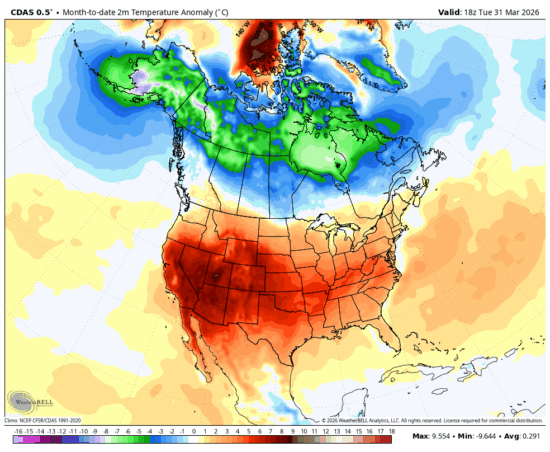
UAH Satellite Lower Tropospheric Temperatures for March 2026
As part of our monthly global temperature updates (posted separately) here are the March temperature departures from normal for the lower troposphere, 1979 through 2026 in the Lower 48 (top panel of Fig. 2). Last month was clearly the warmest in the 48-year satellite temperature record.
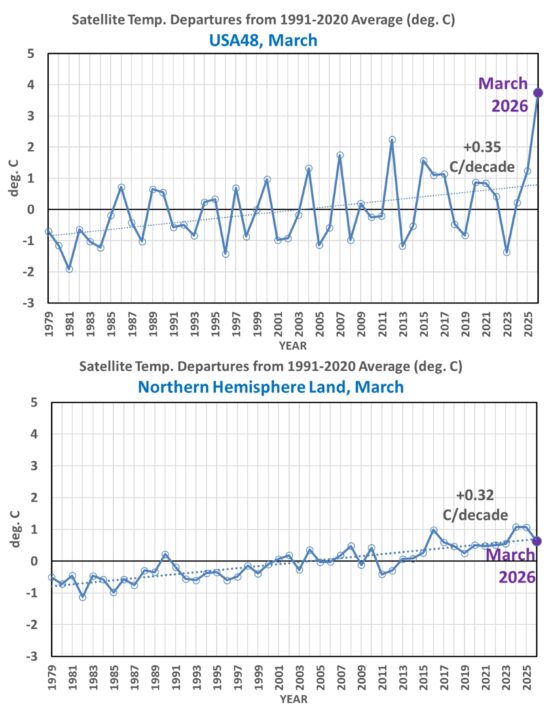
But when we examine the bottom panel in Fig. 2 we see that, averaged over all land areas of the Northern Hemisphere (including Canada and Alaska), March 2026 was uneventful, and was even cooler than 2024 and 2025. In fact, 2026 was right on the long-term trend line.
The message here is that the unusual (and likely record) warmth of March 2026 in the U.S. was largely due to normal month-to-month weather variations, while the large-scale climate signal shows March was a continuation of the slow (and largely benign, and possibly even beneficial) warming trend we have been experiencing in recent decades.





Extreme heat is always a headline, while extreme cold is just a footnote. Somewhere is always hotter than normal… this time it’s going to be a big headline because it’s the U.S. that’s hotter than normal.