Home/Blog
The comment portal at the Federal Register is now open for comments relating to our DOE report. If you think we weren’t alarmist enough, post your comment and explain why. If you think we were too alarmist, post your comment and explain why. I believe the comment period is open for 30 days.
Author Archive
Notice of Availability: A Critical Review of Impacts of Greenhouse Gas Emissions on the U.S. Climate
Saturday, August 2nd, 2025UAH v6.1 Global Temperature Update for July, 2025: +0.36 deg. C
Saturday, August 2nd, 2025The Version 6.1 global average lower tropospheric temperature (LT) anomaly for July, 2025 was +0.36 deg. C departure from the 1991-2020 mean, down from the June, 2025 anomaly of +0.48 deg. C.
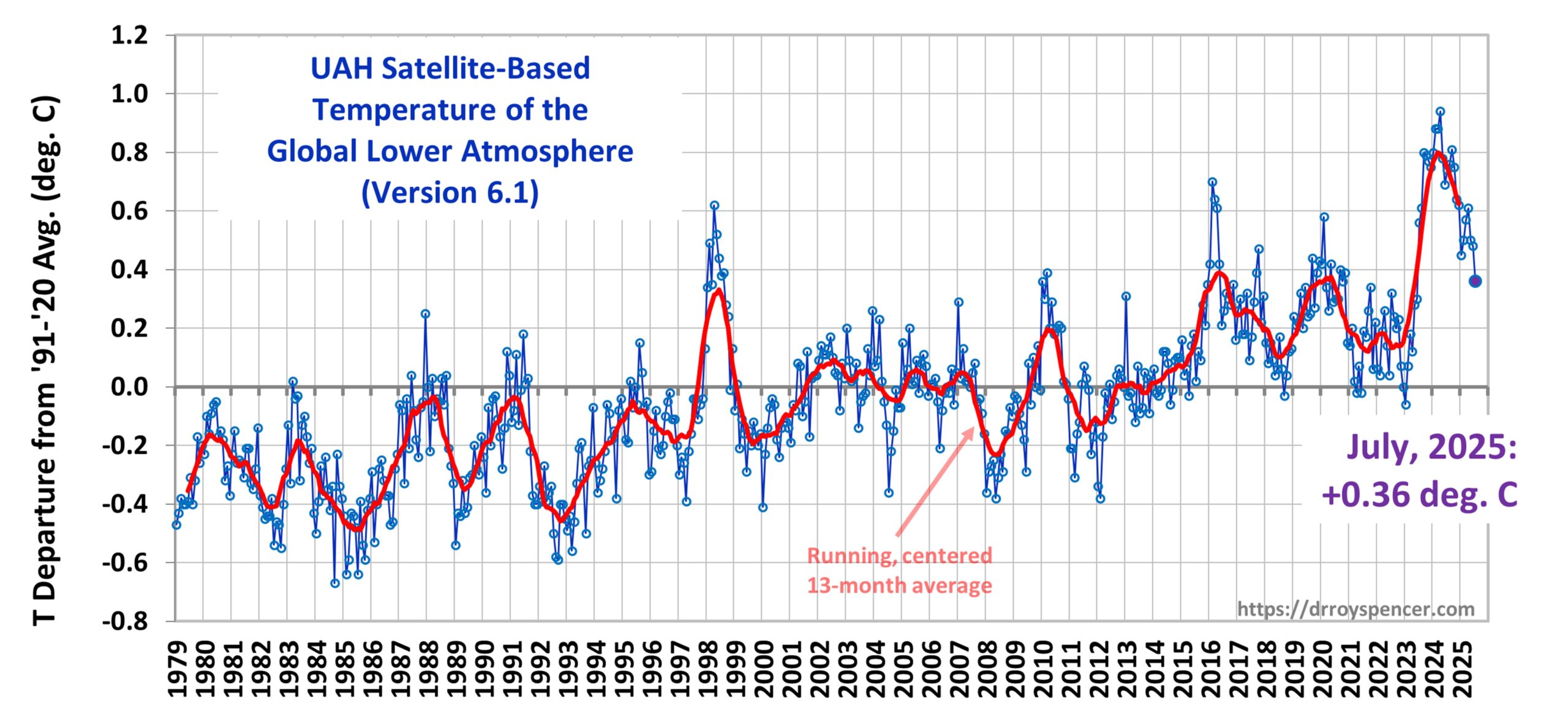
The Version 6.1 global area-averaged linear temperature trend (January 1979 through July 2025) remains at +0.16 deg/ C/decade (+0.22 C/decade over land, +0.13 C/decade over oceans).
The 0.12 deg. C drop in global average temperature anomaly since last month was dominated by the extra-tropical Southern Hemisphere, which fell from +0.55 deg. C in June to +0.10 deg. C in July.
The following table lists various regional Version 6.1 LT departures from the 30-year (1991-2020) average for the last 19 months (record highs are in red).
| YEAR | MO | GLOBE | NHEM. | SHEM. | TROPIC | USA48 | ARCTIC | AUST |
| 2024 | Jan | +0.80 | +1.02 | +0.58 | +1.20 | -0.19 | +0.40 | +1.12 |
| 2024 | Feb | +0.88 | +0.95 | +0.81 | +1.17 | +1.31 | +0.86 | +1.16 |
| 2024 | Mar | +0.88 | +0.96 | +0.80 | +1.26 | +0.22 | +1.05 | +1.34 |
| 2024 | Apr | +0.94 | +1.12 | +0.76 | +1.15 | +0.86 | +0.88 | +0.54 |
| 2024 | May | +0.78 | +0.77 | +0.78 | +1.20 | +0.05 | +0.20 | +0.53 |
| 2024 | June | +0.69 | +0.78 | +0.60 | +0.85 | +1.37 | +0.64 | +0.91 |
| 2024 | July | +0.74 | +0.86 | +0.61 | +0.97 | +0.44 | +0.56 | -0.07 |
| 2024 | Aug | +0.76 | +0.82 | +0.69 | +0.74 | +0.40 | +0.88 | +1.75 |
| 2024 | Sep | +0.81 | +1.04 | +0.58 | +0.82 | +1.31 | +1.48 | +0.98 |
| 2024 | Oct | +0.75 | +0.89 | +0.60 | +0.63 | +1.90 | +0.81 | +1.09 |
| 2024 | Nov | +0.64 | +0.87 | +0.41 | +0.53 | +1.12 | +0.79 | +1.00 |
| 2024 | Dec | +0.62 | +0.76 | +0.48 | +0.52 | +1.42 | +1.12 | +1.54 |
| 2025 | Jan | +0.45 | +0.70 | +0.21 | +0.24 | -1.06 | +0.74 | +0.48 |
| 2025 | Feb | +0.50 | +0.55 | +0.45 | +0.26 | +1.04 | +2.10 | +0.87 |
| 2025 | Mar | +0.57 | +0.74 | +0.41 | +0.40 | +1.24 | +1.23 | +1.20 |
| 2025 | Apr | +0.61 | +0.77 | +0.46 | +0.37 | +0.82 | +0.85 | +1.21 |
| 2025 | May | +0.50 | +0.45 | +0.55 | +0.30 | +0.15 | +0.75 | +0.99 |
| 2025 | June | +0.48 | +0.48 | +0.47 | +0.30 | +0.81 | +0.05 | +0.39 |
| 2025 | July | +0.36 | +0.49 | +0.23 | +0.45 | +0.32 | +0.40 | +0.53 |
The full UAH Global Temperature Report, along with the LT global gridpoint anomaly image for July, 2025, and a more detailed analysis by John Christy, should be available within the next several days here.
The monthly anomalies for various regions for the four deep layers we monitor from satellites will be available in the next several days at the following locations:
Some Thoughts on Our DOE Report Regarding CO2 Impacts on the U.S. Climate
Thursday, July 31st, 2025…we are the “Red Team”; the “Blue Team” has had their say since the late 1980s.

PREFACE: What follows are my own opinions, not seen by my four co-authors of the Dept. of Energy report just released, entitled A Critical Review of Impacts of Greenhouse Gas Emissions on the U.S. Climate. Starting sometime tomorrow, the comment docket at DOE will be open for anyone to post comments regarding the contents of that report. We authors will read all comments, and for those which are substantiative and serious, we will respond in a serious manner. Where we have made mistakes in the report, we will correct them. That is the formal process for adjudicating these issues. Regarding the informal process, tomorrow I expect we will agree on how to handle media requests to respond to objections from the few “climate alarmist” scientists that journalists usually turn to for such comments. To those journalists I would say: read our report, as journalists used to do; you might be surprised to learn a lot of the published science does not support what the public has been led (by you) to believe.
Yes, Increasing CO2 Causes a Warming Tendency in the Climate System… So What?
In my experience, much of the public has splintered into tribal positions on climate change: We either believe increasing CO2 (mainly from fossil fuel burning) has no effect, or we believe it is causing an existential crisis. There are a smaller number of individuals somewhere in the center (climate independents?)
But there is a lot of room between those two extremes for the truth to reside. Among other things, our report presents the evidence supporting the view that (1) long-term warming has been weaker than expected; (2) it’s not even known how much of that warming is due to human greenhouse gas (GHG) emissions; (3) there are good reasons to believe the warming and increasing CO2 effects on agriculture have so far been more beneficial than harmful to humanity; (4) there have been no long-term changes in severe weather events than can be tied to human GHG emissions; and (5) the few dozen climate models now being used to inform policymakers regarding energy policy are not fit for purpose.
Those models, even after decades of improvement, still produce up to a factor of 3 disagreement between those with the least warming and with the most warming (and ALL produce more summertime warming in the critically-important U.S. Corn Belt than has been observed). How can models that are advertised to be based upon “basic physical principles” cause such a wide range of responses to increasing CO2?
And there are many more than those 5 elements contained in our report; those are just my favorites as I sit here thinking at 4:30 a.m.
One of the things we did not delve into was costs versus benefits of energy policies. Clearly, the politically popular switch to energy sources from only wind and solar involves large tradeoffs. If it were not so, there would already be a rapid transition underway from fossil fuels to wind and solar. Yes, those “renewable” sources are growing, and becoming less expensive. Yet, global energy demand is growing apace. But there are practical problems which make ideas such as “Net Zero emissions” essentially impossible to achieve. Maybe that will change in the distant future, who knows? I personally don’t really care where our energy comes from as long as it is abundant, available where it is needed, and is cost-effective. But I won’t buy an EV until it can transport me 920 miles in 14 hours during winter.
But I digress. Yes, recent warming is likely mostly due to increasing CO2 in the atmosphere. But is this necessarily a bad thing, in the net? Cold weather kills far more people than hot weather. Increasing CO2 is causing global greening and contributing to increased agricultural yields. These are things that need to be part of the national conversation, and things our Report begins to address.
Virtually everyone on Earth endures huge changes in weather throughout the year, with as much as 130 deg. F swings in temperature. Can we really not adapt to 2 or 3 degrees more in the yearly average?
Sure, if we can “fix” the “problem” without sending us back to the Stone Age, then do it. But the public has been grossly misled about what that would entail in terms of human suffering (energy is required for literally everything we do), and they have been grossly misled about how much climate change has actually occurred. Read the report.
Why Would Climate Science Be Biased Toward a Specific Outcome?
I’m old enough to remember when climate change meant the global cooling resulting from particulate pollution in the atmosphere. And there was a lot of that pollution as late as the 1970s. In the 1960s during my family’s car trips between Iowa and Pennsylvania, every pass through Gary, Indiana was dreaded. You could see maybe one or two blocks away, because there was so much industrial pollution. I could not understand how anyone could live in those conditions.
Then the EPA was formed in 1970. Messes were cleaned up, on land, in the air, and in our waterways. We came to believe any environmental problem we created could be fixed.
Then we had the ozone depletion scare. With the Montreal Protocol signed in 1987 the countries of the world agreed to gradually phase out production of chlorinated compounds that are believed to cause destruction of the protective ozone layer in the stratosphere.
Finally came the Big Kahuna of manmade pollution: Carbon Dioxide, and fears of global warming. By the late 1980s the U.N. formed the Intergovernmental Panel on Climate Change (IPCC) to evaluate the science of greenhouse gases and how they affect the climate system. Large amounts of federal funds went into this new area of science.
In the early 1990s I visited Robert (Bob) Watson at the White House who was Al Gore’s science advisor on environmental matters. Bob, a stratospheric chemist, was instrumental in getting the 1987 Montreal Protocol established. In that meeting, Bob remarked on the formation of the IPCC something to the effect of, “We are now regulating ozone-depleting chemicals, and carbon dioxide is next”.
I was astounded that the policy goal had already been decided, and now all we needed to do was to fund enough science to support that goal. That was how I interpreted his statement.
In the early years the IPCC was relatively unbiased in its assessments, and conclusions were tentative. All scientists, whether climate alarmists or skeptics, were allowed to participate. But as the years went by, those with skeptical viewpoints (e.g. John Christy) were no longer invited to participate as lead authors of IPCC report chapters.
Other scientists simply chose to stop participating because their science was being misrepresented (e.g. Chris Landsea from the National Hurricane Center, who thought the hurricane data did not support any human influences.)
Today, global warming is big business. According to Grok, since 1990 the U.S. Government has spent $120-$160 Billion on climate change research. As one of the NASA instrument lead scientists on “Mission to Planet Earth”, I was also a beneficiary of that funding, and most of my funding over the years has come from climate-related appropriations.
So, why is climate science biased? First, when we decided that essentially 100% of research funding would come from the government, we put politicians (and thus policy goals) either directly or indirectly in charge of that funding.
Second, Congress only funds problems to be studied… not non-problems. As President Eisenhower warned us in his 1961 farewell address, these forces could lead to a situation where “public policy could itself become the captive of a scientific-technological elite”.
That has now happened. We now have a marching army of scientists (myself included) whose careers depend upon that climate funding, and possibly trillions of dollars in renewable energy infrastructure in the private sector dependent upon the whims of government regulation and mandates. If the climate change threat were to disappear, so would the government grants and regulations and private investments.
As they say, follow the money.
I used to say there are two kinds of scientists in the world: male and female. (Now I’m probably not even allowed to say that). My point was that scientists are regular people. They have their own opinions and worldviews. I went into a science field because I thought science had answers. How naive of me. I should have been an engineer, instead. In the field of climate science (and many other sciences) two researchers can look at the same data and come to totally opposite conclusions. Your data can be perfect, but what the data mean in terms of cause and effect is often not obvious. With engineering, either it works or it doesn’t.
We proved this cause-vs-effect conundrum in the context of climate feedbacks (positive feedbacks amplify climate warming, negative feedbacks reduce it) back in 2011 in this paper. We showed that natural variations in clouds, if not accounted for, can make the climate system seem very sensitive (lots of warming) when in fact it is insensitive (little warming).
The morning that (peer-reviewed) paper appeared in the journal Remote Sensing, the journal editor publicly apologized for letting it be published and was (we believe) forced to resign. Who forced him? Well, from the Climategate emails we get a hint: as it was revealed by one of the “gatekeepers” of climate publications, “[name redacted by me] and I will keep them out somehow — even if we have to redefine what the peer-review literature is!”
That same morning I was called by a particle physicist who heard all of this news and said something to the effect of, “What’s wrong with you climate guys? We have people who believe in string theory and those who don’t, but we still work together”. We both laughed over the divisive nature of climate science compared to other sciences.
Which tells you there is more than science — and even more than money — involved in the disagreement. Every environmental scientist I have ever met believes Nature is fragile. That is not a scientific view, but it is a view that colors how they interpret data, and then what they tell environmental news reporters as it is passed on to the public.
Finally, wouldn’t everyone like to work on something that can make a difference in the world? And what higher calling could there be than to Save the Earth™?
133 Years of Texas Hill Country Heavy Rainfall Data Show No Trends
Wednesday, July 30th, 2025…and for floods across the U.S. and the world, the “scientific consensus” agrees.
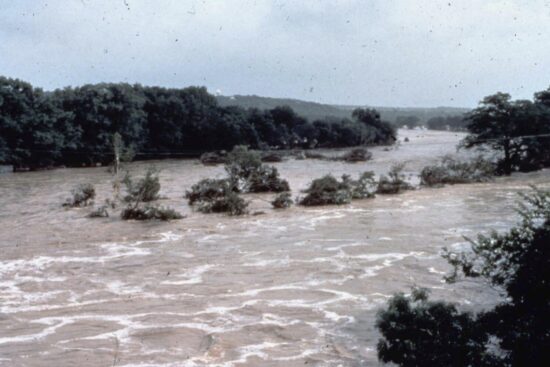
The catastrophic flooding of July 4, 2025 in the Texas hill country has left at least 130 dead. Many news outlets (predictably) have invoked climate change as a contributing cause, for example CNN, NPR, ABC News, The Texas Tribune, et al. As others have documented, there were more than adequate flash flood watches and warnings from the National Weather Service, and there was no shortage of either NWS staff or weather data.
It has long been known that this region is considered “Flash Flood Alley“, where the local topography and little soil covering the rock underneath leads to large amounts of runoff into the Guadeloupe and other nearby rivers in the event of heavy thunderstorms.
Clearly, one weather event is not evidence of climate change. We need to examine long-term weather statistics to evaluate claims that severe weather, of any type, is getting worse. This is especially true of heavy rainfall events, which are notoriously sporadic, with long-term statistics which are not well-behaved.
Flash floods require more than just heavy rainfall; they also require (1) rain to accumulate over a very short period of time, (2) the storms need to stay over the same area, and (3) the geography and hydrology features (little soil, sloping terrain) need to rapidly funnel most of the water into streams and rivers. The Flash Flood Alley region of Texas can deal with, say, 5 inches of rain if it falls steadily over 2 days. But if it falls in only 6 hours, flash flooding is much more likely. As is the case with tornadoes, a catastrophic flash flood requires specific ingredients that seldom occur all at the same time and location. There is a large element of randomness involved.
The Catastrophic Floods of 1978
While the 1987 flood (pictured above) was also severe, it has been nearly 50 years since a flood of similar magnitude to the July 4th flood occurred, and that was in 1978. This San Antonio Express-News article is a fascinating read regarding that event. Like this year’s disaster, the cause was a dissipating tropical storm (Amelia in 1978, T.S. Barry this year). That flood killed 25 people in the Hill Country. What I find especially interesting is that the flood uprooted ancient cypress trees, up to 6 ft. in diameter, estimated to be several hundred years old.
133 Years of Heavy Rainfall Events in the Texas Hill Country
John Christy (UAH) provided me some heavy rainfall statistics for several stations in the Kerrville, TX area. For years John has been going through old daily weather summary forms that were never digitized, extending observational records back into the late 1800s. This is tedious and time-consuming work, but necessary if one has any hope of examining long-term trends in heavy rainfall events.
From those data, here are the last 133 years of the heaviest 2-day rainfall events in each year at Kerrville, TX (since 1893).
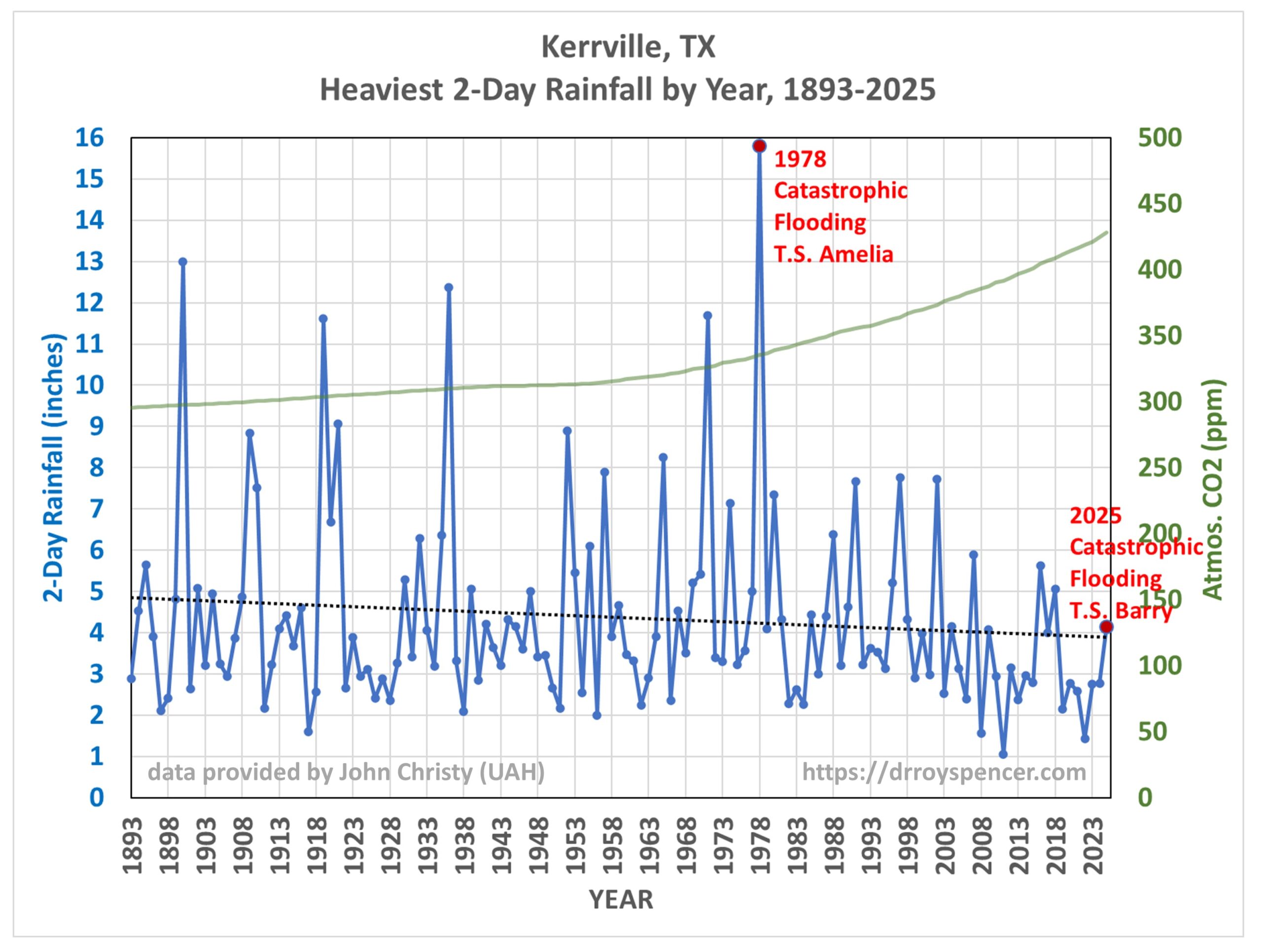
Clearly, there has been no long-term change in heavy rain events at Kerrville, Texas in spite of increasing atmospheric CO2 concentrations (also shown in the above plot). Even the EPA shows maps for the 50-year period 1965-2015 that indicate slight downward trends in river flooding magnitude and frequency over most of Texas, as well as the rest of the U.S.
From the Kerrville plot above you might wonder, why did the 2025 flood have so little rainfall at Kerrville? This is because most of the rain occurred upstream of Kerrville. Flash floods can occur at locations where no rain has fallen, as the water flows downstream from where the heavy rainfall occurred. Because of this effect, not all of the heavy rainfall peaks shown in the above plot produced serious flooding, and some of the documented flood events at Kerrville had only modest rainfall amounts.
Instead, the rainfall statistics at Kerrville should be viewed as evidence to address the question, are heavy rainfall events in Texas Hill Country getting worse? At Kerrville, at least, the answer is “no”.
But that’s just one station. John Christy also provided me data for 3 other nearby stations: Boerne, Fredericksburg, and Hondo Texas (not shown). For the same period (1893-2025) the trend lines for those stations are all essentially flat to slightly downward.
Climate Change, Heavy Rainfall, and Flooding: What Is The “Scientific Consensus”?
As we document in our Department of Energy report released yesterday entitled, A Critical Review of Impacts of Greenhouse Gas Emissions on the U.S. Climate, when one looks at rainfall statistics across the U.S. extending back to the mid- to late-1800s, there is little evidence for anything that might be considered related to human-caused climate change.
And don’t take just our word for it.
For flooding, the most recent IPCC report (AR6) said there is “low confidence for observed changes in the magnitude or frequency of floods at the global scale.”
For the U.S., the 4th National Climate Assessment stated that “trends in extreme high values of streamflow are mixed” with both increases and decreases, and there is no “robust evidence” that any trends are attributable to human influences.
So, for the usual suspects trashing our report to the media (Michael Mann, Andy Dessler, and Zeke Hausfather), maybe they should look at what we actually wrote, and the “consensus” sources we relied upon.
The public has been misled on climate science, and we are trying to set the record straight.
The DOE Scientific Report Underpinning the EPA’s Decision to Reconsider the 2009 Endangerment Finding on CO2
Tuesday, July 29th, 2025A Note to Journalists: Please take few minutes to read some of this so that maybe you can skip asking me for an interview.
Around 3 p.m. ET today, 29 July 2025, a Department of Energy report entitled “A Critical Review of Impacts of Greenhouse Gas Emissions on the U.S. Climate” will be made available here. This is the report providing the scientific basis for today’s announced decision by EPA Administrator Lee Zeldin to reconsider the 2009 CO2 Endangerment Finding.
The report has 5 authors: John Christy, Judith Curry, Steve Koonin, Ross McKitrick, and myself.
We were asked by DOE Secretary Wright a few months ago to produce this report. As the first few pages of the report will explain, we had no pressure to come to any conclusions; we asked for complete autonomy.
Also, we had no knowledge through the whole process of what the decision-makers at the EPA were going to do regarding energy policy. We suspected the Endangerment Finding would be the topic of greatest interest, but we also knew that the EPA’s strategy for rescinding that could take a mostly legal approach, with little need for science arguments… for now.
Even today, I have no idea how much recent court rulings vs. updated (and less biased) science figured into the EPA’s decision.
Why a DOE Report to Support an EPA Decision?
My understanding is that the Trump Administration and all of its Executive Branch agencies have been very busy on myriad issues. Only one of the executive-level appointees in the Administration had the background knowledge and interest to invest in making this science report happen: Energy Secretary Chris Wright. I suspect (this is my reading between the lines) that it was agreed between the White House, EPA, and DOE that Sec. Wright would take the lead on the science document.
Chris called me at home and asked me if I would participate, and he asked who I would recommend for other authors of the report. He had been following my research for many years. He also had on his list of potential contributors the others who now appear on the report with me.
During preparation of the report we decided to avoid any engagement with the press on what we were doing. It would have only been a distraction, and we had little time to accomplish what the Obama Administration spent years and millions of dollars to produce as the original Technical Support Document (TSD) for the 2009 Endangerment Finding.
Our report has 141 pages, 350 references (most if not all peer-reviewed), 6.6% of which were studies we authored or co-authored. The report could not address every claim made in the 2009 Endangerment Finding’s Technical Support Document. Instead, we focused on some of the central claims, the science underpinning them, and especially on the National Climate Assessments, especially NCA4 and NCA5 (the latest), which are relied upon by the U.S. Congress to assist in the making of laws and apportioning research funds.
One thing I learned through this process is how prolific and smart a researcher Ross McKitrick (U. of Guelph, Ontario) is. He was indispensable to our effort. But everyone brought their own experiences and opinions to the process, and we often had disagreements… but none that could not be quickly resolved.
Another thing I learned was just how poorly the science of climate change has been communicated to the public. For example, if you follow Roger Pielke, Jr’s research you will know that most of what the public has been told about climate change and severe weather has been a lie — and Roger still considers human climate change to be an issue worth addressing. It’s just not a “crisis”, and nothing we see in severe weather has been tied to human greenhouse gas emissions.
And that’s not a skeptical talking point, it’s according to the IPCC (!)
Big U.S. Climate Policy Changes To Be Announced Today
Tuesday, July 29th, 2025
Energy Secretary Chris Wright and EPA Administrator Lee Zeldin will be in Indianapolis today (29 July 2025) to announce major climate regulation changes…so, stay tuned!
UPDATE: E&E News (by Politico) provides an unusually neutral assessment of what will be announced: https://www.eenews.net/articles/epa-seeks-to-limit-its-power-to-curb-climate-pollution/
Here’s video of the announcement. I’m one of the 5 scientists chosen to write the DOE report for Sec. Wright which provided the scientific basis for EPA Administrator Zeldin’s decision.
None of us asked to write this report had any insider knowledge of what Zeldin would decide… we were simply asked to write a report of what we believed the threat of increasing CO2 posed to the U.S. That report will be posted very soon (if it hasn’t already). I will do a separate post on that.
UAH v6.1 Global Temperature Update for June, 2025: +0.48 deg. C
Thursday, July 3rd, 2025The Version 6.1 global average lower tropospheric temperature (LT) anomaly for June, 2025 was +0.48 deg. C departure from the 1991-2020 mean, down slightly from the May, 2025 anomaly of +0.50 deg. C.
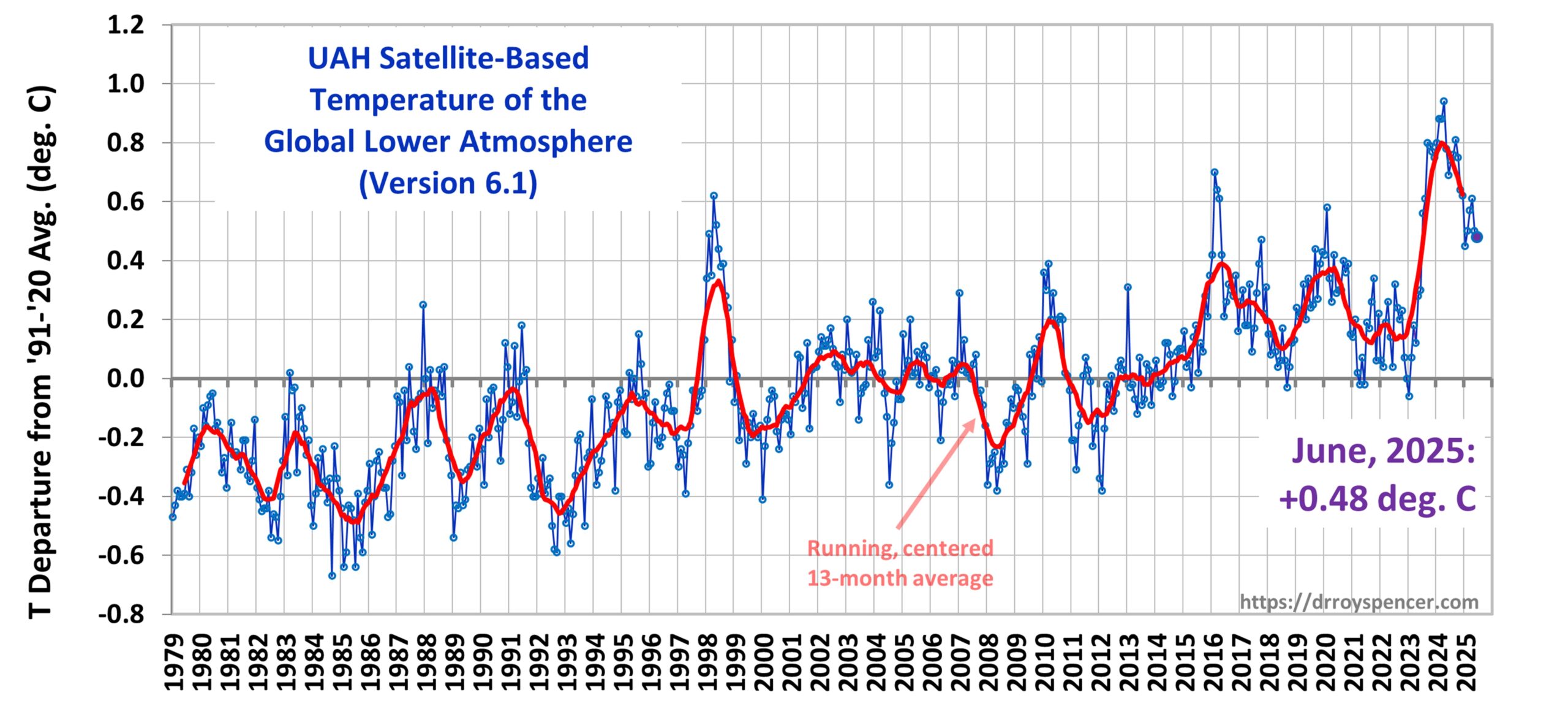
The Version 6.1 global area-averaged linear temperature trend (January 1979 through June 2025) now stands at +0.16 deg/ C/decade (+0.22 C/decade over land, +0.13 C/decade over oceans).
The following table lists various regional Version 6.1 LT departures from the 30-year (1991-2020) average for the last 18 months (record highs are in red).
| YEAR | MO | GLOBE | NHEM. | SHEM. | TROPIC | USA48 | ARCTIC | AUST |
| 2024 | Jan | +0.80 | +1.02 | +0.58 | +1.20 | -0.19 | +0.40 | +1.12 |
| 2024 | Feb | +0.88 | +0.95 | +0.81 | +1.17 | +1.31 | +0.86 | +1.16 |
| 2024 | Mar | +0.88 | +0.96 | +0.80 | +1.26 | +0.22 | +1.05 | +1.34 |
| 2024 | Apr | +0.94 | +1.12 | +0.76 | +1.15 | +0.86 | +0.88 | +0.54 |
| 2024 | May | +0.78 | +0.77 | +0.78 | +1.20 | +0.05 | +0.20 | +0.53 |
| 2024 | June | +0.69 | +0.78 | +0.60 | +0.85 | +1.37 | +0.64 | +0.91 |
| 2024 | July | +0.74 | +0.86 | +0.61 | +0.97 | +0.44 | +0.56 | -0.07 |
| 2024 | Aug | +0.76 | +0.82 | +0.69 | +0.74 | +0.40 | +0.88 | +1.75 |
| 2024 | Sep | +0.81 | +1.04 | +0.58 | +0.82 | +1.31 | +1.48 | +0.98 |
| 2024 | Oct | +0.75 | +0.89 | +0.60 | +0.63 | +1.90 | +0.81 | +1.09 |
| 2024 | Nov | +0.64 | +0.87 | +0.41 | +0.53 | +1.12 | +0.79 | +1.00 |
| 2024 | Dec | +0.62 | +0.76 | +0.48 | +0.52 | +1.42 | +1.12 | +1.54 |
| 2025 | Jan | +0.45 | +0.70 | +0.21 | +0.24 | -1.06 | +0.74 | +0.48 |
| 2025 | Feb | +0.50 | +0.55 | +0.45 | +0.26 | +1.04 | +2.10 | +0.87 |
| 2025 | Mar | +0.57 | +0.74 | +0.41 | +0.40 | +1.24 | +1.23 | +1.20 |
| 2025 | Apr | +0.61 | +0.77 | +0.46 | +0.37 | +0.82 | +0.85 | +1.21 |
| 2025 | May | +0.50 | +0.45 | +0.55 | +0.30 | +0.15 | +0.75 | +0.99 |
| 2025 | June | +0.48 | +0.48 | +0.47 | +0.30 | +0.81 | +0.05 | +0.39 |
The full UAH Global Temperature Report, along with the LT global gridpoint anomaly image for June, 2025, and a more detailed analysis by John Christy, should be available within the next several days here.
The monthly anomalies for various regions for the four deep layers we monitor from satellites will be available in the next several days at the following locations:
In Remembrance
Saturday, June 21st, 2025Most of you are probably not aware that my wife of 48 years, Doreen (“Reenie”) J. Spencer passed away two weeks ago today, on June 7. Reenie had suffered for many years from autoimmune and fatty liver disease, and her condition worsened in the last several months. By the time she agreed to go to the hospital, it was too late to do anything except keep her comfortable.
We married the year I changed my major from computer science to atmospheric science and moved from Michigan State University to the University of Michigan. Reenie was always my most loyal supporter and fiercest defender, exhibiting the ‘sisu’ of her Finnish heritage.
Her spirit is now relieved of her earthly sufferings.

UAH v6.1 Global Temperature Update for May, 2025: +0.50 deg. C
Thursday, June 5th, 2025The Version 6.1 global average lower tropospheric temperature (LT) anomaly for May, 2025 was +0.50 deg. C departure from the 1991-2020 mean, down from the April, 2025 anomaly of +0.61 deg. C.
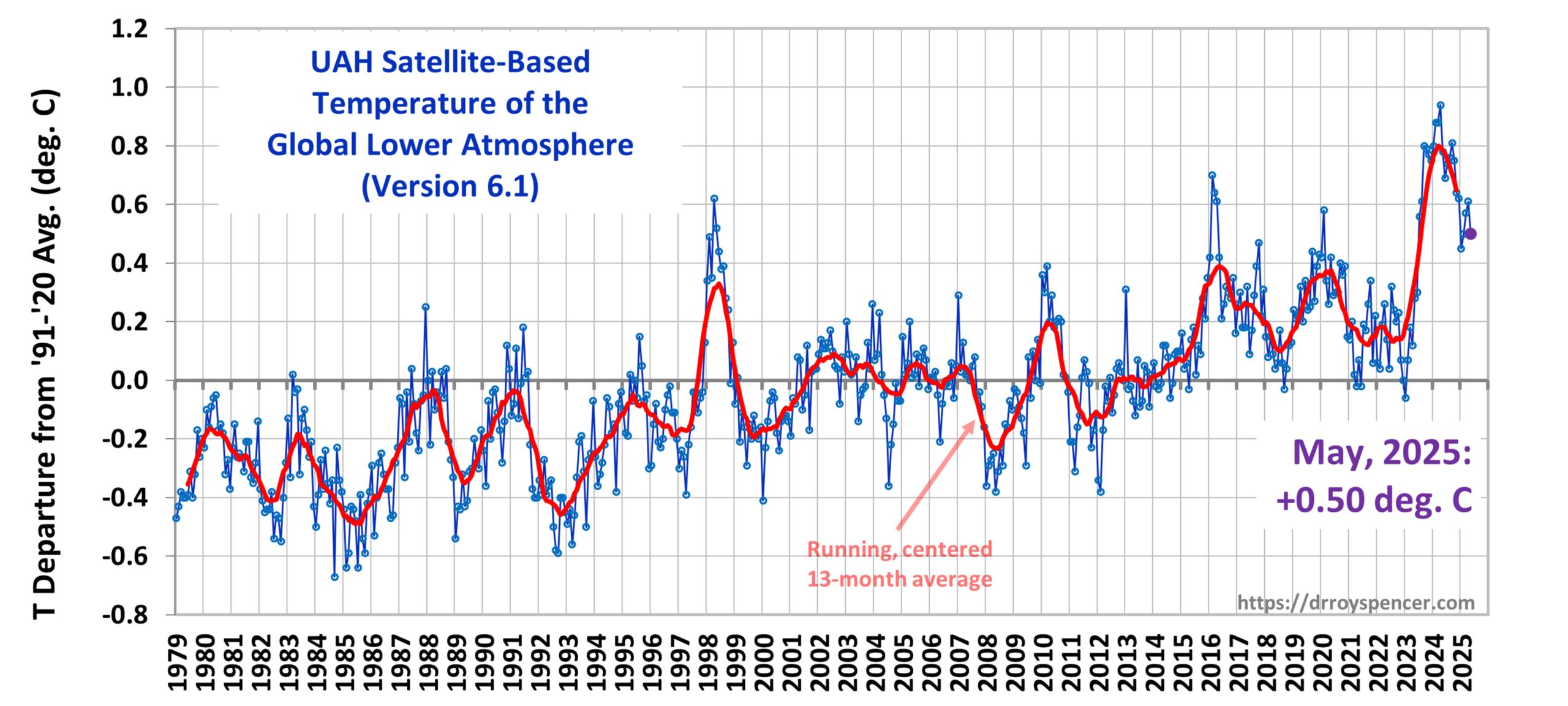
The Version 6.1 global area-averaged linear temperature trend (January 1979 through May 2025) remains at +0.15 deg/ C/decade (+0.22 C/decade over land, +0.13 C/decade over oceans).
The following table lists various regional Version 6.1 LT departures from the 30-year (1991-2020) average for the last 17 months (record highs are in red).
| YEAR | MO | GLOBE | NHEM. | SHEM. | TROPIC | USA48 | ARCTIC | AUST |
| 2024 | Jan | +0.80 | +1.02 | +0.58 | +1.20 | -0.19 | +0.40 | +1.12 |
| 2024 | Feb | +0.88 | +0.95 | +0.81 | +1.17 | +1.31 | +0.86 | +1.16 |
| 2024 | Mar | +0.88 | +0.96 | +0.80 | +1.26 | +0.22 | +1.05 | +1.34 |
| 2024 | Apr | +0.94 | +1.12 | +0.76 | +1.15 | +0.86 | +0.88 | +0.54 |
| 2024 | May | +0.78 | +0.77 | +0.78 | +1.20 | +0.05 | +0.20 | +0.53 |
| 2024 | June | +0.69 | +0.78 | +0.60 | +0.85 | +1.37 | +0.64 | +0.91 |
| 2024 | July | +0.74 | +0.86 | +0.61 | +0.97 | +0.44 | +0.56 | -0.07 |
| 2024 | Aug | +0.76 | +0.82 | +0.69 | +0.74 | +0.40 | +0.88 | +1.75 |
| 2024 | Sep | +0.81 | +1.04 | +0.58 | +0.82 | +1.31 | +1.48 | +0.98 |
| 2024 | Oct | +0.75 | +0.89 | +0.60 | +0.63 | +1.90 | +0.81 | +1.09 |
| 2024 | Nov | +0.64 | +0.87 | +0.41 | +0.53 | +1.12 | +0.79 | +1.00 |
| 2024 | Dec | +0.62 | +0.76 | +0.48 | +0.52 | +1.42 | +1.12 | +1.54 |
| 2025 | Jan | +0.45 | +0.70 | +0.21 | +0.24 | -1.06 | +0.74 | +0.48 |
| 2025 | Feb | +0.50 | +0.55 | +0.45 | +0.26 | +1.04 | +2.10 | +0.87 |
| 2025 | Mar | +0.57 | +0.74 | +0.41 | +0.40 | +1.24 | +1.23 | +1.20 |
| 2025 | Apr | +0.61 | +0.77 | +0.46 | +0.37 | +0.82 | +0.85 | +1.21 |
| 2025 | May | +0.50 | +0.45 | +0.55 | +0.30 | +0.15 | +0.75 | +0.99 |
The full UAH Global Temperature Report, along with the LT global gridpoint anomaly image for May, 2025, and a more detailed analysis by John Christy, should be available within the next several days here.
The monthly anomalies for various regions for the four deep layers we monitor from satellites will be available in the next several days at the following locations:
Our Urban Heat Island Paper Has Been Published
Thursday, May 15th, 2025
It took the better part of two years to satisfy the reviewers, but finally our paper Urban Heat Island Effects in U.S. Summer Surface Temperature Data, 1895–2023 has been published in the AMS Journal of Applied Meteorology and Climatology.
To quickly summarize, we used the average temperature differences between nearby GHCN stations and related those to population density (PD) differences between stations. Why population density? Well, PD datasets are global, and one of the PD datasets goes back to the early 1800s, so we can compute how the UHI effect has changed over time. The effect of PD on UHI temperature is strongly nonlinear, so we had to account for that, too. (The strongest rate of warming occurs when population just starts to increase beyond wilderness conditions, and it mostly stabilizes at very high population densities; This has been known since Oke’s original 1973 study).
We then created a dataset of UHI warming versus time at the gridpoint level by calibrating population density increases in terms of temperature increase.
The bottom line was that 65% of the U.S. linear warming trend between 1895 and 2023 was due to increasing population density at the suburban and urban stations; 8% of the warming was due to urbanization at rural stations. Most of that UHI effect warming occurred before 1970.
But this does not necessarily translate into NOAA’s official temperature record being corrupted at these levels. Read on…
What Does This Mean for Urbanization Effects in the Official U.S. Temperature Record?
That’s a good question, and I don’t have a good answer.
One of the reviewers, who seemed to know a lot about the homogenization technique used by NOAA, said the homogenized data could not be used for our study because the UHI-trends are mostly removed from those data. (Homogenization looks at year-to-year [time domain] temperature changes at neighboring stations, not the spatial temperature differences [space domain] like we do). So, we were forced to use the raw (not homogenized) U.S. summertime GHCN daily average ([Tmax+Tmin]/2) data for the study. One of the surprising things that reviewer claimed was that homogenization warms the past at currently urbanized stations to make their less-urbanized early history just as warm as today.
So, I emphasize: In our study, it was the raw (unadjusted) data which had a substantial UHI warming influence. This isn’t surprising.
But that reviewer of the paper said most of the spurious UHI warming effect has been removed by the homogenization process, which constitutes the official temperature record as reported by NOAA. I am not convinced of this, and at least one recent paper claims that homogenization does not actually correct the urban trends to look like rural trends, but instead it does “urban blending” of the data. As a result, which trends are “preferred” by that statistical procedure are based upon a sort of “statistical voting” process (my terminology here, which might not be accurate).
So, it remains to be seen just how much spurious UHI effect there is in the official, homogenized land-based temperature trends. The jury is still out on that.
Of course, if sufficient rural stations can be found to do land-based temperature monitoring, I still like Anthony Watts’ approach of simply not using suburban and urban sites for long-term trends. Nevertheless, most people live in urbanized areas, so it’s still important to quantify just how much of those “record hot” temperatures we hear about in cities are simply due to urbanization effects. I think our approach gets us a step closer to answering that question.
Is Population Density the Best Way to Do This?
We used PD data because there are now global datasets, and at least one of them extends centuries into the past. But, since we use population density in our study, we cannot account for additional UHI effects due to increased prosperity even when population has stabilized.
For example, even if population density no longer increases over time in some urban areas, there have likely been increases in air conditioning use, with more stores and more parking lots, as wealth has increased since, say, the 1970s. We have started using a Landsat-based dataset of “impervious surfaces” to try to get at part of this issue, but those data only go back to the mid-1970s. But it will be a start.