Deep Ocean Temperature Change Spaghetti: 15 Climate Models Versus Observations

August 14th, 2011

The following comparison between the 20th Century runs from most (15) of the IPCC AR4 climate models, and Levitus observations of ocean warming during 1955-1999, further bolsters the case for a relatively low climate sensitivity: estimated here to be about 1.3 deg. C for a future doubling of atmospheric CO2. This is quite a bit lower than the IPCC’s best estimate of 3 deg. C warming.

But the behavior of the models’ temperatures in the deep ocean was not at all what I expected. They say “too many cooks spoil the broth”. Well, it looks like 15 climate modeling groups make spaghetti out of ocean temperature trends.

Deep Ocean Spaghetti

The deep-ocean temperature trends in the 15 models which had complete ocean data archived for the period 1955-1999 are surprising, because I expected to see warming at all depths. Instead, the models exhibit wildly different behaviors, with deep-ocean cooling just as likely as warming depending upon the model and ocean layer in question (click for the full-size version):


Three of the models actually produced average cooling of the full depth of the oceans while the surface warmed, which seems physically implausible to say the least. More on that in a minute.

The most common difference between the models and the observations down to 700 m (the deepest level for which we have Levitus observations to compare to) is that the models tend to warm the ocean too much. Of those models that don’t, almost all produce unexpected cooling below the mixed layer (approximately the top 100 m of the ocean).

From what I understand, the differences between the various models’ temperature trends are due to some combination of at least 3 processes:

1) CLIMATE SENSITIVITY: More sensitive models should store more heat in the ocean over time; this is the relationship we want to exploit to estimate the sensitivity of the real climate system from the rates of observed warming compared to the rates of warming in the climate models.

2) CHANGES IN VERTICAL MIXING OVER TIME: The deep ocean is filled with cold, dense water formed at high latitudes, while the upper layers are warmed by the sun. Vertical mixing acts to reduce that temperature difference. Thus, if there is strengthening of ocean mixing over time, there would be deep warming and upper ocean cooling, as the vertical temperature differential is reduced. On the other hand, weakening mixing over time would do the opposite, with deep ocean cooling and upper ocean warming. These two effects, which can be seen in a number of the models, should cancel out over the full depth of the ocean.

3) SPURIOUS TEMPERATURE TRENDS IN THE DEEP OCEAN This is a problem that the models apparently have not fully addressed. Because it takes about ~1,000 years for the ocean circulation to overturn, it takes a very long run of a climate model before the model’s deep ocean settles into a stable temperature, say to 0.1 deg. C or less. While some knowledgeable expert reading this might want to correct me, it appears to me that some of these models have spurious temperature trends, unrelated to the CO2 (and other) forcings imposed on the models during 1955-1999. This is likely due to insufficient “spin-up” time for the model to reach a stable deep-ocean temperature. Until this problem is fixed, I don’t see how models can address the extent to which the extra heat from “global warming” is (or isn’t) being mixed into the deep ocean. Maybe the latest versions of the climate models, which will be archived in the coming months, do a better job.

Of course, we would like to exploit process (1) to get an estimate of how sensitive the real climate system is, using the Levitus observations (green curve in the above plot). Unfortunately, the 2nd and 3rd processes causing temperature trends unrelated to upper ocean warming seem to be a real problem in most of these models.

Choosing the Best Subset of Models
Obviously, using models that produce a global net cooling of the oceans during a period of surface warming (1955-1999) cannot be expected to provide a useful comparison to observations. Maybe someone can correct me, but it appears those models do not even conserve energy.

For quantitative comparison to the Levitus observations, I decided to accept only those models whose monthly mixed layer temperature variations during 1955-1999 had at least a 0.7 correlation with the Levitus observations in the 0-50 m layer over the same period. In other words, I omitted the models that behaved least like the observations.

The remaining 4 models’ trends are shown in the next plot, along with their average (click for large version):

Note that the 4-model average (black curve) shows warming down to about 2,500 meters depth. Now that we have excluded the models that are the most unrealistic, we can make a more meaningful quantitative comparison between the Levitus observations (which I have extrapolated to zero warming at 3,000 m depth) and the models.

Estimating Climate Sensitivity from the Levitus Observations
As reported by Forster & Taylor (2006 J. Climate), the average surface warming produced by 2100 in these 4 models (based upon the SRES A1B emissions scenario) is 3.9 deg. C. If we scale that by the smaller amount of warming seen in the observations, you get the following plot for estimated warming by 2100 based upon averaging of the trends to various depths (click for large version):

While the Levitus observations in the mixed layer are consistent with the model predictions of about 3 deg. C of warming by 2100, the much weaker warming in the entire 0-700 m layer suggests a much lower rate of future warming: about 1.3 deg. C or so.

If I loosen the requirements on the number of models accepted, and include 9 (rather than 4) out of 15, the predicted rate of warming increases a little, to 1.5 deg. C.

Discussion
Since this result uses the IPCC models themselves to “calibrate” the Levitus observations, it cannot be faulted for using a model that is “too simple”. To the extent the average IPCC model mimics nature, the models themselves suggest the relatively weak ocean warming observed during 1955-1999 indicates relatively low climate sensitivity.

Previous investigators (as well as the IPCC AR4 report) have claimed that warming of the oceans is “consistent with” anthropogenic forcing of the climate system. But they did not say exactly how consistent, in a quantitative sense.

The IPCC AR4 report admits that the climate models tend to warm the deep ocean too much, but the report puts error bars on both the models and observations which overlap each other, so then it can be claimed the overlap is evidence of “agreement” between models and observations.

The trouble with the ‘overlapping error bars’ argument – which seems to be a favorite statistical ploy of the IPCC – is that it cuts both ways: the other ends of the error bars, where there is no overlap, will suggest even larger disagreement between models and observations than if no error bars were used in the first place!

Nothing is gained with the statistical obfuscation of using overlapping error bars…except to demonstrate that the models and observations do not necessarily disagree.

That is very different from saying they do agree.

THE BOTTOM LINE
It would be difficult to overstate the importance of the results, if they hold up to scrutiny: The observed rate of warming of the ocean has been too weak to be consistent with a sensitive climate system. This is demonstrated with the IPCC models themselves.

The resulting climate sensitivity (around 1.3 deg. C) just happens to be about the same sensitivity I have been getting using the simple forcing-feedback-diffusion model to match the Levitus observations of ocean warming during 1955-2010 directly.

Finally, it should be mentioned the above analysis assumes that there has been no significant natural source of warming during 1955-1999. If there has, then the diagnosed climate sensitivity would be even lower still.

I would be surprised if none of the climate modelers have performed a basic analysis similar to the one above. But since the results would be so damaging to the IPCC’s claims of much greater climate sensitivity (greater future warming) I would expect those results would never see the light of day.

Is Gore’s Missing Heat Really Hiding in the Deep Ocean?

August 7th, 2011

NOTE: For those who are offended by my bringing up Al Gore in this post (but are apparently not offended by Gore falsely accusing scientists like me of being ‘global warming deniers’), I suggest you just focus on the evidence I present. You are invited to offer an alternative explanation for the evidence, but I will not allow you to divert attention from it through irrelevant “copy and paste” factoids you have gathered from other scientific publications. If you persist, I will be forced to adopt the RealClimate tactic of deleting comments, which so far I have been able to avoid on this blog. We’ll just call it “fighting fire with fire”.

As I and others have pointed out, the 20th Century runs of the IPCC climate models have, in general, created more virtual warming in the last 50 years than the real climate system has warmed.

That statement is somewhat arguable, though, since the modelers can run a number of realizations, each with its own “natural” year-to-year internal climate variability, and get different temperature trends for any given 50-year period.

Furthermore, uncertainty over how fast heat is being mixed into the deep ocean also complicates matters. If extra surface heating from more CO2 is being mixed deeper and faster than the modelers have assumed, then climate models warming the surface too fast in the past 50 years does not necessarily mean we will not see their forecasts come true eventually.

As Kevin Trenberth has recently alluded to, it only delays the day of reckoning.

Are More Expensive Models Better?
I have tried in recent posts to estimate climate sensitivity by using a simple forcing-feedback-diffusion model, and tuning it to match observations (which is exactly what the Big Boys do), but it appears that our critics will always question the validity of a simple model, even though it contains the same fundamental physics the IPCC models must also abide by.

So, let’s skip the simple model entirely, and just compare the IPCC climate models to the observations.

IPCC Models versus Ocean Observations, 1955-2000
Since so many people are now pointing to ocean heat content increases, rather than surface warming, as a better index of how sensitive our climate system is, let’s see how observed ocean warming compares to the warming simulated by two very different IPCC climate models.

We have begun analyzing the deep ocean temperature output from the 20th Century runs of the IPCC AR4 climate models. The first we chose were one of the most sensitive models (IPSL-CM4) and one of the least sensitive models (NCAR PCM1).

There is a simple way to use these models to get some idea of what the observed ocean warming tells us about climate sensitivity.

We can simply compare each of the models’ rate of ocean warming during 1955-2000 to their known climate sensitivity, and then see what the warming rate in the Levitus ocean temperature observations suggests for a climate sensitivity in the real climate system.

The following plot shows the temperature trends, as a function of ocean depth, between 1955 (when the ocean observations start) and 2000 (when the climate model experiments end) for those 2 models as well as in the Levitus observations (click for larger version):

Clearly, the most sensitive model (IPSL-CM4) warms the ocean the most, the least sensitive model (NCAR PCM1) warms the ocean much less, and the Levitus observations appear to exhibit the least warming. (NOTE: I have linearly extrapolated the Levitus observations from the deepest reported level, 700 m, to an assumed zero trend at 2,000 m depth.)

If we compute the average warming trends for the 0-700 m layer for the 2 models, and compare them to the known sensitivity of those models, we get the 2 blue dots in the following plot (we will be adding as many models to this as possible later; click for larger version):

If we then use the model relationship between 1955-2000 warming and climate sensitivity (the solid line), we see that the warming trend in the Levitus observations fall on that at a climate sensitivity of 1.3 deg. C.

If you are wondering what the results are if we go deeper, from 700 meters to 2,000 meters deep (keeping in mind we have assumed that the observed warming goes to zero at 2,000 m depth), the answer is that it is nearly the same: 1.4 deg. C, rather than 1.3 deg. C.

This is similar to the kinds of numbers I have been getting recently using a simple forcing-feedback-diffusion model and matching the Levitus observations directly with it. This level of warming is below the 1.5 deg. lower limit that the IPCC has set for total warming in response to 2XCO2.

Obviously, we need to add more of the IPCC models to this comparison, which we will be doing in the coming weeks, to see if there is indeed a strong relationship between model warming and model sensitivity, which there should be if the different models used similar climate forcings.

But the results should not depart too much from what is shown above because the line must go through (0,0) on the graph (zero climate sensitivity means zero warming), and the upper end of the line will be fixed by the 3 most sensitive IPCC climate models, of which IPSL-CM4 is one.

Could Climate Sensitivity be even Lower?
The above analysis assumes there have been no natural forcings of warming. But to the extent that recent warming was partly due to some natural process, this would mean climate sensitivity is even less.

Discussion
Once again we see evidence that the IPCC models are too sensitive, which means they are predicting too much warming for our future, which means Mr. Gore needs to chill out a bit.

Also, the list of modelers’ potential excuses for their models warming more than observed is rapidly dwindling. For example,

1) If the above results are any indication, it is unlikely the heat is hiding in the deep ocean.

2) Blaming Chinese coal-fired power plants for a lack of warming is just taking the modelers anthropocentrism to an even higher plane. There seems to be no good evidence to support such a claim anyway.

3) Another trick the IPCC uses is to put error bars on both the observations and the on the model results until they overlap. It is then claimed that models and observations “agree” to within the margin of error. But what they don’t realize with this last bit of statistical obfuscation is they are also admitting that there is a HUGE disagreement between models and observations when one goes to the other end of those error bars.

“Overlapping error bars” is the last resort for getting two numbers to appear to agree better than they really do.

It’s time for climate modelers to face up to the explanation they have been avoiding at all cost: the climate system is simply not nearly as sensitive as they claim it is.

If they ever have to admit the climate system is insensitive, it is the end of the IPCC and the policy changes that institution was originally formed to advance.

A Step in the Right Direction: Backing off of Anthropocentrism in Climate Research

August 5th, 2011

Yesterday’s press release from the UK Met Office introduces 2 new papers in Geophysical Research Letters which explain the recent lack of ocean warming, approximately since 2003. Most of the pause in warming is attributed to natural ENSO (El Nino-Southern Oscillation, that is, El Nino and La Nina) activity.

First of all let me say I agree with them. It is a step forward for the “skeptics” side of the global warming debate that the climate modelers finally admit that nature can have a role in global warming and cooling episodes… although they seem to be limiting that role to approximate 10-year time scales.

This at least a step in the right direction, since previously climate modelers would not admit to ENSO causing much more than year-to-year variability. Our own ocean modeling research, in progress, is suggesting that about 30% of the ocean warming trend since the 1950s is due to a shift to more frequent El Nino activity in the second half of that period, while the lack of ocean warming in the last 8 years appears to be from a shift back to La Nina activity.

So, the new GRL papers are one more step toward what some of us have been saying all along: Mother Nature is perfectly capable of causing her own climate change. The big question is: HOW MUCH of the ocean warming in the last 50 years has been due nature?

SOME UNANSWERED QUESTIONS
While I am supportive of these 2 papers from the standpoint of acknowledging the roll of El Nino and La Nina in global temperature change, these are just the first 3 issues that come to mind.

1) Both studies discuss the fact that even in the climate models, one does not necessarily expect warming in every decade in response to increasing CO2.
QUESTION: Since this is something that should have been known for about the last 20 years of climate modeling activities, why did they wait till warming stopped to mention it?

2) As you can see in Fig. 1 from the Katsman and Oldenborgh paper, they ignored the first 20 years of ocean heat content data, for the obvious reason that the observations showed no warming, while all of their model simulations indicated considerable warming. The reason they gave was a lack of good data before 1969.
QUESTION: What if the ocean observations DID show warming during those first 20 years? Would those years have been included in the analysis then, since they agreed with the model? Isn’t this rather obvious cherry picking?

3) In the same article, we see the following statement regarding the specific cause of a lack of ocean warming since 2003: “During 2002–2007, a series of El Niño events occurred, which probably yielded a larger than average upper ocean heat loss…” Excuse me? I believe they have this backwards…
QUESTION: If El Nino leads to a net LOSS of upper ocean heat, then why during this same period does a positive MEI index (indicating El Nino) precede WARMING of the 0-700 m ocean layer, as shown in the following plot (click for large version)?

This is how we were able to match the Levitus ocean heat content variations… by including a heat storage term where El Nino leads to heat gain, and La Nina leads to heat loss:

And, since there has been more frequent El Nino activity since the 1980’s, this is consistent with some of the warming being natural. Then, since 2000, this has begun to switch to more La Nina’s, resulting in the most recent slowdown in ocean warming.

What I fear is that because of this mistake in interpretation (the authors were merely postulating why recent warming stopped based upon the statistical behavior of climate models), that others will now point to that publication and claim it showed El Nino causes net cooling of the ocean, not warming. Sheesh.

Oh well, at least these papers represent at least a partial retreat from the IPCC’s anthropocentric view of the climate system.

UAH Global Temperature Update July, 2011: +0.37 deg. C

August 1st, 2011

How ironic..a “global warming denier” reporting on warmer temperatures 😉

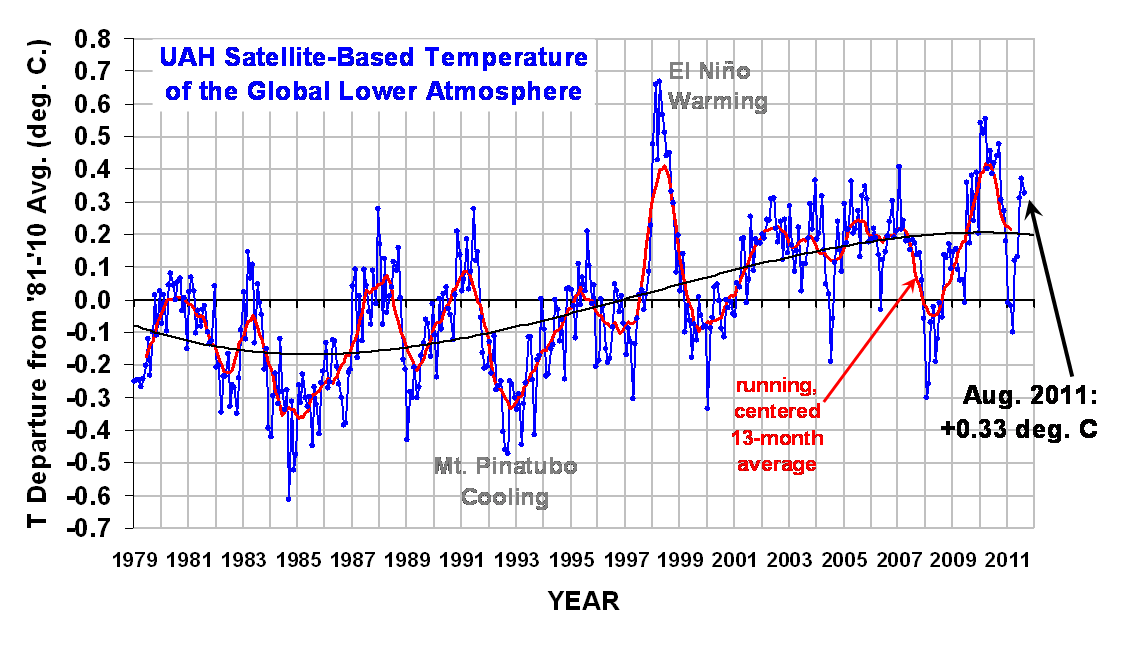
The global average lower tropospheric temperature anomaly for July, 2011 increased to +0.37 deg. C (click on the image for a LARGE version):

Even though the Northern Hemisphere temperature anomaly cooled slightly in July, as did the tropics, warming in the Southern Hemisphere more than made up for it:

YR MON GLOBAL NH SH TROPICS
2011 1 -0.010 -0.055 +0.036 -0.372
2011 2 -0.020 -0.042 +0.002 -0.348
2011 3 -0.101 -0.073 -0.128 -0.342
2011 4 +0.117 +0.195 +0.039 -0.229
2011 5 +0.133 +0.145 +0.121 -0.043
2011 6 +0.315 +0.379 +0.250 +0.233
2011 7 +0.372 +0.340 +0.404 +0.198

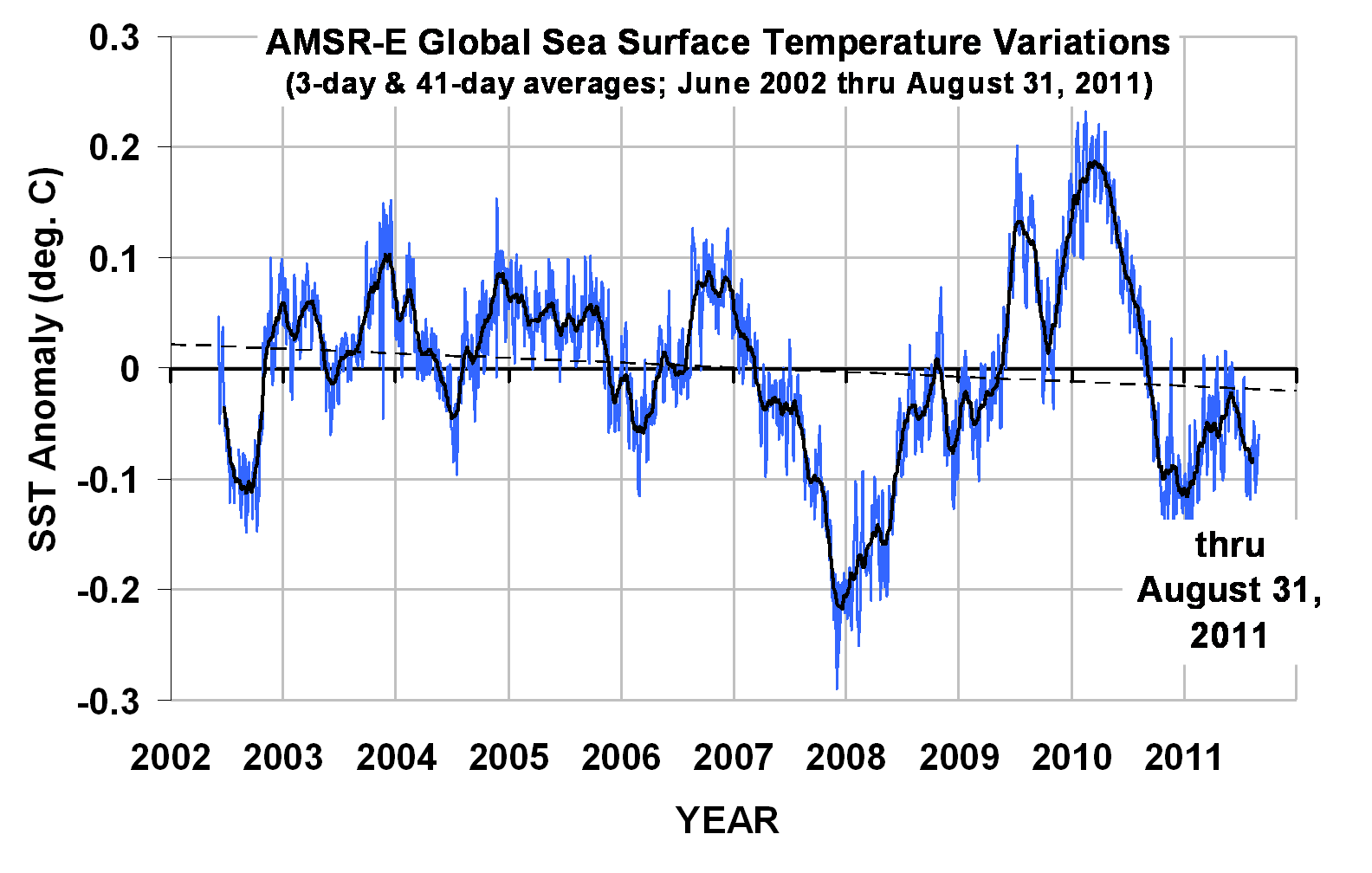
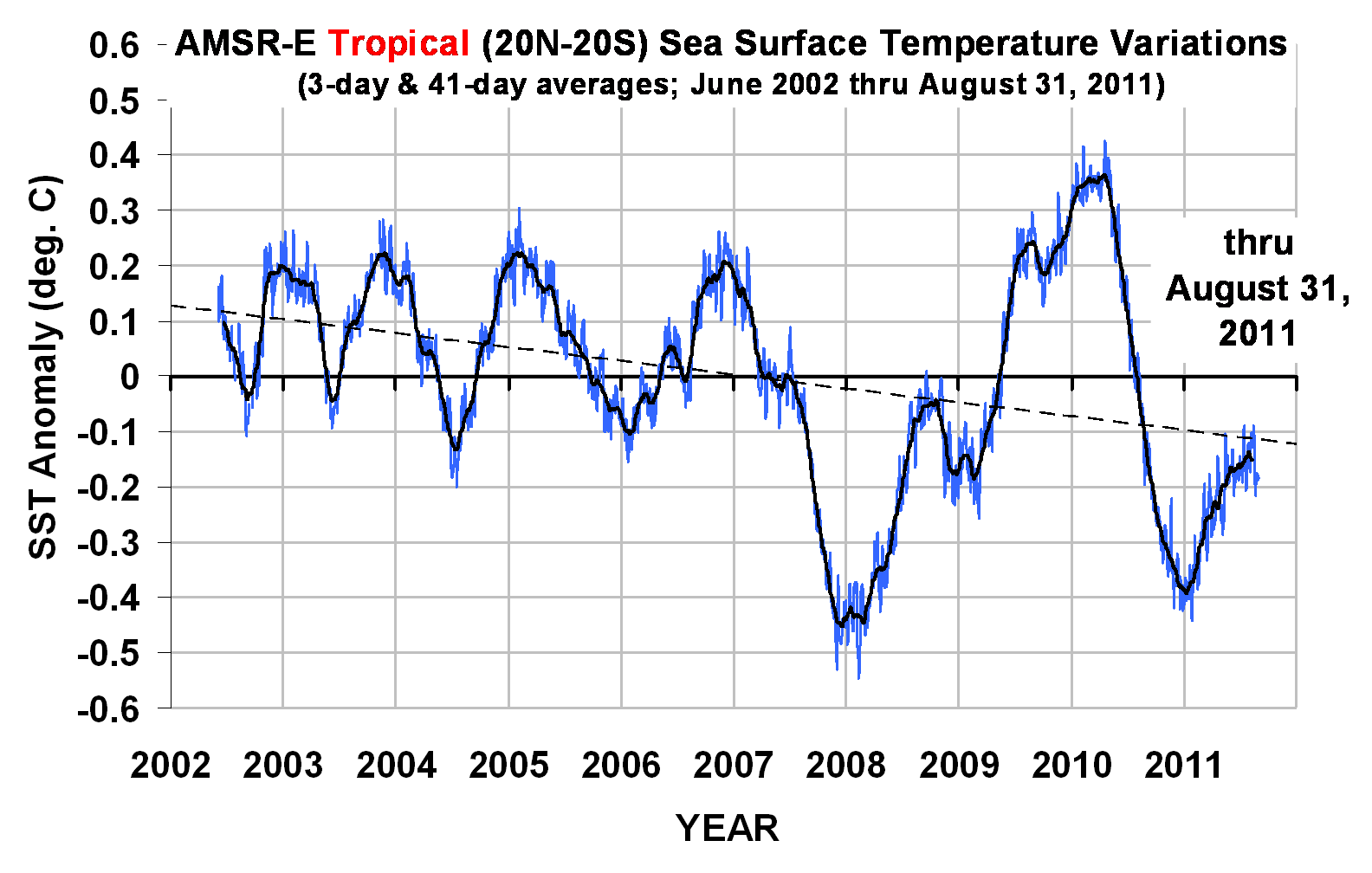
For those who want to infer great meaning from large month-to-month temperature changes, I remind them that much of this activity is due to natural variations in the rate at which the ocean loses heat to the atmosphere. Evidence for this is seen at the end of the sea surface temperature record through last month, which has a down-tick during the recent up-tick in atmospheric temperatures:

Global Sea Surface Temperature through July:
Here are the SST anomalies from AMSR-E on the NASA Aqua satellite (note the different base period, since Aqua has been flying only since 2002…click for a larger version):

Rise of the 1st Law Deniers

July 31st, 2011

So, we continue to be treated to news articles (e.g. here, and here.) quoting esteemed scientists who claim to have found problems with our paper published in Remote Sensing, which shows huge discrepancies between the real, measured climate system and the virtual climate system imagined by U.N.-affilliated climate modelers and George Soros-affiliated pundits (James Hansen, Joe Romm, et al.)

Their objections verge on the bizarre, and so I have to wonder whether any of them actually read our paper. I eagerly await their published papers which show any errors in our analysis.

Apparently, all they need to know is that our paper makes the U.N. IPCC climate models look bad. And we sure can’t have that!

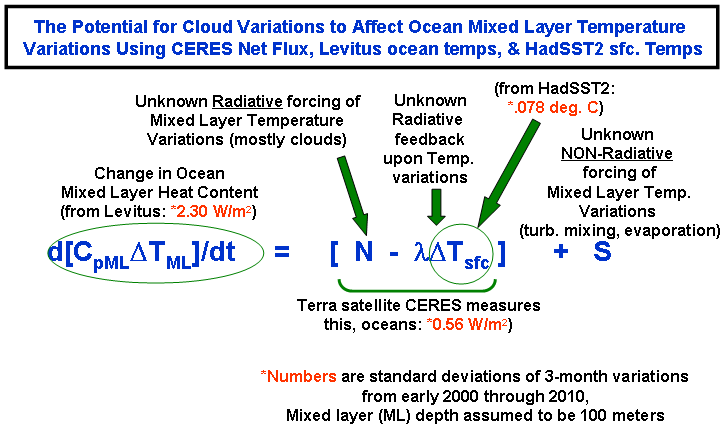
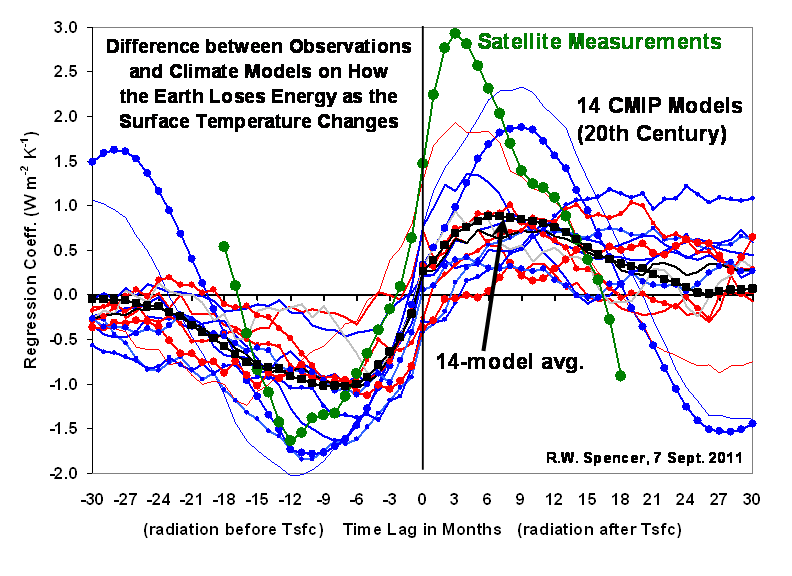
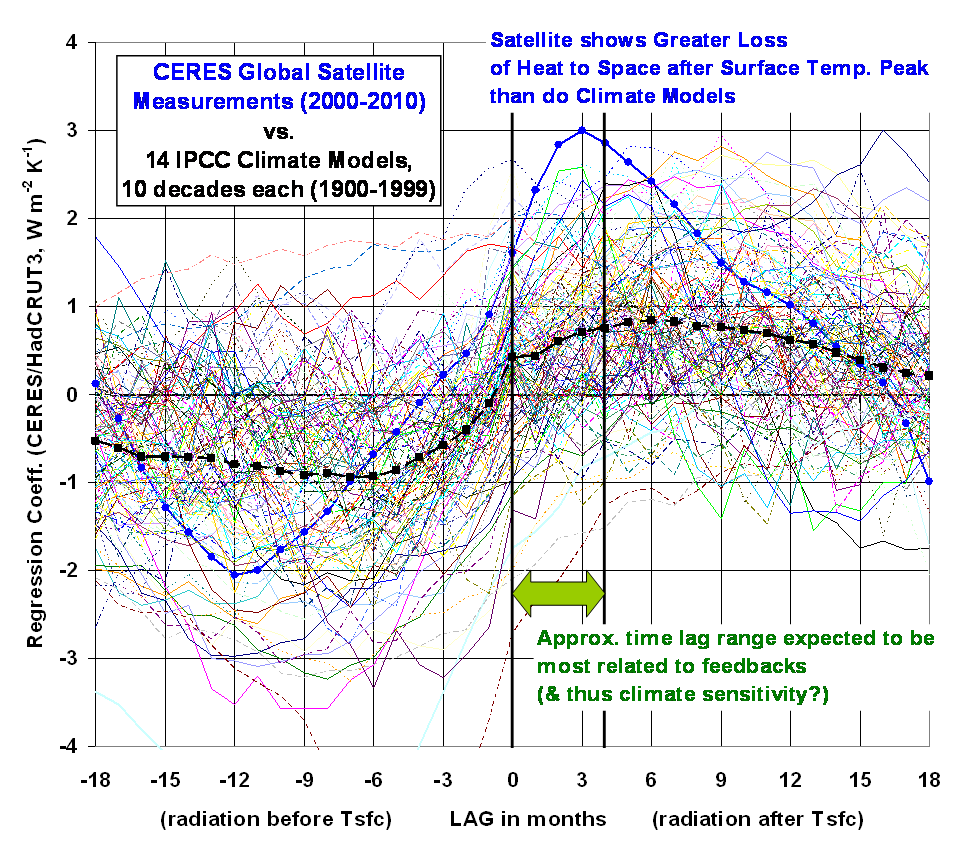
What’s weird is that these scientists, whether they know it or not, are denying the 1st Law of Thermodynamics: simple energy conservation. We show it actually holds for global-average temperature changes: a radiative accumulation of energy leads to a temperature maximum…later. Just like when you put a pot of water on the stove, it takes time to warm.

But while it only takes 10 minutes for a few inches of water to warm, the time lag of many months we find in the real climate system is the time it takes for several tens of meters of the upper ocean to warm.

We showed unequivocal satellite evidence of these episodes of radiant energy accumulation before temperature peaks…and then energy loss afterward. Energy conservation cannot be denied by any reasonably sane physicist.

We then showed (sigh…again…as we did in 2010) that when this kind of radiant forcing of temperature change occurs, you cannot diagnose feedback, at least not at zero time lag as Dessler and others claim to have done.

If you try, you will get a “false positive” even if feedback is strongly negative!

The demonstration of this is simple and persuasive. It is understood by Dick Lindzen at MIT, Isaac Held at Princeton (who is far from a “skeptic”), and many others who have actually taken the time to understand it. You don’t even have to believe that “clouds can cause climate change” (as I do), because it’s the time lag – which is unequivocal – that causes the feedback estimation problem!

Did we “prove” that the IPCC climate models are wrong in their predictions of substantial future warming?

No, but the dirty little secret is that there is still no way to test those models for their warming predictions. And as long as the modelers insist on using short term climate variability to “validate” the long term warming in their models, I will continue to use that same short term variability to show how the modelers might well be fooling themselves into believing in positive feedback. And without net positive feedback, manmade global warming becomes for all practical purposes a non-issue. (e.g., negative cloud feedback could more than cancel out any positive feedback in the climate system).

If I’m a “denier” of the theory of dangerous anthropogenic climate change, so be it. But as a scientist I’d rather deny that theory than deny the 1st Law of Thermodynamics.

The Debt Crisis: Compromise is Not an Option

July 29th, 2011

We are used to politicians having to compromise in Washington. Compromise is viewed as a good thing. Both sides get some of what they want. What our country is facing with the current budget crisis, however, is a totally different situation.

We are not discussing how much this constituency gets out of tax revenue versus that constituency. We are instead dealing with the very real possibility that our economy will collapse due to excessive levels of debt and overspending, at which point no one is going to get much of anything they want.

An Example from the Real World

Let’s say a large family has gotten in the habit of spending more than it earns, borrowing more and more each year to the point where they are now spending 40% more than they are earning (which is where the federal government is now).

The family has loaded up its credit cards, and even opened up new credit card accounts each year in order to pay off the interest owed on the previous cards, as well as to support their lavish spending.

To make matters worse, creditors are about to raise the interest rates on those credit cards because they see the family as a high risk for not being able to pay off their cards. As it is, the parents in this family already know their children will be inheriting the problem they have created, since it will take many years of sacrifice to fix the problem.

What should they do? Should the family keep on the current path? Or, should they start to reduce their rate of spending, rather than increase it year after year?

The husband and wife agree there is a problem, but disagree about what they should do. One wants to start decreasing their rate of spending, even if it is painful in the short run. But the other wants to continue spending more than they earn…after all, the rest of the family has grown accustomed to clamoring for more and more cash to support their lifestyle. It would be cruel to not allow them to continue as before.

On an Unsustainable Path

The following chart dramatically illustrates that the situation our country is in right now, and it is far worse than any financial situation we have ever experienced before (the data come from here). True, almost every year the U.S. Federal Government has run a budget deficit (spending more than it takes in), but the last few years have seen an astronomical growth in that deficit due to the housing bubble, multiple wars being fought, “stimulus” spending, and an increasing proportion of the population willing to just sit back and live off their neighbors’ tax dollars: (click for the full-size version)

The brake this puts on economic growth is now making the budget deficit even worse because the amount of tax revenue coming in is a “percent of the action”, and the “action” (economic activity) has slowed to a trickle.

Clearly, the path we are on is unsustainable. I fear we will soon find ourselves in the same situation as Argentina, whose unsustainable rate of borrowing finally culminated in what amounted to economic collapse around 2001. Much of the country was suddenly poverty stricken, with rampant crime as people were just trying to survive.

Banks either closed, or only allowed customers to withdraw very small amounts of cash each week. Inflation skyrocketed. Many of the ruling elite fled the country with great amounts of wealth, since they saw the crisis coming.

In a matter of a couple of years, Argentina became virtually a Third World country.

Unfortunately, just like the family that could not rein in its spending, so much of our population has become dependent on government handouts (which means, taking from those taxpayers who help keep our economy going) that it will be difficult for politicians to do what needs to be done to put us back on a path toward prosperity.

We must reduce wasteful spending, and we must reduce the governmental tax and regulatory burdens on businesses which are keeping those businesses from growing. Politicians must make tough decisions that will save the country without regard for whether they will be re-elected or not.

The problem cannot be fixed by “taxing the rich more” because (1) there is not nearly enough money there to fix the problem, and even more importantly, (2) unless there is at least some incentive for people to financially benefit in proportion to their good ideas, there is no motivation to take the risks involved in bringing new and better products and services to market. After all, most of those attempts fail, and people who want more of what “the rich” have, are not willing to share in the failures of those who tried and failed.

Remember, “the rich” have kept only a small fraction of the total wealth they have provided to our country in the form of a higher standard of living with innumerable products at reduced prices, along with the millions of jobs provided to bring those products to market.

We need to celebrate the rich, not demonize them.

We are now at a crossroads, and it is our way of life that is at stake. If you want to see what the future looks like, just look at surviving in Argentina.

Fallout from Our Paper: The Empire Strikes Back

July 29th, 2011

UPDATE: Due to the many questions I have received over the last 24 hours about the way in which our paper was characterized in the original Forbes article, please see the new discussion that follows the main post, below.


LiveScience.com posted an article yesterday where the usual IPCC suspects (Gavin Schmidt, Kevin Trenberth, and Andy Dessler) dissed our recent paper in in the journal Remote Sensing.

Given their comments, I doubt any of them could actually state what the major conclusion of our paper was.

For example, Andy Dessler told LiveScience:

“He’s taken an incorrect model, he’s tweaked it to match observations, but the conclusions you get from that are not correct…”

Well, apparently Andy did not notice that those were OBSERVATIONS that disagreed with the IPCC climate models. And our model can quantitatively explain the disagreement.

Besides, is Andy implying the IPCC models he is so fond of DON’T have THEIR results tweaked to match the observations? Yeah, right.

Kevin Trenberth’s response to our paper, rather predictably, was:

“I cannot believe it got published”

Which when translated from IPCC-speak actually means, “Why didn’t I get the chance to deep-six Spencer’s paper, just like I’ve done with his other papers?”

Finally Gavin Schmidt claims that it’s the paleoclimate record that tells us how sensitive the climate system is, not the current satellite data. Oh, really? Then why have so many papers been published over the years trying to figure out how sensitive today’s climate system is? When scientists appeal to unfalsifiable theories of ancient events which we have virtually do data on, and ignore many years of detailed global satellite observations of today’s climate system, *I* think they are giving science a bad name.

COMMENTS ON THE FORBES ARTICLE BY JAMES TAYLOR
I have received literally dozens of phone calls and e-mails asking basically the same question: did James Taylor’s Forbes article really represent what we published in our Remote Sensing journal article this week?

Several of those people, including AP science reporter Seth Borenstein, actually read our article and said that there seemed to be a disconnect.

The short answer is that, while the title of the Forbes article (New NASA Data Blow Gaping Hole In Global Warming Alarmism) is a little over the top (as are most mainstream media articles about global warming science), the body of his article is — upon my re-reading of it — actually pretty good.

About the only disconnect I can see is we state in our paper that, while the discrepancy between the satellite observations were in the direction of the models producing too much global warming, it is really not possible to say by how much. Taylor’s article makes it sound much more certain that we have shown that the models produce too much warming in the long term. (Which I think is true…we just did not actually ‘prove’ it.)

But how is this any different than the reporting we see on the other side of the issue? Heck, how different is it than the misrepresentation of the certainty of the science in the IPCC’s own summaries for policymakers, versus what the scientists write in the body of those IPCC reports?

I am quite frankly getting tired of the climate ‘alarmists’ demanding that we ‘skeptics’ be held a higher standard than they are held to. They claim our results don’t prove their models are wrong in their predictions of strong future warming, yet fail to mention they have no good, independent evidence their models are right.

For example….

…while our detractors correctly point out that the feedbacks we see in short term (year-to-year) climate variability might not indicate what the long-term feedbacks are in response to increasing CO2, the IPCC still uses short-term variability in their models to compare to satellite observations to then support the claimed realism of the long-term behavior of those models.

Well, they can’t have it both ways.

If they are going to validate their models with short term variability as some sort of indication that their models can be believed for long-term global warming, then they are going to HAVE to explain why there is such a huge discrepancy (see Fig. 3 in our paper) between the models and the satellite observations in what is the most fundamental issue: How fast do the models lose excess radiant energy in response to warming?

That is essentially the definition of “feedback”, and feedbacks determine climate sensitivity.

I’m sorry, but if this is the best they can do in the way of rebuttal to our study, they are going to have to become a little more creative.

Our Feedback Diagnosis Paper is Published Today

July 25th, 2011

UPDATE: Since it appears the web traffic trying to access our paper has overloaded the publisher’s server, you can get a copy here.

On the Misdiagnosis of Surface Temperature Feedbacks from Variations in Earth’s Radiant Energy Balance was published today in the journal, Remote Sensing, and a pdf is available. I discussed the findings here.

Modeled Ocean Temperatures from 1880 through 2010

July 22nd, 2011

This is an update of my last post, where I described the results of a Forcing-Feedback-Diffusion (FFD) model of ocean temperature variations to 2,000 meters deep.

The model assumes the GISS-assumed forcings since 1880, including greenhouse gases, volcanoes, and manmade aerosol pollution. To those, I added a forcing term proportional to El Nino/La Nina activity, equal to 0.9 x MEI (Multivariate ENSO Index), in Watts per sq. meter. I adjusted ocean turbulent heat diffusion coefficients and the El Nino term until I got a correlation of 0.95 between the model temperature variations for the surface-50 meter ocean layer for the period 1955 through 2010. It also matches the warming trend in the 650-700 m layer during 1955-2010, which is the deepest layer for which we have long-term data to compare to.

I’ve now extended the model simulation back to 1880, since GISS forcings go back that far, and NOAA has an MEI reconstruction of El Nino/La Nina activity that goes back even before that. The optimum climate sensitivity was 1.1 deg. C for a doubling of atmospheric CO2, a climate sensitivity so low that the IPCC considers it very unlikely.

The results look like this (click on image for full size version):

Note I have also added the HadSST2 sea surface temperatures, scaled to match the variability of the Levitus 0-50 meter layer during 1955-2010.

The match is pretty good, except the model does not capture the exceptionally cool conditions during 1900-1935. Since this was a period of low sunspot activity, it could be this is a cosmic ray effect on global cloud cover.

The important message here is that this simulation was done with a very low climate sensitivity, corresponding to only about 1/3 the warming rate the IPCC projects for the future in response to increasing atmospheric CO2.

A Note on Deep Ocean Heat Storage
For those interested in the deep-ocean heat storage issue, the assumed model diffusivities I used (which average 3.7 x 10⁻⁴ m2/sec down to 2,000 meters depth) are considerably larger than what is usually assumed in climate model simulations. If I use a diffusivity much closer to what is traditionally used (1.2 x 10⁻⁴ m2/sec), then I have to reduce the model sensitivity to 0.9 deg. C for 2XCO2 in order to still match the near-surface warming trend, otherwise the model warms too much compared to observations.

Oh, the Insensitivity! More on Ocean Warming 1955-2010

July 21st, 2011

The evidence for anthropogenic global warming being a false alarm does not get much more convincing than this, folks.

Using a combination of the GISS-assumed external forcings for long-term temperature changes, and an El Nino/La Nina internal forcing term for year-to-year variability, a simple Forcing-Feedback-Diffusion (FFD) model explains 90% of the variance in ocean heat content variations in the surface-to-50 meter depth layer since 1955 (click for full-size version):

The dashed lines are 3rd order polynomial fits; I have included a small offset between the model and observation data so you can see those trend curves, otherwise they would lie on top of each other. Note that the model captures the lack of warming since about 2003.

Here are the model-vs-observations warming trends as a function of ocean depth; I have plotted them for both the full period (56 years, 1955-2010), and also for the 2nd half of the period (1983-2010) which is when almost all of the warming below 200 meters occurred (click for full-size version):

Now, the important news is that the model fits to the data were accomplished with a climate sensitivity of only 1.1 deg. C for a doubling of CO2 (a feedback parameter of 3.6 W m-2 K-1). This is well below what the IPCC claims for future warming rates.

Also, without the El Nino/La Nina term, the model produces far too much warming late in the period. So, a lack of ocean warming since about 2003 could be La Nina’s ‘canceling out’ CO2 warming. (I found using the Pacific Decadal Oscillation, PDO, as a natural forcing term did basically the same thing, but it could not capture the large El Nino/La Nina temperature swings.)

Of course, there could be other natural forcings at work, too. To the extent that a portion of warming since the 1950s was due to those processes, this would mean climate sensitivity is lower still.

Where’s that Darn Missing Heat?
Now, there are Trenberthian claims out there that a recent lack of warming is due to the ‘missing heat’ hiding in the deep ocean somewhere, just waiting to pounce on us when we aren’t looking. To address this possibility, the model mixes a substantial amount of extra heat down to 2000 meters depth (even though a 2009 Levitus presentation suggested that there has been essentially no warming below 1500 meters depth…see slide 14 here).

In fact, even with low climate sensitivity, the model solution for 1955-2010 pumps 18% more heat into the 0-700 meter layer than the Levitus observations show for that 56 year period. Furthermore, 30% of the total heat pumped into the ocean by the model is below 700 meters deep. So, it appears that even deep ocean heating cannot explain away a recent lack of surface warming.

One of the things you find with these models is that, if the heat cannot mix below the thermocline, then there is no way for the ocean below the thermocline to warm. The Levitus data suggests an average thermocline depth of 100 meters or so….notice the “bend” in the warming profiles around that depth, suggesting resistance to turbulent heat diffusion. Instead, much of the extra heat in the mixed layer is lost to space through negative feedback processes which the IPCC claims are instead positive.

[For a little entertainment, here’s an animation of the three-monthly changes in the temperature profile down to 700 meters, 1955 through early 2011, put together for me by Danny Braswell]:
Levitus temperature profile animation

Conclusion
The bottom line is that the relatively weak warming of the ocean since the 1950s is consistent with negative feedback (low climate sensitivity), not positive feedback. The ocean mixed layer and the atmosphere convectively coupled to it loses excess heat to outer space before it can be mixed into the deep ocean.

In other words, Trenberth’s missing heat is not in the deep ocean…it’s instead lost in outer space.

Model Details:
– 40 model layers, each 50 m thick, to a depth of 2,000 meters (the atmosphere is assumed to be in convective equilibrium with the top layer, and its heat capacity is small enough to be ignored).
– Energy is conserved in each model layer through a combination of forcing, feedback (top layer only), and turbulent heat diffusion between layers.
– Feedback (loss of excess energy to space from implicit changes in the atmosphere with temperature) is proportional to the top layer temperature departure from average.
– Heat diffusion coefficients between layers are manually adjusted to give an approximate fit to the warming profiles with depth. We are working on further optimizing those fits with an iterative adjustment procedure.
– Yearly ‘external’ forcing estimates are from GISS, interpolated to monthly, and extrapolated thru 2010.
– El Nino/La Nina ‘internal’ forcing is empirically derived based upon a best fit to observed year-to-year temperature variations: forcing = 0.85 times the Multivariate ENSO Index (MEI), in Watts per sq. meter, with a time lag of 3 months.
– Model is initialized in 1900 using GISS forcings; MEI forcing is included starting in 1955 (which is when the ocean temperature observations become available for comparison).