
 Home/Blog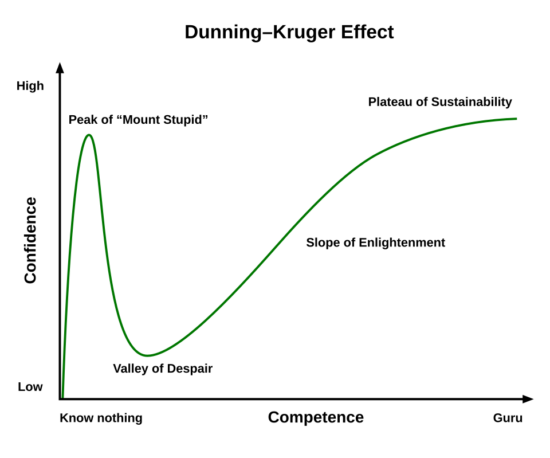
There was a recent weeks-long exchange of emails between many climate people — professional and amateur — regarding the idea that air pressure (in combination with absorbed solar energy) is what causes temperature. There were insults launched at those who refused to believe what a certain physics-trained person says should be a revolution in our understanding of planetary temperatures. That person even managed to get a paper published in a journal that (in my opinion) used reviewers who were in over their heads on the subject.
The whole ordeal makes me think of the Dunning-Kruger Effect, which is the tendency for people who start to understand a complex subject to overestimate their level of understanding. This then leads to a point of peak overconfidence (climbing “Mount Stupid”), which then gradually relaxes as more is learned and the person increasingly realizes that the subject is more complicated and nuanced than they originally thought.
I claim that the person in question who thinks [pressure + absorbed solar energy = temperature] is still stuck on Mount Stupid.
The reason I bring this up again (I’ve preached on it before) is that many have been misled into believing the “theory”. As a result, I have spent many years responding to questions from the public (including science-savvy citizens) regarding the issue. Many have been convinced by the “theory”, and have joined the proponent of the theory on Mount Stupid.
After lurking in the weeks-long email discussion, I finally responded with the following summary of the issue. I have removed the person’s name to protect the not-so-innocent.
SUBJECT: Where <NAME REDACTED> Is Right… and Where <PRONOUN REDACTED> Is Wrong
All:
After working in meteorology and then climate during my 40+ year career, I think I can offer some insight into the issues being discussed in these emails. Like <NAME REDACTED>, I have always been skeptical of what I have been told until I could fully understand an issue for myself.
I’m sure the following explanations will be of help to many of you. (I suspect <NAME REDACTED> is too invested in theories to change <PRONOUN REDACTED> mind.) Many of the concepts are not trivial, and I will admit it wasn’t until many years after all of my education (PhD Meteorology) that I finally understood a few of them, because they were not taught in school. Dick Lindzen helped me in this in the early climate research years.
Most of what follows is fundamental atmospheric thermodynamics, and I question whether <NAME REDACTED> really did take a university-level Atmospheric Thermodynamics course. If he did, I’d like to know where.
And if <PRONOUN REDACTED> shows me <PRONOUN REDACTED> grades, I’ll show <PRONOUN REDACTED> mine.
A THOUGHT EXPERIMENT
Imagine you could suddenly dump an extra 1 atmosphere of air on top of the existing atmosphere, what would happen to air temperature in the 1 ATM below? Just as <NAME REDACTED> would predict, the temperature of the original atmosphere below would increase greatly through adiabatic compression.
But what would happen NEXT?….
The high [hot] atmospheric temperatures in the lower atmosphere would then be far out of energy balance compared to what existed before. The result would be cooling of all of that air that was heated through adiabatic (or nearly so) compression (work done on the lower atmosphere) until a new state of energy equilibrium was reached. The energy loss would be through infrared radiation of the hotter air.
In fact is it always ENERGY BALANCE that determines temperature, through the 1st Law of Thermodynamics. A change in temperature is proportional to the rate of energy input minus the energy output (which includes any work done in the process).
In contrast, the Ideal Gas Law (PV=nRT) cannot tell you what the temperature “should be”. It only says how the variables P, V, and T are interrelated during the process of re-equilibration and in the final equilibrium state. What <NAME REDACTED> misses in <PRONOUN REDACTED> theory is the “n” part of the equation (the number of moles, or mass… which is in the density form of the equation, P = rho RT). In my hypothetical 2-atmosphere thought experiment, as the lower atmosphere cools to reach a new state of energy equilibrium with the solar input, the decreasing temperature causes an increase in the air density (“shrinkage”), and the pressure remains the same… even while the temperature is changing.
Specifically, following the 1st Law, the internal temperature of a volume of atmosphere exposed to an energy INPUT will increase until the temperature-dependent energy OUTPUT processes equal the rate of energy gain. This is true of every physical system… the atmosphere, a pot of water on the stove, a car’s engine, the human body, the interior of the sun, etc. That energy equilibrium is what determines the final temperature. (In the real atmosphere, there are constant energy imbalances and thus changes in temperature; Trenberth’s global-average energy balance diagram is only useful to gain a conceptual understanding of the relative role of the major energy flows in the global-average climate system.)
THE IDEAL GAS LAW
Again, the Ideal Gas Law equation (PV=nRT) cannot tell you what the temperature of a gas should be, only energy flows in and out can do that. The gas law just tells you how the P, n, and T are interrelated for a given volume (V) of air. Yes, <NAME REDACTED>, on short time scales, ascending air cools and descending air warms, but if all of that motion was to stop, energy flow processes would then determine what the final temperature would be… not what the air pressure is.
For a given surface air pressure, a huge range of temperatures is possible, and that huge range is all due to energy flow processes. Again, if the near-surface air temperature over the whole planet is much higher than local energy flow processes can support, the temperature falls, and the air’s volume shrinks (or density, rho, increases, according to the equivalent Ideal Gas Law equation, P=rhoRT). The surface air pressure remains the same because the total mass of the atmosphere is unchanged.
SO WHY MIGHT THERE BE A CLOSE RELATIONSHIP BETWEEN DIFFERENT PLANET’S LOWER ATMOSPHERIC TEMPERATURE AND PRESSURE?
I haven’t studied the atmospheres of other planets, because I don’t care. Even if those other planets did not exist, they are not necessary for understanding our own atmosphere. But if indeed <NAME REDACTED> is correct about a close statistical relationship between different planets’ surface air pressure and temperature, after adjusting for solar input, then I suspect it’s because the more atmosphere there is, the more greenhouse gases there are.
On the subject of GHGs, I’ve forgotten… does <NAME REDACTED> believe that air absorbs and emits IR energy? Because the greenhouse effect is a necessary consequence of that absorption/emission. Energetically, the GHE is a radiative insulator. It’s analogous to adding insulation to a heated building’s walls in winter. For a given energy input into the building, the air temperature inside will rise, and the outside of the walls will experience a temperature fall. This is exactly what the GHE does to the atmospheric temperature profile (in an energetic sense.. clearly involving radiation rather than conduction as a heat transfer mechanism).
If <NAME REDACTED> doesn’t believe air absorbs IR energy, how does <PRONOUN REDACTED> explain all of the thousands of spectroscopic measurements of CO2, water vapor, and methane as a function of temperature and pressure? And if <PRONOUN REDACTED> does believe the atmosphere absorbs and emits IR energy, then <PRONOUN REDACTED> must also believe in a greenhouse effect, because it is a necessary consequence…. the greenhouse effect in planetary atmospheres always causes warming of the lower atmosphere and cooling of the upper atmosphere.
(BTW, it is a common misconception that air which absorbs IR energy immediately loses that energy through emission of IR. Not true. Look up the “kinetic theory of gases” and related concepts. When CO2 or H2O vapor molecules absorb IR photons they extremely rapidly lose their extra energy to other air molecules through collisions. This happens much faster [by a factor of ~50,000] than the time it takes to re-emit energy through IR photons. This is how IR absorption immediately leads to “thermalization” [a term I hate].
Furthermore, it is crucial to understand that since IR absorption is largely independent of temperature, but IR loss is VERY dependent upon temperature, almost all air in the atmosphere is in a continual state of IR energy imbalance. Much of that imbalance is what [is balanced by] convective overturning.
WHAT IS THE ROLE OF THE ADIABATIC LAPSE RATE?
The adiabatic lapse rate in the troposphere (9.8 deg C per km without moisture condensation) is the RESULT OF convective overturning. If condensation of moisture is involved in updrafts, then the lapse rate is lower. Like the Ideal Gas Law, it doesn’t tell you what the temperature “should” be. It just tells you how the temperature of an air parcel changes during ascent or descent, if there is no energy gain or loss (“a-diabatic”). [But there are energy gains and losses occurring everywhere, all the time, and those determine what the absolute temperature will be — not pressure.]
HOW DOES THE GREENHOUSE EFFECT PLAY INTO THE LAPSE RATE?
This is a very interesting subject. It is something that even many atmospheric scientists and climate researchers don’t really understand. The combination of solar heating of the surface and IR absorption and emission by the surface and atmosphere ALONE, WITHOUT ANY CONVECTIVE OVERTURNING would result in an extremely steep tropospheric lapse rate, with very high surface temperatures and exceedingly cold upper tropospheric temperatures. This was first demonstrated by Manabe & Strickler (1964), and it’s called the “pure radiative equilibrium” case. It is sort of what makes the term “greenhouse effect” technically correct; like a real greenhouse inhibiting convective heat loss [because it has a roof], the greenhouse effect is, by definition, what happens WITHOUT the resulting convective overturning.
But in the real world, convective overturning is the RESPONSE to this GHE destabilization! So, that 33 deg. GHE warming people talk about? That’s not the GHE. It’s the GHE + CONVECTION. Without convection, that 33 deg. C figure would be more like 65 or 75 deg. C. Which then leads to another fascinating question…
WHAT WOULD HAPPEN IF THE ATMOSPHERE DID NOT ABSORB AND EMIT IR ENERGY?
Imagine a cold planetary atmosphere with no energy input. Then, turn on the sun. Solar heating of the surface would warm the atmosphere through convective overturning. But the [deep] atmosphere would have no way to shed that energy to cool in the presence of all of that energy input. The temperature of the [deep] atmosphere would then continue to rise until it had the same temperature as the surface, through its entire depth. Long before that process finished convective overturning would have stopped, because the atmosphere would be too stable to support convection. The atmosphere would eventually become isothermal (or nearly so, since there might be some planetary scale overturning between the tropics and the poles, due to their different rates of solar input), with the same temperature as the surface. Interestingly, as a result all weather activity would cease. All clouds would probably disappear, resulting in higher temperatures. Any [remaining] circulation systems would have a planetary scale, because the horizontal scale of those systems are related to the lapse rate (through the “Rossby radius of deformation”), which is also why the stratosphere only has planetary-scale circulations.
-Roy



Dr. Spencer,
How is the lapse rate derived? Theoretically and mathematically? Lord Kelvin disagrees with you. It is from the ideal gas law, hydrostatic equation and first law of thermodynamics. Also, why is it called the adiabatic lapse rate? Convective air currents lose their energy from the adiabatic dissipation of energy through pressure-volume work. As the internal energy of air lowers, the temperature lowers. There is no radiative function in the lapse rate.
It appears you didn’t read what I wrote. Welcome to the mountaintop.
Here’s exactly what you wrote:
[But there are energy gains and losses occurring everywhere, all the time, and those determine what the absolute temperature will be — not pressure.]
It is absolutely pressure. The air parcels expand adiabatically at lower and lower pressures (with height) causing a drop in internal energy of the air parcels. This is the first law of thermodynamics.
–No, Stephen, that is not the 1st Law of Thermodynamics. What you are describing is how temperature CHANGES in an air parcel during convective transport. It tells you NOTHING about the ABSOLUTE temperature. Again, you either did not read what I wrote, or you did not understand it. Read the WHOLE article, and maybe you will learn something. -Roy
Here’s also what you wrote:
[The adiabatic lapse rate in the troposphere (9.8 deg C per km without moisture condensation) is the RESULT OF convective overturning. If condensation of moisture is involved in updrafts, then the lapse rate is lower. Like the Ideal Gas Law, it doesn’t tell you what the temperature “should” be. It just tells you how the temperature of an air parcel changes during ascent or descent, if there is no energy gain or loss (“a-diabatic”). [But there are energy gains and losses occurring everywhere, all the time, and those determine what the absolute temperature will be — not pressure.]
It isn’t the result of convective overturning. As it is derived it is the result of change in pressure with altitude according to the hydrostatic equation and the ideal gas law. (And the first law with moist lapse rate.) This is physics that is in the literature (for centuries) and has never been falsified.
Stephen, if what you say were true, then why does the stratosphere have nearly constant temperature over 2 orders of magnitude change in pressure (~200 mb to ~2 mb)? The answer is that ABSOLUTE TEMPERATURE is the result of energy gain and energy loss, not pressure, and such a stable lapse rate prevents convective overturning, thus no adiabatic lapse rate. — Roy
It is funny how everyone is jumping on board the surface flux minus the top of the atmosphere flux determines the lapse rate. What determines the temperature difference between the base and summit of Mauna Loa? So, is the radiative cooling at the summit different that the base?
As a layman, and with a limited knowledge of climate physics, what truly saddens me is the ABSOLUTE certainty of opinion. It is so self-damaging. Personally, having read up, I am of the opinion that warming is indeed ‘adiabatic’ and that there is little to no radiation in the troposphere, but convection, instead. This would mean that there is no radiation to be re-emitted back down and thus no ‘greenhouse’ gases.
But I like to hear the opinions of others. The absolute certainty which fills the minds of people like Dr Roy Spencer is very disappointing. Anyone who doesn’t agree is “stupid”. Theories are just that. There’s lots we know, lots we don’t know, and lots of theories. People like Dr Spencer should grasp that.
Your derivation is mathematically correct, but you’re misreading what it proves.
Combining the hydrostatic equation, the ideal gas law, and the first law of thermodynamics gives dT/dz = -g/cp ≈ -9.8 K/km for a dry adiabatic parcel. Nobody disputes that. Kelvin derived it; Dr. Spencer doesn’t dispute it either. He explicitly concedes the math in the post.
The problem is that this equation gives you a derivative, not an absolute value. It tells you how temperature changes with altitude when an air parcel rises or falls adiabatically. It does not tell you what the temperature actually is at any given level. To solve the full T(z) profile you need:
1. The slope — dT/dz, from the adiabatic derivation you cited.
2. A boundary condition — typically the surface temperature.
And the boundary condition does not come from pressure. It comes from the energy balance: shortwave absorbed at the surface vs. longwave emitted to space. That is exactly what Dr. Spencer wrote:
“For a given surface air pressure, a huge range of temperatures is possible, and that huge range is all due to energy flow processes.”
Same surface pressure → many possible surface temperatures, depending on the radiative balance. The lapse rate sets the shape of the vertical profile; the radiative balance sets the height of that profile. You quoted the half of the post that already grants your derivation, then re-derived it as if it refuted him. It doesn’t — it restates the part he already accepted.
A quick suposition: if pressure alone determined surface temperature, you could predict any planet’s surface T from its surface pressure. You can’t. Venus is hot at 92 atm not because it has 92 atm, but because nearly all of those 92 atm are CO₂. Replace that atmosphere with 92 atm of pure N₂ — same pressure, same gravity, no IR-active gases — and the surface would radiate freely to space through a transparent column. The equilibrium would settle at a far lower temperature. Pressure provides the stage; greenhouse gases set the temperature on that stage.(actually idk if this is correct, but im keeping it on my answer to see if the right assumption come up)
On the Kelvin appeal: Kelvin derived the adiabatic lapse rate, but he never claimed pressure alone fixes absolute temperature. Invoking him in defense of that thesis attributes to him a position he didn’t hold.
In one line: the adiabatic lapse rate tells you how T changes with altitude. The radiative balance tells you what T equals. Conflating the two is precisely the error Dr. Spencer was pointing at.
Heretic,
It is amazing how you know the mind of Lord Kelvin. Why don’t we let Lord Kelvin’s math speak for itself and what he said that determines atmospheric temperature, it’s pressure. (THAT’s WHAT HE SAID!) No one said radiation from the Sun doesn’t help set the surface temperature, along with adiabatic compression. Yes, one solves first order differential equations by integration which is exactly what Dr. Nikolov did if you care to read his papers. That’s what gets you to the lapse rate, Tau. The cooling of the atmosphere due to radiation helps determine the energy budget but doesn’t determine the lapse rate, pressure does. I’ll ask you the same question I ask everyone. What determines the temperature difference between the base and the summit of Mauna Loa?
t is funny how everyone is jumping on board the surface flux minus the top of the atmosphere flux determines the lapse rate. What determines the temperature difference between the base and summit of Mauna Loa? So, is the radiative cooling at the summit different that the base?
If the base is warmer than the summit, of course it is cooling faster.
See Newton.
Venus has an abledo of ~0.75 to 0.90, meaning the “greenhouse effect” can practically not explain its temperature as most of its CO2 never gets any photons.
Bob,
Sorry, meant to say radiative forcing.
You have been schooled. The mountain top is “Mount Stupid”. You should respectfully thank Dr Spencer, and then read his post as many times as it takes for it to sink in. The science is real. You might try to accept reality instead of trying to insult me and others. We are trying to help you. You should pay attention.
Stephen, you are right!
The formula for the lapse rate does NOT involve any radiative properties of so-called “greenhouse gases”. The dry adiabatic lapse rate (dT/dz), which defines the neutral stability conditions in the troposphere, only depends on gravity (g, m s-2) and specific heat capacity of air (Cp, J kg-1 K-1),i.e.
dT/dz = -g/Cp
For Earth, dT/dz =-9.8/1002 = -0.0098 K/m = -9.8 K/km
The environmental lapse rate is less than dry adiabatic rate (about -6.5 K/km) due to the transport of latent heat by water vapor from low to high altitudes. Again, the environmental lapse rate has no dependency on IR radiative properties of GHGs.
This is textbook knowledge in meteorology, which Roy Spencer apparently does not know or understand, which is shocking!
MORE IMPORTANTLY, however, why did Roy publish here an email he sent to the CLINTEL group without addressing the points I raised in my reply to that email. On May 23, I published on the Tallbloke’s Talkshop both Roy’s original email message and my response to it, so that people can see and understand his misconceptions:
https://tallbloke.wordpress.com/2026/05/23/discussion-between-roy-spencer-and-ned-nikolov-about-the-n-z-climate-concept/
Five days later (on May 28), Roy published his email message here without even referring to my blog article. Clearly, his decision to make his message public was prompted by my blog article, but he deliberately avoided addressing my criticism of his views. Why?
Adiabatic conditions are, of course, not met in the troposphere.
The vast majority of the tropospheric mass is in a state of slow subsidence, and its temperature increases by 10°C per km due to compression and is reduced by radiative cooling by 3.5°C per km, resulting in an average observed gradient of 6.5°C per km.
Manabe, before descending into pseudoscience, wrote this perfectly accurate paragraph in his 1964 paper:
“The observed tropospheric lapse rate of temperature is approximately 6,5°C/km. The explanation for this fact is rather complicated. It is essencially the result of a balance between (a) the stabilizing effect of upward heat transport in moist and dry convection on both small and large scales and (b) the destbilizing effect of radiative transfer.”
It is impossible to know why you are doing this, but you are clearly wrong. The best theory is always the one that includes the most evidence. You have attempted to excluded thermal radiation and pinned your theory on a thermodynamic PROCESS to explain the average temperature of earth.
It is comical to claim that the greenhouse effect does not exist, but that is not the big problem with your theory. The lapse rate is a process that involves the movement of air. It is not a static condition. That kills your theory. If updrafts cool, then downdrafts must heat. You do not get a free ride in the real atmosphere.
The other problem you have is whining about how you have been misunderstood or mistreated. That is a big clue that you realize your theory is full of holes — actually one very big hole — but you want others to take the bait. You have found that “stephen p anderson” has taken the bait. I am not impressed at all.
Tim S,
I think you would be more convincing criticizing the pseudo-consensus that ignores thermodynamics than attacking an isolated researcher who overlooks radiative phenomena.
Ned Nikolov is not trying to manipulate opinions or impoverish the poor.
It is now time to completely destroy this nonsense theory. On your fake graph of the “Pressure-Temperature relationship” for the planets, you have included Venus. That is a classic mistake. Are you trying to be serious? I am sorry, but there is no need to explain this to well informed people.
The atmosphere on Venus is 96.5% carbon dioxide. No serious person making a rational science argument would claim the high temperature there is due to atmospheric pressure rather than an extreme “runaway” greenhouse effect, but you did.
Good bye.
Pay attention to my response to Roy’s INCOHERENT comments and realize that Roy Spencer does NOT know/understand textbook thermodynamics:
https://tallbloke.wordpress.com/2026/05/23/discussion-between-roy-spencer-and-ned-nikolov-about-the-n-z-climate-concept/
There is hardly anything MORE INCOHERENT in science than to argue against observed data using “thought experiments”. This is what Roy Spencer has done… It’s nuts!
I decide to look up Titan which is the other prominent feature of your fake graph. One reference has the composition of Titan’s lower atmosphere at 4.9% methane (CH4) and the other has it at 2.7% with a claimed accuracy of 0.1%. Either way, that would produce a large greenhouse effect with a surface pressure of 1.4 atm. By comparison, some people get all excited about our methane composition of 2 ppmv here on earth.
Your theory has gone down in flames. You have effectively correlated the greenhouse effect instead of atmospheric pressure. Thank you doing that!
Ned,
You say:
“Let’s assume for the sake of the theoretical argument that a planetary atmosphere has no ability to radiate IR energy to Space. What will happen in this case? Well, the energy absorbed from the Sun will keep accumulating inside the system, which will lead to a continuous rise of the global surface temperature without ever reaching an equilibrium.”
“Aside from the fact that it is physically impossible for an open system not to emit infrared energy to Space, Spencers line of reasoning suffers from a profound misunderstanding of atmospheric thermodynamics.”
This makes absolutely no sense.
You are neglecting the IR emitted from the surface direct to space. And the atmosphere can exchange energy with the surface via conduction, and via advection between warmer and cooler regions. Since IR is emitted from the surface, the surface temperature will most certainly NOT rise contnuously.
And if the surface temperature reached as high as it does with GHG, then the surface radiated power, without absorption by GHG, would exceed the solar input power, and violate the First Law.
So without the GHE, it is impossible for the surface T to warm to anywhere near present levels.
You need to read his 2024 paper. You are completely ignorant of his model.
Neither you nor he can manage to answer.
Tim S…why on Earth are you so upset!?
Sorry Ned,
But the specific heat capacity of air depends on the amount of moisture present.
The more water vapor present, the more enthalpy is transferred from the surface to the clouds.
What makes you believe that Dr. Nikolov doesn’t understand that?
I would assume he probably does, but he is being deliberately obtuse.
No greenhouse effect, no lapse rate.
Of course, this would not explain what we see. The adiabatic does not increase temperatures per the ideal gas laws. If you decrease and increase volume (which isn’t happening on Venus), additional heat is still lost rather than gained.You can’t infinitely increase and decrease volume to continually increase temperatures. That’s not how it works. The adiabatic process doesn’t change heat content.
The first thing I want to point out is from about the first week of any Physical Geography class: There is something called the Environmental Lapse Rate (ELR), which is distinct from the Dry and Wet Adiabatic Lapse rates DAR & WAR). In fact it is the interaction between these parameters that determines what the weather will be/is.
It is important to talk about both the ELR and the Adiabatic rate.
Roy, there is some conflation of these in your article, which I suppose is because you wanted to keep it short and sweet)
The atmosphere very often has temperature inversions, cap layers, etc.
The air can be stable, unstable, or conditionally instable, depending on whether the ELR is greater or lesser than the DAR.
That is one of the main reasons weather people send up those balloons every morning.
If some air near the ground is heated by the Sun and contact with the ground, a parcel will pinch off and begin to rise, since it is warmer and thus less dense than the air right above it. It is what is called buoyant. It will keep rising as long as the parcel is warmer than the air it is rising through. If the environment the rising parcel is rising into is cooling off more slowly with height (ELR is < DAR) than the rising parcel is cooling off due to increasing volume (since there is less pressure as you go up into the atmosphere), then the rising parcel will quickly reach a position in which it is cooler than the air above it and it will stop rising.
The same thing happens when wind blows air over mountains (or volcanoes like Mona Loa), or when fronts approach a given location.
The 1st law is conservation of energy.
One more thing about adiabatic processes: They do not actually happen. Adiabatic means no energy is gained or lost by a parcel. It is just like when we do ballistics in physics and they say ignore air resistance. In real life there are not perfectly adiabatic processes. Convecting air is always losing or gaining thermal energy due to radiation and conduction and some diffusion, to the air it is moving through.
Adiabatic cooling of rising air simply means the air is cooling due to expansion (same amount of energy in a larger volume equals lower temp) rather than conduction of heat to adjacent air. The proof of this is that it will be the same temp as it started if it stops rising and instead sinks back down to the ground. Or if it is forced to go up the side of a hill and back down the other side.
(A notable exception is if the air reaches the level at which moisture condenses out, then it will be warmer when it returns to it's original elevation)
OK, now let's think about how the temperature of the Earth has changed over time, in both the historical period and over the course of Earth History.
Was it warmer during the Medieval Warm Period because the Earth had more air back then?
Did we lose a bunch of air and that caused the Little Ice Age?
(Some people have attributed the LIA at least in part to volcanic eruptions, which it seems to me ADD mass to the atmosphere!)
Are the Glacial advances and intervening Interglacial periods of the ongoing Late Quaternary Glaciation caused by fluctuations in the amount of air our planet has?
I get that it is warmer when you go to a lower altitude. It is really hot at the bottom of the Grand Canyon. A mile down, over 5000 feet, (5.4 degrees F per 1000')that's 25 degrees!
But at night it cools off down there too.
Stephen,
Why is it very cold in Siberia in January, and air pressure is very high, but it is very warm in a hurricane in July over the Gulf of America, where the air pressure is very low?
In fact these places and times have among the highest and lowest pressures, respectively, ever recorded on the surface of the planet.
At a given pressure, we can and have routinely measured every temperature in the range that can be commonly found on Earth, from many tens of degrees below zero, to far in excess of 110 degrees.
So, given that plain fact, what the heck does it even mean to say pressure determines temperature? It is very obviously a false statement.
Separately, we know that there have been large fluctuations in the climate regimes of the planet over vast stretches of geologic time, and also over relatively short spans of such time.
Where is the evidence that the planet lost and then regained a bunch of air when these fluctuations occurred? Where did it go when there was less atmosphere(if that is what anyone thinks), and where did it come from when the amount of air returned to prior values?
Air pressure is very simple to derive: It is the weight of all the air molecules above the place the pressure is being measured.
If the air pressure is equal 14.69 pounds per square inch at a given location and at a given time, that means if you gathered up all the air molecules in a one square inch tube that went all the way from that location up to space, then you will find those molecules have a total weight (mass times gravity) of 14.69 pounds.
If all you know is that…the air pressure, and not a location, date or time, what is your estimation of the temperature of the air right there and right then? Should be easy, right, if pressure determines temperature.
BTW, do you think all white dwarf stars of a given mass have the exact same internal temperature at the center of the core?
After all, they are all the same mass and hence have the same central pressure value.
You can win a Nobel Prize in astrophysics if you can prove they never cool over time, since temperature depends only on pressure.
P.S.- Yes and if you suddenly increased the atmospheric pressure by 1 atm then you’d use Gay-Lussac’s Law to calculate the new pressure. The Earth isn’t a closed container but if you could do it fast enough before the heat dissipated you’d see the temperature change.
If you added 1 Atm on top of the existing 1 Atm, the surface pressure would be 2 Atm (2026 mb).
Yes, I agree. And, we’re assuming moles, R and V are constant.
Use only the IGL to explain the temperature difference between Vostok and Death Valley.
That should get them off of the mountain top.
https://tallbloke.wordpress.com/2026/05/23/discussion-between-roy-spencer-and-ned-nikolov-about-the-n-z-climate-concept/
Thanks for posting DREMT. Didn’t realize this had been going on. I came to my conclusions independent of Ned Nikolov. I read Nikolov afterward. It was in a discussion with all people, Nate, when we were discussing Mauna Loa and the difference in temperature between the base and summit. Of all people Nate led me to it.
Good old Nate. Always doing his own cause more harm than good!
Good old Graham D. Warner. Sees Nate everywhere.
Meanwhile, Team Science wins:
https://andthentheresphysics.wordpress.com/2017/08/08/no-pressure-alone-does-not-define-surface-temperatures/
My stalker appears, right on cue.
You keep talking about the difference in temp between the summit and the base of Mona Loa.
As if it is a fixed value.
The temp of each location is constantly changing, for all kinds of reasons.
Air is moving, we have wind, jet streams, the hot Sun, the cold sky, we have weather systems moving through, areas of high and low pressure that constantly change the temperature profile of the atmosphere at every and any particular place and at any and every particular time.
Hawaii sits in the belt of easterly trade winds, which force air up and over the mountain, and back down the other side. Moisture condenses on the way up, and precipitation falls, and latent heat is released.
All of these numbers everyone is quoting for the Environmental Lapse Rate are averages. On the actual mountain, just like everywhere else, the temperature profile of the atmosphere is in a state of flux. From one day to the next, from day to night and back to day, from early morning to late afternoon…
You keep talking about these two locations and “the difference” as if it is a fixed value.
Why do we have stadial and interstadial periods.
Why is the Earth in an ice age?
Do we need more air?
How about this: Any idea that attempts to explain the atmosphere with one simple idea is bound to be wrong, because no single parameter can explain all of the variation we see over time and by location.
The air is dirty, sometimes more than others, the amount of moisture changes, the amount and types of clouds varies.
The Sun is not perfectly constant either.
P.S.-I learned a few more things here too in Nikolov’s response to Dr. Spencer. I highly respect Dr. Spencer- his satellite temperature measurement is the only temperature measurement with integrity in my opinion. And he provides a valuable forum for debate. The irony here is the crowd will cheer this response but then turn around and jeer when he posts another report on UHI. If you’re not all in, they hate you.
stephen p anderson,
“The irony here is the crowd will cheer this response…”
Certainly not. GCMs are based on a curious theory that assumes the value of the tropospheric gradient depends solely on convection, and therefore on pressure.
Manabe et Wetherald 1967, Thermal Equilibrium of the Atmosphere with a Given Distribution of
Relative Humidity :
“Free and forced convection, and mixing by the large-scale eddies, prevent the lapse rate from exceeding a critical lapse rate equal to 6.5C km-1.”
One problem is that if there are no greenhouse gases then the troposphere is isothermal. Big problem.
https://www.drroyspencer.com/2025/11/uah-v6-1-global-temperature-update-for-october-2025-0-53-deg-c/#comment-1724141
Willard links to another argument he lost. Stalkers can be useful, sometimes.
Graham gaslights again, this time he also omits that the link leads to an exchange that centered on NZ in which Troglodyte participated.
Always two sides to a story: either he did not notice at the time, or he forgot.
I didn’t participate. I didn’t even know about it. I didn’t know about Nikolov’s debate with Dr. Spencer. The only debating I’ve done is here.
Yes, Willard – stalkers can be useful sometimes. Especially when they link to arguments that they lost.
Graham also omits that the link points to another one:
https://www.drroyspencer.com/2011/12/why-atmospheric-pressure-cannot-explain-the-elevated-surface-temperature-of-the-earth/
Astute readers might note the date.
They can also expect more gaslighting from Graham.
Astute readers can expect more stalking from Willard.
Thank you, DREMT, for posting that link to Roger T.’s 5/23 blog article. I posted a comment there almost a week ago, but it still hasn’t appeared.
I’m mildly disappointed that Roger T. is publishing Ned Nikolov’s nonsense, but I’m extremely disappointed that Roger is apparently censoring the comments there to prevent rebuttal of that nonsense. Aside from a quibble over the hypothetical adiabatic lapse rate on an imaginary Earth with no GHGs, Ned is wrong about almost everything.
A few years ago, Roger understood that Ned’s hypothesis is impossible. Roger wrote to Ned:
Roger was right then, but now he seems to have forgotten what he then understood.
The following is a slightly edited version of a comment which I attempted to post on Roger’s 5/23 blog article, almost a week ago, but which Roger did not allow:
——– BEGIN UNAPPROVED COMMENT ——–
When I first read of Nikolov & Zeller’s machinations to get their paper published—spelling their names backward to dodge a blacklist—I was inclined to be sympathetic. But it turns out that their work is just really bad.
Ned Nikolov says (and Karl Zeller presumably agrees) that, repeatedly over the last 780K years, roughly 1/3 of the Earth’s atmosphere somehow vanished and then reappeared, then vanished and then reappeared, repeatedly over glaciation cycles. That’s physically impossible, but Ned insists that it must have happened, because he’s sure that temperatures are controlled by air pressure.
Here’re a couple of other rebuttals of that nonsense:
● https://www.drroyspencer.com/2018/12/giving-credit-to-willis-eschenbach/
● https://www.quora.com/Did-Nikolov-and-Zeller-prove-that-atmospheres-warm-planets-only-through-pressure-and-not-as-a-result-of-greenhouse-gases/answer/Bob-Wentworth
This is Ned’s graph, captured as a screenshot from one of his videos (except that I added the pink annotations, and omitted the lefthand part):
https://sealevel.info/Nikolov_Model_last500Kyr_annot3.png
Source:
https://www.youtube.com/watch?v=DpUkPPtkPVc&t=23m24s
When I challenged Ned with the impossibility of the Earth repeatedly losing and then recovering 1/3 of its atmosphere over the last 780K years (without even affecting the N2:O2:Ar ratio), he defended his claim with hand-waving. He wrote:
Screenshot:
https://sealevel.info/tallbloke_2022-01-03_ned-nikolov-dispelling-the-milankovitch-myth_cmt-174727.png
In reply, I pointed out that at the current rate of atmosphere loss it would take eleven times the age of the universe for 33% of the Earth’s atmosphere to be lost to space.
Screenshot:
https://sealevel.info/tallbloke_2022-01-03_ned-nikolov-dispelling-the-milankovitch-myth_cmt-174729.png
Ned ignored that.
I tried again, saying:
“Ned, it is not possible that the mass of the oxygen, the nitrogen, and the argon in the Earth’s atmosphere could all have increased by 33% [or 49%] in 10,000 years.
”Oxygen and nitrogen are involved in biological processes, which could, in theory, very slightly change the quantities of those gases in the atmosphere, though certainly not by 33% [or 49%] in 10K years. Argon isn’t involved in any biological processes at all.”
Screenshot:
https://sealevel.info/tallbloke_2022-01-03_ned-nikolov-dispelling-the-milankovitch-myth_cmt-174781.png
Ned replied:
“we don’t need to have all the answers regarding where the gasses are coming from at this point.”
Screenshot:
https://sealevel.info/tallbloke_2022-01-03_ned-nikolov-dispelling-the-milankovitch-myth_cmt-174785_highlighted.png
In other words, Ned just doesn’t care that what he believes is impossible.
https://sealevel.info/white_queen_six_impossible_things_before_breakfast3.png
——– END UNAPPROVED COMMENT ——–
According to a moderation comment your post did not appear as there were too many links. So it’s not that you’re being censored. Perhaps you can link to your comment above in a fresh comment over at the Talkshop, then at least people can read it there.
DREMPT, if there’s some sort of technical issue with Roger’s blog, which prevents him from approving comments with lots of links, then I guess it’s a good thing that we have Roy’s blog and WUWT for these discussions.
Note that over the course of nearly a week I twice emailed Roger, asking him to approve my long comment, but I got no reply.
I’ve also posted a variant of my comment at WUWT, here:
https://wattsupwiththat.com/2026/05/29/pressure-causes-temperature-its-time-to-climb-down-from-mount-stupid/#comment-4200387
I posted a link to that one in a comment over on Roger’s blog. It did not appear immediately, but I see that he has approved it:
https://tallbloke.wordpress.com/2026/05/23/discussion-between-roy-spencer-and-ned-nikolov-about-the-n-z-climate-concept/comment-page-1/#comment-197881
Dr. Spencer,
I am very happy to read good science. Regarding the GHG free scenario, I wrote a comment a few years ago on your blog: http://www.drroyspencer.com/2019/11/climate-extremism-in-the-age-of-disinformation/#comment-409094
Unfortunately, the comments have disappeared, and I am copying it below:
phi says:
November 26, 2019 at 2:09 AM
bdgwx, snape,
The question is quite limited, it is simply a matter of understanding the general role of GHGs in the atmosphere and not knowing what a GHG-free atmosphere really would be. Probably a GHG-free atmosphere is not stable because it’s too hot and will disappear but, again, that’s not the question.
The important thing is only to notice that GHGs do not have the function of heating the atmosphere, convection does it very well.
For the very simplified theoretical model without GHG:
1. Surface at 255 K average but large differences in temperature (Max close to 70 C ?).
2. Convection and horizontal circulation will quickly bring all the atmosphere to an adiabatic profile adjusted on surface T max with a thin boundary layer in strong inversion.
3. More slowly, by conduction, the whole atmosphere, except the boundary layer, will tend towards isothermy with T a little weaker than Tmax surface.
Dr. Spencer,
I’m embarassed to say that I was caught up in this pressure causes atmospheric heating theory when I first saw it. I have since dropped it based on many of the ideas you list.
I do want to correct a popular misconception about Dunning-Kruger, however. The actual study had two findings 1) the subject would accurately assess their own understanding of a subject. 2) the subject was horrible at assessing where they stood in relation to others understanding of a subject.
This is very different than the popular narrative that Dunning-Kruger causes someone to think they know more than they really do. I’ll post a link if I can find the study.
Thanks as always, Dr. Roy.
You say:
“SO WHY MIGHT THERE BE A CLOSE RELATIONSHIP BETWEEN DIFFERENT PLANET’S LOWER ATMOSPHERIC TEMPERATURE AND PRESSURE?
I haven’t studied the atmospheres of other planets, because I don’t care. Even if those other planets did not exist, they are not necessary for understanding our own atmosphere. But if indeed is correct about a close statistical relationship between different planets’ surface air pressure and temperature, after adjusting for solar input, then I suspect it’s because the more atmosphere there is, the more greenhouse gases there are.”
Actually, the answer is even simpler. He has 8 data points, unlimited choice of parameters, and no less than 5 tunable parameters.
In my post below I disassemble their nonsense. I also create my own equation that does a better job than theirs of relating temperature and pressure using two fewer tunable parameters.
It’s a mathematical joke.
w.
https://wattsupwiththat.com/2012/01/23/the-mystery-of-equation-8/
https://tallbloke.wordpress.com/2012/02/09/nikolov-zeller-reply-eschenbach/
The only climate science claim that I was ever able to prove was wrong, not just show was wrong, is the claim you are discussing by NAME REDACTED.
The proof is in the post below.
Best to all,
w.
http://wattsupwiththat.com/2012/01/13/a-matter-of-some-gravity/
https://tallbloke.wordpress.com/2019/01/17/nikolov-zeller-reply-to-dr-roy-spencers-blog-article/
“The thought experiment proposed by Willis Eschenbach in 2012 (i.e. 5 years prior to the publication of our paper!) to “disprove” our findings has no basis in real physics and reflects a poor understanding of thermodynamics.“
Nice proof, Willis.
And our Mt Stupid climbers also wont understand why
“8 data points, unlimited choice of parameters, and no less than 5 tunable parameters.”
is a problem.
I also noticed that one parameter was added to fit a single outlier planet data point.
https://tallbloke.wordpress.com/2019/01/17/nikolov-zeller-reply-to-dr-roy-spencers-blog-article/
“Specifically, an adiabatic (pressure-induced) warming cannot violate the First Law of Thermodynamics as claimed by Dr. Spencer [and Willis, with his thought experiment], because it is derived from that Law!”
And, just like that, the “proof” goes “poof”!
There’s two sides to every story.
It seems all a crank has to do is declare theyve done nothing wrong, and that convinces our very own cranks!
Willis’s proof is straightforward, the energy emitted from a GHG-free planet with an elevated surface temperature, such as Earth’s, goes straght to space, and will thus EXCEED the input solar energy.
An obvios 1LOT violation.
Thus GHG are required to make this work.
But our Mt. Stupid climbers will fail to get this. Its what they do best!
Hello Nate,
“Willis’s proof is straightforward, the energy emitted from a GHG-free planet with an elevated surface temperature, such as Earth’s, goes straght to space, and will thus EXCEED the input solar energy.
An obvios 1LOT violation”
The Earths output to space has been exceeding its solar input for 4.5 billion years. How is that a 1lot violation?
Ugggh.
Red herring
We are talking here about how to account for the equilibrium temperatures of various planets
What planet is in a state of equilibrium?
That has never happened On Earth, not outside at least.
Alright ~ steady state.
On average, the Earth is within 1 W/m2 of energy balance.
There’s two sides to every story.
Of course, you have to actually listen to, and try to understand, both sides. Not just automatically reject what one side has to say.
“the “proof” goes “poof”!”
This is clearly accepting one sides claim, without listening to and understanding the other sides proof.
Not at all. To suggest Willis is definitely right is to claim that he has a “proof”. To say the “proof” goes “poof” is simply to point out that his thought experiment has been noted by Nikolov & Zeller, and responded to.
You’re trying to say it’s already settled in Willis’ favour, I’m simply saying maybe that’s not the case.
One of us is definitely biased. It’s just not me!
‘Poof’ goes your credibility.
…by daring to suggest that Willis isn’t definitely right!?
OK, Nate. Your bias is showing again.
I looked it and understand his proof, and found it to be factual and convincing, as I explained above.
Now you.
DREMT,
How did you find out all that was going on? What blog is that?
I looked at and understand his thought experiment, and found it to be factual and persuasive.
And I looked at Nikolov’s response, and found it to be factual and persuasive.
Stephen – the blog is Tallbloke’s Talkshop. It’s nowhere near as popular or well-known as it once was. They fell out of favour with WUWT because they frequently run articles and have in-depth discussions questioning the GHE. And, apparently skeptics should be skeptical of everything except the one most important and fundamental aspect of the entire climate debate! Lol.
Nikolov and Zeller have many articles published there.
Also Tim Folkerts once had an article published there. They want to hear both sides of the story.
Was Nikolov only speaking of “a parcel of subsiding air”?
Since you find his arguments persuasive, you tell me.
Nate hasn’t got a clue, basically.
The clue is to take Ned at his word when he says
“adiabatic (pressure-induced) warming” is the thing derived with the First Law.
Exactly. So he wasn’t only speaking of “a parcel of subsiding air”.
Why post just to demonstrate how little you understand?
I was going to ask you the same question.
Your question was “Was Nikolov only speaking of “a parcel of subsiding air”?
Where else does ‘adiabatic (pressure-induced) warming’ occur other than in in parcels of subsiding air?
He claims his overall planetary-scale warming effect is an “adiabatic (pressure-induced) warming” effect and I assume that must have been what he was referring to. Which is why it is a counter-argument to Willis’ planetary-scale thought experiment.
“I assume that” and theres your mistake.
I don’t think so, Nate.
And still unable to tell us where else does ‘adiabatic (pressure-induced) warming’ occur other than in in parcels of subsiding air?
https://www.drroyspencer.com/2026/05/pressure-causes-temperature-its-time-to-climb-down-from-mount-stupid/#comment-1745438
Sill unable to tell us. Then why post just to tell us how little you understand?
I did tell you, Nate. I can’t understand it for you, unfortunately.
And, there’s no “us”. Just you, out on a limb, relentlessly stalking me again.
What “he claims” is not answer about what you understand.
So continue to not understand.
Google can help you, Nate:
“In the climate theories of Ned Nikolov and Karl Zeller, the planetary-scale adiabatic (pressure-induced) warming effect is the concept that a planet’s atmospheric mass and surface pressure—not heat-trapping greenhouse gases—determine the baseline surface temperature. This effect acts as a "pressure cooker" that establishes the thermal climate continuum across rocky bodies.
How the Effect Works
Mass Dictates Pressure: The total mass of an atmosphere exerts a compressive force (pressure) on the planetary surface.
Compression and Kinetic Energy: According to the thermodynamic principles of gases, this atmospheric weight creates continuous quasi-adiabatic compression. The compression imparts kinetic energy to the gas molecules, resulting in an elevated ambient temperature.
Solar Heating Intersect: Incoming solar irradiance warms this pressurized mass, setting up a convective overturning known as a lapse rate.
Composition Independence: In this framework, the specific molecular composition of the atmosphere (e.g., carbon dioxide, water vapor) does not drive global warming. Rather, the temperature is dictated by the magnitude of total solar shortwave absorption combined with the thermodynamic enhancement provided by total atmospheric mass.
Nikolov and Zeller posited that downwelling longwave radiation is a result of this pressure-and-solar-established temperature, rather than a driver of surface heat.“
What question did you ask? Because this doesnt answer ours. It is simply quoting the abstract of the paper.
Can you point out where this flawed expert answers the question: “where else does ‘adiabatic (pressure-induced) warming’ occur other than in in parcels of subsiding air?”
We take note that you cannot indepently answer anything.
The ONLY actual occurrence of ‘adiabatic pressure-induced warming’ that can be derived from 1LOT, is within a subsiding parcel of air.
Rising parcels of air experience the reverse, cooling.
Thus, his model still cannot satisfy 1LOT, ie achieve radiative energy balance at the TOA, without the help of GHG.
Consider Venus. It has tremendous surface pressure. But because it is mostly CO2, it has a runaway greenhouse effect.
There is no way for a planet surface to be so warm, yet emit so little energy to space, without the GHG to absorb and remove most of those emissions.
Nate, you’re being purely argumentative for the sake of it. If you’d been following the discussion, you’d know all I needed to do is provide you with an explanation of his planetary-scale adiabatic (pressure-induced) warming effect. Then, you have a response to Willis’ planetary-scale thought experiment, because “an adiabatic (pressure-induced) warming cannot violate the First Law of Thermodynamics as claimed by Dr Spencer, because it is derived from that Law!”
You now have what you need. So, stop responding to me.
I am quite sure that you are at least half responsible for making this an argument.
I have made the case that his statement about 1LOT has to do with a standard meteorologic phenomena: subsiding air parcels must warm by adiabatic compression.
Which DOES NOT get him out of trouble for violating 1LOT for the whole planet.
Willis’s proof is not refuted.
Because, again for the very slow learners: without GHG there is nothing to stop a hot surface from emitting direct to space. Therefore the emission from the surface must equal the absorbed solar.
Lets take Venus. Its albedo is ~ 0.75. 25% of solar input is absorbed.
That amounts to 0.25 *650 W/m2 = 163 W/m2.
But the surface T averages 464 C =737K. Which means the surface emits 16,700 W/m2.
Clearly the vast majority of that IR emission has to be absorbed by the high GHG density in the atmosphere, and prevented from escaping the atmosphere, else 1LOT would not be satisfied.
This is fully explained as by extremely strong GHE.
You now have what you need. So, stop responding to me.
Then you find it convincing that there is
an obvious 1LOT violation by NZ,
but also not an obvious 1LOT violation by NZ?
Just your usual contradictory positions.
I didn’t say, “convincing”. That was you, Nate.
My point was that I looked at both arguments. Did you? All you’ve done so far is misrepresent their response as to, “declare they’ve done nothing wrong”, when in fact they said:
“Specifically, an adiabatic (pressure-induced) warming cannot violate the First Law of Thermodynamics as claimed by Dr. Spencer, because it is derived from that Law!”
Is that not a factual and persuasive rebuttal?
“Just your usual contradictory positions.”
I don’t need to hold any particular position either way. I’ve said before I remain skeptical on N & Z. Undecided. I already know there’s no GHE, due to the impossibility of “back-radiation warming”. They may well turn out to be correct. I’m sure time will tell.
“Specifically, an adiabatic (pressure-induced) warming cannot violate the First Law of Thermodynamics as claimed by Dr. Spencer, because it is derived from that Law!”
If NZ derived the T of a parcel of subsiding air using the 1LOT, does that mean 1LOT is satisfied for the whole Earth?
Ponder that.
Because the proof is about 1LOT for the whole Earth.
“I already know there’s no GHE, due to the impossibility of “back-radiation warming”.”
So you have high confidence (the vertical axis of Roy’s graph)
And where would you put yourself on the horizontal axis (competence in physics)?
https://www.drroyspencer.com/2026/05/pressure-causes-temperature-its-time-to-climb-down-from-mount-stupid/#comment-1745216
DREMT,
What is it about NZ theory where you remain skeptical? To be hones this is the first time I’ve read their theory but the thing I like about it is that it seems to fit the evidence and it uses classical physics and thermodynamics. Where are your concerns?
Nate,
It is kind of hard to claim it violates First Law when the lapse rate is derived from IGL, hydrostatic equation and First Law. The derivation of the lapse rate is competently shown in many places on the internet.
Because the proof is about 1LOT for the whole Earth.
Sounds like you didnt ponder that.
Yes, Nate. The thought experiment involves the whole Earth.
Now, please answer my question.
“What is it about NZ theory where you remain skeptical?”
Just unsure as to the potential 1LoT violation. That’s the biggest criticism coming from “the mainstream”. There’s all sorts of nonsense “rebuttals” regularly made by the commenters on here, some involving scuba tanks, and the stratospheric inversion, etc, which are all absolutely ridiculous and not at all what anyone serious criticises N & Z for. I just wonder if Willis may have a point with his thought experiment.
What do you think about it (Willis’ thought experiment)?
No, if there was no attenuation of the flux due to pressure the flux at the top of the atmosphere (their term- it isn’t really at the top of the atmosphere) would be the same as the flux from the surface.
Many people on the far right of the competence axis in Roy,s plot have pointed out fundamental flaws in the NZ paper.
You two are onthe left side of the copetence axis, yet are mostly ignoring what the high competence people are telling you and instead expressing confidence that NZ are right.
That puts you on top of Mt. Stupid.
And you seem proud to be there.
“flux (at TOA)would be the same as the flux from the surface.”
Which, again, if the surface T is elevated by pressure, then according to the SB law, it will be emitting MORE that what is received from the sun.
And that is the problem. Without GHG the Earths surface would need to cool a lot.
Only by GHG absorption can the surface T remain elevated, while keeping the TOA flux lower and in balance with the solar input.
Here is the evidence:
https://qph.cf2.quoracdn.net/main-qimg-1ff669c349eb44cca68035b3ccab882f-pjlq
I say: “I’ve said before I remain skeptical on N & Z.”
Nate hears: “…expressing confidence that NZ are right”.
Nate’s reading comprehension fails him again.
And stll no answers from Ned or his defenders, to explain away his obvious 1LOT violation.
“Nate hears:” you attempting to defend him from every critique.
No, just correct misrepresentations and point out there are two sides to every story.
Nate,
Explain that curve you keep linking. You know the one that is unequivocal evidence.
Will you listen?
It clearly shows that the outgoing IR energy flux from the Earth is reduced in CO2 and H2O absrption wavelength bands, as compared to the spectum emitted directly from the Earth’s surface.
The GHG absorption in these bands thus reduces the Earth’s heat loss to space, ie it is insulating the Earth’s surface from the cold of space, enabling it to get warmer than without the GHG.
Only by GHG absorption can the surface T remain elevated, while keeping the TOA flux lower and in balance with the solar input.
OK, so to what altitude doe that CO2 band correspond?
Also, I’m a little suspicious how that graph was generated. You typically see absorbance or transmittance on the y-axis. The y-axis is w/m^2/cm^-1. What unit is this? Never heard of it.
“The y-axis is w/m^2/cm^-1. What unit is this? Never heard of it.”
No surprise there.
These are standard spectroscopy units.
cm^-1 are a measure of frequency of the light.
Isn’t that the same as W/m^2/1/cm = Wcm/m^2?
Isn’t that the same as W/m^2/1/cm = Wcm/m^2?
Also, you don’t have frequency on both axes. You don’t even know what you’re posting.
…….Guru.
I know exactly what I posted, because I have looked at many similar spectroscopy data plots, and understand them.
Whereas you seem to have little experience with spectroscopy data, and are seeking excuses to reject it.
OK, so maybe they made a typo or something. Not sure why you’d be referencing an IR plot with mistakes but now answer my question about altitude. Also, how was that spectrum generated? I know how an IR spectrophotometer works. This isn’t a spectrophotometer. It uses a transmitter, a cell, and a sensor to get a spectrum, and Beer’s Law to get a concentration. This ain’t it. It is a satellite with a sensor.
If you look at this spectrum it is about 230W/m^2. I think this is the emission spectrum for CO2. I don’t know how they processed this, but this is OLR it looks like to me.
All about this plot is explained here in this Physical Geology class.
https://www.youtube.com/watch?v=4S1ZD2sS4vQ
See 7:30
https://www.dropbox.com/scl/fi/fstu6bxrebvdw2kkjp22q/R-futation-Anglais-3-CO2-climat.fr.en-6.pdf?rlkey=37xnen3bzua4r6rn2id4qjn9f&st=et13jjtn&dl=0
Pourquoi tant de débats vains alors que les réalités sont si simples :
– ce sont les océans qui se sont réchauffés depuis 200 ans
– ils ne sont sensibles énergétiquement, qu’à l’intensité solaire
-le soleil régent sa plaine énergie depuis 300 ans
Translating:
Good points in any language….
https://www.dropbox.com/scl/fi/fstu6bxrebvdw2kkjp22q/R-futation-Anglais-3-CO2-climat.fr.en-6.pdf?rlkey=37xnen3bzua4r6rn2id4qjn9f&st=et13jjtn&dl=0
Pourquoi tant de débats vains alors que les réalités sont si simples :
– ce sont les océans qui se sont réchauffés depuis 200 ans
– ils ne sont sensibles énergétiquement, qu’à l’intensité solaire
-le soleil régent sa plaine énergie depuis 300 ans
> weeks-long exchange
On the Climateball time scale, that’s a sprint.
https://chatgpt.com/share/6a188bdd-0bc8-83ea-9a2a-fb13c5484dc6
## Best consolidated theory
The best framing is:
> **Planetary temperature is set by radiative energy balance, while the temperature structure is shaped by gravity, atmospheric mass, pressure, rotation, convection, circulation, clouds, oceans, and composition.**
So it is not:
> “greenhouse gases alone determine temperature”
and it is not:
> “pressure alone determines temperature.”
It is a **radiative–convective–dynamical equilibrium** problem.
—
## Clean version
A planet’s climate emerges from four coupled layers:
| Layer | What it does |
| ————————– | ———————————————- |
| **Solar input** | Supplies the energy |
| **Radiative transfer** | Controls how energy enters, moves, and escapes |
| **Gravity + pressure** | Structure the atmosphere vertically |
| **Rotation + circulation** | Redistribute heat horizontally and vertically |
The greenhouse effect is not separate from this. It is part of the radiative-transfer layer.
—
## The most accurate short statement
> **Pressure and gravity organize the atmosphere; rotation and thermal gradients move it; greenhouse gases and clouds regulate infrared escape; energy balance sets the long-term average temperature.**
That captures the whole system better than either side of the debate.
—
## Where pressure fits
Pressure matters because it affects:
* density
* lapse rate behavior
* collision rates
* pressure broadening of absorption lines
* heat capacity per unit area
* vertical compression/expansion
* circulation strength
But pressure does **not** create continuing heat by itself.
—
## Where rotation fits
Rotation matters because it prevents a simple permanent day/night equilibrium and organizes heat transport through:
* Coriolis effects
* jet streams
* Hadley cells
* planetary waves
* storm tracks
* day/night thermal cycling
Earth is not a static greenhouse. It is a rotating heat engine.
—
## Best final model
Call it:
# **Radiative–Convective–Dynamical Planetary Climate Theory**
Or, more plainly:
# **Energy Balance Plus Atmospheric Dynamics**
That model says:
1. **The Sun supplies energy.**
2. **Albedo controls how much is absorbed.**
3. **Greenhouse gases, clouds, and atmospheric opacity control how easily IR escapes.**
4. **Gravity and pressure create vertical structure.**
5. **Convection enforces a physically stable lapse rate.**
6. **Rotation and uneven heating drive circulation.**
7. **Atmosphere and oceans redistribute heat.**
8. **The final observed climate is the dynamic equilibrium of all of the above.**
That is the most defensible consolidated theory.
That’s pretty much Dr. Nikolov’s theory but most here don’t care to read it.
Do wind turbines interfere with convection?
I think helicopters do. They push the air back down.
AFAIK, convection is viewed globally as a process governed by solar radiation, which possesses much more energy than all wind farms taken worldwide together.
Locally, minor changes might well happen within huge farms.
Wind is just one way solar energy makes it’s way from the surface out to space.
It does not take the direct route.
Stephen Anderson
“The air parcels expand adiabatically at lower and lower pressures (with height) causing a drop in internal energy of the air parcels.”
No.
Adiabatic means constant energy. A parcel of air is a constant mass. Expanding and cooling adiabatically in accordance with the Ideal Gas Law the parcel has the same mass and the same energy content at all altiudes.
I visualise this by considering a high altitude balloon such as BLAST. The helium inside is a constant mass parcel of gas which equilibrates to the air outside.
At sea level the balloon holds about 40,000 cubic feet of helium at 1000 hpa pressure and 15C.
At 20km altitude the pressure inside the balloon has dropped to about 2 hpa, the volume has increased 100 times to 4 million cubic feet and the temperature has dropped to -50C.
Nevertheless the energy content of the parcel of helium gas in the balloon is the same at 20km as it was at sea level.
No, adiabatic means no Q. Go back to your bog.
Exactly. There is no heat exchange between the helium in the balloon and the air outside.
With no heat exchange Q=0 and the helium expands and cools adiabatically as tthe balloon rises.
If its doing work, then its internal energy must change.
Nate gets an “A.”
Nate
Helium ia less dense than the air around it It is gaining gravitational potential energy as it ascends and displaces an equivalent mass if air downwards.
The work done was probably when the helium was pumped into the balloon, displacing air at ground level.
I dont think there is any heat transfer involved once the balloon began to rise.
Ent,
When the balloon rises and expands the (system) will do work on the (surroundings) resulting in a drop in internal energy of the system.
There’s an increase in gravitational potential energy of the balloon and the helium within it. Do you count that as a change in internal energy?
I deliberately chose the high altitude balloon example because it shows the changes in P,V and T expected from the Ideal Gas Law as the altitude increased without the complications seen in heat induced convection.
If you do think that there’s a change in the heat content of the helium parcel please indicate whether Q is positive or negative and what mechanism is driving the heat flow.
Internal energy has two components, heat and work.
Weather balloons
“The Launch: Large rubber balloons are inflated with hydrogen or helium and launched twice daily (and sometimes three times during severe weather) at synchronized times worldwide.The Instruments: Attached to the balloon is a small, lightweight device called a radiosonde. It contains sensors for tracking weather variables and uses GPS to calculate wind speed.The Ascent: As the balloon climbs to over \(100,000\) feet into the stratosphere, it expands from about 5 feet wide to the size of a moving truck due to dropping air pressure.”
Nate
A weather balloon is made of elastic latex. It stretches as it expands at altiude, which requires work.
Logically this requires that the behaviour of the gas deviates from the Ideal Gas Law as the stretched membrane presses in on the helium.
How, then does the PVT state of the helium inside the balloon deviate from the state of the air outside? Is P greater, V smaller and T lower inside the balloon?
The big high altitude balloons have an inelastic membrane. At launch the membrane is folded and the gas volume V only occupies a few % of the potential unfolded volume. Until it reaches the altitude at which V equals maximum unfolds volume of the balloon P is the same for the balloon interior and it’s surrounding. There is no need for work to be done, Q=0 and the gas inside the balloon changes state adiabatically as it rises.
https://en.wikipedia.org/wiki/High-altitude_balloon
The science deniers are having fun with this. The issue is fairly simple. Can a dynamic system be evaluated with a static analysis? The obvious answer is no, but that seems to energize the science deniers who feed on any chance to create confusion. Or, are they genuinely confused themselves? For some, that seems to be the case.
SOLAR MINIMUM UPDATE
https://wattsupwiththat.com/2012/01/13/a-matter-of-some-gravity/comment-page-3/#comment-747203
Those were the days.
There’s a striking paradox in these discussions about the lapse rate. Those who seek to refute the physics of the greenhouse effect are actually defending the theoretical framework upon which climate models are built, while those who present themselves as defenders of the official greenhouse effect theory are dismantling its physical foundations.
Those who doubt this extraordinary paradox can do some research online. 99.9% of sources explain the lapse rate by the pressure gradient via convection.
“while those who present themselves as defenders of the official greenhouse effect theory are dismantling its physical foundations.”
Quote someone doing that please.
Nate,
Here’s how the Gemini AI sees things (translation):
“The models introduce the g/Cp gradient as a fixed mechanical constraint (adjusted by the radiative-convective fit). To simplify large-scale calculations, it is assumed that fluid dynamics instantaneously “adjusts” the profile.”
“* The defensive dogma: If the official approach were to openly admit in its popularizations that pressure alone does nothing and that everything depends on a complex and unstable dynamic equilibrium between radiative and convective fluxes, it would weaken the clarity of its linear models for the public. It therefore defends the error (pressure causes cold) to protect the validity of its mathematical formula (parameterization).”
I suppose that from this point on, you will better understand the paradox and who says what.
Who are you quoting here?
“* The defensive dogma: If the official approach were to openly admit in its popularizations that pressure alone does nothing and that everything depends on a complex and unstable dynamic equilibrium between radiative and convective fluxes, it would weaken the clarity of its linear models for the public. It therefore defends the error (pressure causes cold) to protect the validity of its mathematical formula (parameterization).”
Again, you fail to explain why this is an error. The point of theory is to make predictions. This theory of the critical lapse rate is used to accurately predict weather, everyday.
Nate,
Gemini is targeting climate propaganda.
“This theory of the critical lapse rate is used to accurately predict weather, every day.”
Without the slightest concern about the increase in CO2 levels. And it works, precisely!
Climate is long term weather…
roy….”There was a recent weeks-long exchange of emails between many climate people — professional and amateur — regarding the idea that air pressure (in combination with absorbed solar energy) is what causes temperature”.
***
If that is aimed at me, I said no such thing. I have merely tried, using physics, to prove a direct relationship between pressure and temperature in a constant and static volume atmosphere. I have also claimed that the reduction in pressure with altitude is due to gravity.
Please note, I did not use thought experiments, I quoted physics directly. Thus far, I have received zero objective rebuttals.
My focus has not been on the cause of temperature, rather I am focused on the natural loss of heat in our atmosphere which is not included in the energy budget. We are concentrated these days on the inane theory that trivial gases in the atmosphere are responsible for over-heating it and at the same time, dissipating much of incoming solar to space. I don’t understand why you cannot see the nonsense in that proposition.
Of course, due to gravity and its negative pressure gradient, our overall atmosphere cannot be considered a constant volume. It represents a truly unique condition that cannot be experienced elsewhere on Earth, or perhaps, in the entire universe. However, by reducing the atmosphere to smaller, concentric spheres where the volume is constant, and the gas in those rings is fairly constant in n (mass), we can estimate the ***relationship*** of temperature and pressure using the IGL.
Ergo, the IGL tells us temperature reduces with pressure, therefore heat is naturally dissipated with altitude. The meaning is clear, that lost heat no longer needs to be returned to space therefore the planet is hotter than it should be at lower altitudes.
The energy in – energy out balance argument was developed in a day before anyone had the slightest idea how atomic structure works. It has been incorrectly associated with the 1st law which is really only about heat and work. In that context, heat as energy and work as energy must balance not only with each other but with internal energy, which also has a heat and work component according to Clausius, who wrote the internal energy component.
We know now that an energy like heat can not only be dissipated to a point of nothingness, it can be destroyed altogether. You can do that simply by slowing the atomic vibrations of the atoms in a mass to nothing, at which time you approach 0K. That puts a lie to the general misinformation that energy can neither be created nor destroyed.
So, why can we not reduce heat significantly in the atmosphere through reducing the KE of the molecules associated with heat? As heated molecules rise, they rise into thinner air, and the molecules spread out, losing KE, which is heat.
I do not dispute in any way that the Sun is the source of heat, hence the temperature. Remember, temperature is a human invention aimed at measuring relative heat levels. Boltzmann and Maxwell did us a disservice by equating the temperature of a gas with its average KE. They did not make it clear that KE is heat. Initially, the Celsius and Fahrenheit scales were developed to measure relative heat levels based on the set points of the freezing and boiling points of water.
You call heat ‘energy’ and the ‘kinetic’ in kinetic energy simply means the energy is in motion. KE can be applied to any form of energy. In the case of heat, KE is s reference to thermal energy which in return is a description of atoms in motion, either external or to the electrons internally.
It’s dangerous and misleading to use the generic term of energy when a specific form of energy is inferred.
What I am disputing is the sheer nonsense that GHGs are responsible for controlling the temperature of the atmosphere. All one needs is to apply the IGL to one of the concentric spheres I have mentioned to get a basic idea of why the GHG theory is so inanely stupid. A gas with a mass percent of 0.06% cannot possibly generate enough heat in a gas mixture that exceeds the mass percent of the gas by whopping 99%, in this case 0.06C per 1C rise in the entire gas.
Check out Dalton’s Law of Partial Pressures, part of the IGL, to see why. Combined with Gay-Lussac’s Law, it is all explained.
You have invoked a thought experiment and a misinterpretation of the Ideal Gas Law. Part of the IGL is the Gay-Lussac Law, P1/T1 = P2/T2, and it is measured with units appropriate to pressure and temperature, degrees K for T and the appropriate unit for pressure provided they are the same on either side of the equation.
That is, if you know P1 and T1 at sea level, in a purely static atmosphere, you should be able to calculate P2 and T2 at any altitude below the stratosphere. That is the basis of the lapse rate, not some cockamamey theory about a negative vertical heat transfer.
There is a direct relationship between pressure and temperature and I laid it out for anyone interested. Both are a measure of the kinetic energy of molecules in a gas and differ only in their effect. Pressure is a human invention that measures the cumulative force of the molecules on the walls of the container whereas temperature is a human measure of the average KE of the molecules.
Pressure and temperature are closely related. It stands to reason that both are directly proportional in a constant volume with a constant number of molecules. And it stands to reason that gravity affects both by allowing the air pressure to decrease with altitude.
______________——-
Under the IGL section you claimed…
“…on short time scales, ascending air cools and descending air warms, but if all of that motion was to stop, energy flow processes would then determine what the final temperature would be… not what the air pressure is”.
***
Why? Why does descending air warm and ascending air cool? You are using generic terms like ‘energy’ in lieu of heat, which is measured by temperature. I have explained why at the molecular/atomic level and you have apparently dismissed my explanation without providing a scientific rebuttal.
Air pressure!!!!!!!!!!!!!!!!!!!!!!!!!!
The lower you get, the higher the air pressure. The higher pressure is due to more air molecules per volume (density). More air molecules means more collisions which leads to a higher KE, which means more heat.
There are more air molecules because gravity gets stronger closer to the surface.
BTW…I am not inferring this as the cause of heat (temperature). Without solar input, the entire Earth would be around the temperature of the dark side of the Moon, and discussing temperature would be a moot point.
I have to be careful here, because gravitational force is measured from Earth’s centre, not the surface. The top of Everest near 30,000 feet is 9.77 m/s^2 whereas at sea level it is 9.81 m/s^2. That simple reduction in gravitational acceleration allows the air pressure to drop to 1/3 its pressure at sea level.
In other words, i does not take much of a drop in gravitational force to reduce pressure, hence temperature, drastically.
ent…”Adiabatic means constant energy”.
***
Not so, adiabatic means there is no heat entering or leaving a system. That is an impossibility in a theoretical column of air, which can freely exchange heat via convection.
I wasnt taling about air. I was talking about a constant mass packet of helium enclosed in a balloon.
The upward force comes from the difference in density between helium and air, not from a difference in heat content. Convection and heat transfer arw therefore irrelevant and in this example you can concenteatw on other aspwxts od the lapae rate.
Roy W. Spencer, Ph. D.:
I don’t know why you bother with people like Nikolov; your steadfastness and patience are admirable.
But I digress.
It is well known, by those who know it well, that pressure by itself cannot generate sustained heating, because pressure alone is not an energy source. A book resting on a table exerts pressure, but the table does not continually heat up from that pressure.
To maintain a warm surface there must be a continuous energy source, and a restriction on energy loss.
For Earth, the Sun supplies the energy, and greenhouse gases impede infrared cooling to space. Without those radiative processes, pressure alone cannot sustain the observed surface temperature.
Regards.
No one said pressure alone does. No one.
No one?
From the referenced link:
Yes, through total pressure. But not alone. It still needs the Sun.
Here’s exactly what he wrote:
4. Roy appears to have misunderstood our model relating pressure to temperature. As explained in our 2017 paper, pressure only has a relative effect on temperature, not an absolute one. Pressure as a force in a compressible fluid only provides a relative enhancement of the energy delivered by the Sun. So, a given atmospheric pressure can be associated with a wide range of absolute global surface temperatures. This is mathematically accounted for by our universal planetary temperature model.
> a given atmospheric pressure can be associated with a wide range of absolute global surface temperatures.
Looking at the graph here:
https://www.drroyspencer.com/2026/05/uah-v6-1-global-temperature-update-for-april-2026-0-39-deg-c/
Is this because atmospheric pressure increased or did we miss some solar minimum update?
So, not “no one,” then.
But the Sun only shines half the time.
How does pressure prevent nighttime cooling?
Why does Earth’s nightside remain relatively warm?
Why do deserts cool so rapidly at night?
Why are cloudy nights warmer than clear nights?
Why does the Moon experience such enormous day-night temperature swings?
The short answer to all the above questions is: those are all fundamentally radiative phenomena.
Arkady gets caught misrepresenting N & Z so tries to cover her tracks by throwing more crap against the wall, hoping something will stick. Silly Sabine. Still pretending to be an elderly, male engineer!
Graham D. Warner can’t answer Arkady’s questions, and so decides to gaslight him instead.
Everything’s “gaslighting” to Willard…but Arkady really did get caught misrepresenting N & Z, and really did try to cover her tracks by throwing more crap against the wall, hoping something would stick.
Your third and fourth paragraphs were spot on. Maybe you should look at Nikolov’s Model. It will show you where your fifth paragraph is wrong.
What determines generates.
“It is well known, by those who know it well, that pressure by itself cannot generate sustained heating, because pressure alone is not an energy source.”
There is a misconception:
You do not need constant heating to STORE the energy by pressure.
As long as there IS pressure, there is an additional energy in the system that elevates it above the ground state without pressure. This is independent of the radiative nature of a gas by the Ideal Gas Law.
As the latent energy of a book laying on the table is still stored there until it falls down.
Otherwise, this would violate the 1. Law of Thermodynamics.
So, what keeps the pressure on Earth?
It’s not radiation from the sun, it is gravity and atmospheric mass.
The initial rise in latent energy might most likely have had an additional heating effect at the forming event of the atmosphere, but then it found an equilibrium above the ground state without an atmosphere where we now live in.
This will only change when the planet loses its atmosphere or the equilibrium changes and the aggregate state of the atmosphere shifts from gas to liquid.
Ron v. F. at 5:38 AM
Please don’t cherry pick my comments.
I wrote:
Let’s look at the First Law:
ΔU=-Δ(mgh)-Qloss-W;
where ΔU is the change in internal energy;
Δ(mgh) is the change in gravitational potential;
Qloss is the heat transferred out to the surroundings;
W is work energy dissipated into deformation, sound, vibration, etc.
In my example, when the book falls onto the table or is pressed downward, mechanical energy is converted into thermal energy through deformation, friction, and molecular collisions.
But once the motion ceases and the book is merely resting statically on the table afterward, the generated heat dissipates into the surroundings because a static force is not a continuous energy source. To maintain a persistent ΔU in a dissipative system, there must be continuous energy input and restricted energy loss.
Another common example is a gas in a cylinder with a freely moving piston. Compress the gas and its temperature rises. But unless continuous force is applied to hold the piston in place and prevent re-expansion, the gas decompresses and cools again. Pressure alone does not maintain elevated temperature indefinitely.
As for the rest of your comment, Earth is not a sealed insulated container. It continuously loses energy to space through infrared radiation.
But gravity is conservative, and it cannot provide a continuing net energy source. Once the atmosphere forms and settles into hydrostatic equilibrium, compressional heating ceases. There is no perpetual conversion of gravitational energy into heat thereafter.
The atmosphere does not “store” a permanently elevated temperature simply because it has weight.
Earth’s climate changes continuously, day versus night, seasons, glacial cycles, volcanic perturbations, ENSO, GHG forcing, cloud variations, etc., yet atmospheric mass remains nearly constant.
If what you say were true, one could obtain endless thermal energy merely from static pressure, which would amount to a perpetual motion machine of the second kind.
@Arkady
You don’t get the point:
You mention that Earth is not an insulated system as it receives constantly energy from the sun and loses energy to space but you do not extend your thoughts to it.
Your isolated examples are all about system CHANGES, not how the system is made up and the maintained equilibrium came to be.
Therefore, we are talking not about gravity, atmospheric mass and pressure “producing” energy but STORING energy and setting the real ground state, elevating the energy in the system above the mere expected ground state of a black/grey body.
One part of it is the mere fact of the aggregate state of gas vs. liquid.
The latent heat energy that elevates the liquid nitrogen from the gaseous in the atmosphere is 7.69 x 10^23 Joules.
Oxygen adds 2.52 x 10^23 J
Water Vapor adds 0.31 x 10^23 J
That results in total energy stored as latent heat just because the atmosphere is an atmosphere in 1.05 x 10^24 J
This is just the atmospheric mass.
We have not talked about the latent heat storage of all the water on earth.
And here is where pressure comes in even before the Ideal Gas Law:
Without pressure, all water would not be liquid, it would evaporate. But it doesn’t and this creates are massive latent heat reservoir.
Coming to the Ideal Gas Law:
If you double atmospheric mass then you get double the pressure at sea level as
P = m x g / A so doubling m is P = 2m x g /A
taking the Ideal Gas Law solved to T
T = (PV)/(nR)
you get
T = (2m x g x V /A)/(nR)
This is how atmospheric mass interacts with the ground state of temperature and gravity.
Ron v. F. at 10:09 AM
You wrote “You mention that Earth is not an insulated system as it receives constantly energy from the sun and loses energy to space but you do not extend your thoughts to it.”
Here’s the “extended thought” version: without GHGs the Earth’s surface at 288 K is losing 390 W/m2 to space while only gaining 240 W/m2 from the sun, it’s bleeding energy. Nikolov and Zeller’s model requires atmospheric pressure to continuously supply the missing 150 W/m2 out of thin air. Because a static force cannot create energy, the planet would rapidly cool down until its surface matched the solar input.
Next, you try to shift the goal posts with a specious argument about vast latent heat reservoirs stored in atmospheric phase states. This argument is so weak that even Nikolov & Zeller themselves did not attempt to make it. The atmosphere is not steadily releasing 10^24 J of new heat simply because it exists.
Latent heat is merely energy exchanged during phase changes and does not create energy. It redistributes energy already present in the system and is part of the system’s thermodynamic history and state, not a continuously operating heat engine. It’s not like the chemical energy stored in fuel.
Furthermore, you keep treating the Ideal Gas Law as though it were a causal climate mechanism. It is not.
The ideal gas law is a diagnostic equation, not a prognostic one. A diagnostic equation merely relates state variables at an instant in time; if you know any three of (P,V,n,T), the equation constrains the fourth.
@Arkady Ivanovich
You do not seem to be able to comprehend the difference between conservation and storing of energy within a system in an acquired equilibrium and releasing/gaining energy to induce a system change.
Just as a side note, the latent heat stored in the atmosphere alone is so massive that if you shut down the sun, it will take 100 days for Earth to be down to the temperature of the moon, when with no atmosphere it will happen immediately.
Even without taking in the latent heat stored in the oceans.
The Ideal Gas Law determines the connection between temperature and pressure.
The connection between atmospheric mass and pressure is set by gravity:
P = m x g / A
If you are denying direct physical connections, I can’t help you.
As long as the energy from the sun is sufficient to keep the atmosphere in its current state, the effect of the atmospheric mass on Earth’s temperature is there.
Or the equations are no equations.
“Furthermore, you keep treating the Ideal Gas Law as though it were a causal climate mechanism. It is not.”
You are again confusing the mechanisms of maintaining an equilibrium with reaching the equilibrium state.
Pressure is an inherent part of the climate system and has, by the Ideal Gas Law, a direct link to temperature, BUT(!) as long as the atmospheric mass stays constant and not becomes liquid, the pressure at sea level will not change even if the temperature will drop drastically.
Because V will shrink, the dry-lapse rate will get smaller. But P will stay the same. It will stay at 1013 Pa nonetheless.
This direct physical relationship determines that gravity and atmospheric mass are integral constituents of T.
If you change one of them, T will change. But keeping them constant, keeps T constant in the equation. If you change them, you change T.
You must, if a change in V is not completely eradicating the offset.
And it doesn’t as V is determined through the adiabatic lapse rate which again is also connected to gravity:
Gamma(d) = g / C(p)
dry adiabatic lapse rate = Gamma(d)
gravity = g
specific heat capacity of the atmospheric gas mixture = C(p)
And C(p) is to over 99% from oxygen and nitrogen.
So g, m and C(p) are all interconnected to T shifting the equilibrium(!) from where T would be without them.
The only requirement for the first law for not being violated is that the flux remains equal. What goes in, must come out.
It doesn’t expand to the ground state.
The radiation-centered view on T and the solar constant only ignores the nature of gases, their C(p) and the interconnection of P to m and g.
Ron v. F. at 2:30 AM
Why do you dodge the question?
Once again: If not the GHE then, what is the actual ongoing energy transfer mechanism that is continuously supplying the missing 150 W/m2? What keeps the Earth’s surface at 288 K while it loses 390 W/m2 to space and only gains 240 W/m2 from the sun?
You keep rambling that pressure, atmospheric mass, and gravity “shift the equilibrium” but never identify the actual physical mechanism that supplies the missing 2.4×10^24 J/year without greenhouse gases.
Stored energy is not a sustained source of thermal power; can you comprehend stocks vs flows? A lake can contain an enormous volume of water (stock), but its level is determined by net flow (inflow rate – outflow rate). You’re effectively arguing that “the lake is large; therefore inflow and outflow do not matter,” but they are exactly what matter.
Furthermore, the dry adiabatic lapse rate only describes how temperature changes with altitude for an adiabatically displaced parcel. It does not determine the absolute surface temperature of a planet independent of radiation.
In closing, it is well known by those who know it well that Earth continuously emits infrared radiation to space. Therefore, any long-term equilibrium temperature requires continuous energy input, and continuous regulation of energy loss, a.k.a. basic thermodynamics.
“What keeps the Earth’s surface at 288 K while it loses 390 W/m2 to space and only gains 240 W/m2 from the sun?”
That’s easy, I don’t have to.
The 390 W/m2 are nowhere to be measured and they are not lost to space. They are only deducted by the S-B-equation and do not reflect anything that anybody has measured in reality.
At the top of the atmosphere there are only 239 W/m2 measured.
Meaning the system is pretty much in a steady-state.
I have pointed out some fundamentals that effect temperature without the need to rely on CO2 “trapping” energy. You can ignore them, but they are there.
You also just do not seem to being able to comprehend that the flux in and out of a system does not tell you anything about its internal energy if there is no difference between those two.
You are just assuming – because of the simplification of radiation-only perspective of the Earth assuming that Earth would behave like an atom, immediately releasing all energy by radiative transfer – that you can deduct the inherent energy of the system by looking at what comes in and goes out.
In a steady-state system you simply can’t.
Earth could be hotter or colder, if flux in and out equal, that does not matter.
Duly noted!
“is correct about a close statistical relationship between different planets’ surface air pressure and temperature, after adjusting for solar input, then I suspect it’s because the more atmosphere there is, the more greenhouse gases there are.”
And the spectral lines have pressure broadening, so higher atm pressure increases their ability to absorb upward radiation, and thus increases their GHE.
https://www.pnas.org/doi/10.1073/pnas.0809436106
Nate,
“And the spectral lines have pressure broadening, so higher atm pressure increases their ability to absorb upward radiation, and thus increases their GHE.”
No. Absorption itself has nothing to do with the greenhouse effect. From a surface perspective, only the increase in irradiance matters. The relationship between pressure broadening and the greenhouse effect isn’t wrong, but you’re misinterpreting it.
Well, close to nothing, because the radiance of the CO2 comes predominantly from the excitation of the IR active molecular stretching and bending mode.
And that irradiance goes in all directions.
And pressure broadening increases that irradiance.
Ugggh, quite strange that you dont think absorption is involved in the GHE!
Which I would remind you, its forcing is determined at the top of the atmosphere.
Nate,
You’re constantly mixing up paradigms.
When you say that pressure broadening increases absorption, you’re thinking of photons, which are a model of the microscopic universe. You’re drawing conclusions about the greenhouse effect, which is a macroscopic phenomenon.
The greenhouse effect should be addressed using the macroscopic tools of classical thermodynamics. In this framework, pressure broadening causes a decrease, not an increase, in the absorption of radiative heat.
In this framework, the addition of CO2 or an increase in pressure affects irradiance in conjunction with temperature, which is also controlled by convection. There is actually no direct and unequivocal link between these phenomena and the greenhouse effect.
“When you say that pressure broadening increases absorption, you’re thinking of photons”
Nope. I am simply thinking about the observed absorption peaks widening with pressure, and thus increasing the fraction of the spectral range over which blackbody emissions from a planet will be blocked.
“The greenhouse effect should be addressed using the macroscopic tools of classical thermodynamics. In this framework, pressure broadening causes a decrease, not an increase, in the absorption of radiative heat.”
Explain how you arrive at that odd conclusion.
Nate,
It’s actually quite simple. Pressure broadening increases the atmosphere’s irradiance and therefore decreases the upward radiative heat flux. In other words, it reduces the absorption of the net upward radiative flux. The greenhouse effect is therefore a decrease in absorption in the thermodynamic sense, and not an increase at all.
Just saw this.
“Nate,
It’s actually quite simple. Pressure broadening increases the atmosphere’s irradiance and therefore decreases the upward radiative heat flux.”
Ok.
“In other words, it reduces the absorption of the net upward radiative flux.”
Umm, no. You have that backwards. Decreased upward radiative heat flux is decreasesed transmission of Net IR, which = increased absorption of IR.
“The greenhouse effect is therefore a decrease in absorption in the thermodynamic sense, and not an increase at all.”
Nonsense. See above.
This is the question from Dr. Nikolov that I’d really love to see answered:
“My big question regarding the above debate is this: Why do some “climate skeptics” such as Dr. Roy Spencer, Anthony Watts and Wills Eschenbach go out of their way to defend a discombobulated 19th-Century theory, which is at the heart of the anthropogenic climate-change exaggerations that they claim to have been fighting against for decades? It makes no rational sense for skeptics to argue ad nauseam about marginal issues such as rates of warming or sea-level rise while vigorously protecting by all means the rotten core of a concept that allows the promotion of exaggerated claims about such issues to be made in the first place.”
The answer here is that the only important issue is to get the science right. There is absolutely no need whatsoever in “vigorously protecting” anything except accurate science.
I continue to assert that whether unknowingly, or on purpose, the result of science deniers efforts is to make the alarmists response easy. They can simply claim that all skepticism as science denial.
tim…once you learn some accurate science, we can have a discussion.
I have yet to see you respond to any of my claims with objective science. You have resorted to ad homs and insults.
Gordon Robinson is turd who floats around trying to cause trouble. He contributes nothing and should just flushed away like any turd. That is as nice a comment as possible.
Gordon Robertson (sic) is a turd who floats around trying to cause trouble. He contributes nothing and should be just flushed away like any turd. That is as nice a comment as possible.
“Why do some ‘climate skeptics” such as Dr. Roy Spencer, Anthony Watts and Wills Eschenbach go out of their way to defend a discombobulated 19th-Century theory…”
As Roy has said…
“when skeptics embrace science that is worse that the IPCC’s science, we hurt our credibility.”
https://www.drroyspencer.com/2014/04/skeptical-arguments-that-dont-hold-water/
He ‘defends’ the GHE because he knows its real.
SOLAR MINIMUM UPDATE
Use only the IGL to explain the temperature difference between Vostok and Death Valley.
https://www.drroyspencer.com/2026/05/pressure-causes-temperature-its-time-to-climb-down-from-mount-stupid/#comment-1745087
A question from Bob that I’d really love to see answered by those on the mountain top.
As someone with pretty good math skills but no professional involvement in climate/weather modeling, I feel that the “thought experiment” of an atmosphere that is perfectly transparent to thermal radiation to be quite illuminating.
It’s probably an idea taught in introductory courses but I had never seen it or reflected on it..
Bob
Imagine a slab of a solid (or even of a liquid) lying in the sun and at temperature equilibrium between energy gained and lost. If pressure is applied to that slab, its temperature will change very little (measurable only if very high pressure is applied). The slab energy is contained in the vibration and rotation energies of its bonding. Slab temperature is determined by the net energy contained within its molecules, not so much from any applied pressure.
If this is true for a substance existing as a solid or liquid, why would the physics be different for the gas phase??
Yes indeed, a lot of climate scientists do not understand the GHE. That is despite it being really simple. The problem is just, there has been so many bad ideas.
One such very bad idea is that by Manabe, Strickler.
“The combination of solar heating of the surface and IR absorption and emission by the surface and atmosphere ALONE, WITHOUT ANY CONVECTIVE OVERTURNING would result in an extremely steep tropospheric lapse rate”
We have situations where the convective system breaks down, due to a lack of solar input. We then get inversions, that is a smaller lapse rate. Reality, as well as logic if someone is fit in it, tells us the Manabe, Strickler model does not work, because of course it does not. “Back radiation” does not heat anything. The adiabatic lapse rate is NOT due to GHGs. Also this model is perfectly inconsistent with real life inversions, i.e. they should not exist. Also if the model worked, you could use it as a blue print for a “Manabe-Strickler device” to produce free energy.
The GHE is perfectly explained by a) emission altitude and b) the adiabatic lapse rate. It are these two components. If you can explain the GHE without them, or need something else, you are doing it wrong.
For those who like to quote Richard Feynman about real world testing, there is absolute proof that CO2 and water vapor are strong radiant gases. Every piece of fossil fuel powered equipment ever produced relies on radiant heat transfer from the products of combustion. This includes your gas stove. No, the flame does not need to contact the pan. In fact, in most cases it will not touch the metal. In boilers, furnaces, and hot water heaters, flame impingement is strictly controlled to prevent local heating that would damage the equipment.
In all cases, heat transfer from the gas phase without a radiant effect is extremely poor and requires fins for minimal effectiveness. Fired equipment may have finned surfaces near the exhaust end after the combustion gases have cooled, but never anywhere near the flame because fins interfere with radiant heat transfer and become excessively hot.
The trace gas and Kinetic Theory of Gases arguments are another matter, but neither one can eliminate the basic effect. Those arguments have to do with the strength of the effect, not the basic physics.
I will fix this before the science deniers get a chance. Here is the correct sentence with the corrections in brackets:
Every piece of fossil fuel powered equipment ever produced[, that generates a heat effect rather than work directly (such as various engines),] relies on radiant heat transfer from the products of combustion.
In Roy’s Dunning-Kruger graph at top of page is a curve slope called the slope of enlightenment. These psych fags would not understand enlightenment if it was presented to them in a year long course. More on this later.
They refer to self-awareness, a human perception that someone can be aware of themselves??? Duh!!! That immediately suggests two people in one body, the person being aware and the person that person is aware of.
I have little time for ijits like Dunning-Kruger who have reduced a complex issue to a pat observation that is rife with inaccuracies. They have lumped everyone into the uneducated and the educated essentially, a snobbish idea that someone lacking education cannot possibly understand anything.
For example, Michael Faraday, about whom Wiki has this to say…
“Michael Faraday (22 September 1791 – 25 August 1867) was an English chemist and physicist who contributed vastly to the study of electrochemistry and electromagnetism. His main discoveries include the principles underlying electromagnetic induction, diamagnetism, and electrolysis. Although Faraday received little formal education, as a self-made man, he was one of the most influential scientists in history”.
They actually refer to him as a chemist and a physicist even though he had little formal education. The snobs of his day, who would be the elite according to Dunning-Kruger, rejected Faraday’s finding outright until Maxwell, a mathematician, came to his rescue and interpreted his important finding re magnetism into the appropriate math to which the snobs could identify. Apparently, they were too stupid to understand basic science at a subjective level.
A few important scientists over the years lacked a formal education. There was the likes of James Watt (steam engine), Nicola Tesla (3-phase electricity transmission, motors, etc. – never graduated university), Edison (light bulb, electricity), van Leeuwenhoek (father of biology), Ramanujan (mathematician), Mary Anning (anatomy, geology), Ben Franklin (electricity), Leonardo da Vinci (you name it).
Wiki offers an extensive list of scholars in many fields who had little or no formal education.
https://en.wikipedia.org/wiki/List_of_autodidacts
Having been to university and studied 4 years of psychology as an elective, I am aware of the many clowns who call themselves psychologists. Dunning-Kruger would fit in well in the IPCC reviews since the IPCC does not care about science, only supporting an inane paradigm that lacks the least amount of scientific acumen.
————-
after-thoughts…
Since Freud started psychology rolling, circa 1900, by creating imaginary constructs to model brain fucntions that cannot be explained in actuality, like ego, superego and id, psychology redefined those terms into a lumped version called self. Since then, ijits calling themselves psychologists and psychiatrists have taken liberties, speaking as if those human-defined constructs have a reality.
Enlightenment, on the other hand is a far deeper and more profound phenomenon inate to the human mind than the trivial meaning applied by these psychologists. The use of enlightenment by D-K suggests that certain scientists are enlightened when in reality they are not.
The cosmic joke in Zen, with reference to enlightenment, is about realizing God gave us a brain that does not work fully and the joke is that we are not aware of that condition. We carry on with this faulty apparatus behaving as if it works perfectly. Enlightenment is a process by which we can see the joke and that moment of enlightenment comes in a flash, not through a long-term processes of learning.
Ironically, many psychologists have not the slightest idea that their brain’s are faulty. They carry on charades aimed at reintegrating people with neurotic issues back into a society that is rife with neurotic issues. In other words, most psychotherapy is aimed at reintegrating people regarded as neurotic back into a bizarre world that is deemed to be sane.
BTW, neurotic means a person is having different degrees of difficulty differentiating what is really out there in the world with what they perceive as going on. Psychosis on the other hand affects poor souls where they have no mechanisms to tell the difference. Some hear voices and cannot tell them apart from nonsense conjured in the mind. To them the voices are real.
Anyone thinking of taking a shot at me re me being neurotic had better thinks twice. The old saying comes to mind, those in glass houses should not be the first to throw stones.
I have no criticism of this rant because I did not read most of it. That saves a lot time and aggravation. Are you suggesting that anything you write is a genuine expression of anything real or rational.
Just asking for friend or anyone who would make the mistake of reading your crap. The exception is Bindidon who deserves to be drawn into your crap.
tim…I take a good amount of time to compose my novellas and to ensure scientific accuracy. I have a strong background in real science and don’t take at all to the newer consensus-based form.
While some of my claims are purely theoretical, if you take the time to verify what I am saying, I have no doubt you will find truth in it.
The other day I laid out a very clear comparison of pressure and temperature and received not one rebuttal or comment. What I wrote it totally verifiable.
The problem is that many people today cannot read more than a few words without losing tract due to a comprehension issue. That’s how I regard you, based on the few encounters we’ve had. You are too mentally lazy to read and comprehend. I know that because you cannot respond with objectivity to anything I write.
It’s either that or you are so steeped in and attached to your views that you have no patience to hear what others have to say. That’s a belief system and I discarded beliefs long ago. Once you discard belief, it leaves you far more energy to explore science.
Catastrophic climate issues are based on a belief system with no hard scientific evidence to back any of it.
Science should not be about belief and consensus, it should be about exploration and adventure.
I would like to get along with you but I’d have more luck talking to a wall. We can change that any time you like.
Nate
A weather balloon is made of elastic latex. It stretches as it expands at altiude, which requires work.
Logically this requires that the behaviour of the gas deviates from the Ideal Gas Law as the stretched membrane presses in on the helium.
How, then does the PVT state of the helium inside the balloon deviate from the state of the air outside? Is P greater, V smaller and T lower inside the balloon?
The big high altitude balloons have an inelastic membrane. At launch the membrane is folded and the gas volume V only occupies a few % of the potential unfolded volume. Until it reaches the altitude at which V equals maximum unfolds volume of the balloon P is the same for the balloon interior and it’s surrounding. There is no need for work to be done, Q=0 and the gas inside the balloon changes state adiabatically as it rises.
https://en.wikipedia.org/wiki/High-altitude_balloon
“The big high altitude balloons have an inelastic membrane. At launch the membrane is folded and the gas volume V only occupies a few % of the potential unfolded volume.”
Yes, that was my impression of how they worked.
But dont agree with the rest. If the interior volume grows, then it does work on its srroundings.
Thre’s a small amount of work done unfolding the balloon.Because the expansion obeys the Ideal Gas Law and is adiabatic Q=0 and no orher change in energy is necessary.
Surely that is the whole point of the adiabatic lapse rate. The internal energy per kilogram is the same for parcels of air at all altitudes.
Most of the work goes into increasing the gravitational potential enetgy of the balloon. Where is that energy coming from? I’m not an expert on the thermodynamics of bouyancy. Is the balloon doing work on its surroundings or are the surroundings doing work on the balloon. I suspect the latter.
Entropic man,
Surely you not saying that the temperature of the helium remains the same or is perfectly insulated from the atmosphere.
No. I’m saying that P,V and T are the same inside and outside the balloon.
Remember the gas law.
PV/T=k
k is constant because under adiabatic conditions the heat content per kilogram is constant.
For the atmosphere the pressure decreases with altitude because the weight of gas above that altitude decreases. The volume increases accordingly and the temperature decreases because the the heat content is constant.
This adiabatic lapse rate is saying that in a stable atmosphere the heat content per kilogram is the same at all altitudes and P,V and T adjust accordingly.
The same happens inside the balloon.
This reason why I introduced the balloon was to use a discrete parcel of gas subject only to the gas laws, without the extra complexity of mixing and convection which so confuse Gordon Robertson.
related to the ‘self’ mentioned in Dunning-Kruger…
This notion of self apparently dates back to 1890, when William James declared an I and a me, as the basis of self. Huh??? It was later developed by the likes of Carl Jung, then Carl Rogers.
The self, like time, has no existence in reality. Both are human-defined constructs. So, how does one become aware of one’s self? Computers are time-slice devices in that they examine code in slices of time, where time is generated by an internal clock. By processing these time slices object represented by code), the processor is ultimately able to project them in parallel as objects on a computer screen as if they are all happening in real time.
However, only one of the parallel screen images can be active at one time. Same with the human mind. We can only focus on one thing at a time, even though subconsciously, and unconsciously, our body is processing many events in parallel.
It’s an illusion but happens so quickly that the human mind is fooled. Same with movies. If individual frames representing a time slice of a process are projected quickly enough (about 24 frames per second) the human brain is fooled into seeing seemless motion.
At best, that’s how the human mind operates when it is claimed to be self-examining. However, the computer usually has accurate information to examine whereas the human mind can only rely on memories, most of which are distorted to one extent or another.
The problem is, while this self-centred mechanism is operating, awareness is completely blocked. Neither awareness nor intelligence can operate while the brain is in self-mode (thinking). Hence, the term self-awareness become an oxymoron. Don’t believe me, try it. Try being absolutely aware of your surroundings wile you are examining your thoughts. In order to become aware, all thought must stop.
In other words, awareness can only happen when the mind is not in its normal mode based on thought. It is possible to alternate moments of awareness with moments of thought, however, the self, being thought based, is not available to awareness other than in states like hypnosis.
Here is an example. If you are sewing a pair of socks while ruminating, a normal state, and the needle gets driven into your finger, all thought immediately stops while the body, in full awareness mode, attends to the pain. For an instant, you become full aware. Then the awareness is replaced y the stupid thought mode, wherein you are likely to become angry at the needle, or in a more enlightened state, you might blame yourself for being so stupid by not paying attention.
That’s a good way to put it, ‘paying attention’. Attention is related to awareness and is almost the antithesis of thought, the normal mode.
We need both awareness and attention to do dangerous jobs, or even to do technological work. Anyone who has done such work knows how easily it is to drift off into day-dreams. Normally, however, we spend out lives in a state of oblivion.
Of course, the moment you try to quieten the mind to allow awareness, the mind, like a noisy child, insists on interrupting and carrying on its on agenda. That becomes the trick, how to allow awareness by quieting the mind. It can be done, however, and that is a testament to the exquisite design of the human mind. That is, if you can get past the Cosmic Joke. No way the human brain is a product of a chance happening in primeval muds.
Ergo, there is no separate entity in the human psyche that is an independent self. Self is an illusion, and anyone who claims to be self-aware is simply indulging an illusion. Having said that, there is a phenomenon available to humans called awareness. It is an unknown process, like intelligence, we can tap into, provided we get the rubbish we call ego, out of the way.
Awareness is in no way related to the illusion of self hence the term self-awarness is an oxymoron. Although psychology has been around now as a study for over a century, and many psychological techniques are of benefit, we are still in the dark ages, despite what the D-Ks seem to think.
Via true enlightenment, a person can become permanently aware of this cosmic joke but there is no guarantee he/she will act on it. All it takes for any one person is to have that flash of insight and to realize the truth in it. Once that truth is seen and accepted, a very natural process kicks in that enables future awareness automatically. Then a person can become enlightened in a permanent sense. However, it is a day to day, second to second, condition, whereby an enlightened person can revert back to utter stupidity.
To the right of the D-K graph are those they see as enlightened. Bs. Any scientist can have moments of insight but that does not make them enlightened. They can have tremendous insight in a moment only to revert back to utter stupidity the next. No truly enlightened person would revert back to stupidity as a way of life. It would mean living a lie once he/she has seen the truth of actuality.
tim s…”Every piece of fossil fuel powered equipment ever produced relies on radiant heat transfer from the products of combustion. This includes your gas stove”.
***
The older steam engines used in locomotives heat the water boiler directly. The pistons are driven by steam under tremendous pressure. Radiation plays no part in driving the locomotive.
When you hold a pan above a gas flame, it is the air super-heated by air convection that is the primary transfer agent. Convection is what is lacking from the alarmist meme and it is 260 times more effective at transferring heat than radiation alone.
As very high temperatures are approached, apparently the effect of radiation increases, but how does one go about measuring the difference between radiation and convection in the real world?
All we have is consensus based on theoretical applications of S-B. When Stefan calculated the first T^4 relationship between heat temperature and radiation, he did it based on an experiment by Tyndall, focused in the 500C – 1200C range. The experiment was based on a heated platinum filament wire where convection would have been at a minimum.
They were not interested in how much radiation was emitted, only the relationship between the filament temperature and the intensity of radiation. However, a Pirani gauge can measure both and indicates that conduction/convection is far more effective than radiation alone.
What would happen if you heated a one square metre metal plate to 1200C? It would no doubt have considerable convection but the plate might start to disintegrate. Is that why radiation becomes more prominent, convection becomes limited due to disintegration of metal?
How about the Sun? It is some one million C at its core and only 5000C at the surface. There is no radiation involved till well above the surface.
This is the temperature profile of the atmosphere.
http://www.physicalgeography.net/fundamentals/7b.html
Clearly pressure gradient and lapse rate are not enough to explain the profile.
Processes are warming the air at the surface, at 50km and above 80 km.
Something is cooling the air at 10km and 80km.
It would be interesting to hear Stephen and Gordon explain the mechanisms adding heat at some altitudes and removing it at others.
I think TOA means top of the troposphere. If you look at the lapse rate curves they don’t go where the pressure is essentially nothing like the stratosphere or the mesopause. I don’t think temperature profiles can be governed by pressure when there is no pressure. Why don’t you read Dr. Nikolov’s paper?
https://www.mdpi.com/2673-7418/4/3/17
https://climatepuzzles.org/2021/04/nikolov-zeller/
The section entitled, “Effect of Pressure on Temperature” should answer Entropic Man’s query, but Stephen has it right:
https://www.researchgate.net/publication/317570648_New_Insights_on_the_Physical_Nature_of_the_Atmospheric_Greenhouse_Effect_Deduced_from_an_Empirical_Planetary_Temperature_Model
“The section entitled, “Effect of Pressure on Temperature” should answer Entropic Man’s query, but Stephen has it right:”
Has it “Right?”
Roy Spencer – at least – points to problems with Nikolov’s theories.
DREMT very recently pointed to two different points of view and scolded others for taking a side and not allowing for the possibility of the alternative view to have merit.
The hypocrisy is vibrant!
Ned Nikolov, who has a PhD in Forest Ecology, perhaps doesn’t deserve equal weighting compared to an actual atmospheric physicist and meteorologist, Roy Spencer, not to mention the entire research community of atmospheric physicists and meteorologists (including Richard Lindzen, John Christie and Anthony Watts).
Bit who knows, maybe Nikolov is a genius who sees through the bad science of people who are more qualified than him.
Truth is highly malleable in the new world, and expertise is apparently worthless. A great breeding ground for flat Earthers and astrologers to contend their science is equally valid to the corrupt consensus!
I meant…very, very specifically…that Stephen has it right when he said, “I don’t think temperature profiles can be governed by pressure when there is no pressure”.
The section I referred to answers Entropic Man’s query, but Stephen had already responded to it correctly. That’s what I meant. I’m only commenting in this sub-thread on topic to Entropic Man’s query. Not making any general statements about who is right or wrong in the entire matter overall.
Gee whizz.
Oh really? You took stephen’s comment that was apropos of nothing and THAT was what you were responding to? That the pressure argument isn’t valid when there is no pressure?
Well obviously. If only that was responding to something someone said. If only your commendation of this comment related to something anyone else discussed.
But I tok time to read the section of the Nikolov paper you mentioned.
“This implies that the absolute temperature of a gas may not follow variations of pressure if the gas energy absorption changes in opposite direction to that of pressure. For instance, the temperature of Earth’s stratosphere increases with altitude above the tropopause despite a falling air pressure, because the absorption of UV radiation by ozone steeply increases with height, thus offsetting the effect of a dropping pressure. If the UV absorption were constant throughout the stratosphere, the air temperature would decrease with altitude.”
If only he followed this thought through. Not only the stratosphere but the thermosphere has a lapse rate opposite to the troposphere.
The lapse rates are NOT set by pressure, as Nikolov says, but doesn’t quite realise, unfortunately.’
If the troposphere absorbs Earth radiation more effectively than solar radiation, then the warmest temperatures will be at the surface.
What a coincidence that this is what we see.
Every layer of the atmosphere, with changing sign of lapse rate, owes the sign of the lapse rate to how each layer intercepts different frequencies of EMR.
This theory explains it all. The pressure theory doesn’t. The pressure theory concedes to the radiative theory in two of the four layers of the atmosphere.
Not worth trying to convince you. Others may read and be properly skeptical.
barry, 75%-80% of the total mass of the Earth’s atmosphere is in the troposphere. The pressure effect in the stratosphere would thus be much smaller, and it gets outweighed by the effect of UV radiation absorp.tion by ozone. The pressure effect in the thermosphere would be almost nonexistent.
Entropic Man’s point does not come anywhere close to refuting N & Z. It’s not a problem for their theory at all.
And, that’s not the first time I’ve referred you to that section of the paper, and explained this to you. You just don’t listen.
Related to the “construct” mentioned above…
Hammers have been with us for millions of years. Three point three million, if we can take the 2012 find near Lake Turkana seriously. But that’s without handles. Those with one appeared way later, around 30K BCE.
The hammer is an old tool. Perhaps the oldest. Older than the nail.
We did not discover hammers. We made them. They’re our constructs.
So, how does one become aware of one’s hammer?
Impossible, as Spock would say. Nobody has ever seen Spock use a hammer. His V-grip did not evolve to use one. He did not need a hammer to knock people out.
He simply used pressure.
Could some Vulcan force be responsible for our current temperature?
Quite possible. What’s possible could be profitable. And a Ferengi without profit is no Ferengi at all.
As of this morning, we therefore have two more hypotheses: Vulcan force, and Ferengi profit. They’re way more plausible than what THOSE DAMN ALARMISTS are trying to sell us. And as you well know by now, Scots don’t buy anything unless it’s free.
Thank you.
Imagine
A completely flat earth
with an atmosphere hydrogen
As the sun rises, the ground will warm, warming the ground layer of hydrogen, instabilities will develop and convection will begin.
As this rises so it will cool.
And a lapse rate will develop?
This is the lovely view from the peak of Mount Stupid.
Hydrogen is completely transparent to infrared at Earth temperatures, so any surface heating will only occur due to conduction from the surface. But as the radiation from this layer goes straight through the atmosphere to space, and as hydrogen absorbs SOME solar radiation, you would have a lapse rate like the stratosphere and no convection: because temperature goes up with height, the rising warmth will very shortly equalise with the environment and convection will terminate near the surface.
Convection doesn’t create the sign of the lapse rate, it responds to it (if the atmosphere is cooler aloft) and modifies it.
barry,thanks …I will now start the descent:-)
It is quite surprising that apparently no one has yet understood that Nikolov provided a theoretical basis for the hidden hypothesis of Manabe (1967) and the modelers who followed.
The lapse rate is, of course, in reality highly dependent on the radiative structure of the atmosphere. Disproving Nikolov’s theory would also consign climate modeling to the dustbin of history.
Sincere and knowledgeable Skeptics are still making the same mistakes.
1) Too often Skeptics waste time, and lose arguments, by trying to dispute the current warming. They fight UHI, sea level rise, glaciers melting, ocean warming, etc., all while ignoring UAH, which clearly tracks the warming trend.
2) Worse, well-meaning Skeptics try to find explanations for the warming, that are easy to debunk. The warming is ALL natural, until the cult can show how CO2’s 15μ photons can raise Earth’s 288K temperature.
I advise Skeptics to learn the basic science involved. Don’t try to make crap up, as the cult does. Learn to enjoy and appreciate their child-like antics, instead of being offended by them. The more childish responses I get, the more I know I’ve made points.
In the end, reality always wins.
“The warming is ALL natural, until the cult can show how CO2’s 15μ photons can raise Earth’s 288K temperature.”
If we’re doing normal science then a claim like “the warming is all natural” has exactly the same burden of proof and evidence as does any other hypothesis.
Politicking, of course, operates under different standards making it easy to differentiate actors.
Yes Mark B, we’re doing “normal science”. So any perturbation from normal requires “the same burden of proof and evidence as does any other hypothesis”.
“…CO2’s 15μ photons …”
My oh my! Still spouting the same rubbish.
Tell us again how a CO2 15μ photon differs from any other 15μ photon.
(Does it still carry a tiny stamped passport?)
LOL
Most of the responsible adults here know what photons are. And, many know that photons can differ, based on their wavelengths. And, most know that with photons, a wavelength corresponds to a specific frequency and energy. And some may even know that the frequency represents an “organization” of energy, related to entropy.
All that, or course, means that not all photons are the same.
So mentioning “CO2’s 15μ photons” refers to the cult science belief that CO2 in the atmosphere causes Earth to warm by restricting energy being emitted to space. They even refer to the 15μ band “notch” in the model emitted spectrum. They believe that “notch” means energy is being “trapped” by CO2, so Earth cannot cool. Those beliefs are debunked by radiative physics and thermodynamics. But, both of those sciences are unknown to 99.9999% of the population, so the cult beliefs will continue until “climate scientists” learn the basic physics, or until Earth’s next cooling trend.
Answer the question and stop deflecting.
How is a CO2 15μ photon different from a H2O 15μ photon?
What, in my explanation, would make you believe one 15μ is any different from another 15μ photon?
Some “students” just can’t learn….
All 15μ photons are identical.
The question is why you refer to CO2 15μ photons – as if they are somehow different to other 15μ photons.
Why do you do this?
You didn’t get it the first time, so you may need an adult to explain it to you:
stuentb,
It is pretty obvious the short-wave IR from the Sun does heat the oceans, but the long-wave IR doesn’t. It doesn’t penetrate the surface. You can’t transfer energy from a higher entropy atmosphere to lower entropy planet. So, a system like the atmosphere can’t receive energy from the planet and then turn around and heat the planet. You could create a perpetual motion machine.
Let me get this straight.
We agree that all 15μ photons are identical. Yes?
Therefore the temperature of their origin is irrelevant – there is no way to tell one from another.
Therefore there is nothing to prevent them being absorbed by any black body. Yes?
Therefore they can be absorbed by an ice-cold planet (e.g.Pluto), or a warm planet (e.g.earth) or even the sun. Yes?
I look forward to your agreement.
The concept of an imaginary black body is used in cult science to confuse the unwashed.
First, there is no such thing as a black body. Second, photon absorp.tion is based on compatibility between the arriving photon and the surface. In the case of mid-range infrared, that means compatibility with the impacted molecule. If a 15μ is not absorbed, it will be reflected. Even if it is absorbed, it may not be able to raise the temperature.
The phenomenon of “reflection” is anathema to the CO2 cult. They would likely ban all mirrors, if they could! That’s why they cling so religiously to the imaginary black body. They understand that “reflection” is one of the realities that destroys their cult beliefs.
The funny thing is, “reflection” (31% of solar) is mentioned in the bogus K-T “energy” diagram….
“based on compatibility”
So without you giving us a definition of that from a physics source, we’ll just have to rely on the laws of physics.
Which tell us, by Kirchhoffs Law, that absorptivity equals emissivity. If emissivity is very close to 1, as it is for the ocean, and most land surfaces, at 15 microns, then the absorptivity is also very close to 1 at 15 microns.
So we know that for the bulk of the Earth’s surface, 15 micron photons will be near 100 % absorbed, which is defined as giving up their energy to the surface.
If you think reality wins, then follow earths climate history but you may find it proves you wrong.
???
I’m not sure Ian even knows what his own comment means. Maybe he just can’t stand reality?
A little refresher course for Clint.
Internal energy[U] is the total energy of a system, including kinetic and potential energies as well as any other types of energy.
Temperature is the average kinetic energy of the particles mak I ng up the system.
First law delta U = Q + W
Second Law: you can’t convert all Q to Work.
When a surface abbysomething a photon, that photon is gone, converted to W or Q.
Conclusion: The photon is converted to internal energy raising the average kinetic energy of the particles.
Raising the temperature of the system, in this the Earth. Earth.
Sorry bob, but you failed to understand all energy is not the same, as concerning temperature increase. For example, two ice cubes contain more energy than one ice cube, but two ice cubes can’t raise the temperature more than one ice cube.
That’s why CO2’s 15μ photons cannot raise Earth’s 288K temperature, no matter how many such photons there are.
Clint,
You failed to refute anything I posted.
Just your ice cube rant.
Tell me where the photons energy goes, if you claim it is not converted into internal energy and raising the temperature of the Earth.
The photons are not from ice.
Wrong again, bob. You were clearly refuted. You’re just too uneducated to understand.
Good thing I’m here!
Just as ice cubes cannot raise the temperature of a 288K surface, CO2’s 15μ would have even a harder time, approaching impossible! The WDL photon from ice is about 10μ. That means it’s even “hotter” (has higher frequency) than a 15μ photon. The higher frequency translates to a higher kinetic energy, if absorbed. But still not enough to raise the average kinetic energy.
So if ice can’t do it, CO2 certainly can’t do it.
I know learning is difficult for you….
Clint,
Do not confuse the emissions of CO2 with the blackbody emissions of a block of ice.
Still looking for that Quantum Physics textbook I see.
I actually passed three semesters of Physics for physics majors and engineers, a prerequisite for the study of Physical Chemistry.
“But still not enough to raise the average kinetic energy”
That statement is a violation of the First law. The photons from CO2 are abbysorbed, because the same energy photons are emitted from the surface.
And you are not applying the WDL correctly. It does not apply to the CO2 emmisions.
Goes back to the question: Where did you study Physics?
All of the confusion comes from you, bob. I NEVER confused CO2 emissions with those from a block of ice. And nothing I stated was a violation of 1LoT. And, I NEVER applied WDL to CO2 emissions. You’re just very confused.
I’ve seen you make that mistake with 1LoT before. In fact, several times. It’s just another indication you know NOTHING about the relevant science. 1LoT says NOTHING about temperature. So, you can add all the energy you want to a system, and the temperature does not have to increase. To increase temperature, you MUST add the “right kind” of energy.
So if you actually studied any science, it didn’t work for you. Some people just aren’t cut out to learn technical material. Don’t feel bad, your entire CO2 cult doesn’t understand science either.
You’re only here to stalk Skeptics, and try to be cute. You appear more suited to comedy than science. I suggest you change your screen name to “boob”. That’s would make your performances here even “cuter”.
Clint,
The first law relates internal energy to heat and work.
Internal energy is kinetic energy plus potential energy.
When a photon is abbysorbed, it either adds to the kinetic energy or does work.
Either way the temperature goes up.
You haven’t studied thermo, so you just make things up as you go.
Sorry boob, but you’re trying to warm your cup of coffee by adding an ice cube.
Stick with comedy.
When Bob stated the second law, he supported your claim that the atmosphere cannot warm the Earth. What are you guys arguing about?
Clit returned to the Sky Dragon cranks bailey. That’s all.
Just Asking Questions can’t replace reading.
Clint, you are totally off topic.
Coffee, heat, and ice cubes are not what is being discussed.
The 15 u photons are from gaseous CO2 molecules at every temperature that occurs on Earth.
We are not talking about any heating of anything as Stephen pointed out.
The first law is about Internal energy, which is temperature plus the contribution from all the different kinds excited states.
Try to get an upgrade from Dumbbunny to Anybunny.
I’m very fond of paradoxes, and I think there’s one that could shed some light on the discussion. Orthodoxy, in its attempt to demonize CO2, radically underestimates the role of greenhouse gases (GHGs).
As the cold source of the atmosphere, it is GHGs that power the formidable atmospheric heat engine. The blocking of radiative cooling of the surface is merely a side effect. Of course, a side effect cannot be calculated without first modeling the primary effect. Unfortunately, this is technically impossible. Hence the endless debates about utterly flawed mental models.
https://doi.org/10.3390/thermo5030025
Roy, I accept much of your commentary on warming, but in this case on pressure I disagree.
Pressure has two sources, one as weight supported per unit area and a second source as thermal pressure or force per unit area according to the gas law. The mass of the total atmosphere can be estimated by dividing standard pressure of 101,325 Pascals at sea level or Newtons per square metre by gravity, or 101,325/9.81 = 10,300 kg or 10.3 metric tonnes per square metre of surface area.
Thermal pressure by the ideal gas law that applies well in the atmosphere is given most simply as an average per air molecule by pa^3 = kT, where a is the mean separation in a cubic frame. My key assumption is that these two versions of pressure will tend to become equal on the Earth’s surface. The same pressure at sea level occurs approximately globally as an equalising process. Do you agree?
As a consequence, T = pa^-3/k, where Boltzmann’s constant k corrects temperature to molecular energies. Then the density of gas molecules determines the temperature once pressure is measured. We find that air density at the poles is greatest, according to this equivalence.
So what may happen to the thermal energy absorbed by greenhouse gases? Depending on the surface temperature, it raises the atmosphere, doing work while reaching the point of equilibrium. Carnot showed in his ideal cycle that a hot source can expand a gas isothermally provided external work is performed. We find that the troposphere is about 10 km high at the poles and about 15 km at the equator, varying seasonally. Obviously, by absorbing heat from the Earth’s surface GHG facilitate this process by transferring this excess energy in collisions to other air molecules almost instantly, as you explain.
If you doubled the mass of the atmosphere the surface pressure would be doubled and the surface temperature to maintain equal pressure must adjust accordingly, providing a density required for equal thermal pressure. Of course the actual temperature is primarily a function of the insolation and black body temperature and the lapse rate is a function of the mass, degrees of freedom of the molecules and the forge of gravity. Given that solar energy generates surface radiation the gravitational work expansion is not adiabatic. Indeed, it is quite small shown in our article published last year in MDPI Thermo in 2025, equal to about the decrease in rotational energy with gravitational elevation. https://doi.org/10.3390/thermo5030025
Note that the adiabatic expansion of the working fluid when cooling in Carnot’s ideal cycle to maximum volume occurs with almost zero change in gravitational energy, not at all in a Subaru horizontal piston. The expansion of air by heat above the Earth’s surface is cooling work, generated thermally or phase changes for water. So this expansion vertically is not adiabatic, as convection doing gravitational work is done while solar-surface heat continues to be absorbed. Large scale increases in air of the amounts of greenhouse gases like evaporating irrigation water in dry areas with little rain or combustion processes of fossil carbon compounds will be a temporary perturbation while heat-work adjustments are made to raise the atmosphere against gravity.
Using this virial-action theory to help explain climate science suggests that no catastrophe awaits us. Nature is in control. We need to link thermodynamics better with gravity. And the surface pressure from the weight of the atmosphere must be a key factor in determining surface temperature, just as it is on Venus. Perhaps we should be grateful for GHG, but adjust their changes in pressure in air a little more carefully.
I did like your discussion on convection on a GHG-less planet. As for Mount Stupid, to some extent that may apply to us all still with much to learn. Prove me wrong.
We do need a more resilient climate science.
I’m sorry, but this comment is full of technical jibberish. -Roy
SOLAR MINIMUM UPDATE
https://www.youtube.com/watch?v=Awn_qRWFFsI
Ned Nikolov wrote: “There is hardly anything MORE INCOHERENT in science than to argue against observed data using “thought experiments”. This is what Roy Spencer has done… It’s nuts!”
This comment is rich with irony. Nikolov & Zeller(2017) constructs hypothetical airless planets, synthetic no-atmosphere temperatures (Tna), empirical regression equations, fitted coefficients, and extrapolated “universal” relationships; none of which are direct observations.
For example, no one has observed an “airless Earth” at 197 K or directly measured their hypothetical RATE quantity, and their planetary temperature equation is ultimately a fitted abstraction based on a very small sample of planetary bodies.
Their framework is therefore deeply theoretical, and much of it is effectively a thought experiment designed to interpret observational data, precisely the kind of reasoning he criticizes.
This comment isn’t really worth responding to. All of this data is already out there. They didn’t make it up. Don’t you find it interesting that the atmospheric thermal effect (pressure induced) is independent of atmospheric composition and is determined by pressure for Earth, Moon, Titan, Triton, Mars and Venus? They all fall on the same continuum, almost perfectly.
“and Venus? They all fall on the same continuum, almost perfectly.”
Accept the don’t. To explain Venus another term needs to be added with a new parameter, just for Venus.
Thermodynamics of climate as a topic on this blog is a step forward. Radiation models are poor models; they do not reflect the actual picture of climate change.
Test
I remember Dr Dean Edell making this statement many times: “A major claim requires a major proof.” This claim about gravity regulating temperature falls well short of that. In fact, it is just plain wrong.
Dimensional Analysis it not a primary tool of science at all. It is not even a secondary tool, and does not replace well reasoned and documented evidence. Here is a pdf.
https://www.omicsonline.org/open-access/New-Insights-on-the-Physical-Nature-of-the-Atmospheric-Greenhouse-Effect-Deduced-from-an-Empirical-Planetary-Temperature-Model.pdf
The challenge was to read the paper, so I did. I found this:
“If gases of high LW absorptivity/emissivity such as CO2, methane and water vapor were indeed capable of trapping radiant heat, they could be used as insulators. However, practical experience has taught us that thermal radiation losses can only be reduced by using materials of very low LW absorptivity/emissivity and correspondingly high thermal reflectivity such as aluminum foil. These materials are known among engineers at NASA and in the construction industry as radiant barriers [129]. It is also known that high-emissivity materials promote radiative cooling. Yet, all climate models proposed since 1800s are built on the premise that the atmosphere warms Earth by limiting radiant heat losses of the surface through the action of infrared absorbing gases aloft.”
That statement is not even worthy of a high school student. It certainly does not belong in a discussion of the greenhouse effect. It completely misstates the effect by comparing it to a sheet of aluminum foil.
To start with, the greenhouse effect does not heat or “warm” anything. All of the heat on the surface of earth comes from the sun. Other possible sources such as volcanoes are too small to measure. The process of radiant gases slowing the release of heat from the sun is complex and difficult for many well educated people to understand. But it is real, and can be explained to any intelligent person who is will to listen with an open mind.
The effect of radiant gases is complex. Indeed there are many who regularly post on this site who, either do not get it, or pretend to not get it, but they are not publishing research papers. I echo Dr Spencer’s concern that this paper was not properly peer reviewed. That is the most polite way to put it. It is fundamentally wrong. It should never have been published.
Good night.
“To start with, the greenhouse effect does not heat or “warm” anything. All of the heat on the surface of earth comes from the sun.”
What about their statement makes you think they’re saying otherwise? Where did they say GHGs supposedly directly heat or warm anything? They’re questioning GHGs role as insulators, but not by claiming they’re supposedly heaters rather than insulators.
The strawmen continue.
“That statement is not even worthy of a high school student”
Yep.
And it is how our cranks, like DREMT, think. If you cant find it in the insulation aisle at the Home Depot, then it cant insulate!
“? Where did they say GHGs supposedly directly heat or warm anything”
That has been your strawman forever.
The GHG’s have no role in the NZ Model until you get to the effective emission altitude as defined by the modified SB equation you can see in his papers. This equation comes from combining the polytropic temperature-pressure relationship, the barometric formula, and SB equation that produces an equation that correctly predicts the tropospheric energy flux attenuation coefficient as a function of the effective emission altitude. It matches IPCC’s coefficient of 239/501=0.477. Read all three of his papers. I don’t know where these two guys (Nikolov and Zellar) came from (out of the forest?), but they are brilliant.
> The GHG’s have no role in the NZ Model until
Nice “until”.
Let’s hope NZ’s models (with an S) are compatible with Ed Berry’s!
Are they?
Tim got caught attacking a straw man, and Nate laps it up. Apparently Nate is unable to read properly.
[To start with, the greenhouse effect does not heat or “warm” anything. All of the heat on the surface of earth comes from the sun. Other possible sources such as volcanoes are too small to measure. The process of radiant gases slowing the release of heat from the sun is complex and difficult for many well educated people to understand. But it is real, and can be explained to any intelligent person who is will to listen with an open mind]
What’s DLR? Are you running away from your model?
And the usual suspects who are more intent on arguing than at least seeming to be intelligent show up on cue. The fake moderator, Dr Roys Emergency Moderation Team, now DREMT, thinks he is being clever by crapping up my statement. The problem is that when you make a dumb statement, some might believe it. Maybe you are as dumb as you seem. Nate is more obvious.
Tim S bashes a straw man then tries to blame me for it! Hilarious.
I’ll keep it simple so Nate can follow this time.
You said:
“To start with, the greenhouse effect does not heat or “warm” anything. All of the heat on the surface of earth comes from the sun.”
Where, in the statement from Nikolov & Zeller, do they suggest otherwise?
Presumably you are trying to argue that they do not understand the GHE. So, quote the part where they suggest other than what I quoted from you. If you can’t, we’ll all know you’re full of it.
“Yet, all climate models proposed since 1800s are built on the premise that the atmosphere warms Earth by limiting radiant heat losses of the surface through the action of infrared absorbing gases aloft.”
To start with, the greenhouse effect does not heat or “warm” anything. All of the heat on the surface of earth comes from the sun.
This is called not understanding the greenhouse gas theory:
“However, practical experience has taught us that thermal radiation losses can only be reduced by using materials of very low LW absorptivity/emissivity and correspondingly high thermal reflectivity such as aluminum foil.”
Beyond that observation, this is why the bottom dwellers such as DREMT, the fake moderator, have such a low level of respect or credibility. They argue and get caught making fools of themselves. Then they move on to the next argument without ever contributing anything of substance or value to the conversation.
Beating up on Nate is not difficult or an accomplishment in life. Do something better with your life!
So because they don’t mention the Sun, you’re assuming they don’t think the Sun is supposed to factor into the GHE?
Why would they even mention insulation, then?
Why would they be talking of “limiting radiant heat losses of the surface”? You’re seriously trying to suggest they don’t think the Sun warms the Earth’s surface in the first place!?
You guys just attack the most ridiculous straw men you can think of, refusing to give your opponents even the slightest bit of credit.
Tim…what they’re saying is, radiative insulation is known to function via the reflectivity of the insulator, and GHGs are not reflective. Thus (they’re claiming) they do not radiatively insulate.
They’re not saying the Sun isn’t supposed to factor into the GHE.
“However, practical experience has taught us that thermal radiation losses can only be reduced by using materials of very low LW absorptivity/emissivity and correspondingly high thermal reflectivity such as aluminum foil.”
Again, this is a shameless physics fail by NZ, that we can only expect from the ignorati.
It is absurd that NED denies absorption of outgoing IR by GHG as a means of reducing radiative heat loss from the Earth, with the flimsy excuse that is not an insulation product you can buy.
Particularly when the observational evidence is so unequivocal.
https://qph.cf2.quoracdn.net/main-qimg-1ff669c349eb44cca68035b3ccab882f-pjlq
So, Tim S attacks a straw man, but Nate doesn’t mind. He’s already on to something else.
Tim is indeed confused about some things, ie you “Beating up on Nate”, but he is correct that when it comes to understanding the GHE, Ned joins you on top of Mt. Stupid.
My other absurdity is that you keep trying to defend Ned against all critics, while continuously moaning that you are not taking sides.
In this instance, you ask
“Where did they say GHGs supposedly directly heat or warm anything”
This is hilarious because this is what Barry and I are always asking you, when YOU keep on posing the strawman that WE are treating back radiation as HEAT…when in fact it is only YOU who is doing so.
See eg this discussion:
https://www.drroyspencer.com/2026/05/uah-v6-1-global-temperature-update-for-april-2026-0-39-deg-c/#comment-1745040
Starts with Barry saying:
“You keep mistaking EMR for heat. Over and over again.”
Nate, you’re like a child. With the reading comprehension abilities of a child.
This:
“Where did they say GHGs supposedly directly heat or warm anything”
Contains the word, “supposedly”. The point I was making is that the GHE is not supposed to involve GHGs directly heating or warming anything, and Nikolov was not stating that a typical description of the GHE suggests this.
Nate,
The GHG theory as proposed by the IPCC and NASA include DLR (340W/m^2) in their energy budget. Is this not correct?
Point out where I deny that it is a strawman. You can’t.
I am saying it IS a strawman.
And I am also saying that YOU used it against Barry and me.
And in that instance, you also could not find any intance of Barry nor I using backradiation as heat.
On the contrary, it was only you pushing that false narrative.
Nate still cannot understand.
Oh well, not my problem. I explained it clearly enough.
“include DLR (340W/m^2) in their energy budget.”
Which no climate scientist claims is heat.
P.S: In the 262 K…220 K solution, “back-radiation” is treated as heat. My points 1) – 5):
https://www.drroyspencer.com/2026/02/uah-v6-1-global-temperature-update-for-january-2026-0-35-deg-c/#comment-1733329
demonstrate that in your 262 K…220 K solution, the “back-radiation” transfer builds up internal energy in the [warmer] BP at the expense of the [cooler] GP, regardless of the starting temperature of the GP.
That’s the “back-radiation” transfer being treated as heat.
I know you don’t admit that’s what’s happening, I know you wouldn’t describe it that way, but that’s what is happening, nonetheless.
DREMPTY,
No, the back radiation is still treated as energy, not heat.
The heat transfer is still and always BP to GP.
The “back-radiation” transfer is treated as “heat” in the 262 K…220 K solution, and “energy” in the 244 K…244 K solution. The difference between those final plate temperatures in either solution speaks for itself.
“Which no climate scientist claims is heat.”
Heat and energy are one in the same.
Everyone needs a good laugh each day, and this is mine:
“Tim is indeed confused about some things, ie you “Beating up on Nate”, but he is correct that when it comes to understanding the GHE, Ned joins you on top of Mt. Stupid.”
I want to thank both of you. You deserve each other.
Tim attacks a straw man, tries to pretend he hasn’t, gets shown that he has, disappears, then reappears just to throw insults and laugh about it.
And, whether I deserve Nate or not, I have no choice in the matter. He follows me around from thread to thread, wherever I post. I tried to suggest, a few years ago, that we just keep out of each other’s way, and refused to directly respond to him…but he just kept following me around wherever I posted.
The facts are clear that Barry and I have always used the standard defintion of heat, it is the Net energy transfer, from the warmer to the colder body, the BP to the GP to space.
So it is a strawman, YOUR strawman this time, that we are treating back radiation as heat.
As Barry noted, you and Bill, erroneously think that if a heated body warms, and the adjacent cooler body cools, then heat must have flowed from the cooler to the warmer.
But this is irrational, since putting on a sweater, or closing the oven door has exactly this effect, and no heat is flowing from the cooler to the warmer in those cases.
These are just examples of reducing heat transfer, ie insulating.
Thus, as YOU noted, neither NZ, nor clmate scientists, are treating the backradiation as heat.
Nor are Barry and I.
Perhaps now, this will sink in.
Last I checked, your skin didn’t gain in internal energy at the expense of the sweater via a direct transfer of energy.
N & Z seem to be in agreement with me, not you.
“Last I checked, your skin didn’t gain in internal energy at the expense of the sweater via a direct transfer of energy.”
Yep. The sweater works because it reduces heat transfer. I know you get that.
And both bb plates and atm CO2 reduce heat transfer.
So make an effort to climb down from Mt Stupid.
“N & Z seem to be in agreement with me, not you”
And Roy Spencer, Willis E., Eli and many others agree with me that NZ has made some poor arguments.
The argument that ‘our experience tells us that only reflective materials radiatively insulate’ is terrible on many grounds.
Human technologies can work better than what nature has developed on its own. This doesnt prove nature cant do it at all.
There are few highly reflective materials found in nature, yet nature has found ways to insulate.
Humans invented highly efficient heat engines. But nature makes massive but inefficient ones, eg hurricanes.
Nate, I just pointed out the difference between “insulation” and “the Green Plate Effect”. You just responded “yep” as if I was agreeing with you! Gee whizz.
https://www.drroyspencer.com/2026/05/pressure-causes-temperature-its-time-to-climb-down-from-mount-stupid/#comment-1745562
Step One: Re-read the linked comment.
Step Two: Understand the linked comment.
Step Three: Read my response to bob.
Step Four: Understand my response to bob.
Step Five: Re-read the response I just made to you.
Step Six: Understand the response I just made to you.
Let me know when you’re up to speed.
Graham’s abuse of the concept of insulation has been covered a thousand of times at least. For one last instance, astute readers might wish to look over there:
https://www.drroyspencer.com/2026/05/uah-v6-1-global-temperature-update-for-april-2026-0-39-deg-c/#comment-1745077
My stalker appears, offering a useful link. Yes, readers can look through the entire discussion at that link, being sure to scroll up first. Right to the very start of the discussion, preferably. Like, here:
https://www.drroyspencer.com/2026/05/uah-v6-1-global-temperature-update-for-april-2026-0-39-deg-c/#comment-1744027
So you elect not to climb down from Mt. Stupid. Got it.
You will still play dumb and ‘not undestand’ how the ability of blackbody plates and CO2 to reduce heat loss enables them to warm a heated body.
So whether you call that ‘insulation’ or not, the name makes no difference since its effect is an insulating effect, identical to that of an other type of insulation.
Whether a sweater, blanket, oven door, blackbody plates, or CO2 in the atmosphere, they all reduce heat loss.
Thus if you understand how reduction in heat loss makes any heated body get warmer, than you understand all.
Still not up to speed, Nate? Get reading, get understanding.
The GPE is not “insulation”, nor is it even an “insulating effect”.
You are demonstrating a determined effort to not understand what insulating means for heat transfer.
That puts you at the far left on the Competence axis of Roy’s graph.
Yet you keep declaring with high confidence that your erroneous beliefs on this subject are true.
That puts you, like or not, smack on top of Mt. Stupid.
And you seem content to remain there.
> you keep trying to defend Ned against all critics, while continuously moaning that you are not taking sides.
Gaslighting Graham isn’t called Gaslighting Graham for no reason.
Nate keeps trying to pretend I don’t fully understand his hilariously simple “argument” for the GPE. No, I’ve understood it perfectly clearly for eight years. That’s how I know it’s wrong. He still doesn’t understand my argument despite following me around obsessively for all that time.
“No, I’ve understood it perfectly clearly for eight years. That’s how I know it’s wrong. He still doesn’t understand my argument”
The same old song and dance.
Because ill-logic, lacking evidence makes no sense and thus cannot be ‘understood’.
You ‘knowing’ its wrong requires evidence, facts, and sound logic.
But you dont have that. You dont have any evidence that heat is flowing from cold to warm. In neither the GHE nor the GPE.
Whats left is your hope and desire for the ability of blackbody plates to reduce heat loss to, somehow, some way, not matter in the same way that it matters for sweaters and oven doors.
All of Nate’s false accusations aside, it’s great to see him finally admit that he just doesn’t understand.
““No, I’ve understood it perfectly clearly for eight years.”
Well, so you say.
You claim to understand that placing a material that can reduce heat loss between a heated body and a cold environment causes the heated body to warm,
when it is an oven door placed between a heated oven and a cool kitchen, or
When it is a sweater place around a live person in cold air,
and many other examples.
but when it is parallel blackbody plates (that you agree reduce heat loss) placed between a heated plate and a cold environment, you no longer understand the cause and effect, and claim that some other means of warming the plate is required.
With no sound rationale given.
The way in which “heat loss is reduced” matters. In the GPE, the mechanism is a direct transfer of thermal energy “against the flow”. That’s fundamentally different to the way “insulation”, or even an “insulating effect”, works.
2LoT says “no” to it.
Of course, I’ve explained that so many times it’s unreal.
DREMPTY,
You are the one treating thr radiation fron GP to BP as heat.
Everyone who has passed a course in Thermodynamics knows to treat it as energy, not heat.
Re-read until understood, bob:
https://www.drroyspencer.com/2026/05/pressure-causes-temperature-its-time-to-climb-down-from-mount-stupid/#comment-1745574
> until understood
Gaslighting Graham isn’t called Gaslighting Graham for no reason.
Willard isn’t called “a desperately obsessive stalking freak” for no reason.
DREMPTY,
You point to your claim that the transfer from GP to BP is treated as heat. YOUR CLAIM.
Got a cite for anyone who isn’t on the peak of Mt Stupid who agrees with you.
It’s your claim that it’s treated as heat.
No one that passed a course in Thermodynamics would claim that.
bob still doesn’t get it! Funny.
“The way in which “heat loss is reduced” matters.
Thats your feeling. Not a fact.
“In the GPE, the mechanism is a direct transfer of thermal energy “against the flow”.”
Absurd.
You agreed that blackbody plates reduce heat loss, presumably because physics sources demonstrate that. And that action, is the CAUSE of the warming EFFECT, you claim to understand
Now, you claim that its mechanism is illegal according to physics.
Again a fundamental contradiction!
Until you offer evidence of Net energy transfer, ie HEAT transfer, against the flow, this claim is pure fiction.
No point responding to Nate as he’s clearly not in the mood to understand anything, even stuff that’s been explained to him in great depth dozens of times already. So, I’ll just leave this link here to the beginning of a discussion anyone is welcome to read through:
https://www.drroyspencer.com/2026/05/uah-v6-1-global-temperature-update-for-april-2026-0-39-deg-c/#comment-1744027
It’s all in there. Everything anyone needs to understand the issue.
Done. The GPE’s debunked.
Back on-topic, Tim S attacked a straw man and was rightfully called out on it. End of story.
> he’s clearly not in the mood to understand anything,
https://www.drroyspencer.com/2026/05/pressure-causes-temperature-its-time-to-climb-down-from-mount-stupid/#comment-1745727
Besides:
https://rabett.blogspot.com/2018/08/the-simplest-green-plate-effect.html
Willard can keep on stalkin’, but the GPE’s debunked.
I don’t care what a song stealing Bogan east ender lime dastardly ignorant uneducated thinks I don’t understand.
It’s one stinking equation for the GPE.
DREMPTY can’t stand math nor physics.
What da F are you doing on a Science blog.
For Graham D. Warner, everything is stalking.
On behalf of Team Science, Eli wins again!
What am I doing on a science blog? Effortlessly winning arguments against pompous clowns. That’s what.
The GPE’s debunked.
DREMT,
Since, as usual, you have no response to your contradiction,
here it is again.
You agreed that blackbody plates reduce heat loss, presumably because physics sources demonstrate that. And that action, is the CAUSE of the warming EFFECT, you claim to understand.
Now, you claim that its mechanism is illegal according to physics.
Again a fundamental contradiction!
You cannot have it both ways.
Get yourself out of this pickle, else admit you have no idea what youre talking about.
There’s no contradiction, Nate. What is proposed in the GPE is that the “back-radiation” transfer builds up internal energy in the warmer BP at the expense of the cooler GP. That can’t happen, due to 2LoT. So, the BP won’t warm to 262 K.
What does happen, however, is that the GP, if introduced at a temperature lower than 244 K, warms to 244 K, at which point heat flow between the plates goes to zero. So, “heat loss is reduced” by adding the blackbody GP, but warming of the BP does not occur.
Yes, you find this to be strange because you believe that any “reduction in heat loss” coupled with a continuous input of energy from an external source ought to lead to warming. But, like I already explained, the mechanism matters. Thermal energy cannot just “go against the flow”. It’s like water flowing uphill. Doesn’t happen.
You should now understand. All false accusations of a contradiction should be dropped.
I’m predicting they won’t be.
“There’s no contradiction, Nate. What is proposed in the GPE is that the “back-radiation” transfer builds up internal energy in the warmer BP at the expense of the cooler GP.”
Only you have proposed that. Eli and the rest of us certainly dont, as you know very well.
“So, “heat loss is reduced” by adding the blackbody GP, but warming of the BP does not occur.”
“you find this to be strange because you believe that any “reduction in heat loss” coupled with a continuous input of energy from an external source ought to lead to warming. But, like I already explained, the mechanism matters.”
If heat loss is reduced, we know, by 1LOT that the heated body must warm. And in all other cases, it does.
So, as much as you would want it not to, it must warm. Because 1LOT is correct, and you offer no reason to believe otherwise.
“Thermal energy cannot just “go against the flow”. It’s like water flowing uphill. Doesn’t happen.”
I agree.
Since we all agree heat loss reduction does happen, we know that thing that “doesnt happen” has nothing whatsoever to with it.
“Only you have proposed that. Eli and the rest of us certainly dont, as you know very well.”
Lol, my points 1) – 5) show that’s what happens in the GPE, Nate. In your 262 K…220 K solution, the “back-radiation” transfer builds up internal energy in the [warmer] BP at the expense of the [cooler] GP, regardless of the starting temperature of the GP. That’s a fact.
The rest of your comment falls apart, accordingly.
The GPE’s debunked.
Your ongoing delusion that “the GPE is debunked” is based on your these two claims.
1. Blackbody plates DO reduce heat loss.
2. The mechanism for (1) violates physics, so it “Doesn’t happen”
All our readers, not just the astute ones, can recognize that you are in state of contradiction.
Why cant you?
There’s no contradiction, Nate. “Heat loss is reduced” from the BP as the GP warms to 244 K, the same temperature as the BP. The BP does not get warmer at the expense of the GP, due to 2LoT. It’s not that difficult to understand, so why are you struggling so much?
‘There’s no contradiction, Nate. “Heat loss is reduced”,
Putting the contradiction in quotes doesnt make it go away!
Sorry.
Astute readers can see that you are stuck in a contradiction, with no way out, and that is the classic way to lose a debate.
Whether you admit it or not, that is exactly what has happened.
Now continue to play the fool. I dont care.
OK, so remove the quotes! I’ve explained to you twice now exactly why there’s no contradiction. As predicted, you continue to falsely accuse me of being caught in a contradiction anyway. That’s because you’re not a genuine commenter.
If you really don’t care, a great option for you is to stop responding to me.
Bookmarked: DREMT Unresolved Contradiction. for next time you start this nonsense.
1) So you do care, after all (you responded).
2) You brought up the GPE in the comments under this article. Not me.
3) Please do bookmark this discussion. Then readers can see my clear explanation, and understand that there’s no contradiction. They will assume you are either too stupid to understand, or are just being dishonest.
Thanks.
[GRAHAM] Where did they say GHGs supposedly directly heat or warm anything
[NATE] That has been your strawman forever.
[GRAHAM] *More gaslighting*
[NATE] Point out where I deny that it is a strawman. You can’t.
[GRAHAM] P.S: In the 262 K…220 K solution
A few days pass by…
[GRAHAM D. WARNER] You brought up the GPE
Yep, Nate brought up the GPE. Here:
https://www.drroyspencer.com/2026/05/pressure-causes-temperature-its-time-to-climb-down-from-mount-stupid/#comment-1745520
DREMPTY,
The 244 244 solution violates 1st law, as 400 watts/m^2 is enough for 244, but the BP is getting 400 from the Sun and some from the GP, so it has to increase in temperature until everything balances.
Energy in and out for both plates must balance.
That was one of the conditions for the problem.
IE, RTFP.
Wrong, bob. There is no violation of 1LoT in the 244 K…244 K solution. The diagram shows that everything balances. This has been explained so many times now that it defies belief you would attempt to claim a 1LoT violation. But then…you guys ain’t exactly honest.
DREMPTY,
In your 244 244 solution, the BP is getting more energy than the single plate solution, where we all agree is 244.
When the second plate, the GP is added, the BP is getting more than 400, 533 in Eli’s solution and even more 600 in the 244 244 non solution.
So by first law delta U = Q + W the internal energy must increase, and no second law violation as the heat transfer is from BP to GP.
By the second law there can be no heat transfer from cold to hot.
Nothing wrong with an energy transfer from cold to hot.
As many times as this has been explained to you, you still don’t get it.
One plate getting 600 and the other getting 400 means both can’t be at the same temperature.
bob, there’s no 1LoT violation in the 244 K…244 K solution.
I completely understood Eli’s way of looking at this, with absolute crystal clarity, years ago. There’s no point pretending there’s something I “don’t get”.
You’re not genuine commenters. None of you are.
Now, please wait another couple of days to slowly drip in another response, always secretly hoping I’ll have moved on and won’t see it.
Astute readers might wonder to what the word “strawmen” refers here, considering that we’re dealing with greenhouse gasses acting as insulators:
“The strawmen continue.”
https://www.drroyspencer.com/2026/05/pressure-causes-temperature-its-time-to-climb-down-from-mount-stupid/#comment-1745384
Graham’s gaslighting continues.
No gaslighting, stalker, and there never has been.
In the quote from Nikolov & Zeller’s paper that Tim S was originally discussing, N & Z were talking through their understanding of the GHE. Typically, the GHE is presented (these days) as an insulating effect, “slowing down” the loss of radiation from the Earth system, and not as a direct “heating” effect. Tim S attacked the straw man that N & Z were saying the GHE is typically understood to be a direct “heating” effect. Tim suggested N & Z were unaware that the heat was meant to come from the Sun, and not directly from the GHGs themselves. But, they are (of course) perfectly well aware of how the GHE is supposed to work.
Here’s what N&Z actually said:
Graham keeps gaslighting because it’s the whole “radiative barriers can’t insulate” gimmick that underpins his schtick against Eli’s thought experiment, for instance here:
https://www.drroyspencer.com/2026/05/uah-v6-1-global-temperature-update-for-april-2026-0-39-deg-c/#comment-1744778
N&Z clearly implies that the greenhouse effect relies on “trapping heat”.
Insulators don’t need to “trap heat” to insulate. They only need to provide a thermal shield.
Graham’s gaslighting will forever keep winning the Mount Stupid contest. N&Z can bow to him.
No, Willard. Radiative barriers can insulate. They do so because they are highly reflective. GHGs are not reflective.
Here is Tim S with his straw man:
“To start with, the greenhouse effect does not heat or “warm” anything. All of the heat on the surface of earth comes from the sun.”
Where do N & Z show that they’re not aware this is how the GHE supposedly operates? Everybody gets that the GHE is supposed to be an insulating effect. The problem is that it’s not actually an insulating effect. It actually involves heat flowing from cold to hot. Which is why the GHE doesn’t work, in reality.
Graham D. Warner keeps on gaslighting:
A blackbody provides a barrier shield even if it doesn’t reflect anything.
That’s, like, the point of Eli’s thought experiment.
That point is fairly clear when looking at the algebra:
https://rabett.blogspot.com/2018/08/the-simplest-green-plate-effect.html
Gaslighting Graham is on Mount Stupid yet Eli’s point still flies over his head. It must not be a big Mount. And then there’s Nate’s dilemma he refuses to address with more gaslighting.
Besides, it’s as if N&Z has never heard of the trick of using plastic film on windows or that igloos are made of ice.
It’s pretty obvious that you guys wanted to hi-jack this thread to make it all about the GPE and about my arguments (and me, personally) rather than just acknowledge that Tim S was bashing a straw man.
A perfectly conducting blackbody GP only “reduces heat loss” from the BP in that as the GP warms to 244 K (matching the BPs temperature) heat flow between the two plates goes to zero. The BP won’t warm to 262 K, at the expense of the GP, though, due to 2LoT.
No GPE, no GHE.
BTW,
This:
“However, practical experience has taught us that thermal radiation losses can ONLY be reduced by using materials of very low LW absorptivity/emissivity and correspondingly high thermal reflectivity such as aluminum foil.”
is another quite ignorant and untrue statement by NZ.
And DREMT knows it.
Because he has seen the solid evidence that blackbody plates CAN reduce radiant heat loss, and agreed that they DO reduce radiative heat loss in the GPE.
Nate, I didn’t need to see any evidence about blackbody plates reducing heat loss, having said for eight years that when Eli’s plates are at 244 K…244 K, heat flow between them is at zero.
You’re desperately trying to push a narrative that something in my argument, or position, has changed. It hasn’t. You’re just slowly beginning to understand what I’ve been saying all along, is all.
As for N & Z’s statement, I get what they mean. As far as reducing thermal radiation losses that could result in a warming effect are concerned, blackbodies are useless.
It’s pretty obvious to astute readers that Graham will continue to gaslight come what may:
https://www.drroyspencer.com/2026/05/pressure-causes-temperature-its-time-to-climb-down-from-mount-stupid/#comment-1745444
His actual recipe is quite simple:
1. Pure Denial.
2. Sammich Request
3. Saying Stuff.
4. Cheap bargaining
5. Go to 1.
He’s now at 2.
Devote thousands of hours of your life to being desperately obsessed with someone else, stalker.
“Nate, I didn’t need to see any evidence about blackbody plates reducing heat loss”
Youve been shown the evidence. It was from reputable physics textbook sources.
Not surprised that you didnt bother to look at it.
In any case you did not refute it, and agreed that BB plates reduce heat loss.
NZ are correct that:
“all climate models proposed since 1800s are built on the premise that the atmosphere warms Earth by limiting radiant heat losses of the surface through the action of infrared absorbing gases aloft.”
Thus NZ need to deny that high emissivity materials can reduce radiant heat losses. And as you know, they are plainly incorrect.
Thus the GHE has a perfectly valid premise.
Nate’s reading comprehension fails him again.
I said I didn’t need to be shown any evidence, meaning I’ve never disputed it in the first place. I’ve acknowledged for eight years that when the GP is at the same temperature as the BP (both 244 K), that heat flow between the plates has gone to zero.
And, the BP won’t warm at the expense of the GP, due to 2LoT.
No GPE, no GHE.
Graham never fails gaslighting.
His “at the expense” still rings a bell:
https://www.drroyspencer.com/2026/05/uah-v6-1-global-temperature-update-for-april-2026-0-39-deg-c/#comment-1744680
“is at the same temperature as the BP (both 244 K), that heat flow between the plates has gone to zero.”
Indeed, and the physics sources show that in general, blackbody plates reduce heat loss when placed between bodies with different temperatures, ie they insulate. They derive the reduction in heat loss for any emissivity, even 0.
“And, the BP won’t warm at the expense of the GP, due to 2LoT.”
Again, you keep contradicting yourself:
You think BB plates DO reduce radiative heat loss from a heated body to a cold environment, which WOULD cause the heared plate to warm…
But you ALSO think that violates the laws of physics, SO that doesnt happen.
Pick one, but not both!
For the fourth time, there’s no contradiction. Will you listen this time?
The correct solution to the plates problem is 244 K…244 K. That’s always been what I’ve said the solution is. Note that heat flow between the plates is at zero, as I’ve always said. As the GP warms to 244 K, heat loss is thus reduced from the BP. Yes?
Now, obviously, that is me accepting that blackbody plates reduce heat loss. And, notice that the solution is 244 K…244 K. Not 262 K…220 K.
Blackbody plates reduce heat loss, but they do not lead to warming of the warmer object at the expense of the cooler object. Why not? For all the reasons I have already explained ad nauseam. My points 1) – 5). All my arguments, that all remain undefeated. Nothing has changed! The BP won’t warm, due to 2LoT. And, there’s no problem with 1LoT, because the “back-radiation” transfer is returned to the GP.
Everything I’m saying is the same as I’ve always said.
You’re just finally starting to see why your “reduction in heat loss” argument doesn’t work. And, you’re in total denial about that.
No GPE, no GHE.
“Blackbody plates reduce heat loss, but they do not lead to warming of the warmer object at the expense of the cooler object. Why not?”
We discussed all the different examples, blankets, coats, oven doors, etc where the same principle is operating.
Which is that when an object is heated by a source, and you reduce its heat loss, then it warms.
This is simply 1LOT in action, and it is fundamental, and by now you must understand that.
Is it reducing heat loss, and thus by 1LOT, causing the heated body to warm?
Or is it NOT reducing heat loss and then not causing the body to warm.
Cant have both!
Youve tried to say, it operates differently somehow, and does not work because it violates 2LOT.
“The way in which ‘heat loss is reduced’ matters.
In the GPE, the mechanism is a direct transfer of thermal energy “against the flow”.”
“2LoT says ‘no’ to it.”
So here your are clearly saying 2LOT rules out the mechanism by which ‘heat loss is reduced’.
Well, if so, then it cannot be reducing heat loss. Its ruled out!
But you claim it still does reduce heat loss.
So this is a contradiction, and a logical pretzel.
And you have no clear, sensible explanation.
Simply saying it is not a contradiction is an admission that you have no answer.
A blackbody GP can “reduce heat loss” from the BP and result in the 244 K…244 K solution.
A blackbody GP cannot “reduce heat loss” from the BP and result in the 262 K…220 K solution. To do so would involve the “back-radiation” transfer building up internal energy in the warmer BP at the expense of the cooler GP. Thermal energy cannot “go against the flow” like that, as you already agreed earlier!
“Insulation” functions via a resistance, or barrier, to the flow of heat. It does not function via thermal energy being directly transferred “against the flow”. That’s why reflective insulation, and all the other examples you mention (coats, oven doors etc) do not violate 2LoT.
There is no problem with 1LoT in the 244 K…244 K solution, as I already explained.
The 244 K…244 K solution satisfies 1LoT and 2LoT.
The 262 K…220 K solution satisfies 1LoT and violates 2LoT. You simply can’t see the 2LoT violation because you’ve endlessly confused yourself to the point you believe a radiative 2LoT violation must necessarily involve a violation of the SB Law!
Astute readers heard Graham say:
Plates with an emissivity of exactly 1 reduce heat loss, but they do not lead to warming of the warmer object at the expense of the cooler object.
They might never hear him say:
Plates with an emissivity of 0.999 reduce heat loss, but they do not lead to warming of the warmer object at the expense of the cooler object.
Or perhaps:
Plates with an emissivity of 0.9 reduce heat loss, but they do not lead to warming of the warmer object at the expense of the cooler object.
Or:
Plates with an emissivity of 0.8 reduce heat loss, but they do not lead to warming of the warmer object at the expense of the cooler object.
And so on and so forth.
They should expect more gaslighting from him, instead of owning his silly special pleading.
Same old talking points, none of which explain away your contradictions.
Obliviously you just repeat the contradictory claims
““Insulation” functions via a resistance, or barrier, to the flow of heat. It does not function via thermal energy being directly transferred “against the flow”. That’s why reflective insulation, and all the other examples you mention (coats, oven doors etc) do not violate 2LoT.”
What you call ‘insulation’ is simply the ability to reduce heat loss between bodies at different temperatures, which as you agree, blackbody plates can do!
Your opinion that they are ‘not insulation’ is semantics distraction, without any consequence.
You are just flailing and failing.
“So here your are clearly saying 2LOT rules out the mechanism by which ‘heat loss is reduced’. Well, if so, then it cannot be reducing heat loss. It’s ruled out! But you claim it still does reduce heat loss.”
Astute readers will have noticed that in the response I just wrote to Nate, I explained that a blackbody GP can “reduce heat loss” from the BP and result in the 244 K…244 K solution, but that a blackbody GP cannot “reduce heat loss” from the BP and result in the 262 K…220 K solution. That resolves his claimed contradiction. But, he just doesn’t listen. Or, if he does listen, he’s incapable of understanding. That’s not my problem, though.
Your words:
1. “Nate, I didn’t need to see any evidence about blackbody plates reducing heat loss, having said for eight years that when Eli’s plates are at 244 K…244 K, heat flow between them is at zero.”
2.“The way in which ‘heat loss is reduced’ matters.
In the GPE, the mechanism is a direct transfer of thermal energy ‘against the flow’.”
“2LoT says ‘no’ to it.”
Astute readers can discern #2 is saying #1 cannot happen.
Thus you need to pick one:
Either the ‘mechanism’ by which bb plates reduce heat loss violates physics and thus DOES NOT HAPPEN, or BB plates DO reduce heat loss.
Hint: one of these is an observable fact, and one of these is SPIN.
Astute readers have heard Graham say:
Plates with an emissivity of exactly 1 can “reduce heat loss” from the BP and result in the 244…244 K solution, but cannot “reduce heat loss” from the BP and result in the 262 K…220 K solution.
They won’t hear him say:
Plates with an emissivity of exactly 0.999 can “reduce heat loss” from the BP and result in the 244…244 K solution, but cannot “reduce heat loss” from the BP and result in the 262 K…220 K solution.
Or perhaps:
Plates with an emissivity of exactly 0.9 can “reduce heat loss” from the BP and result in the 244…244 K solution, but cannot “reduce heat loss” from the BP and result in the 262 K…220 K solution.
Plates with an emissivity of exactly 0.8 can “reduce heat loss” from the BP and result in the 244…244 K solution, but cannot “reduce heat loss” from the BP and result in the 262 K…220 K solution.
Nevermind that his “solutions” refer to nothing really clear, as Graham won’t present any equation, ever.
Willard, if a plate has an emissivity of 0.99 then it has reflectivity 0.01, and can thus radiatively insulate (just extremely poorly). You’ve got nothing, as usual.
Nate still doesn’t get it. No surprises there.
“Astute readers can discern #2 is saying #1 cannot happen.“
Wrong, because #1 involves the 244 K…244 K solution, but only the 262 K…220 K solution involves thermal energy being directly transferred “against the flow”.
I have to do all his thinking for him.
BB plates can reduce heat transfer between bodies at different temperatures, not just = temperatures.
So this is not an explanation.
Either the mechanism (which is RHT) by which BB reduce heat loss is legal by the laws of physics, or it isnt.
If it isnt allowed to happen then it cannot reduce heat loss.
If it is allowed to happen, then it does reduce heat loss and that results in yhe BP warming.
Either you are following the logic to where it leads, or you are ditching it all together.
Astute readers have heard Graham saying:
If a plate has an emissivity of 0.99 then it has reflectivity 0.01, and can thus insulate (just extremely poorly).
They may also have heard him saying:
A plate with an emissivity of 1 can be a radiative barrier but it cannot insulate, and that word game alone suffices to change how equations behave.
They haven’t heard him connect these two cases with the “solutions” to which he alludes to without deriving them. Which means Graham spent 8 years on a problem without ever trying to solve it.
Willard is incoherent, and Nate incapable of learning.
Nate, in the 262 K…220 K solution, thermal energy is directly transferred “against the flow”. That cannot happen, due to 2LoT, and it does not happen in the 244 K…244 K solution. Nevertheless, in both solutions, “heat loss is reduced” by the blackbody GP. There’s no contradiction, but you are as desperate as I’ve ever seen you to try to manufacture one.
Graham D. Warner has returned to gaslighting.
Either he accepts that Eli’s plates offer a thermal shield or he doesn’t.
If he doesn’t, then he rejects the thought experiment right from the start and he has nothing to offer except trolling.
If he does, then he needs to show where Eli’s algebra breaks down:
https://rabett.blogspot.com/2018/08/the-simplest-green-plate-effect.html
Preferably using equations, something he never does.
Astute readers already heard him accepting this algebra.
Sky Dragon cranks are stuck in a loop of word games. They suck at word games.
“A plate with an emissivity of 1 can be a radiative barrier but it cannot insulate, and that word game alone suffices to change how equations behave.”
Which of course it doesn’t. This captures quite well the essence of his failed arguments.
“in the 262 K-220 K solution, thermal energy is directly transferred ‘against the flow’.”
Which is again, the mechanism he invoked for the ‘reduction of heat loss’.
(Which also brings up a question, ‘against the flow’ of what? Heat obviously. He is saying the quiet part out loud: he recognizes that the HEAT FLOW is in the proper direction from warm to cold. And thus his next claim makes no sense.)
“That cannot happen, due to 2LoT, and it does not happen in the 244 K…244 K solution. Nevertheless, in both solutions, ‘heat loss is reduced’ by the blackbody GP.”
There’s no contradiction,”
Again, we see DREMT blithely repeat the two things that plainly cannot BOTH be true, then shamelessly declares there is no contradiction.
A credibility killer.
“They may also have heard him saying:
A plate with an emissivity of 1 can be a radiative barrier but it cannot insulate, and that word game alone suffices to change how equations behave.”
No, they would never have heard me saying that. Radiant barriers are reflective.
Willard doesn’t have a clue about any of this, but prattles on anyway. He just likes to waste other people’s time.
There really is just no getting through to Nate.
“Either the mechanism (which is RHT) by which BB reduce heat loss is legal by the laws of physics, or it isnt.”
There is a mechanism specific to the 262 K…220 K solution. That’s the direct transfer of thermal energy “against the flow”. That is not “legal by the laws of physics”.
That mechanism does not take place in the 244 K…244 K solution, however. And, obviously, “heat loss is reduced” in that solution as the GP approaches 244 K.
So, in reality, “heat loss is reduced” by blackbody plates without the mechanism specific to the 262 K…220 K solution occurring.
So…there’s no contradiction. Nate’s failure to understand is his own “credibility killer”.
How will he twist this comment?
Graham’s mention of mechanism might remind readers of this:
https://www.drroyspencer.com/2026/05/uah-v6-1-global-temperature-update-for-april-2026-0-39-deg-c/#comment-1744097
Ah, changing the subject. Usually not a good sign.
“There is a mechanism specific to the 262 K…220 K solution. That’s the direct transfer of thermal energy “against the flow”. That is not “legal by the laws of physics”.”
No, dimwit. The mechanism for the Eli solution has always been heat loss reduction by introducing the GP.
And you agree that the GP does reduce heat loss!
But your thinking on this is just an endless muddle of contradictions.
Astute readers might notice that Graham D. Warner fails to identify the two subjects, and that the only “mechanism” his concept of insulation provides is a rhetorical one.
Nate gets abusive as he realises his entire argument has gone up in flames, and Willard is incoherent again.
Up in flames? Obviously you observed that happening to Clint’s theory and got confused.
Look it is plainly obvious that you have no way out of your logical muddle.
Thus youre are making it up schemes on the fly.
You are shamelessly manufacturing new, implausible rules for how the mechanism for reducing heat loss by BB plates operates,
Eg it works one way for your 244K-244K solution, which is legal by physics, it works another way for 262K-220K solution, which is not legal by physics.
It is clear that this nonsense is totally contrived to bless your preffered ‘solution’ with legality, while placing Eli’s correct solution on the naughty list, and magically relieving yourself from your very real contradictions.
Of course, none of this comes from real physics.
And so Graham D. Warner returns to gaslighting, after being caught conflating the “mechanism” he’s asked to produce with his strawman.
Your entire argument has been completely dismantled, and you barely even realise what has happened! Too funny. Thank you for your failure.
No credit for extra delusional outbursts.
Off you go to find a new faux controversy.
The points 1) – 5) establish that in your 262 K…220 K solution, the “back-radiation” transfer builds up internal energy in the warmer BP at the expense of the cooler GP, regardless of the starting temperature of the GP. That is the mechanism by which “heat loss is reduced” in your 262 K…220 K solution, and it violates 2LoT, which is why your solution cannot happen! Your solution is a bust. In the 244 K…244 K solution, as the GP warms to 244 K, “heat loss is reduced” from the BP. So, blackbody plates “reduce heat loss”, but do not lead to warming.
Is it really so hard to understand?
Eli’s thought experiment makes Team Science wins:
https://rabett.blogspot.com/2018/08/the-simplest-green-plate-effect.html
Was they able to code even a spreadsheet, Sky Dragon cranks could have realized just how bad they got defeated:
https://skepticalscience.com/green-plate-dynamics.html
Graham D. Warner can do very little about that, whether he keeps to his motte and pouts or advances in his bailey and trolls.
Eli’s GPE solution is not so hard to understand because it is in accord with the 2LOT eqn. which shows for a real process the BP temperature MUST increase once the GP is added. Since there is no BP temperature increase in DREMT’s solution after GP is added, there is no hope for DREMT to be correct in failing the 2LOT eqn. as shown over the last several months.
DREMT still clings to his many years long failed solution based on 3:51 pm comment words wrongly taken out of context from somewhere else.
Reinforcements are called in, as apparently three people vs. one was not enough for them.
The GPE’s debunked.
12:08 am: … as a transient, non-equilibrium imaginary system per DREMT; GPE remains in good standing as a time tested, real at equilibrium system as shown by Eli long ago consistent with 2LOT eqn.
“That is the mechanism by which “heat loss is reduced” in your 262 K…220 K solution, and it violates 2LoT,”
But, as you agree, the GP DOES reduce heat loss, regardless of temperatures of the bodies.
Gee, these items still contradict each other.
What to do? Say they dont contradict and repeat them a few more times.
But, ‘the mechanism by which “heat loss is reduced” in your 262 K…220 K solution, and it violates 2LoT,’
But as you agree the GP DOES reduce heat loss, regardless of the temperatures.
Maybe a few more repetitions will fix your problem.
The GPE’s debunked (which of course means the 262 K…220 K solution is debunked).
Have your last delusional words:
My 3:51 PM comment from yesterday fully and completely explained (once again) why there’s no contradiction. So what does Nate do? Quotes only one sentence from it, removing the rest, and then twists it to make it seem like there’s a contradiction!
They ain’t exactly honest.
As already completely explained, DREMT’s 3:51 pm comment contains an obvious 2LOT eqn. violation with no BP temperature increase. There is no hope for the 3:51 pm comment to be correct. Eli’s GPE solution is correct.
It’s laughable that they always pick on my tendency to get the last word (despite me having explained many times exactly why that is so) when collectively they go to the ends of the Earth to try to get it for their “team”. They’re even prepared to roll in proven liar and notorious climate troll Ball4 at the last minute to try and get it!
gromit…”As the sun rises, the ground will warm, warming the ground layer of hydrogen, instabilities will develop and convection will begin.
As this rises so it will cool.
And a lapse rate will develop?”
***
It’s a good question…but…don’t think so.
In the Arctic and Antarctic, in winter with no sunlight for months, there is a lapse rate. albeit a negative lapse rate for the first couple of kilometres. Then it converts to a normal lapse rate. There is essentially no heat to produce that.
Besides, when the Earth rotates so the Sun does not shine on the surface, the lapse rate does not change significantly. On the Canadian Prairies in winter, it is not as cold as the Arctic unless freezing Arctic air descends over the area. Still, temps are well below 0C on average. The lapse rate near the surface is negative, like in the Arctic, but the altitude at which it converts back to positive is much lower, a few hundred metres as opposed to 1 to 2 km in the Arctic.
I am venturing a guess that the reason for the positive lapse rate is the inability of sunlight to reach the surface whereas it can reach higher levels of the atmosphere in those areas. That is, the Sun is warming the altitudes above the surface while being invisible to people living at the surface.
Google AI explains it as follows…
https://tinyurl.com/bdhurvcc
Of course, we are talking temperatures well below 0C where heat as we generally experience it from the Sun is at a level where it is difficult to survive. There is no significant heat to produce such an effect.
It is painfully obvious that gravity produces the negative pressure gradient that produces the lapse rate. Early scientists like Manabe got it wrong in their models, which is typical since modelers tend to be deficient in real science.
This is about basic physics…forces and masses…and not about convective heat. It’s about gravitational force, and how that was missed by the likes of Manabe is beyond me.
I have tried to read Nikolov et al but it is so heavy with mathematical methods and modeling theory it is hard to follow. However, I think their claim that pressure alone near the surface can warm that layer of air as much as they claim is questionable. Also, I can’t follow their reasoning that the atmosphere is applying all that much pressure at the surface.
Air is not like a liquid in that cohesive molecules can accumulate mass and cause considerable vertical air pressure. Each air molecule near the surface is separated from the next molecule by roughly 10 molecular diameters, or 3 nm. As I recall, molecules must be withing 6 molecular diameters to interact via electrostatic repulsion. Based on that I claim their is no weight vertically in the atmosphere due to gravitational attraction other than a trivial amount that impinges directly on the surface..
Ergo, any pressure exerted on the surface must be from individual molecules impinging on the surface due to gravity. We would need to know how many per square metres and their average KE to calculate the PSI on the surface.
Mind you, a human walking on the surface has to break apart great numbers of air molecules in order to walk or jump. The ease with which we do that suggests we are not facing pressures of 15 PSI in general. I don’t understand where this 15 PSI figure comes from, whether it is a contrived number that is made to fit simply because we think it should be that high based on our calculations.
S-B temperature calculations near the surface at STP is definitely a contrived value. When ice is rated at 315 w/m^2 of radiation intensity, something is amiss. There are 745 watts in one horsepower, and claiming ice can deliver half that power is a bit off.
To get a true 15 PSI in a container, it would have to be sealed with a means of pumping air molecules into it. Then we could reach a uniform 15 PSI throughout the container. However, there is only one wall in the atmospheric container, the surface. No one has explained where the force comes from near the surface to produce a 15 PSI average.
Gordon,
Any engineer looking at a pressure gage would be able to tell if 0 means atmospheric pressure or if 0 means a good vacuum.
No one is claiming the radiation from ice can be turned into power.
You mentioned STP, you get what the P is?
1 atmosphere of pressure is 14.5 psi, the pressure at sea level.
The force comes from gravity.
And it needs to do.
Otherwise entropy would get rid of all the gases in the atmosphere as there are no ionic or covalent bonds between the molecules to keep them together.
Gravity counteracts entropy on a local level like a planet but paradoxically increases it on an universal scale as it increases the turnover of energy ultimately into IR.
Bob Droege gets an “A.”
Gordon,
A reminder, land cools faster than sea water, especially in winter and at night. Above ocean and for the average atmosphere, air temperature decreases with height. Just above land surface in winter and at night, air temperature increases with height in a boundary layer, then resumes its decrease with height.
Hurricane season starts today, June 1, 2026, and for those of us living along the Gulf Coast, that always gets our attention. The encouraging news is that forecasters expect a quieter than normal Atlantic season this year because of a developing El Niño in the eastern Pacific.
The basic idea is that the warmer eastern Pacific promotes rising air and thunderstorm activity there, which in turn tends to increase wind shear and sinking air over the tropical Atlantic and Caribbean. Those conditions generally make it harder for Atlantic hurricanes to form and intensify.
Of course, these are model-based forecasts, not guarantees. But atmospheric and oceanic models have become indispensable tools for emergency managers, utilities, insurers, offshore operators, and families making seasonal preparations. They do not predict the future with certainty, but they help us estimate risk and plan accordingly.
That point is worth remembering because weather models and climate models are built on the same underlying physics of conservation of mass, momentum, and energy, along with thermodynamics, fluid dynamics, and radiative transfer. The difference is mainly the time scale and the specific questions being asked. Weather models try to predict the precise evolution of the atmosphere over days, while climate models examine long-term statistical behavior and changing energy balances over decades.
And “quieter than normal” does not mean “no hurricanes.” It only takes one storm in the wrong place to make it a bad season, so preparation still matters just as much as ever.
Yes, you have it very much right on. Since I published a paper and preprint pending publication on this subject, I would like to add that tropical cyclones are heat engines. They require seasonal heat and temperature driving force between water and air, 2-3 degrees c. During El Nino, this temperature is reached sooner with time for typhoons, and their share of the seasonal energy is greater. Their count is greater as a result. The opposite occurs during la Nina, hurricane count increases.
“Hard Science” — Based on Reality. Not subject to change.
“Soft Science” — Based on assumptions, beliefs, guesses, and estimates. Subject to change with each new “paper”.
“Cult Science” — Based on nonsense, almost always violating some laws of physics.
This is a debate between two “cult sciences”. I like to make things simple, so here are the two sides:
CO2 cult — Adding more CO2 to the atmosphere will make Earth warmer.
Pressure cult — Gravity is heating the planet.
Now both sides are welcome to restate their beliefs, if they think I’ve got it wrong. But, if you can’t keep to less than 100 words, there might be something wrong with your beliefs.
From these two simple, straightforward statements of beliefs it should be easy to see the violations of science. That’s the importance of keeping things simple.
Why don’t you read Nikolov’s papers? My assertion has been the lapse rate falsifies the GHT in several different ways. The lapse rate is derived from pressure. The moist lapse rate is more isothermal than the dry lapse rate. There is no radiative function in the lapse rate. If you don’t believe compression of air causes a temperature increase, then explain to me how a diesel engine works? Nikolov’s Model is that the Sun warms the planet and that atmospheric compression enhances the warming at the surface based on a lot of evidence. Not a cult, just classical thermodynamics.
The lapse rate is not caused by pressure. The lapse rate is merely the drop in temperature through Earth’s “blanket”.
You need to be arguing against the bogus CO2 nonsense with valid science, not confusing the issue with more invalid beliefs, IMHO.
stephen p anderson
The problem with the theory is that convection actually works to cool the surface NOT increase the temperature.
The major convection cells for Earth’s atmosphere are from the Solar heated surface at the Equator. The air rises removing energy from the surface not adding any. The air is moist forms clouds and rains then sinks over the desert regions of the globe. The deserts exist at those locations because the air is sinking and dry and so you do not get the lift and cloud formation.
However this sinking air does not lead to warming surface as the desert areas actually act as global cooling function. The sand reflects a lot of solar energy and the clear sky allows much more radiant energy to be emitted at those locations. The theory is a total failure and can easily be shown to be quite incorrect.
https://svs.gsfc.nasa.gov/30368/
This is an image of outgoing longwave radiation. You can see it is reduced at the Equator and increases at the latitudes of sinking air where it is lots of desert area.
Sahara desert has an overall global cooling effect not warming and that is the location of the sinking air.
https://science.feedback.org/review/deserts-cool-the-planet-by-reflecting-solar-radiation-to-space-vegetated-areas-have-an-overall-warming-effect-so-planting-trees-in-deserts-doesnt-necessarily-cool-the-planet-the-guardian/
Norman,
I agree and that’s not a problem with the theory just your understanding of the theory.
Clint,
P.S.-What causes the temperature difference between the base and summit of Mauna Loa? So, if not radiative forcing, and not pressure, give me your non cultish theory.
The lapse rate.
Clint,
P.S.P.S.-If you don’t think gravitational energy and pressure can’t cause heat then what causes the Earth’s molten core? I’ll wait for your non-cultish scientific answer.
Stephen, don’t you see that you’re doing the same thing as the CO2 crowd? You’re just throwing crap against the wall. That’s what they do. They can’t even come up with a description/definition of the their bogus CO2 nonsense, that sticks.
Can you describe/define yours?
Clint,
It isn’t really mine; it is the Nikolov-Zeller Model. I actually only found out about it recently. Here is their most recent paper published in 2024.
https://www.mdpi.com/2673-7418/4/3/17
I just recently realized, thanks to Nate of all people, that the lapse rate is a function of pressure. (This falsifies GHT along with Berry’s Model by the way.) I then went out looking for scientists who might be working in this area and found Nikolov. I have even corresponded with him on email recently, and he is very nice and answers questions. I think Dr. Spencer might have addressed pressure contribution a few years ago, but I didn’t really pay much attention to it or even think much about it. I had no idea he had been in an online debate with Dr. Spencer. Essentially his theory is that the atmosphere is in hydrostatic equilibrium. Gravity is pulling down and pressure is pushing out. The Sun warms the planet, the planet warms the atmosphere through mostly conduction and convection and some radiation, but the radiation doesn’t really take over until about mid troposphere. The hydrostatic compression is the atmospheric thermal effect instead of greenhouse effect. Everything we know about classical physics and thermodynamics supports this idea. The (adiabatic) lapse rate supports this idea. Warm parcels of air are heated mostly from conduction and convection, very little radiation until mid-troposphere, as the warm air rises it expands and loses energy through pressure volume work resulting in drop of internal energy and temperature. This is what causes the flux attenuation and not greenhouse gases. He has derived a modified SB equation that comes from combining the polytropic temperature-pressure relationship, the barometric formula, and SB equation that produces an equation that correctly predicts the tropospheric energy flux attenuation coefficient as a function of the effective emission altitude. It matches IPCC’s coefficient of 239/501=0.477. The flux attenuation is closer to 90K instead of the 33K you see from GHT. All this makes so much more sense. There never has been a 33K, you know that. Look at the temperatures at the surface and top of the troposphere.
The lapse rate is not caused by pressure. The lapse rate is merely the drop in temperature through Earth’s “blanket”.
Clint,
What does this mean? Physically? What? How does the temperature drop? What causes it to drop?
I’m not sure what is confusing you. A “blanket” is a fairly common item. Do you not understand that if a blanket is placed over a hot object in a cold room, there will be a temperature gradient through the blanket?
I’m not using any higher math here. Keeping it simple. This is pretty much everyday knowledge, ie, “common sense”.
How does the blanket attenuate the temperature?
I was thinking a little more about your analogy of a blanket and it is somewhat similar. You can think of the atmosphere as a blanket, but it is a blanket of ideal gas molecules instead of a fabric. The energy is attenuated through a drop in internal energy of the ideal gas molecules through work.
I go to goggle search, and type in: global warming:
“Global warming is the long-term, human-driven rise in Earth’s average surface temperature. Since the mid-19th century, human activities—primarily the burning of fossil fuels—have released heat-trapping greenhouse gases like \(CO_{2}\) into the atmosphere, causing the global average temperature to rise significantly”
Then I type the question: Is it correct to say we living in an Icehouse global climate:
“Yes, it is entirely correct to say that we are living during a period called an Icehouse global climate.”
And:
“Geologically speaking, the Earth’s long-term climate flips between two primary macro-states: Greenhouse (periods with no permanent continental ice sheets) and Icehouse (periods where permanent, year-round ice caps crown the poles). Because Antarctica and Greenland currently hold massive, permanent ice sheets, the planet remains firmly in an Icehouse state.”
I think if you made Earth have 2 atm of atmosphere at sea level, it’s interesting question of whether it, would increase global average surface temperature, or decrease it.
I tend to think it might decrease the average global temperature.
But making Earth atmosphere twice as massive, would make global average temperature a more important issue.
If it didn’t change the average surface temperature of 15 C, living on Earth would effectively seem colder as far as humans are concerned. Currently, our temperature being colder, causes more deaths, as compared to warmer temperatures, and with twice as much atm, it should kill even more people.
“I think if you made Earth have 2 atm of atmosphere at sea level, it’s interesting question of whether it, would increase global average surface temperature, or decrease it”.
***
GB…good question. However, if you look it up on Google, the answer invariably comes from climate alarmists who are stuck on the Draconian notion that radiation controls warming and the so-called energy budget. No one seems interested in the fact that the main GHG makes up only 0.06% by mass of the atmosphere. There is no explanation for how a trace gas like that can cause appreciable warming.
It amazes how little there is in the way of atomic physics where pressure and temperature are defined and applied at that level. When the meaning of both are examined, it becomes apparent that one cannot exist without the other and with a constant volume, both are directly proportional to each other.
We get stuck with 19th century calculation from Maxwell and Boltzmann who made the calculations a significant time before atomic theory was formulated.
Current climate alarm theory and even much of atmospheric physics theory seem to be in complete denial of the simple and direct relationship between pressure and temperature.
What does 2 atm mean wrt to 1 atm? It means, in our atmosphere that twice the number of air molecules in the same proportion would exist. We feel heat from air molecules when their kinetic energy is transferred to the molecules in our skin. Also, we feel pressure when the sum of the molecular forces (KE) in contact with our skin is applied.
If you place a thermometer in that 2 atm environment, twice the number of molecules would be contacting the bulb at the base of mercury thermometer. It would suggest that means the temperature will rise in proportion.
This assumes, of course, that the molecules have the same individual KEs as at 1 atm, and that is unlikely. With twice the number of molecules per unit volume, there would be far more collisions, and the number of collisions seems to be a factor in temperature.
Google AI, suggests the temperature would rise to 25C to 50C from our current average of 15 C. Then they spoil it, by quoting the ridiculous radiation theory bases.
In calculating that we have to account for heat lost by molecules in direct contact with the surface. Also, heat is lost as molecules rise when heated. And I presume that heat transfer to water vapour molecules is significant, especially in the Tropics where a high WV content exists.
Without an atmosphere sunlight directly over head, the ground would be heated with average of 1360 watts per square meter, with an atmosphere it heats the ground with 1120 watts of sunlight and of that 70 watts is indirect sunlight [this is at sea level, say at 5000 feet higher, one gets more sunlight and less indirect sunlight].
With 2 atm atmosphere, one would get less sunlight heating the surface and more of it, being indirect sunlight.
Oh, it should be noted, that every day the sunlight shines thru 2 atm of air, it also shines thru more than 10 atm of air, this is when the sun is not directly over head.
And this is part of what is called, peak solar hours- with the peak being at noon, or most amount of sunlight reaching the surface, is at noon.
This is also related to why solar power, doesn’t work on Earth- at best one gets close to 6 hours of peak solar hours per day.
And someplace like Mars, doesn’t have anything that matters in regard to peak solar hours, you have solar panels pointing at sun and you get 1/2 of the 24 hour, getting solar energy- because Mars has hardly any atmosphere.
Or one can get more solar energy [and “better” solar energy] anywhere on Mars, as compared to best places on Earth. And Mars polar regions would be best places on Mars. And with short distance to next time zone, one get 24 hours per 24 hour of solar energy, with the grid power.
And that related to a question, if Earth/Moon were at Mars orbital distance, and Mars was at Earth distance from the sun:
Would Mars be a more habitable planet [or less habitable planet].
And would Earth be more [or less] habitable planet.
You have very much covered the current understanding. Since I published a paper and preprint on this subject, I would like to add that tropical cyclones are heat engines. They require seasonal heat and a driving temperature difference between sea water and air, 2-3 degrees C. During El Nino, the temperature difference is reached sooner with time in the Pacific, and typhoons share of seasonal energy is larger than average. Their count is greater as a result. The opposite occurs during la Nina, hurricane count increases
It’s Nikolov and/or Zeller
Don’t forget Volokin and Rellez.
It is perhaps worth interjecting that …
* any model simple enough to discuss here is too simple to accurately describe the actual climate
* any model accurate enough to describe the actually climate is too complex to discuss here.
So we get different people staking out different levels of complexity and different ‘sweet spots’ between the two extremes. Your favorite ‘sweet spot’ might or might not include …
* day/night cycles
* polar/equatorial variations
* clouds
* land/water surfaces
* GHGs/no GHGs
* theoretical/actual lapse rates
* surface pressure
* … and many more.
To me, the ‘ideal’ discussion would start with very simple models. Get everyone to agree. Then gradually add more factors as people build up a common understanding.
Tim Folkerts,
I think there’s a more fundamental precaution to take.
studentb wrote above:
“We agree that all 15µ photons are identical. Yes?
Therefore, the temperature of their origin is irrelevant – there is no way to distinguish one from another.”
This is a striking way of demonstrating that the photon model should be excluded from the discussion.
The temperature of the source is, of course, crucial to the system’s reaction.
To understand anything about the mechanism of the greenhouse effect, it is absolutely essential to treat it within the strict framework of classical thermodynamics.
“The temperature of the source is, of course, crucial to the system’s reaction.”
Herein is the flaw in sceptical “reasoning” laid bare.
i.e. ditch common sense in favour of some weird anti-scientific interpretation of the laws of thermodynamics.
I rest my case your honour.
This is a striking way of demonstrating Roy’s top post.
Phi, you are missing the point. The 15 um photons ARE identical. When a 15 um photo arrives somewhere, it will react exactly the same whether it came from dry ice or from the sun!
The temperature of the source is indeed important, but that is because the sun and the dry ice send different amounts of 15 um photos, and they send different ranges of photon wavelengths.
The photon model AND classical thermodynamics are BOTH correct and BOTH important.
For your reasoning to make sense, you would need to know what you’re talking about, which you clearly don’t.
With your photon, you’re placing yourself in a universe where there is no more temperature than entropy.
To use the photon model, you need to delve into statistical thermodynamics, which is completely impossible for you because you don’t grasp the concepts of classical thermodynamics.
Your lack of scientific background leads you to utter pure nonsense.
“With your photon, you’re placing yourself in a universe where there is no more temperature than entropy.”
You seem to be making the same error Gordon does later. A single photon does not have a temperature. So yes, when discussing the behavior of a single 15 um photon, temperature and entropy are NOT important. These concepts only exist for collections or particles; for macroscopic systems.
Tim Folkerts,
You’re making the same mistake as studentb. Because two photons are identical, you conclude that the macroscopic phenomenon they participate in doesn’t depend on the source temperature. The difference has nothing to do with quantity but with quality. It’s the associated entropy variation that matters.
You seem to believe that we can do without entropy to solve the thermodynamic system. This doesn’t surprise me too much because the notion of radiative forcing and the parameterization of the greenhouse effect in GCMs are based on this very ignorance.
The general framework to use is that of classical thermodynamics, and those who don’t understand it will continue to misunderstand the mechanism of the greenhouse effect.
Phi,
No, I conclude that the MICROSCOPIC phenomena they [15 um photons in this particular case] participate in don’t depend on the source temperature.
When a 15 um photon arrives at the earth’s surface, it interacts at a microscopic level exactly the same whether that photon came from the sun or whether it came from dry ice.
Phi,
To address your point more broadly, yes it is not enough to agree on what model we are trying to use. We must ALSO have a common understanding of physics. We need some common understanding of heat and photons and lapse rate (and many other things).
But I disagree that “it is absolutely essential to treat it within the strict framework of classical thermodynamics.” Statistical mechanics is ALSO a viable way to look at things (just a way that is much less familiar to most).
* If we are talking about individual photons or atoms or molecules, then we need quantum mechanics.
* If we are talking about collections of photons or atoms or molecules, then we need statistical mechanics.
*If we are talking only about bulk materials, then classical mechanics is sufficient.
Tim Fokerts,
“Statistical mechanics is ALSO a viable way to look at things ”
What I’ve been trying to explain is that there’s a great deal of confusion in the discussions because everyone is referring to different paradigms. A comprehensive understanding of the greenhouse effect mechanism can’t be achieved within any general framework other than classical thermodynamics. Statistical thermodynamics isn’t applicable because it would force you to formalize phenomena like moist convection, which would be meaningless.
Of course, one can assert that two photons of the same frequency are indistinguishable. So what? Does that provide any relevant information for understanding the greenhouse effect mechanism, which is macroscopic in nature? No, of course not. Comparing two photons and drawing a conclusion about temperature from that is meaningless.
“Of course, one can assert that two photons of the same frequency are indistinguishable. So what? Does that provide any relevant information for understanding the greenhouse effect mechanism, which is macroscopic in nature?”
But people DO make an issue of this! They tie photon energies to temperatures and entropy and 2LoT. And they typically do it incorrectly.
Understanding the GHE requires understanding 2Lot. And truly understanding the 2LoT requires an understanding of stat mech. So I would argue that this level of understanding IS required for anything more than a general understanding of the GHE (and is required to counter the incorrect arguments that some people make).
phi, can you provide us with a viable definition of “greenhouse effect mechanism”? Without a firm, non-changing, scientific definition, it’s all just nonsense as you know.
Tim Folkerts,
“and is required to counter the incorrect arguments that some people make”
Perhaps it would be better to set the proper framework from the outset and not confuse irradiance with heat fluxes. If the greenhouse effect weren’t presented in such utterly ludicrous ways as in KT’s diagrams, if theorists didn’t invent parallel physics like the laughable notion of radiative forcing, if climatologists were to clearly admit that the greenhouse effect is parameterized in GCMs, perhaps then there wouldn’t be so many flawed theories about the greenhouse effect to refute. Don’t you think?
Clint R,
Since greenhouse gases are the cold source of the atmosphere, they drive the gigantic thermal engine that is the troposphere. A side effect is that they partially block radiative cooling of the surface, thus increasing its average temperature. The problem is that this vast system cannot be calculated, and we don’t know what the consequences of an increase in CO2 levels might be. We simply lack the appropriate tools.
Thanks phi.
Let’s ignore the “gigantic thermal engine” for now and key on:
“A side effect is that they partially block radiative cooling of the surface, thus increasing its average temperature.”
Almost everyone accepts that CO2 absorbs infrared, but how does that translate to increasing surface temperature? Or is that just an assumption?
Clint R,
An important first point, as I’ve already mentioned, is that the greenhouse effect can only be properly understood within the general framework of classical thermodynamics. These transfers are heat transfers.
Greenhouse gases (GHGs) are net emitters; the absorbed radiative flux is marginal and decreases as the greenhouse effect intensifies. The surface is in near radiative equilibrium with the atmosphere. The dominant mechanism begins with the absorption of solar radiation by the surface. The heat produced is dissipated primarily as latent heat, which is gradually transformed into sensible heat during ascent. Thanks to GHGs, the atmospheric mass is constantly in slight radiative disequilibrium, and an infrared flux roughly proportional to the density carries this heat into space.
If there were no GHGs, the surface would be radiatively directly connected to cold space, and its equilibrium temperature would average -18°C to the fourth power, and on average, much lower for the same solar input.
phi, there’s certainly a lot of hand-waving blah-blah and CO2 cult beliefs there, including the mythical “-18°”, but little science.
I would appreciate the actual science that says CO2 can raise Earth’s 288K surface temperature.
No Clint R, this is not blah blah but the current state of knowledge based on physics and outside of the pataphysics of climate.
You can ignore it and spend another 20 years having fun comparing your personal physics to pataphysics, but it won’t get us anywhere.
La pataphysique est pas une chose dont on se moque, Ducon.
Personne ne sait c’est quoi en dehors de la francophonie anyway.
Willard,
We’ll discuss it when you come down from your hill, if you don’t go the wrong way.
Tu repasseras quand t’auras lu Jarry, Ducon,
A la niche, le roquet!
phi, then it’s safe to say you have no valid support for the bogus CO2 nonsense.
Like the CO2 cult, you can ramble endlessly about CO2 absorbing infrared, not letting it transfer to space, yet you have NO actual science that says CO2 can raise Earth’s 288K surface temperature.
That’s what I thought….
Climt R,
I warned you that the greenhouse effect mechanism cannot be understood outside of classical thermodynamics.
The temperature of the insulation is irrelevant; it’s not the limiting factor and is merely a consequence of heat fluxes. The limit is determined by the temperature of the heat source, 5800K for the sun!
You really don’t understand any of this, do you phi?
You’re just here to blow smoke.
At least you’re not belligerent…..yet.
clint…” A “blanket” is a fairly common item. Do you not understand that if a blanket is placed over a hot object in a cold room, there will be a temperature gradient through the blanket?”
***
We’re all on the same side of this argument so here’s my two-bits worth. Meantime, let’s try to get along while we agree to disagree.
We know how a blanket works, it stifles direct conduction from the human body while blanket material acts to stifle convection directly from the skin as well.
How is that comparable to an atmosphere filled with gases? Gases are very poor conductors of heat but they transfer heat easily via convection.
I agree with Stephen, the negative pressure gradient due to gravity allows a negative temperature gradient as well. You can’t have one without the other.
Neither one of us appears to be arguing that the atmosphere is ultimately warmed by that pressure. It’s the Sun supplying the heat. I have argued that the negative pressure gradient provides a very natural heat dissipation mechanism. Without the Sun, we’d be a cold, desolate planet, however, we’d still have a negative pressure gradient.
I have added that rising heat parcels dissipate the heat as it expands into lower density vertical regions, where pressure and temperature are already lower. Of course, dissipated heat due to the negative pressure gradient means that heat does not have to be returned to space.
If you leave the freezer door open in a warm room, what happens? The freezer contents immediately warm up. What happens then if heated air at the surface rises into a colder, less dense gas? It naturally cools. Ergo, heat is lost naturally and does not need to be returned to space.
Energy budget kaput!!! Also, a far better explanation for the alleged GHE.
Some have argued that rising hot air does work on the less dense air above it, thus heat is lost. I still claim work requires a force and a surface to act on over a distance.
Doesn’t matter, when you convert heat to work it is still lost. Work doesn’t warm anyone directly nor does it need to be returned to space.
The Sun heats the surface, and the atmosphere, and the surface heat conducts directly to molecules in touch with the surface. Heated molecules rise but as they rise into an ever-decreasing negative pressure gradient, created by gravity, they expand and lose heat naturally.
There is also radiative heat losses but according to Shula it has 260 times less the dissipating effect of conduction/convection. About 90% of that radiation escapes directly to space, making GHGs a negligible player.
I stopped trying to help gordon years ago. Others have tried to help him also, to no avail. He can’t be helped. That’s why I recommended therapy for him.
He likes to stalk me, but I seldom respond. From time to time, I see him continue to make the same mistakes, as here where he confuses flux with power:
“There are 745 watts in one horsepower, and claiming ice can deliver half that power is a bit off.”
Years ago I made a list of all his ignorance. I will try to find it, when I get time. Then, I can add a “blanket” to the list….
phi…from Tim f…”“We agree that all 15µ photons are identical. Yes?
Therefore, the temperature of their origin is irrelevant – there is no way to distinguish one from another.”
***
There must be a precise temperature for a photon. According to Google AI…”A perfect blackbody radiator would emit a 15u photon at its peak wavelength at a temperature of 193.18K (-79.97C)….”.
If we translate that to altitude, we’d need to get really high to find a CO2 molecule radiating that wavelength.
Any atom, with an electron emitting EM, must abide by the formula
E = hf. You can see there is a one-to-one relationship between the EM intensity and the frequency.
If you look deeper into Planck, who invented h, you will see that he used a multiple frequency generator as his model. He visualized an infinite series of EM frequencies along the x-axis to which he assigned different intensities based on their frequency. The h value is measure in joules/hertz.
If you look deeper, the frequency must come from the electron’s angular frequency, where the electron provided the E and the M field. The electron frequency is proportional to the temperature of the mass containing the atoms with said electrons.
We can look at this another way. If we heat a mass, the electrons become more and more energetic, meaning they jump to higher electron orbits. The outermost electrons in the valence band are often used to hold the atoms together, If they jump to higher energy levels they can break bonds, allowing the material to break up.
We know from Bohr’s work that electrons gain KE as they move to higher energy orbitals. Since KE = 1/2mv^2, the angular velocity, hence angualr frequency must increase. Also, we know that an electron absorbing heat or EM will jump to a higher energy level. When it drops back, it emits a quantum of EM at a frequency associated with its precise angular frequency.
It seems blatantly obvious to me that photons have precise frequencies related to the electron angular frequency that emitted them and that the electron frequency is related to the temperature of the entire mass containing the atom and their electrons.
It seems ingenuous to me to presume 15u photons can be generated at anything other than 1 temperature and one frequency. Some have asked how a photon would know its source but it doesn’t need to know anything. It is created under certain conditions in which an electron performs and those conditions dictate it frequency.
That is the effective emission altitude in NZ Climate Model.
“There must be a precise temperature for a photon.”
Only one sentence in, and already you are confirming Roy’s top post.
A single photon does not have a temperature, just like a single atom does not have a temperature. Temperature is ONLY defined when looking at a collection of particles.
With such a fundamental error in the first sentence, it is no surprise that the rest is mostly garbage.
Tim Folkerts gets an “A.”
Gordo says a lot of stuff but sometimes gets a few points wrong but I think his general ideas and instincts are correct.
Tim is 100% correct.
Gordon, like CR, has publicly humiliated himself by making the stupidest comment I have seen on this site.
“Nothing in the world is more dangerous than sincere ignorance and conscientious stupidity.”
Planck did not invent his constant, he discovered it.
Actually, Nicholas, Planck fudged ‘h’ and admitted to doing so. He ruminated over it for years, wondering if he’d made a mistake.
The issue before he produced this theory was known as the ultraviolet catastrophe. The equation en vogue was based on the Rayleigh-Jeans Law which lead to an infinite amount of electromagnetic energy being produced as EM frequency extended beyond the UV range.
You can see that in the more modern E = hf, where EM radiation and frequency are directly proportional. Therefore, as f increases without bounds, the intensity of the radiation must increase.
Planck got around that using an exponential to dampen the intensity as frequency increased. It was already known that EM intensity dropped off as frequency increased, so Planck manipulated the math to make it do so in his equation.
Nothing wrong with that if it works, but it was not exactly a stellar discovery, as if he’d found something in nature that explains the phenomenon. In fact, he knew nothing about electrons or atomic structure, which do explain it, so he was guessing. When asked about electrons and their discovery in 1898, he replied that had he known about the relationship between electrons and electromagnetic energy, it would have made his work far easier.
Anyway, kudos to him for his insight.
I admire Planck for being so forthcoming about his work. A lot of scientists would have applied a generous amount of bs to make himself appear a genius, but he downplayed his discovery, much to his credit.
I read through his book on heat and in one paragraph he revealed that humans have defined several phenomena such a time, pressure, length, temperature., etc., based on natural phenomena. He pointed out that temperature is defined based on the set points of the freezing and boiling points of water. Of course, Maxwell and Boltzmann later tried to define it based on purely theoretical particles but they already had the advantage of knowing temperature based on a thermometer. So, they could work toward a statistical solution.
Planck clarified that humans invented time based on the rotational period of the Earth. A period does not have to be measured in time units such as seconds, it could simply be the period between sunrises, or the period between the zenith position of the Sun at midday. We humans invented the clock to keep better track of such events.
He also pointed out how we invented density as related to the mass of a given volume of water and the metre as a fraction of the distance from the Equator to the North Pole. That was better than the foot, which was defined based on the length of a king’s smelly foot.
“Planck got around that using an exponential to dampen the intensity as frequency increased. It was already known that EM intensity dropped off as frequency increased, so Planck manipulated the math to make it do so in his equation.
Nothing wrong with that if it works, but it was not exactly a stellar discovery, as if he’d found something in nature that explains the phenomenon”
Not quite. He derived the exponential using statistical mechanics, with the postulate that atoms had quantized energy levels and were oscillators oscillating at frequency f.
They could only absorb energy from light in energy quanta of multiples of hf. This is not quite right for atoms, but is correct for vibrating molecules.
His discovery of the quantum began a revolution, thus it was quite stellar.
It’s not really the constant.
It’s that only frequencies that are integer multiples of Placnk’s constant that can exist.
I first read Nikolov & Zeller (2017) in 2018. I’ve just re-read it and written the following summary for my own benefit.
Based on a statistical comparison of several planets, moons, and at least one highly customized imaginary Earth, they believed to have demonstrated that atmospheric pressure is apparently responsible for nearly everything previously attributed to radiative transfer, GHGs, spectroscopy, and basic atmospheric physics.
Furthermore, although GHGs exhibit well-measured a b s o r p t i o n bands in both laboratory and satellite observations, they found it more parsimonious to ignore these details entirely and instead fit a curve through a very small number of planetary bodies until the correlation became emotionally satisfying.
They then concluded that, because several planetary bodies fall approximately along a pressure-temperature correlation trend, causation has been established universally and forever.
More recently, Ned Nikolov I presume speaking for Zeller also, further emphasizes that theoretical reasoning, thought experiments, and simplified models are unacceptable in science. Except of course for their hypothetical airless Earth, synthetic RATE parameter, fitted universal equations, and the entirely theoretical planetary thermal enhancement framework.
Seeing Nikolov & Zeller’s names reappear reminds me of this: Happy National Forest Week (May 31-June 6).
ROY SAYS: “But if indeed is correct about a close statistical relationship between different planets’ surface air pressure and temperature, after adjusting for solar input, then I suspect it’s because the more atmosphere there is, the more greenhouse gases there are.”
My ‘short answer’ is a bit different. Namely, the more atmosphere there is, the *higher* the atmosphere will extend. Height matters, not pressure per se.
As Roy noted, the lapse rate is critical. Every atmosphere has GHGs (H2O, CH4, CO2 and others) and every atmosphere has a lapse rate. More height mean means a greater difference between top and bottom. A greater difference means hotter temperatures at the bottom to maintain the same total energy out to space.
Bob
Conditions on an Earth with a transparent atmosphere been calculated as a null hypothesis of an Earth with no greenhouse gases.
240W/m^2 reaches the surface which radiates 240W/m2 to space. This gives an equilibrium surface temperature of 255K.
With no gases absorbing radiation the only heat input or heat loss to the atmosphere is from the surface. At equilibrium the surface and the bottom of the atmosphere is at 255K and the air temperature then drops steadily in accordance with the adiabatic lapse rate all the way to space.
There is no troposphere, no heat radiating layer at the tropopause and no warmer ozone layer.
Oh yes, I forgot. Above 80km the atmosphere starts to warm again as it interacts with particles from the solar wind.
Your 240 figure is incorrect. The surface would on average receive the same as the Moon because the atmosphere would not absorb or reflect any insolation. So the mean would be a quarter of the Solar Constant. The solar constant for the Moon is essentially the same as for Earth: about 1361 W/m², so you are way out. Furthermore, even if 240 were correct, the equilibrium temperature would be lower than 255K because in the Stefan-Boltzmann Law the temperature is raised to the fourth power – so you work out why what I wrote is correct.
But so what? You can’t assume that warming would be even roughly proportional to the percentage of greenhouse gases. As soon as there is even a small amount of water vapor a radiating altitude would form and the solar radiation would maintain a certain temperature at that altitude. Then the temperature gradient from that altitude to the surface would be determined by gravity acting on individual molecules as a leading physicist explained in the 1870’s.
ent…With no gases absorbing radiation the only heat input or heat loss to the atmosphere is from the surface. At equilibrium the surface and the bottom of the atmosphere is at 255K and the air temperature then drops steadily in accordance with the adiabatic lapse rate all the way to space.
***
Ent…bit of a contradiction. You claim heat is dissipated by the lapse rate but you don’t indicate how much heat is left at the top of the troposphere. Even at its lower level of 5C/km, even at the top f Everest at nearly 9 km, the air temperature is down by 45C from the surface temperature.
Top troposphere is about 13 km, meaning the temperature has dropped about 65C. That is a major loss of heat and it is lost within the atmosphere and does not have to be returned to space.
That is what is so wrong with AGW theory, they have tried to explain it all from the perspective of only so-called greenhouse gases and have blundered mightily. Heat loss due to the lapse rate explains it all and defeats the inane argument of an energy budget.
It does warm slightly in the stratosphere by which time the amount of air molecules is negligible. Then it continues to cool with altitude. What amount of heat is left?
“You claim heat is dissipated by the lapse rate but you don’t indicate how much heat is left at the top of the troposphere”
Gordon
You’ve misread me.
The adiabatic lapse rate describes the state of a stable column of air wit no convection. In a stable atmosphere the heat content of one kilogram of air is the same at all altitudes.
“the air temperature then drops steadily in accordance with the adiabatic lapse rate all the way to space”
This part is incorrect. Without a GHE the tropopause is effectively at the surface because there will be no deep convective overturning of the atmosphere. The atmosphere would effectively be isothermal. Roy has explained this.
You are quite right Roy. High pressure does not maintain high temperatures. If you slowly compress air in a perfectly sealed and insulated cylinder then virtually all the energy you use to do so merely goes into potential energy (such as that in a wound up clock spring) and hardly any into extra thermal energy because the average kinetic energy of the molecules hardly changes if the piston moves far slower than the speed of the molecules, that being about 500m/sec. Nikolov and Zeller were wrong.
So Roy is indeed perfectly correct: mean planetary surface temperatures are not determined by pressure. But that immediately raises the real question — what does determine them?
According to AI‑summarised data, the mean atmospheric concentration of water vapour is about 0.25%, and adding all other greenhouse gases brings the total to roughly 0.3%. Now consider the physical implication: even if that entire 0.3% of greenhouse gas were somehow concentrated into a single vertical column covering just 0.3% of Earth’s surface, by what conceivable mechanism could it raise the global mean surface temperature by several degrees?
Ray has previously acknowledged that the so‑called “back‑radiation” figure is not a measured physical flux at all, but a calculated residual chosen to force an energy‑balance diagram to close at the surface. Yet radiation from a cooler region of the atmosphere to a warmer surface cannot be thermalized into heat in that surface. It cannot cause any heat transfer at all into the warmer body. That is basic thermodynamics.
This leaves the unavoidable question: if back‑radiation cannot supply the missing energy, what does? And the answer (derived directly from the laws of physics) is that the required energy cannot come from any radiative process. The only remaining mechanism consistent with thermodynamics is a non‑radiative process that operates in any force field, a process that standard climatology has never properly examined.
tim f…”You seem to be making the same error Gordon does later. A single photon does not have a temperature”.
{GR}”There must be a precise temperature for a photon”.
***
That’s a cherry pick, Tim. I have made it clear over the years that electromagnetic energy is not heat. So, of course, a photon cannot have a temperature. However, photons are emitted from electrons orbiting atom in masses that do have temperatures. I am merely trying to demonstrate that the frequency of a photon is generated by electrons in atoms in a mass at a certain temperature. Ergo, a 15u photon has to come from a mass at a certain temperature (something like -80C).
My point is clear if you read my post carefully. I am inferring that photons from electrons in a mass have different discrete frequencies that depend on the temperature of the entire mass.
Some have argued that electrons do not have a temperature. From that, we must define temperature. One of the modern definitions is that temperature is the average kinetic energy of all atoms/molecules in a gas. How would one go about determining the KE of one atom/molecule, never mind the temperature of one electron? I dare say that is not possible since we cannot measure the KE of one electron, even though electrons in orbitals have a definite KE.
We cannot even isolate one electrons, or atom, or molecule. That means we cannot isolate one photon. That is the basis of the stupid claim that Newtonian mechanics does not apply at the atomic level. If that’s the case, then neither does quantum theory apply or Einstein’s relativity theory.
Quantum theory is an educated guess based largely on Schrodinger’s wave equation. As Feynman intimated, it works but no one knows why. I can offer a partial explanation.
Schrodinger derived his theory from Newtonian wave theory based on a mistake by de Broglie, that an electron can behave both as a particle and a wave. Electrons do not behave like waves unless one considers a particle like an electron orbiting a nucleus as a wave function. Here, there is a major difference between an electron behaving like a wave and its wave function as an orbiting particle.
And, please, no comments from the peanut gallery re single slit experiments. An expert, physicist David Bohm, explained the diffraction pattern vaguely as a quantum interaction between an electron beam and the surfaces of the slit. That is a far more reasonable explanation than claiming electrons behave like waves simply because they produce a diffraction pattern.
Free electrons, such as those in the beam of a cathode ray tube or an electron microscope exhibit no wave action. Of course, they had nothing like that in the day of de Broglie, so he can be forgiven for applying a thought experiment to the immeasurable. That does not excuse any scientist today claiming the same thing.
A wave function is an actual function that compares the position of an electron in an orbit to its shadow projected onto the x- or y-axis. The projection can be expanded onto a z-axis and compared to time, and it generates a perfect sine wave wrt the time axis.
Ergo, a wave function is not a wave per se, it is a pseudo-wave produced by following the shadow of an orbiting particle onto the x- or y-axis then expanding the motion of that shadow along a z-axis wrt time.
Here’s how it works. If the particle is at y = 0, crossing the x-axis, its shadow on the x-axis is also zero. Remember, we are creating a sine wave along the time coordinate related to a z-axis based on the amplitude along the y-axis wrt to the x-axis. If we consider only motion of the shadow along the x-axis it would have no depth, jut a straight line motion. To get depth we must apply a z-axis wrt the x-axis then do a transformation of the y-value to the z-axis wrt time to generate a sine wave.
That’s hard to visualize unless you are really into this so it can be forgotten for now.
If the particle moves to a point where a radial line pointing to the particle is at 45 degrees with the x-axis, then sin45 = 0.707. This is the ratio of opposite/hypotenuse and for 45 degrees it will always be 0.707 for a 45 degree angle provided we have a right angle between y and the x-axis.
Remember, the sine of an angle is the ratio of the side opposite to the angle with the hypotenuse, in this case the radial line. The ratio will always be the same provided there is a right angle in the triangle.
If the graph is normalized so R = 1, then sin(theta) will give the actual amplitude of y when R makes a 45 degree angle with the x-axis.
So what??? Well, if you keep R = 1, then all values of y generated by the orbiting particle will form a sine wave over 360 degrees. That’s the wave function.
To see that, we use degrees along the x-axis rather than straight numbers and calculate sin(x) at each point. In essence, the wave function become y = sinx. let’s check it at x = 45 degrees. Above we calculated that sin 45 is 0.707. Therefore the wave function for a sine wave agrees with the trigonometry, where we calculated sin45 using trig.
If you consider any other point along the orbit, say at 30, 60, and 90 degrees, you get the sin of each angle as 0.5, 0.866. and 1. And those values are exactly the y values for the particle orbit provided R = 1. At the same time, they are also the exact values of a sine wave.
Therefore, as a particle follows a circular path, its vertical shadow (y) creates the amplitudes of a pure sine wave around the entire circumference at any one point on the x-axis.
A shadow is not a wave, it is merely a geometrical rendition of the harmonic motion created by the shadow of the particle on the x-axis as it orbits with a regular period. Hence claiming an electron behaves like a real physical wave is sheer bs.
The idea that a 15u photon can be generated by the Sun comes only from the dark science associated with blackbody theory. The Sun is not a blackbody, although some claim it comes close. It does not since the Sun as a super-hot body cannot absorb the frequencies claimed by BB theory. We need to scrap BB theory since it is nonsense. It leads to pseudo-science such as heat being transferred both ways by bodies of different temperatures.
BB theory was defined originally as a body in thermal equilibrium. That rules out having two bodies not in thermal equilibrium, but like the S-B equation it is applied in contexts where it does not work. If you apply S-B to ice, it is capable of generating 315 watts/m^2 of power, which is absurd.
stoopidb…”Gordon, like CR, has publicly humiliated himself by making the stupidest comment I have seen on this site”.
***
Ironically, I have seen little out of you in the way of objective scientific rebuttal. You seem satisfied to sit in the peanut gallery and snipe. I have never seen one good rebuttal from you on anything I have offered.
At least Clint offers scientific opinion. I don’t always agree with his interpretation of science but I support his right to express his views. And I do agree with some of his points.
I even stick up for Clint on occasion. Recently someone claimed that Clint eats poop sandwiches. I objected vehemently, pointing out that Clint doesn’t like bread.
stephen…”Gordo says a lot of stuff but sometimes gets a few points wrong but I think his general ideas and instincts are correct”.
***
Thanks for kind words. I have my bad hair days but I have never claimed to be an authority on anything. I have been known to offer contentious statements in the hopes it will spur an intelligent response.
I take shots at Einstein, opening myself up to scorn, but thus far I have received no objective rebuttals, only appeals to authority or the more familiar ad homs and insults.
I enjoy your comments and have no issues with your POVs.
The other day I unwittingly replied to a post of Barry re IR detection by a FLIR. Hopefully you did not take my reply as a shot at you. I had no idea what you had posted on the matter, I was simply replying to Barry based on what I know about FLIRs based on expertise I have gained on the semiconductor detectors used, and electronics in general.
Of course, Barry turned it around to make it appear as if I was supporting the GHE. ☺ ☺ ☺
The point is, any radiation back-radiated from the atmosphere cannot be converted to heat in the surface. That would contradict the 2nd law that forbids any transfer of heat, by its own means, from a cooler atmosphere to a warmer surface, especially a surface that produced the energy in the first place. Such a recycling of heat would represent perpetual motion machine.
phi….”Greenhouse gases (GHGs) are net emitters; the absorbed radiative flux is marginal and decreases as the greenhouse effect intensifies. The surface is in near radiative equilibrium with the atmosphere. The dominant mechanism begins with the absorption of solar radiation by the surface. The heat produced is dissipated primarily as latent heat, which is gradually transformed into sensible heat during ascent. Thanks to GHGs, the atmospheric mass is constantly in slight radiative disequilibrium, and an infrared flux roughly proportional to the density carries this heat into space”.
***
1)The surface is not nearly in thermal equilibrium with the atmosphere. If it was, there would be no convection and as Lindzen put it, the average surface temperature would rise to around 70C.
It’s not in equilibrium for the simple reason that air parcels are warmed by the surface and that air rises constantly. When it does, cooler air rushes in to take its place via convection, hence the surface air is in a constant state of turmoil, with heat leaving, and cooling.
On the west coast here in Vancouver, Canada, we generally experience the convection as gentle breezes. It can get gusty at times. However, on the Prairies, as a thunderstorm forms, the gust can become quite violent. They can cause your car to swerve at times as you drive through the the turbulence.
2)Latent heat is produced by a change of state in a gas. Whereas that may be an issue over water, I doubt that it applies over land. In other words, latent heat is released when water molecules break apart. However, latent heat cannot be transferred as an invisible, undefined energy, it must either be converted to radiation, when it is no longer heat, or be convected from the surface via water vapour molecules.
Meantime, bazillions of nitrogen and oxygen molecules are heated directly at all surfaces. Those molecules must surely be responsible for most rising heat and that is sensible heat. However, if you look this up on Google, you get the climate alarmist POV, which is bs.
At best, wv makes up 4% of atmospheric gases and that is in the Tropics. Nitrogen and oxygen make up 99% of dry air. So, tell me, which gases will carry more heat via convection? Even moist air can have only 4% wv at best.
3)The vast majority of atmospheric air molecules have nothing to do with infrared radiation. This info is simply a regurgitation of climate alarmists who simply fail to grasp the related, real, hard science.
The best case scenario for warming in the atmosphere, with CO2 at 0.06 mass percent, is a 0.06C rise in temperature for every 1C rise due to largely nitrogen and oxygen.
You are all reproducing exactly the same error as the climate pataphysicians. You are taking consequences of the thermodynamic mechanism (atmospheric temperature or lapse rate) as causes. The causes are hot sources, cold sources, and the structure of the atmosphere.
It is unfortunate that no one seems able to approach the problem correctly.
What extraordinary confusion this can create!
“How many legs would a dog have if you called its tail a leg?”
This famous quote, often attributed to Abraham Lincoln, means that changing what you call something does not change what it actually is.
The quote highlights the fatal flaw of the Nikolov and Zeller (2017) paper. They are calling the tail (atmospheric pressure) a leg by treating a static mechanical force as a continuous source of heat energy.
Their model confuses correlation with causation and ultimately violates the law of conservation of energy. Static atmospheric pressure is a mechanical force not a continuous energy generator.
They misapply the dynamic concept of adiabatic compression (which only generates heat when a gas is actively being compressed by an external force) and assume that a static column of heavy air permanently acts as a 90 K heater.
Nikolov and Zeller tried to turn a mechanical force into an active energy source by mathematically labeling pressure as an “adiabatic thermal enhancement driver.” But just as Lincoln noted, a tail remains a tail, and static pressure cannot generate continuous heat.
“…changing what you call something does not change what it actually is.”
We see this also tried in the CO2 nonsense. They claim CO2 “traps heat”, instead of the correct “absorbs”. And in the bogus K-T “energy” diagram, then magically change “flux” to “energy”.
Different cults, but the same techniques….
The heat is supplied by the Earth. Gravity is the continuous external force. It causes volume of the atmosphere to decrease causing the density to increase and therefore temperature increases.
” Static atmospheric pressure is a mechanical force not a continuous energy generator.”
Though atmospheres don’t have a static pressure, one has day and night, equator and poles. Or you have weather.
I’ve had it with the inappropriate use of adiabatic to describe an atmospheric process. It has gotten beyond dumb and is right up there on Roy’s Mount Stupid.
An adiabatic process simply means zero heat is entering or leaving a system. How is that possible in a column of air rife with convection where molecular collisions are also rife?
Does anyone seriously believe that air in a theoretical column will stay in that column?
adiabatic = zero heat in or zero heat out.
That means all internal changes in energy must happen within the system via changes in pressure, etc. A bicycle pump is a good example but only in the very short term. Eventually, any heat generated internally must leak off through the walls of the pump or the hose.
It is obvious that compressing air in a pump produces heat according to the IGL but we must understand that heat will also bleed off almost immediately. It escapes through the walls of a container or in the case of a car tire, through the rubber of the tire and through the steel rims.
Can that happen in the atmosphere. Yes. Any heat produced by gravitational compression (pressure) will be lost since the heated air rises. However, as the heated air parcels rises it does so into lower pressure, lower temperature areas and that heat is lost.
This in not rocket science nor is it a mystery. In a gas, heat is the energy associated with atomic motion, both externally and internally. Externally, heat is the KE of the atoms, and if those atoms expand into a lower P, lower T area, they will lose KE, hence heat. Internally, electrons can lose KE. emitting radiation, and the result over all atom in a mass is a cooling of the mass.
I am claiming a major omission in the energy budget, which is actually a heat budget, of heat being produced by incoming solar being lost naturally in the atmosphere due to heated air rising and cooling naturally. That heat does not have to be returned to space.
There are no walls or hoses in the atmosphere to contain rising air and it is apparent the notion of an adiabatic column of air came from climate alarmists who rely on radiation alone as the driver of global warming.
In fact, I find some of the theory used in atmospheric physics to be off base. As far as I am concerned, there are three contributing factors to temperatures in the atmosphere: solar energy, gravitational force, and the composition f the atmospheric gases.
Without solar energy, we’d have no heat to talk about. Without gravity, we’d have no pressure to talk about. In fact, without gravity we’d have no atmosphere at all.
The composition of the atmosphere is important. Current catastrophic warming theories are reliant on the pseudo-science that a trace gas with a mass percent of 0.06% is responsible for the heating catastrophe projected. Basic intuition tells you that is nonsense but intuition is to a part of science re proofs.
More on that later.
Gordo,
Adiabatic, or quasi-adiabatic like Nikolov calls it is because the change in internal energy of the air parcel involves pressure-volume work and not a heat transfer process, mostly.
later….
Despite what anyone theorizes about the Ideal Gas Law, it can give a one to one relationship between pressure and temperature via prediction. Part of the IGL is Gay-Lussac’s law, P1/T1 = P2/T2. The IGL, PV = nRT was derived from this law and other related laws. like Dalton’s law of partial pressures.
PV = nRT can be written as…
PtV = ntRT, where t refers to total
If we have gases in the atmosphere like N2, O2, A, and C, using Dalton we have Pt = Pn + Po + Pa + Pc
By mass percent we know that Pn + Po is about 98.6% and Pc is about 0.06%.
Does it not bother anyone at all that a trace gas with a mass percent of 0.06% can warm an atmosphere significantly, never mind catastrophically, when 98.6% of the atmospheric gas is nitrogen and oxygen?
Well. look at it this way. According to Dalton, we ‘should’ be able write the IGL as…
(Pn + Po + Pa +Pc).V = (nn + no + na + nc). R (Tn + To + Ta + Tc)
Where…
Pn = partial pressure nitrogen
Po = partial pressure oxygen
Pa = partial pressure argon
Pc = partial pressure carbon
nn = number moles nitrogen
no = number moles oxygen
na = number moles argon
nc = number of moles carbon
Tn = partial temperature due to moles of nitrogen
To = partial temperature due to moles of oxygen
Ta = partial temperature due to moles of argon
Tc = partial temperature due to moles of carbon
Here’s where our definition of temperature fails us. According to ijits like Boltzmann, the temperature of a gas is the average kinetic energy of all gas particles. I am calling bs on that. An average temperature like that is surely calculated based on the average of the KE of all particles.
If each molecule in a gas with a particular partial pressure contributes a proportional amount of heat, then the amount of heat contributed must be proportional to its mass percent.
We have gotten lazy since we cannot measure the KE of each gas molecule so we have lumped them under a highly tenuous average. In reality, we must associate each molecule of each partial pressure with the KE it contributes to the average. Ergo, there is nothing wrong with claiming an average T for each gas which is associated with its partial pressure.
If we do that as indicated above, it becomes blatantly obvious that the temperature in degree C contributed by CO2 is 0.06C for every 1C warming which is basically due to nitrogen and oxygen.
Enough of misconceptions about language. Language is a virus. Viruses don’t exist. Language doesn’t exist. Both are a social art.
A convector is a series of vectors. Convection is the act of grouping vectors. At least that’s what I discovered this morning, eating my cereals. What brand was I eating, I hear you ask? I wasn’t eating a brand. It wasn’t bran either.
I’ll let you guess.
Thank you.
Ron v. F. at 10:09 AM provides an excellent teaching moment about latent heat.
He argues that there is a vast store (10^24 J) of latent heat energy hiding in the atmosphere just because it exists.
This general confusion around latent heat stems from an older, obsolete theory of physics. The name was chosen because the heat seemed to “hide” from the thermometer, not because it was stored as a physical fuel reservoir.
Rudolf Clausius dismantled this misconception in 1867:
Latent heat is merely energy exchanged during phase changes and does not create energy. It redistributes energy already present in the system and is part of the system’s thermodynamic history and state, not a continuously operating heat engine. It’s not like the chemical energy stored in fuel.
@Arkady Ivanovich
Please see my other note about what this latent heat means in terms of energy in the systems once you would switch off the sun.
It would prevent the Earth to cool down instantly for about 100 days.
How can it do this if it has no existence?
But yes, it IS part of the thermodynamic state of the system and therefore it changes its energy ground state.
It will stay within the system until it is released via an aggregate change.
Do physicists ever learn chemistry, I begin to wonder…
Ron v. F. at 2:40 AM
That’s the kind of remark that usually appears when the physics has run out.
Nothing in your argument about latent heat reservoirs, thermal inertia, pressure, or the Ideal Gas Law overturns the fundamental requirement that Earth’s temperature is governed by radiative energy balance. Repeatedly invoking stored latent heat does not solve the problem you have yet to address: Earth continuously loses energy to space through infrared radiation.
Yes, chemistry matters. In fact, atmospheric chemistry is precisely why GHGs matter:
1/ CO2, H2O, CH4, and others a b s o r b and emit infrared radiation through quantized molecular vibrational modes;
2/ N2 and O2 largely do not.
That is spectroscopy, quantum mechanics, radiative transfer, and thermodynamics all working together.
At this point, the discussion has drifted so far from the original Nikolov & Zeller claims that you are now talking about speculative latent heat reservoirs and phase-state “ground energies” that even they never invoked in their paper.
That should tell you something.
You are confusing quantum mechanics with chemical properties of molecules beyond the quantum realm.
“That is spectroscopy, quantum mechanics, radiative transfer, and thermodynamics all working together.”
Yeah, none of those incorporates the heat capacity. Matter does not radiate instantly away all its energy. Neither does it take into account latent heat matter is gaining from solid to liquid, from liquid to gaseous. You are completely ignoring those two features of matter.
I never said I agree with Nikolov and Zeller that they have it right.
I merely pointed out that there are physical connections between mass, gravity, P and V over the dry lapse rate, so that those must affect T by the Ideal Gas Law.
In an abstract radiation-only world they might not be there, but in the real world they are.
Beside saying “those are all not important” and “latent heat is not existing”(*) you have failed to invalidate anything I said.
(*)(which is seriously bogus, you can measure it)
Duly noted too!
stephen…”Adiabatic, or quasi-adiabatic like Nikolov calls it is because the change in internal energy of the air parcel involves pressure-volume work and not a heat transfer process, mostly.Adiabatic, or quasi-adiabatic like Nikolov calls it is because the change in internal energy of the air parcel involves pressure-volume work and not a heat transfer process, mostly”.
***
Stephen…I broke this reply into two parts…
In one of my novellas, I tried to produce an explanation for the similarities of pressure and temperature and why they are so intimately intertwined. In essence, in our atmosphere, you can’t have one without the other. If I read you correctly, Nikolov is interpreting the internal energy of a gas to mean only pressure and volume work.
P-V work would apply only in a situation like a piston and cylinder. As you compress the gas with the piston, the volume of the cylinder reduces and with it the pressure. Of course, that has to change the temperature too, but some claim, it it can be done fast enough, it represents an adiabatic process. It’s not, adiabatic refers to no heat transfer through the walls of a container.
Plus, if you suddenly compress a gas, the temperature must rise with it. If you compress it extremely slowly, the increased heat will bleed off through cylinder walls, and the piston, and equalize with the ambient temperature of the room.
Remember, work defines a force acting on a mass over a distance. We have that with gravity acting on each air molecule but how does that create work in an overall sense? We have a variable force with altitude acting on individual air molecules, but where is the work acting on anything? Seems to me that implying work done by gravity acting on individual air molecules is a non sequitur argument.
Work could be done if an air mass acted on a surface, like the wing of an aircraft. But how does work act if there is no surface to act on? Air cannot be said to do work on air. I simply cannot see why decreasing pressure with altitude can be claimed as work.
I think an error has been made here in using Boyle’s Law, part of the IGL, improperly. The relationship P1/V1 = P2/V2 applies only if the temperature, T, and the number of molecules, n, is held constant. That could be described as adiabatic, the problem being, it cannot be done without affecting temperature. And there is certainly no way to prevent heat entering or leaving the system via convection.
Besides, how can you realize a change in V with altitude? I have tried to get around it by defining two or more concentric spheres of atmosphere with equal volume based on each sphere having equal pressure. In that case, the IGL makes it clear that P is directly proportional to T. However, Nikolov seems to be suggesting that volume reduces with pressure with altitude. That makes no sense since it is the number of molecules, n, that is decreasing with altitude. For all intents and purposes, that affects only pressure and temperature, not volume.
Gay-Lussac’s Law, another IGL component, tell us that P1/T1 = P2/T2. Here, the volume must be held constant, but not n, since P is proportional to ‘n’ as well as temperature.
Boyle’s Law is never the case in the atmosphere since as altitude increases, P, T, and N decrease with V essentially a constant. We have no other containers that behave that way.
In summary, there is simply no way to prevent a column of air from adding or losing heat via convection. It might work in some theoretical thought experiment, but practically it is not feasible.
I am thinking that much of the misunderstand began when people like Manabe started applying unvalidated models to atmospheric physics. They simply misunderstood the basic physics, chemistry, and thermodynamics.
stephen..part 2
I am not sermonizing here, I am throwing out my personal views to see if I can get intelligent responses. You are one of the only posters who bothers to rebut intelligently what I am saying and I appreciate that. I am not claiming you are wrong, I am merely providing an alternative view.
Clausius supplied the definition for internal energy for the 1st law. He described internal energy as comprising both heat and work but his definition was dropped, presumably to simplify the meaning of internal energy. Actually, Kelvin, a contributor to the 1st law, talked him out of using both energies since he thought it could prove confusing. Instead, Kelvin’s advice muddied the true meaning of internal energy so much that many modern scientists don’t understand it.
When you have an equation like Q + W = U, both sides must balance wrt units. If the units are joules we must not lose tract of the fact that the native unit of heat, Q, is the calorie. It is stated here as an equivalence, where so many calories of are equivalent to so many joules of work.
The 1st law should have been written using the equivalence symbol, which is three long dashes horizontal to each other. Don’t know of this will post correctly… ≡ It is definitely not a direct equality and misleads readers re internal energy. Since heat and work are written as equivalents in joules, then U gets written in joules, suggesting it is a reference to work.
When you get to the RHS of the 1st law, U, both those units must be represented. By lumping everything into work units, joules, we lose tract of the actuality. We are ignoring heat as a legitimate part of U, along with W.
That’s why I harp on about precision. Smart-alec, anal scientists have tried to tidy the equivalence of heat and work while brushing aside the reality that an equivalence is not an equality. It is simply incorrect to lump heat and work as a generic energy in internal energy. Heat is the energy producing work, although in some cases, work produces heat.
As Clausius put it, heat entering a solid mass is realized as both heat, which raises temperature, and a portion is absorbed by atoms internally to increase atomic vibrations.
However, C. was absolutely correct about internal energy having both heat and work, and a close examination at the atomic level reveals why. If anyone is interested I can post the a link to the book in which he claimed that.
However, Clausius also made it clear that calculating internal energy was not important since it can be easily deduced macroscopically from the initial and final temperature, pressure, and volume in any process.
Clausius reasoned that atoms in a gas, liquid, or solid are vibrating at a certain rate. He compared that vibration to work. However, he claimed that changing the vibration required the addition or subtraction of heat. You can do all the work you want on a solid and it’s temperature will change a bit, but it’s not till you add heat from an external source that is hotter than the mass, the the atomic vibrations increase significantly.
In other words, internal work must have internal heat to affect it. It’s a serious mistake to regard internal energy as being a generic energy when, as Clausius so carefully pointed out, both heat and work are required for internal energy.
You can never regard internal energy as being solely about work/pressure. There must be a heat component, for the simple reason that the same molecules in motion to produce pressure also affect the temperature. That’s why I think referencing an adiabatic condition in a gas is silly in the atmosphere.
To repeat that, if you increase the KE of a gas both the pressure and temperature must increase in proportion for a give volume. That is true because both pressure and temperature are defined on the same KE.
Heat is being regarded as a ‘known’ entity when in fact we have no idea what any form of energy is. It is defined loosely as the capacity to do work, but that tells us absolutely nothing about what energy is. The best we have done is try to equate the effects of energy based on various definitions, or forms of energy.
Thus, we have defined heat as the motivating energy of atomic sized masses. Since heat causes the atomic sized mass to move faster, we measure it with the kinetic energy of those masses but we are implying that the ‘energy’ in kinetic energy here is thermal energy.
We have defined mechanical energy as the motivator that moves larger masses and we call that work. However, we use KE to describe any motion with mechanical energy therefore KE is a reference here to mechanical energy, not heat.
We have defined electrical energy as the motion of electron charges in a conductor. However, there appears to be no KE defined for this. That’s likely because the electron mass is so tiny and the KE uninteresting. However, if we run the electron current through a motor winding and convert it to mechanical energy, then we can calculate the KE in turning the motor.
However, that torque comes from an interaction of the magnetic field created by current flow through motor windings with static windings that have a magnetic field created by an independent current. We are talking here of another form of energy, magnetic energy. Ergo, using the term ‘energy’, as a generic forms of something that is not understood, is ingenuous. To be precise we should state the form of energy referenced.
My point is that different forms of energy are defined and not energy itself. It appears obvious that we are grasping at straws by defining energy based on its effect on different masses while unable to say what energy is in actuality.
Kinetic energy is thrown about as meaning something when all it tells us that ‘something’, or energy, is in motion. We have no idea what is in motion, all we know is that we can measure its effect on a mass by the relationship KE = 1/2 mv^2. All that tells us is that a mass is in motion with a velocity, but it tells us nothing about the form of energy, or the energy per se, that is in motion.
It comes down to kinetic energy, which relates P & T. Pressure is the total kinetic energy imparted to a surface by the molecules of a gas whereas temperature is the overall average of the KE of all the gas molecules. If you add heat to a constant volume gas, both the pressure and temperature must rise. Conversely, if you remove heat from a constant volume gas, both the pressure and temperature must drop.
I am trying to establish that the kinetic energy here is the same for both pressure and heat. They are inseparable and that’s why if one changes the other must change.
The adiabatic lapse rate suggests there is no heat entering or leaving a column of air. Since both temperature and pressure rely on the KE of molecules in that column, if any molecules leave or enter the column, it automatically changes both the temperature and pressure.
What they are implying here is a static column of air with an insulation shield around it to prevent any leakage of molecules. At the same time, some have dismissed the Ideal Gas Law since it too references static air. I prefer the IGL since it is based on several relationships involving n, P, V, and T deduced from actual experiments.
That’s in a constant volume container. However, we have problems here because the atmosphere cannot really be considered a constant volume nor is it’s pressure constant. These are unique phenomena that are not found in ordinary containers and which appear to be misunderstood altogether.
Gordo,
Thermodynamics doesn’t confine pV work to a piston. It is a system doing work against its surroundings.
ark…”Latent heat is merely energy exchanged during phase changes and does not create energy”.
***
This is not intended as a shot at you, merely an expansion of what you are saying.
Latent heat as I understand it, is the release of bond energies as heat. For example, water molecules are bonded by weak hydrogen bonds. The bonds tend to break slightly at room temperature but as you heat the water, more and more bonds break.
What does that mean? It means that molecules of water break free from liquid form, carrying latent heat (essentially, bond energy) with them. This is in addition to heated nitrogen and oxygen molecules that are heated by contacting a water surface.
Problem is, when the name latent heat was coined, no one knew anything about chemical bonds and bond energies. That theory was not developed till the 1930s or so and largely by Linus Pauling. They simply disounted the energy as being apparent, but not there.
Also, when the water molecules break bonds and rise, the condition at the surface is called evapourative cooling. In order for the surface to cool via that process, the surface must lose heat while the atmosphere gains heat. We all know that by now, that evapouration caused a surface to cool.
As I see it, a water molecule breaking free from a water surface carries not only the energy gained to break the bond to water, it also carries heat from solar energy.
Unlike this?
Do not confuse intermolecular forces, which are quite weak, with intramolecular forces i.e. covalent bonds. It takes 40.7 kJ of energy to convert one mole of liquid water into steam at 100 °C, whereas 972 kJ is required to decompose one mole of water vapor into H and O atoms.
If not for this distinction, boiling water would split it into explosive H and O atoms. This was well understood long before Pauling, e.g. van der Waals 1873.
As Clausius wrote: during vaporization of water all the latent heat is spent ~92% as internal work to break the Hydrogen bonds, and ~8% as external work to expand against atmospheric pressure.
Latent heat is actually potential heat, not an actual heat, hence cannot be measured in vapour. When water vapourizes at a surface, it requires a lot of heat to break the hydrogen bonds holding the water molecules as a liquid. Therefore vapourization of water requires heat input and does not represent a release of heat.
However, when the vapour condenses back to water droplets, the latent heat is released. From what I understand, under equatorial conditions, this warm dry air causes desert conditions like the Sahara desert. I am theorizing that the released heat due to condensation is absorbed directly by nitrogen and oxygen molecules.
I was arguing against the idea that most of the heat in air over the oceans is due to latent heat. To be measurable, the heat must be sensible heat. I presume that all heating in the air comes from sunlight heating air directly and heating the oceans, causing the water temperature to rise. The warming water also causes all air molecules in contact with the water to warm, and rise.
Ergo, nitrogen and oxygen, accounting from 99% of dry air, is responsible for most atmospheric warming in the Tropics. Mind you, WV accounts for up to 4% of Tropical air and has a more significant warming effect than at latitudes toward the Poles. Still, that would leave N2 and O2 at some 95% and that effect is missing from most climate alarm theory.
“Early thermodynamic pioneers (like James Prescott Joule) sometimes described latent heat as “potential heat” because it was hidden. In modern thermodynamics, it is precisely measured as the enthalpy of vaporization.”
https://www.youtube.com/watch?v=hRoUQgyOhvw&t=7s
I just heard “We are ignoring heat as a legitimate part of U, along with W”. My flame doesn’t abate when cowards don’t say my name!
The adiabatic process is fairly simple to understand. Dumping CO2 like there’s no tomorrow in the atmosphere doesn’t change it. If it was, we’d be talking about diabetic process. For CO2 is like sugar: too much of it turns us into easy marks for the processed-food industry.
Some say that at the end of Waiting for Godot, the main characters do not move. That’s an ALARMIST lie, perpetrated by those who lack educamation in the scientific method. Even I thought it was true, but last year I went and measured their shadow using a Stonehenge calendar. I repeated the experiment this year. The results were beyond a shadow of a doubt: Eppur si muovono, as would Kopernik say were he Italian.
I’m willing to change my mind on this. But I will still repeat what I just said in July. Prove me wrong!
Thank you.
stephen…”Thermodynamics doesn’t confine pV work to a piston. It is a system doing work against its surroundings”.
***
The problem is, Stephen, how does air do work on air? I suppose it is possible at a molecular level whereby one molecule does work when colliding with another molecule but how do you define work unless air is acting on a surface of an appreciable mass? Although mass is not specified in the work equation, W = F.d, it is definitely implied. I cannot think of an instance where mass is not implied.
As I inferred earlier, if you have air working against the wings of a gliders or other aircraft, or even a hot air balloon, the air can lift those devices. I fail to grasp the thought experiment of air acting on air to do work. I realize it happens in turbulent atmosphere but calculating the amount of work done is far from trivial. Furthermore, I don’t think that applies to the problem at hand where warmer air is rising into a less dense, colder atmosphere.
BTW, the reason the higher elevation air is less dense is not because it is colder, it is less dense because their is less mass per unit volume. That fact automatically explains why the air is colder.
Work is defined as a force acting over a distance. That by itself is insufficient. When Watt developed the idea of work per unit time, he specified it based on the amount of work a horse should be able to do lifting a weight vertically via a pulley system in a certain time period. Here the force is the weight lifted over a vertical distance. In fact, the horsepower is defined as 33,000 ft-lb/min (550 ft-lb/sec).
In this case, the force is measured in pounds and the distance moved in feet. How could one possibly apply that to air acting on air?
A force has to be acting on a mass in order for the definition to have meaning. It’s like Newton II, which is defined simply as f = ma. That is not true in cases like static equilibrium and Newton specified that it is true, only if the force can move the mass.
We are not taught that in engineering classes, only that a force applied to a mass produces an acceleration of the mass. I have questioned, in cases like the very slight gravitational effect Earth produces on the Moon, where such a weak force can produce any significant acceleration on the Moon. Gravitation is enough to hold the Moon in orbit, but I question if such a weak force can accelerate the Moon vertically to any significant degree. If that was the case, the Moon should lose a bit of vertical height during each orbit.
If a force is just barely able to move a mass, will the velocity change enough to call it acceleration?
The idea that heated, rising air is doing work on cooler air above strikes me as being more a thought experiment than an actuality. And it’s not the reason the warmer air cools as it rises. The cooling is due to a loss of kinetic energy due to simple expansion into a less dense, cooler atmosphere. If air expands into a less dense, cooler volume, it automatically loses KE, hence heat and pressure.
Repeating myself from an earlier post, pressure and temperature are related by their common KE. Pressure is the sum force of all molecular KE’s impinging on a surface while temperature is the KE for all molecules in the gas. KE is also directly related to the number of molecules in a volume. Ergo, if the number of molecules is less at a higher altitude, and the warmer gas expands into the less dense higher volume, then the KE of the air reduces, hence the temperature and pressure.
This process represents a very natural dissipation of heat from the surface, although not much is being said about how much the Sun heats the atmosphere itself. If that is a factor, and I think it is, it helps explains how air at different altitudes has different temperatures proportional to the air pressure. After all, the higher the altitude, the more sunlight the molecules encounter.
Let’s not forget that all air molecules are capable of absorbing broad-band solar energy.
The thing to note is that KE implies heat, hence temperature. Since the heat cannot be restricted to a column of air it is free to cross all boundaries, hence this cannot be regarded an adiabatic process.
The distinction between adiabatic and non-adiabatic for me is whether internal heat can escape through a container walls. Where is such a container in the atmosphere? Heat is free to enter or leave a parcel of air via convection.
This is important. If a gas is compressed in a cylinder, it’s temperature will rise in proportion to the pressure in the short term. In an adiabatic environment, heat cannot escape through the walls of the container therefore the temperature should remain constant. However, in a non-adiabatic system, heat is free to leak through the walls of the container.
ark…”He [Ron, v F)argues that there is a vast store (10^24 J) of latent heat energy hiding in the atmosphere just because it exists”.
***
You have to be more specific, that number applies only to water vapour, essentially a trace gas in most of the atmosphere. Over the entire atmosphere, WV makes up only about 0.31%.
There is little doubt that heat in the atmosphere is due to nitrogen and oxygen, making up 99% of it. That fact is completely ignore by climate alarmists who are focused primarily on radiation and the trace gases that absorb it.
Much ado about nothing, IMHO.
“There is little doubt that heat in the atmosphere is due to nitrogen and oxygen, making up 99% of it. That fact is completely ignore by climate alarmists who are focused primarily on radiation and the trace gases that absorb it.”
Exactly.
The radiation-centered view completely ignores the heat capacity of the atmosphere and the oceans.
This creates a latency of energy emission from the planet into space.
Most energy reaching the planet arrives in the tropics and of that a lot is being transported to the poles for release.
But until that energy arrives and is released at the poles, other photons are reaching Earth so that the energy of more photons is within the system as are constantly arriving and emitting.
The radiation-centered view ignores this and handles Earth as there is instant emission of the energy photons are bringing to Earth and that the Greenhouse gases are the ones delaying the process by reflecting photons down to Earth, not the heat capacity of the system storing more photon energy than arrives at a time.
The thought that the system needed to absorb a lot of energy before it reached its interglacial state and keep the energy to STAY in an interglacial state, reaching a new equilibrium, does not seem to be that easy to follow.
In particular, as the geological record rules out a role for CO2 in this latest transition.
We just don’t know the answer what caused this transition.
And until we do, we cannot claim we understand the mechanisms behind climate change.
The floppy disk just turned 54 years old.
June 6, 1972, the patent application for the floppy disk was granted to two IBM engineers: https://patents.google.com/patent/US3668658A/en
IBM put these first 8-inch floppies into production in 1971, a year ahead of the patent date, alongside compatible drives. So folks were using these for several months ahead of the patent.
If you show a real 3.5″ floppy to someone born in this millennium, they may say “Cute, someone did 3D print the save icon.”
https://youtu.be/5FVwheTVWko
Ark…found your post interesting since I’ve had considerable experience with these kinds of floppies. Not trying to hijack your thread, just trying to augment your post with info you and others might find interesting. Or not.
Until the early 1980s, a ‘mini’-computer, which preceded the microcomputer revolution later in the ’80s, used 8″ floppies as their data storage device. Four floppies in tandem was the sole means of external storage, giving a whopping 4 x 360 kilobytes or about 1 meg of storage.
Internal RAM ran around 16 kilobytes. A newer kid on the block was a hard drive with 5 megabytes of memory. The static onboard HD had 5 Mb storage and it had an accompanying removable drive that was 18″ in diameter encased in a cartridge.
In the past 50 years, the floppy has become pretty well extinct being replaced by USB drives, or thumb drives, the thumb indicating the size, and the smallest has at least 16 gigabytes of storage space.
The older spinning drives now exceed a terabyte easily which represent a whopping 200 billion times increase in storage space using a 3.5″ diameter disk. That represents only the personal kind that can be bought at your friendly computer supply shop.
Since 1945, when there were essentially no computers of the modern kind, the computer field have been revolutionized. We could actually make that 1970, since no serious computer were available till the advent of ‘chip’ (integrated circuits) rather than discrete transistors.
Is there a limit? Who knows? The limit thus far has been the ability to create magnetic storage surfaces where the magnetic poles sit vertically rather in disarray. By aligning them vertically, much more track space can be created for writing to them.
The 5 Mb x 18 inch diameter drives I mentioned earlier had 1000 data tracks per inch. The 8″ floppy had 48 tracks per inch. A modern one terabyte 3.5″ hard drive has between 250,000 and 340,000 tracks er inch.
Nicholas McGinley says: June 2, 2026 at 2:49 PM
“You keep talking about the difference in temp between the summit and the base of Mona Loa. As if it is a fixed value. The temp of each location is constantly changing, for all kinds of reasons”.
***
Nicholas…I agree that the atmosphere is dynamic but we need a static reference to discuss it. Even though the atmosphere is generally in turmoil, as you ascend in altitude toward the peak of Everest at nearly 30,000 feet, the air becomes gradually thinner, till at the peak, air pressure is 1/3rd the pressure at sea level. also, the static temperature decreases with the pressure.
The temperature is also affected by sunlight and hurricane force winds, but the long term average suggests a lapse rate wrt pressure..
I agree that the atmosphere is far too complex to assess in real-time, or even at all. Therefore, we must look at static conditions, which is the case with the Ideal Gas Law and the lapse rate theory.
The lapse rate suggests a linear temperature decrease with altitude in the troposphere, which is backed by the IGL, for static conditions, yet the interpretations for the reason behind each is vastly different.
Why??? How could a well-established gas law be wrong and the lapse rate theory be correct, yet be based on an entirely different theory? The truth is evident to me, the IGL is correct and the lapse rate theory is wrong.
I was surprised to learn that the lapse rate theory dates back to 1850 and was proposed by Kelvin. A major problem with Kelvin’s theory is that in his day heat was believed to be transported through the atmosphere by undefined heat rays. Of course, he’d have known about heat transfer via convection but nothing about heat transfer via radiation.
The theory was proposed some 65 years before Bohr discovered the real process of heat transfer via radiation. Seems to me that modern lapse rate theory is a convoluted re-interpretation of Kelvin’s theory with more bs added to make it appear legitimate. The LRT simply cannot be corroborated using current theories. It is apparently a theory based on consensus with little in the way of fact.
Kelvin based his theory on the 1st law and Ideal Gas Law. So why do modern lapse rate theorists try so hard to distance the theory from the IGL, which surely takes gravity into account? Actually, the IGL does not care about altitude, only that P1/T1 = P2/T2.
Don’t get me wrong, I support the idea that pressure and temperature decline at a regular rate in the troposphere, under static conditions especially, I simply disagree with the theory of why. Why is the explanation so convoluted when the IGL explains it using a simple and proportional pressure and temperature relationship? And why was the IGL good enough for Kelvin yet not good enough for modern lapse rate proponents.
I think part of the opposition to the IGL is that people presume those supportive of the theory are suggested pressure is responsible for all heat in the atmosphere. I certainly am not suggesting that since without the Sun, temperatures would be well below freezing all of the time, and likely closer to 0K.
Pressure alone cannot explain the current global average of 15C. However, the P-T relationship based on the IGL does explain the lapse rate as well as the fact that a whole lot of heat gets dissipated naturally within the atmosphere as denser air expands into less dense air and does not need to be returned to space.
Then there’s the Arctic and Antarctic in winter where surface heat is not an issue. Yet there is a lapse rate, albeit in the opposite direct for the first couple of kilometers due to the extremely cold surface. Ergo, under those conditions, the surface is cooling the atmosphere, the closer to the surface, the colder the air.
The opposite lapse rate in the Arctic in mid-winter is explained by the extremely cold surface cooling adjacent air a whole lot, then that air gradually warms with altitude for a kilometre or so. The explanation is that although the surface is dark and extremely cold due to a lack of sunlight, higher altitudes actually get warmed by sunlight, then beyond a km of so, the lapse rate reverts to cooling with altitude.
Well, why??? It the IGL. The Sun can only warm based on air density. It warms the stratosphere and beyond far more but there is simply not enough mass in the air to warm significantly. hence the stratosphere is always at sub-zero temperatures. The lower the mass, the lower the density, and the lower temperature to which the air can be warmed (in Arctic in winter), hence a continuation of the lapse rate after a km or so of altitude due to solar heating of the air.
They call it a negative lapse rate because lapse rate suggests a negative rate, or cooling. Therefore a negative lapse rate means it is warming in a relative sense.
In Nikolov and Zeller (2017) they claim that “a radiant-heat trapping by freely convective gases has never been demonstrated experimentally.” This is an obfuscation easily refuted by the Nimbus IV meteorological satellite mission launched on April 8, 1970.
Nimbus IV directly measured Earth’s outgoing infrared spectrum from space and revealed distinct a b s o r p t i o n and emission features associated with specific greenhouse gases, exactly as predicted by radiative transfer theory decades earlier.
And this leads directly to the central problem with all pressure-only arguments:
The Ideal Gas Law is blind to the specific molecular properties and spectral a b s o r p t i o n features of greenhouse gases, as demonstrated in the observed spectrum shown here: https://ibb.co/chfy3mmq.
If atmospheric heating scaled with mass fraction, the CO2 trough in and around the 15μm band would be negligible. Note that the dips become bumps in the emission spectrum over Antarctica because the surface there is colder than the atmosphere overhead.
The fact that the Ideal Gas Law cannot replicate the measured satellite data defeats all attempts to obfuscate the radiative forcing of CO2 (and other greenhouse gases). Despite CO2 being ~0.04% of the atmosphere by volume, it dominates the spectrum near 15μm.
Numquam ponenda est pluralitas sine necessitate.
This is nonsense.
The Ideal Gas Law is a macroscopic thermodynamic equation.
The emission spectrum of a mixture of gases is a quantum mechanical property.
You can’t show one thing about the other – in any direction.
They are just not connected.
Btw, the qualitative composition of the emission spectrum of Earth is completely irrelevant for the energy flux equilibrium.
As long as the quantitative side equals out, the same Watts/m2 that go in come out, it could have any spectral shape. It doesn’t matter.
I fear that science has lost it’s way, being replaced by consensus and philosophy. It appears today that science is being based on how many people agree on something, or on misinterpreting basics.
For example, the 2nd law is being redefined as a net transfer of heat even though Clausius made it clear with his definition, and his subsequent definition of entropy, that heat can only be transferred–by its own means–from hot to cold.
The IGL, as Ken has pointed out, deals with macroscopic events and does not care what happens in between. Clausius was clear on that, claiming that all we need to know in thermodynamics is the initial and final temperature, pressure, and volume in a process.
The IGL is perfect for that, but it proves very inconvenient for climate alarmists hence their rush to discredit the law.
Delving into this law recently has proved illuminating for me. I had not realize before that temperature and pressure are directly related by the internal energy of gas molecules/atoms. KE is why they are so intimately connected and why one has to change with the other in a constant volume condition.
Anyone claiming that temperature and pressure are not directly related in the atmosphere does not understand the gas laws.
Gay-Lussac’s law, P1/T1 = P2/T2, stymied me for a bit because it suggests an absolute equality. I had forgotten that an equal sign can also mean a ratio equality whereby the ratio P1/T1 is equal to the ration P2/T2.
The units are obviously not related since pressure is a summation of molecular forces related to KE exerted on a surface whereas temperature is the overall average of all molecular velocities. Hence temperature and pressure are not equalities, rather the ratios are equal.
Digging into it more, and considering the commonality of KE to both quantities, it became apparent that KE is the common factor.
At least, that’s my story and I’m sticking to it.
We can write the sum of KEp = 1/2mv^2, the pressure applied to the container walls, and write KEt = 1/2 mv^2, where Tke is the KE related to the entire gas. Of course the m = mass is different.
I don’t know how Boltzmann and Maxwell worked that out, but it seems obvious there is a direct relationship between temperature and pressure. The only difference seems to be in the units used to describe force (newtons) and Temperature (degrees K).
KE, of course, is dependent on the number of molecules, n, and the temperature, T. If a rising parcel of air rises into a less dense, cooler parcel of air, it’s molecules must spread out making fewer molecular collisions per unit volume. Also, the collision of hotter molecules (more energetic, so to speak) with less energetic molecules will result in a less energetic parcel of air. Ergo, KE is reduced automatically.
We don’t need a reference to work here it is explained in terms of temperature only. What it comes down to here is defining work as P.dV, which does not apply in the atmosphere since there is nothing to do work on. There is no change in volume. This is more an isochoric process where work is define as agitating the air molecules to change their velocity.
Joule, the scientist did that with water molecules without changing the volume. He converted work on the water molecules, done by a tiny paddle rotated in the water, and the force in the work broke hydrogen bonds holding the molecules together. That released heat into the water, raising it temperature.
I cannot see how that would apply in thinning air, in fact, I cannot imagine air doing work on air.
Precisely!
The Nimbus measurements absolutely falsify Nikolov and Zeller’s claim that no experimental evidence exists for radiative effects of greenhouse gases in a convective atmosphere.
No, as there is something people are mostly ignoring but which is apparent in the data:
The emission in other parts of the spectrum EXCEEDS what you would expect for a pure black body of 255 K.
The integral under the spectrum equals still 240 W/m2.
This could be interpreted merely that there is a distribution of energy in the atmosphere towards a preferred wavelength for emission.
That there are wavelengths that emit more than one would expect argues for redistribution of energy before emission to space rather than trapping anything.
The Ideal Gas Law says it better. Using Dalton’s Law of Partial Pressures, part of the IGL, we can easily assign warming factors to each gas in the atmosphere.
The mass percent of each gas is directly related to its partial pressure and that partial pressure has to be related to an equivalent partial temperature. One cannot separate pressure and temperature, if there is a partial pressure, there must also be an associated partial temperature.
Since the mass percent of nitrogen and oxygen combined is roughly 98%, those two gases are responsible for 98% of atmospheric heat. CO2, at 0.06%, can produce no more than 0.06C for each 1C rise in overall atmospheric temperature.
That is a far cry from the alarmist warming factor of 9% to 25%, depending on the WV content. They picked that range from a magician’s hat, not from any serious science.
Given that CO2 can absorb a tiny fraction of surface radiation and warm, the amount of heat that can be passed to other gases in the atmosphere, according to the heat diffusion equation, is the same as the IGL, about 0.06C.
Mass percent is everything in a gas, although some have tried to put one over on us by comparing gas mixtures to a drop of ink in water. No comparison whatsoever.
The energy budget put forth by Trenberth-Kiehle takes it to the point of the ridiculous whereby trace gases can back-radiate more heat to the surface than what solar energy can supply. I have no idea where Trenberth learned science but he has obviously never heard of the 2nd law, which prohibits such a heat transfer from a colder atmosphere to a warmer surface that produced the IR in the first place.
Such a recycling of heat that is claimed to raise surface temperatures is an example of perpetual motion. What an invention that would be, a machine that can radiate IR from a room and recycle it, converted back to heat, to raise the room temperature.
“Partial temperature”? By all means, say more!
It is easy to imagine doing work “on air”.
I am on air now, and this is my microphone. I can hog that mic until you got all blue in the face. I will still work. I will work that crowd.
This is my work ethic. The protestor’s ethic. Protesting will always win over prostrating to ALARMISTS.
True, I can get some help by copy-pasting parts of my earlier comments. But to copy-paste is still work, right? Besides, one day Gill will tell me how to use Google AI. My work will then be enhanced! AI is just an enhancement pill, in a way.
We must use our work ethic and protest against ALARMIST science like my fellow protestors did in Glasgow.
Thank you.
trying
preesure and temperature do correlate
Charles’ law…another part of the Ideal gas Law. V1/T1 = V2/T2.
I wondered how this could work to keep pressure constant while volume and temperature varied. Turns out you need a cylinder with a free-floating sealed piston that allows the gas to expand as the gas is heated. The gas expansion moves the piston, allowing the pressure to remain the same, while changing the volume.
In actuality, expanding the cylinder volume gives the gas molecules more room to move about, reducing their KE at the surface contact. However, there overall KE, which represents T, increases.
Kool!!!
The magic here is that the process is self-regulating. Remember, this is an ideal law and I am sure reality varies somewhat from reality. Still, there is not much variation between real gases and ideal gases.
Neat stuff. Now if we could just get alarmists to buy into this excellent science.
Hello Roy,
thanks a lot for sharing your view on the topic. I have done some work on radiative transport in cloudy skies myself.
I never thought about the influence of convection in this way — which is quite funny, considering that I did some small and humble work on clouds.
And to all the others that have the big picture:
On my first day of studying physics, a professor told me: “We don’t discover how the world works as a whole; we piece it together, aspect by aspect, until a picture begins to form.”
So thanks for sharing your part of the picture — I appreciate it.
regards
uli
The Atmosphere does not weight, in a column. The pressure is every unit around:
Every single point in a solid body has around it a gas a pressure that is function of the thermodynamics and the continuum fluid mechanics.
The atmospheric fluid do not follows the ideal gas dynamics because the gas of the air behaviour is a dynamic fluid that flows in non boundary conditions.
All the air is flowing by thermodynamic laws. There some times when there are High Pressure around 1500 meters over the ground level and you have a cap at this isotherm that makes the ground heat because the pressure over the air makes a rebound and the cap pressure makes the convection, the transfer of heat, goes to the ground. You have a heating ground because the high pressures at 5000 m above the sea level are experiencing the return of the cap reflection o heat-
That’s why we are experiencing Europe the rebound of the High pressure.The heat comes from the mass of Ocean and heats up the lands, and heat the atmosphere that is unable to get out the atmospheric pressure,
You have a Mass of Air that is making a cap. A real cap of high pression that impides the transfer of heat, and for that we have so many high temperatures.
You missed redacting at least one pronoun.
“If he did, ”
Interesting debate on the minutiae of the contributing factors to the Earth’s observed global warming.
For the layman, the question is, is the warming we see? (a) caused by human habitation, and (b) is it God forbid “catastrophic”?
The Earth has shown a remarkable path to the present era of stability, and the balancing factors responsible for this are re-assuring.
Fortunately there is empirical evidence is available to us laymen, such as the temperature data Dr. Spencer provides for the last 45 years or so. It has been collected by satellite, so it at is at least a consistent record.
We also have the Arctic Ice Cap still with us (North West Passage still closed to shipping) and the Antarctic record shows no ice loss over that same 45 year time span. This is more important because the Antarctic contains 90% of the Earth’s ice volume.
The few hundredth’s of a degree rise or fall each month is given far to much attention and not noticeable by humans anyway.
Over the measured satellite record, the temperature anomaly shows a warming of 0.48 degrees over the 46 years. At that rate, it will be 1 degree warmer over the next 100 years. But who can say it will be a straight line up?
It is obvious that increased human activities contribute to warming, but it’s an easy price to pay for the benefits the Industrial Revolution and modern technology, has brought to the humankind!
Respectfully submitted!
SCIENCE, VOL. 201, 4 AUGUST 1978: https://www.science.org/doi/abs/10.1126/science.201.4354.401
If you pulled a Rip Van Winkle and woke up today, you would do well to read this 1978 Science paper by Dewey M. McLean, not because every hypothesis it contains stood the test of time, but because it shows how remarkably early scientists recognized the potential consequences of increasing atmospheric CO2. It demonstrates that concern about anthropogenic CO2 predates modern politics.
Even though its principal hypothesis about the end-Cretaceous extinction has not become the accepted explanation, the paper is prescient because it contained several ideas that anticipated later developments in climate science.
At that time:
1/ atmospheric CO2 was about 335 ppm,
2/ satellite observations were in their infancy,
3/ modern General Circulation Models were primitive,
4/ no IPCC yet existed.
The paper contains genuine scientific foresight, and it reminds us that concern over anthropogenic climate change did not arise suddenly with the IPCC in the late 1980s, but was already emerging from geology, oceanography, atmospheric physics, and paleoclimatology in the 1960s and 1970s.
Among the many concepts already being discussed seriously in the peer-reviewed literature then were:
1/ anthropogenic alteration of the carbon cycle,
2/ greenhouse warming from CO2,
3/ feedback amplification,
4/ polar amplification,
5/ sea-level rise,
6/ and the possibility of crossing climatic thresholds.
Serendipity lies in the fact that, while investigating one geological mystery, McLean articulated several concepts that later became central pillars of modern Earth system science.
The final paragraph in the paper reads:
We are there.
¯\_(ツ)_/¯