Home/Blog
A new study just published in the January 2009 issue of Journal of Climate uses a model to study the effect of warming oceans on the extensive low-level stratocumulus cloud layers that cover substantial parts of the global oceans. This study, entitled “Response of a Subtropical Stratocumulus-Capped Mixed Layer to Climate and Aerosol Changes”, by Peter Caldwell and Christopher Bretherton, is important because it represents a test of climate models, all of which now cause low level clouds to decrease with warming.
And since less low cloud cover means more sunlight reaching the surface, the small amount of direct warming from extra CO2 in climate models gets amplified – greatly amplified in some models. And the greater the strength of this ‘positive cloud feedback’, the worse manmade global warming and associated climate change will be.
But everyone agrees that clouds are complicated beasts…and it is not at all clear to me that positive cloud feedback really exists in nature. (See here and here for such evidence).
The new Journal of Climate study addressed the marine stratocumulus clouds which form just beneath the temperature inversion (warm air layer) capping the relatively cool boundary layer to the west of the continents. The marine boundary layer is where turbulent mixing of water vapor evaporated from the ocean surface gets trapped and some of that vapor condenses into cloud just below the inversion.
That warm temperature inversion, in turn, is caused by rising air in thunderstorms – usually far away — forcing the air above the inversion to sink, and sinking air always warms. The inversion forms at a relatively low altitude where the air is ‘prevented’ from sinking any farther. This relationship is shown in their Figure 1, which I have reproduced below.
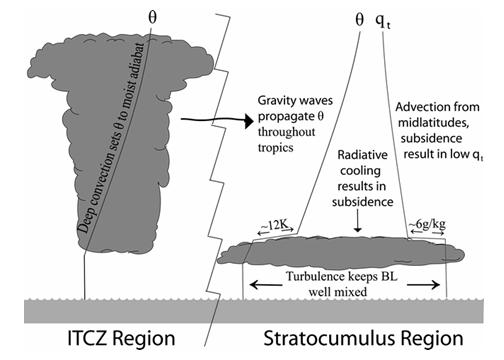
Conceptual model of how marine stratocumulus clouds are formed, from Fig. 1 in Caldwell and Bretherton (2009).
The authors used a fairly detailed model to study the behavior of these clouds in response to warming of the ocean and found that the cloud liquid water content increased with warming, under all simulated conditions. This, by itself, would be a negative feedback (natural cooling effect) in response to the warming since denser clouds will reflect more sunlight. At face value, then, these results would not be supportive of positive cloud feedback in the climate models.
But what is interesting is that the authors do not explicitly make this connection. Even though they mention in the Introduction the importance of their study to testing the behavior of climate models, in their Conclusions they don’t mention whether the results support – or don’t support — the climate models.
And I would imagine they will not be happy with me making that connection for them, either. They would probably say that their study is just one part of a giant puzzle that doesn’t necessarily prove anything about the climate models that predict so much global warming.
Fair enough. But a double standard has clearly been established when it comes to publishing studies related to global warming. Published studies that support climate model predictions of substantial manmade global warming are clearly preferred over those that do not support the models, and explicitly stating that support in the studies is permitted.
But results that appear to contradict the models either can not get published…or (like in this study) the contradiction can not be explicitly stated without upsetting one or more of the peer reviewers.
For instance, a paper I recently submitted to Geophysical Research Letters was very rapidly rejected based upon only one reviewer who was asked to review that paper. (I have never heard of a paper’s fate being left up to a single reviewer, unless no other reviewers could be found, which clearly was not the case in my situation). That reviewer was quite hostile to our satellite-based results, which implied the climate models were wrong in their cloud feedbacks.
One wonders whether support of climate models would have been mentioned in the Caldwell and Bretherton paper if their results were just the opposite, and supported the models. Of course, we will never know.